SEMINAR
ON
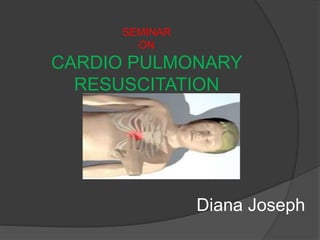
CARDIO PULMONARY
RESUSCITATION
Diana Joseph
DEFINITION:
Cardio pulmonary resuscitation (CPR)
is a technique of basic life support for the
purpose of oxygenation to the heart, lungs and
brain until and unless the appropriate medical
treatment can come and restore the normal
cardiopulmonary function.
Cardio pulmonary resuscitation is a
series of steps used to establish artificial
ventilation and circulation in the patient who is
not breathing and has no pulse.
DEFINITION
 Cardiopulmonary resuscitation is the
process of artificially supporting a
patient’s breathing and heart beat when
respirations and pulse have ceased.
 CPR is the process of externally
supporting the circulation and respiration
of a person of who has a cardiac arrest.
CPR- INDICATIONS
 Cardiopulmonary arrest
 Pulseless VT
 VF
 Asystole
 Electro Mechanical Dissociation
 Unresponsive person with no breathing
OBJECTIVES
 Delay tissue death
 Extend the brief window of opportunity
for a successful resuscitation without
permanent brain damage.
 Induce a heart rhythm which may be
shockable.
 CPR is generally continued until the
subject regain return of spontaneous
circulation (ROSC) or is declared dead.
Historical review:
 5000- First artificial mouth to mouth respiration.
 3000 BC- Ventilation.
 1780-First attempt of newborn resuscitation by blowing.
 874- First experimental cardiac massage.
 1901- First successful direct cardiac massage in man.
 1946- First experimental indirect cardiac massage and
defibrillation.
 1960- Indirect cardiac massage.
 1980- Development of cardio pulmonary resuscitation due to
works of peter safar.
PRINCIPLES
1. Define the team leader
2. Establish effective artificial circulation
3. Effective oxygenation and ventilation
4. Establish a route for medication
administration
5. Create an effective cardiac rhythm
6. Evacuate the patient to the ICU as soon
as practical
7. Re-evaluate and stabilize
8. Preserve the brain
CHAIN OF SURVIVAL
8
1) EARLY RECOGNITION
Assessment is of crucial importance. It
includes :
1) Unresponsiveness
 Check the victim for a response.
 Shake shoulders gently
 Ask “Are you all right?’’
9
2) No breathing or no normal breathing (i.e,
only gasping)
10
3) No pulse felt within 10 seconds.
11
2) CPR Sequence
A Change From A-B-C to C-A-B
12
PHASES OF THE CARDIO PULMONARY
RESUSCITATION:
Phases Steps
Phase-1 Basic life support C= circulation
A= Airway
B= Breathing
Phase-2 Advance cardiac life
support
D= Drugs
E= ECG
F= fibrillation
Phase-3 Prolonged life
support
Post resuscitation care
13
BLS
(Basic Life Support)
 BLS is used for patients with life
threatening illnesses or injury until the
person can be given full medical care at
hospital.BLS is provided in a pre
hospital set up and can be provided
without medical group
○BLS is defined as a life saving
procedure which involves the
external support of circulation
and ventilation for patient with
cardiac or respiratory arrest
BLS
 Consists of
CHEST COMPRESSIONS
AIRWAY
BREATHING
DEFIBRILLATION
MAIN STAGES OF
RESUSCITATION:
A (Airway)- ensure open airway by prevention the
falling back of tongue, tracheal intubation if possible.
B (Breathing) – start artificial ventilation of lung.
C (Circulation) – restore the circulation by external
cardiac massage.
D (Differentiation, drug, defibrillation) – quickly
perform differential diagnosis of cardiac arrest; use
different medication and electric defibrillation in case
of ventricular fibrillation.
ASSESSMENT
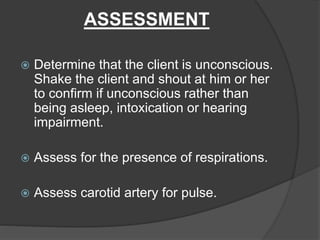
 Determine that the client is unconscious.
Shake the client and shout at him or her
to confirm if unconscious rather than
being asleep, intoxication or hearing
impairment.
 Assess for the presence of respirations.
 Assess carotid artery for pulse.
EQUIPMENTS
 A hard flat surface.
 No additional equipment is necessary but in hospital setting, an
emergency (crash) cart with defibrillator and cardiac monitor
should be brought to the bedside. A crash cart contains:
 Airway equipment.
 Suction equipment.
 Intravenous equipment.
 Laboratory tubes and syringes.
 Pre packed medication for advanced life support.
CAUSES
System Reasons
CNS  Cerebro-vascular accidents.
 Shock.
Pulmonary:  COPD.
 Airway obstruction.
 Atelectasis.
Cardio vascular:  Acute M I.
 CABG.
 Heart failure.
 Dysrhythmias.
 Heart block.
Miscellaneous:  Drowning, Fall, Poisoning.
 Emboli, Accident.
PHASES OF THE CARDIO
PULMONARY
RESUSCITATION:
Phases Steps
Phase-1 Basic life support A= Airway
B= Breathing
C= circulation
Phase-2 Advance cardiac life
support
D= Drugs
E= ECG
F= fibrillation
Phase-3 Prolonged life
support
G= Gauging
H= Human Mentation
I= Intensive care
TYPICALLY THE SEQUENCE OF BLS
CONSISTS OF ASSESSMENT AND THE
ABCS OF CPR.
Assessment
It is of crucial importance. It
includes
 Assess responsiveness
by calling the person;
shouting and shaking.
 Assess breathing by
look, listen and feel: Look
for chest movements,
listen for breath sounds
and feel for the
movements of the air flow.
 Assess circulation-
feel the carotid
pulse.
BASIC LIFE SUPPORT
Airway management
Open and clear the airway: This is
achieved by head tilt and chin lift
maneuver or if there is suspicion/
evidence of head or neck trauma, the
jaw thrust maneuver is used.
HEAD TILT CHIN LIFT
MANEUVER:
Place one hand on
the victim’s hairline
and place the other
hand’s index finger
and the middle
finger on the chin
and apply firm
backward pressure.
JAW THRUST MANEUVER: -
It is accomplished
by placing one hand
on each side of the
victim’s head,
grasping the angles
of the victim’s lower
jaw, lifting with both
hands.
FINGER-SWEEP MANEUVER:
-
 With the victim’s head up, opens the
victim’s mouth by grasping both tongue
and the lower jaw between the thumb
and fingers and lifting (tongue-jaw lift).
 This action draws the tongue from the
back of the throat and away from the
foreign body. The obstruction may be
partially relieved by this maneuver.
 If the tongue-jaw lift fails to open the mouth
then crossed finger technique may be used.
This is accomplished by opening the mouth by
crossing the index finger and the thumb and
pushing the teeth apart. The index finger of the
available hand is inserted along the inside of
the cheek and deeply into the throat to the
base of the tongue.
 A hooking motion is used to dislodge the
foreign body and maneuver it into the mouth
for removal.
 If the tongue-jaw lift fails to
open the mouth the crossed
finger technique may be used.
This is accomplished by
opening the mouth by crossing
the index finger and the thumb
and pushing the teeth apart.
The index finger of the
available hand is inserted
along the inside of the cheek
and deeply into the throat to
the base of the tongue.
 A hooking motion is used to
dislodge the foreign body and
maneuver it into the mouth for
removal.
BREATHING: -
After the airway
management if the victim is
still not breathing, then
maintaining head tilt, chin lift
positions pinch the nostrils
and place the mouth around
the victim’s mouth to make a
tight seal, take two deep
breaths and deliver two
positive pressure
ventilations; each at least of
two seconds duration. When
performing mouth-to-mouth
ventilation always assess for
chest wall movement.
BAG AND MASK
VENTILATION
 Use a resuscitator bag
and mask.
 Apply the mask to the
victim’s mouth and
create a seal by
pressing the left thumb
on the bridge of the
nose and the index
finger on the chin.
 Use rest of the fingers
of the left hand to pull
on the chin and the
angle of the mandible to
maintain the head in
extension.
 Use the right hand to inflate the lungs by
squeezing the bag to its full volume.
 Observe the chest wall for symmetric expansion.
 The volume of air of each ventilation should be
approximately 700-1000ml, which can be
determined by noting a rise of 1-2 inches in the
victim’s chest.
 Smaller volume (400-600ml) should be attempted
during bag and mask ventilation.
CIRCULATION:
 The carotid artery is used to
determine the absence of
pulse.
 While maintaining the head tilt
position with one hand on the
forehead, locate the victim’s trachea
with two or three fingers of the other
hand, then slides these fingers into
the groove between the trachea and
the muscles of the neck where the
carotid pulse can be felt.
 The technique is more easily
performed on the side nearest the
rescuer.
 If on assessment, there are no signs
of circulation start external cardiac
compressions.
 Position hands, arms and shoulders
 External cardiac compressions
technique consists of serial
rhythmic application of pressure
on the lower half of the sternum.
 The victim is on the horizontal
supine position on a flat and hard
surface.
 The rescuer should be positioned
closed to the side of the victim’s
chest.
 Locate landmark notch hands in
the center of the chest, right
between the nipples and four
fingers above the xiphoid process.
 Elbows should be locked and
arms are straight.
 Rescuer’s shoulders position
directly over hands.
 Begin compression.
 Pressure should come from
the shoulders.
 Compression should depress
victim’s sternum
approximately 1.5- 2 inches.
 Don’t allow the fingers to
touch the chest wall.
 Allow chest to rebound to
normal position after each
compression.
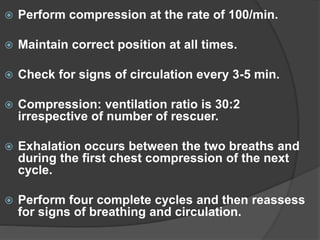
 Perform compression at the rate of 100/min.
 Maintain correct position at all times.
 Check for signs of circulation every 3-5 min.
 Compression: ventilation ratio is 30:2
irrespective of number of rescuer.
 Exhalation occurs between the two breaths and
during the first chest compression of the next
cycle.
 Perform four complete cycles and then reassess
for signs of breathing and circulation.
Five keys aspects to great
CPR
 Rate
 Depth
 Release
 Ventilation
 Uninterrupted
DEFINETION
It is asynchronous cardio-version
that is used in emergency situation.
Defibrillation completely depolarizes the
all myocardial cells at once, allowing the
sinus node to recapture its role as the
pacemaker.
IMPORTANCE OF EARLY
DEFIBRILLATIONS
 Most frequent arrest
frequent arrest rhythm
VF/VT
 Treatment is defibrillation.
 Successful conversion
diminished over time.
 VF tends to deteriorate to A
systole.
NOT USED FOR
Sinus rhythm
Bradycardia
A systole
DEFIBRILLATION: GENERAL
CONCEPT
Immediate defibrillation if
witnessed arrest and
automated external
defibrillation available
compressions before
defibrillation if unwitnessed or
arrival at the scene >4-5
minutes. One shock followed
by immediate CPR ( beginning
with chest compression)
KEY POINTS TO REMEMBER
WHILE DEFIBRILLATING
Use a conducting agent
between the skins the paddles
such as saline pads or electrode
paste. This decreases the
electrical impedance and helps to
prevent burns.
 The paddles are placed on the
chest wall one the sternal paddle
is placed to the right of the
sternum, 2’nd intercostals space
just below the clavicle. The apex
paddle is placed on the left 6’Th
intercostals space mid axillary line.
 Switch on the defibrillator.
 Move the knob of the defibrillator
to the required amount of joules.
Shock at 200,300,360 joules.
 Exert 20-25 pounds of pressure
on each paddle to ensure good
skin contact.
 Press the charge button.
 Call “stand clear” to ensure that
personal are not touching the
patient or the bed at the time of
discharge.
 The defibrillator is then
discharged by depressing the
buttons on the both paddles
simultaneously.
GAUGING:
 Identify the cause of cardiac arrest by:
 Cardiac monitoring.
 Lab examination of the blood.
HUMAN MENTATION:
 Start CPR within 4 min as brain can only
survive for four min without oxygen.
 Do not interrupt the CPR more than 7min.
 Reassess for breathing and circulation every
2-3min.
ECG
ECG is the graphical representation
of the electrical activity of the cardiac
muscles. During CPR the victim’s ECG
should be continuously monitored for
monitored for monitoring evaluating and
recording.
INTENSIVE CARE
If the victim’s condition is stable, send the
victim to the ICU for close and continuous monitoring.
DRUGS THAT CAN BE USED DURING CPR
 INJ EPINEPHRIN
 INJ ATROPINE
 INJ LIDNOCAINE
 INJ MAGNESIUM SULPHATE
 INJ DOPAMINE
 INJ DOBUTAMINE
 INJ SODA BI CARB
 INJ CALCIUM GLUCONATE
TERMINATION OF BASIC
LIFE SUPPORT:
CPR is stopped as a result of a number
of circumstances; these are typically restoration of
spontaneous respiration and circulation, complete
rescuer exhaustion, or medical decision. Signs of
restored ventilation and circulation include:
 Struggling movements
 Improved color
 Return of or strong pulse
 Return of systemic blood pressure
NURSING TEAM LEADER
(USUALLY SENIOR WARD
NURSE)
 Identifies self as Nursing Team Leader, responsible for co-
coordinating and directing emergent nursing care of the patient.
 Checks appropriate emergency call has been placed
 Starts timer as soon as the Emergency trolley arrives.
 Delegates available staff to roles appropriate to their level of
practice: Airway, Compression, Monitor & Medications and
Runner to collect or remove extra equipment, supplies, labs etc.
 Establishes the patient’s weight and delegates someone to print
out an Emergency Drug Worksheet (Icon on desktop of clinical
computers).
Cont …….
 Ensures that the patient is placed on CPR back board.
 Reassigns nursing staff once the PICU nurse and additional staff arrive
as required.
 Ensure someone is assigned to support family members.
 Documents initial and ongoing vital signs and cardiac rhythm,
medication administration, procedures and patient’s response to
interventions on the ACH/Starship Resuscitation record (CR8545).
 Monitors the time interval between adrenaline administration and
prompts the Team Leader when 4 minutes has passed since last dose
administered.
 Completes, including a brief summation of presenting events and signs
the ACH/Starship Resuscitation record (CR8545).
 Ensures the outside copy of the CR8545 form is placed on the Charge
Nurse desk and the inside copy is placed in the clinical record.
AIRWAY NURSE
(USUALLY THE PATIENTS NURSE OR THE
NURSE WHO FINDS THE PATIENT)
 Summons help and initiates CPR as required until
initial assistance arrives and then assumes
responsibility for airway management.
 Maintains airway patency with use of airway
adjuncts as required (suction, high flow oxygen,
via Hudson mask, blob mask with O2 or bag valve
mask ventilation).
Cont……..
 This role becomes the responsibility of the
PICU nurse on their arrival.
 Assist with intubation and securing of ETT
 Inserts gastric tube and/or facilitates gastric
decompression post intubation as required.
 Assists with ongoing management of
airway patency and adequate ventilation
 Supports less experienced staff by
coaching/guidance e.g. drug preparation
COMPRESSION NURSE
 If CPR in progress, assume responsibility for
cardiac compressions (this includes ensuring that
staff doing compressions are changed at regular
intervals (e.g. every 2 minutes) to avoid fatigue
resulting in inadequate compressions being
delivered)
 Assess pulses (including pulse volume) and
capillary refill as required
SPECIAL CONSIDERATION:
Although aids isn’t known to be
transmitted in saliva, some health care
professionals may hesitate to give
rescue breath, especially if the victim
has AIDS. For these reason, it is
recommended that all health care
professional should how to use
disposable air way equipments.
CONCLUSION:
CPR is the responsibility of a team of
personnel and not one person in
isolation. For cardiac arrest we strive to
prevent when possible, treat effectively
when challenged and support humanely
when death is imminent.
Cpr ppt

Cpr ppt

  • 1.
  • 2.
    DEFINITION: Cardio pulmonary resuscitation(CPR) is a technique of basic life support for the purpose of oxygenation to the heart, lungs and brain until and unless the appropriate medical treatment can come and restore the normal cardiopulmonary function. Cardio pulmonary resuscitation is a series of steps used to establish artificial ventilation and circulation in the patient who is not breathing and has no pulse.
  • 3.
    DEFINITION  Cardiopulmonary resuscitationis the process of artificially supporting a patient’s breathing and heart beat when respirations and pulse have ceased.  CPR is the process of externally supporting the circulation and respiration of a person of who has a cardiac arrest.
  • 4.
    CPR- INDICATIONS  Cardiopulmonaryarrest  Pulseless VT  VF  Asystole  Electro Mechanical Dissociation  Unresponsive person with no breathing
  • 5.
    OBJECTIVES  Delay tissuedeath  Extend the brief window of opportunity for a successful resuscitation without permanent brain damage.  Induce a heart rhythm which may be shockable.  CPR is generally continued until the subject regain return of spontaneous circulation (ROSC) or is declared dead.
  • 6.
    Historical review:  5000-First artificial mouth to mouth respiration.  3000 BC- Ventilation.  1780-First attempt of newborn resuscitation by blowing.  874- First experimental cardiac massage.  1901- First successful direct cardiac massage in man.  1946- First experimental indirect cardiac massage and defibrillation.  1960- Indirect cardiac massage.  1980- Development of cardio pulmonary resuscitation due to works of peter safar.
  • 7.
    PRINCIPLES 1. Define theteam leader 2. Establish effective artificial circulation 3. Effective oxygenation and ventilation 4. Establish a route for medication administration 5. Create an effective cardiac rhythm 6. Evacuate the patient to the ICU as soon as practical 7. Re-evaluate and stabilize 8. Preserve the brain
  • 8.
  • 9.
    1) EARLY RECOGNITION Assessmentis of crucial importance. It includes : 1) Unresponsiveness  Check the victim for a response.  Shake shoulders gently  Ask “Are you all right?’’ 9
  • 10.
    2) No breathingor no normal breathing (i.e, only gasping) 10
  • 11.
    3) No pulsefelt within 10 seconds. 11
  • 12.
    2) CPR Sequence AChange From A-B-C to C-A-B 12
  • 13.
    PHASES OF THECARDIO PULMONARY RESUSCITATION: Phases Steps Phase-1 Basic life support C= circulation A= Airway B= Breathing Phase-2 Advance cardiac life support D= Drugs E= ECG F= fibrillation Phase-3 Prolonged life support Post resuscitation care 13
  • 14.
    BLS (Basic Life Support) BLS is used for patients with life threatening illnesses or injury until the person can be given full medical care at hospital.BLS is provided in a pre hospital set up and can be provided without medical group
  • 15.
    ○BLS is definedas a life saving procedure which involves the external support of circulation and ventilation for patient with cardiac or respiratory arrest
  • 16.
    BLS  Consists of CHESTCOMPRESSIONS AIRWAY BREATHING DEFIBRILLATION
  • 18.
    MAIN STAGES OF RESUSCITATION: A(Airway)- ensure open airway by prevention the falling back of tongue, tracheal intubation if possible. B (Breathing) – start artificial ventilation of lung. C (Circulation) – restore the circulation by external cardiac massage. D (Differentiation, drug, defibrillation) – quickly perform differential diagnosis of cardiac arrest; use different medication and electric defibrillation in case of ventricular fibrillation.
  • 19.
    ASSESSMENT  Determine thatthe client is unconscious. Shake the client and shout at him or her to confirm if unconscious rather than being asleep, intoxication or hearing impairment.  Assess for the presence of respirations.  Assess carotid artery for pulse.
  • 20.
    EQUIPMENTS  A hardflat surface.  No additional equipment is necessary but in hospital setting, an emergency (crash) cart with defibrillator and cardiac monitor should be brought to the bedside. A crash cart contains:  Airway equipment.  Suction equipment.  Intravenous equipment.  Laboratory tubes and syringes.  Pre packed medication for advanced life support.
  • 21.
    CAUSES System Reasons CNS Cerebro-vascular accidents.  Shock. Pulmonary:  COPD.  Airway obstruction.  Atelectasis. Cardio vascular:  Acute M I.  CABG.  Heart failure.  Dysrhythmias.  Heart block. Miscellaneous:  Drowning, Fall, Poisoning.  Emboli, Accident.
  • 22.
    PHASES OF THECARDIO PULMONARY RESUSCITATION: Phases Steps Phase-1 Basic life support A= Airway B= Breathing C= circulation Phase-2 Advance cardiac life support D= Drugs E= ECG F= fibrillation Phase-3 Prolonged life support G= Gauging H= Human Mentation I= Intensive care
  • 23.
    TYPICALLY THE SEQUENCEOF BLS CONSISTS OF ASSESSMENT AND THE ABCS OF CPR. Assessment It is of crucial importance. It includes  Assess responsiveness by calling the person; shouting and shaking.  Assess breathing by look, listen and feel: Look for chest movements, listen for breath sounds and feel for the movements of the air flow.
  • 24.
     Assess circulation- feelthe carotid pulse.
  • 25.
    BASIC LIFE SUPPORT Airwaymanagement Open and clear the airway: This is achieved by head tilt and chin lift maneuver or if there is suspicion/ evidence of head or neck trauma, the jaw thrust maneuver is used.
  • 26.
    HEAD TILT CHINLIFT MANEUVER: Place one hand on the victim’s hairline and place the other hand’s index finger and the middle finger on the chin and apply firm backward pressure.
  • 27.
    JAW THRUST MANEUVER:- It is accomplished by placing one hand on each side of the victim’s head, grasping the angles of the victim’s lower jaw, lifting with both hands.
  • 28.
    FINGER-SWEEP MANEUVER: -  Withthe victim’s head up, opens the victim’s mouth by grasping both tongue and the lower jaw between the thumb and fingers and lifting (tongue-jaw lift).  This action draws the tongue from the back of the throat and away from the foreign body. The obstruction may be partially relieved by this maneuver.
  • 29.
     If thetongue-jaw lift fails to open the mouth then crossed finger technique may be used. This is accomplished by opening the mouth by crossing the index finger and the thumb and pushing the teeth apart. The index finger of the available hand is inserted along the inside of the cheek and deeply into the throat to the base of the tongue.  A hooking motion is used to dislodge the foreign body and maneuver it into the mouth for removal.
  • 30.
     If thetongue-jaw lift fails to open the mouth the crossed finger technique may be used. This is accomplished by opening the mouth by crossing the index finger and the thumb and pushing the teeth apart. The index finger of the available hand is inserted along the inside of the cheek and deeply into the throat to the base of the tongue.  A hooking motion is used to dislodge the foreign body and maneuver it into the mouth for removal.
  • 31.
    BREATHING: - After theairway management if the victim is still not breathing, then maintaining head tilt, chin lift positions pinch the nostrils and place the mouth around the victim’s mouth to make a tight seal, take two deep breaths and deliver two positive pressure ventilations; each at least of two seconds duration. When performing mouth-to-mouth ventilation always assess for chest wall movement.
  • 32.
    BAG AND MASK VENTILATION Use a resuscitator bag and mask.  Apply the mask to the victim’s mouth and create a seal by pressing the left thumb on the bridge of the nose and the index finger on the chin.  Use rest of the fingers of the left hand to pull on the chin and the angle of the mandible to maintain the head in extension.
  • 33.
     Use theright hand to inflate the lungs by squeezing the bag to its full volume.  Observe the chest wall for symmetric expansion.  The volume of air of each ventilation should be approximately 700-1000ml, which can be determined by noting a rise of 1-2 inches in the victim’s chest.  Smaller volume (400-600ml) should be attempted during bag and mask ventilation.
  • 34.
    CIRCULATION:  The carotidartery is used to determine the absence of pulse.  While maintaining the head tilt position with one hand on the forehead, locate the victim’s trachea with two or three fingers of the other hand, then slides these fingers into the groove between the trachea and the muscles of the neck where the carotid pulse can be felt.  The technique is more easily performed on the side nearest the rescuer.  If on assessment, there are no signs of circulation start external cardiac compressions.  Position hands, arms and shoulders
  • 35.
     External cardiaccompressions technique consists of serial rhythmic application of pressure on the lower half of the sternum.  The victim is on the horizontal supine position on a flat and hard surface.  The rescuer should be positioned closed to the side of the victim’s chest.  Locate landmark notch hands in the center of the chest, right between the nipples and four fingers above the xiphoid process.
  • 36.
     Elbows shouldbe locked and arms are straight.  Rescuer’s shoulders position directly over hands.  Begin compression.  Pressure should come from the shoulders.  Compression should depress victim’s sternum approximately 1.5- 2 inches.  Don’t allow the fingers to touch the chest wall.  Allow chest to rebound to normal position after each compression.
  • 37.
     Perform compressionat the rate of 100/min.  Maintain correct position at all times.  Check for signs of circulation every 3-5 min.  Compression: ventilation ratio is 30:2 irrespective of number of rescuer.  Exhalation occurs between the two breaths and during the first chest compression of the next cycle.  Perform four complete cycles and then reassess for signs of breathing and circulation.
  • 38.
    Five keys aspectsto great CPR  Rate  Depth  Release  Ventilation  Uninterrupted
  • 39.
    DEFINETION It is asynchronouscardio-version that is used in emergency situation. Defibrillation completely depolarizes the all myocardial cells at once, allowing the sinus node to recapture its role as the pacemaker.
  • 40.
    IMPORTANCE OF EARLY DEFIBRILLATIONS Most frequent arrest frequent arrest rhythm VF/VT  Treatment is defibrillation.  Successful conversion diminished over time.  VF tends to deteriorate to A systole.
  • 41.
  • 42.
  • 43.
  • 44.
    DEFIBRILLATION: GENERAL CONCEPT Immediate defibrillationif witnessed arrest and automated external defibrillation available compressions before defibrillation if unwitnessed or arrival at the scene >4-5 minutes. One shock followed by immediate CPR ( beginning with chest compression)
  • 45.
    KEY POINTS TOREMEMBER WHILE DEFIBRILLATING Use a conducting agent between the skins the paddles such as saline pads or electrode paste. This decreases the electrical impedance and helps to prevent burns.  The paddles are placed on the chest wall one the sternal paddle is placed to the right of the sternum, 2’nd intercostals space just below the clavicle. The apex paddle is placed on the left 6’Th intercostals space mid axillary line.  Switch on the defibrillator.
  • 46.
     Move theknob of the defibrillator to the required amount of joules. Shock at 200,300,360 joules.  Exert 20-25 pounds of pressure on each paddle to ensure good skin contact.  Press the charge button.  Call “stand clear” to ensure that personal are not touching the patient or the bed at the time of discharge.  The defibrillator is then discharged by depressing the buttons on the both paddles simultaneously.
  • 47.
    GAUGING:  Identify thecause of cardiac arrest by:  Cardiac monitoring.  Lab examination of the blood. HUMAN MENTATION:  Start CPR within 4 min as brain can only survive for four min without oxygen.  Do not interrupt the CPR more than 7min.  Reassess for breathing and circulation every 2-3min.
  • 48.
    ECG ECG is thegraphical representation of the electrical activity of the cardiac muscles. During CPR the victim’s ECG should be continuously monitored for monitored for monitoring evaluating and recording.
  • 49.
    INTENSIVE CARE If thevictim’s condition is stable, send the victim to the ICU for close and continuous monitoring. DRUGS THAT CAN BE USED DURING CPR  INJ EPINEPHRIN  INJ ATROPINE  INJ LIDNOCAINE  INJ MAGNESIUM SULPHATE  INJ DOPAMINE  INJ DOBUTAMINE  INJ SODA BI CARB  INJ CALCIUM GLUCONATE
  • 50.
    TERMINATION OF BASIC LIFESUPPORT: CPR is stopped as a result of a number of circumstances; these are typically restoration of spontaneous respiration and circulation, complete rescuer exhaustion, or medical decision. Signs of restored ventilation and circulation include:  Struggling movements  Improved color  Return of or strong pulse  Return of systemic blood pressure
  • 51.
    NURSING TEAM LEADER (USUALLYSENIOR WARD NURSE)  Identifies self as Nursing Team Leader, responsible for co- coordinating and directing emergent nursing care of the patient.  Checks appropriate emergency call has been placed  Starts timer as soon as the Emergency trolley arrives.  Delegates available staff to roles appropriate to their level of practice: Airway, Compression, Monitor & Medications and Runner to collect or remove extra equipment, supplies, labs etc.  Establishes the patient’s weight and delegates someone to print out an Emergency Drug Worksheet (Icon on desktop of clinical computers).
  • 52.
    Cont …….  Ensuresthat the patient is placed on CPR back board.  Reassigns nursing staff once the PICU nurse and additional staff arrive as required.  Ensure someone is assigned to support family members.  Documents initial and ongoing vital signs and cardiac rhythm, medication administration, procedures and patient’s response to interventions on the ACH/Starship Resuscitation record (CR8545).  Monitors the time interval between adrenaline administration and prompts the Team Leader when 4 minutes has passed since last dose administered.  Completes, including a brief summation of presenting events and signs the ACH/Starship Resuscitation record (CR8545).  Ensures the outside copy of the CR8545 form is placed on the Charge Nurse desk and the inside copy is placed in the clinical record.
  • 53.
    AIRWAY NURSE (USUALLY THEPATIENTS NURSE OR THE NURSE WHO FINDS THE PATIENT)  Summons help and initiates CPR as required until initial assistance arrives and then assumes responsibility for airway management.  Maintains airway patency with use of airway adjuncts as required (suction, high flow oxygen, via Hudson mask, blob mask with O2 or bag valve mask ventilation).
  • 54.
    Cont……..  This rolebecomes the responsibility of the PICU nurse on their arrival.  Assist with intubation and securing of ETT  Inserts gastric tube and/or facilitates gastric decompression post intubation as required.  Assists with ongoing management of airway patency and adequate ventilation  Supports less experienced staff by coaching/guidance e.g. drug preparation
  • 55.
    COMPRESSION NURSE  IfCPR in progress, assume responsibility for cardiac compressions (this includes ensuring that staff doing compressions are changed at regular intervals (e.g. every 2 minutes) to avoid fatigue resulting in inadequate compressions being delivered)  Assess pulses (including pulse volume) and capillary refill as required
  • 56.
    SPECIAL CONSIDERATION: Although aidsisn’t known to be transmitted in saliva, some health care professionals may hesitate to give rescue breath, especially if the victim has AIDS. For these reason, it is recommended that all health care professional should how to use disposable air way equipments.
  • 57.
    CONCLUSION: CPR is theresponsibility of a team of personnel and not one person in isolation. For cardiac arrest we strive to prevent when possible, treat effectively when challenged and support humanely when death is imminent.