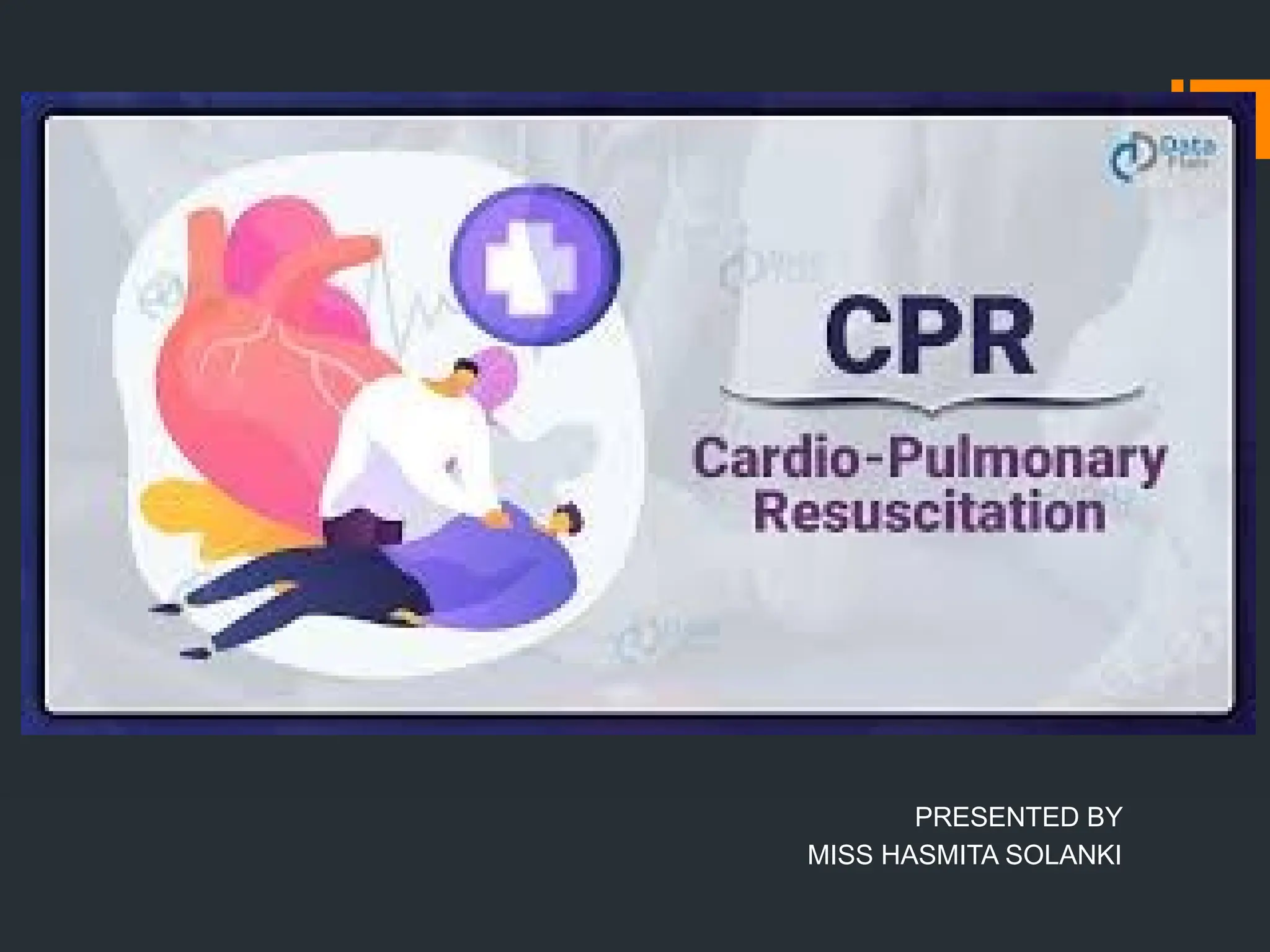
DEFINITION
Cardio Pulmonary Resuscitationis a
technique of basic life support for
oxygenating the brain and heart until
appropriate, definitive medical treatment
can restore normal heart and ventilatory
action.
4.
Purpose:
(1) Tomaintain an open and clear airway
(2) To maintain breathing by external
ventilation (B).
(3) To maintain blood circulation by external
cardiac massages (C).
(4) To save life of the patient.
(5) To provide basic life support till medical
and advanced life support arrives.Indica
5.
Indication :
(1) CardiacArrest:
Ventricular fibrillation (VF)
Ventricular tachycardia (VT)
A systole Pulse less electricaL activity
(2) Respiratory Arrest:
Drowning.
Stroke
Foreign body in throat
Smoke inhalation
Suffocation
Coma
Accident
Injury
Drug overdose
Epiglottis paralysis
6.
Principles of CPR:
(1) To restore effective circulation and
ventilation
(2) To prevent irreverssible cerebral
damage due to anoxia./hypoxia
7.
Steps of CPR:
Before Starting CPR, Check
Is the person conscious or unconscious
If the person appears unconscious tap or
shake his or her shoulder and ask loudly, "Are
you ok"?
If the person doesn't respond and two people
are available number and one should begin
CPR.
8.
If you arealone and have immediate access to a
telephone, call 108 before beginning CPR-unless
you think the person has become unresponsive
because of suffocation (such as from drowning).
In thin special case, begin CPR for one minute
and then call 108 or the local emergency
number.
If an AED is immediately available deliver one
shock if instructed by the device then begin
CPR.
Remember CAB:
Remember the of CAB. Which stands for
C:compression,
A:airway,
B : breathing
when remembering the order perform the steps
of CPR.
9.
Compressions:
: Restoreblood circulation:
Put the person on his or her back on afirm surface.
Kneel net to the person's neck and shoulders.
Place the neel of one hand over the center of the
person's chest between the nipples. Place your
other hand on top of the first hand. Keep your
elbows straight and position your shoulders
directly above your hands.
10.
Use your upperbody weight (not just
your arms) as you push straight down on
(compress) the chest at least 2 inches
(approximately 5 centimeters) push hard
at a rate of about 100 compressions a
minute.
11.
Airway
: Clearthe airway:
If you're trained in CPR and you've performed 30
chest compressions open the person's airway
using the head-till chin-lift maneuver, put your
palm on the person's forehead and gently tilt the
head back, then with the other hand gently lift
the chin forward to open the airway.
12.
Check : Fornormal breathing taking no more
than five or 10 seconds. Look for chest motion,
listen for normal breath sound
If the person is not breathing normally and you
are trained in CPR begin mouth-to mouth
breathing.
If you believe the person is unconscious from a
heart attack and you haven't been trained in
emergency procedures. Skip mouth to mouth
breathing continue chest compressions.mouth-
to-mouth breathing
13.
Breathing
: Breathe forthe person :
Rescue breathing can be mouth-to mouth
breathing or mouth-to-nose breathing if
the mouth is seriously injured or can't be
opened.
14.
(1) Withthe airway open (using the head-
tilt chin-lift pinch the nostrils shut for
mouth-to-mouth breathing and cover the
person's yours making a seal.
15.
(2) Prepare togive two resure breaths,
give the first rescure breath-lasting one
second and watch to see if the chest
rises. If it does rise, give the second
breath, if the chest doesn't rise, repeat
the head tilt. Chin-lift maneuver and then
give the second breath. Thirty chest
compression followed by two rescure
breath is considered one cycle.
(4) If theperson has not begun moving after five
cycles (about two minutes) and an automated
external defibrillator (AED) is available,
apply it and fallow the prompts,
Administer one shock, then resume CPR-starting
with compressions-for two more minutes before
administering a second shock.
If you're not trained to use an AED a 108 or other
emergancy medical operator may be able to guide
you in its use
19.
(5) Continue CPRuntil there are signs of
movement or emergency medical
personnel take over.