BY- AHMED SODHA
M.Sc.(N)- M.S.N.
• Cardiopulmonary resuscitation (CPR)
is a lifesaving technique useful in
many emergencies, including heart
attack or near drowning, in whichattack or near drowning, in which
someone's breathing or heartbeat has
stopped.
• Cardio Pulmonary Resuscitation is a
technique of basic life support for
oxygenating the brain and heart until
appropriate, definitive medicalappropriate, definitive medical
treatment can restore normal heart
and ventilatory action.
• To maintain an open and clear airway
(A).
• To maintain breathing by external
ventilation (B).ventilation (B).
• To maintain Blood circulation by external
cardiac massages (C).
• To save life of the Patient.
• To provide basic life support till medical
and advanced life support arrives.
Cardiac Arrest
• Ventricular fibrillation (VF)
• Ventricular tachycardia (VT)• Ventricular tachycardia (VT)
• Asystole
• Pulse less electrical activity
Respiratory Arresst
• This may be result of following:
• Drowning
• Stroke
• Foreign body in throat
• Smoke inhalation• Smoke inhalation
• Drug overdose
• Suffocation
• Accident, injury
• Coma
• Epiglottis paralysis.
• To restore effective circulation and
ventilation.
• To prevent irreversible cerebral
damage due to anoxia. When thedamage due to anoxia. When the
heart fails to maintain the cerebral
circulation for approximately four
minutes the brain may suffer
irreversible damage.
SEQUENCES OF PROCEDURES
PERFORMED TO RESTORE THE
CIRCULATION OF OXYGENATED BLOOD
AFTER A SUDDEN PULMONARY AND/OR
CARDIAC ARRESTCARDIAC ARREST
CHEST COMPRESSIONS AND PULMONARY
VENTILATION PERFORMED BY ANYONE
WHO KNOWS HOW TO DO
IT, ANYWHERE, IMMEDIATELY, WITHOUT
ANY OTHER EQUIPMENT
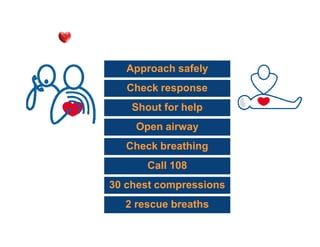
Approach safely
Check response
Shout for help
Open airwayOpen airway
Check breathing
Call 108
30 chest compressions
2 rescue breaths
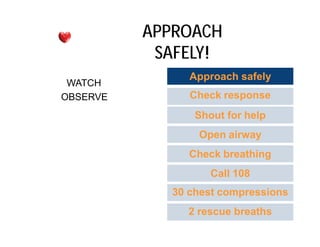
APPROACH
SAFELY!
WATCH
OBSERVE
Approach safely
Check response
Shout for help
Open airway
Check breathing
Call 108
30 chest compressions
2 rescue breaths
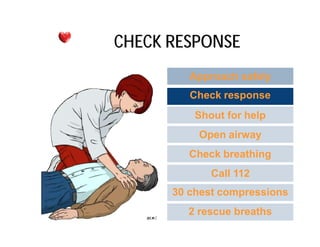
CHECK RESPONSE
Approach safely
Check response
Shout for help
Open airway
Check breathing
Call 112
30 chest compressions
2 rescue breaths
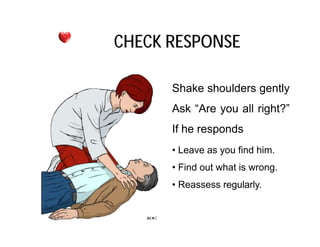
Shake shoulders gently
Ask “Are you all right?”
If he responds
CHECK RESPONSE
If he responds
• Leave as you find him.
• Find out what is wrong.
• Reassess regularly.
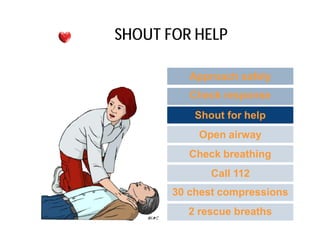
SHOUT FOR HELP
Approach safely
Check response
Shout for help
Open airway
Check breathing
Call 112
30 chest compressions
2 rescue breaths
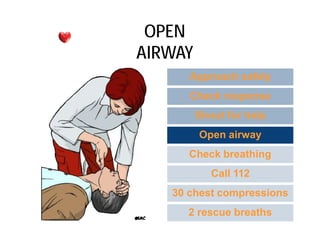
OPEN
AIRWAY
Approach safely
Check response
Shout for help
Open airway
Check breathing
Call 112
30 chest compressions
2 rescue breaths
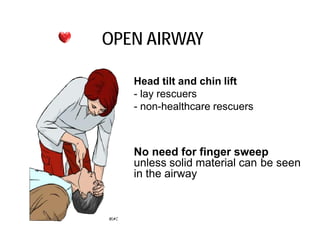
OPEN AIRWAY
Head tilt and chin lift
- lay rescuers
- non-healthcare rescuers
No need for finger sweep
unless solid material can be seen
in the airway
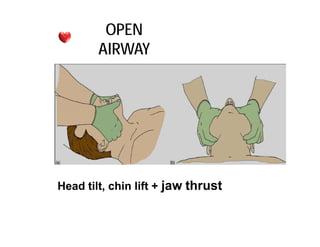
OPEN
AIRWAY
Head tilt, chin lift + jaw thrust
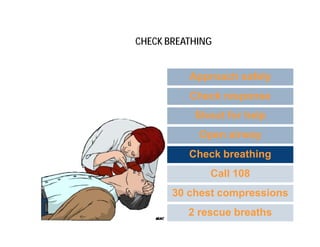
CHECK BREATHING
Approach safely
Check response
Shout for help
Open airway
Check breathing
Call 108
30 chest compressions
2 rescue breaths
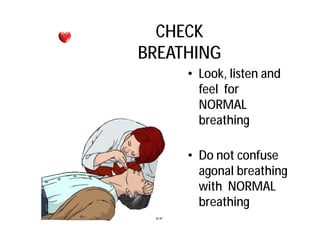
CHECK
BREATHING
• Look, listen and
feel for
NORMAL
breathingbreathing
• Do not confuse
agonal breathing
with NORMAL
breathing
• Occurs shortly after the heart stops
in up to 40% of cardiac arrests
• Described as barely, heavy, noisy or
gasping breathing
• Recognise as a sign of cardiac arrest
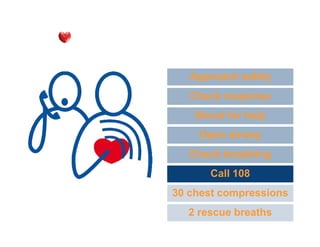
Approach safely
Check response
Shout for help
Open airway
Check breathing
Call 108
30 chest compressions
2 rescue breaths
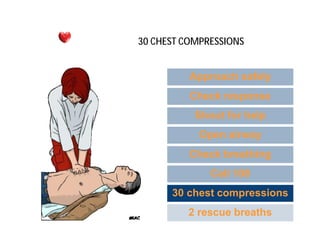
30 CHEST COMPRESSIONS
Approach safely
Check response
Shout for help
Open airway
Check breathing
Call 108
30 chest compressions
2 rescue breaths
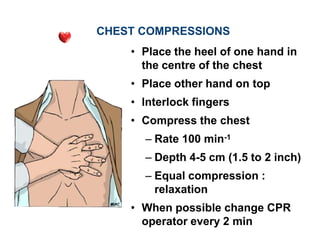
CHEST COMPRESSIONS
• Place the heel of one hand in
the centre of the chest
• Place other hand on top
• Interlock fingers
• Compress the chest• Compress the chest
– Rate 100 min-1
– Depth 4-5 cm (1.5 to 2 inch)
– Equal compression :
relaxation
• When possible change CPR
operator every 2 min
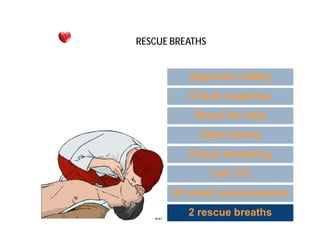
RESCUE BREATHS
Approach safely
Check response
Shout for help
Open airway
Check breathing
Call 112
30 chest compressions
2 rescue breaths
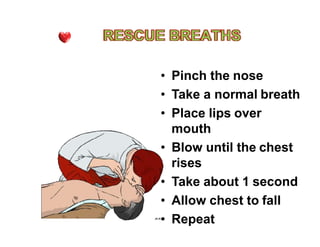
• Pinch the nose
• Take a normal breath
• Place lips over
mouthmouth
• Blow until the chest
rises
• Take about 1 second
• Allow chest to fall
• Repeat
RECOMMENDATIONS:
- Tidal volume
500 – 600 ml
- Respiratory rate
give each breaths over about 1s with enough
volume to make the victim’s chest rise
- Chest-compression-only
continuously at a rate of 100 min
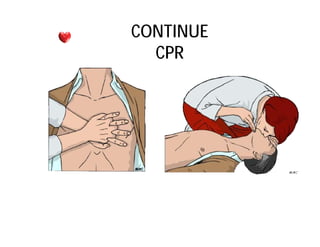
CONTINUE
CPR
30 2
• Coronary vessel injury
• Diaphragm injury
• Hemopericardium• Hemopericardium
• Hemothorax
• Interference with ventilation
• Liver injury
• Myocardial injury
• Pneumothorax
• Rib fractures
• Spleen injury• Spleen injury
• Sternal fracture
Adrenaline
• Adrenaline (epinephrine) is the main drug used
during resuscitation from cardiac arrest.
Atropine
• Atropine as a single dose of 3mg is sufficient to• Atropine as a single dose of 3mg is sufficient to
block vagal tone completely and should be used
once in cases of asystole. It is also indicated for
symptomatic bradycardia in a dose of 0.5mg -
1mg.
Amiodarone
• It is an antiarrhythmic drug.
• Maintains airway patency with use of airway
adjuncts as required (suction, high flow
oxygen with O2 or bag valve mask
ventilation).
• Assist with intubation and securing of ETT
• Inserts gastric tube and/or facilitates gastric
decompression post intubation as required.
• Assists with ongoing management of airway
patency and adequate ventilation
• Supports less experienced staff by
coaching/guidance e.g. drug
preparation
• If a shockable rhythm is present
(VF/VT) ensure manual defibrillator
pads are applied and connected.
• If CPR is in progress, prepare and
independently double check and label 3
doses of adrenaline
• Prepare and administer IV fluids
• Document medications administered
(including time)
♦ VIDEO LINKS ♦
https://www.youtube.com/watch?v=ozzZVQQTvo4
https://www.youtube.com/watch?v=1lwRQTGzKcw
https://www.youtube.com/watch?v=pqygh9Bmma4

Procedure of CPR

  • 1.
  • 2.
    • Cardiopulmonary resuscitation(CPR) is a lifesaving technique useful in many emergencies, including heart attack or near drowning, in whichattack or near drowning, in which someone's breathing or heartbeat has stopped.
  • 3.
    • Cardio PulmonaryResuscitation is a technique of basic life support for oxygenating the brain and heart until appropriate, definitive medicalappropriate, definitive medical treatment can restore normal heart and ventilatory action.
  • 4.
    • To maintainan open and clear airway (A). • To maintain breathing by external ventilation (B).ventilation (B). • To maintain Blood circulation by external cardiac massages (C). • To save life of the Patient. • To provide basic life support till medical and advanced life support arrives.
  • 5.
    Cardiac Arrest • Ventricularfibrillation (VF) • Ventricular tachycardia (VT)• Ventricular tachycardia (VT) • Asystole • Pulse less electrical activity
  • 6.
    Respiratory Arresst • Thismay be result of following: • Drowning • Stroke • Foreign body in throat • Smoke inhalation• Smoke inhalation • Drug overdose • Suffocation • Accident, injury • Coma • Epiglottis paralysis.
  • 7.
    • To restoreeffective circulation and ventilation. • To prevent irreversible cerebral damage due to anoxia. When thedamage due to anoxia. When the heart fails to maintain the cerebral circulation for approximately four minutes the brain may suffer irreversible damage.
  • 8.
    SEQUENCES OF PROCEDURES PERFORMEDTO RESTORE THE CIRCULATION OF OXYGENATED BLOOD AFTER A SUDDEN PULMONARY AND/OR CARDIAC ARRESTCARDIAC ARREST CHEST COMPRESSIONS AND PULMONARY VENTILATION PERFORMED BY ANYONE WHO KNOWS HOW TO DO IT, ANYWHERE, IMMEDIATELY, WITHOUT ANY OTHER EQUIPMENT
  • 9.
    Approach safely Check response Shoutfor help Open airwayOpen airway Check breathing Call 108 30 chest compressions 2 rescue breaths
  • 10.
    APPROACH SAFELY! WATCH OBSERVE Approach safely Check response Shoutfor help Open airway Check breathing Call 108 30 chest compressions 2 rescue breaths
  • 11.
    CHECK RESPONSE Approach safely Checkresponse Shout for help Open airway Check breathing Call 112 30 chest compressions 2 rescue breaths
  • 12.
    Shake shoulders gently Ask“Are you all right?” If he responds CHECK RESPONSE If he responds • Leave as you find him. • Find out what is wrong. • Reassess regularly.
  • 13.
    SHOUT FOR HELP Approachsafely Check response Shout for help Open airway Check breathing Call 112 30 chest compressions 2 rescue breaths
  • 14.
    OPEN AIRWAY Approach safely Check response Shoutfor help Open airway Check breathing Call 112 30 chest compressions 2 rescue breaths
  • 15.
    OPEN AIRWAY Head tiltand chin lift - lay rescuers - non-healthcare rescuers No need for finger sweep unless solid material can be seen in the airway
  • 16.
    OPEN AIRWAY Head tilt, chinlift + jaw thrust
  • 17.
    CHECK BREATHING Approach safely Checkresponse Shout for help Open airway Check breathing Call 108 30 chest compressions 2 rescue breaths
  • 18.
    CHECK BREATHING • Look, listenand feel for NORMAL breathingbreathing • Do not confuse agonal breathing with NORMAL breathing
  • 19.
    • Occurs shortlyafter the heart stops in up to 40% of cardiac arrests • Described as barely, heavy, noisy or gasping breathing • Recognise as a sign of cardiac arrest
  • 20.
    Approach safely Check response Shoutfor help Open airway Check breathing Call 108 30 chest compressions 2 rescue breaths
  • 21.
    30 CHEST COMPRESSIONS Approachsafely Check response Shout for help Open airway Check breathing Call 108 30 chest compressions 2 rescue breaths
  • 22.
    CHEST COMPRESSIONS • Placethe heel of one hand in the centre of the chest • Place other hand on top • Interlock fingers • Compress the chest• Compress the chest – Rate 100 min-1 – Depth 4-5 cm (1.5 to 2 inch) – Equal compression : relaxation • When possible change CPR operator every 2 min
  • 23.
    RESCUE BREATHS Approach safely Checkresponse Shout for help Open airway Check breathing Call 112 30 chest compressions 2 rescue breaths
  • 24.
    • Pinch thenose • Take a normal breath • Place lips over mouthmouth • Blow until the chest rises • Take about 1 second • Allow chest to fall • Repeat
  • 25.
    RECOMMENDATIONS: - Tidal volume 500– 600 ml - Respiratory rate give each breaths over about 1s with enough volume to make the victim’s chest rise - Chest-compression-only continuously at a rate of 100 min
  • 26.
  • 27.
    • Coronary vesselinjury • Diaphragm injury • Hemopericardium• Hemopericardium • Hemothorax • Interference with ventilation
  • 28.
    • Liver injury •Myocardial injury • Pneumothorax • Rib fractures • Spleen injury• Spleen injury • Sternal fracture
  • 29.
    Adrenaline • Adrenaline (epinephrine)is the main drug used during resuscitation from cardiac arrest. Atropine • Atropine as a single dose of 3mg is sufficient to• Atropine as a single dose of 3mg is sufficient to block vagal tone completely and should be used once in cases of asystole. It is also indicated for symptomatic bradycardia in a dose of 0.5mg - 1mg. Amiodarone • It is an antiarrhythmic drug.
  • 30.
    • Maintains airwaypatency with use of airway adjuncts as required (suction, high flow oxygen with O2 or bag valve mask ventilation). • Assist with intubation and securing of ETT • Inserts gastric tube and/or facilitates gastric decompression post intubation as required. • Assists with ongoing management of airway patency and adequate ventilation
  • 31.
    • Supports lessexperienced staff by coaching/guidance e.g. drug preparation • If a shockable rhythm is present (VF/VT) ensure manual defibrillator pads are applied and connected. • If CPR is in progress, prepare and independently double check and label 3 doses of adrenaline • Prepare and administer IV fluids • Document medications administered (including time)
  • 32.
    ♦ VIDEO LINKS♦ https://www.youtube.com/watch?v=ozzZVQQTvo4 https://www.youtube.com/watch?v=1lwRQTGzKcw https://www.youtube.com/watch?v=pqygh9Bmma4