BASIC LIFE SUPPORTBASIC LIFE SUPPORT
&&
CARDIO PULMONARYCARDIO PULMONARY
RESUSCITATIONRESUSCITATION
Presented by
UDIT KR DIXIT
KHARAGPUR
Upon completion of lesson you will be able to
know:-
What is chain of survival
Importance of rescue breathing
FBAO and their types
CPR IN ADULTS, CHILDREN &
INFANTS
Demonstration of FBAO and CPR
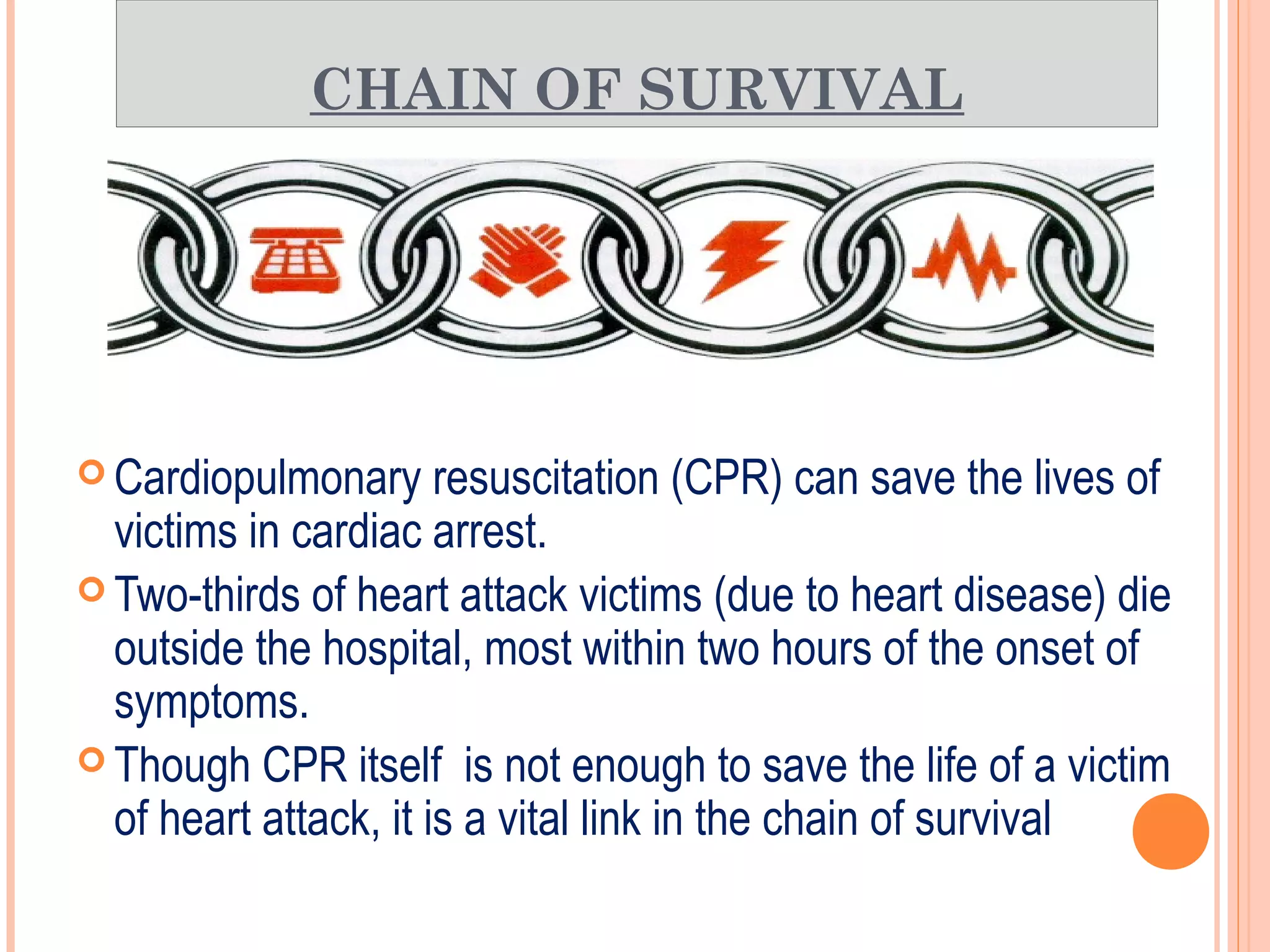
CHAIN OF SURVIVAL
 Cardiopulmonary resuscitation (CPR) can save the lives of
victims in cardiac arrest.
 Two-thirds of heart attack victims (due to heart disease) die
outside the hospital, most within two hours of the onset of
symptoms.
 Though CPR itself is not enough to save the life of a victim
of heart attack, it is a vital link in the chain of survival
Early Access : Recognize the signs and
symptoms of cardiac and respiratory
emergencies early and notify Emergency
Medical Services.
Early CPR : Perform effective CPR.
Starting CPR early greatly increases the
patients chances for survival
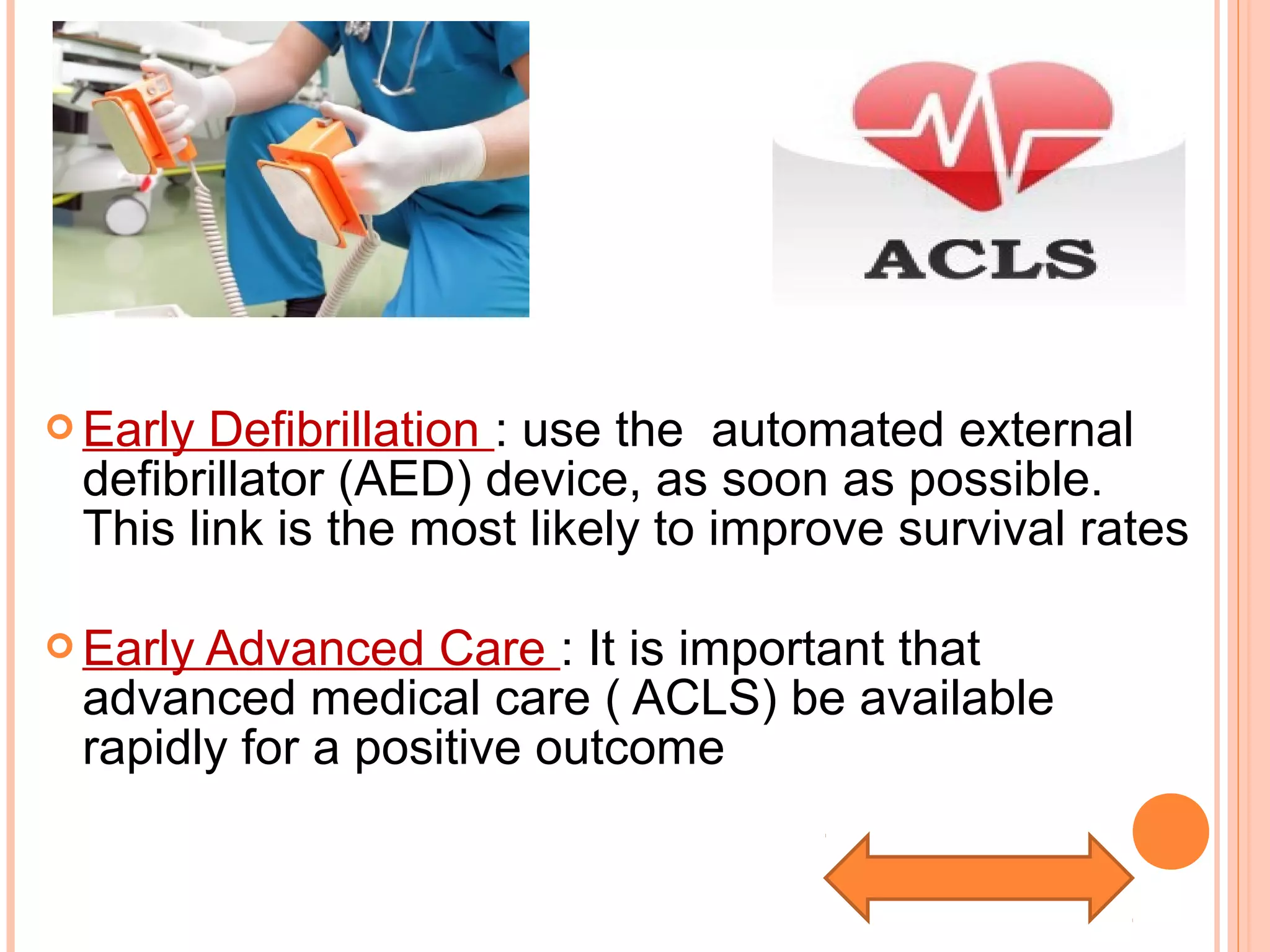
 Early Defibrillation : use the automated external
defibrillator (AED) device, as soon as possible.
This link is the most likely to improve survival rates
 Early Advanced Care : It is important that
advanced medical care ( ACLS) be available
rapidly for a positive outcome
HEART ATTACK RISK FACTORS
 Factors that cannot be changed
1. Family history
2. Sex
3. Ethnic Background
4. Age
RISK FACTORS THAT CAN BE
CHANGED
1. Smoking
2. High blood pressure
3. High Cholesterol
4. Physical activity
CONTRIBUTING FACTORS
1. Obesity
2. Diabetes
3. Excessive stress
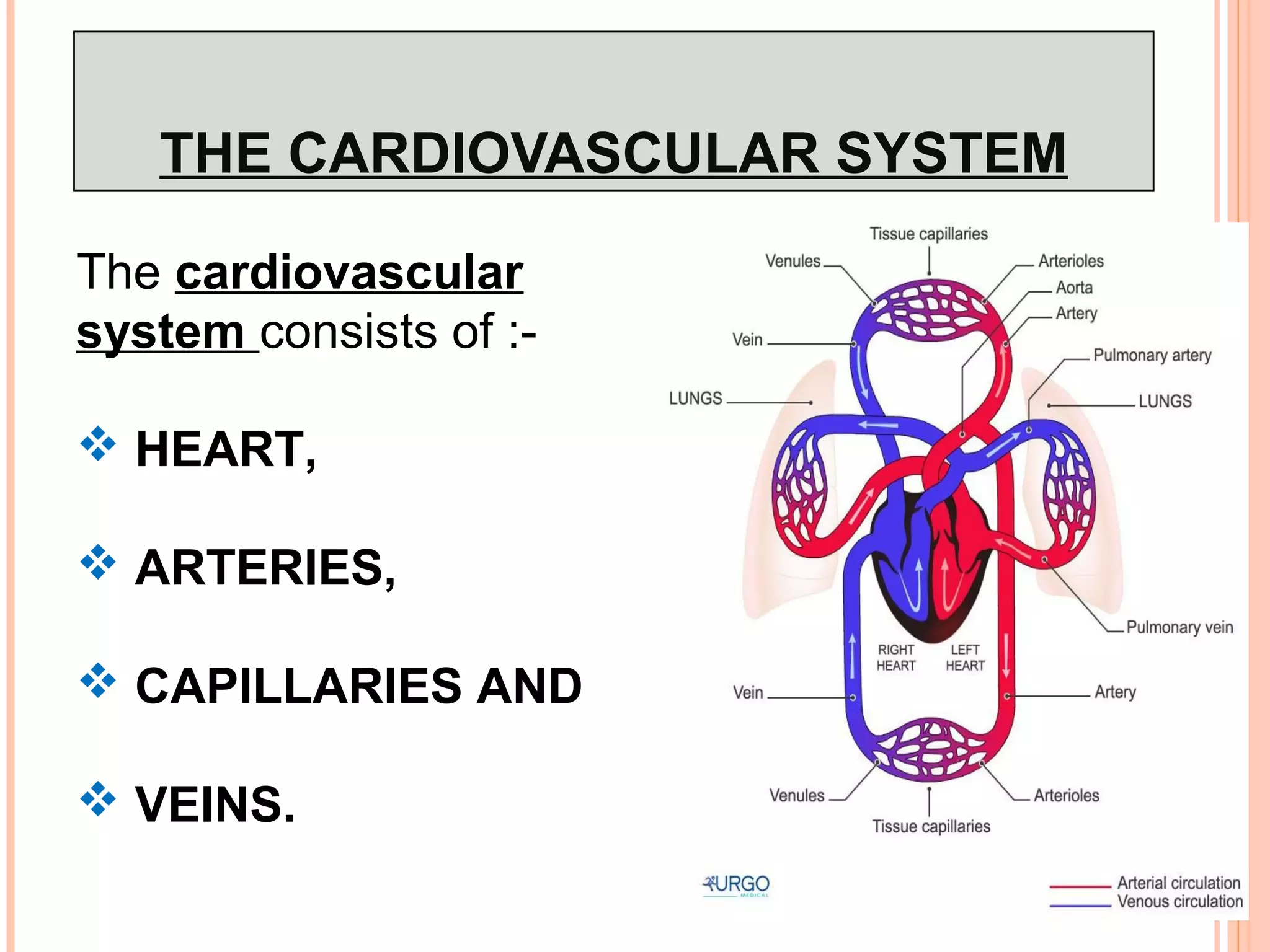
THE CARDIOVASCULAR SYSTEM
The cardiovascular
system consists of :-
 HEART,
 ARTERIES,
 CAPILLARIES AND
 VEINS.
THE CARDIOVASCULAR SYSTEM
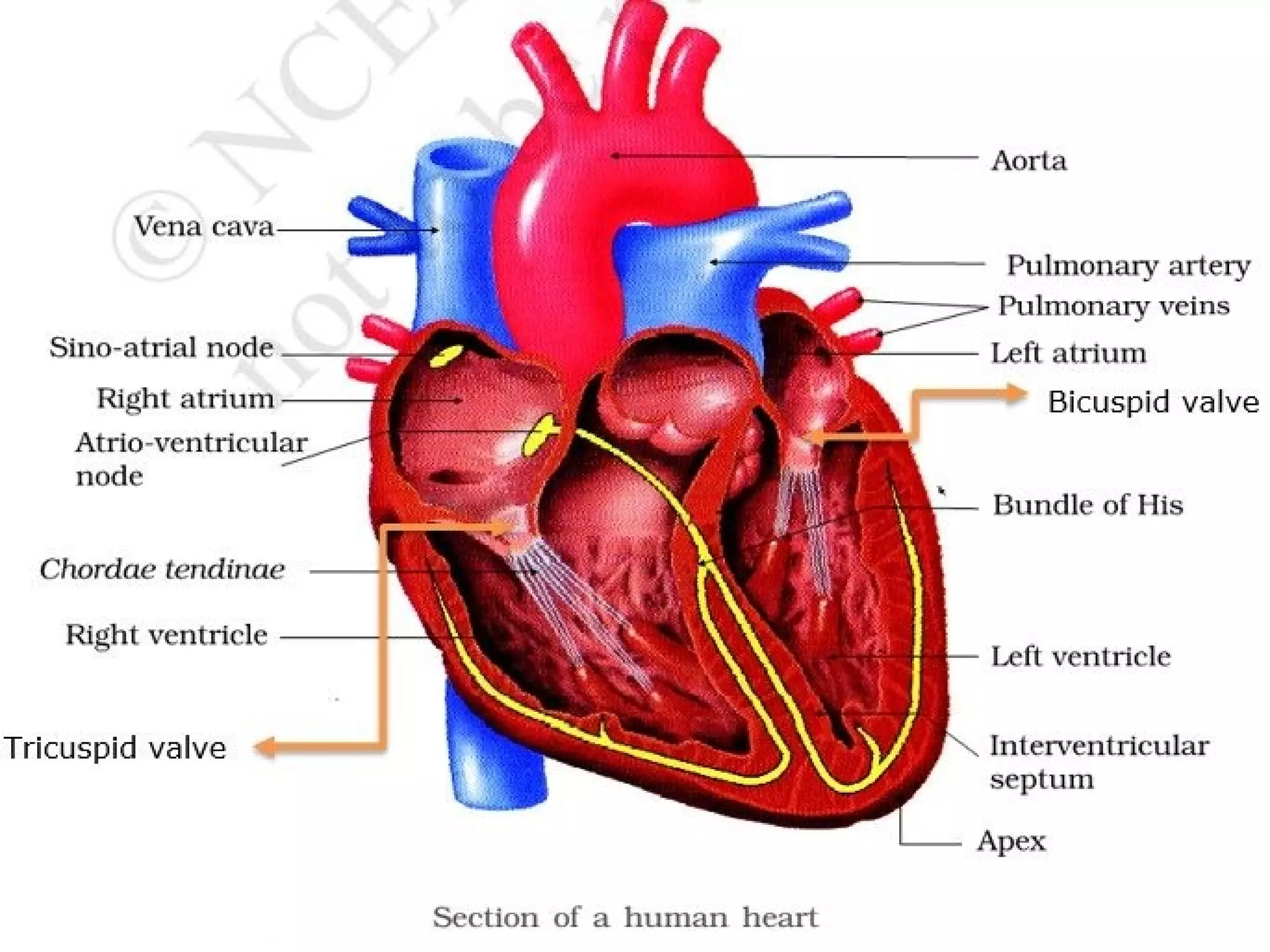
 The heart is a involuntary muscular
hollow organ, approximately the size of a
fist.
 It is located in the thoracic cavity behind
the sternum and between the lungs.
 The coronary arteries are special arteries
that supply blood to the heart muscles
themselves.
THE CARDIOVASCULAR
SYSTEM
 The left side of heart receives oxygenated
blood from the lungs and pumps it to the
body through the arteries.
 The right side of heart receives the blood
from the veins, that has circulated through
the body and pumps it to the lungs to be
oxygenated once again.
THE RESPIRATORY SYSTEM
The respiratory system is made up of four
components:
 An airway ( upper and lower)
 A neuromuscular system.
 Alveoli – tiny air sacs surrounded by capillaries
 Arteries, capillaries and veins
BREATHING
Adequate breathing is characterized by :
 Chest and abdomen rise and fall with each
breath
 Air can be heard and felt exiting the mouth
or nose
 Ease of breathing( effortlessness)
 Adequate rate
INADEQUATE RESPIRATION
 Inadequate rise and fall of the chest
 Noisy breathing: Bubbles ,rales. Stridor ,
whistling etc
 Increased respiratory effort
SIGNS OF INADEQUATE
RESPIRATION
Cyanosis :- Bluish coloration of the skin and
mucous Membranes caused by lack of oxygen in
the blood and tissues.
Inadequate rate
Altered mental status
SIGNS OF ABSENT
RESPIRATION
No chest or abdominal movement
Air cannot be heard or felt exiting the
mouth or nose
TYPE OF DEATH
Clinical Death:-
 Occurs when a patient is in respiratory arrest or in
cardiac arrest .
 The patient has a period of 4 to 6 minutes to be
resuscitated without brain damage.
 Clinical death can be reversed
Biological Death
 The moment the brain cells begin to die.It cannot
be reversed
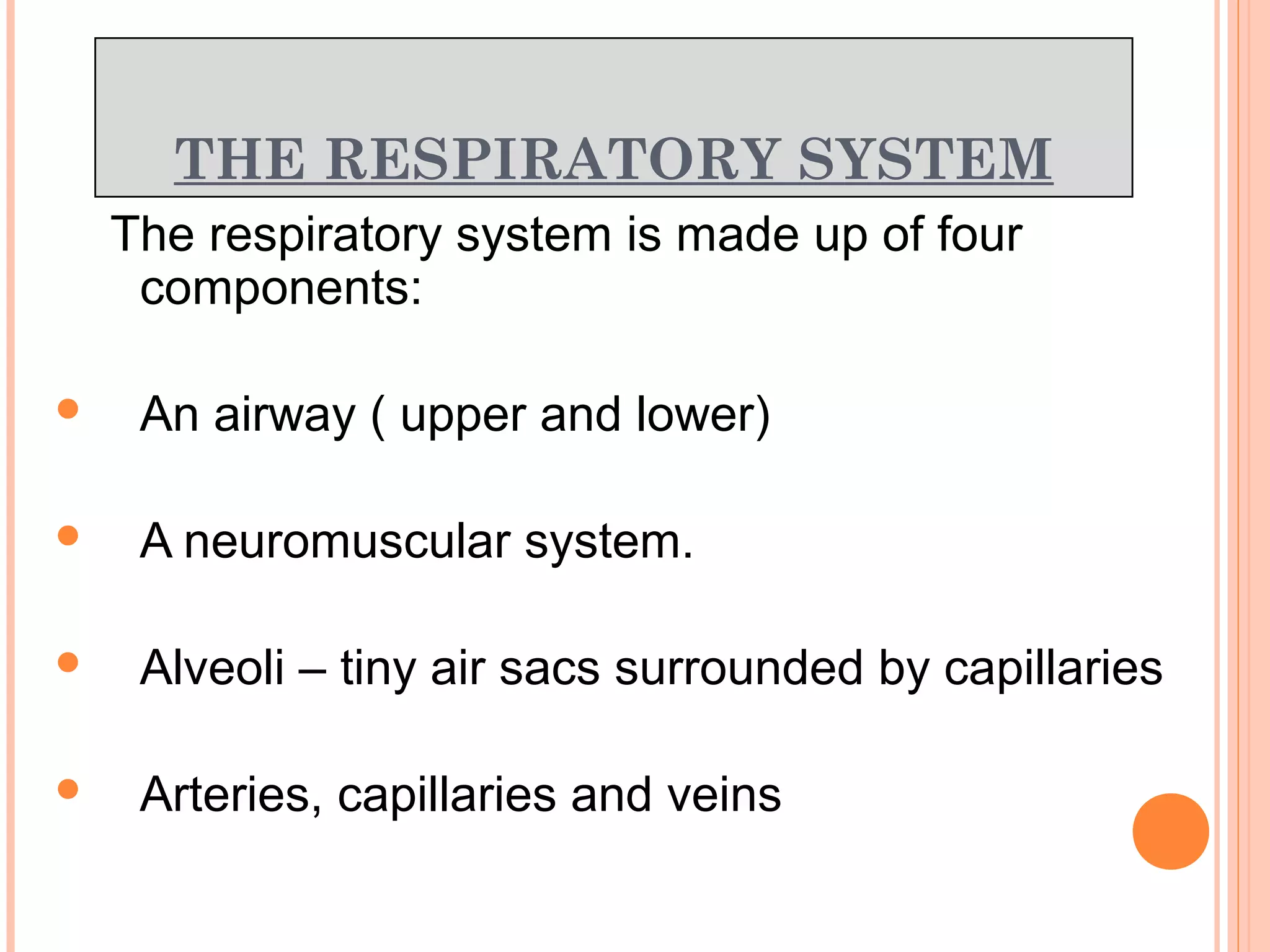
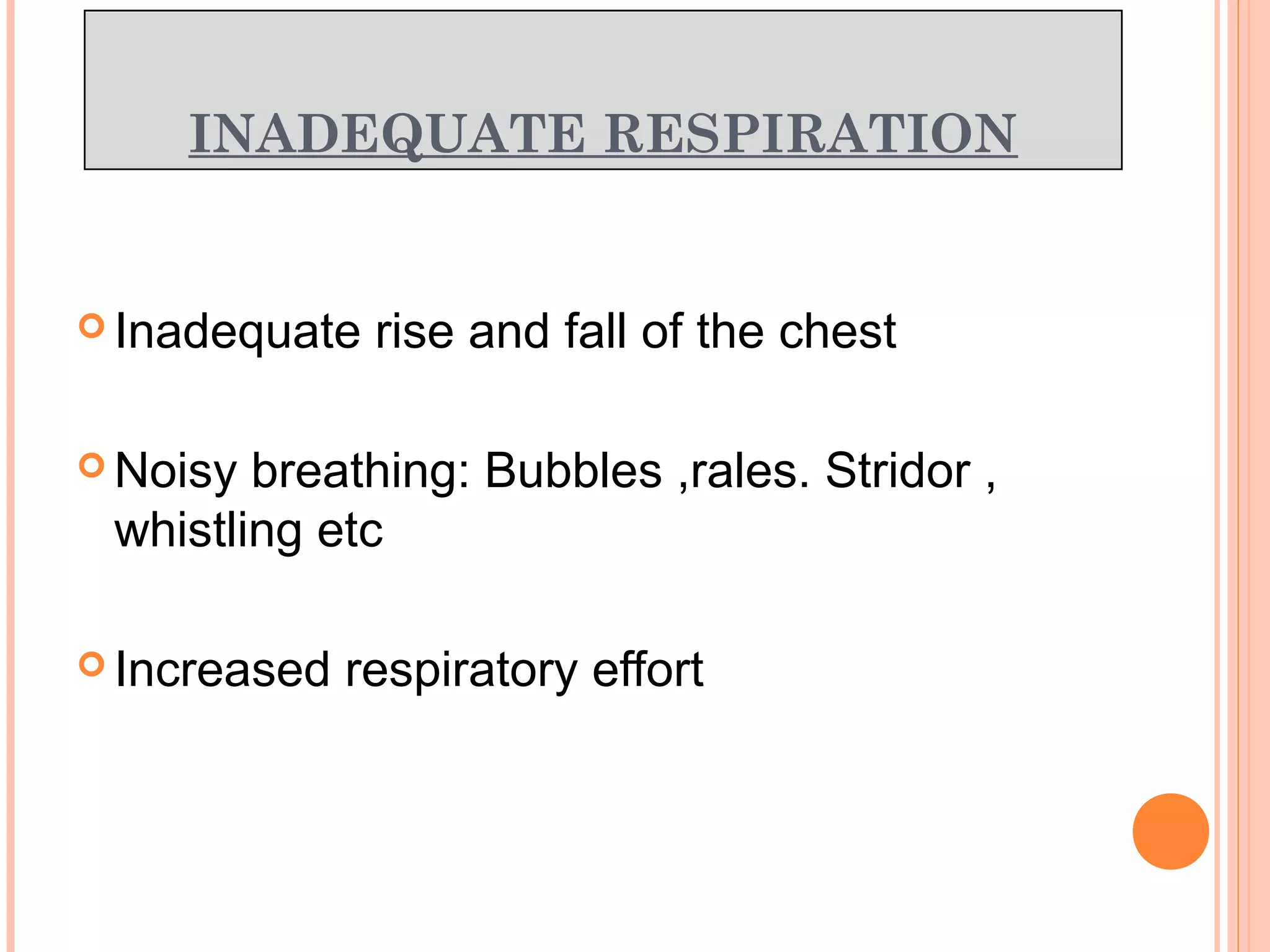
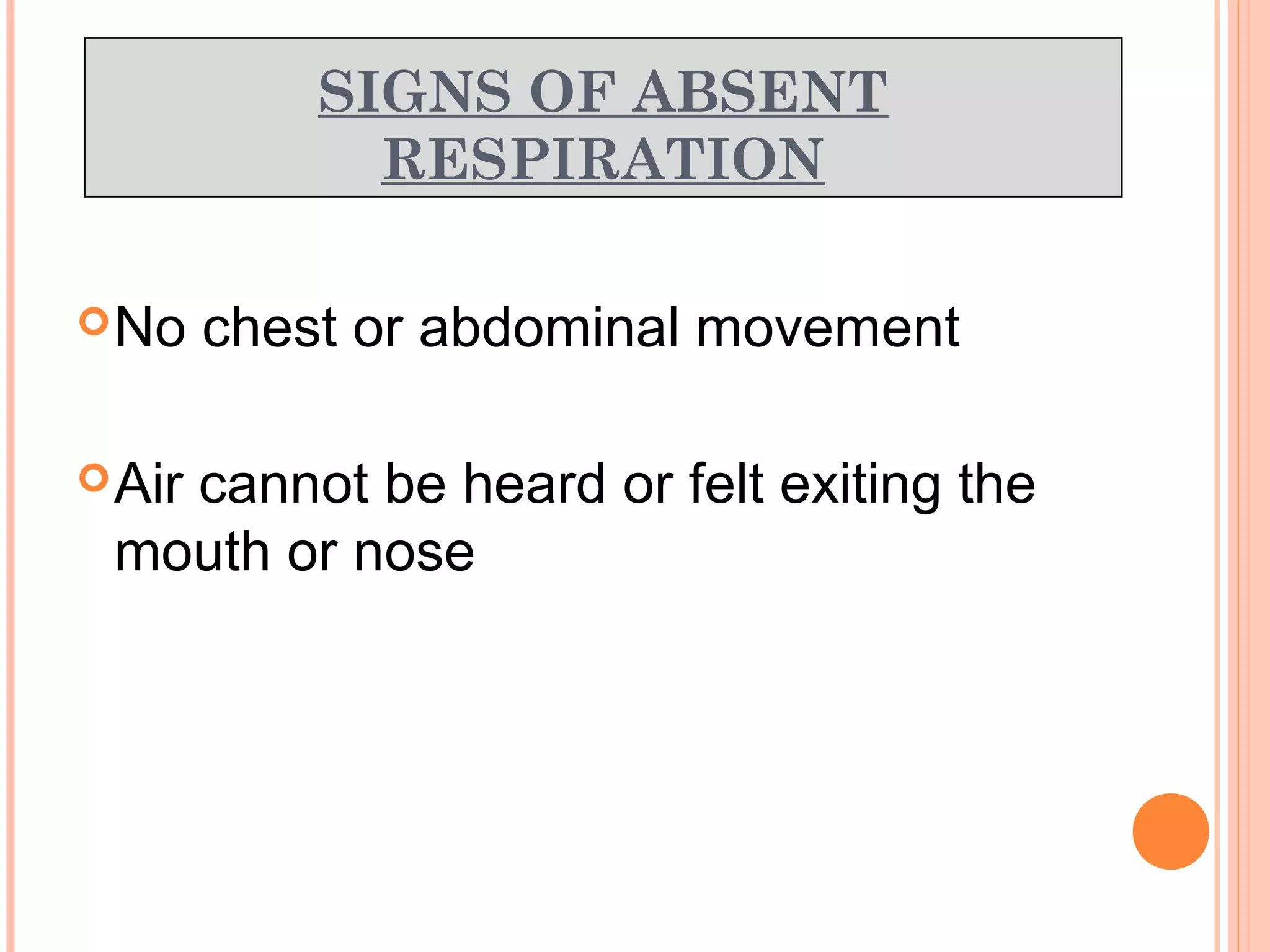
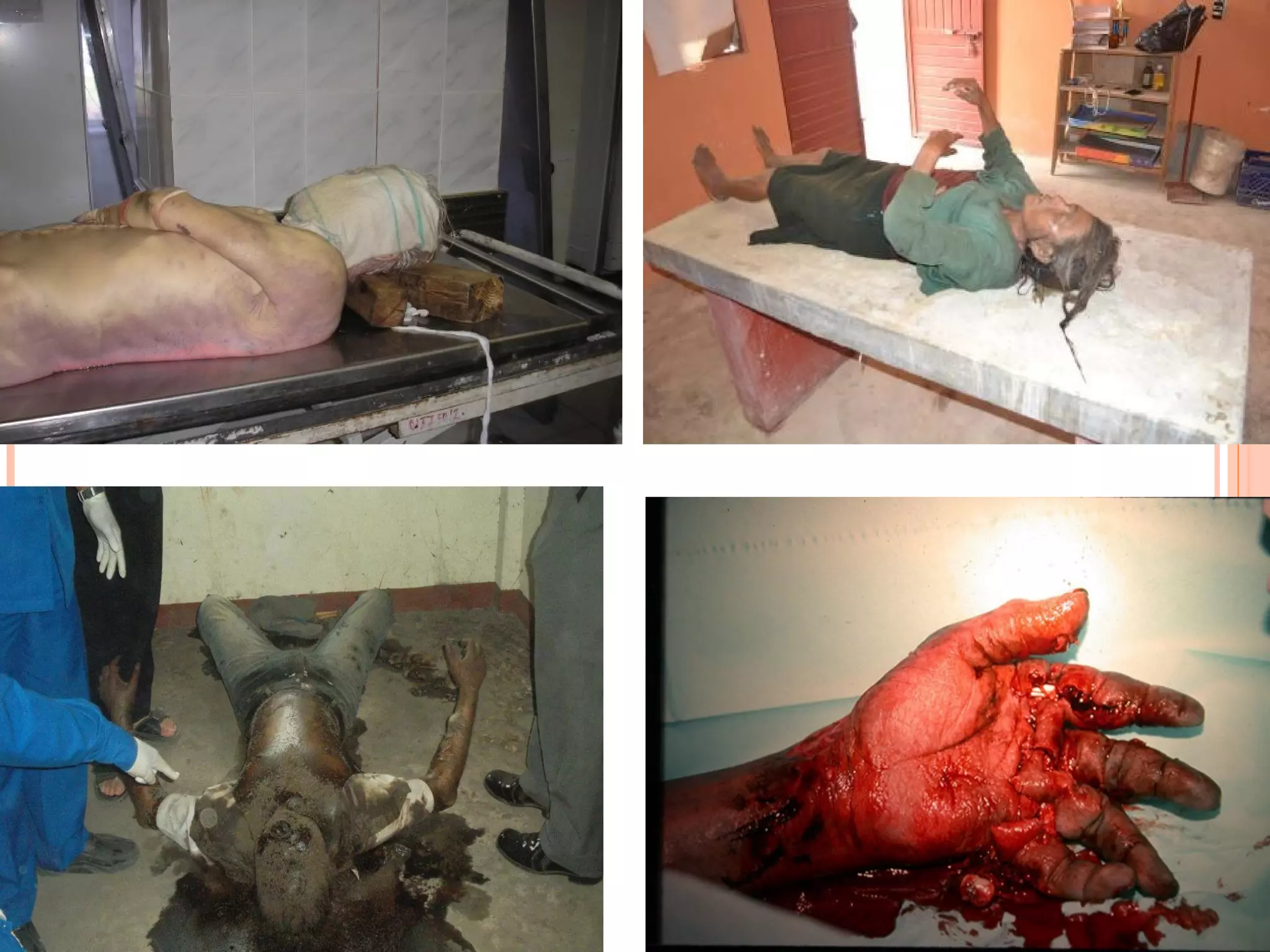
SIGNS OF CERTAIN DEATH
 Lividity :
 Rigor mortis :
 Decomposition
 Other Signs :- Decapitation, severe crushing
injuries, dismemberment, incineration, etc.
Head -Tilt Chin - Lift :- this method used in
medical patient.
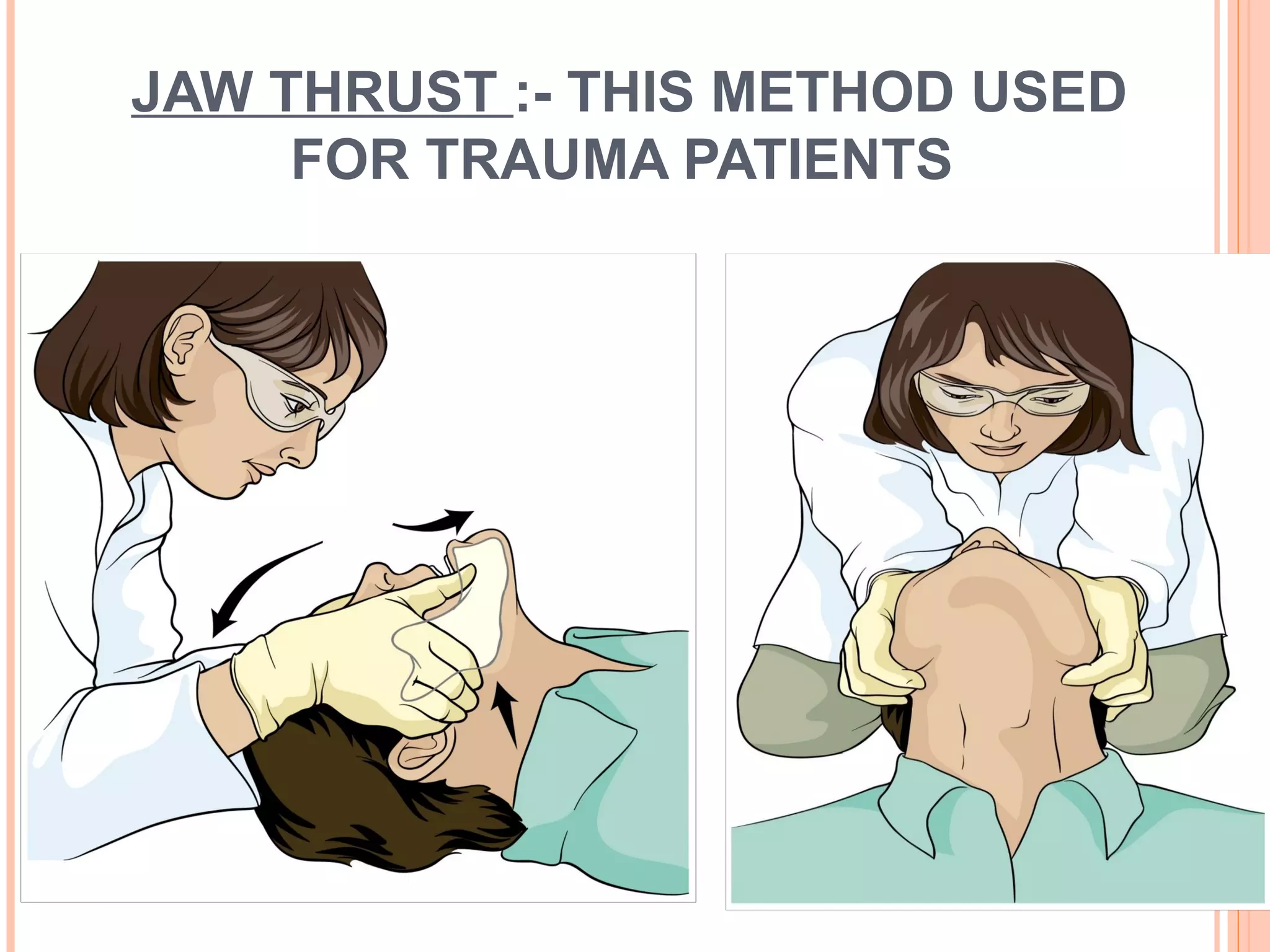
JAW THRUST :- THIS METHOD USED
FOR TRAUMA PATIENTS
TECHNIQUE OF ARTIFICIAL
VENTILATION
 Mouth to Mask
 Mouth to Barrier Device
 Mouth to Mouth
Once the patient has an open air way
obstruction, you can provide artificial
ventilation for a patient breathing
inadequately or not at all.
Causes of Airway Obstruction
Foreign Body
Tongue
Tissue damage
Acute epiglottitis
Illness
 An object caught in the throat that does
not totally block breathing.
 A patient with partial obstruction may
have adequate or poor air exchange.
 Treat this situation as a complete airway
obstruction.
Two types of FBAO
SIGN OF PARTIAL AIRSIGN OF PARTIAL AIR
OBSTRUCTIONOBSTRUCTION
 Weak ineffective cough
 High pitch noise when inhaling
 Increased respiratory difficulty and may
clutch at the throat
 Cyanosis ( Bluish discoloration of the
skin and mucous membrane)
 The patient is unable to speak, breathe or
cough.
 May clutch neck with thumb and finger
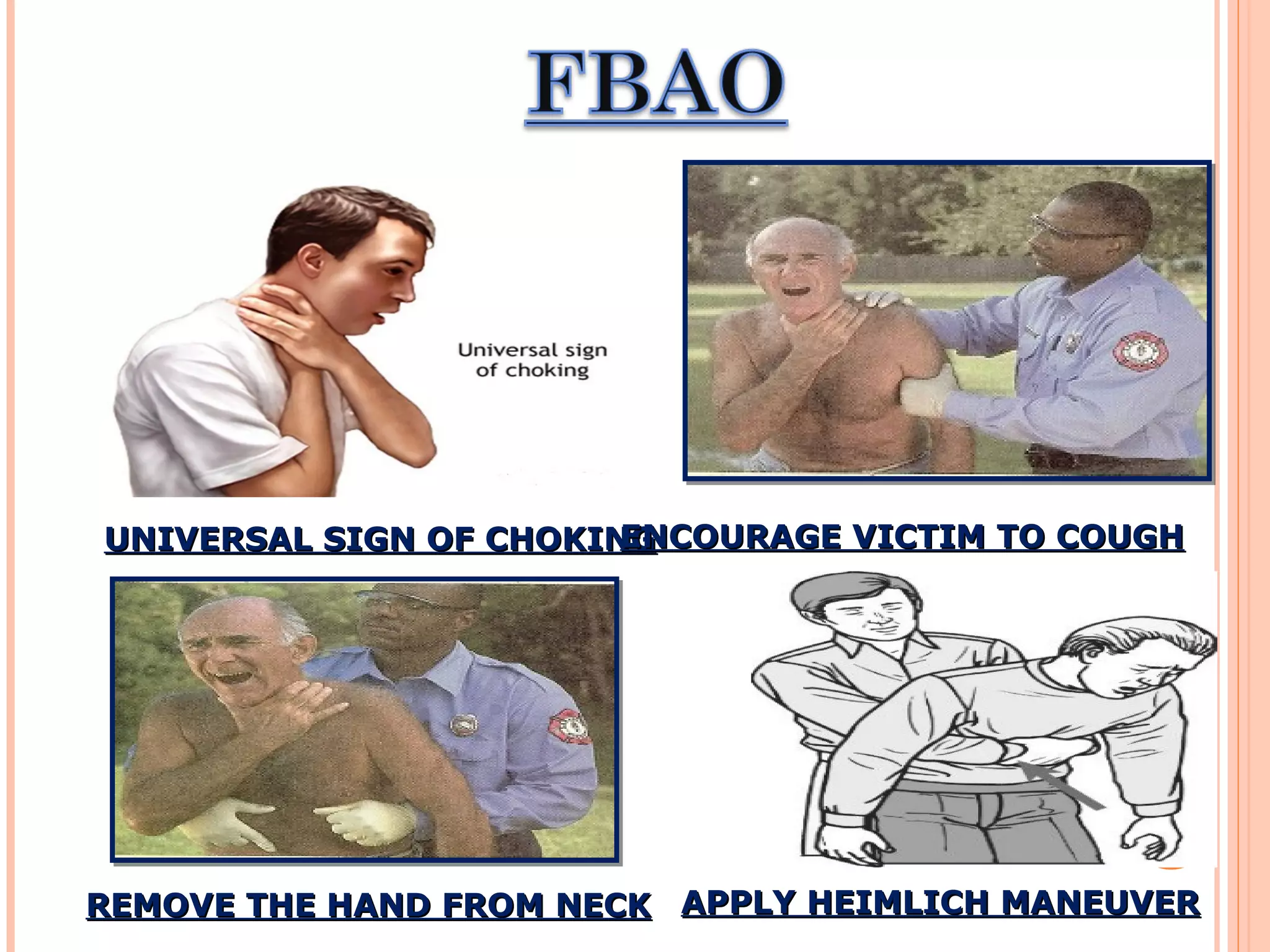
 Clutch neck with thumb and finger gesture
is known as the universal sign of choking.
 Movement of air will be absent.
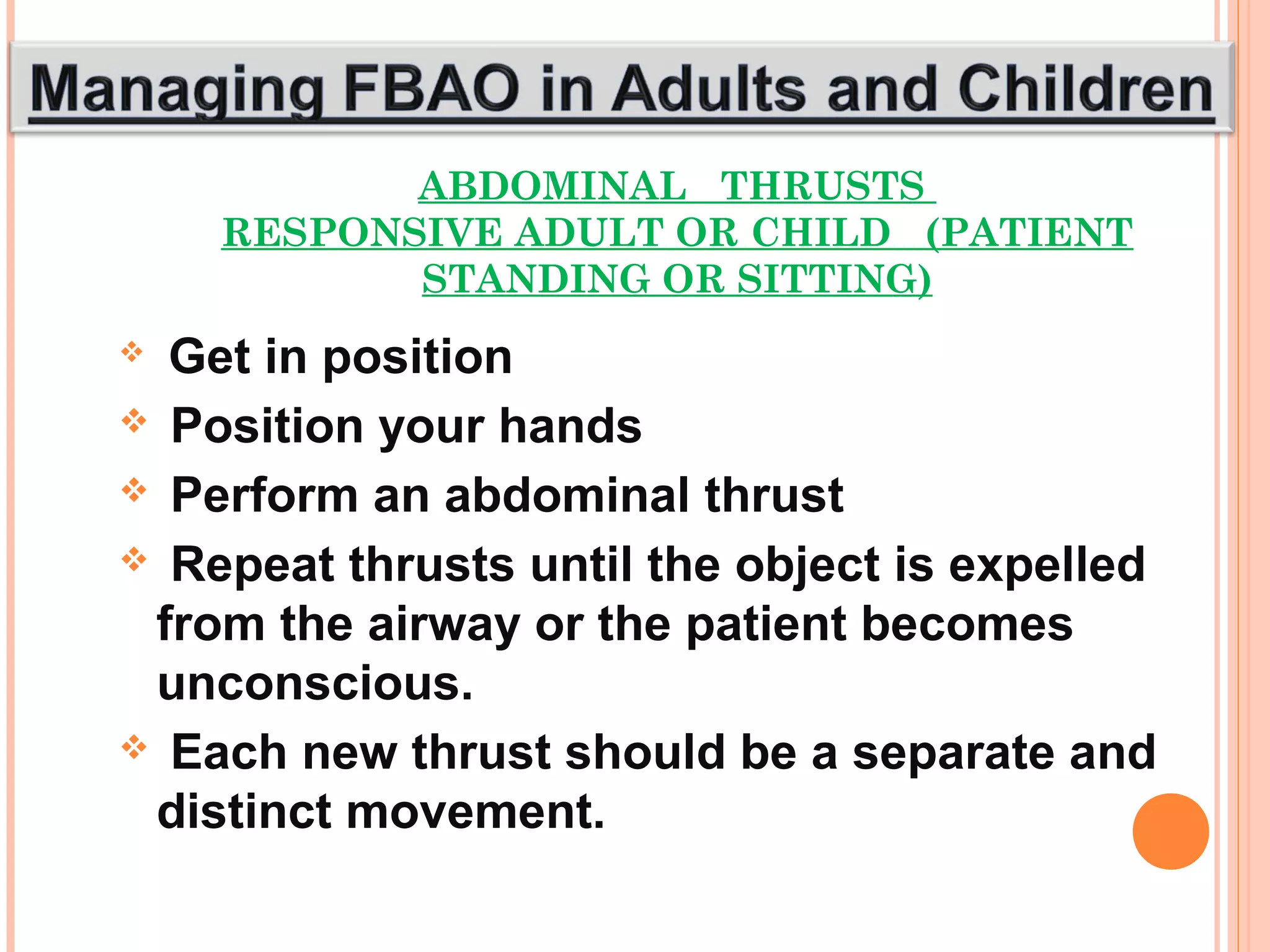
ABDOMINAL THRUSTS
RESPONSIVE ADULT OR CHILD (PATIENT
STANDING OR SITTING)
 Get in position
 Position your hands
 Perform an abdominal thrust
 Repeat thrusts until the object is expelled
from the airway or the patient becomes
unconscious.
 Each new thrust should be a separate and
distinct movement.
UNIVERSAL SIGN OF CHOKINGUNIVERSAL SIGN OF CHOKINGENCOURAGE VICTIM TO COUGHENCOURAGE VICTIM TO COUGH
REMOVE THE HAND FROM NECKREMOVE THE HAND FROM NECK APPLY HEIMLICH MANEUVERAPPLY HEIMLICH MANEUVER
MANAGING FBAO IN ADULTS AND CHILDRE
Heimlich Maneuver
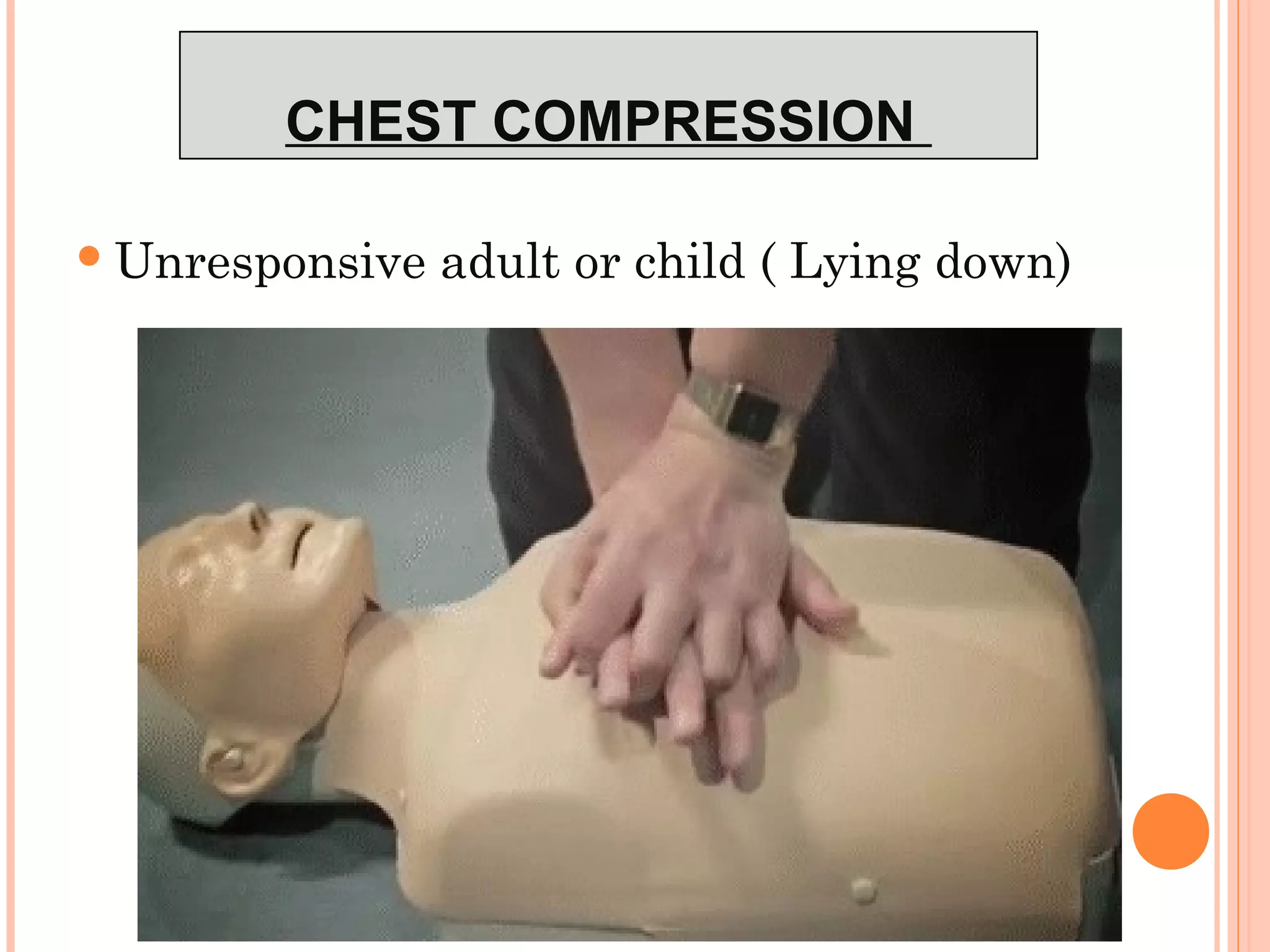
CHEST COMPRESSION
Unresponsive adult or child ( Lying down)
FINGER SWEEP
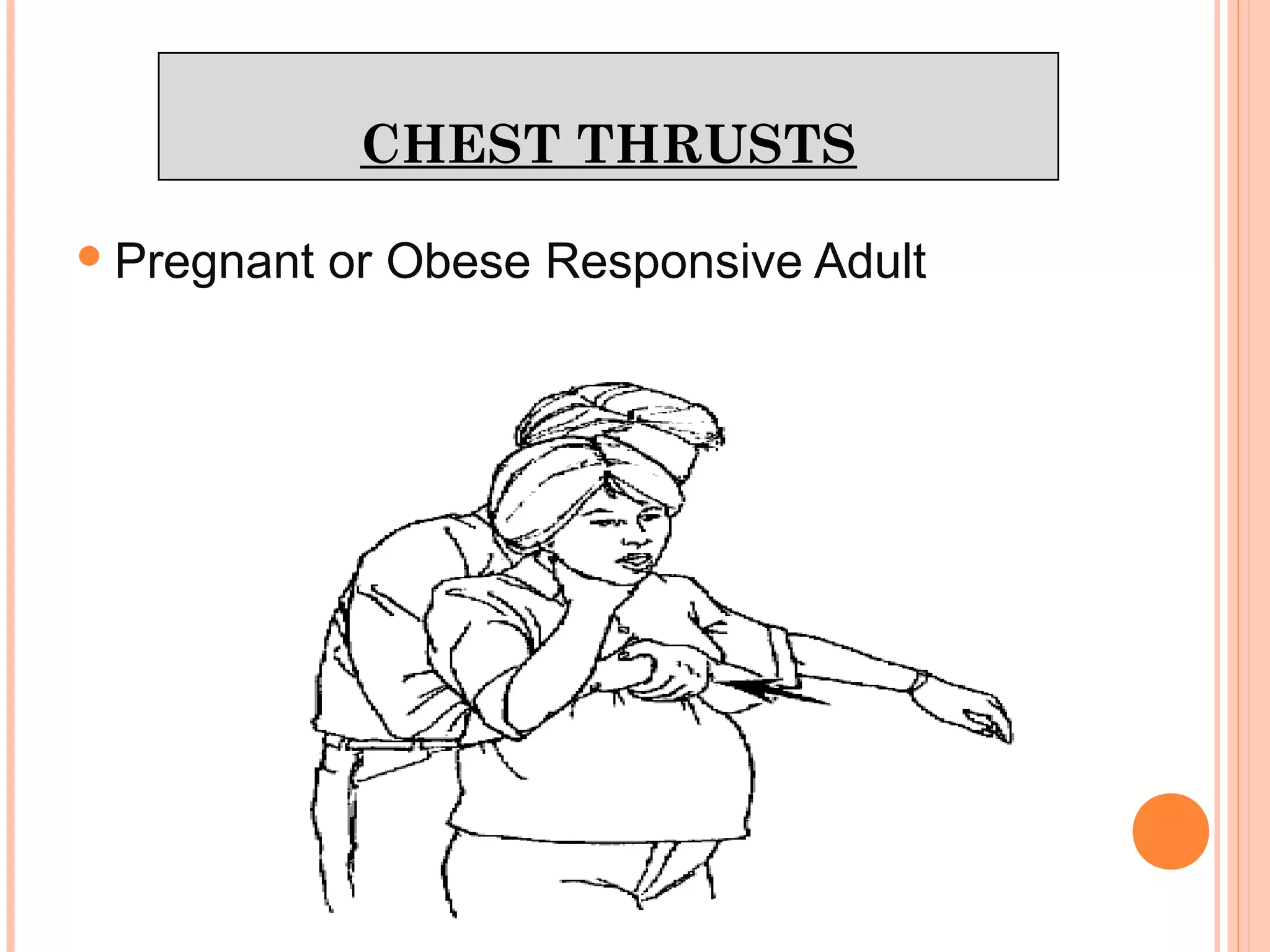
CHEST THRUSTS
Pregnant or Obese Responsive Adult
MANAGING FBAO IN INFANTS
 CPR involves a combination of chest
compressions and artificial ventilations.
 It designed to revive a person and prevent
biological death.
 By mechanically keeping a person`s heart and
lungs working.
 Within 4 to 6 minutes without circulation, brain
damage will begin, and after 8 to 10 minutes,
the damage is irreversible.
PREPARING FOR CPR
 Before providing CPR you must determine
unresponsiveness, breathless and pulse less.
 Establish unresponsiveness
 Activate the EMS
 Check CAB
1. Airway : Use appropriate method
2. Breathing : check LLF method
3. Circulation :Carotid for adult and child and
brachial for infants.
CPR CHEST COMPRESSION
 Chest compressions consist of rhythmic, repeated
pressure over the lower half of the sternum
 Position the Patient : Must be supine on firm, flat
surface with arm along sides
 Expose the Patient's chest :
 Get in position
CPR CHEST COMPRESSION
 Locate the xiphoid process
 Locate the compression site
 Position your hands
 Position your shoulders
 Perform Chest compressions : Keeping your
arms straight and your elbows locked
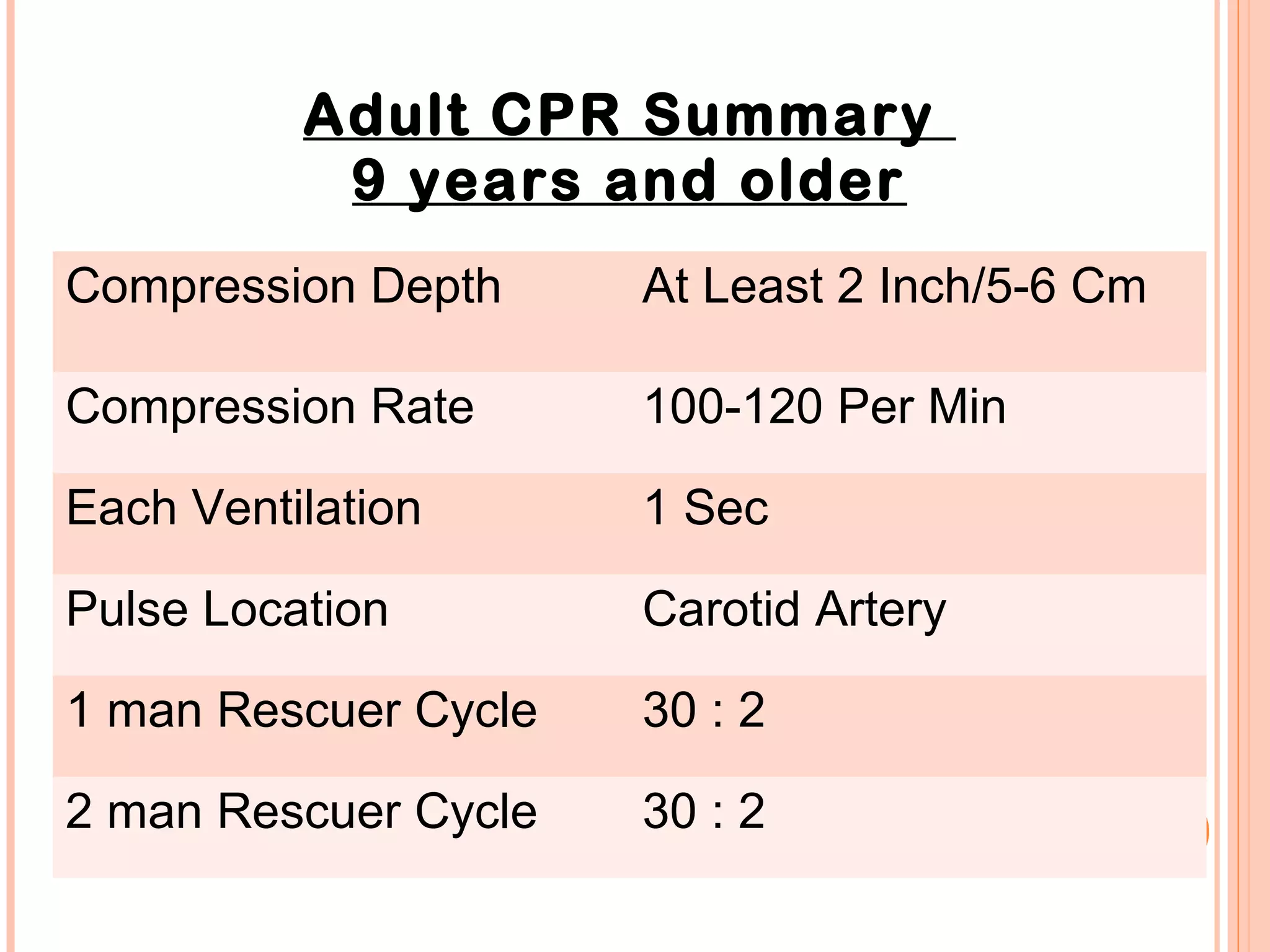
Adult CPR Summary
9 years and older
Compression Depth At Least 2 Inch/5-6 Cm
Compression Rate 100-120 Per Min
Each Ventilation 1 Sec
Pulse Location Carotid Artery
1 man Rescuer Cycle 30 : 2
2 man Rescuer Cycle 30 : 2
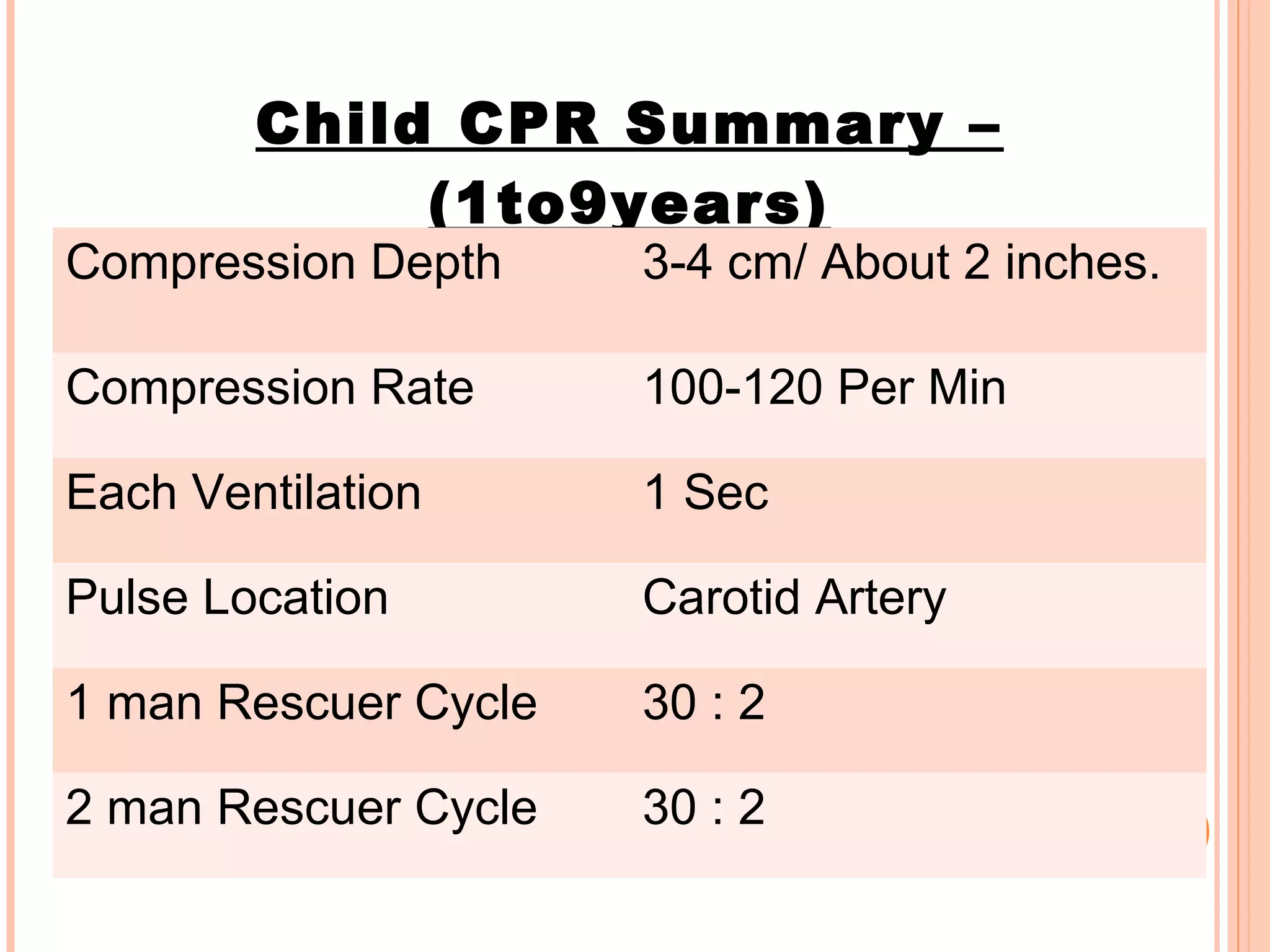
Child CPR Summary –
(1to9years)
Compression Depth 3-4 cm/ About 2 inches.
Compression Rate 100-120 Per Min
Each Ventilation 1 Sec
Pulse Location Carotid Artery
1 man Rescuer Cycle 30 : 2
2 man Rescuer Cycle 30 : 2
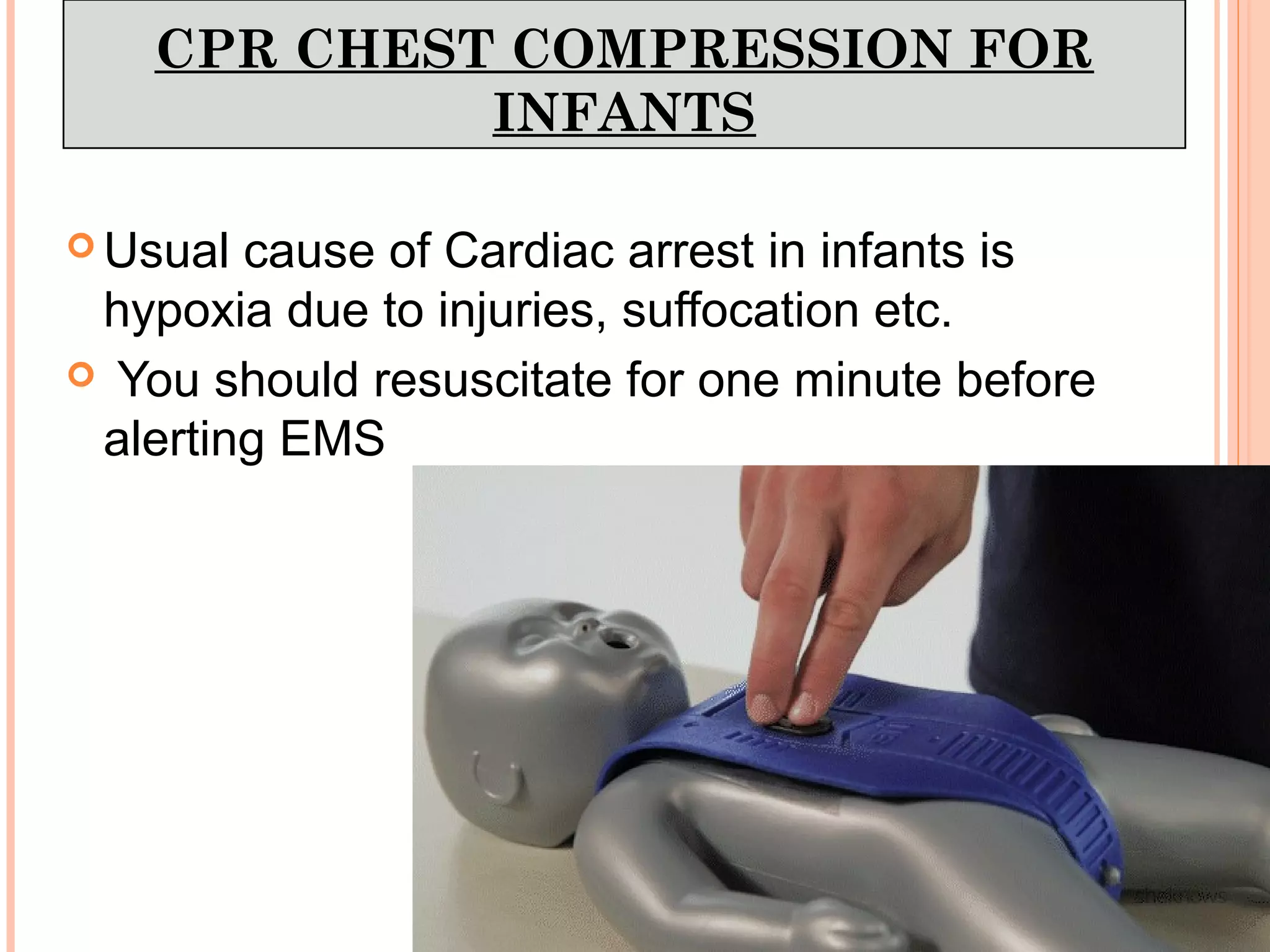
CPR CHEST COMPRESSION FOR
INFANTS
 Usual cause of Cardiac arrest in infants is
hypoxia due to injuries, suffocation etc.
 You should resuscitate for one minute before
alerting EMS
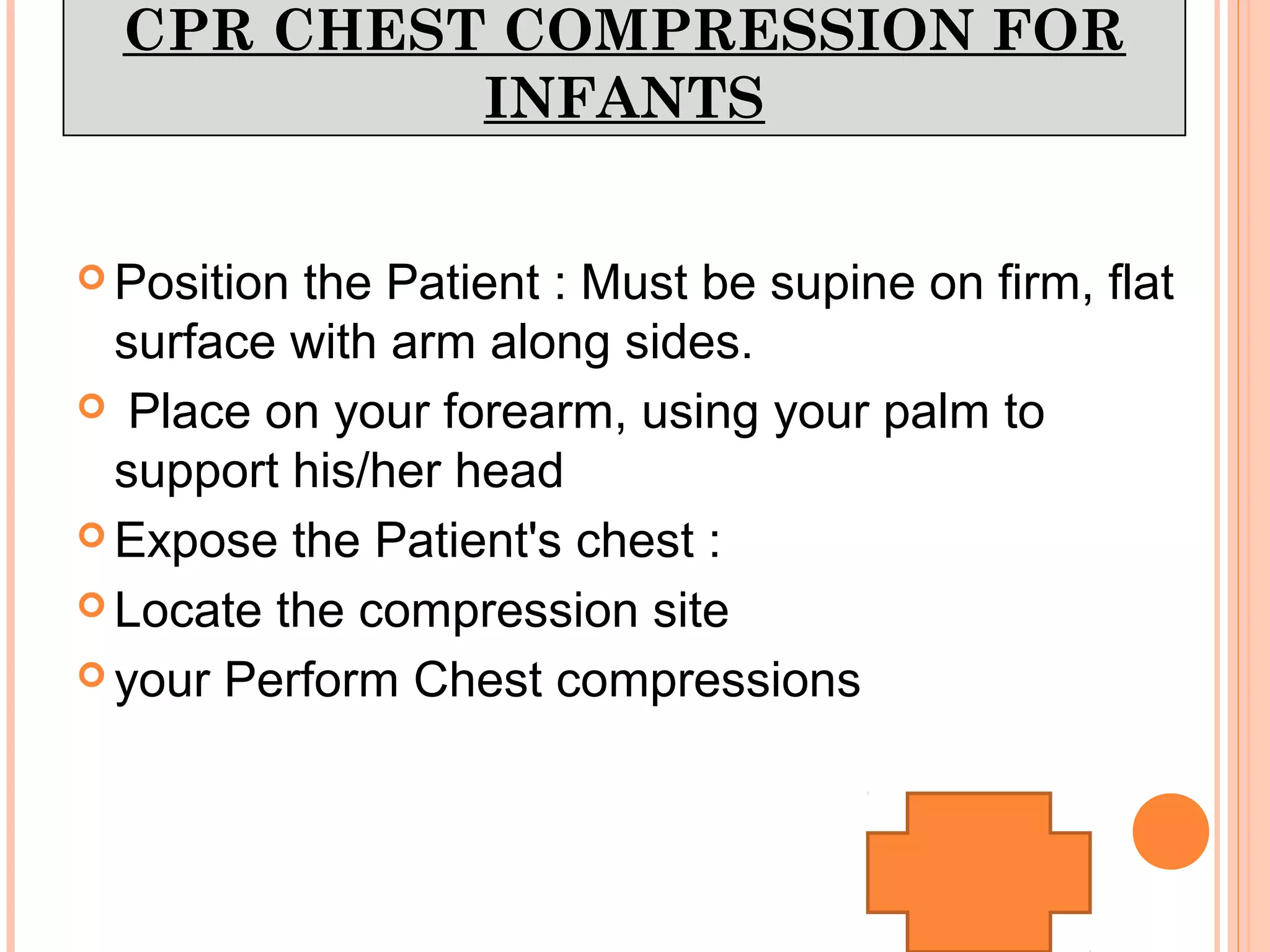
CPR CHEST COMPRESSION FOR
INFANTS
 Position the Patient : Must be supine on firm, flat
surface with arm along sides.
 Place on your forearm, using your palm to
support his/her head
 Expose the Patient's chest :
 Locate the compression site
 your Perform Chest compressions
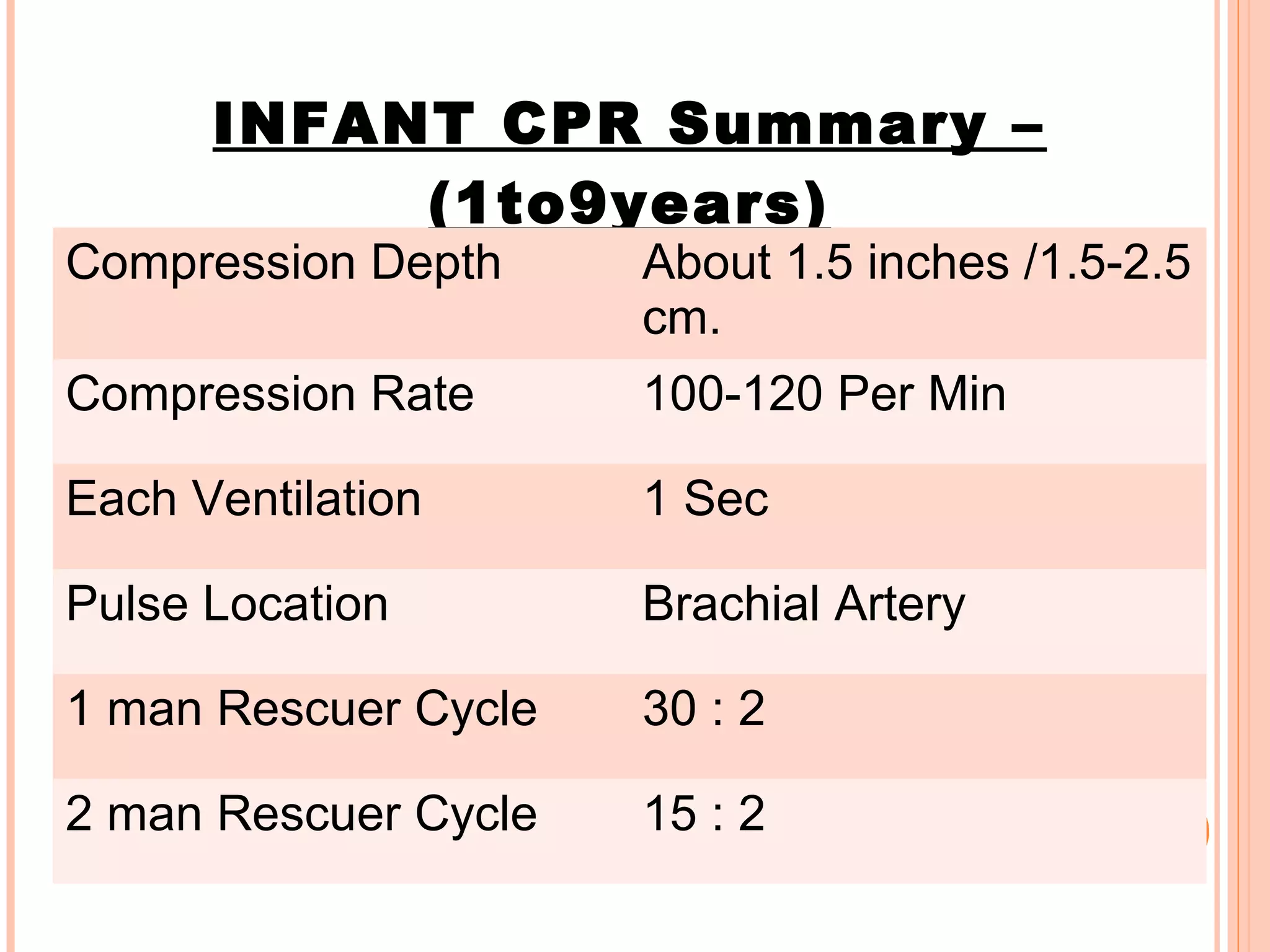
INFANT CPR Summary –
(1to9years)
Compression Depth About 1.5 inches /1.5-2.5
cm.
Compression Rate 100-120 Per Min
Each Ventilation 1 Sec
Pulse Location Brachial Artery
1 man Rescuer Cycle 30 : 2
2 man Rescuer Cycle 15 : 2
SIGN OF SUCCESSFUL CPR
 A pulse should be palpable with every compression.
 The chest should rise and fall with each ventilation.
 The pupils may begin to react normally.
 Patient’s skin colour may improve.
 Patient may attempt to move and try to swallow.
 Heart beat may return.
WHEN NOT TO BEGIN CPR
Obvious mortal wounds
Rigor mortis
Decomposition
Lividity
Still birth
COMPLICATION CAUSED BY
CPR
Fracture of the sternum and ribs
Pneumothorax
Haemothorax
Cuts and bruises to the lungs
Laceration to the liver
Most of these complications are rare. Even
if CPR results in complications, the
alternative is death.
MISTAKES IN PERFORMING
CPR
 Patient is not on hard surface and horizontal
position.
 Incomplete seal around the patient`s mouth and
nose
 Nostrils are not completely pinched during mouth
to mouth ventilation.
MISTAKES IN PERFORMING
CPR
Improper compression/ ventilation ratio.
Hands not in correct position or compressions
incorrectly placed.
Compression too deep or too frequent
INTERRUPTION IN CPR
While moving a patient onto a stretcher.
While moving a patient down a flight of stairs or
through a hallway.
While loading or unloading a patient into an
ambulance.
To allow for defibrillation or ACLS to be initiated.
Recover from physical exhaustion.
After completion of lesson now you are able
to know :-
What is chain of survival
Importance of rescue breathing
FBAO and their types
Cardio pulmonary resuscitation
Demonstration of FBAO and CPR
 What is the full form of FBAO ?
 In adult the Ratio of compression during
CPR is--------?
Cpr and fbao

Cpr and fbao

  • 1.
    BASIC LIFE SUPPORTBASICLIFE SUPPORT && CARDIO PULMONARYCARDIO PULMONARY RESUSCITATIONRESUSCITATION Presented by UDIT KR DIXIT KHARAGPUR
  • 2.
    Upon completion oflesson you will be able to know:- What is chain of survival Importance of rescue breathing FBAO and their types CPR IN ADULTS, CHILDREN & INFANTS Demonstration of FBAO and CPR
  • 3.
    CHAIN OF SURVIVAL Cardiopulmonary resuscitation (CPR) can save the lives of victims in cardiac arrest.  Two-thirds of heart attack victims (due to heart disease) die outside the hospital, most within two hours of the onset of symptoms.  Though CPR itself is not enough to save the life of a victim of heart attack, it is a vital link in the chain of survival
  • 4.
    Early Access :Recognize the signs and symptoms of cardiac and respiratory emergencies early and notify Emergency Medical Services. Early CPR : Perform effective CPR. Starting CPR early greatly increases the patients chances for survival
  • 5.
     Early Defibrillation: use the automated external defibrillator (AED) device, as soon as possible. This link is the most likely to improve survival rates  Early Advanced Care : It is important that advanced medical care ( ACLS) be available rapidly for a positive outcome
  • 6.
    HEART ATTACK RISKFACTORS  Factors that cannot be changed 1. Family history 2. Sex 3. Ethnic Background 4. Age
  • 7.
    RISK FACTORS THATCAN BE CHANGED 1. Smoking 2. High blood pressure 3. High Cholesterol 4. Physical activity
  • 8.
    CONTRIBUTING FACTORS 1. Obesity 2.Diabetes 3. Excessive stress
  • 9.
    THE CARDIOVASCULAR SYSTEM Thecardiovascular system consists of :-  HEART,  ARTERIES,  CAPILLARIES AND  VEINS.
  • 11.
    THE CARDIOVASCULAR SYSTEM The heart is a involuntary muscular hollow organ, approximately the size of a fist.  It is located in the thoracic cavity behind the sternum and between the lungs.  The coronary arteries are special arteries that supply blood to the heart muscles themselves.
  • 12.
    THE CARDIOVASCULAR SYSTEM  Theleft side of heart receives oxygenated blood from the lungs and pumps it to the body through the arteries.  The right side of heart receives the blood from the veins, that has circulated through the body and pumps it to the lungs to be oxygenated once again.
  • 13.
    THE RESPIRATORY SYSTEM Therespiratory system is made up of four components:  An airway ( upper and lower)  A neuromuscular system.  Alveoli – tiny air sacs surrounded by capillaries  Arteries, capillaries and veins
  • 14.
    BREATHING Adequate breathing ischaracterized by :  Chest and abdomen rise and fall with each breath  Air can be heard and felt exiting the mouth or nose  Ease of breathing( effortlessness)  Adequate rate
  • 15.
    INADEQUATE RESPIRATION  Inadequaterise and fall of the chest  Noisy breathing: Bubbles ,rales. Stridor , whistling etc  Increased respiratory effort
  • 16.
    SIGNS OF INADEQUATE RESPIRATION Cyanosis:- Bluish coloration of the skin and mucous Membranes caused by lack of oxygen in the blood and tissues. Inadequate rate Altered mental status
  • 17.
    SIGNS OF ABSENT RESPIRATION Nochest or abdominal movement Air cannot be heard or felt exiting the mouth or nose
  • 18.
    TYPE OF DEATH ClinicalDeath:-  Occurs when a patient is in respiratory arrest or in cardiac arrest .  The patient has a period of 4 to 6 minutes to be resuscitated without brain damage.  Clinical death can be reversed Biological Death  The moment the brain cells begin to die.It cannot be reversed
  • 19.
    SIGNS OF CERTAINDEATH  Lividity :  Rigor mortis :  Decomposition  Other Signs :- Decapitation, severe crushing injuries, dismemberment, incineration, etc.
  • 21.
    Head -Tilt Chin- Lift :- this method used in medical patient.
  • 22.
    JAW THRUST :-THIS METHOD USED FOR TRAUMA PATIENTS
  • 23.
    TECHNIQUE OF ARTIFICIAL VENTILATION Mouth to Mask  Mouth to Barrier Device  Mouth to Mouth
  • 24.
    Once the patienthas an open air way obstruction, you can provide artificial ventilation for a patient breathing inadequately or not at all.
  • 25.
    Causes of AirwayObstruction Foreign Body Tongue Tissue damage Acute epiglottitis Illness
  • 26.
     An objectcaught in the throat that does not totally block breathing.  A patient with partial obstruction may have adequate or poor air exchange.  Treat this situation as a complete airway obstruction. Two types of FBAO
  • 27.
    SIGN OF PARTIALAIRSIGN OF PARTIAL AIR OBSTRUCTIONOBSTRUCTION  Weak ineffective cough  High pitch noise when inhaling  Increased respiratory difficulty and may clutch at the throat  Cyanosis ( Bluish discoloration of the skin and mucous membrane)
  • 28.
     The patientis unable to speak, breathe or cough.  May clutch neck with thumb and finger  Clutch neck with thumb and finger gesture is known as the universal sign of choking.  Movement of air will be absent.
  • 29.
    ABDOMINAL THRUSTS RESPONSIVE ADULTOR CHILD (PATIENT STANDING OR SITTING)  Get in position  Position your hands  Perform an abdominal thrust  Repeat thrusts until the object is expelled from the airway or the patient becomes unconscious.  Each new thrust should be a separate and distinct movement.
  • 30.
    UNIVERSAL SIGN OFCHOKINGUNIVERSAL SIGN OF CHOKINGENCOURAGE VICTIM TO COUGHENCOURAGE VICTIM TO COUGH REMOVE THE HAND FROM NECKREMOVE THE HAND FROM NECK APPLY HEIMLICH MANEUVERAPPLY HEIMLICH MANEUVER
  • 31.
    MANAGING FBAO INADULTS AND CHILDRE Heimlich Maneuver
  • 32.
  • 33.
  • 34.
    CHEST THRUSTS Pregnant orObese Responsive Adult
  • 35.
  • 36.
     CPR involvesa combination of chest compressions and artificial ventilations.  It designed to revive a person and prevent biological death.  By mechanically keeping a person`s heart and lungs working.  Within 4 to 6 minutes without circulation, brain damage will begin, and after 8 to 10 minutes, the damage is irreversible.
  • 37.
    PREPARING FOR CPR Before providing CPR you must determine unresponsiveness, breathless and pulse less.  Establish unresponsiveness  Activate the EMS  Check CAB 1. Airway : Use appropriate method 2. Breathing : check LLF method 3. Circulation :Carotid for adult and child and brachial for infants.
  • 38.
    CPR CHEST COMPRESSION Chest compressions consist of rhythmic, repeated pressure over the lower half of the sternum  Position the Patient : Must be supine on firm, flat surface with arm along sides  Expose the Patient's chest :  Get in position
  • 39.
    CPR CHEST COMPRESSION Locate the xiphoid process  Locate the compression site  Position your hands  Position your shoulders  Perform Chest compressions : Keeping your arms straight and your elbows locked
  • 40.
    Adult CPR Summary 9years and older Compression Depth At Least 2 Inch/5-6 Cm Compression Rate 100-120 Per Min Each Ventilation 1 Sec Pulse Location Carotid Artery 1 man Rescuer Cycle 30 : 2 2 man Rescuer Cycle 30 : 2
  • 41.
    Child CPR Summary– (1to9years) Compression Depth 3-4 cm/ About 2 inches. Compression Rate 100-120 Per Min Each Ventilation 1 Sec Pulse Location Carotid Artery 1 man Rescuer Cycle 30 : 2 2 man Rescuer Cycle 30 : 2
  • 42.
    CPR CHEST COMPRESSIONFOR INFANTS  Usual cause of Cardiac arrest in infants is hypoxia due to injuries, suffocation etc.  You should resuscitate for one minute before alerting EMS
  • 43.
    CPR CHEST COMPRESSIONFOR INFANTS  Position the Patient : Must be supine on firm, flat surface with arm along sides.  Place on your forearm, using your palm to support his/her head  Expose the Patient's chest :  Locate the compression site  your Perform Chest compressions
  • 44.
    INFANT CPR Summary– (1to9years) Compression Depth About 1.5 inches /1.5-2.5 cm. Compression Rate 100-120 Per Min Each Ventilation 1 Sec Pulse Location Brachial Artery 1 man Rescuer Cycle 30 : 2 2 man Rescuer Cycle 15 : 2
  • 45.
    SIGN OF SUCCESSFULCPR  A pulse should be palpable with every compression.  The chest should rise and fall with each ventilation.  The pupils may begin to react normally.  Patient’s skin colour may improve.  Patient may attempt to move and try to swallow.  Heart beat may return.
  • 46.
    WHEN NOT TOBEGIN CPR Obvious mortal wounds Rigor mortis Decomposition Lividity Still birth
  • 47.
    COMPLICATION CAUSED BY CPR Fractureof the sternum and ribs Pneumothorax Haemothorax Cuts and bruises to the lungs Laceration to the liver Most of these complications are rare. Even if CPR results in complications, the alternative is death.
  • 48.
    MISTAKES IN PERFORMING CPR Patient is not on hard surface and horizontal position.  Incomplete seal around the patient`s mouth and nose  Nostrils are not completely pinched during mouth to mouth ventilation.
  • 49.
    MISTAKES IN PERFORMING CPR Impropercompression/ ventilation ratio. Hands not in correct position or compressions incorrectly placed. Compression too deep or too frequent
  • 50.
    INTERRUPTION IN CPR Whilemoving a patient onto a stretcher. While moving a patient down a flight of stairs or through a hallway. While loading or unloading a patient into an ambulance. To allow for defibrillation or ACLS to be initiated. Recover from physical exhaustion.
  • 51.
    After completion oflesson now you are able to know :- What is chain of survival Importance of rescue breathing FBAO and their types Cardio pulmonary resuscitation Demonstration of FBAO and CPR
  • 53.
     What isthe full form of FBAO ?  In adult the Ratio of compression during CPR is--------?