Differences between
Financial Accounting, Cost
Accounting & Management
Accounting
Basis Financial Accounting Cost Accounting
Management
Accounting
Accounting
method
It depending on double
entry system.
It is not depending on
double entry system.
It is not depending
on double entry
system.
Accounting
standards
Accounts should be
prepared based on
accounting standards
issued by Institute of
Charted Accountants
of India.
It is not bound by any
accounting standards.
It is not bound by
any accounting
standards.
Analysis of cost
and profit
It shows overview of
business.
It shows detailed cost
and profit data for each
product.
It provides the info.
relating to plants,
departments,
individual product,
etc.
Control Aspect
It does not attach
importance to control
aspect.
It provides detailed
system like standard
costing & budgetary
control.
It provides detailed
info. for taking
optimum decisions.
Basis
Financial
Accounting
Cost Accounting
Management
Accounting
External &
Internal Users
It is for external
use.
It is for internal use. It is for internal use.
Format of
presenting
information
Structured format
(P&L a/c, Balance
Sheet, etc.)
There is no uniform
format. Format is
tailored to meet the
needs of
management.
There is no uniform
format. Format is
tailored to meet the
needs of
management.
Historical and
predetermined
cost
It is concerned
historical records.
It depends on
historical data and
extends plans to
improve performance
in the future.
It depends on
historical data and it
is future oriented.
Periodicity of
reporting
Usually on an
annual basis.
Depending on
requirements
(weekly, monthly,
etc.).
Depending on
requirements
(weekly, monthly,
etc.).
Basis
Financial
Accounting
Cost Accounting
Management
Accounting
Purpose
To know Profit &
loss.
To provide detailed
cost info. to Mgt.
To take decisions.
Statutory
Requirements
As per Companies
Act & Income Tax
Act.
It is voluntary (it is
mandatory for certain
industries as per
Companies Act)
It is optional.
Types of
statements
prepared
For general
purpose (P&L
a/c., Balance
Sheet, etc.)
For specific purpose
(variance report, idle
time report, etc.)
For specific purpose
(ex. Performance
report of sales
manager).
Types of
transactions
recorded
It records only
monetary
transactions.
It records external as
well as internal
transactions (issue of
materials to
production dept.)
It records external
as well as internal
transactions (sales,
expenditure,
product quality,
etc.)
Role of Accounting
Information in
Planning and Control
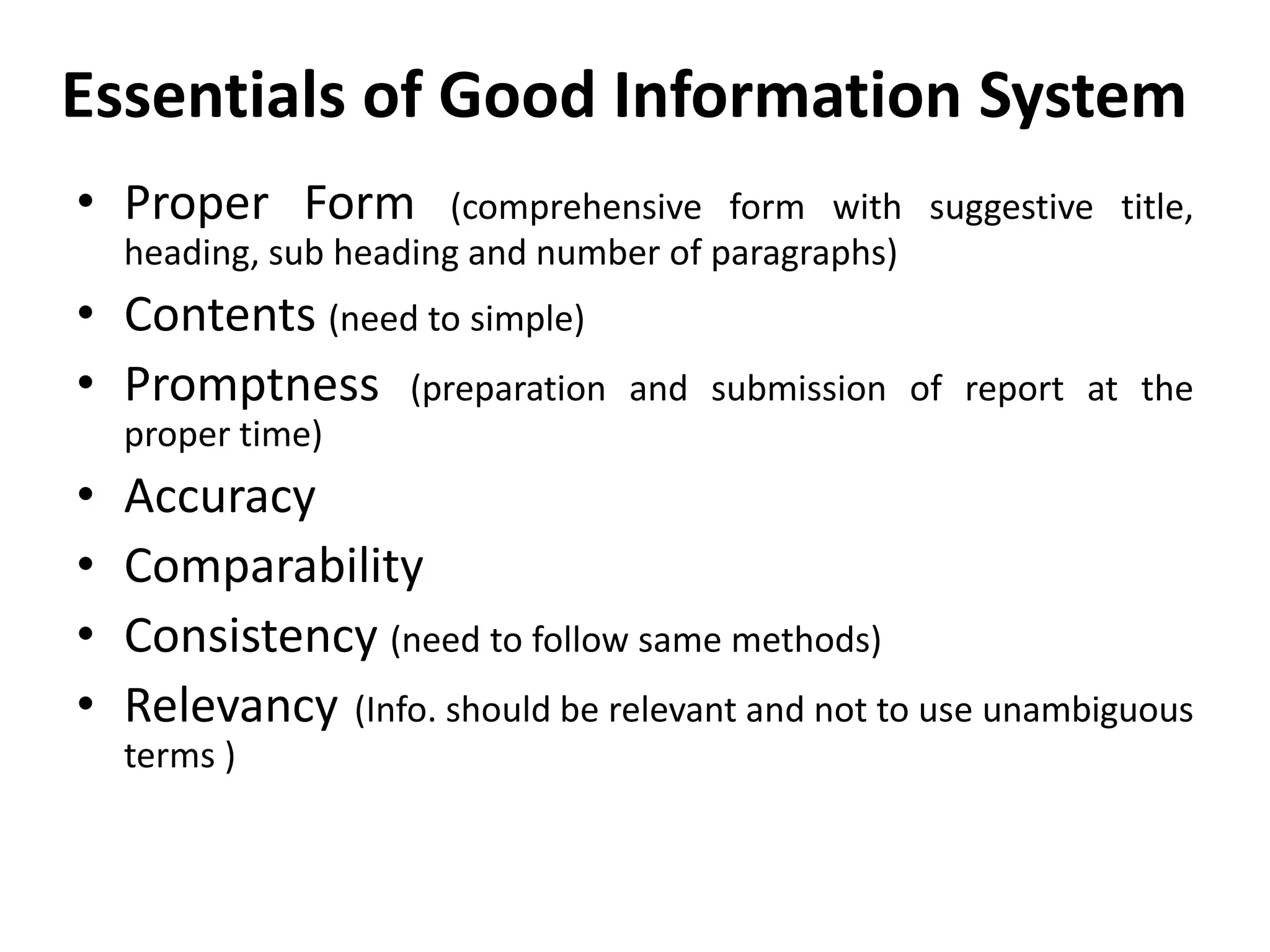
Essentials of Good Information System
• Proper Form (comprehensive form with suggestive title,
heading, sub heading and number of paragraphs)
• Contents (need to simple)
• Promptness (preparation and submission of report at the
proper time)
• Accuracy
• Comparability
• Consistency (need to follow same methods)
• Relevancy (Info. should be relevant and not to use unambiguous
terms )
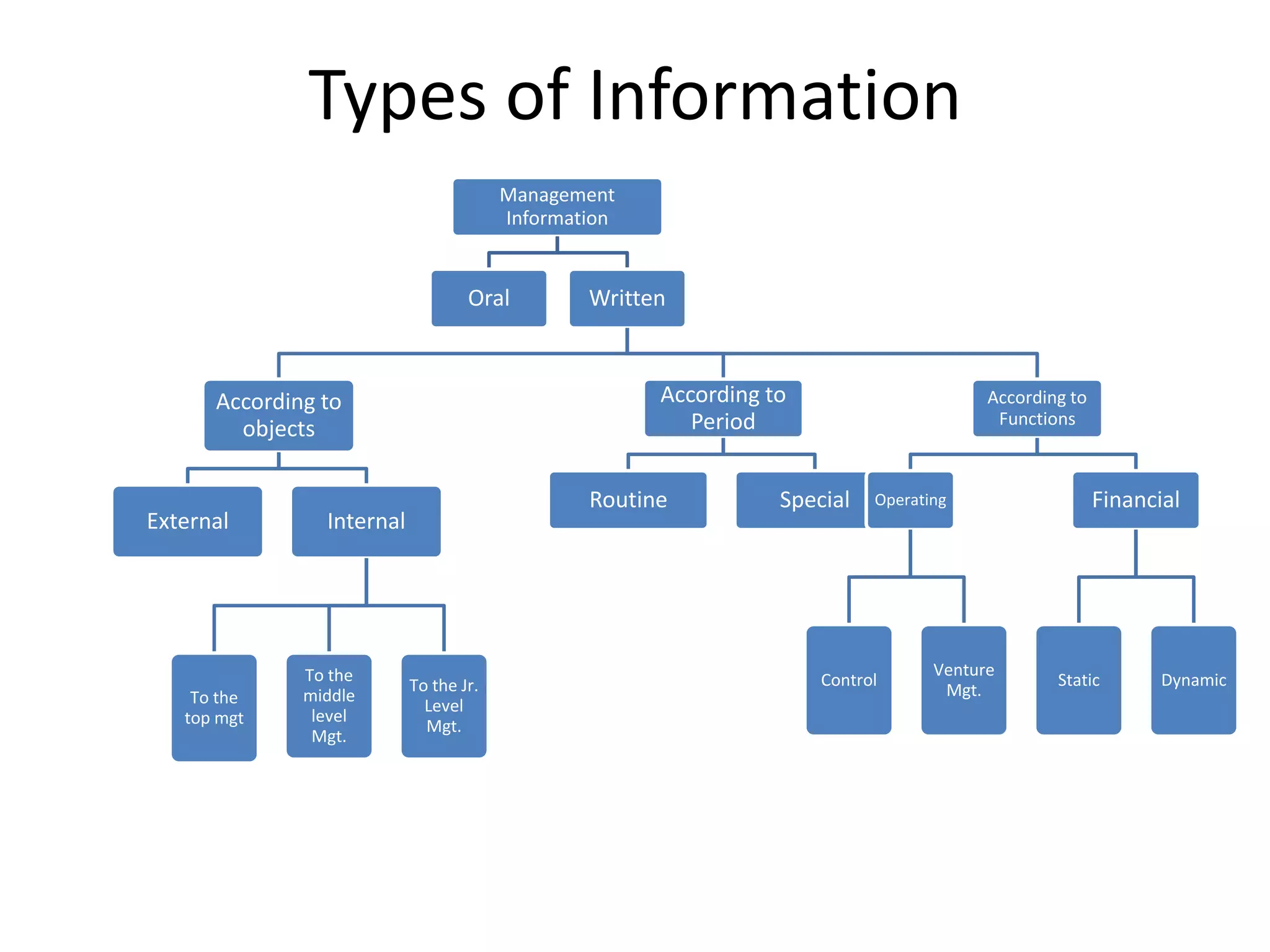
Types of Information
Management
Information
Oral Written
According to
objects
External Internal
To the
top mgt
To the
middle
level
Mgt.
To the Jr.
Level
Mgt.
According to
Period
Routine Special
According to
Functions
Operating
Control
Venture
Mgt.
Financial
Static Dynamic
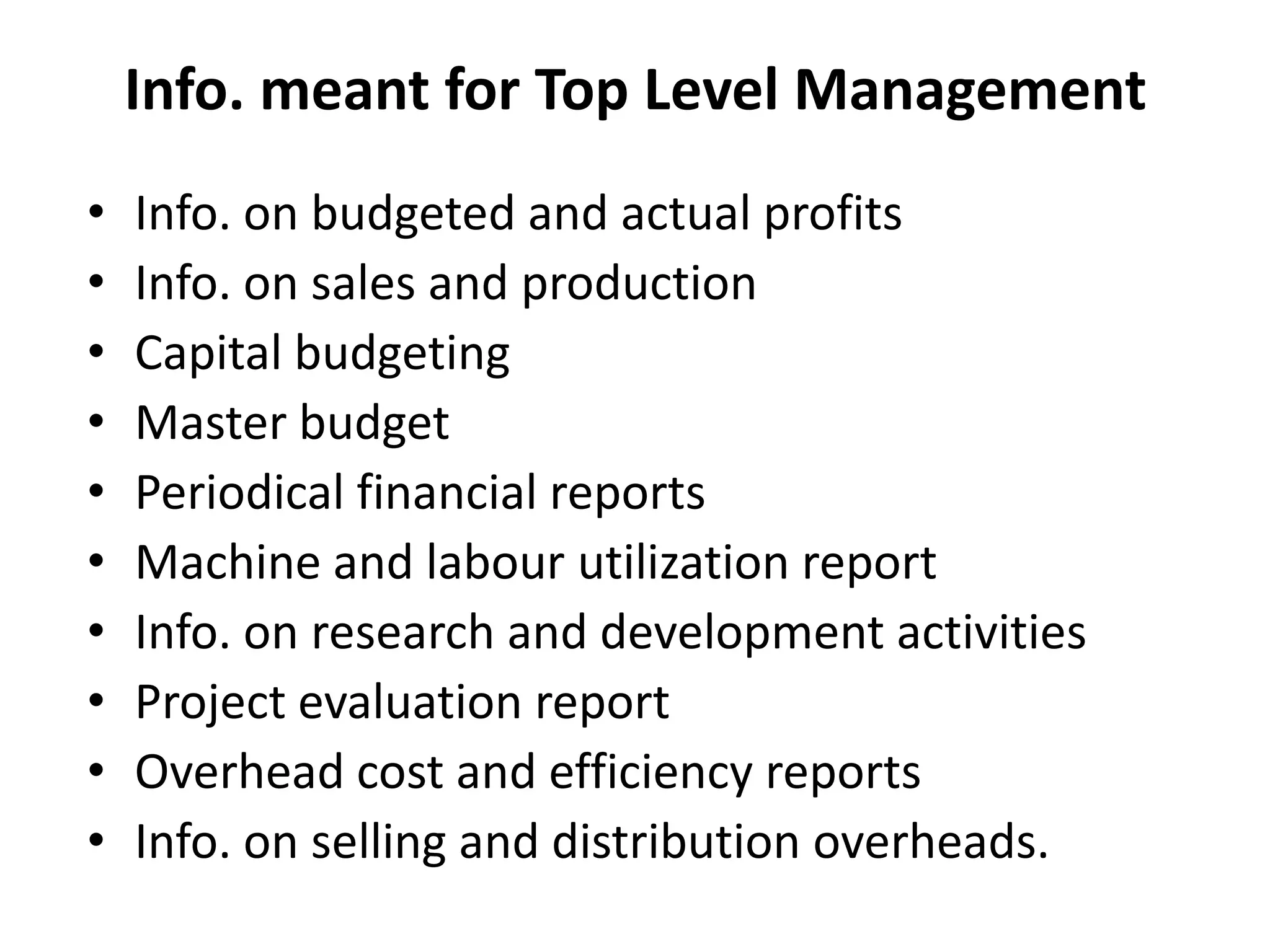
Info. meant for Top Level Management
• Info. on budgeted and actual profits
• Info. on sales and production
• Capital budgeting
• Master budget
• Periodical financial reports
• Machine and labour utilization report
• Info. on research and development activities
• Project evaluation report
• Overhead cost and efficiency reports
• Info. on selling and distribution overheads.
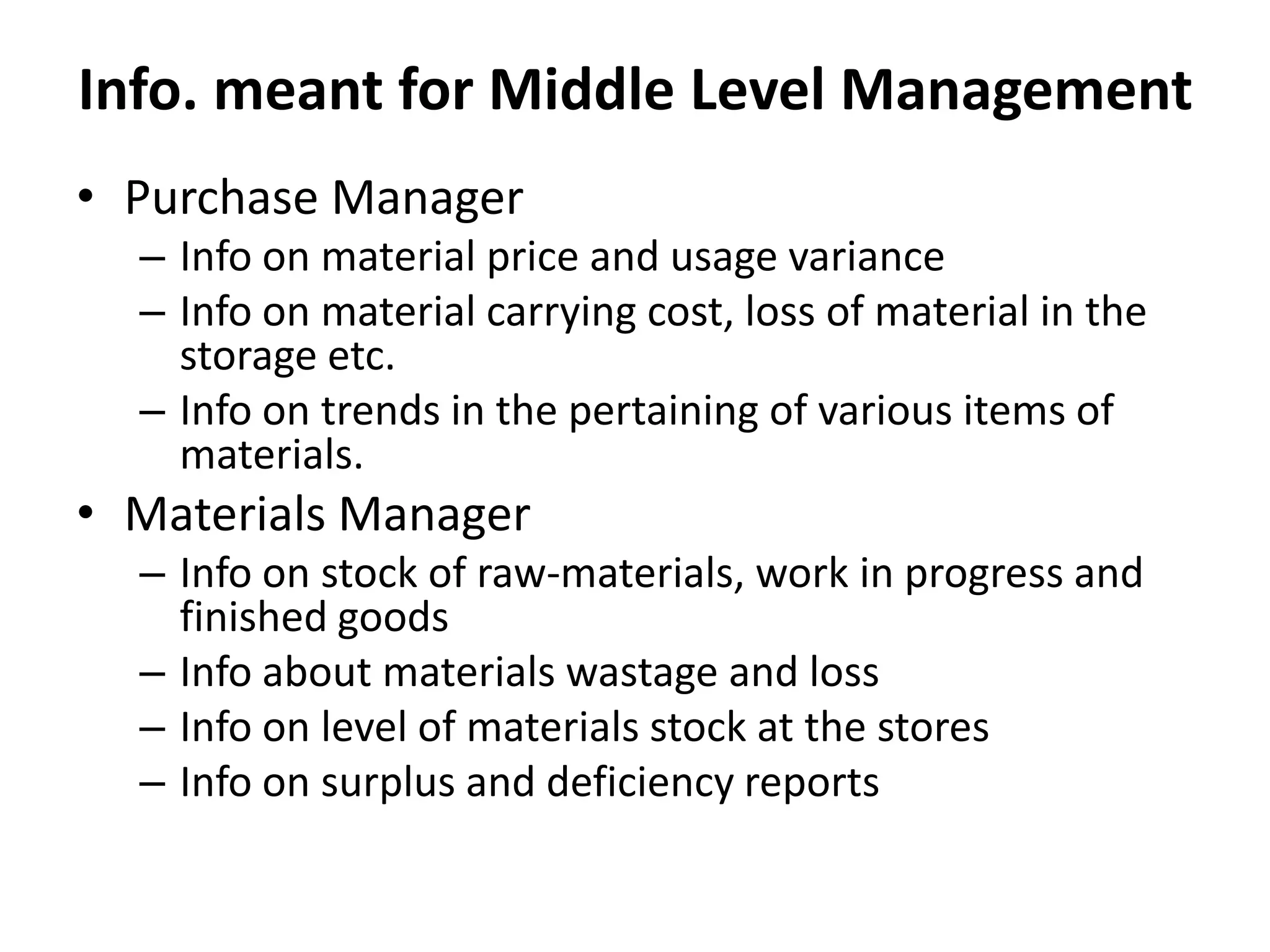
• Purchase Manager
– Info on material price and usage variance
– Info on material carrying cost, loss of material in the
storage etc.
– Info on trends in the pertaining of various items of
materials.
• Materials Manager
– Info on stock of raw-materials, work in progress and
finished goods
– Info about materials wastage and loss
– Info on level of materials stock at the stores
– Info on surplus and deficiency reports
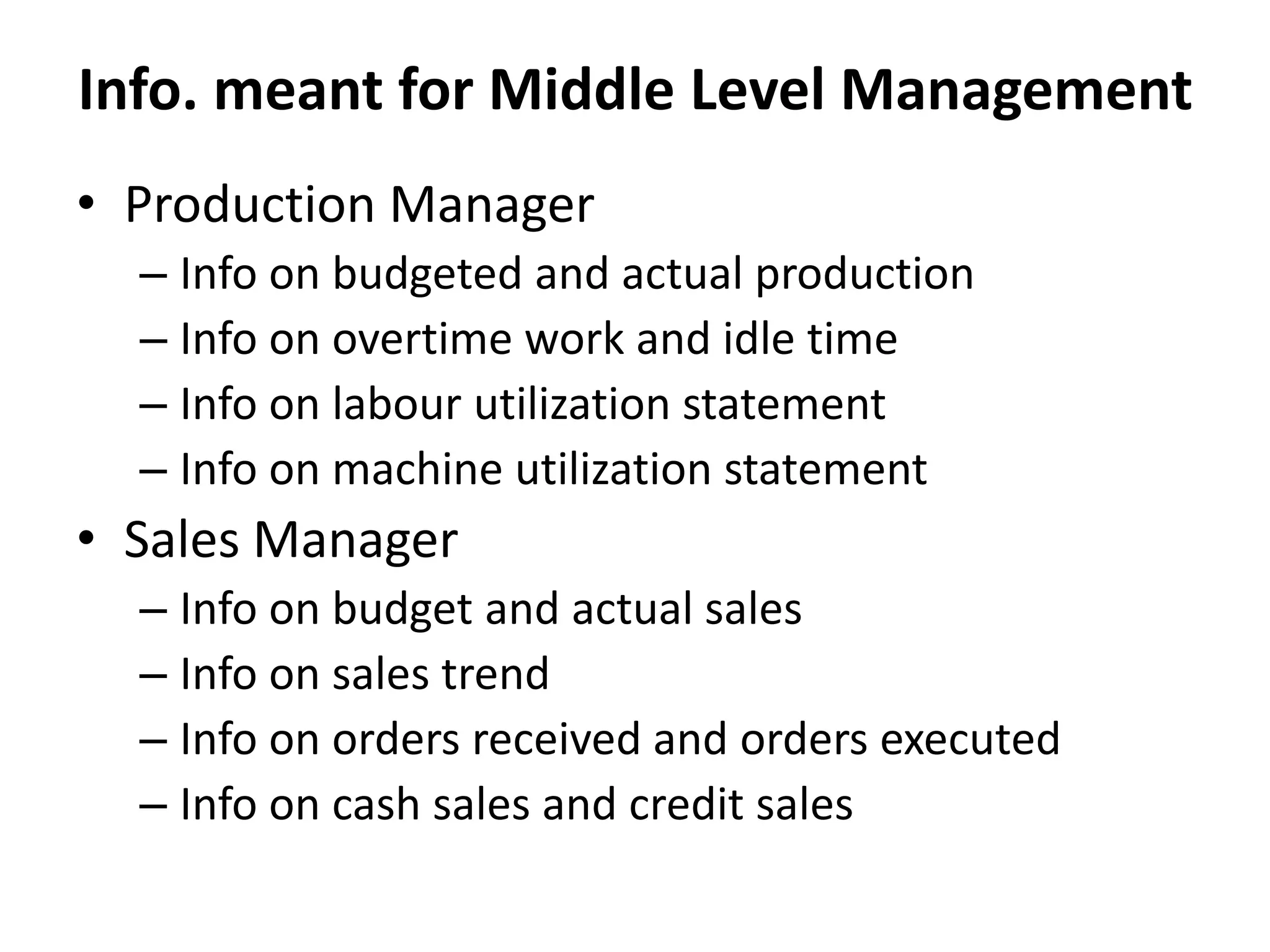
Info. meant for Middle Level Management
• Production Manager
– Info on budgeted and actual production
– Info on overtime work and idle time
– Info on labour utilization statement
– Info on machine utilization statement
• Sales Manager
– Info on budget and actual sales
– Info on sales trend
– Info on orders received and orders executed
– Info on cash sales and credit sales
Info. meant for Middle Level Management
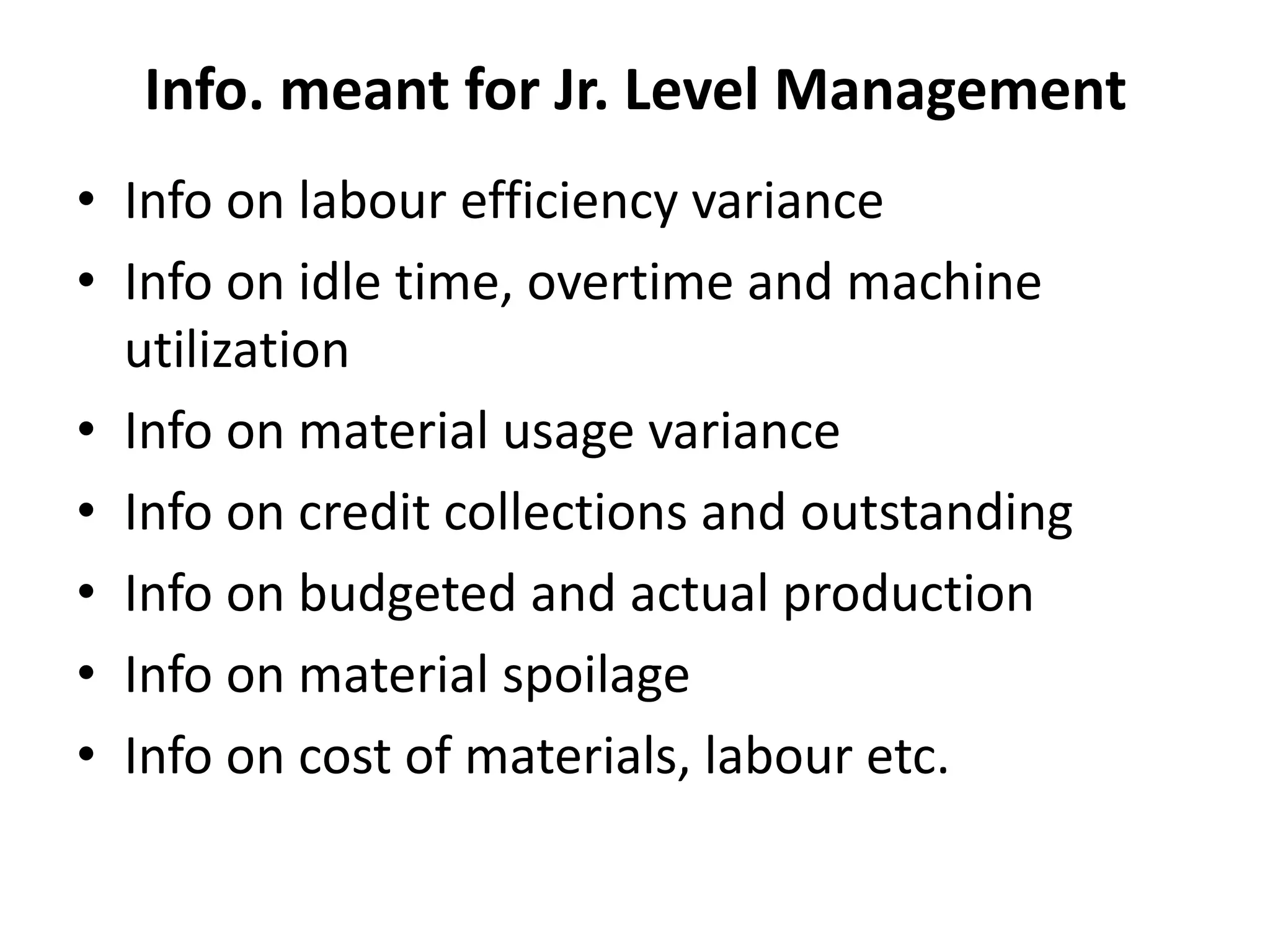
• Info on labour efficiency variance
• Info on idle time, overtime and machine
utilization
• Info on material usage variance
• Info on credit collections and outstanding
• Info on budgeted and actual production
• Info on material spoilage
• Info on cost of materials, labour etc.
Info. meant for Jr. Level Management
Cost Concepts
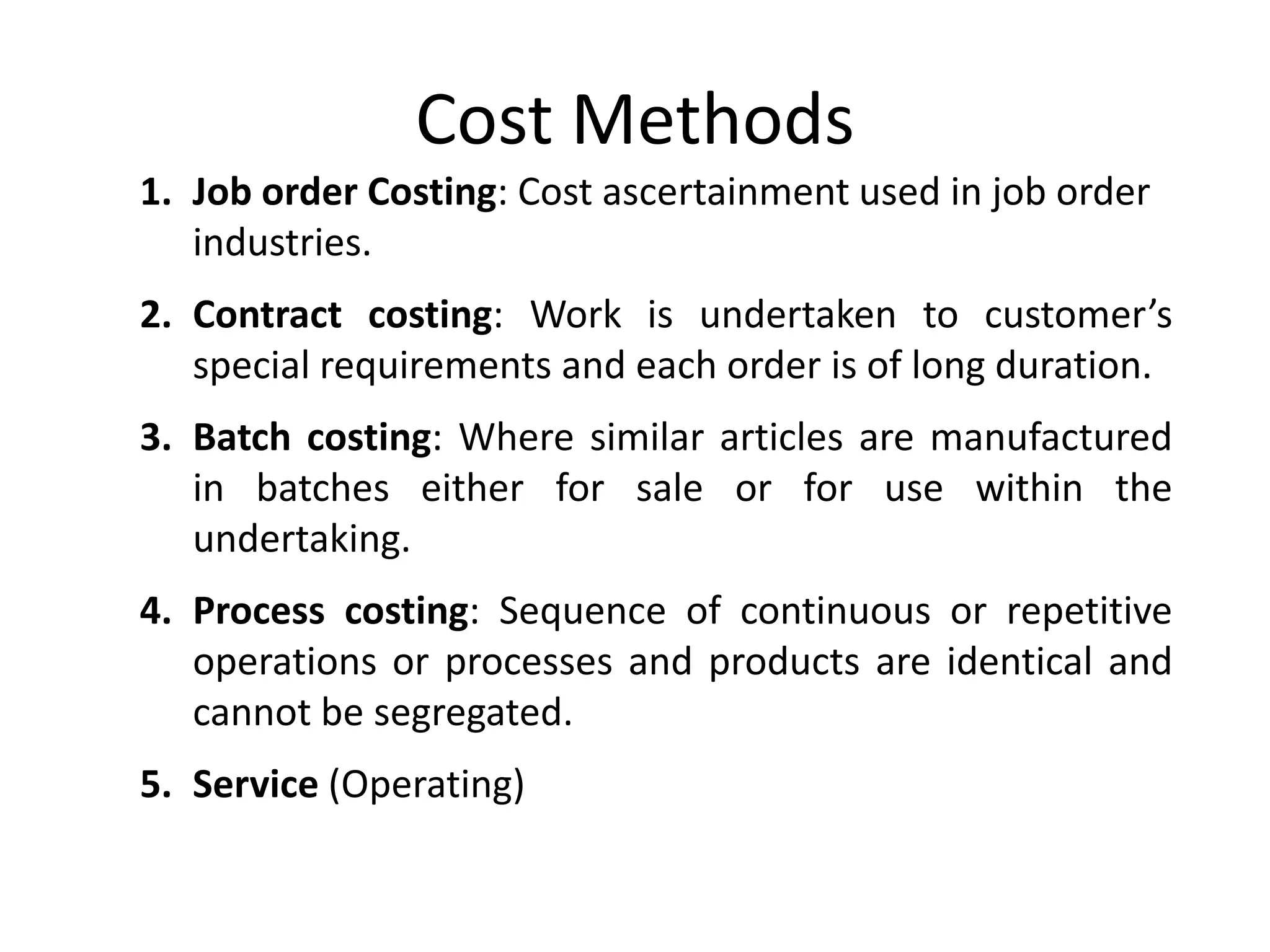
Cost Methods
1. Job order Costing: Cost ascertainment used in job order
industries.
2. Contract costing: Work is undertaken to customer’s
special requirements and each order is of long duration.
3. Batch costing: Where similar articles are manufactured
in batches either for sale or for use within the
undertaking.
4. Process costing: Sequence of continuous or repetitive
operations or processes and products are identical and
cannot be segregated.
5. Service (Operating)
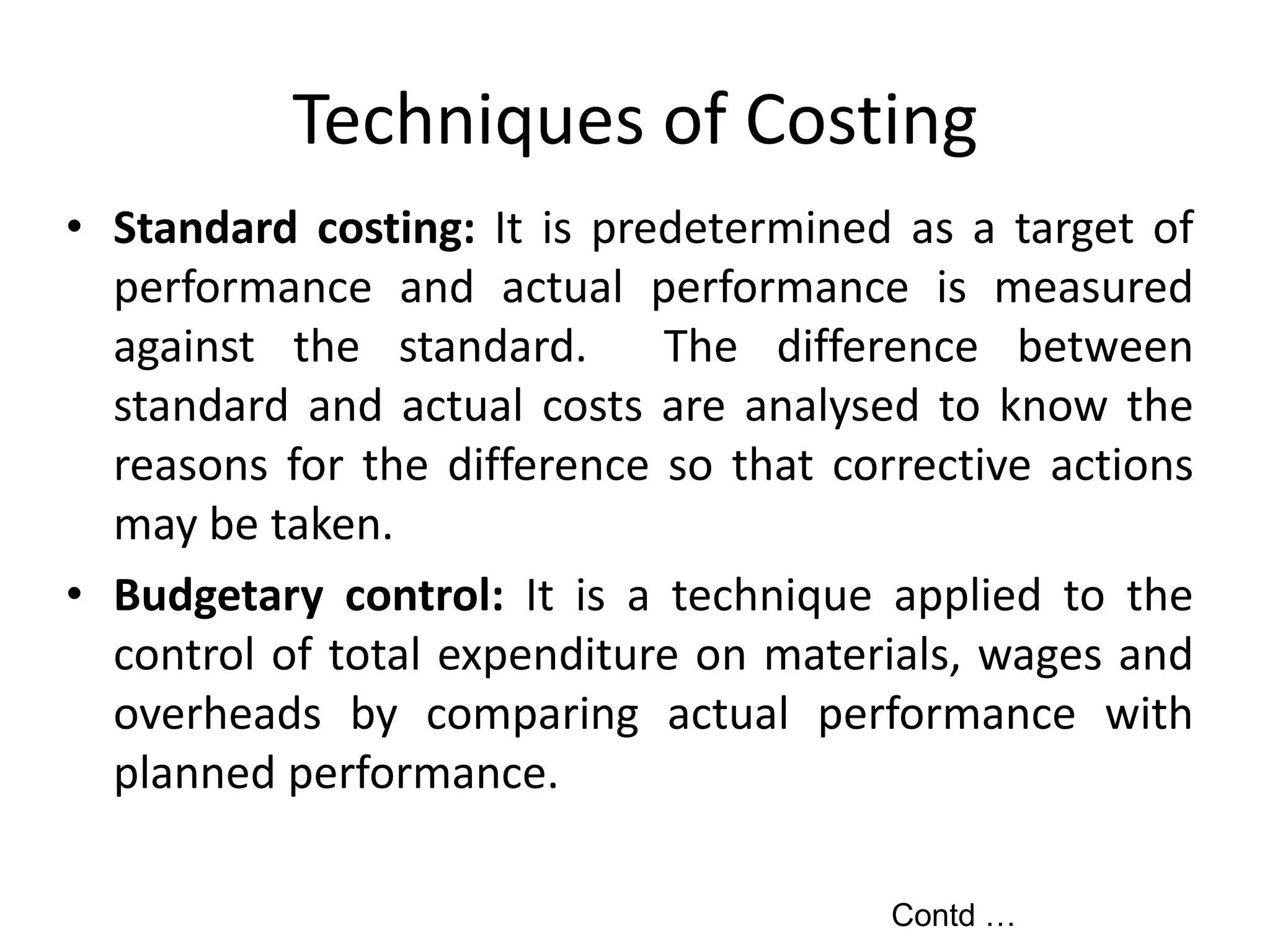
Techniques of Costing
• Standard costing: It is predetermined as a target of
performance and actual performance is measured
against the standard. The difference between
standard and actual costs are analysed to know the
reasons for the difference so that corrective actions
may be taken.
• Budgetary control: It is a technique applied to the
control of total expenditure on materials, wages and
overheads by comparing actual performance with
planned performance.
Contd …
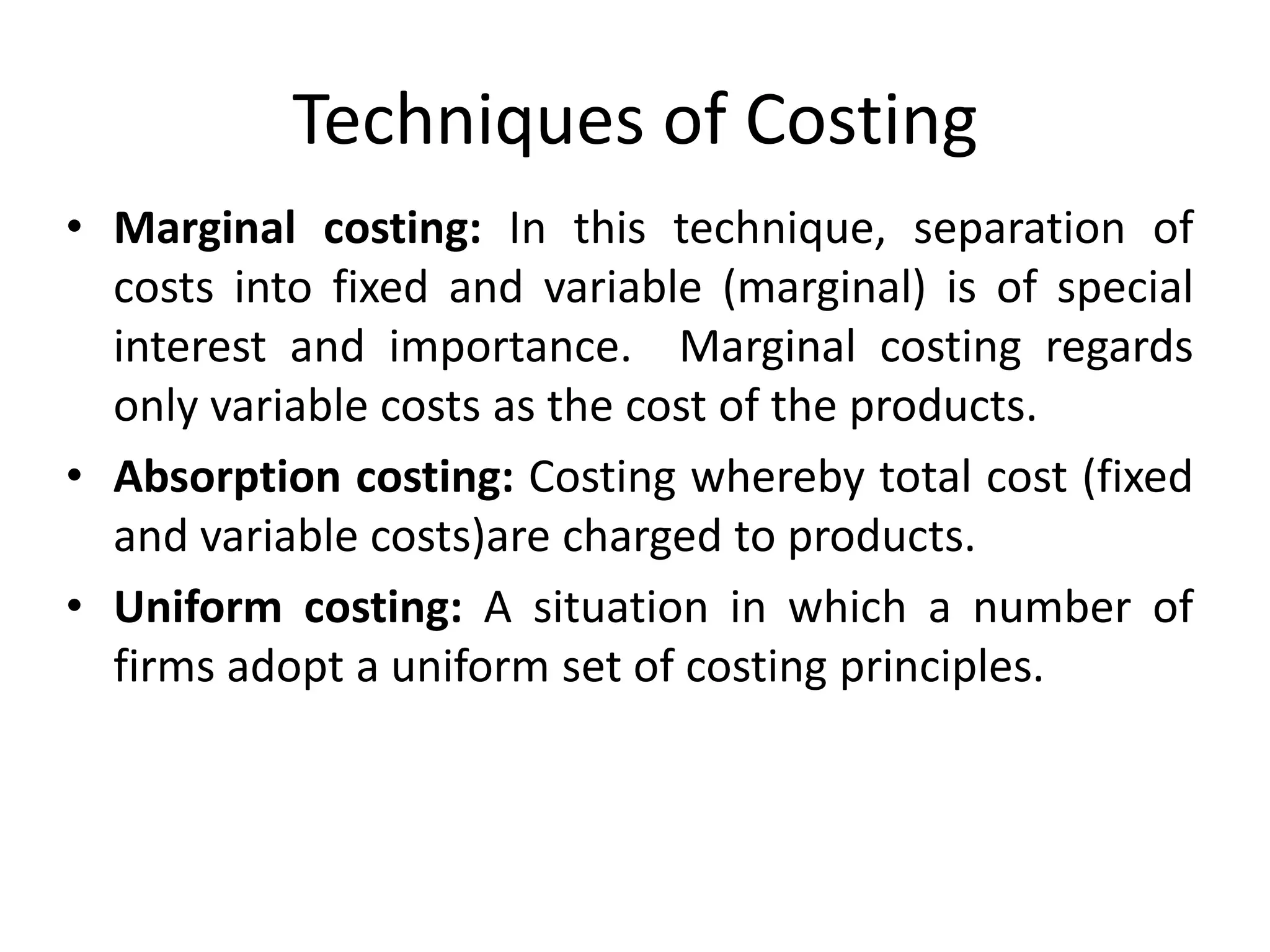
Techniques of Costing
• Marginal costing: In this technique, separation of
costs into fixed and variable (marginal) is of special
interest and importance. Marginal costing regards
only variable costs as the cost of the products.
• Absorption costing: Costing whereby total cost (fixed
and variable costs)are charged to products.
• Uniform costing: A situation in which a number of
firms adopt a uniform set of costing principles.
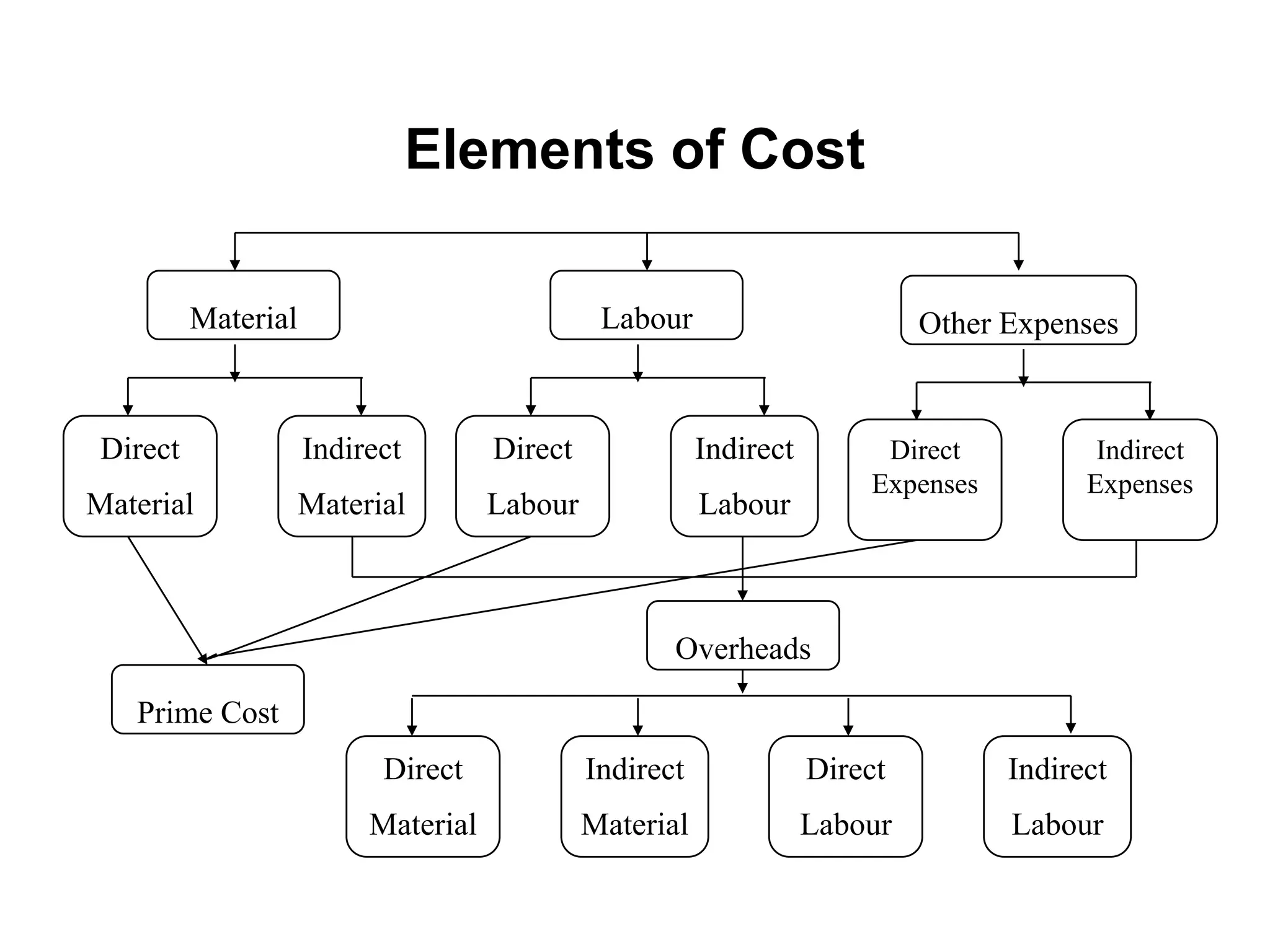
Material Labour Other Expenses
Direct
Material
Indirect
Material
Direct
Labour
Indirect
Labour
Direct
Expenses
Indirect
Expenses
Overheads
Direct
Material
Indirect
Material
Direct
Labour
Indirect
Labour
Prime Cost
Elements of Cost
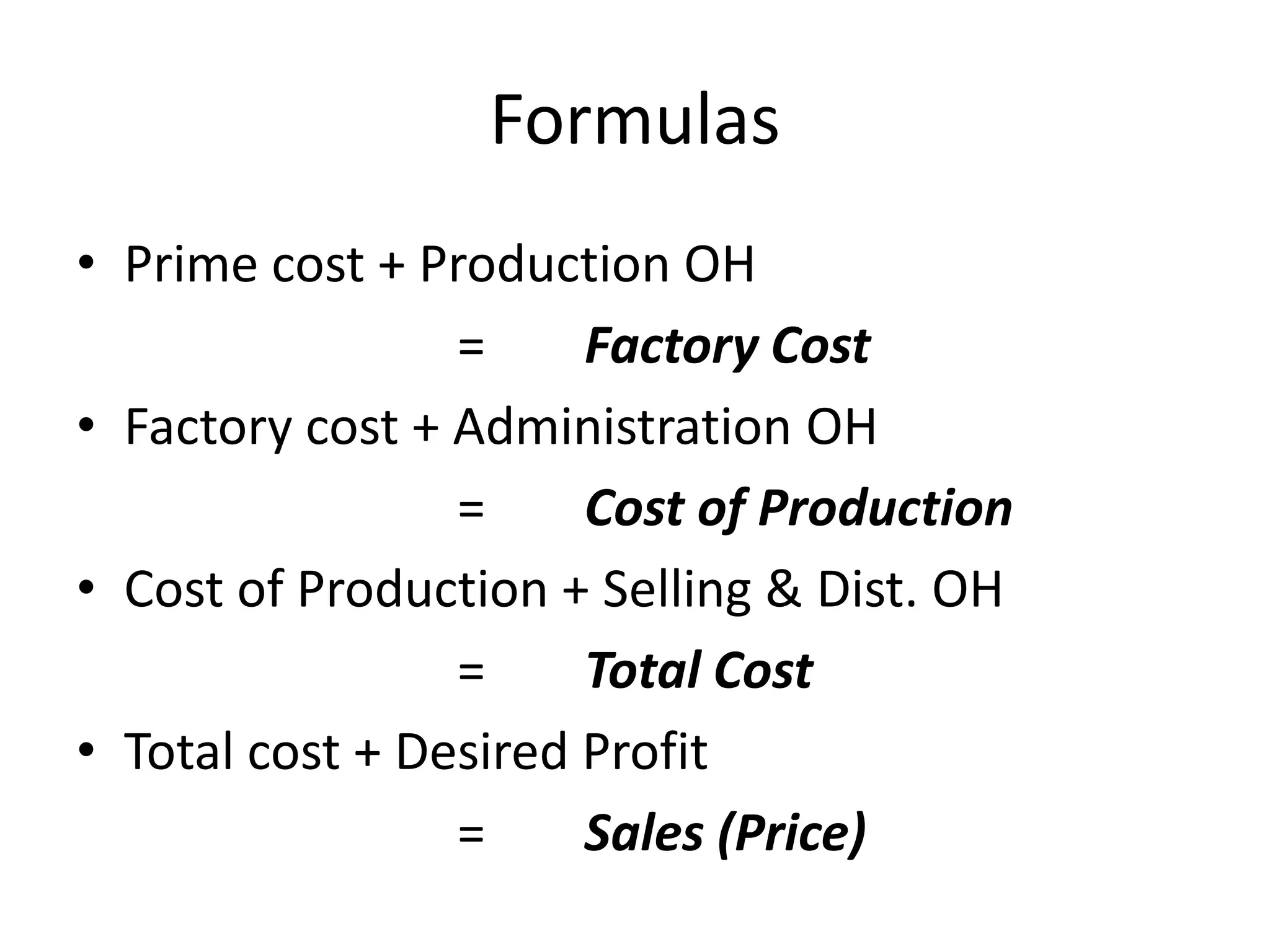
Formulas
• Prime cost + Production OH
= Factory Cost
• Factory cost + Administration OH
= Cost of Production
• Cost of Production + Selling & Dist. OH
= Total Cost
• Total cost + Desired Profit
= Sales (Price)
Cost Classification
By Nature of Expenses
–Material
• Raw-materials
• Semi finished goods &
• Finished goods
–Labour
• Skilled
• Semi skilled &
• Unskilled
–Expenses
• Direct
• Indirect
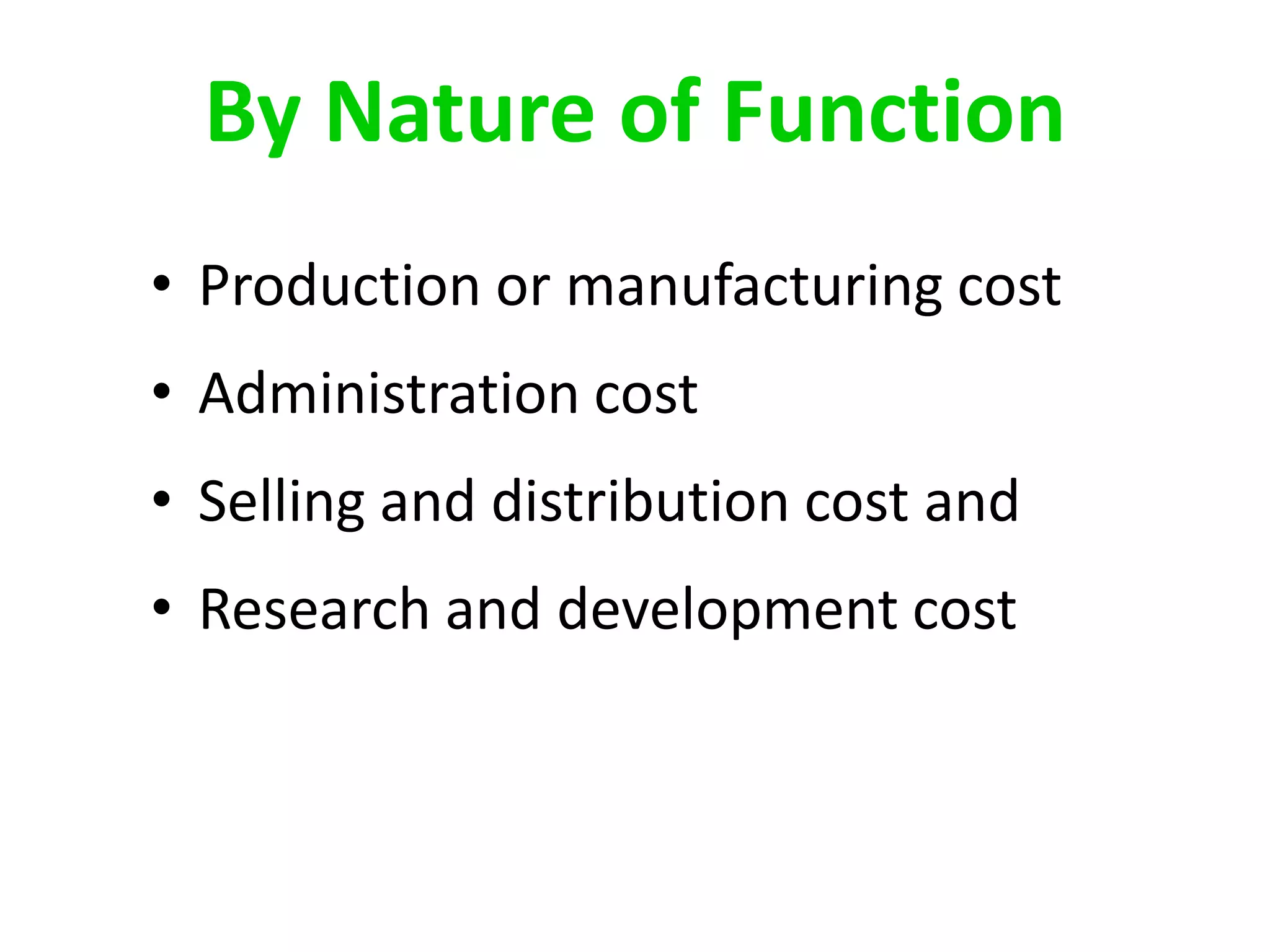
• Production or manufacturing cost
• Administration cost
• Selling and distribution cost and
• Research and development cost
By Nature of Function
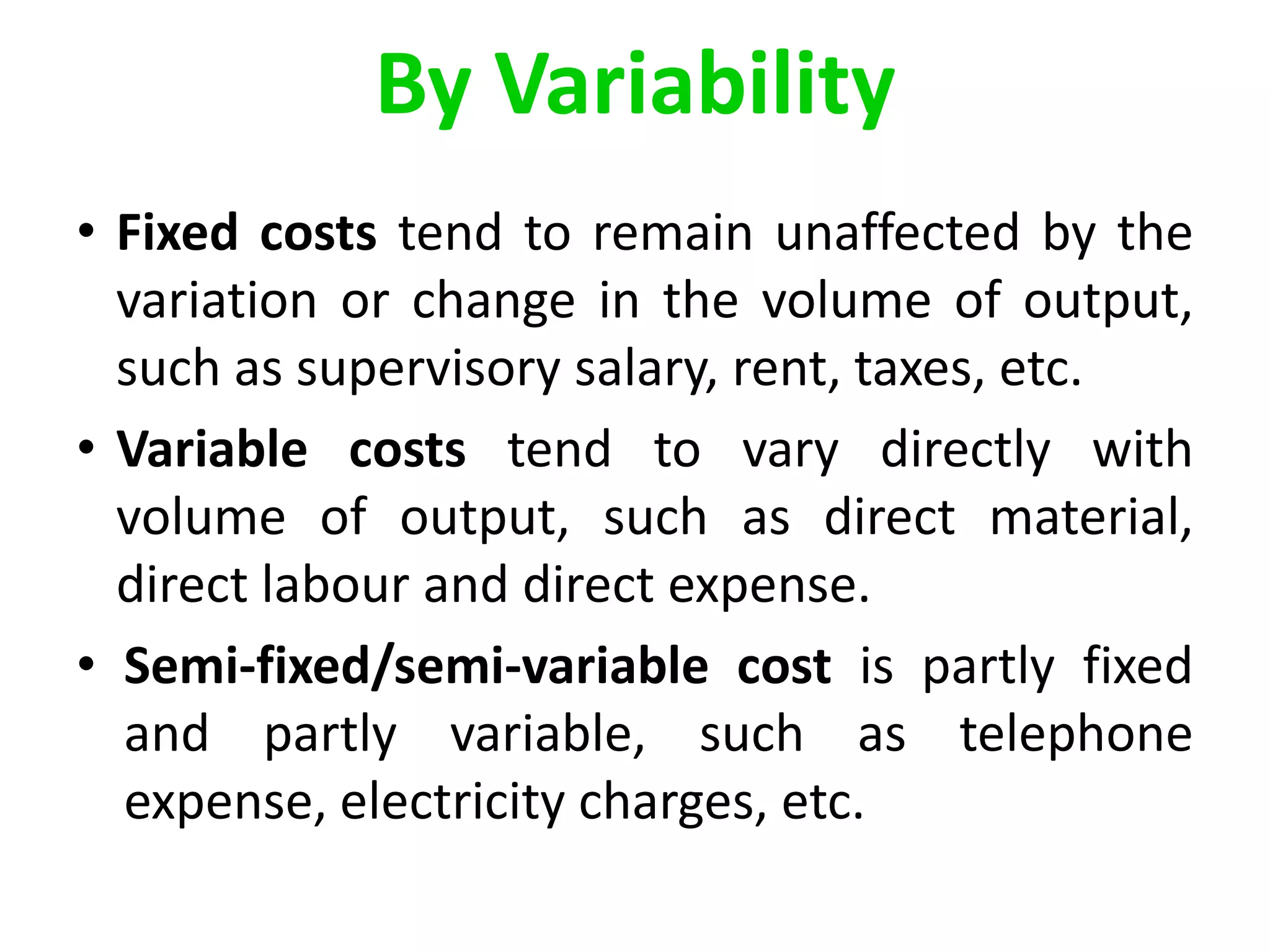
By Variability
• Fixed costs tend to remain unaffected by the
variation or change in the volume of output,
such as supervisory salary, rent, taxes, etc.
• Variable costs tend to vary directly with
volume of output, such as direct material,
direct labour and direct expense.
• Semi-fixed/semi-variable cost is partly fixed
and partly variable, such as telephone
expense, electricity charges, etc.
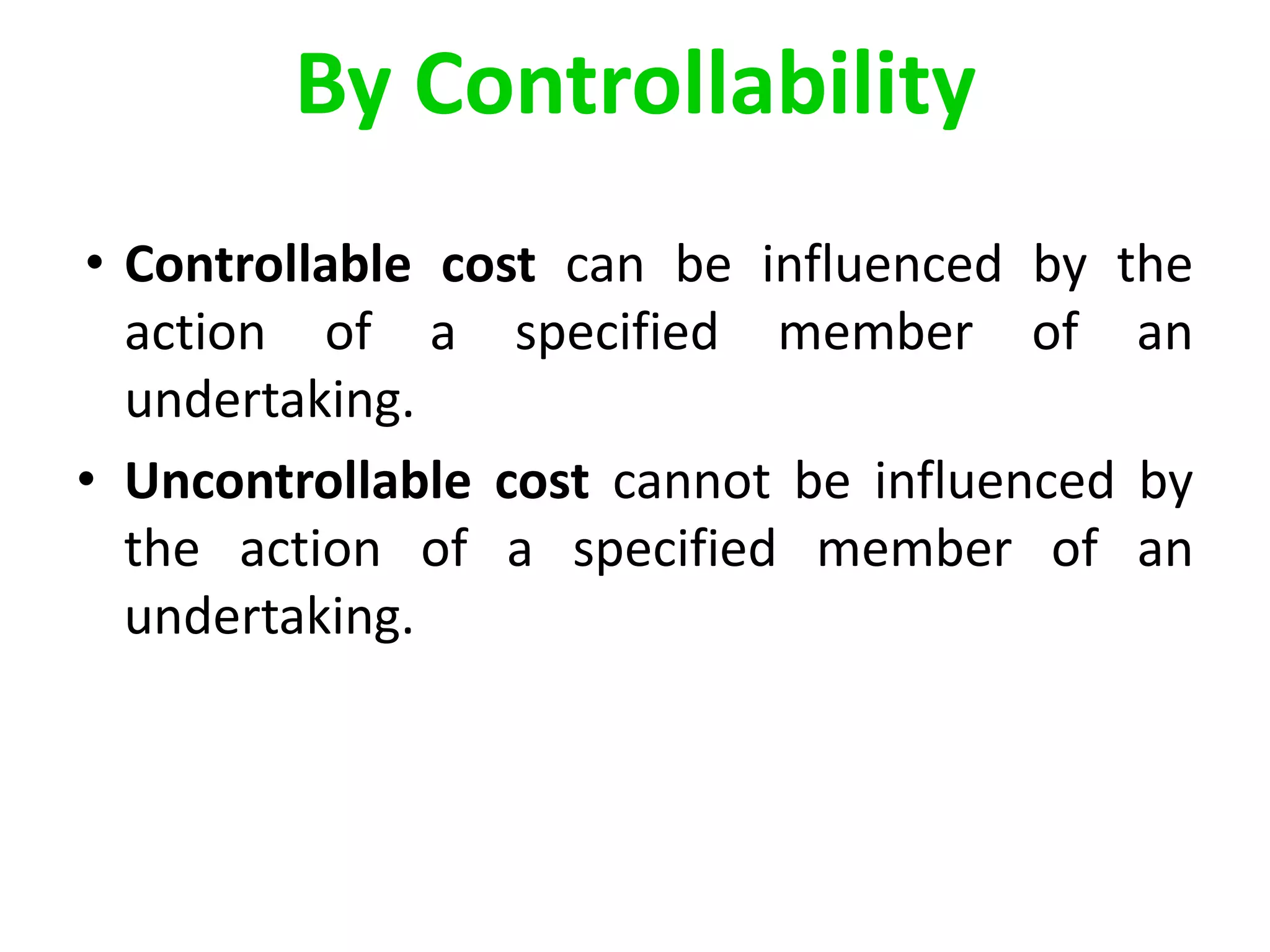
• Controllable cost can be influenced by the
action of a specified member of an
undertaking.
• Uncontrollable cost cannot be influenced by
the action of a specified member of an
undertaking.
By Controllability
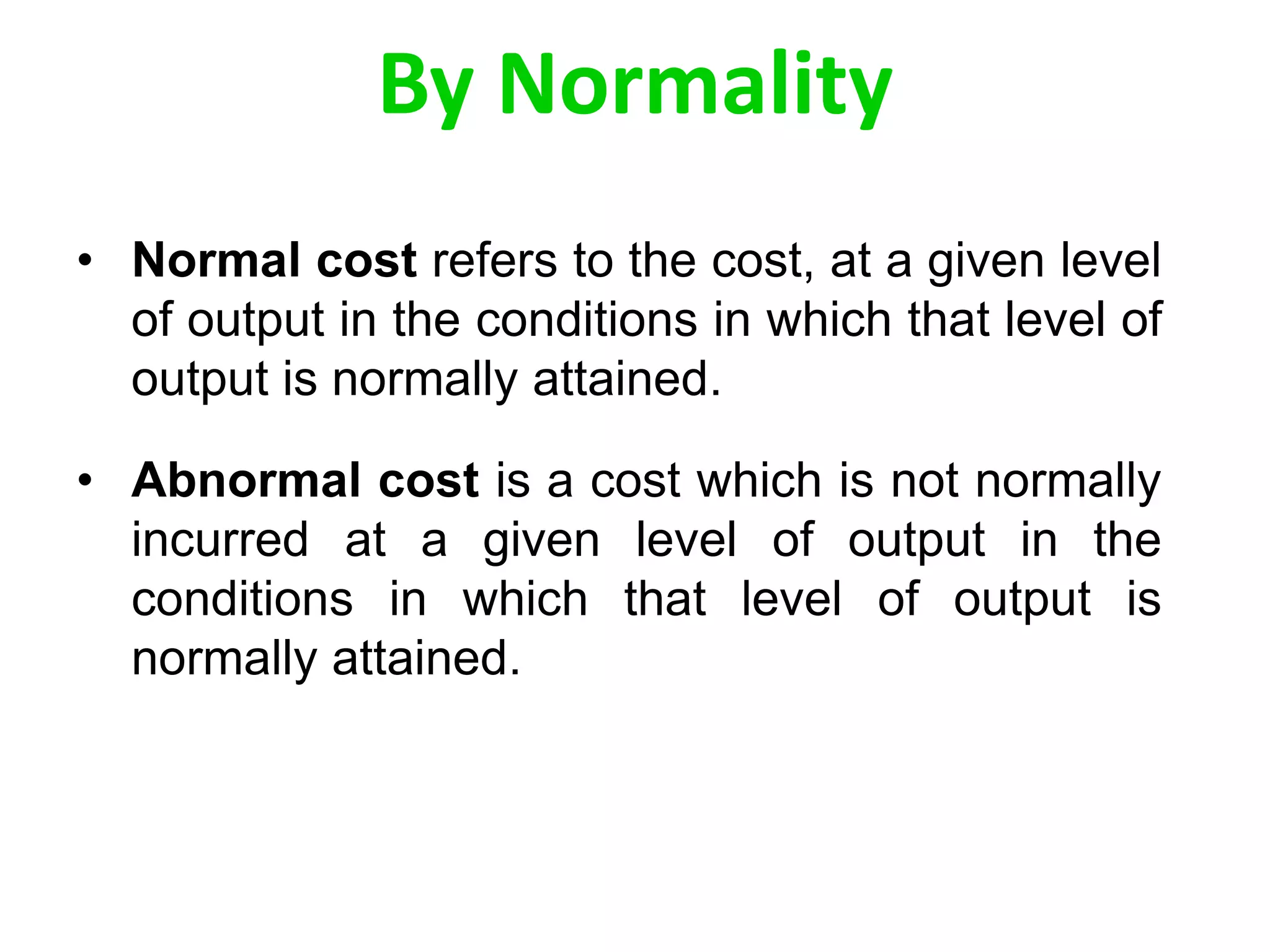
By Normality
• Normal cost refers to the cost, at a given level
of output in the conditions in which that level of
output is normally attained.
• Abnormal cost is a cost which is not normally
incurred at a given level of output in the
conditions in which that level of output is
normally attained.
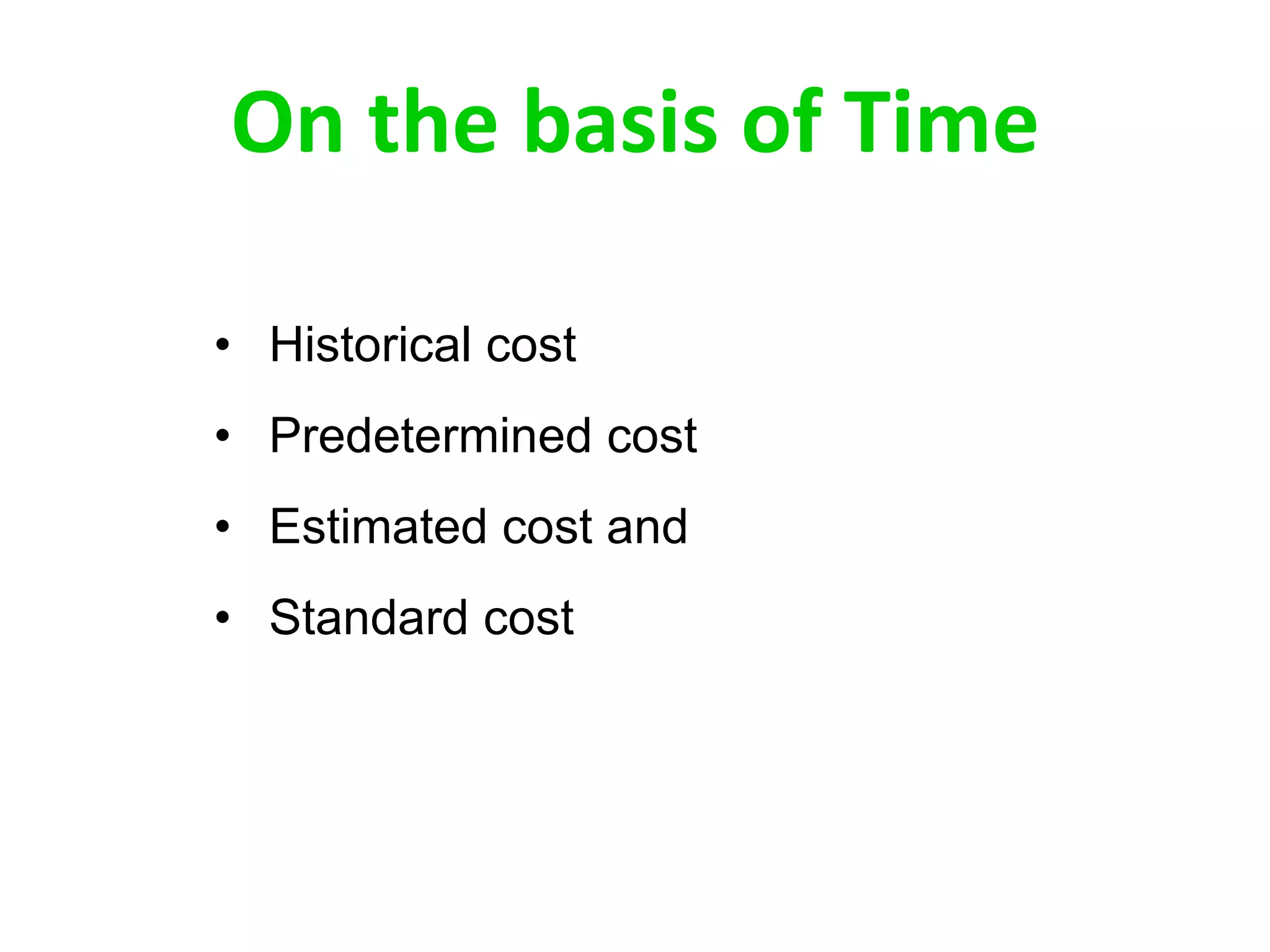
On the basis of Time
• Historical cost
• Predetermined cost
• Estimated cost and
• Standard cost
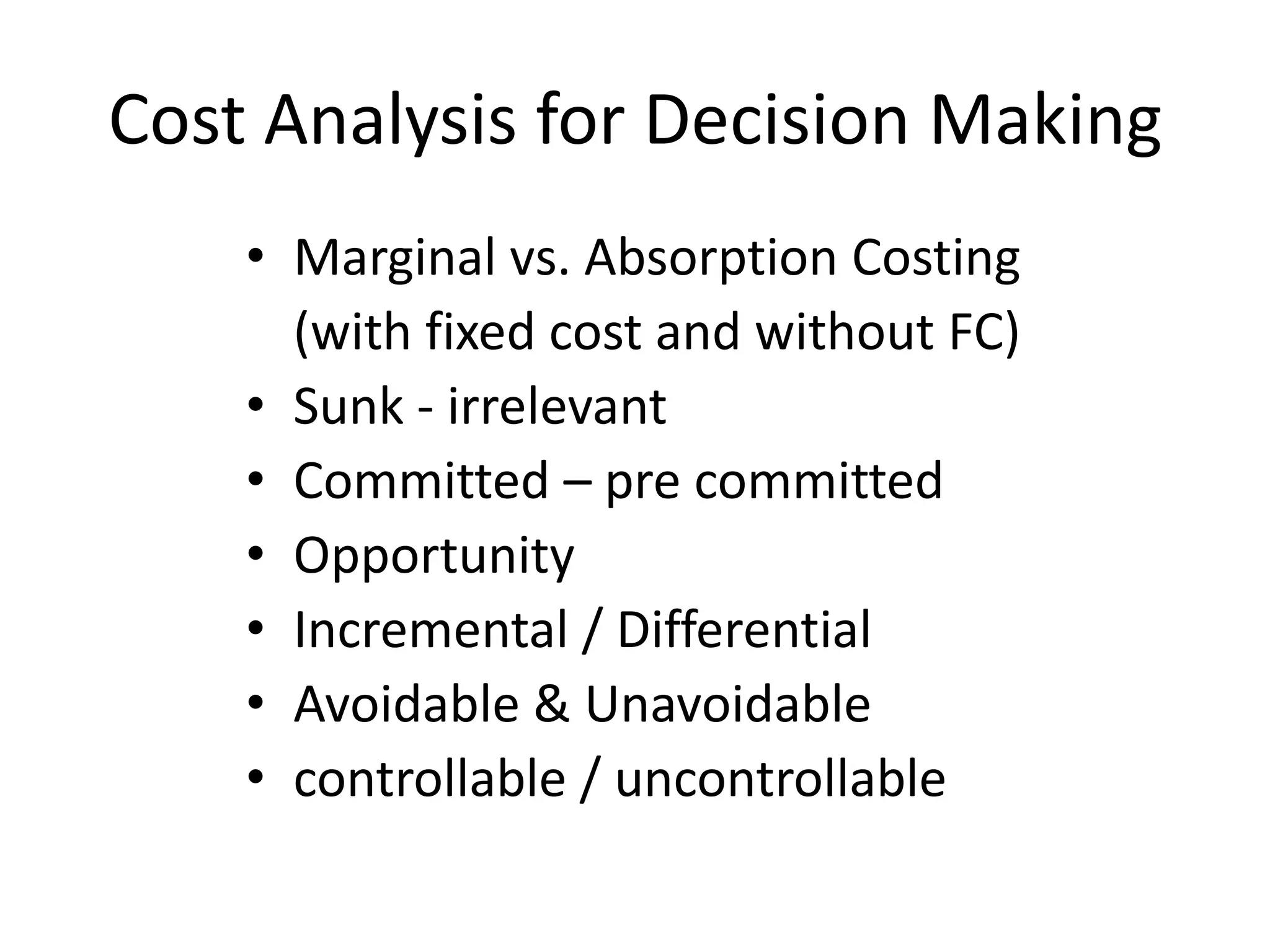
Cost Analysis for Decision Making
• Marginal vs. Absorption Costing
(with fixed cost and without FC)
• Sunk - irrelevant
• Committed – pre committed
• Opportunity
• Incremental / Differential
• Avoidable & Unavoidable
• controllable / uncontrollable

Cost concepts

  • 1.
    Differences between Financial Accounting,Cost Accounting & Management Accounting
  • 2.
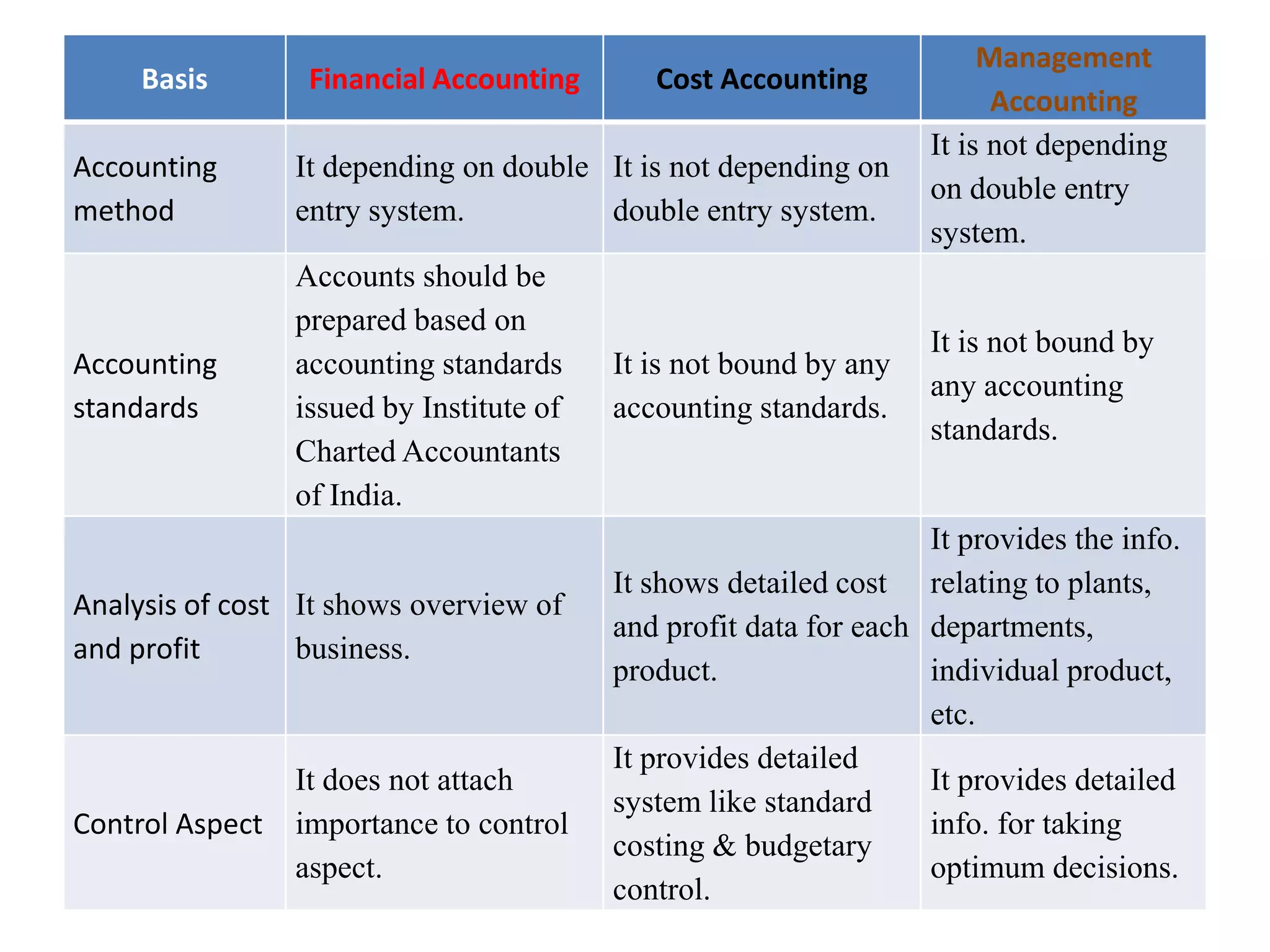
    Basis Financial AccountingCost Accounting Management Accounting Accounting method It depending on double entry system. It is not depending on double entry system. It is not depending on double entry system. Accounting standards Accounts should be prepared based on accounting standards issued by Institute of Charted Accountants of India. It is not bound by any accounting standards. It is not bound by any accounting standards. Analysis of cost and profit It shows overview of business. It shows detailed cost and profit data for each product. It provides the info. relating to plants, departments, individual product, etc. Control Aspect It does not attach importance to control aspect. It provides detailed system like standard costing & budgetary control. It provides detailed info. for taking optimum decisions.
  • 3.
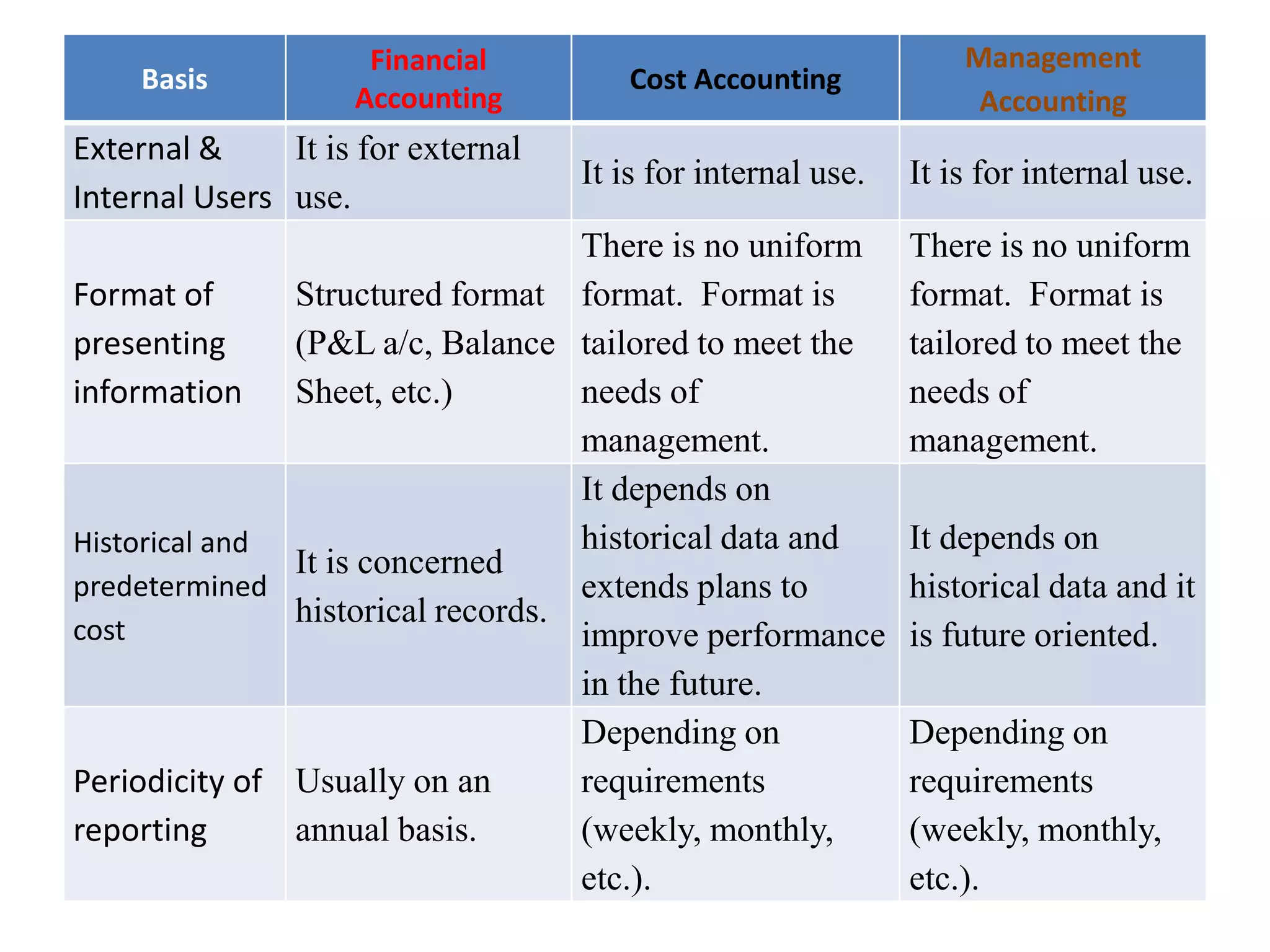
    Basis Financial Accounting Cost Accounting Management Accounting External & InternalUsers It is for external use. It is for internal use. It is for internal use. Format of presenting information Structured format (P&L a/c, Balance Sheet, etc.) There is no uniform format. Format is tailored to meet the needs of management. There is no uniform format. Format is tailored to meet the needs of management. Historical and predetermined cost It is concerned historical records. It depends on historical data and extends plans to improve performance in the future. It depends on historical data and it is future oriented. Periodicity of reporting Usually on an annual basis. Depending on requirements (weekly, monthly, etc.). Depending on requirements (weekly, monthly, etc.).
  • 4.
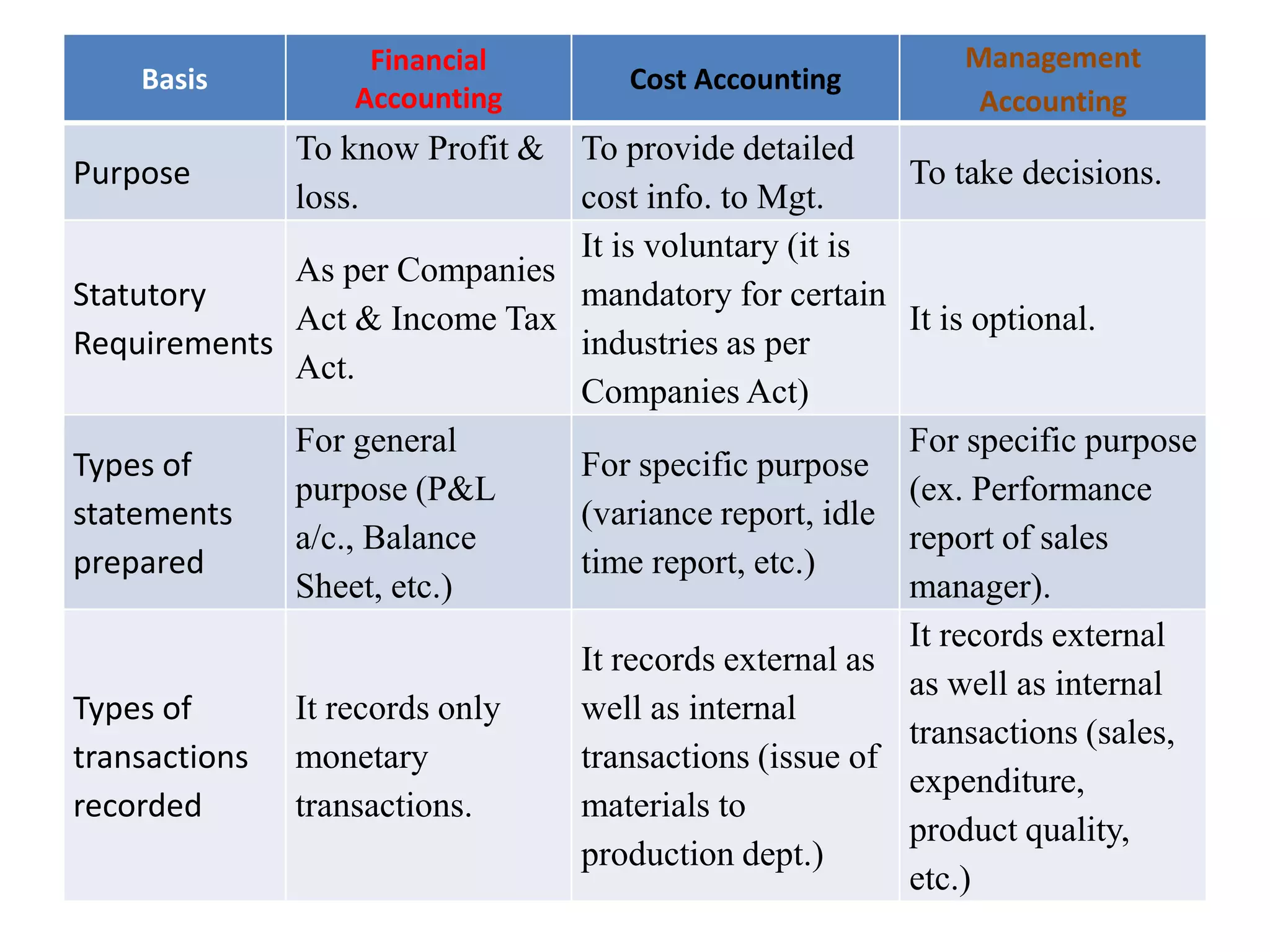
    Basis Financial Accounting Cost Accounting Management Accounting Purpose To knowProfit & loss. To provide detailed cost info. to Mgt. To take decisions. Statutory Requirements As per Companies Act & Income Tax Act. It is voluntary (it is mandatory for certain industries as per Companies Act) It is optional. Types of statements prepared For general purpose (P&L a/c., Balance Sheet, etc.) For specific purpose (variance report, idle time report, etc.) For specific purpose (ex. Performance report of sales manager). Types of transactions recorded It records only monetary transactions. It records external as well as internal transactions (issue of materials to production dept.) It records external as well as internal transactions (sales, expenditure, product quality, etc.)
  • 5.
    Role of Accounting Informationin Planning and Control
  • 6.
    Essentials of GoodInformation System • Proper Form (comprehensive form with suggestive title, heading, sub heading and number of paragraphs) • Contents (need to simple) • Promptness (preparation and submission of report at the proper time) • Accuracy • Comparability • Consistency (need to follow same methods) • Relevancy (Info. should be relevant and not to use unambiguous terms )
  • 7.
    Types of Information Management Information OralWritten According to objects External Internal To the top mgt To the middle level Mgt. To the Jr. Level Mgt. According to Period Routine Special According to Functions Operating Control Venture Mgt. Financial Static Dynamic
  • 8.
    Info. meant forTop Level Management • Info. on budgeted and actual profits • Info. on sales and production • Capital budgeting • Master budget • Periodical financial reports • Machine and labour utilization report • Info. on research and development activities • Project evaluation report • Overhead cost and efficiency reports • Info. on selling and distribution overheads.
  • 9.
    • Purchase Manager –Info on material price and usage variance – Info on material carrying cost, loss of material in the storage etc. – Info on trends in the pertaining of various items of materials. • Materials Manager – Info on stock of raw-materials, work in progress and finished goods – Info about materials wastage and loss – Info on level of materials stock at the stores – Info on surplus and deficiency reports Info. meant for Middle Level Management
  • 10.
    • Production Manager –Info on budgeted and actual production – Info on overtime work and idle time – Info on labour utilization statement – Info on machine utilization statement • Sales Manager – Info on budget and actual sales – Info on sales trend – Info on orders received and orders executed – Info on cash sales and credit sales Info. meant for Middle Level Management
  • 11.
    • Info onlabour efficiency variance • Info on idle time, overtime and machine utilization • Info on material usage variance • Info on credit collections and outstanding • Info on budgeted and actual production • Info on material spoilage • Info on cost of materials, labour etc. Info. meant for Jr. Level Management
  • 12.
  • 13.
    Cost Methods 1. Joborder Costing: Cost ascertainment used in job order industries. 2. Contract costing: Work is undertaken to customer’s special requirements and each order is of long duration. 3. Batch costing: Where similar articles are manufactured in batches either for sale or for use within the undertaking. 4. Process costing: Sequence of continuous or repetitive operations or processes and products are identical and cannot be segregated. 5. Service (Operating)
  • 14.
    Techniques of Costing •Standard costing: It is predetermined as a target of performance and actual performance is measured against the standard. The difference between standard and actual costs are analysed to know the reasons for the difference so that corrective actions may be taken. • Budgetary control: It is a technique applied to the control of total expenditure on materials, wages and overheads by comparing actual performance with planned performance. Contd …
  • 15.
    Techniques of Costing •Marginal costing: In this technique, separation of costs into fixed and variable (marginal) is of special interest and importance. Marginal costing regards only variable costs as the cost of the products. • Absorption costing: Costing whereby total cost (fixed and variable costs)are charged to products. • Uniform costing: A situation in which a number of firms adopt a uniform set of costing principles.
  • 16.
    Material Labour OtherExpenses Direct Material Indirect Material Direct Labour Indirect Labour Direct Expenses Indirect Expenses Overheads Direct Material Indirect Material Direct Labour Indirect Labour Prime Cost Elements of Cost
  • 17.
    Formulas • Prime cost+ Production OH = Factory Cost • Factory cost + Administration OH = Cost of Production • Cost of Production + Selling & Dist. OH = Total Cost • Total cost + Desired Profit = Sales (Price)
  • 18.
  • 19.
    By Nature ofExpenses –Material • Raw-materials • Semi finished goods & • Finished goods –Labour • Skilled • Semi skilled & • Unskilled –Expenses • Direct • Indirect
  • 20.
    • Production ormanufacturing cost • Administration cost • Selling and distribution cost and • Research and development cost By Nature of Function
  • 21.
    By Variability • Fixedcosts tend to remain unaffected by the variation or change in the volume of output, such as supervisory salary, rent, taxes, etc. • Variable costs tend to vary directly with volume of output, such as direct material, direct labour and direct expense. • Semi-fixed/semi-variable cost is partly fixed and partly variable, such as telephone expense, electricity charges, etc.
  • 22.
    • Controllable costcan be influenced by the action of a specified member of an undertaking. • Uncontrollable cost cannot be influenced by the action of a specified member of an undertaking. By Controllability
  • 23.
    By Normality • Normalcost refers to the cost, at a given level of output in the conditions in which that level of output is normally attained. • Abnormal cost is a cost which is not normally incurred at a given level of output in the conditions in which that level of output is normally attained.
  • 24.
    On the basisof Time • Historical cost • Predetermined cost • Estimated cost and • Standard cost
  • 25.
    Cost Analysis forDecision Making • Marginal vs. Absorption Costing (with fixed cost and without FC) • Sunk - irrelevant • Committed – pre committed • Opportunity • Incremental / Differential • Avoidable & Unavoidable • controllable / uncontrollable