VALUATION OF INVENTORY
 Objectives
 Scope
 Definition
 Measurement of Inventory
 Cost of Inventory
 Cost of purchase
 Cost of conversion
 Other Cost
 Cost Formulas
 Technique for measurement of cost
 Disclosures
The primary issue in accounting for inventories
is the determination of the value of at which
inventories are carried in the financial
statement until the related revenues are
recognised.
This statement should be applied in accounting for
inventories other than:
 work-in-progress arising under construction
contracts.
 Work in progress arising in the ordinary course of
business of service providers.
 Shares, debentures and other financial
instruments held as stock-in-trade.
 Producers inventories of livestock, agricultural
and forest product and mineral oils, ores and
gases to the extent that they are measured at
net realizable value.
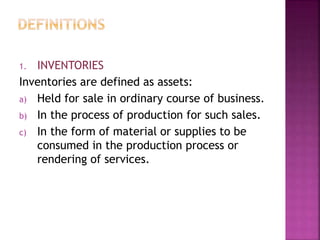
1. INVENTORIES
Inventories are defined as assets:
a) Held for sale in ordinary course of business.
b) In the process of production for such sales.
c) In the form of material or supplies to be
consumed in the production process or
rendering of services.
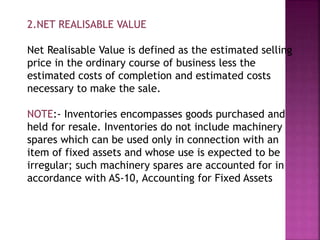
2.NET REALISABLE VALUE
Net Realisable Value is defined as the estimated selling
price in the ordinary course of business less the
estimated costs of completion and estimated costs
necessary to make the sale.
NOTE:- Inventories encompasses goods purchased and
held for resale. Inventories do not include machinery
spares which can be used only in connection with an
item of fixed assets and whose use is expected to be
irregular; such machinery spares are accounted for in
accordance with AS-10, Accounting for Fixed Assets
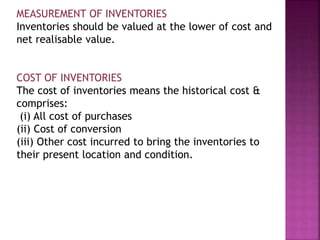
MEASUREMENT OF INVENTORIES
Inventories should be valued at the lower of cost and
net realisable value.
COST OF INVENTORIES
The cost of inventories means the historical cost &
comprises:
(i) All cost of purchases
(ii) Cost of conversion
(iii) Other cost incurred to bring the inventories to
their present location and condition.
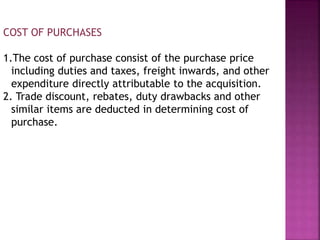
COST OF PURCHASES
1.The cost of purchase consist of the purchase price
including duties and taxes, freight inwards, and other
expenditure directly attributable to the acquisition.
2. Trade discount, rebates, duty drawbacks and other
similar items are deducted in determining cost of
purchase.
COST OF CONVERSION
The cost of conversion of inventories includes cost
directly related to the units of production, such as
direct labour. They also include a systematic
allocation of fixed and variable production
overheads that are incurred in converting materials
into finished goods.
 The allocation of fixed production overheads for
the purpose of their inclusion in the cost of
conversion is based on the normal capacity of
production facilities. Normal capacity is the
production expected to be achieved on an average
over a number of periods and seasons under normal
circumstances, taking into account the loss of
capacity resulting from planned maintenance.
 A production process may result in more than one
product being produced simultaneously. When the
costs of conversion of each product are not
separately identifiable, they are allocated between
the product on rational basis. The allocation may be
based on the relative sales value of each product
either at the stage in production or at the completion
of production.
OTHER COST
1.Other cost are included in cost of inventories only
to the extent that they are incurred in bringing the
inventories to their present location and condition.
2. Interest and other borrowing cost usually not
included in the cost of inventories.
EXCLUSIONS FROM THE COST OF INVENTORIES
1.Abnormal cost of wasted material, labour or other
production cost.
2.Storage cost
3.Administrative overhead that do not contribute to
bringing the inventories to their present location
and condition.
4.Selling and Distribution cost.
COST FORMULA
The standard specifies the following cost of
determining the historical of inventories:
(i) Specific identification cost.
(ii) FIFO
(iii) Weighted Average Cost
Specific identification of cost means that specific
costs attributed to identified item of the inventory.
The FIFO formula assumes that the item of inventory
which were purchased or produced first and
consequently the item remaining in inventory at the
end of the period are those most recently purchased
or produced.
The weighted average cost formula, the cost of each
item is determined from the weighted average of the
cost of similar item purchased or produced during the
year.
TECHNIQUE FOR THE MEASUREMENT OF COST
1.Standard Cost Method.
2.Retail Method.
DISCLOSURES SHOULD BE MADE IN THE FINANCIAL
STATEMENT
(a)The accounting policies adopted in measuring
inventories; including the cost formulas used and
(b) The total carrying amount of inventories and its
classification appropriate to the enterprises.

Accounting standard 2

  • 1.
  • 2.
     Objectives  Scope Definition  Measurement of Inventory  Cost of Inventory  Cost of purchase  Cost of conversion  Other Cost  Cost Formulas  Technique for measurement of cost  Disclosures
  • 3.
    The primary issuein accounting for inventories is the determination of the value of at which inventories are carried in the financial statement until the related revenues are recognised.
  • 4.
    This statement shouldbe applied in accounting for inventories other than:  work-in-progress arising under construction contracts.  Work in progress arising in the ordinary course of business of service providers.  Shares, debentures and other financial instruments held as stock-in-trade.  Producers inventories of livestock, agricultural and forest product and mineral oils, ores and gases to the extent that they are measured at net realizable value.
  • 5.
    1. INVENTORIES Inventories aredefined as assets: a) Held for sale in ordinary course of business. b) In the process of production for such sales. c) In the form of material or supplies to be consumed in the production process or rendering of services.
  • 6.
    2.NET REALISABLE VALUE NetRealisable Value is defined as the estimated selling price in the ordinary course of business less the estimated costs of completion and estimated costs necessary to make the sale. NOTE:- Inventories encompasses goods purchased and held for resale. Inventories do not include machinery spares which can be used only in connection with an item of fixed assets and whose use is expected to be irregular; such machinery spares are accounted for in accordance with AS-10, Accounting for Fixed Assets
  • 7.
    MEASUREMENT OF INVENTORIES Inventoriesshould be valued at the lower of cost and net realisable value. COST OF INVENTORIES The cost of inventories means the historical cost & comprises: (i) All cost of purchases (ii) Cost of conversion (iii) Other cost incurred to bring the inventories to their present location and condition.
  • 8.
    COST OF PURCHASES 1.Thecost of purchase consist of the purchase price including duties and taxes, freight inwards, and other expenditure directly attributable to the acquisition. 2. Trade discount, rebates, duty drawbacks and other similar items are deducted in determining cost of purchase.
  • 9.
    COST OF CONVERSION Thecost of conversion of inventories includes cost directly related to the units of production, such as direct labour. They also include a systematic allocation of fixed and variable production overheads that are incurred in converting materials into finished goods.  The allocation of fixed production overheads for the purpose of their inclusion in the cost of conversion is based on the normal capacity of production facilities. Normal capacity is the production expected to be achieved on an average over a number of periods and seasons under normal circumstances, taking into account the loss of capacity resulting from planned maintenance.
  • 10.
     A productionprocess may result in more than one product being produced simultaneously. When the costs of conversion of each product are not separately identifiable, they are allocated between the product on rational basis. The allocation may be based on the relative sales value of each product either at the stage in production or at the completion of production.
  • 11.
    OTHER COST 1.Other costare included in cost of inventories only to the extent that they are incurred in bringing the inventories to their present location and condition. 2. Interest and other borrowing cost usually not included in the cost of inventories. EXCLUSIONS FROM THE COST OF INVENTORIES 1.Abnormal cost of wasted material, labour or other production cost. 2.Storage cost 3.Administrative overhead that do not contribute to bringing the inventories to their present location and condition. 4.Selling and Distribution cost.
  • 12.
    COST FORMULA The standardspecifies the following cost of determining the historical of inventories: (i) Specific identification cost. (ii) FIFO (iii) Weighted Average Cost Specific identification of cost means that specific costs attributed to identified item of the inventory. The FIFO formula assumes that the item of inventory which were purchased or produced first and consequently the item remaining in inventory at the end of the period are those most recently purchased or produced. The weighted average cost formula, the cost of each item is determined from the weighted average of the cost of similar item purchased or produced during the year.
  • 13.
    TECHNIQUE FOR THEMEASUREMENT OF COST 1.Standard Cost Method. 2.Retail Method. DISCLOSURES SHOULD BE MADE IN THE FINANCIAL STATEMENT (a)The accounting policies adopted in measuring inventories; including the cost formulas used and (b) The total carrying amount of inventories and its classification appropriate to the enterprises.

Editor's Notes

  • #12 OTHER COST 1.Other cost are included in cost of inventories only to the extent that they are incurred in bringing the inventories to their present location and condition. 2. Interest and other borrowing cost usually not included in the cost of inventories. EXCLUSIONS FROM THE COST OF INVENTORIES Abnormal cost of wasted material, labour or other production cost. Storage cost Administrative overhead that do not contribute to bringing the inventories to their present location and condition. Selling and Distribution cost.