Limitations of financial
accounting
Due to the following limitations of financial accounting
,the cost accounting got its origin:
⚫only provides past data.
⚫does not show profit or loss of each product, job,
process etc..
⚫Fails to exercise control over resources
⚫Does not measure organizational efficiency.
⚫Fail to provide adequate data for price fixation.
⚫Does not provide data for comparison of cost
⚫Fails to take into account the impact of price level
changes
COST
⚫Meaning:
Simply it is the price paid for something
⚫In cost accounting:
It is the amount of resources consumed to
produce a product or service.
⚫Definition:
The institute of management accountants , U.S.A,
defines cost as “a measurement in monetory terms
of the amount of resources used for some
purposes.”
Objectives of Cost Accounting
⚫Ascertainment of cost
⚫Control of cost
⚫Guide to business policy such as makeor
buy, introduction of new productetc
⚫Determinationof selling price
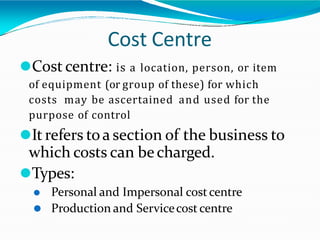
Cost Centre
⚫Cost centre: is a location, person, or item
of equipment (or group of these) for which
costs may be ascertained and used for the
purpose of control
⚫It refers toa section of the business to
which costs can becharged.
⚫Types:
⚫ Personal and Impersonal costcentre
⚫ Production and Servicecost centre
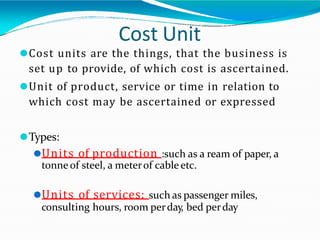
Cost Unit
⚫Cost units are the things, that the business is
set up to provide, of which cost is ascertained.
⚫Unit of product, service or time in relation to
which cost may be ascertained or expressed
⚫Types:
⚫Units of production :such as a ream of paper, a
tonne of steel, a meterof cable etc.
⚫Units of services: such as passenger miles,
consulting hours, room perday, bed perday
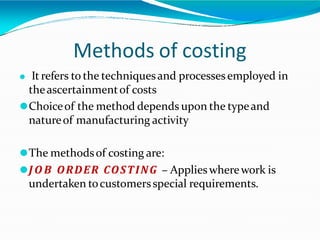
Methods of costing
⚫ It refers to the techniquesand processesemployed in
theascertainmentof costs
⚫Choiceof the method depends upon the typeand
natureof manufacturing activity
⚫The methodsof costing are:
⚫JO B ORDER COSTING – Applieswherework is
undertaken tocustomersspecial requirements.
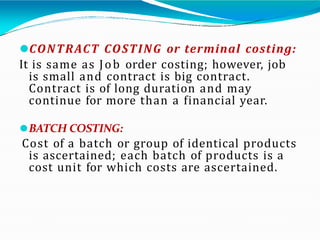
⚫CONTRACT COSTING or terminal costing:
It is same as Job order costing; however, job
is small and contract is big contract.
Contract is of long duration and may
continue for more than a financial year.
⚫BATCH COSTING:
Cost of a batch or group of identical products
is ascertained; each batch of products is a
cost unit for which costs are ascertained.
⚫PROCESS COSTING :
Applies to a context where there is a continuous
process. Costs areaccumulated foreach process.
And then total costof a process is divided by the
numberof units produced toarriveat cost per
unit.
⚫OPERATIONS COSTING:
Involvescost ascertainment foreach operation.
⚫OPERATING OR SERVICES COSTING:
It is applied toservices; cost units are passenger –
kilometer, room perday, bed perday.
⚫MULTIPLE OR COMPOSITE COSTING
Application of more than one method of costing in
respectof the same product.
Used in industries where a number of components
are separately manufactured and then assembled
intoa final product.
⚫SINGLE, OUTPUT OR UNIT COSTING:
Applied toa contextwhereoutput produced are
identical, the cost perunit is found bydividing the
total cost by the numberof units produced.
E.g. Steel output is identical but differentiated by
grades.
Techniques of costing – Types…..
⚫STANDARD COSTING:
Standard cost is predetermined as targetof performance
and actual performance is measured against the
standard.
⚫BUDGETARY CONTROL:
Bycomparing actual with planned / budgeted
performance
⚫MARGINAL COSTING:
Onlyvariablecost is allocated to individual costcenters
orcostunits
⚫TOTALABSORPTION COSTING :
Both fixed and variablecosts arecharged to
products.
⚫UNIFORM COSTING:
It is nota technique but a situation wherein several
undertakings use the same costing principle and
practices.
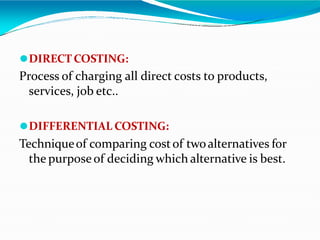
⚫DIRECT COSTING:
Process of charging all direct costs to products,
services, job etc..
⚫DIFFERENTIAL COSTING:
Techniqueof comparing costof twoalternatives for
the purposeof deciding which alternative is best.
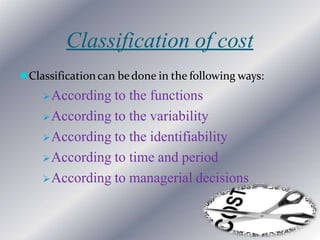
Classification of cost
⚫Classificationcan bedone in the following ways:
According to the functions
According to the variability
According to the identifiability
According to time and period
According to managerial decisions
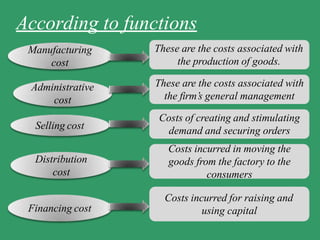
According to functions
Manufacturing
cost
Administrative
cost
Selling cost
Distribution
cost
Financing cost
These are the costs associated with
the production of goods.
These are the costs associated with
the firm’s general management
Costs of creating and stimulating
demand and securing orders
Costs incurred in moving the
goods from the factory to the
consumers
Costs incurred for raising and
using capital
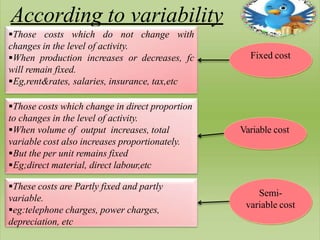
According to variability
Those costs which do not change with
changes in the level of activity.
When production increases or decreases, fc
will remain fixed.
Eg,rent&rates, salaries, insurance, tax,etc
These costs are Partly fixed and partly
variable.
eg:telephone charges, power charges,
depreciation, etc
Those costs which change in direct proportion
to changes in the level of activity.
When volume of output increases, total
variable cost also increases proportionately.
But the per unit remains fixed
Eg;direct material, direct labour,etc
Fixed cost
Variable cost
Semi-
variable cost
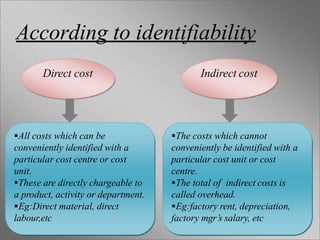
Direct cost Indirect cost
According to identifiability
All costs which can be
conveniently identified with a
particular cost centre or cost
unit.
These are directly chargeable to
a product, activity or department.
Eg:Direct material, direct
labour,etc
The costs which cannot
conveniently be identified with a
particular cost unit or cost
centre.
The total of indirect costs is
called overhead.
Eg:factory rent, depreciation,
factory mgr’s salary, etc
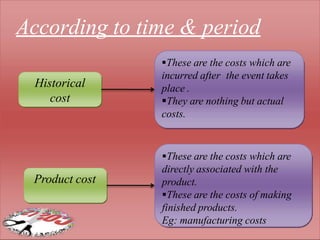
Historical
cost
Product cost
These are the costs which are
incurred after the event takes
place .
They are nothing but actual
costs.
These are the costs which are
directly associated with the
product.
These are the costs of making
finished products.
Eg: manufacturing costs
According to time & period
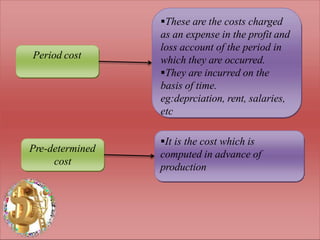
Period cost
Pre-determined
cost
These are the costs charged
as an expense in the profit and
loss account of the period in
which they are occurred.
They are incurred on the
basis of time.
eg:deprciation, rent, salaries,
etc
It is the cost which is
computed in advance of
production
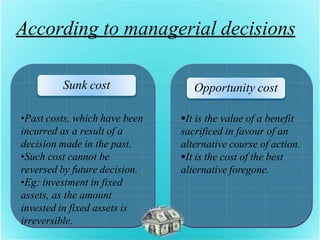
According to managerial decisions
Sunk cost
•Past costs, which have been
incurred as a result of a
decision made in the past.
•Such cost cannot be
reversed by future decision.
•Eg: investment in fixed
assets, as the amount
invested in fixed assets is
irreversible.
Opportunity cost
It is the value of a benefit
sacrificed in favour of an
alternative course of action.
It is the cost of the best
alternative foregone.
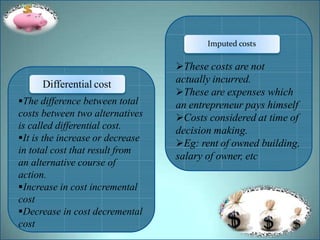
The difference between total
costs between two alternatives
is called differential cost.
It is the increase or decrease
in total cost that result from
an alternative course of
action.
Increase in cost incremental
cost
Decrease in cost decremental
cost
These costs are not
actually incurred.
These are expenses which
an entrepreneur pays himself
Costs considered at time of
decision making.
Eg: rent of owned building,
salary of owner, etc
Differential cost
Imputed costs
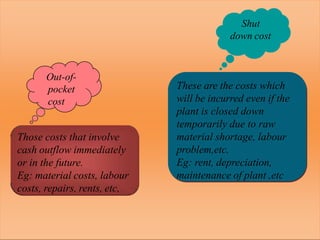
Out-of-
pocket
cost
Those costs that involve
cash outflow immediately
or in the future.
Eg: material costs, labour
costs, repairs, rents, etc,
Shut
down cost
These are the costs which
will be incurred even if the
plant is closed down
temporarily due to raw
material shortage, labour
problem,etc.
Eg: rent, depreciation,
maintenance of plant ,etc
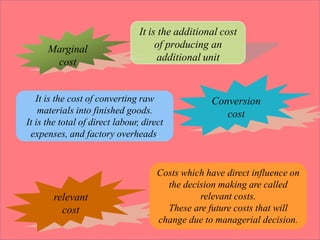
It is the additional cost
of producing an
additional unit
Marginal
cost
Conversion
cost
It is the cost of converting raw
materials into finished goods.
It is the total of direct labour, direct
expenses, and factory overheads.
relevant
cost
Costs which have direct influence on
the decision making are called
relevant costs.
These are future costs that will
change due to managerial decision.
Elements of costs
In order to interpret the term cost correctly and to
ascertain the cost with respect to the cost centers,
the cost attached with the manufacturing process
may be subdivided, known as Elements of Costs.
(A) Material
(B)Labour
(C)Expenses
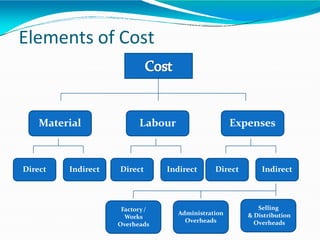
Elements of Cost
Material
Direct Indirect
Labour
Direct Indirect
Expenses
Direct Indirect
Selling
& Distribution
Overheads
Administration
Overheads
Factory/
Works
Overheads
Material Cost
and materials used by the
The cost of commodities
organization.
Direct Material Cost –
all raw materials, either purchased from outside or
manufactured in house.
Indirect Material Cost –
material which cannot be identified with the individual
cost centre, assist the manufacturing process and does not
becomean integral partof finished goods.
Consumable stores, Cotton waste, oils and lubricants,
stationary material etc.
Labour Cost
The cost of remuneration paid to the employees of the
organization.
Direct Labour Cost –
identified with the individual cost centre and is incurred for
those employees who are engaged in the manufacturing
process.
Indirect Labour Cost –
cost which cannot be identified with the individual cost
centre and is incurred for those employees who are not
engaged in the manufacturing process butonly assist.
wages paid to foreman/storekeeper, salary of works manager,
Accountant/Personnel dept. salariesetc.
Expenses Cost
This is the cost of services provided to the organization
and the notional cost of assets owned.
Direct Expenses Cost –
Expenses identified by individual cost centers.
Hire charges of machinery/equipment for particular job,
costof defectivework etc.
Indirect Expenses Cost –
Expenses which cannot be identified by individual cost
centers.
Rent , Telephoneexpenses, Insurance, Lightening etc.
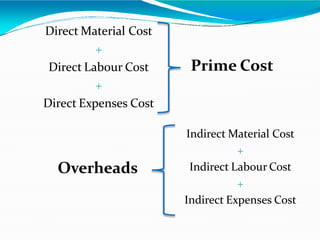
Direct Material Cost
+
Direct Labour Cost
+
Direct Expenses Cost
Indirect Material Cost
+
Indirect Labour Cost
+
Indirect Expenses Cost
Prime Cost
Overheads
Overheads- Classification
Factory / Works Overheads
Consist of all overhead costs incurred from the stage of
procurement of material till the production of finished goods.
⚫Indirect material such as Consumable stores, Cotton waste,
oilsand lubricants, stationary material etc.
⚫Indirect labour such as wages paid to foreman/storekeeper,
salary of works manager, Accountant/Personnel dept. salaries
etc.
⚫Indirect Expenses such as Carriage inward cost, Factory
lightening/power expenses, rent/ Insurance /repairs for
factory building/machinery, depreciation on factory building
or machinery etc.
Officeand Administrative Overheads
These overheads consists of all overheads costs
incurred for the overall administration of the
organisation. They include :
⚫Indirect material such as stationary items, office
suppliesetc.
⚫Indirect labour such as salaries paid to account and
administrativestaff, Directors’ remuneration etc.
⚫Indirect expenses such as postage/telephone,
depreciation on office building, legal/audit charges,
Bank charges . Rent/insurance / repairs in officesetc.
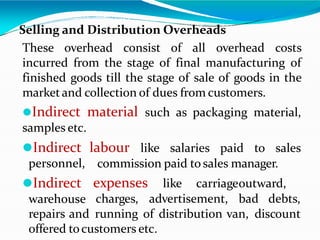
Selling and Distribution Overheads
These overhead consist of all overhead costs
incurred from the stage of final manufacturing of
finished goods till the stage of sale of goods in the
marketand collection of dues from customers.
⚫Indirect material such as packaging material,
samples etc.
labour like salaries paid to sales
commission paid tosales manager.
⚫Indirect
personnel,
⚫Indirect
warehouse
expenses like carriageoutward,
charges, advertisement, bad debts,
repairs and running of distribution van, discount
offered tocustomers etc.
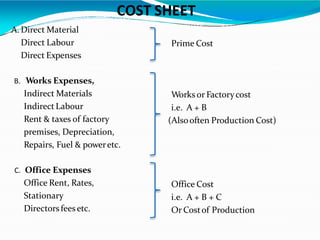
COST SHEET
Prime Cost
Works or Factorycost
i.e. A + B
(Alsooften Production Cost)
A. Direct Material
Direct Labour
Direct Expenses
B. Works Expenses,
Indirect Materials
Indirect Labour
Rent & taxes of factory
premises, Depreciation,
Repairs, Fuel & poweretc.
C. Office Expenses
Office Rent, Rates,
Stationary
Directorsfeesetc.
Office Cost
i.e. A + B + C
Or Costof Production
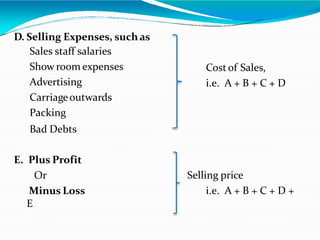
Cost of Sales,
i.e. A + B + C + D
D. Selling Expenses, suchas
Sales staff salaries
Show room expenses
Advertising
Carriageoutwards
Packing
Bad Debts
Selling price
i.e. A + B + C + D +
E. Plus Profit
Or
Minus Loss
E
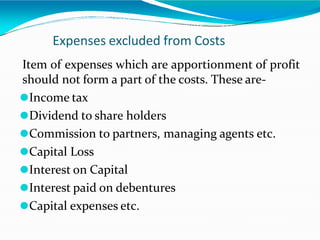
Expenses excluded from Costs
Item of expenses which are apportionment of profit
should not form a part of the costs. These are-
⚫Income tax
⚫Dividend to share holders
⚫Commission to partners, managing agents etc.
⚫Capital Loss
⚫Interest on Capital
⚫Interest paid on debentures
⚫Capital expenses etc.
7_C's_OF_COMMUNIOCATION[1].pptx

7_C's_OF_COMMUNIOCATION[1].pptx

  • 2.
    Limitations of financial accounting Dueto the following limitations of financial accounting ,the cost accounting got its origin: ⚫only provides past data. ⚫does not show profit or loss of each product, job, process etc.. ⚫Fails to exercise control over resources ⚫Does not measure organizational efficiency. ⚫Fail to provide adequate data for price fixation. ⚫Does not provide data for comparison of cost ⚫Fails to take into account the impact of price level changes
  • 3.
    COST ⚫Meaning: Simply it isthe price paid for something ⚫In cost accounting: It is the amount of resources consumed to produce a product or service. ⚫Definition: The institute of management accountants , U.S.A, defines cost as “a measurement in monetory terms of the amount of resources used for some purposes.”
  • 4.
    Objectives of CostAccounting ⚫Ascertainment of cost ⚫Control of cost ⚫Guide to business policy such as makeor buy, introduction of new productetc ⚫Determinationof selling price
  • 5.
    Cost Centre ⚫Cost centre:is a location, person, or item of equipment (or group of these) for which costs may be ascertained and used for the purpose of control ⚫It refers toa section of the business to which costs can becharged. ⚫Types: ⚫ Personal and Impersonal costcentre ⚫ Production and Servicecost centre
  • 6.
    Cost Unit ⚫Cost unitsare the things, that the business is set up to provide, of which cost is ascertained. ⚫Unit of product, service or time in relation to which cost may be ascertained or expressed ⚫Types: ⚫Units of production :such as a ream of paper, a tonne of steel, a meterof cable etc. ⚫Units of services: such as passenger miles, consulting hours, room perday, bed perday
  • 7.
    Methods of costing ⚫It refers to the techniquesand processesemployed in theascertainmentof costs ⚫Choiceof the method depends upon the typeand natureof manufacturing activity ⚫The methodsof costing are: ⚫JO B ORDER COSTING – Applieswherework is undertaken tocustomersspecial requirements.
  • 8.
    ⚫CONTRACT COSTING orterminal costing: It is same as Job order costing; however, job is small and contract is big contract. Contract is of long duration and may continue for more than a financial year. ⚫BATCH COSTING: Cost of a batch or group of identical products is ascertained; each batch of products is a cost unit for which costs are ascertained.
  • 9.
    ⚫PROCESS COSTING : Appliesto a context where there is a continuous process. Costs areaccumulated foreach process. And then total costof a process is divided by the numberof units produced toarriveat cost per unit. ⚫OPERATIONS COSTING: Involvescost ascertainment foreach operation. ⚫OPERATING OR SERVICES COSTING: It is applied toservices; cost units are passenger – kilometer, room perday, bed perday.
  • 10.
    ⚫MULTIPLE OR COMPOSITECOSTING Application of more than one method of costing in respectof the same product. Used in industries where a number of components are separately manufactured and then assembled intoa final product. ⚫SINGLE, OUTPUT OR UNIT COSTING: Applied toa contextwhereoutput produced are identical, the cost perunit is found bydividing the total cost by the numberof units produced. E.g. Steel output is identical but differentiated by grades.
  • 11.
    Techniques of costing– Types….. ⚫STANDARD COSTING: Standard cost is predetermined as targetof performance and actual performance is measured against the standard. ⚫BUDGETARY CONTROL: Bycomparing actual with planned / budgeted performance
  • 12.
    ⚫MARGINAL COSTING: Onlyvariablecost isallocated to individual costcenters orcostunits ⚫TOTALABSORPTION COSTING : Both fixed and variablecosts arecharged to products. ⚫UNIFORM COSTING: It is nota technique but a situation wherein several undertakings use the same costing principle and practices.
  • 13.
    ⚫DIRECT COSTING: Process ofcharging all direct costs to products, services, job etc.. ⚫DIFFERENTIAL COSTING: Techniqueof comparing costof twoalternatives for the purposeof deciding which alternative is best.
  • 14.
    Classification of cost ⚫Classificationcanbedone in the following ways: According to the functions According to the variability According to the identifiability According to time and period According to managerial decisions
  • 15.
    According to functions Manufacturing cost Administrative cost Sellingcost Distribution cost Financing cost These are the costs associated with the production of goods. These are the costs associated with the firm’s general management Costs of creating and stimulating demand and securing orders Costs incurred in moving the goods from the factory to the consumers Costs incurred for raising and using capital
  • 16.
    According to variability Thosecosts which do not change with changes in the level of activity. When production increases or decreases, fc will remain fixed. Eg,rent&rates, salaries, insurance, tax,etc These costs are Partly fixed and partly variable. eg:telephone charges, power charges, depreciation, etc Those costs which change in direct proportion to changes in the level of activity. When volume of output increases, total variable cost also increases proportionately. But the per unit remains fixed Eg;direct material, direct labour,etc Fixed cost Variable cost Semi- variable cost
  • 17.
    Direct cost Indirectcost According to identifiability All costs which can be conveniently identified with a particular cost centre or cost unit. These are directly chargeable to a product, activity or department. Eg:Direct material, direct labour,etc The costs which cannot conveniently be identified with a particular cost unit or cost centre. The total of indirect costs is called overhead. Eg:factory rent, depreciation, factory mgr’s salary, etc
  • 18.
    Historical cost Product cost These arethe costs which are incurred after the event takes place . They are nothing but actual costs. These are the costs which are directly associated with the product. These are the costs of making finished products. Eg: manufacturing costs According to time & period
  • 19.
    Period cost Pre-determined cost These arethe costs charged as an expense in the profit and loss account of the period in which they are occurred. They are incurred on the basis of time. eg:deprciation, rent, salaries, etc It is the cost which is computed in advance of production
  • 20.
    According to managerialdecisions Sunk cost •Past costs, which have been incurred as a result of a decision made in the past. •Such cost cannot be reversed by future decision. •Eg: investment in fixed assets, as the amount invested in fixed assets is irreversible. Opportunity cost It is the value of a benefit sacrificed in favour of an alternative course of action. It is the cost of the best alternative foregone.
  • 21.
    The difference betweentotal costs between two alternatives is called differential cost. It is the increase or decrease in total cost that result from an alternative course of action. Increase in cost incremental cost Decrease in cost decremental cost These costs are not actually incurred. These are expenses which an entrepreneur pays himself Costs considered at time of decision making. Eg: rent of owned building, salary of owner, etc Differential cost Imputed costs
  • 22.
    Out-of- pocket cost Those costs thatinvolve cash outflow immediately or in the future. Eg: material costs, labour costs, repairs, rents, etc, Shut down cost These are the costs which will be incurred even if the plant is closed down temporarily due to raw material shortage, labour problem,etc. Eg: rent, depreciation, maintenance of plant ,etc
  • 23.
    It is theadditional cost of producing an additional unit Marginal cost Conversion cost It is the cost of converting raw materials into finished goods. It is the total of direct labour, direct expenses, and factory overheads. relevant cost Costs which have direct influence on the decision making are called relevant costs. These are future costs that will change due to managerial decision.
  • 25.
    Elements of costs Inorder to interpret the term cost correctly and to ascertain the cost with respect to the cost centers, the cost attached with the manufacturing process may be subdivided, known as Elements of Costs. (A) Material (B)Labour (C)Expenses
  • 26.
    Elements of Cost Material DirectIndirect Labour Direct Indirect Expenses Direct Indirect Selling & Distribution Overheads Administration Overheads Factory/ Works Overheads
  • 27.
    Material Cost and materialsused by the The cost of commodities organization. Direct Material Cost – all raw materials, either purchased from outside or manufactured in house. Indirect Material Cost – material which cannot be identified with the individual cost centre, assist the manufacturing process and does not becomean integral partof finished goods. Consumable stores, Cotton waste, oils and lubricants, stationary material etc.
  • 28.
    Labour Cost The costof remuneration paid to the employees of the organization. Direct Labour Cost – identified with the individual cost centre and is incurred for those employees who are engaged in the manufacturing process. Indirect Labour Cost – cost which cannot be identified with the individual cost centre and is incurred for those employees who are not engaged in the manufacturing process butonly assist. wages paid to foreman/storekeeper, salary of works manager, Accountant/Personnel dept. salariesetc.
  • 29.
    Expenses Cost This isthe cost of services provided to the organization and the notional cost of assets owned. Direct Expenses Cost – Expenses identified by individual cost centers. Hire charges of machinery/equipment for particular job, costof defectivework etc. Indirect Expenses Cost – Expenses which cannot be identified by individual cost centers. Rent , Telephoneexpenses, Insurance, Lightening etc.
  • 30.
    Direct Material Cost + DirectLabour Cost + Direct Expenses Cost Indirect Material Cost + Indirect Labour Cost + Indirect Expenses Cost Prime Cost Overheads
  • 31.
    Overheads- Classification Factory /Works Overheads Consist of all overhead costs incurred from the stage of procurement of material till the production of finished goods. ⚫Indirect material such as Consumable stores, Cotton waste, oilsand lubricants, stationary material etc. ⚫Indirect labour such as wages paid to foreman/storekeeper, salary of works manager, Accountant/Personnel dept. salaries etc. ⚫Indirect Expenses such as Carriage inward cost, Factory lightening/power expenses, rent/ Insurance /repairs for factory building/machinery, depreciation on factory building or machinery etc.
  • 32.
    Officeand Administrative Overheads Theseoverheads consists of all overheads costs incurred for the overall administration of the organisation. They include : ⚫Indirect material such as stationary items, office suppliesetc. ⚫Indirect labour such as salaries paid to account and administrativestaff, Directors’ remuneration etc. ⚫Indirect expenses such as postage/telephone, depreciation on office building, legal/audit charges, Bank charges . Rent/insurance / repairs in officesetc.
  • 33.
    Selling and DistributionOverheads These overhead consist of all overhead costs incurred from the stage of final manufacturing of finished goods till the stage of sale of goods in the marketand collection of dues from customers. ⚫Indirect material such as packaging material, samples etc. labour like salaries paid to sales commission paid tosales manager. ⚫Indirect personnel, ⚫Indirect warehouse expenses like carriageoutward, charges, advertisement, bad debts, repairs and running of distribution van, discount offered tocustomers etc.
  • 34.
    COST SHEET Prime Cost Worksor Factorycost i.e. A + B (Alsooften Production Cost) A. Direct Material Direct Labour Direct Expenses B. Works Expenses, Indirect Materials Indirect Labour Rent & taxes of factory premises, Depreciation, Repairs, Fuel & poweretc. C. Office Expenses Office Rent, Rates, Stationary Directorsfeesetc. Office Cost i.e. A + B + C Or Costof Production
  • 35.
    Cost of Sales, i.e.A + B + C + D D. Selling Expenses, suchas Sales staff salaries Show room expenses Advertising Carriageoutwards Packing Bad Debts Selling price i.e. A + B + C + D + E. Plus Profit Or Minus Loss E
  • 36.
    Expenses excluded fromCosts Item of expenses which are apportionment of profit should not form a part of the costs. These are- ⚫Income tax ⚫Dividend to share holders ⚫Commission to partners, managing agents etc. ⚫Capital Loss ⚫Interest on Capital ⚫Interest paid on debentures ⚫Capital expenses etc.