O F
      Y
     R T
    O S
   E O
T H C
COST
    It is the firm of the individual
    operating in a marketing has a
    influence on the market supply of the
    commodity.
    In order to make use of the various
    factor and non-factor inputs.
    In common, the amount spend on these
    inputs is called the cost of production.
CONCEPT OF COST
   MONEY COST :
      The amount spend in terms of money for
    the production of the commodity is known as
    money cost .
   NOMINAL COST:
      It is the money cost of production.
   REAL COST :
     It is the mental and physical and sacrifices
    undergone with a view to producing a
    commodity .
   OPPORTUNITY COST :
          The real concept of production of
    given commodity is the next best alternative
    sacrificed in order to obtain that
    commodity.
   IMPLICIT COST :
          It is the cost of self-owned resources
    such as salary of proprietor.
   EXPLICIT COST :
         * It is the paid-out cost.
        * It means payments made for the
    productive resources purchased.
 ACCOUNTING OR BUSINESS COST:

                Cash payments which firms make for factor and
    non-factor input depreciation other book keeping entries.
•   SOCIAL COST:

                It is the amount of cost the society bears due to
    industrialization.
•   ENTREPRENEUR’S COST:
           The cost of production in the sense of money cost or
    expenses of production.
CLASSIFICATION OF
ENTREPREUNER’S COST
   PRODUTION COST.

   SELLING COST.

   OTHER COST.

   MANAGERIAL COST.
ELEMENTS
   WAGES.
   INTEREST.
   RENT.
   COST OF RAW MATERIALS.
   REPLACEMENT AND REPAIRING.
   DEPRICIATION.
   PROFITS.
SHORT-RUN COSTS


   In the short run atleast one factor of
    production is fixed.
   Output can be varied only by adding
    more variable factors.
  PRIME COSTS:
                 Some costs vary more
  proportionately with the output,while others
  are fixed and do not vary output in the same
  way.
 SUPPLEMENTARY COSTS:

                Some costs vary less
  proportionately with the output,while others
  are fixed and do not vary output in the same
  way.
FIXED COST
   Remains constant.
   Also known as short-run cost.
   This cost includes:
       *Cost on managerial staff.
       *Expenditure on depeciation.
       *Maintenance cost of the factory.
VARIABLE COST
   Vary directly with the level of output
   Used in the actual production process.
   Functions of output changes.
   Eg: Cost of raw-materials.
        Cost in direct labour.
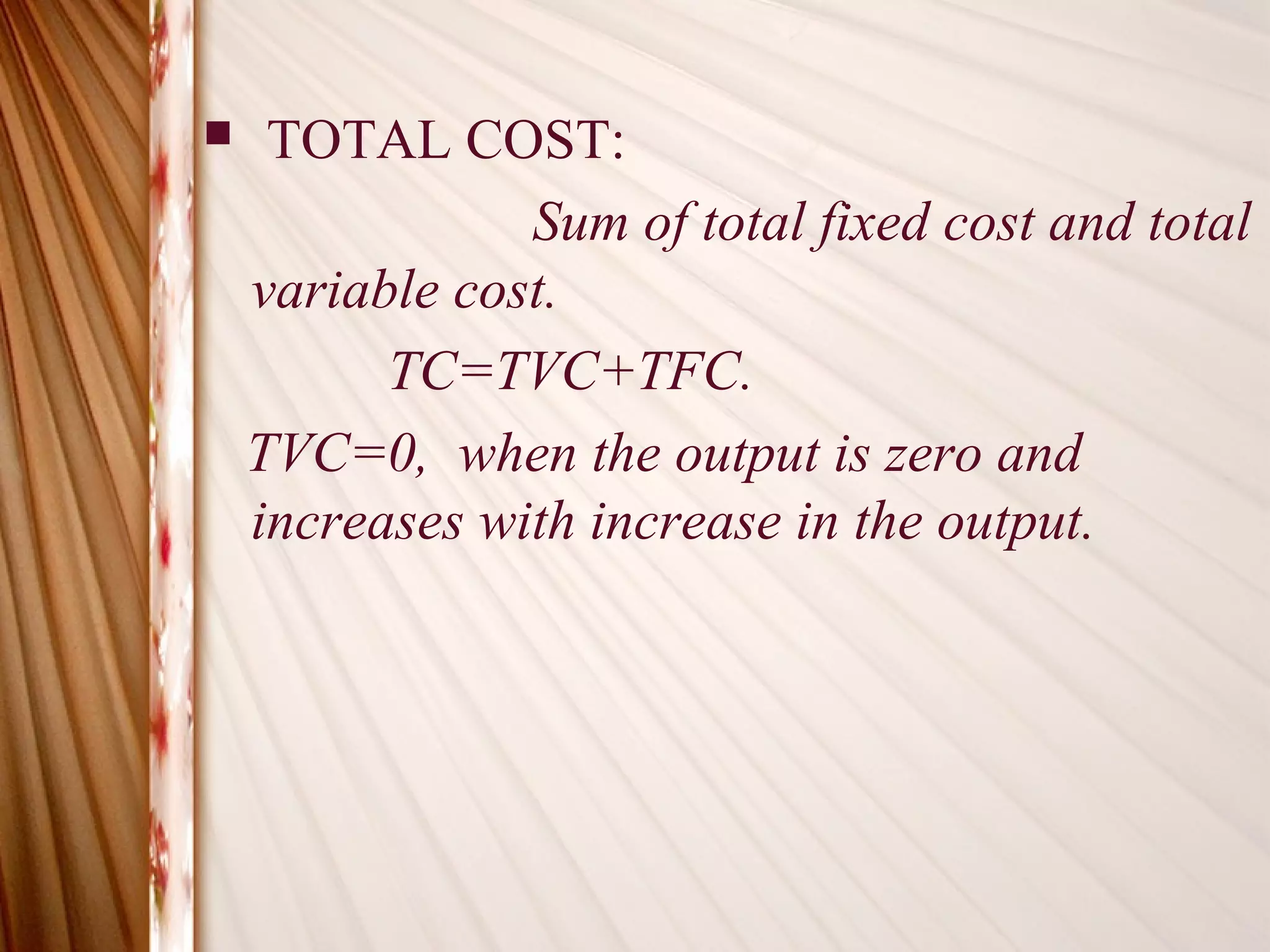
    TOTAL COST:
                Sum of total fixed cost and total
    variable cost.
          TC=TVC+TFC.
    TVC=0, when the output is zero and
    increases with increase in the output.
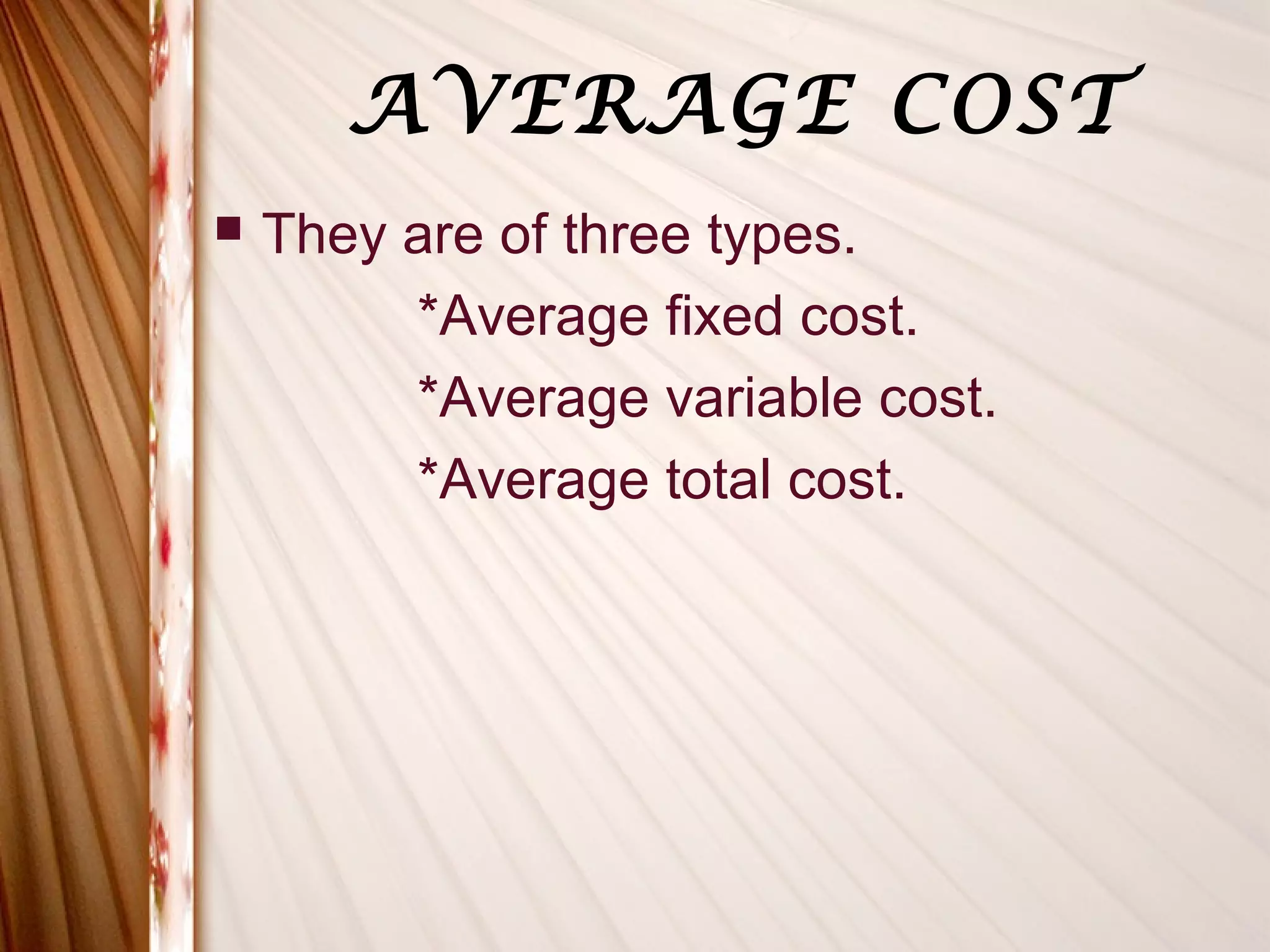
AVERAGE COST
   They are of three types.
         *Average fixed cost.
         *Average variable cost.
         *Average total cost.
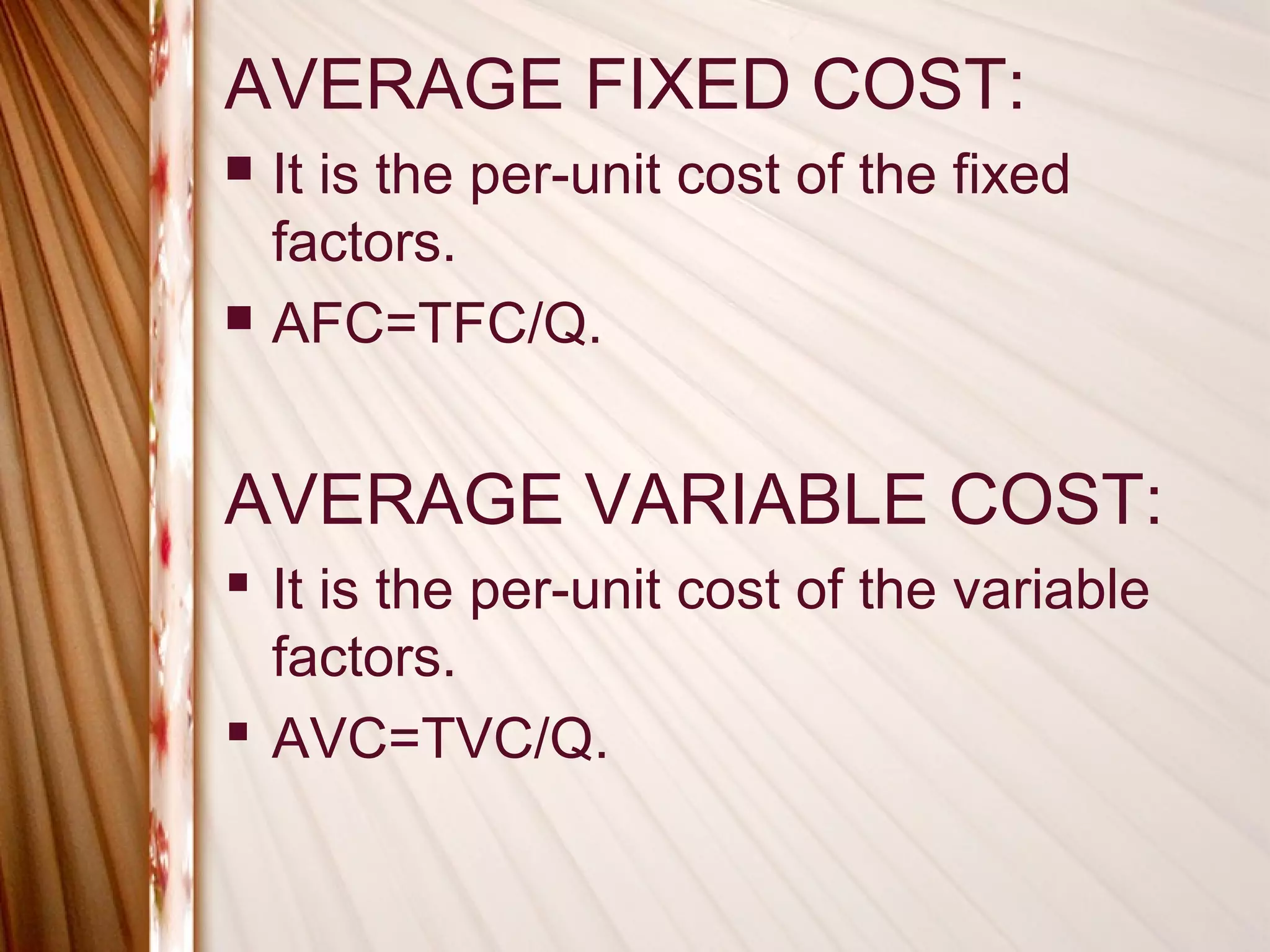
AVERAGE FIXED COST:
   It is the per-unit cost of the fixed
    factors.
   AFC=TFC/Q.


AVERAGE VARIABLE COST:
 It is the per-unit cost of the variable
  factors.
 AVC=TVC/Q.
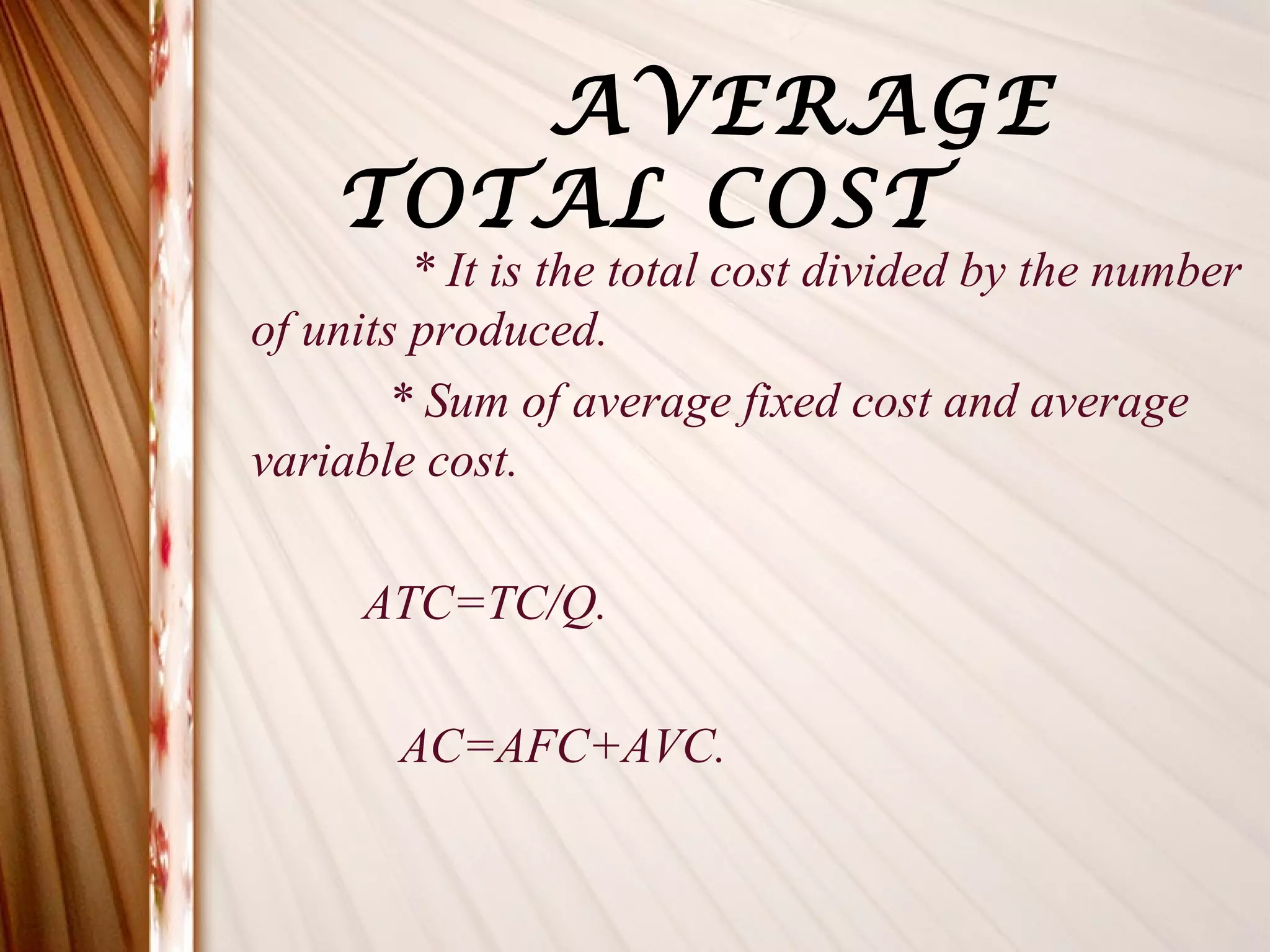
AVERAGE
    TOTAL COST
         * It is the total cost divided by the number
of units produced.
       * Sum of average fixed cost and average
variable cost.

     ATC=TC/Q.

       AC=AFC+AVC.
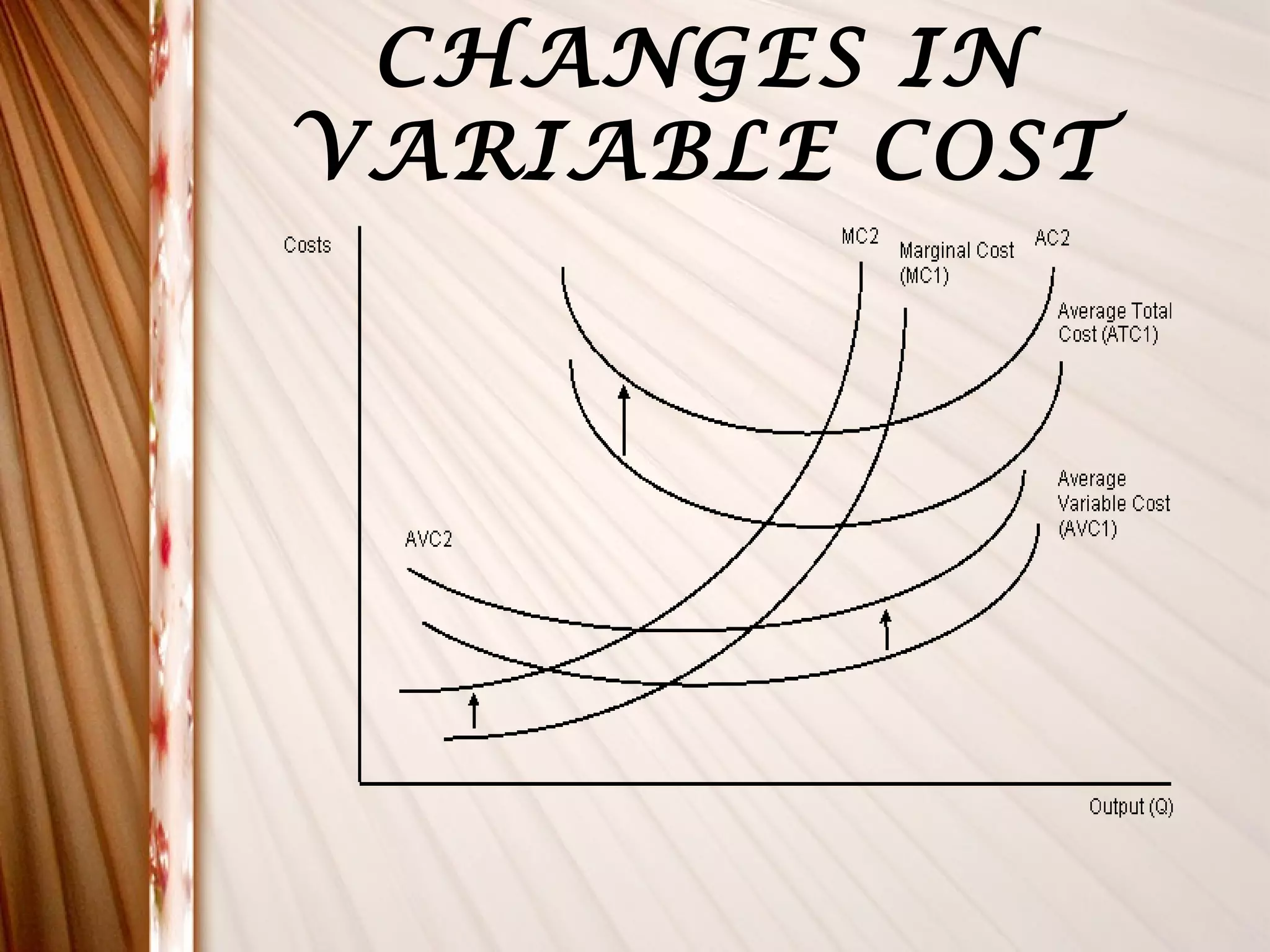
CHANGES IN
VARIABLE COST
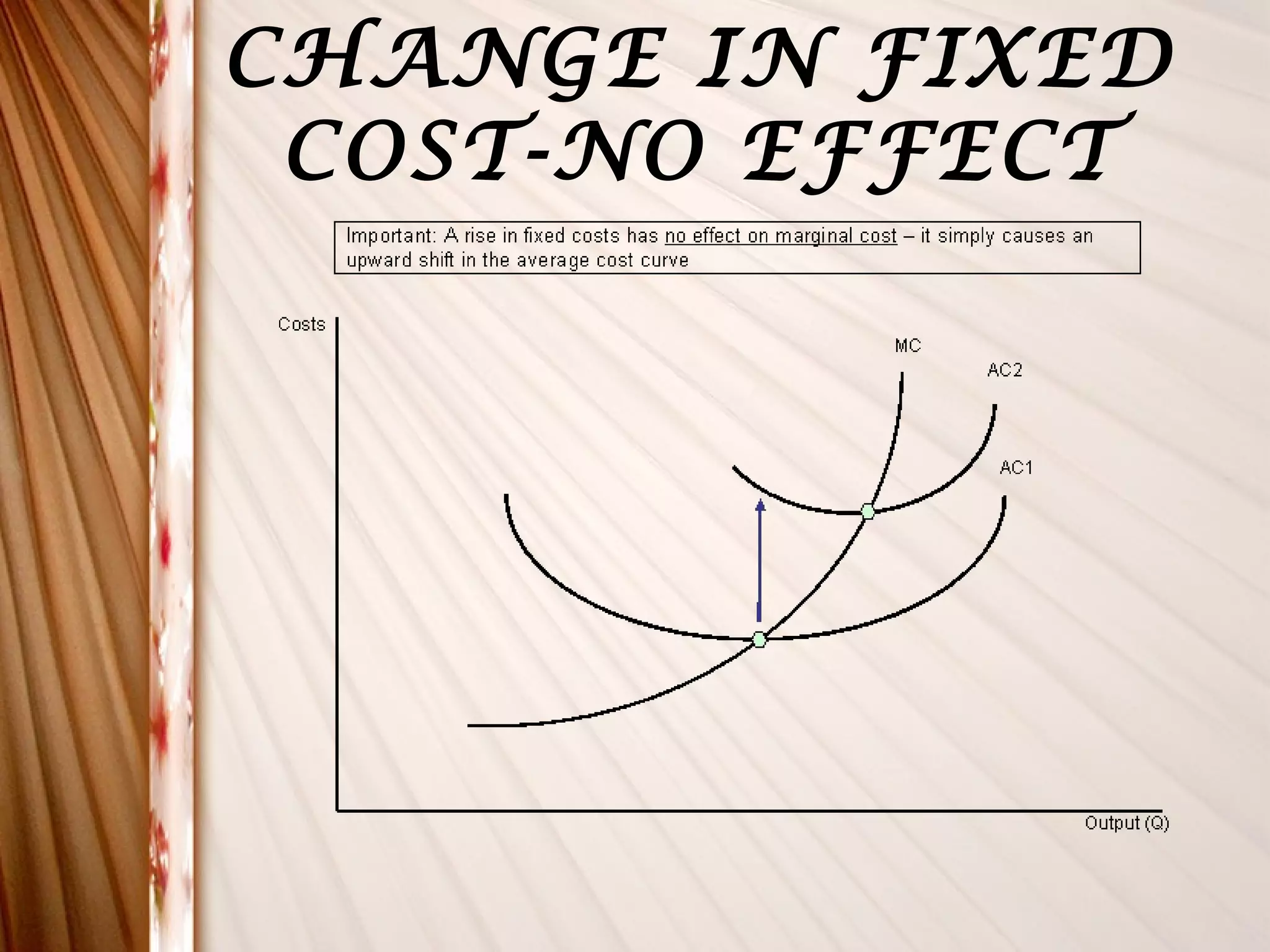
CHANGE IN FIXED
 COST-NO EFFECT
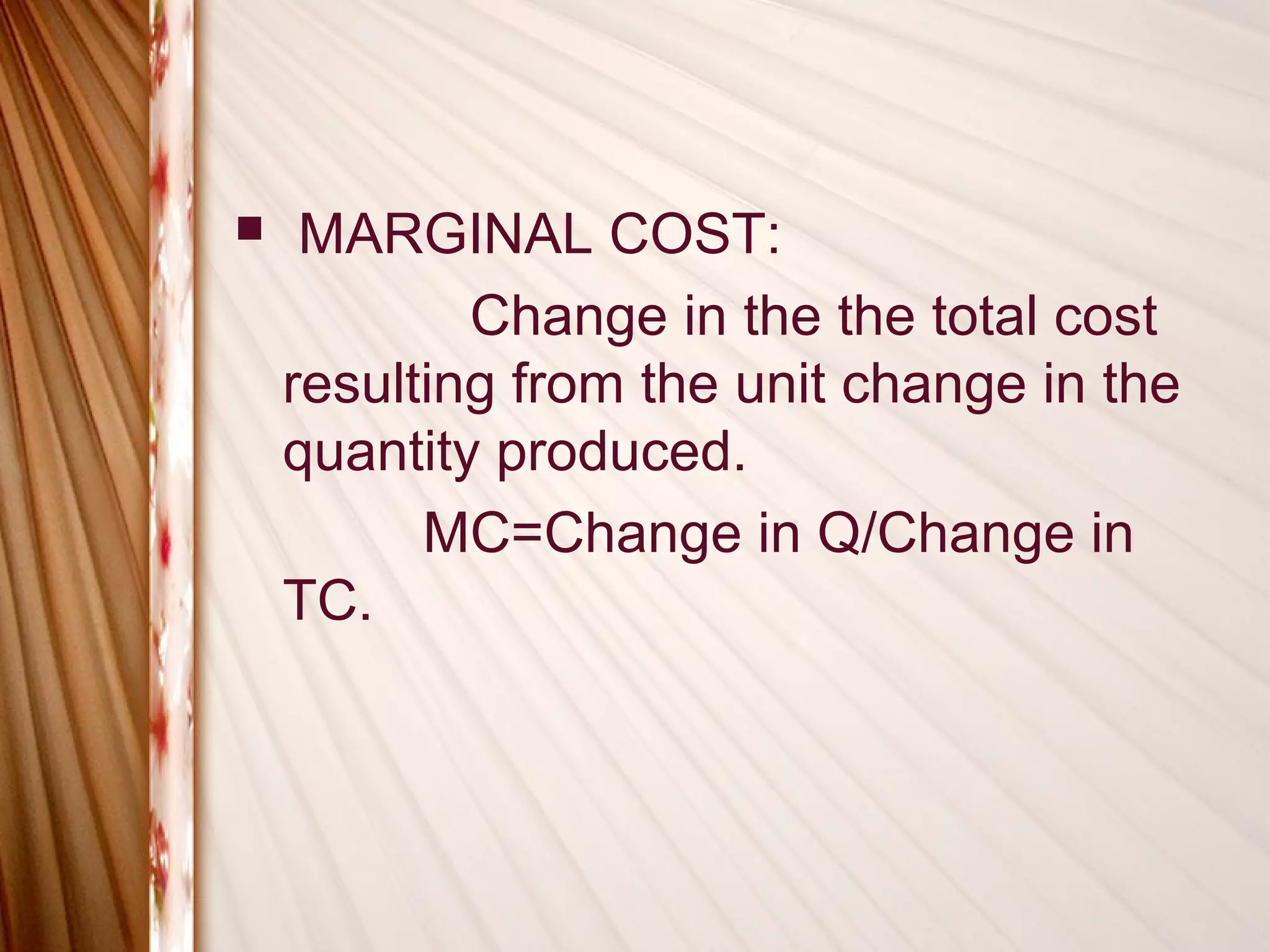
    MARGINAL COST:
            Change in the the total cost
    resulting from the unit change in the
    quantity produced.
          MC=Change in Q/Change in
    TC.
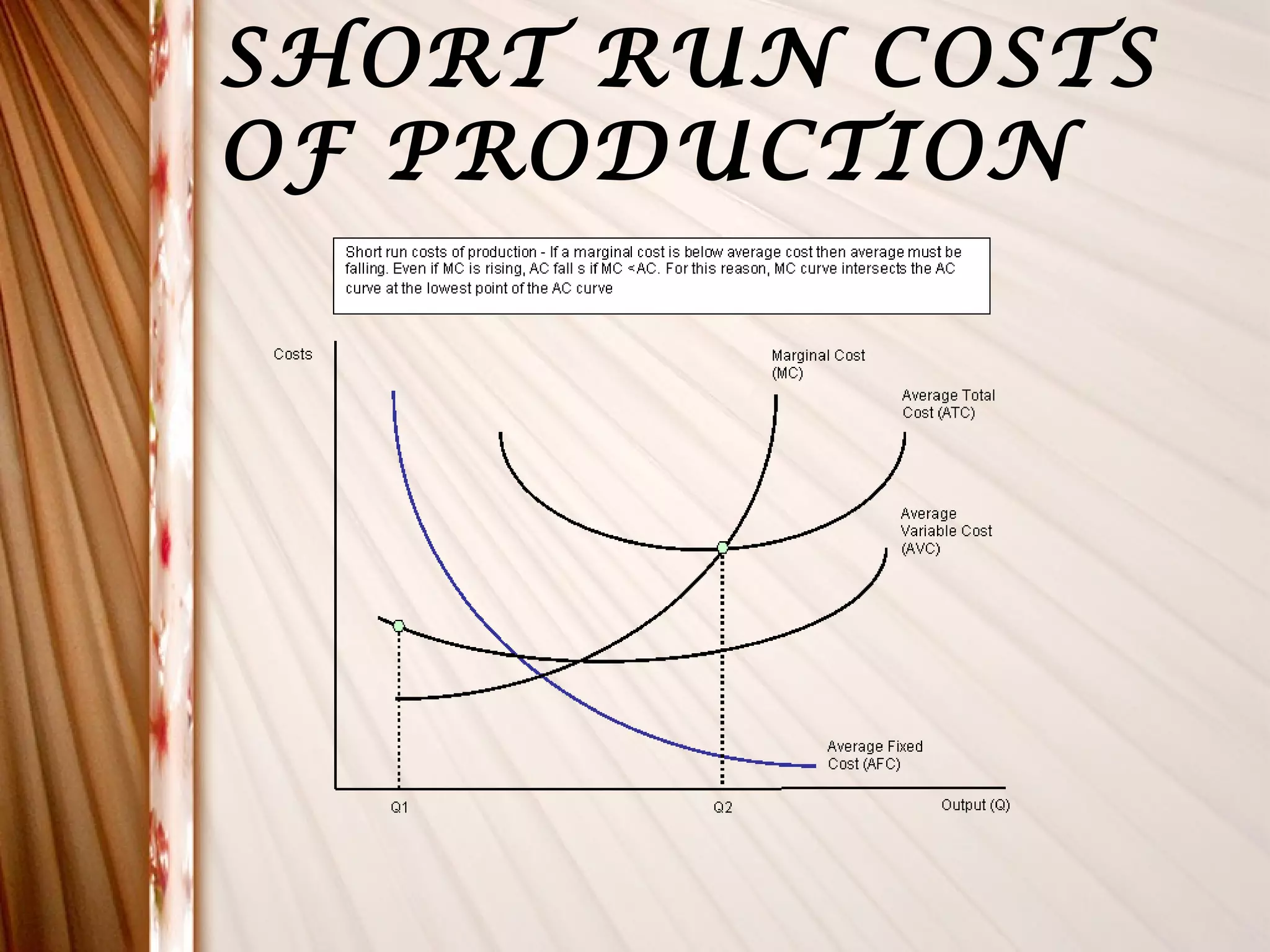
SHORT RUN COSTS
OF PRODUCTION
LONG-RUN COST
    CURVES

    It is a period of time during which
    the quantities of all factors,variable
    as well as fixed can be adjusted.
 LONG-RUN AVERAGE COST
 CURVE:
        Slopes downwards.
 Larger scope of specialization of
 labour.
 Increasing use of specialized
 machinery.
 Other technological management.
    LONG-RUN MARGINAL COST
    CURVE:
         Cuts the LRAC at the lowest point.
         It is equal to the LRAC when LAC
    is neither rising nor falling.
ANKU
TH

Theory of cost

  • 1.
    O F Y R T O S E O T H C
  • 2.
    COST  It is the firm of the individual operating in a marketing has a influence on the market supply of the commodity.  In order to make use of the various factor and non-factor inputs.  In common, the amount spend on these inputs is called the cost of production.
  • 3.
    CONCEPT OF COST  MONEY COST : The amount spend in terms of money for the production of the commodity is known as money cost .  NOMINAL COST: It is the money cost of production.  REAL COST : It is the mental and physical and sacrifices undergone with a view to producing a commodity .
  • 4.
    OPPORTUNITY COST : The real concept of production of given commodity is the next best alternative sacrificed in order to obtain that commodity.
  • 5.
    IMPLICIT COST : It is the cost of self-owned resources such as salary of proprietor.  EXPLICIT COST : * It is the paid-out cost. * It means payments made for the productive resources purchased.
  • 6.
     ACCOUNTING ORBUSINESS COST: Cash payments which firms make for factor and non-factor input depreciation other book keeping entries. • SOCIAL COST: It is the amount of cost the society bears due to industrialization. • ENTREPRENEUR’S COST: The cost of production in the sense of money cost or expenses of production.
  • 7.
    CLASSIFICATION OF ENTREPREUNER’S COST  PRODUTION COST.  SELLING COST.  OTHER COST.  MANAGERIAL COST.
  • 8.
    ELEMENTS  WAGES.  INTEREST.  RENT.  COST OF RAW MATERIALS.  REPLACEMENT AND REPAIRING.  DEPRICIATION.  PROFITS.
  • 9.
    SHORT-RUN COSTS  In the short run atleast one factor of production is fixed.  Output can be varied only by adding more variable factors.
  • 10.
     PRIMECOSTS: Some costs vary more proportionately with the output,while others are fixed and do not vary output in the same way.  SUPPLEMENTARY COSTS: Some costs vary less proportionately with the output,while others are fixed and do not vary output in the same way.
  • 11.
    FIXED COST  Remains constant.  Also known as short-run cost.  This cost includes: *Cost on managerial staff. *Expenditure on depeciation. *Maintenance cost of the factory.
  • 12.
    VARIABLE COST  Vary directly with the level of output  Used in the actual production process.  Functions of output changes.  Eg: Cost of raw-materials. Cost in direct labour.
  • 13.
    TOTAL COST: Sum of total fixed cost and total variable cost. TC=TVC+TFC. TVC=0, when the output is zero and increases with increase in the output.
  • 14.
    AVERAGE COST  They are of three types. *Average fixed cost. *Average variable cost. *Average total cost.
  • 15.
    AVERAGE FIXED COST:  It is the per-unit cost of the fixed factors.  AFC=TFC/Q. AVERAGE VARIABLE COST:  It is the per-unit cost of the variable factors.  AVC=TVC/Q.
  • 16.
    AVERAGE TOTAL COST * It is the total cost divided by the number of units produced. * Sum of average fixed cost and average variable cost. ATC=TC/Q. AC=AFC+AVC.
  • 17.
  • 18.
    CHANGE IN FIXED COST-NO EFFECT
  • 19.
    MARGINAL COST: Change in the the total cost resulting from the unit change in the quantity produced. MC=Change in Q/Change in TC.
  • 20.
  • 21.
    LONG-RUN COST CURVES  It is a period of time during which the quantities of all factors,variable as well as fixed can be adjusted.
  • 22.
     LONG-RUN AVERAGECOST CURVE: Slopes downwards.  Larger scope of specialization of labour.  Increasing use of specialized machinery.  Other technological management.
  • 23.
    LONG-RUN MARGINAL COST CURVE: Cuts the LRAC at the lowest point. It is equal to the LRAC when LAC is neither rising nor falling.
  • 24.