Standard costing

1
Standard
 The

word standard means a criterion (principle,
measure).
 A standard figure is one against which one can
measure an actual figure to see the deviation.

2
Standard Rate




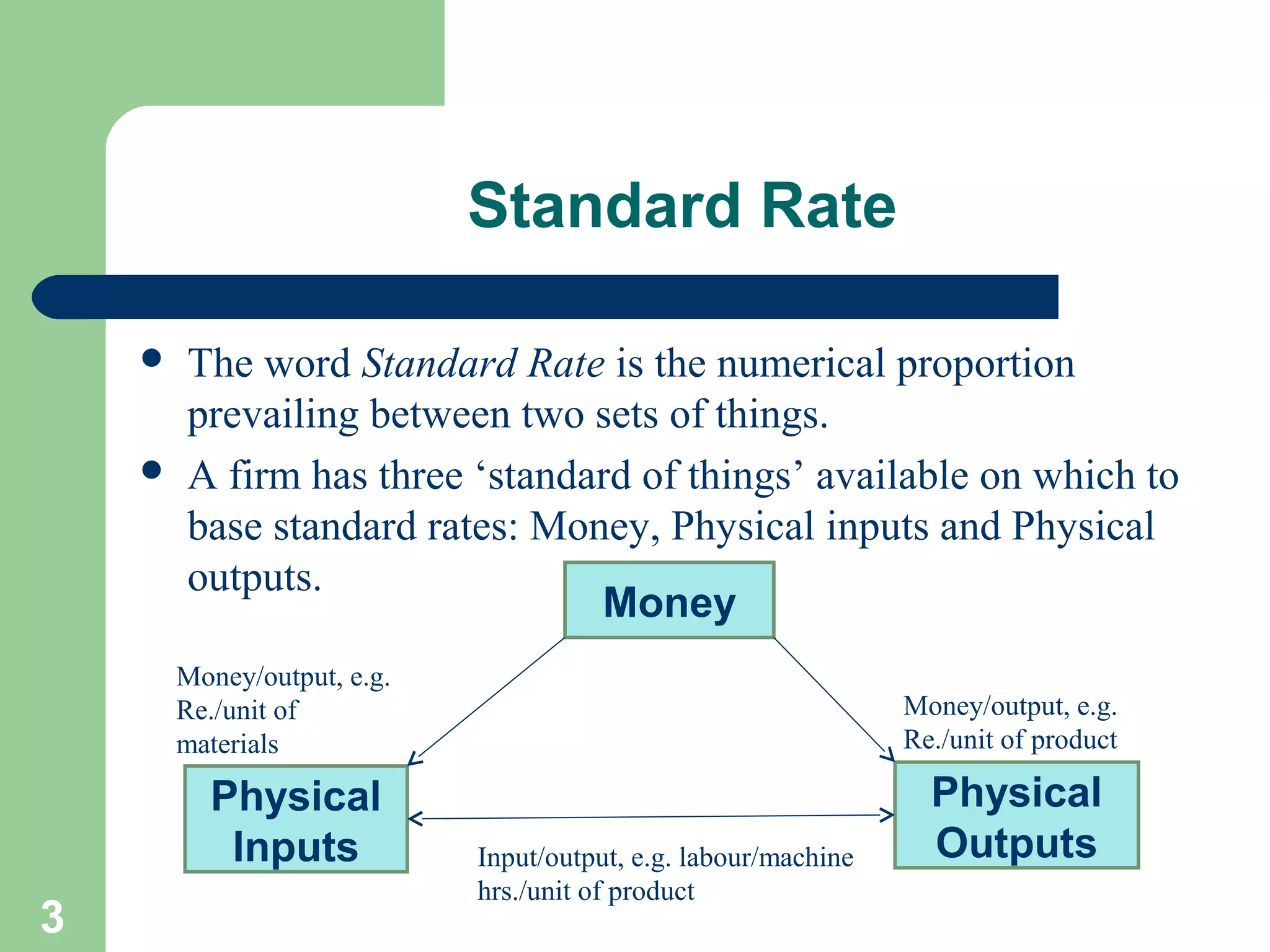
The word Standard Rate is the numerical proportion
prevailing between two sets of things.
A firm has three ‘standard of things’ available on which to
base standard rates: Money, Physical inputs and Physical
outputs.
Money
Money/output, e.g.
Re./unit of
materials

Physical
Inputs

3

Money/output, e.g.
Re./unit of product

Input/output, e.g. labour/machine
hrs./unit of product

Physical
Outputs
Standard Cost
 Standard

cost is ‘a predetermined cost which is
compared in advance of production on the basis of
specifications of all the factors affecting costs and
used in standard costing.’
 In other words, standard cost is a predetermined
cost that should be attained under a given set of
operating conditions.

4
Standard Costing








5

Standard costing is a technique which is used in many
industries, where production is of repetitive nature.
Standard costing is developed due to the shortcomings of
historical costing.
CIMA, London, defines standard costing ‘as the
predetermined cost based on technical estimates of materials,
labour and overheads for selected period of time and for the
prescribed set of working conditions’.
Standard costing is that technique in which the standard cost
is determined before starting the production.
Standard costing system
 The

management evaluates the performance
of a company by comparing it with some
predetermined measures
 Therefore, it can be used as a process of
measuring and correcting actual performance
to ensure that the plans are properly set and
implemented

6
Objectives Of Standard Costing
 To

establish control
 To set standards for various elements of cost
 To fix responsibility
 To make budgetary control more effective

7
Procedures of standard costing
system







8

Set the predetermined standards for sales margin and
production costs
Collect the information about the actual performance
Compare the actual performance with the standards to
arrive at the variance
Analyze the variances and ascertaining the causes of
variance
Take corrective action to avoid adverse variance
Adjust the budget in order to make the standards more
realistic
Functions of standard costing
system
 Valuation
–

Assigning the standard cost to the actual output

 Planning
–

Use the current standards to estimate future sales
volume and future costs

 Controlling
–

9

Evaluating performance by determining how
efficiently the current operations are being carried
out
 Motivation
–

Notify the staff of the management’s expectations

 Setting

10

of selling price
Variance

11
Variance analysis
A

variance is the difference between the
standards and the actual performance
 When the actual results are better than the
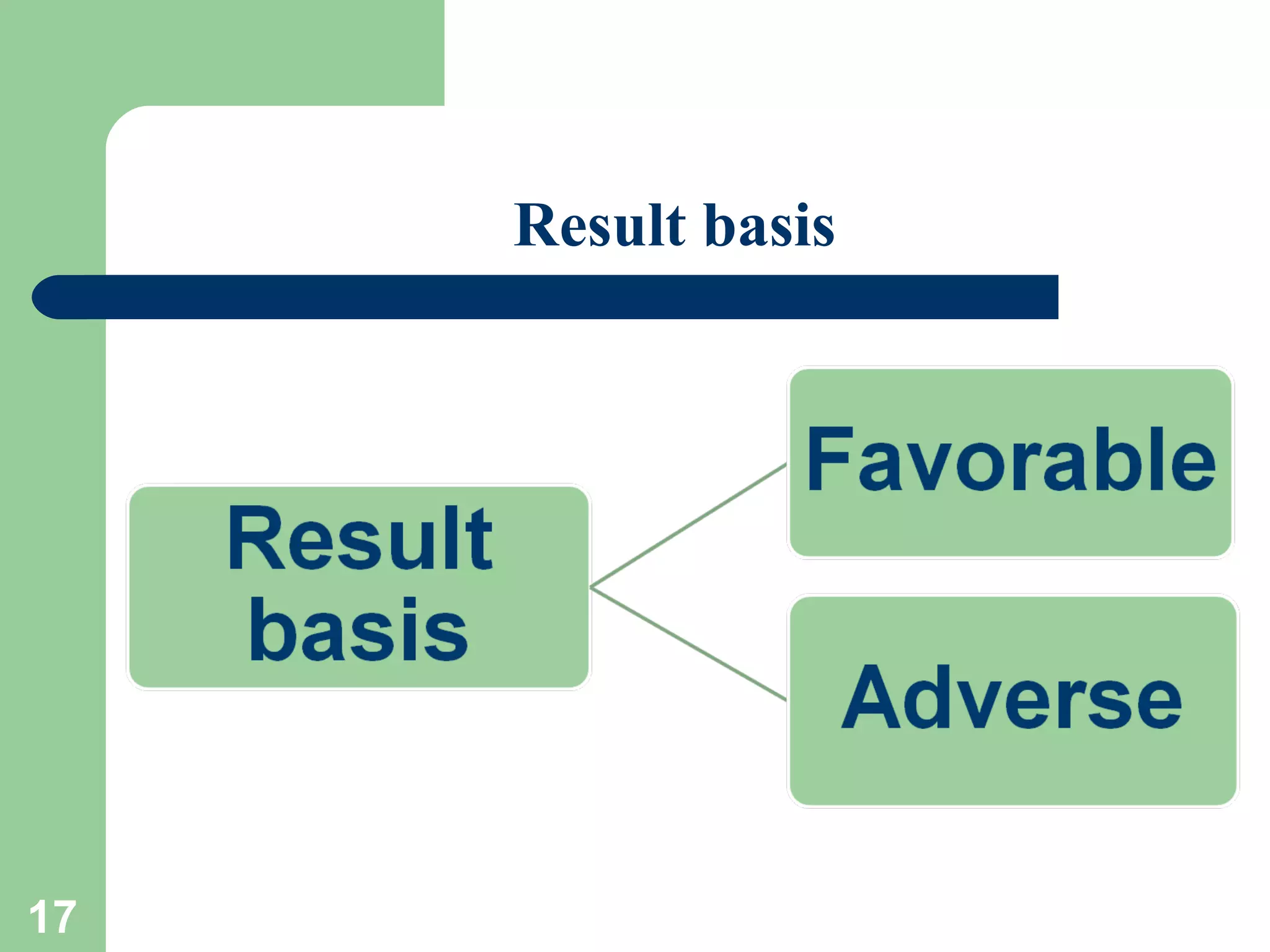
expected results, there will be a favourable
variance (F)
 If the actual results are worse than the
expected results, there will be an adverse
variance (A)
12
Classification Of Variances
 Functional

Basis
 Measurement Basis
 Result Basis
 Controllability Basis

13
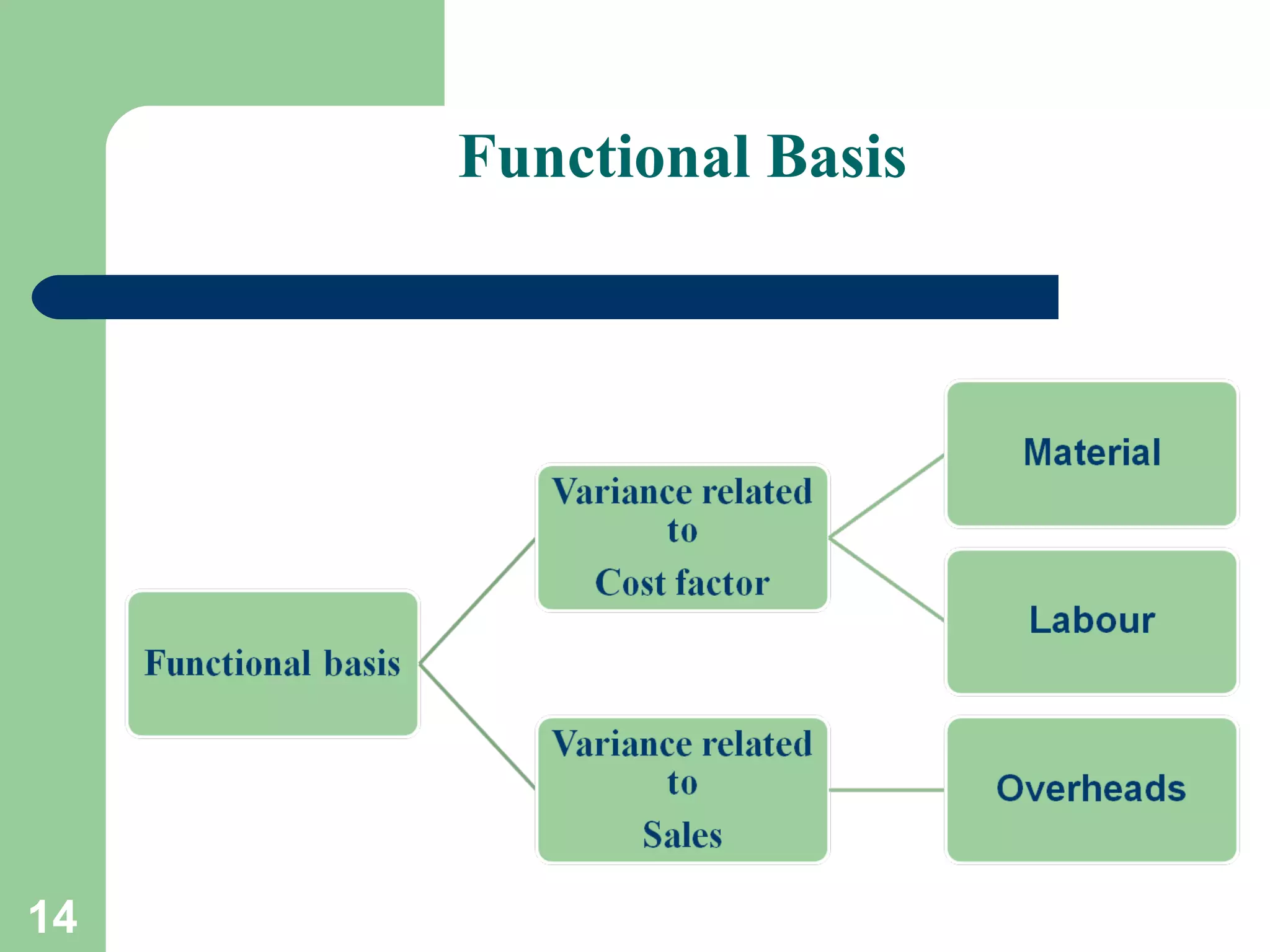
Functional Basis

14
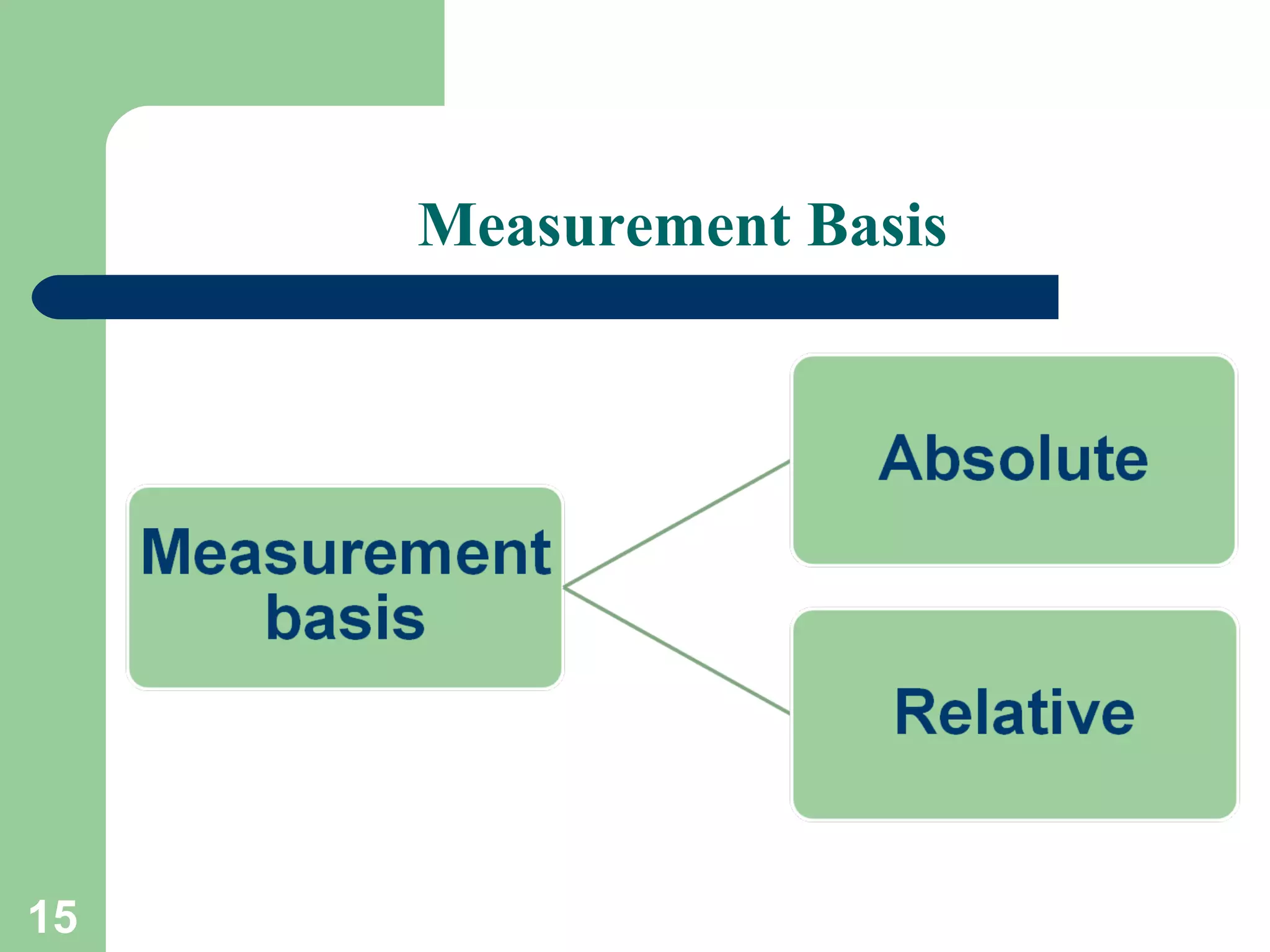
Measurement Basis

15
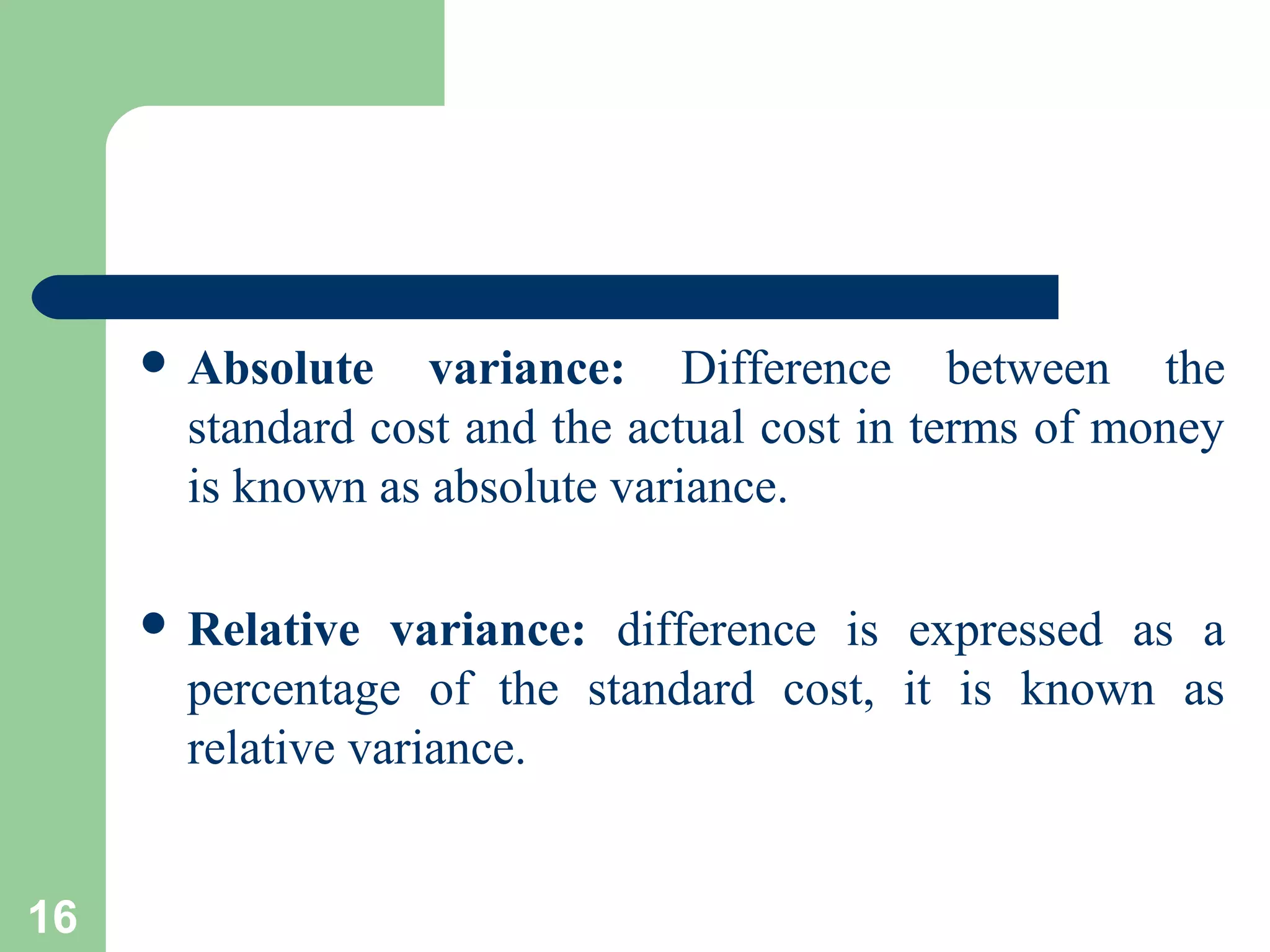
 Absolute

variance: Difference between the
standard cost and the actual cost in terms of money
is known as absolute variance.

 Relative

variance: difference is expressed as a
percentage of the standard cost, it is known as
relative variance.

16
Result basis

17
Cost variance

18
Cost variance
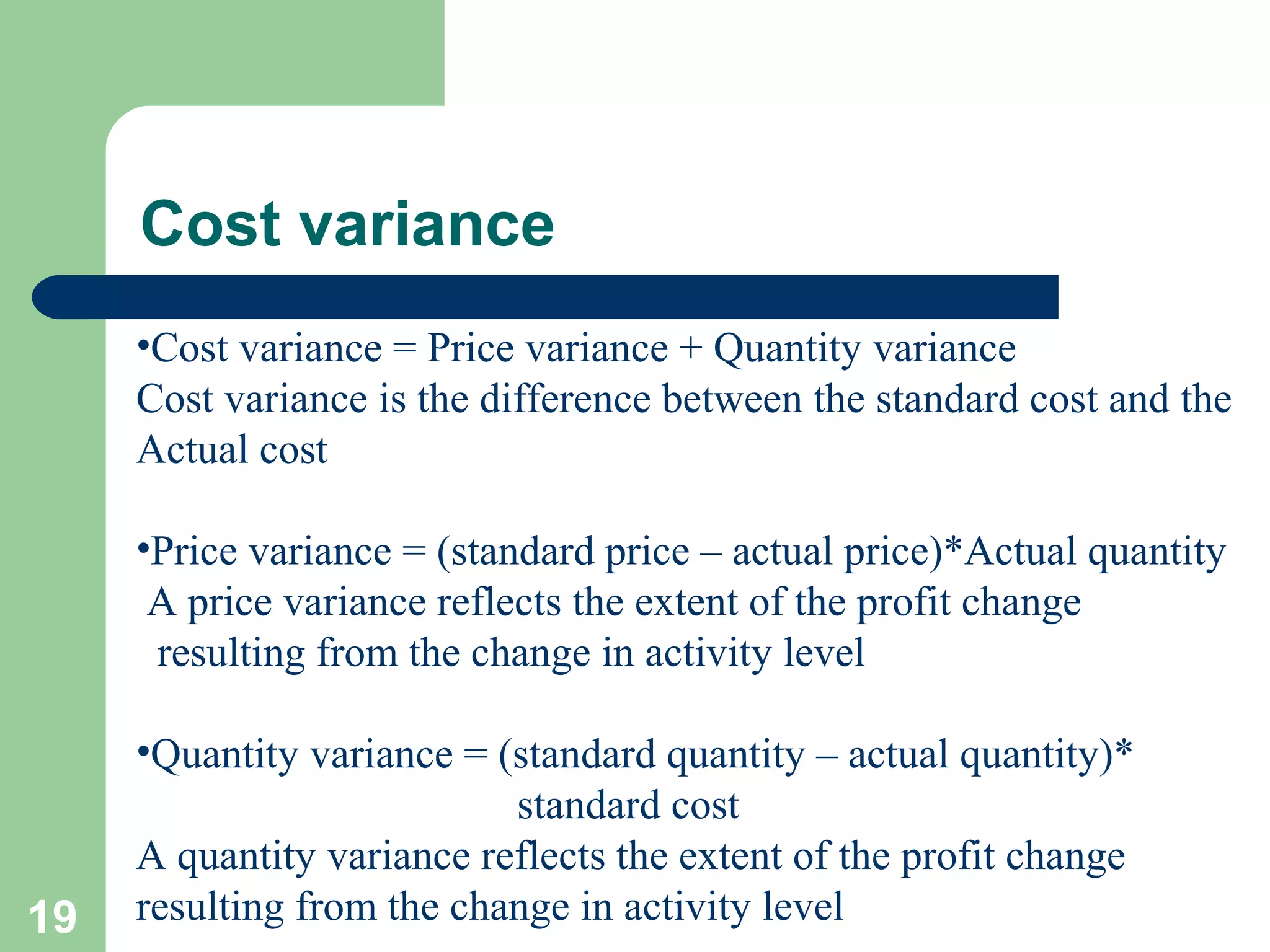
•Cost variance = Price variance + Quantity variance
Cost variance is the difference between the standard cost and the
Actual cost
•Price variance = (standard price – actual price)*Actual quantity
A price variance reflects the extent of the profit change
resulting from the change in activity level

19

•Quantity variance = (standard quantity – actual quantity)*
standard cost
A quantity variance reflects the extent of the profit change
resulting from the change in activity level
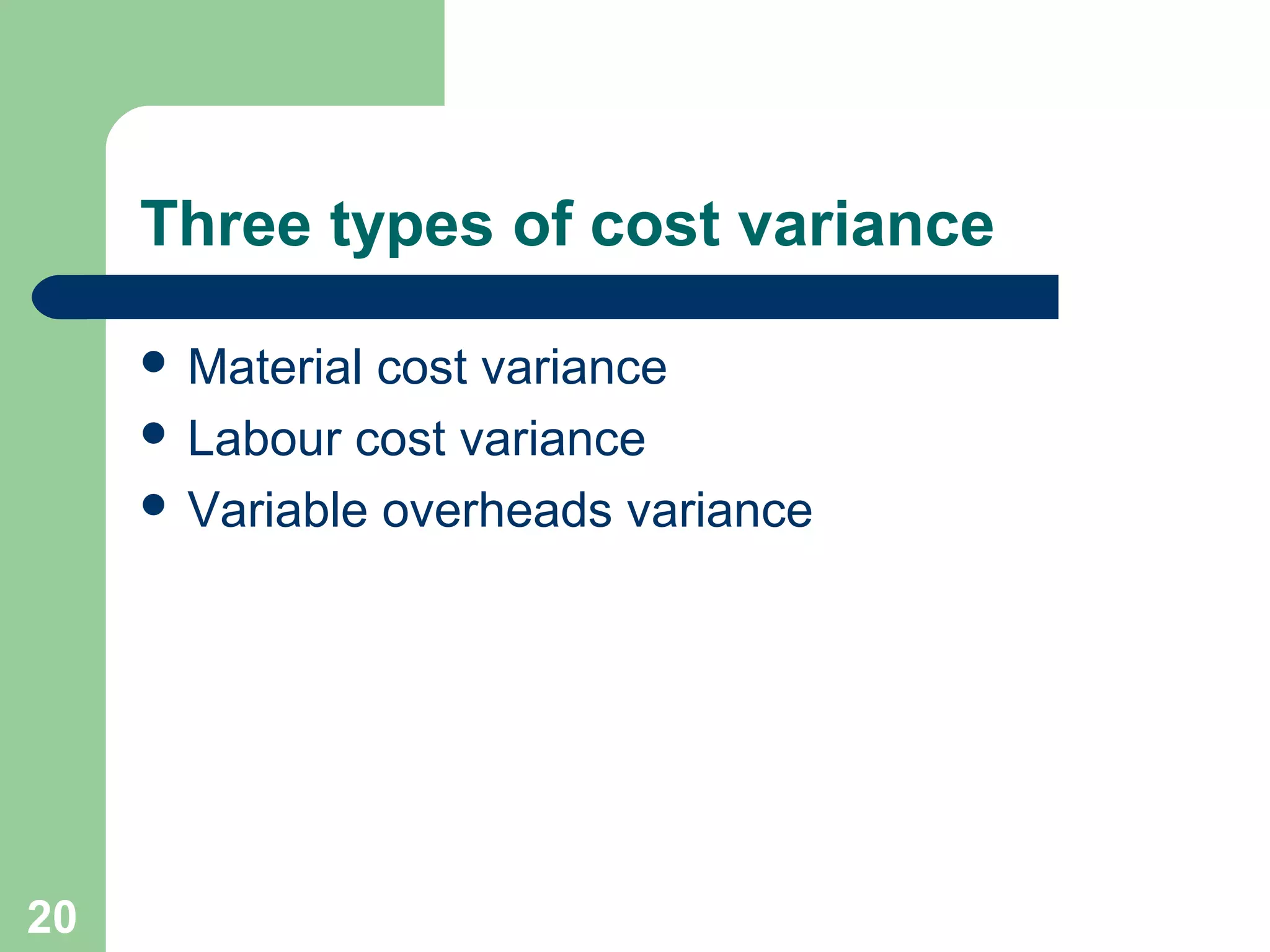
Three types of cost variance
 Material

cost variance
 Labour cost variance
 Variable overheads variance

20
Material and labour variance

21
22
23
Material cost variance






24

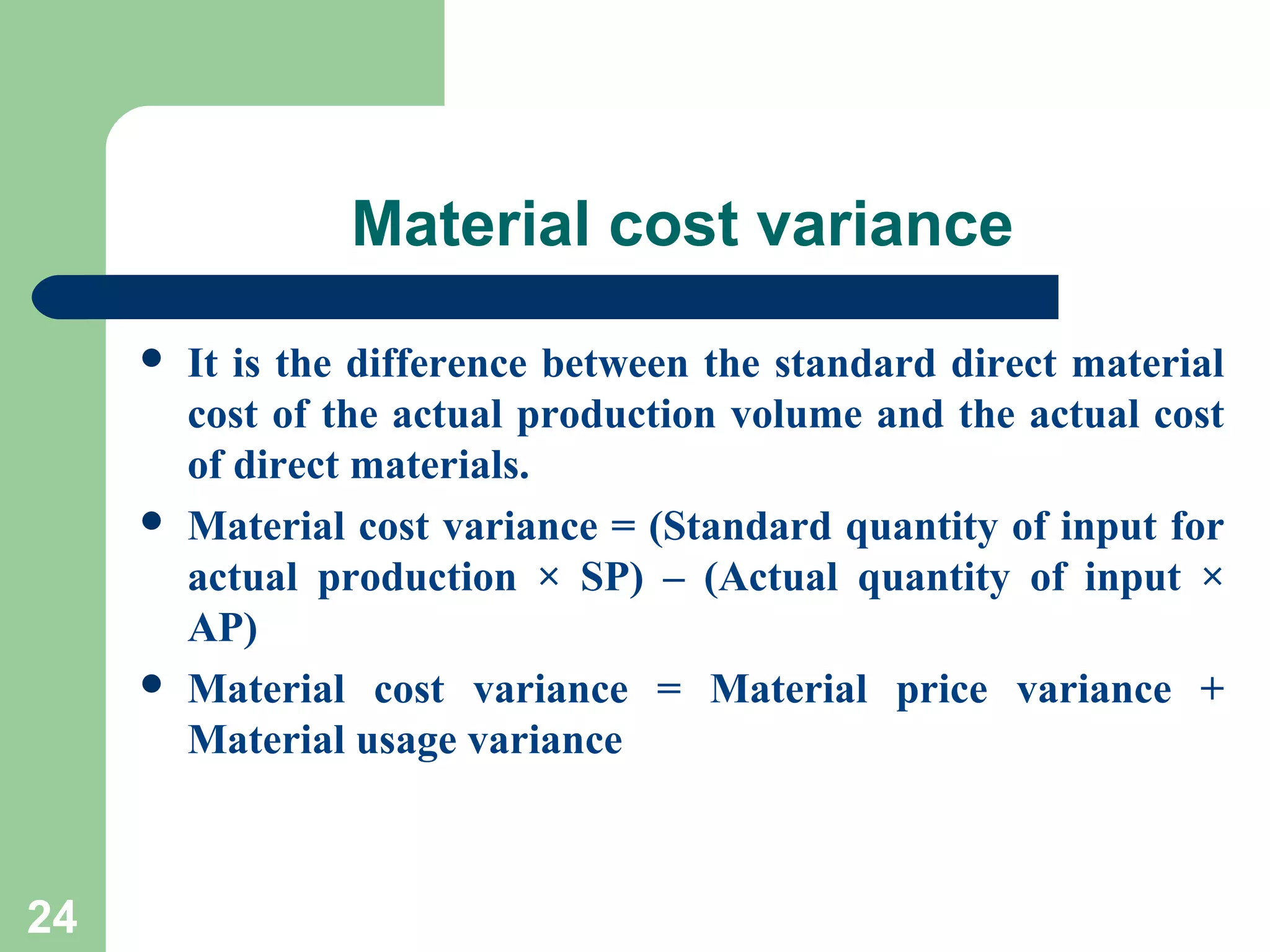
It is the difference between the standard direct material
cost of the actual production volume and the actual cost
of direct materials.
Material cost variance = (Standard quantity of input for
actual production × SP) – (Actual quantity of input ×
AP)
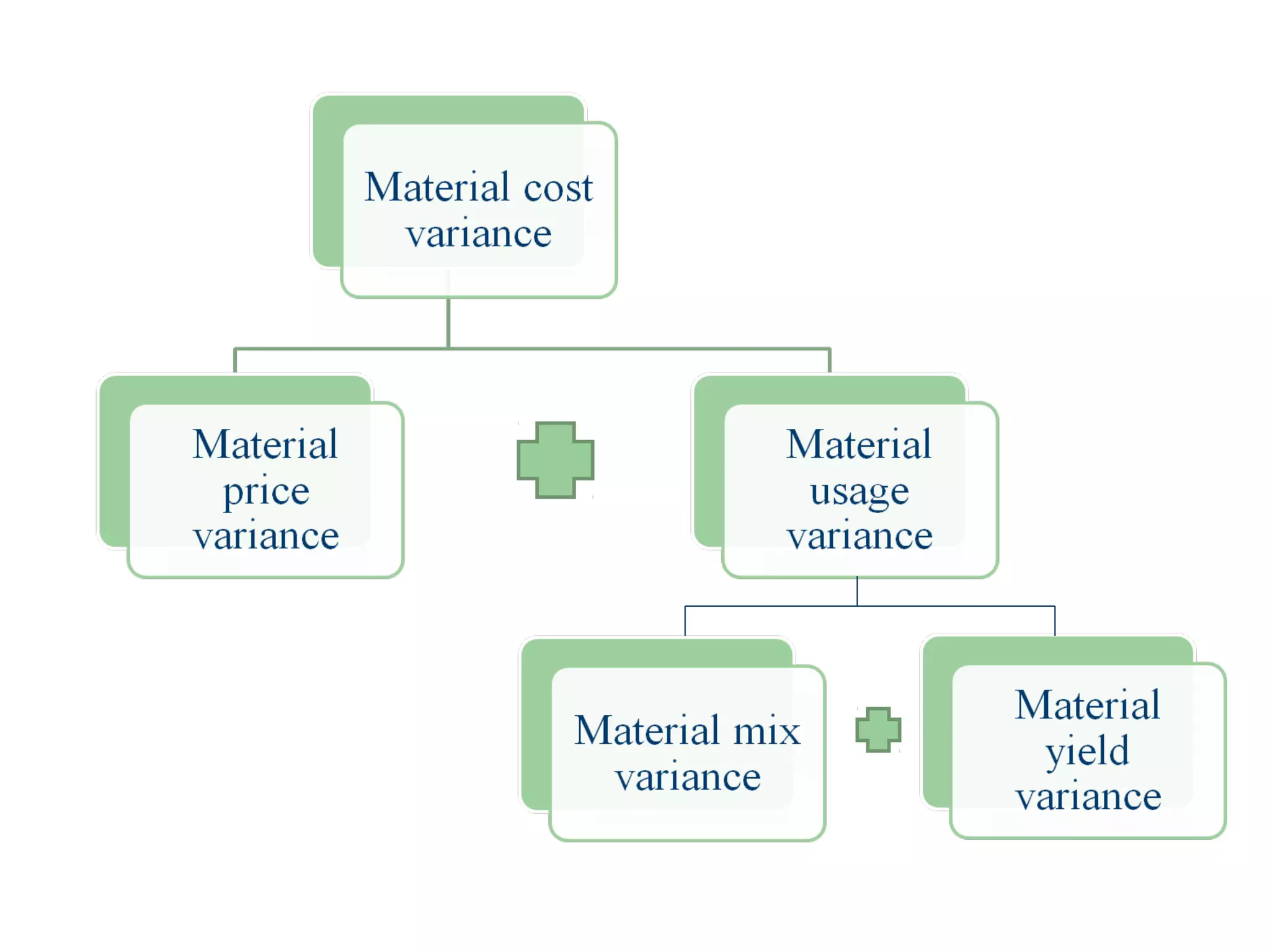
Material cost variance = Material price variance +
Material usage variance
Material cost variance
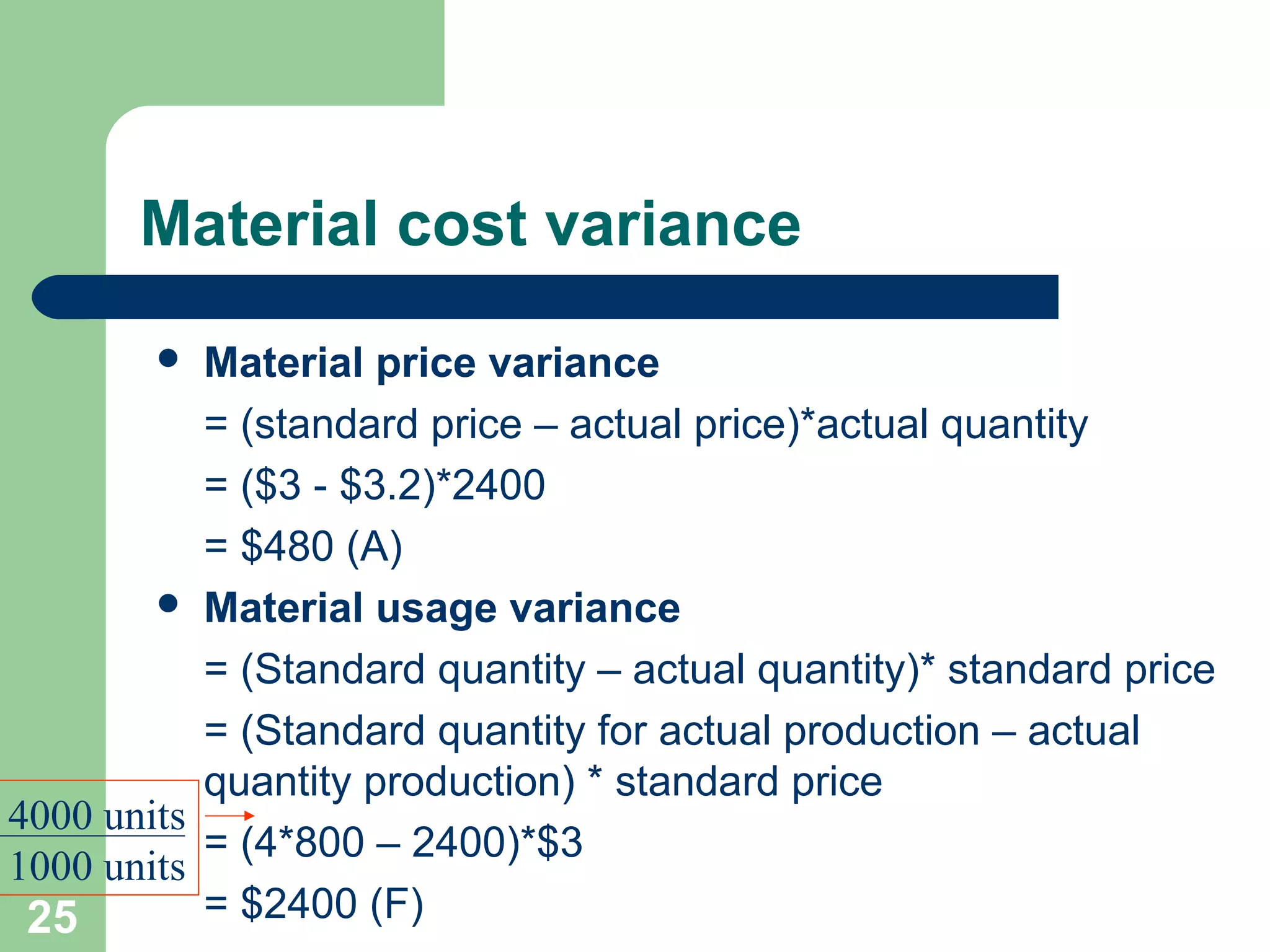
Material price variance
= (standard price – actual price)*actual quantity
= ($3 - $3.2)*2400
= $480 (A)
 Material usage variance
= (Standard quantity – actual quantity)* standard price
= (Standard quantity for actual production – actual
quantity production) * standard price
4000 units
= (4*800 – 2400)*$3
1000 units
= $2400 (F)
25

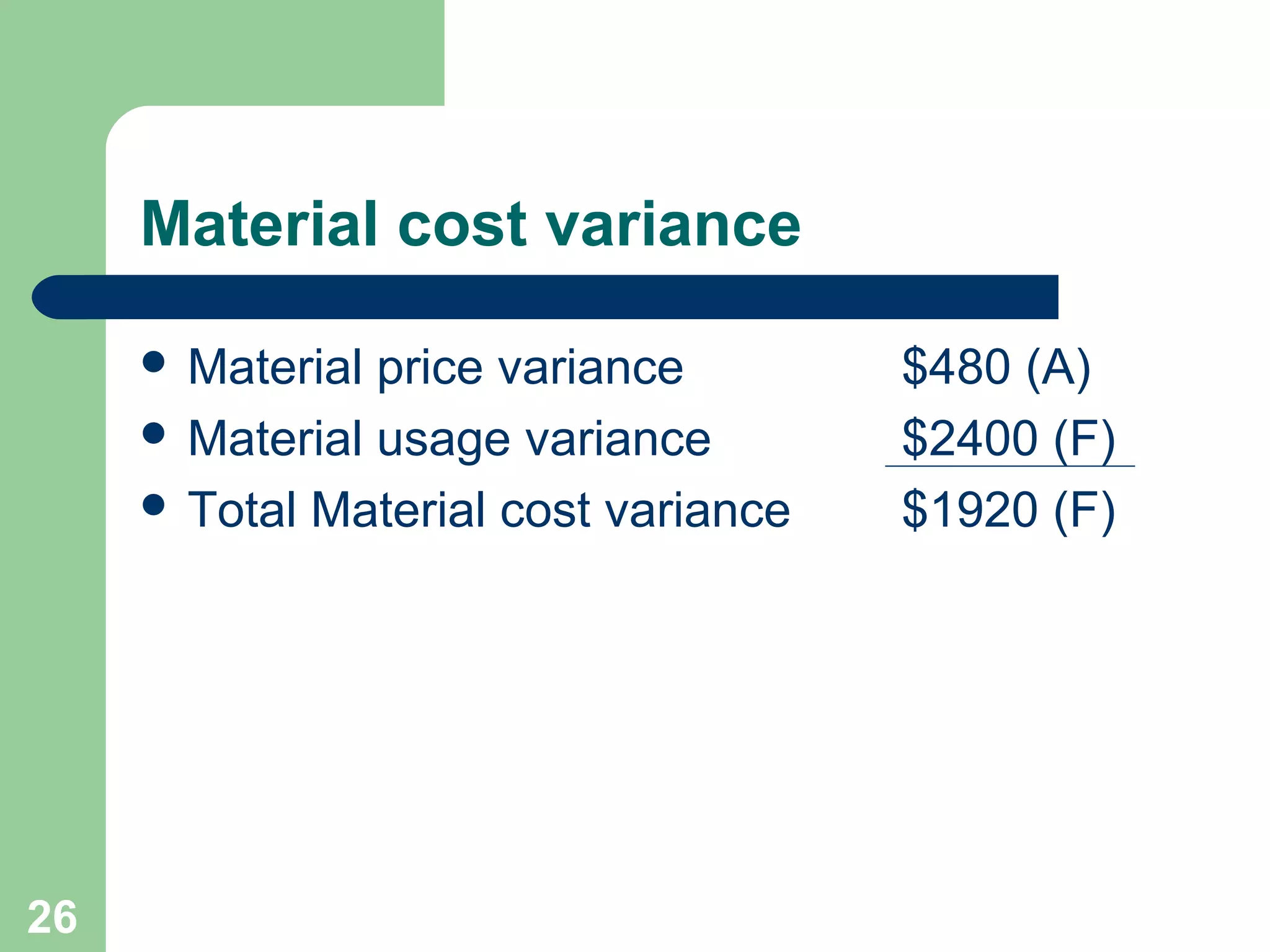
Material cost variance
 Material

price variance
 Material usage variance
 Total Material cost variance

26

$480 (A)
$2400 (F)
$1920 (F)
Material price variance
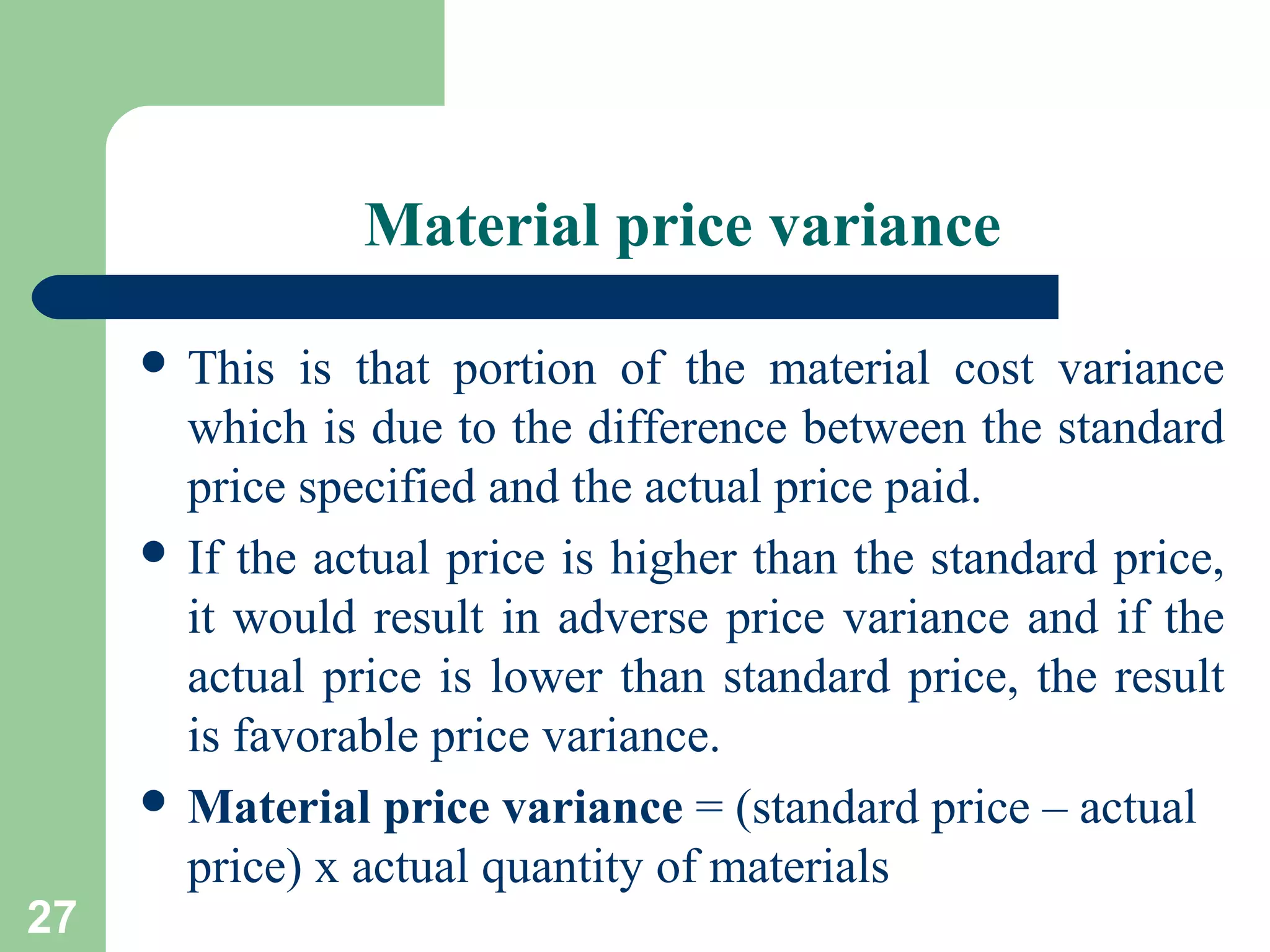
 This

27

is that portion of the material cost variance
which is due to the difference between the standard
price specified and the actual price paid.
 If the actual price is higher than the standard price,
it would result in adverse price variance and if the
actual price is lower than standard price, the result
is favorable price variance.
 Material price variance = (standard price – actual
price) x actual quantity of materials
Material Usage Variance
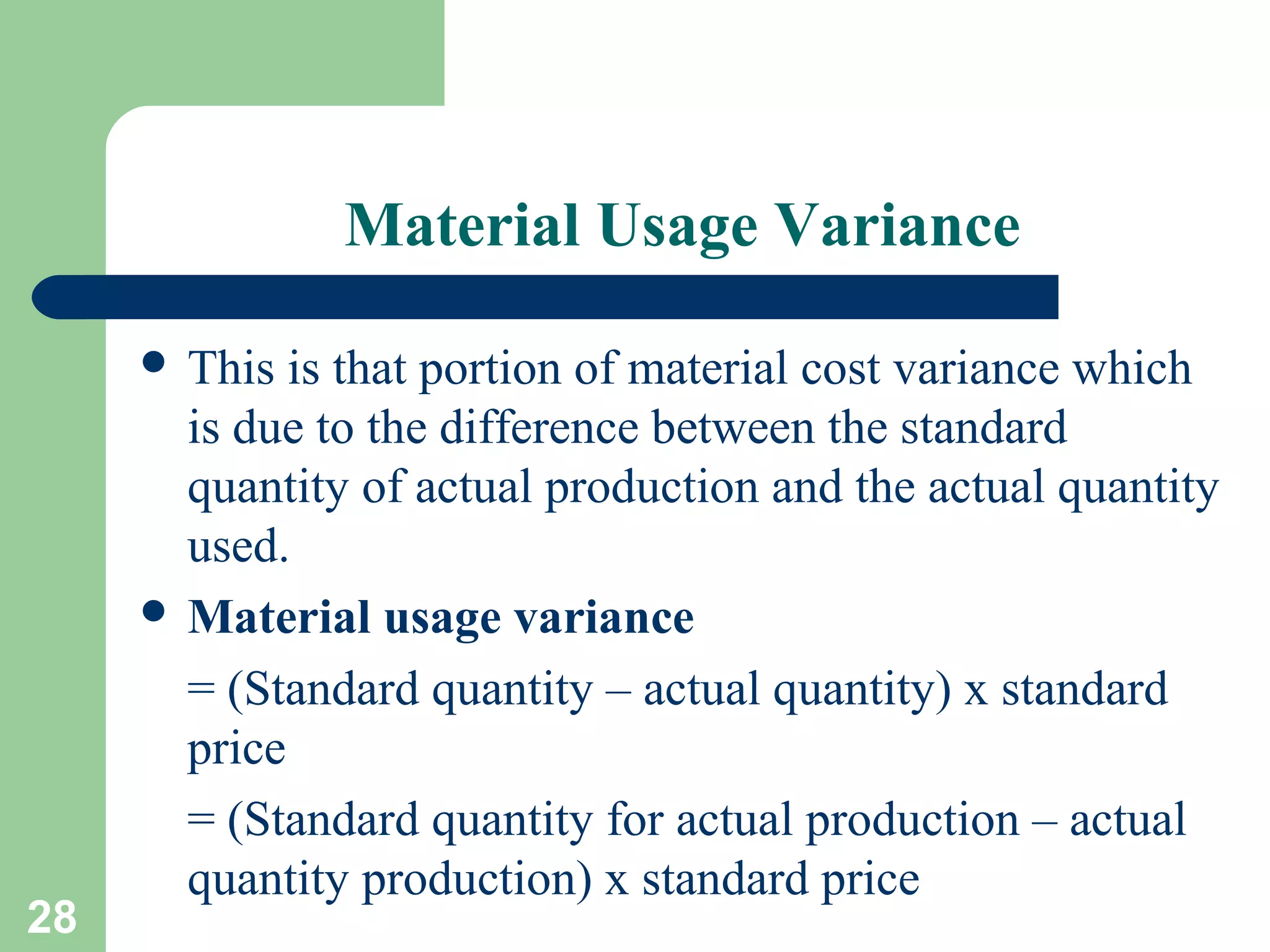
 This

28

is that portion of material cost variance which
is due to the difference between the standard
quantity of actual production and the actual quantity
used.
 Material usage variance
= (Standard quantity – actual quantity) x standard
price
= (Standard quantity for actual production – actual
quantity production) x standard price
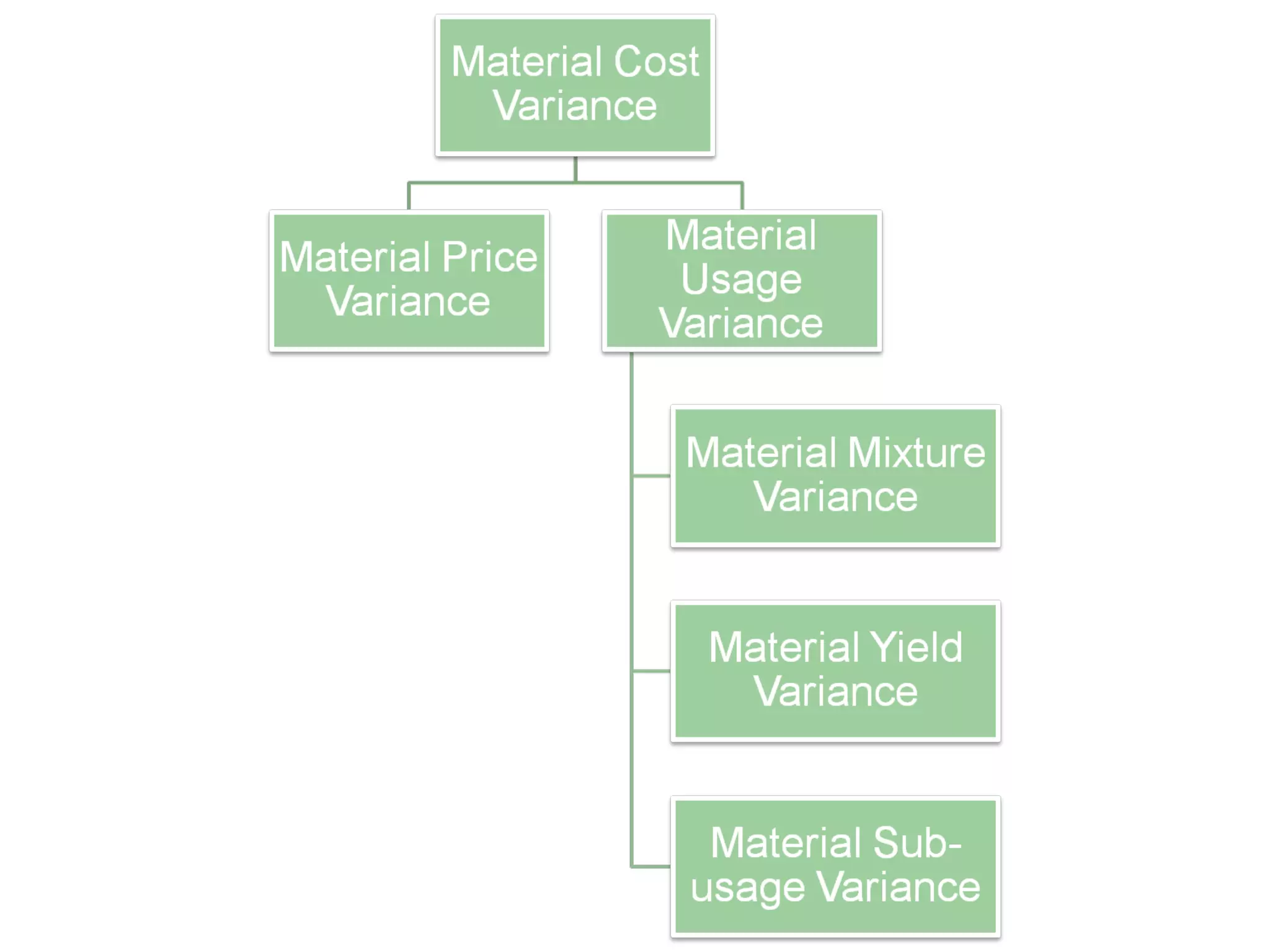
Material Mix Variance
 This

is that portion of usage variance which is due
to the difference between the standard and actual
composition of mixture.
 Material Mixture Variance = Standard price
[Actual quantity in standard mix (i.e. RSQ) – Actual
quantity]
 Revised Standard quantity = Total actual quantity
consumed ×
29
Material Yield Variance
 This

variance arises due to the difference between
the standard yield specified and actual yield
obtained.
 Material yield variance = [(Standard loss in terms
of actual input) – (Actual loss on actual input)] ×
(Average standard price)
 Material yield variance = Material usage variance
– Material mix variance
30
Material Sub-usage Variance
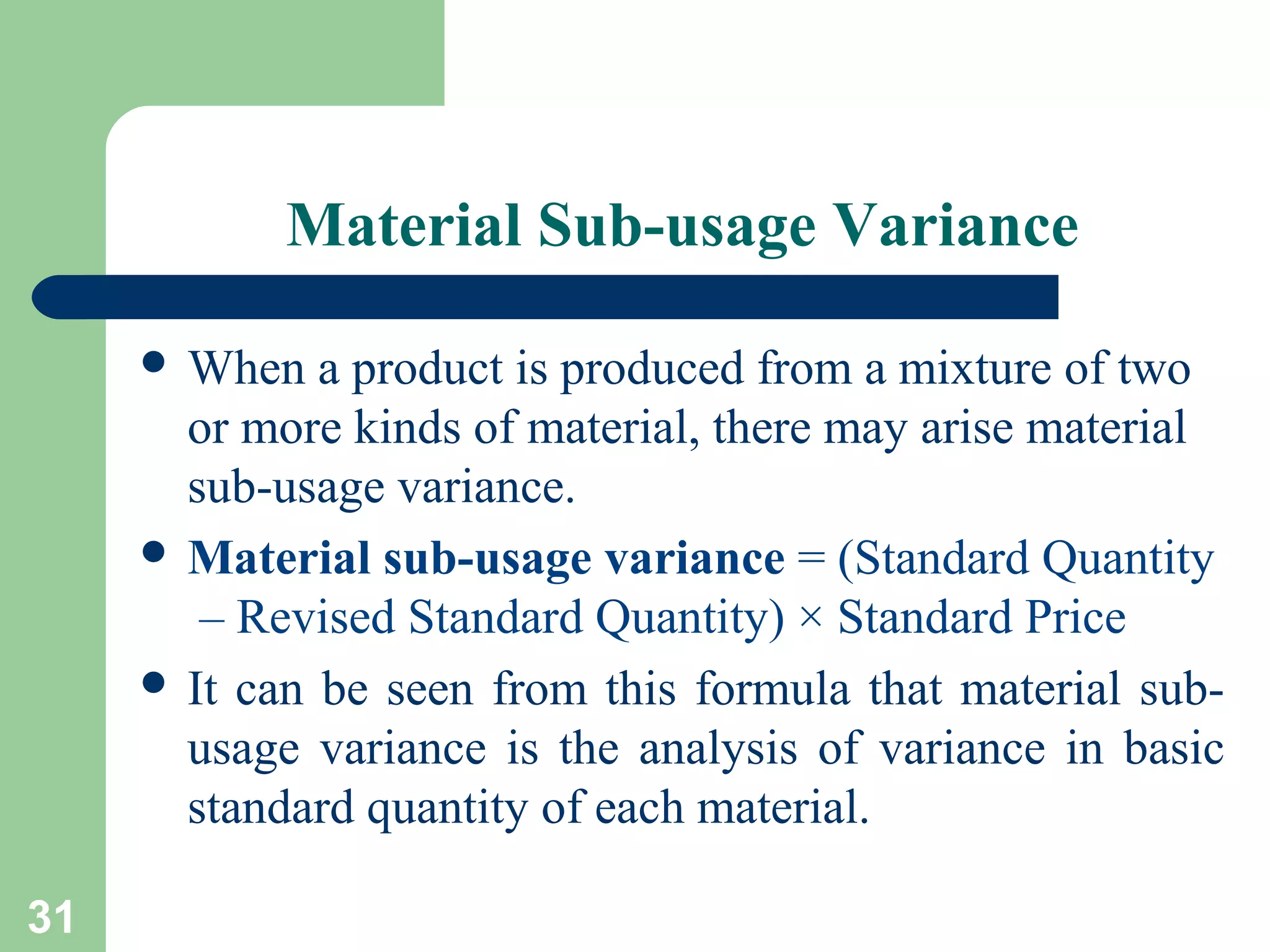
 When

a product is produced from a mixture of two
or more kinds of material, there may arise material
sub-usage variance.
 Material sub-usage variance = (Standard Quantity
– Revised Standard Quantity) × Standard Price
 It can be seen from this formula that material subusage variance is the analysis of variance in basic
standard quantity of each material.
31
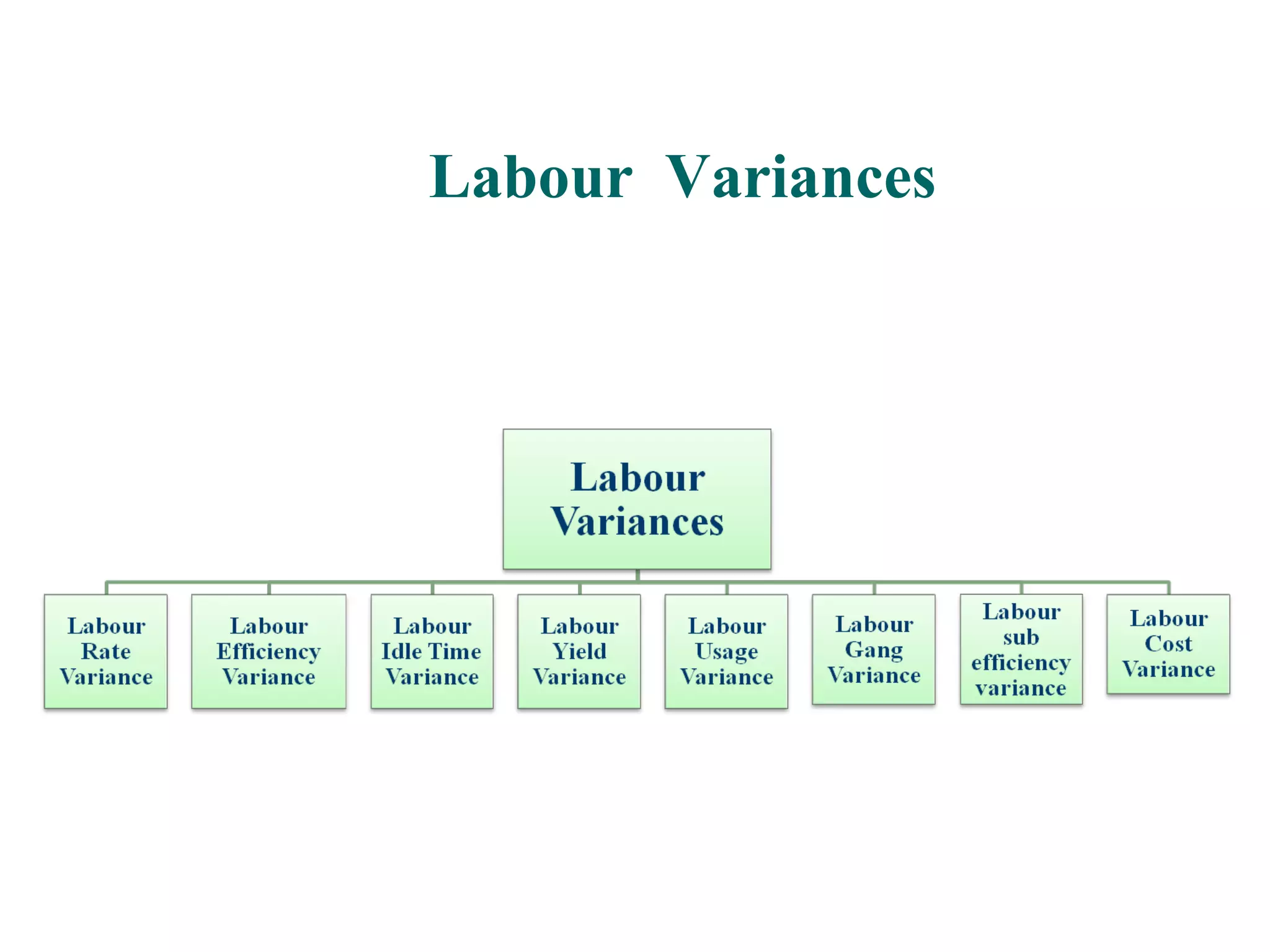
Labour Variances

32
Formulas Of Labour Variances










33

Labour rate variance = (standard price – actual price) x actual
hours
Labour Idle Time Variance = [(actual hrs.- idle time) x standard
price] – (actual hrs. x standard price)
Labour Gang variance = [revised(actual hrs.- idle time) x standard
price] – [(actual hrs.- idle time) x standard price]
Labour Yield variance = [revised(actual hrs.- idle time) x standard
price x (actual output/standard output)] - [revised(actual hrs.- idle
time) x standard price]
Labour sub-efficiency variance = (standard hrs. x standard price)
- [revised(actual hrs.- idle time) x standard price x (actual
output/standard output)]






34

Labour Cost Variance = (standard hrs. x standard price) –
(actual hrs. x actual price)
Labour Usage variance = standard price x (standard hrs. –
actual hrs.)
Labour efficiency variance = (standard hrs. x standard price) [revised(actual hrs.- idle time) x standard price]
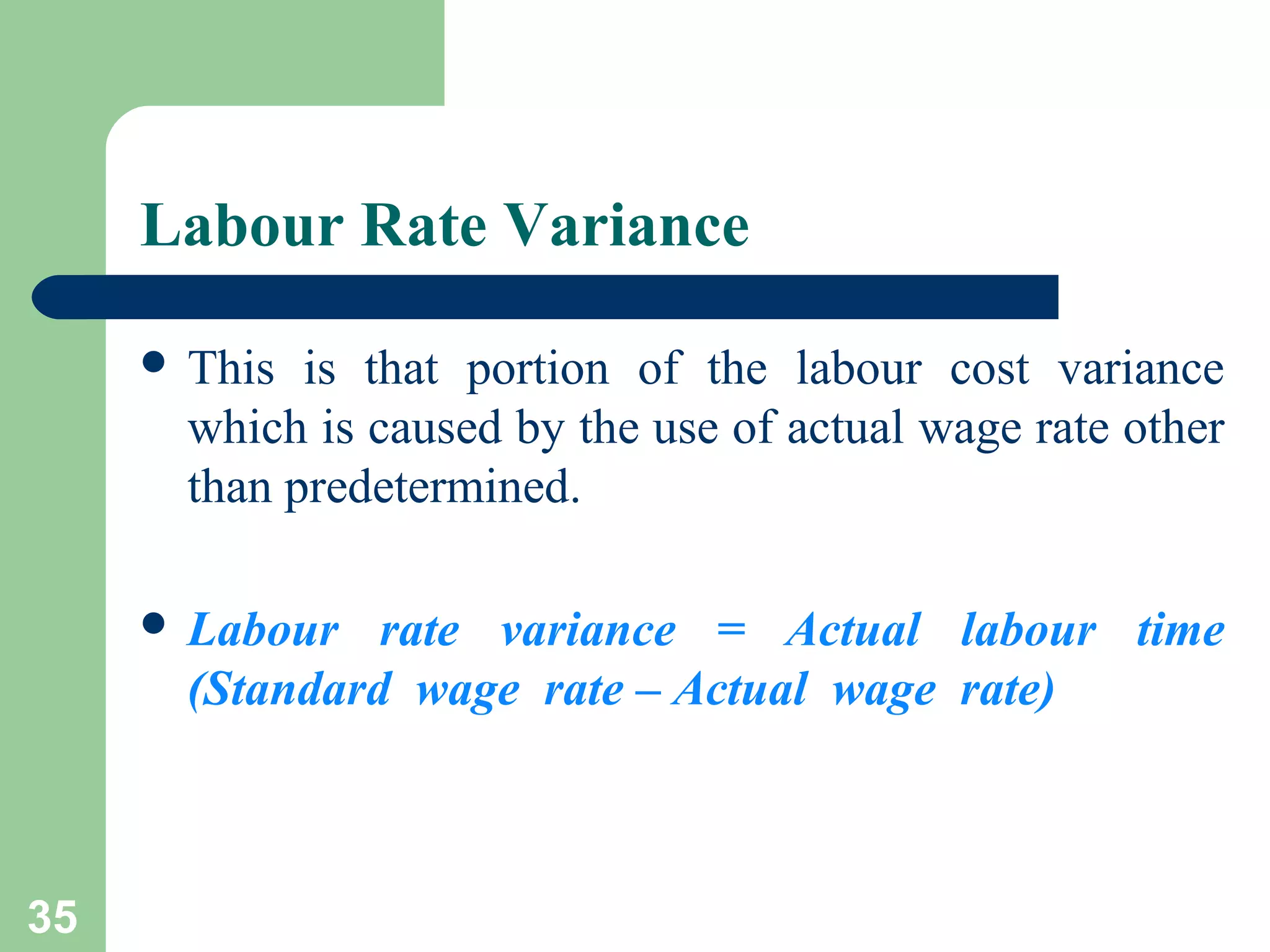
Labour Rate Variance
 This

is that portion of the labour cost variance
which is caused by the use of actual wage rate other
than predetermined.

 Labour

rate variance = Actual labour time
(Standard wage rate – Actual wage rate)

35
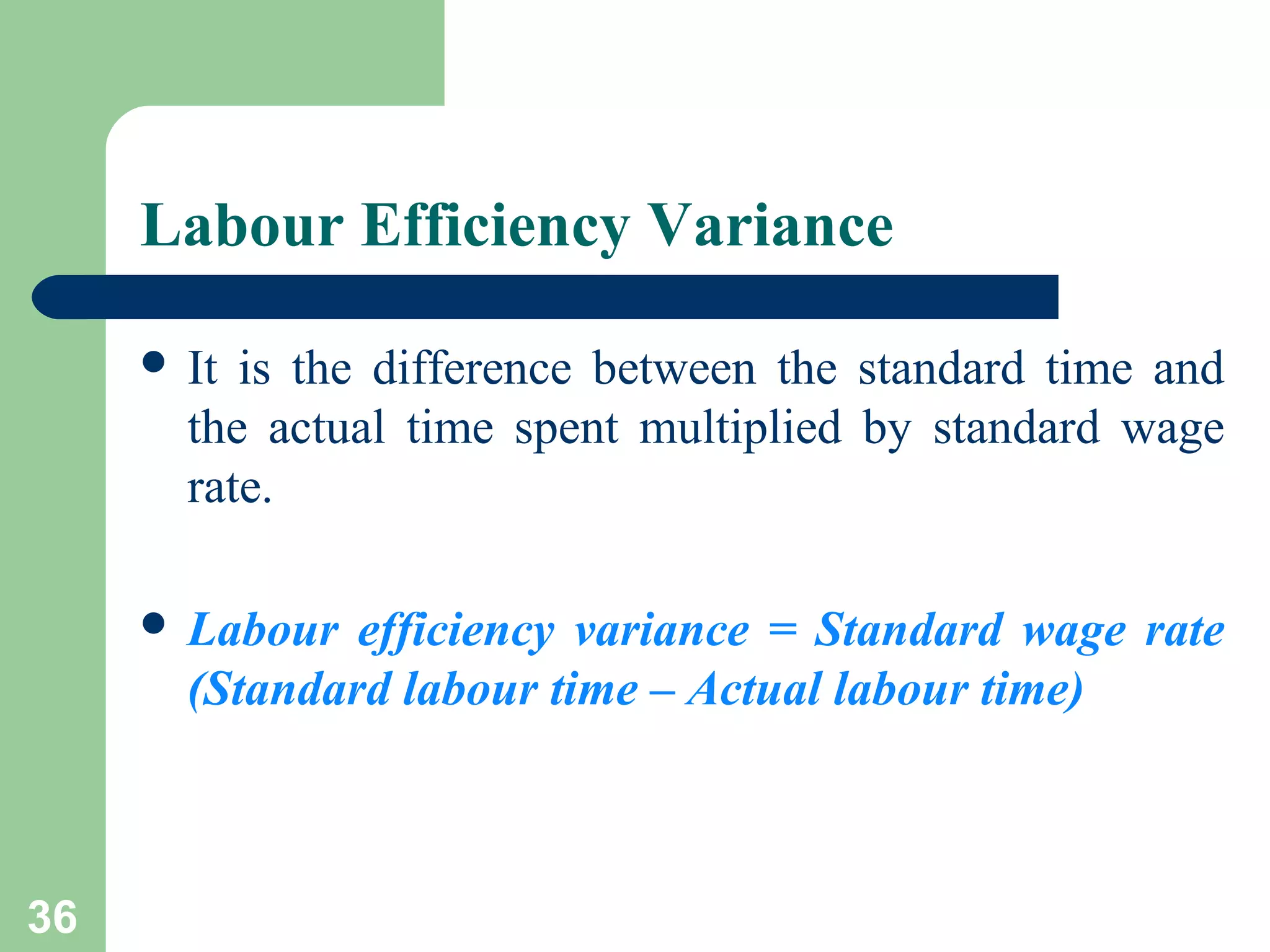
Labour Efficiency Variance
 It

is the difference between the standard time and
the actual time spent multiplied by standard wage
rate.

 Labour

efficiency variance = Standard wage rate
(Standard labour time – Actual labour time)

36
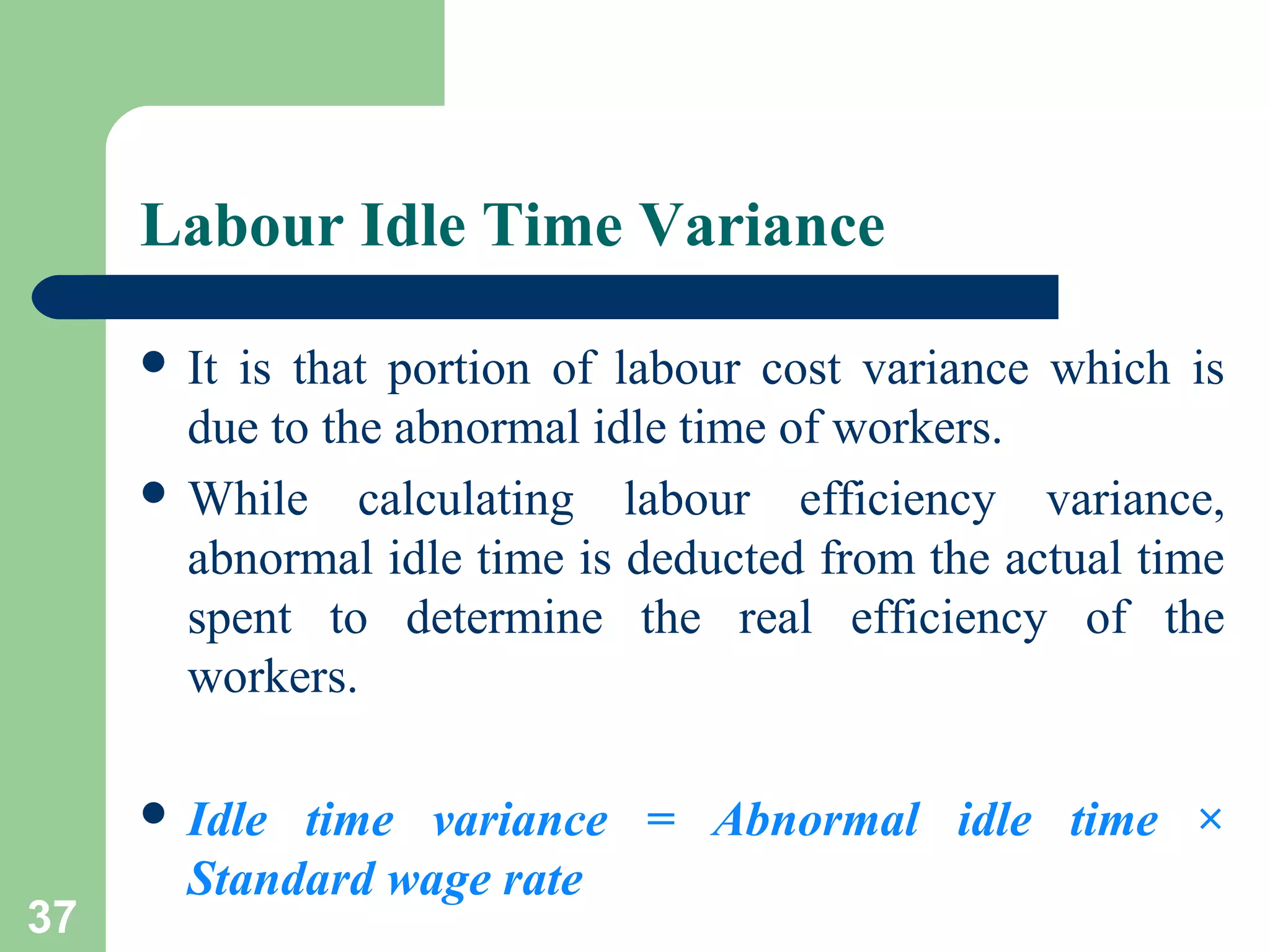
Labour Idle Time Variance
 It

is that portion of labour cost variance which is
due to the abnormal idle time of workers.
 While calculating labour efficiency variance,
abnormal idle time is deducted from the actual time
spent to determine the real efficiency of the
workers.
 Idle

37

time variance = Abnormal idle time ×
Standard wage rate
Labour Gang Variance
 This

variance arises due to the change in the
composition or mix of a group of workers as
compared to the standard composition or mix.

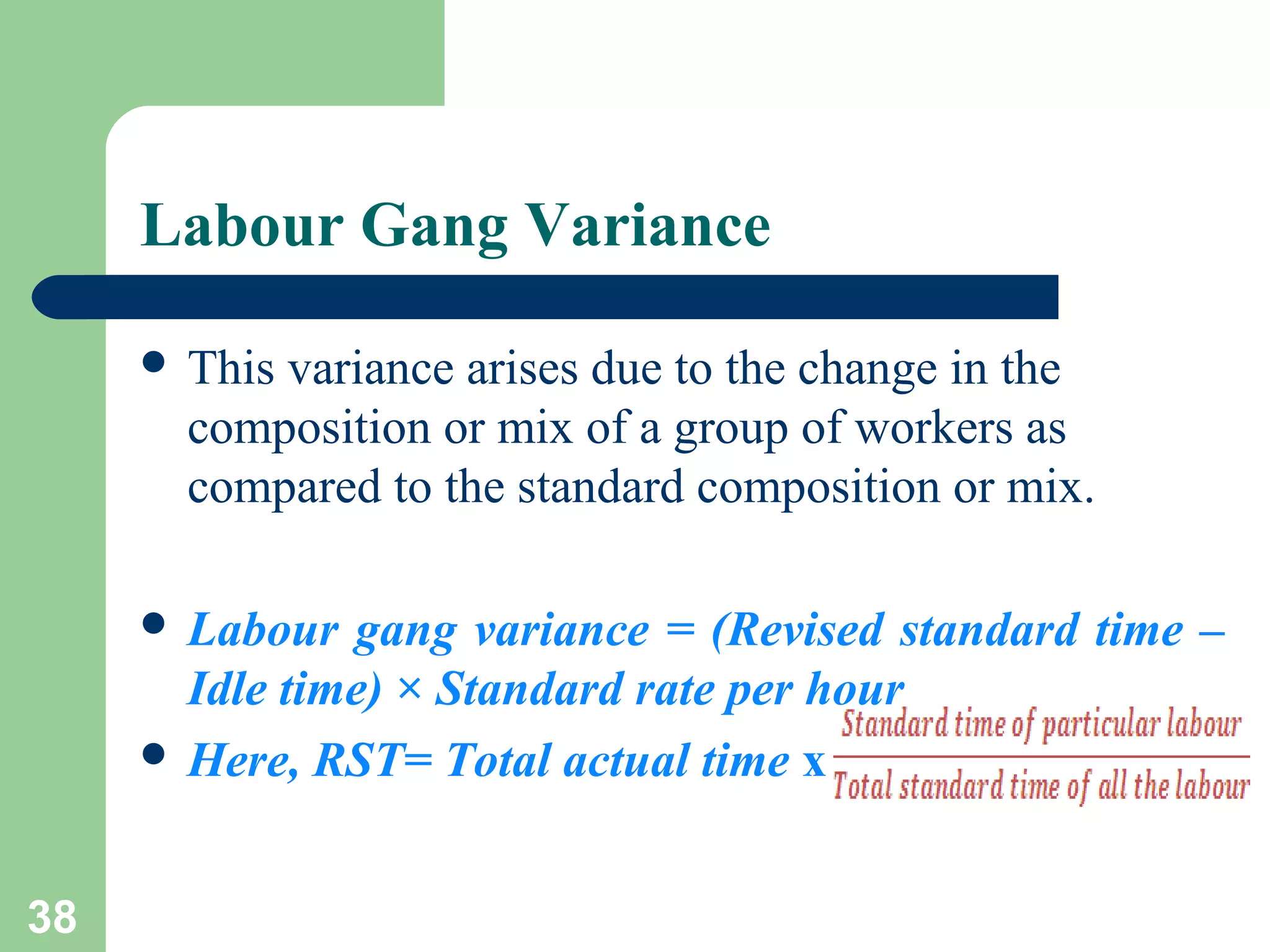
 Labour

gang variance = (Revised standard time –
Idle time) × Standard rate per hour
 Here, RST= Total actual time x
38
Labour Yield Variance
 It

is computed on the basis of the increase or
decrease in the actual yield or output when
compared to the standard.

 Labour

Yield Variance = [Actual yield – Standard
yield in units expected from the actual hours
worked] × Standard labour cost per unit

39
Labour Usage Variance
 Labour

Usage Variance is the measure of difference
between standard hours and actual hours,multiplied
by the standard rate.

 Labour

Usage variance = (standard hrs. –
actual hrs.) x standard price

40
Labour Cost Variance
 Labor

cost variance can be defined as the
deviation of the actual direct wages paid from
the direct wages specified for the standard
output.
 Labour Cost Variance= (Standard time x
Standard price)-(Actual time x Actual price)

41
Overheads variance

42
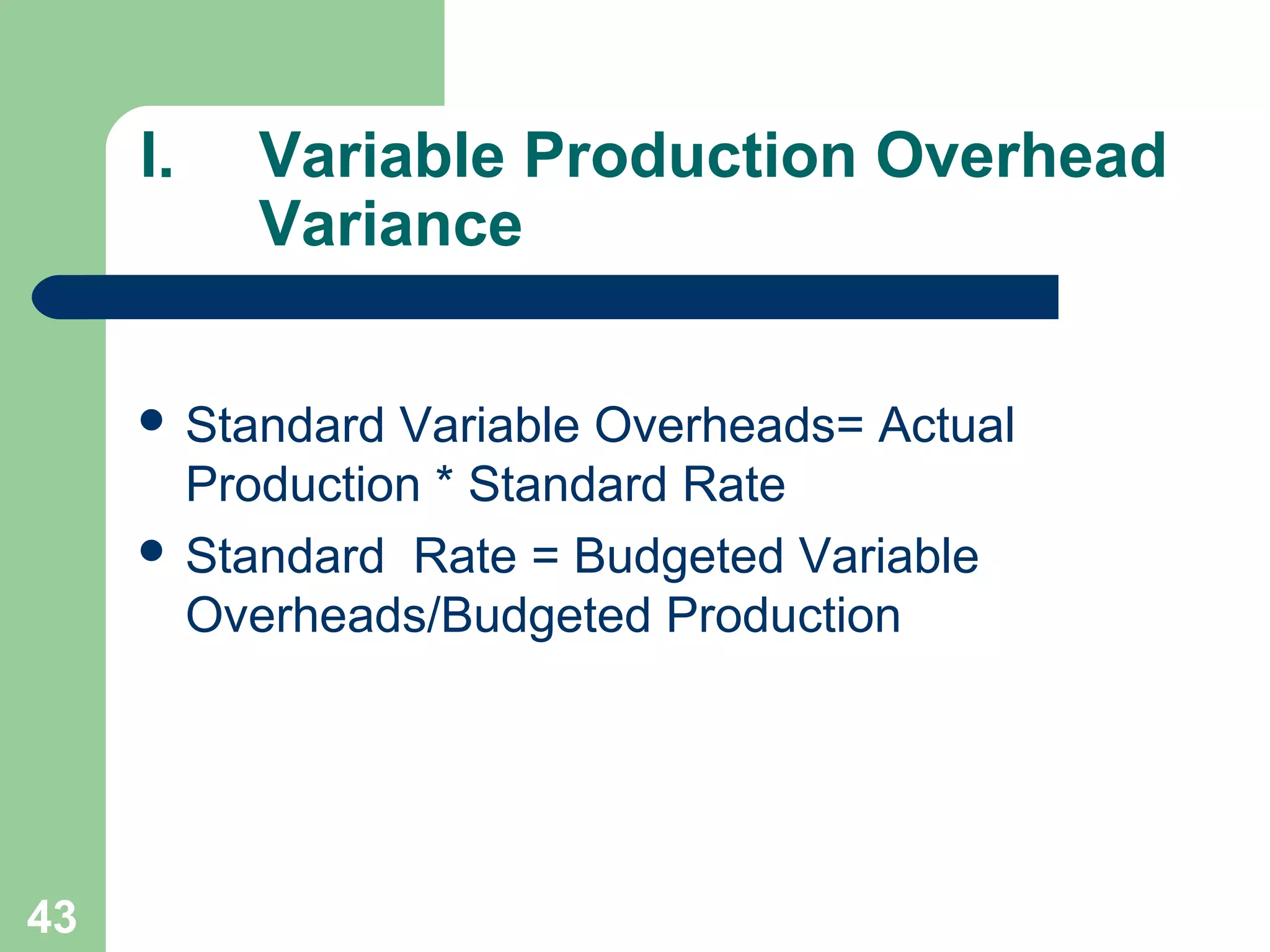
I.

Variable Production Overhead
Variance

 Standard

Variable Overheads= Actual
Production * Standard Rate
 Standard Rate = Budgeted Variable
Overheads/Budgeted Production

43
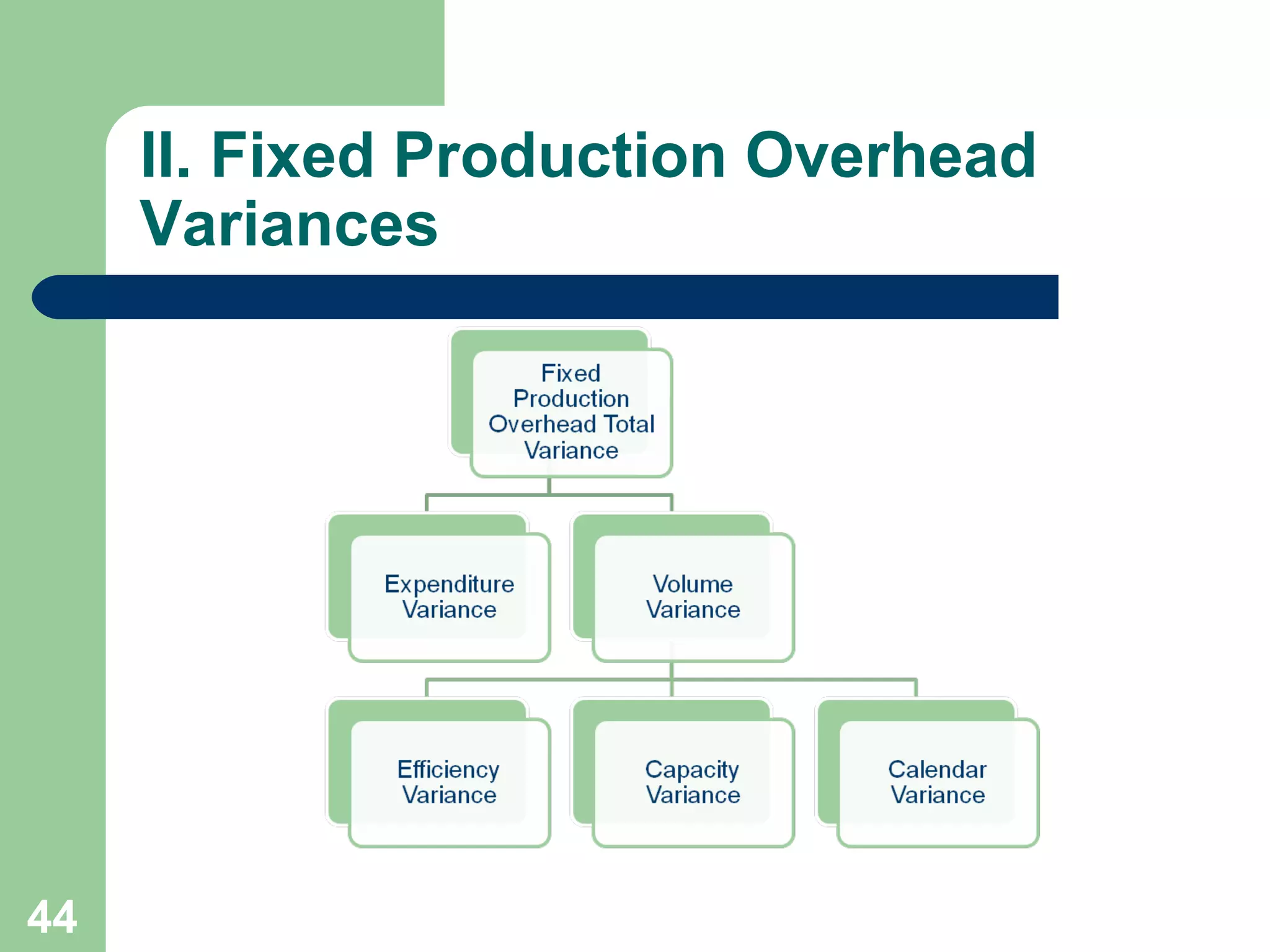
II. Fixed Production Overhead
Variances

44
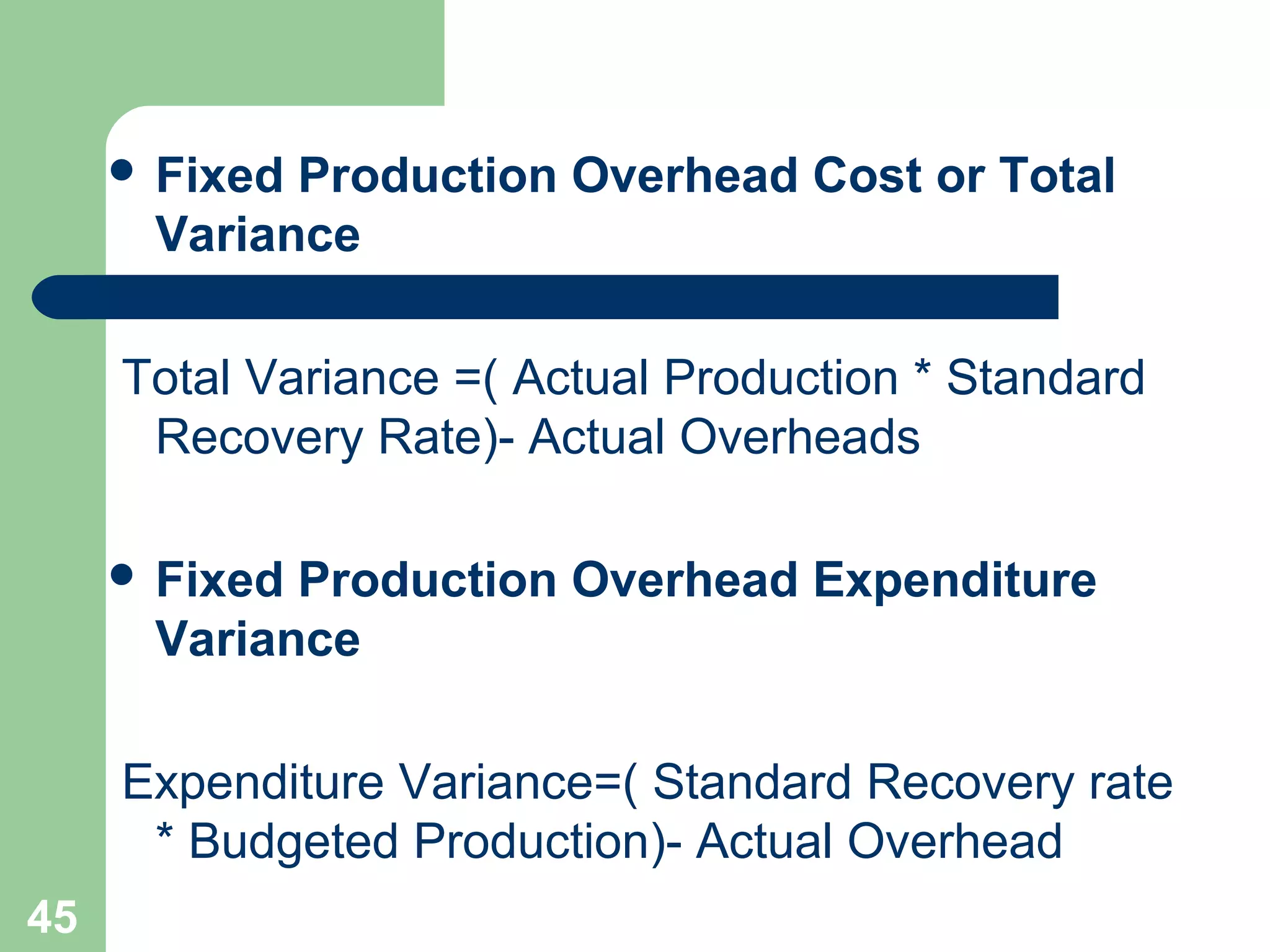
 Fixed

Production Overhead Cost or Total
Variance

Total Variance =( Actual Production * Standard
Recovery Rate)- Actual Overheads
 Fixed

Production Overhead Expenditure
Variance

Expenditure Variance=( Standard Recovery rate
* Budgeted Production)- Actual Overhead
45
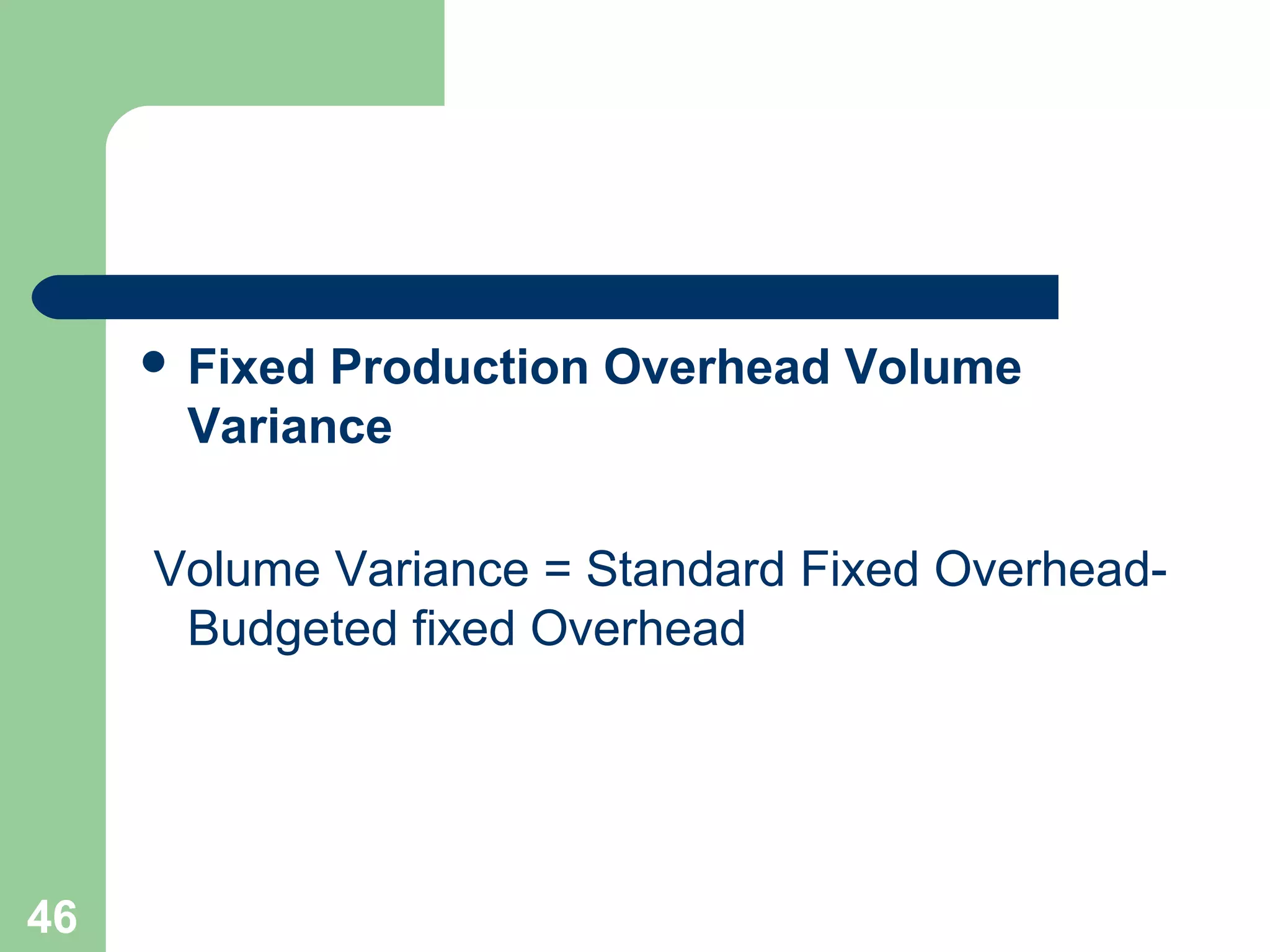
 Fixed

Production Overhead Volume
Variance

Volume Variance = Standard Fixed OverheadBudgeted fixed Overhead

46
SALES
 Sales

variances an b calculated in two ways:
A. The turnover or the volume method
B. The profit or the margin method

47
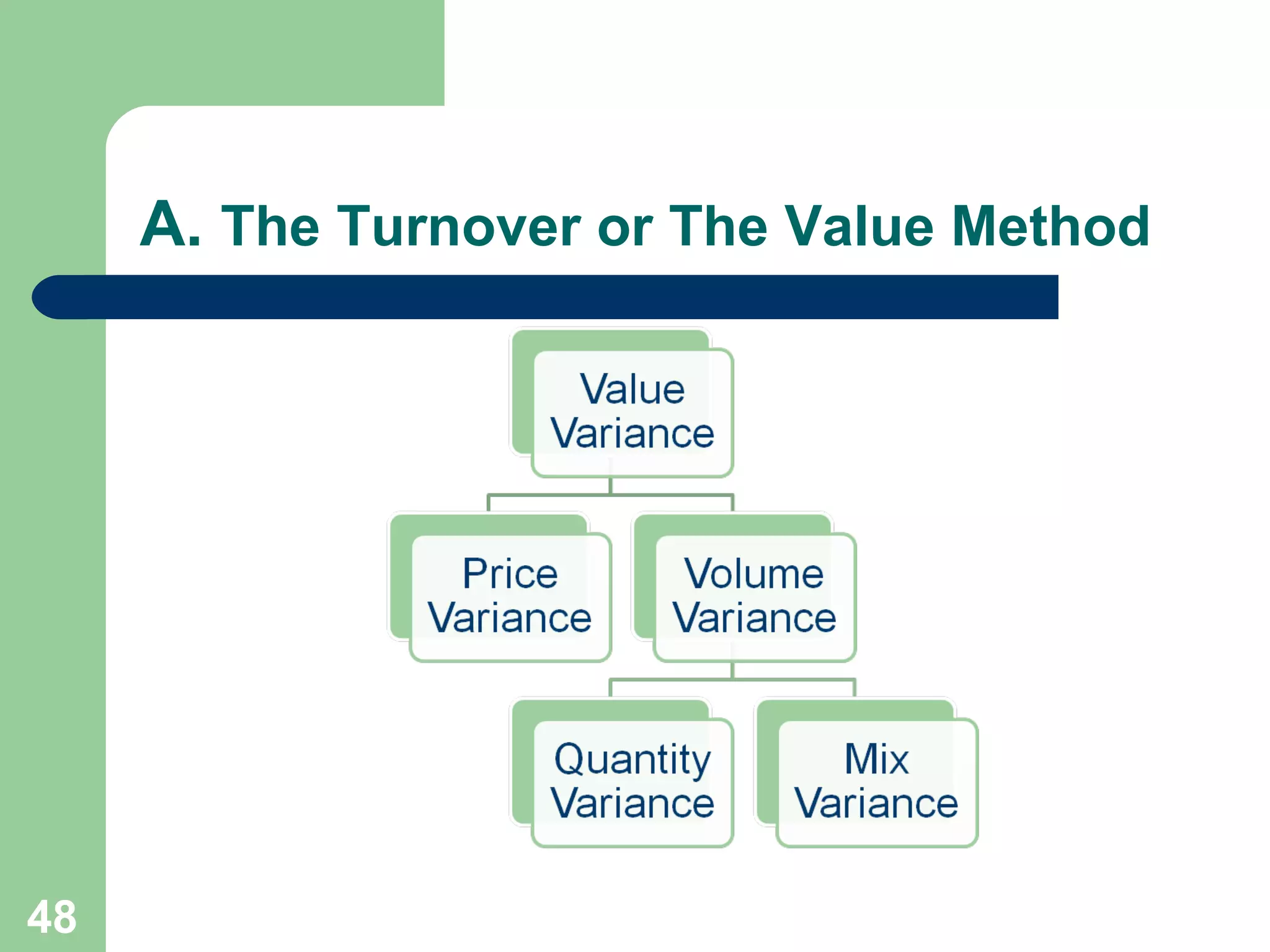
A. The Turnover or The Value Method

48
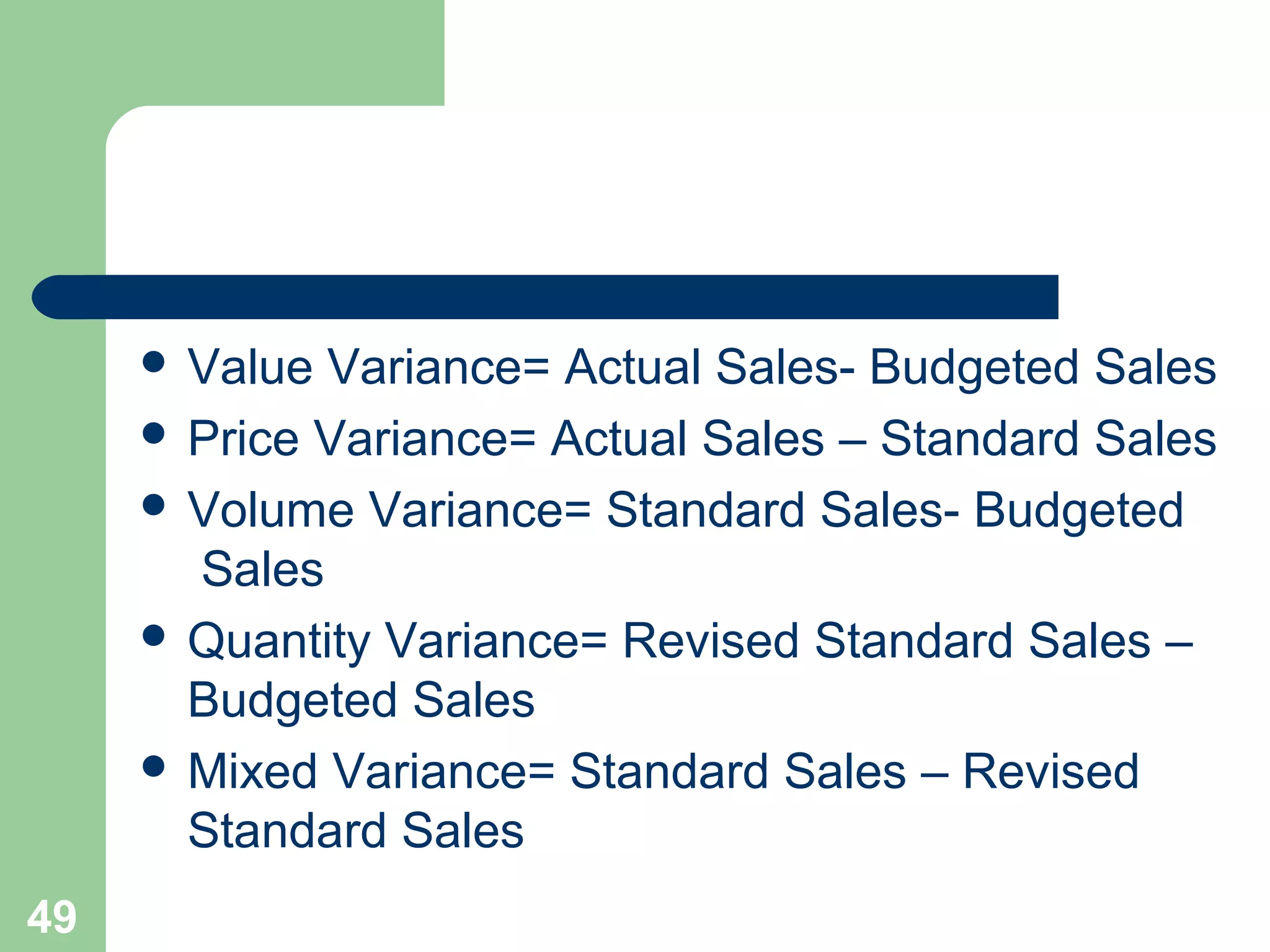
 Value

Variance= Actual Sales- Budgeted Sales
 Price Variance= Actual Sales – Standard Sales
 Volume Variance= Standard Sales- Budgeted
Sales
 Quantity Variance= Revised Standard Sales –
Budgeted Sales
 Mixed Variance= Standard Sales – Revised
Standard Sales
49
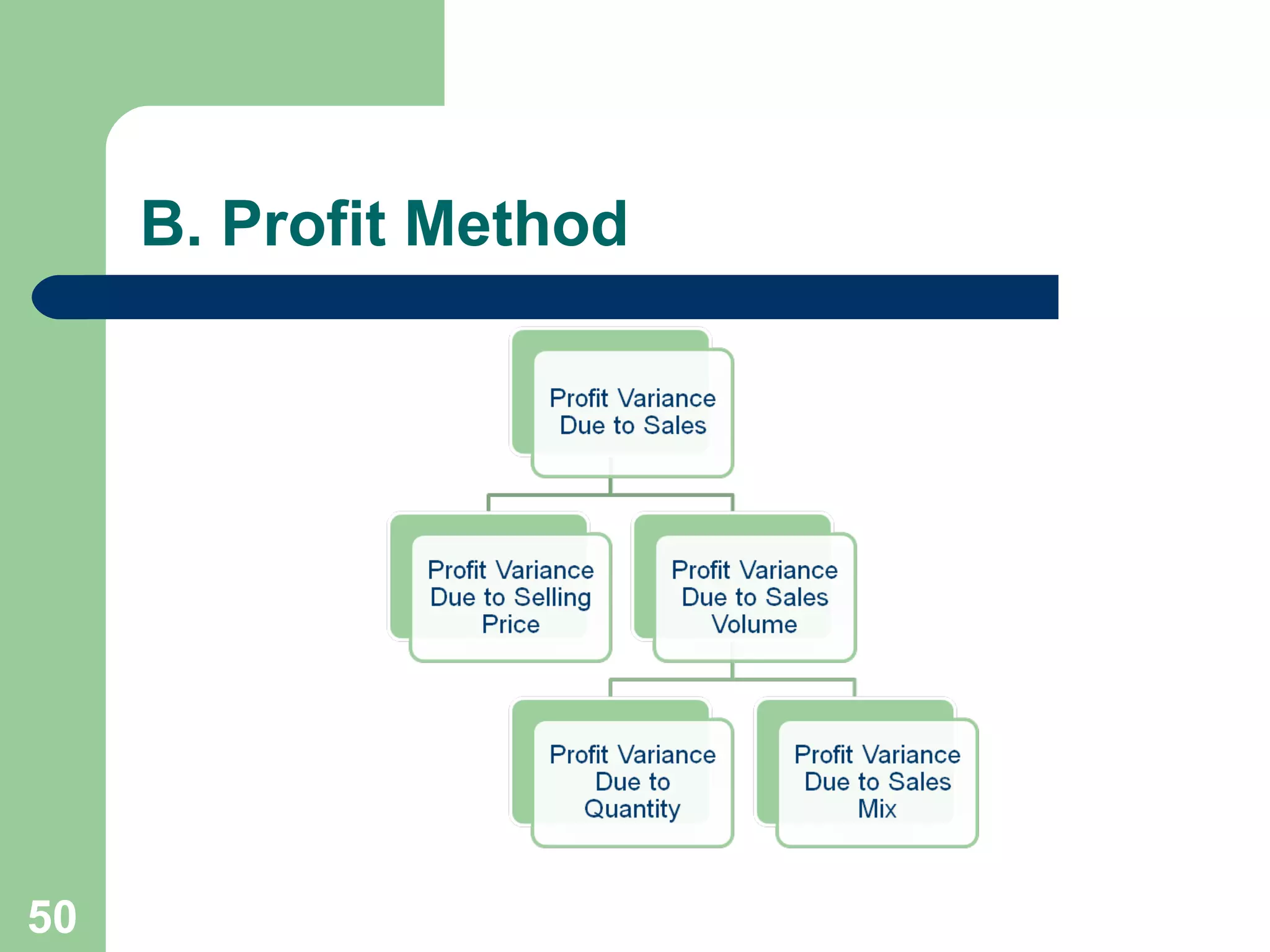
B. Profit Method

50
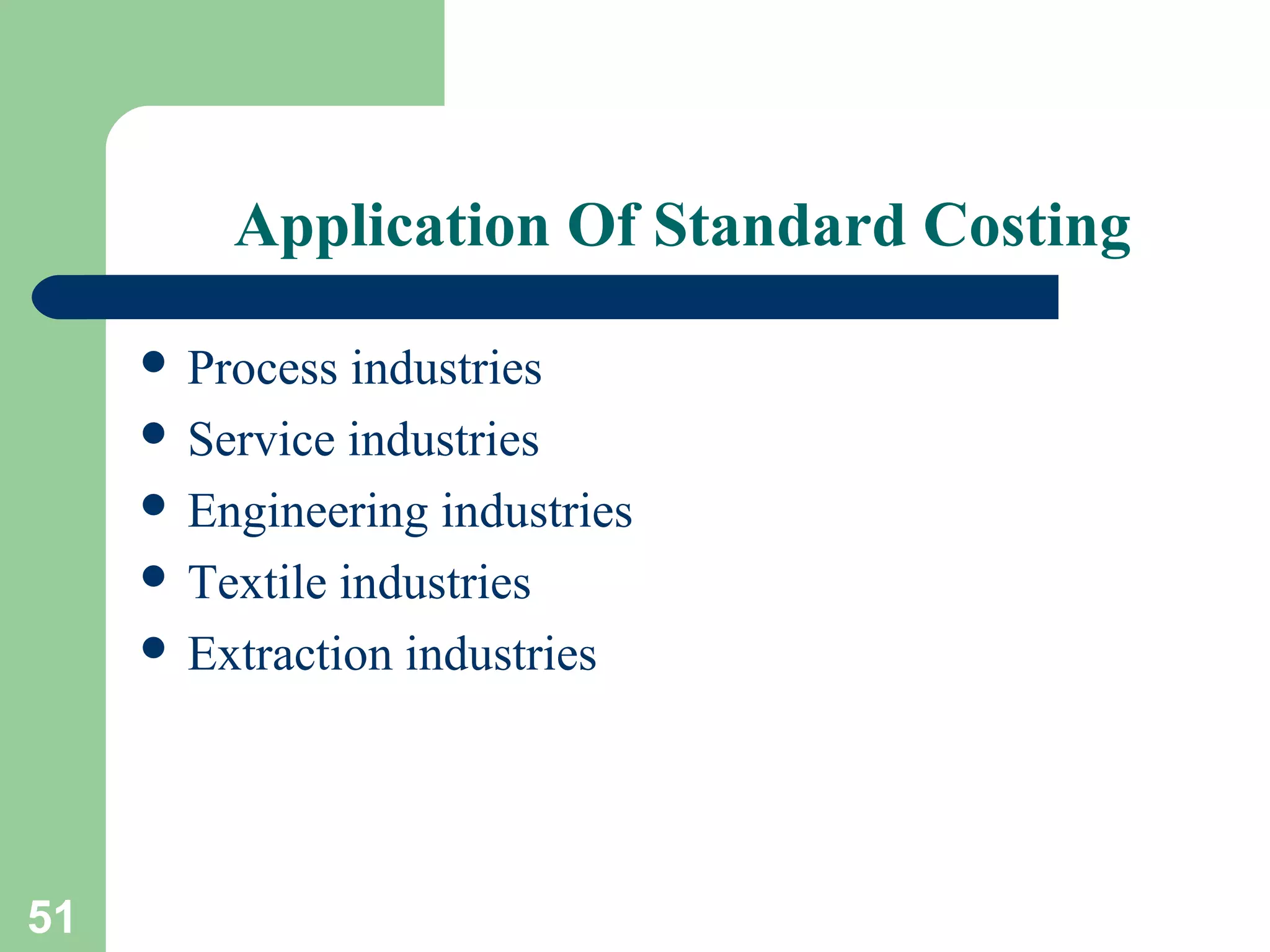
Application Of Standard Costing
 Process

industries
 Service industries
 Engineering industries
 Textile industries
 Extraction industries

51
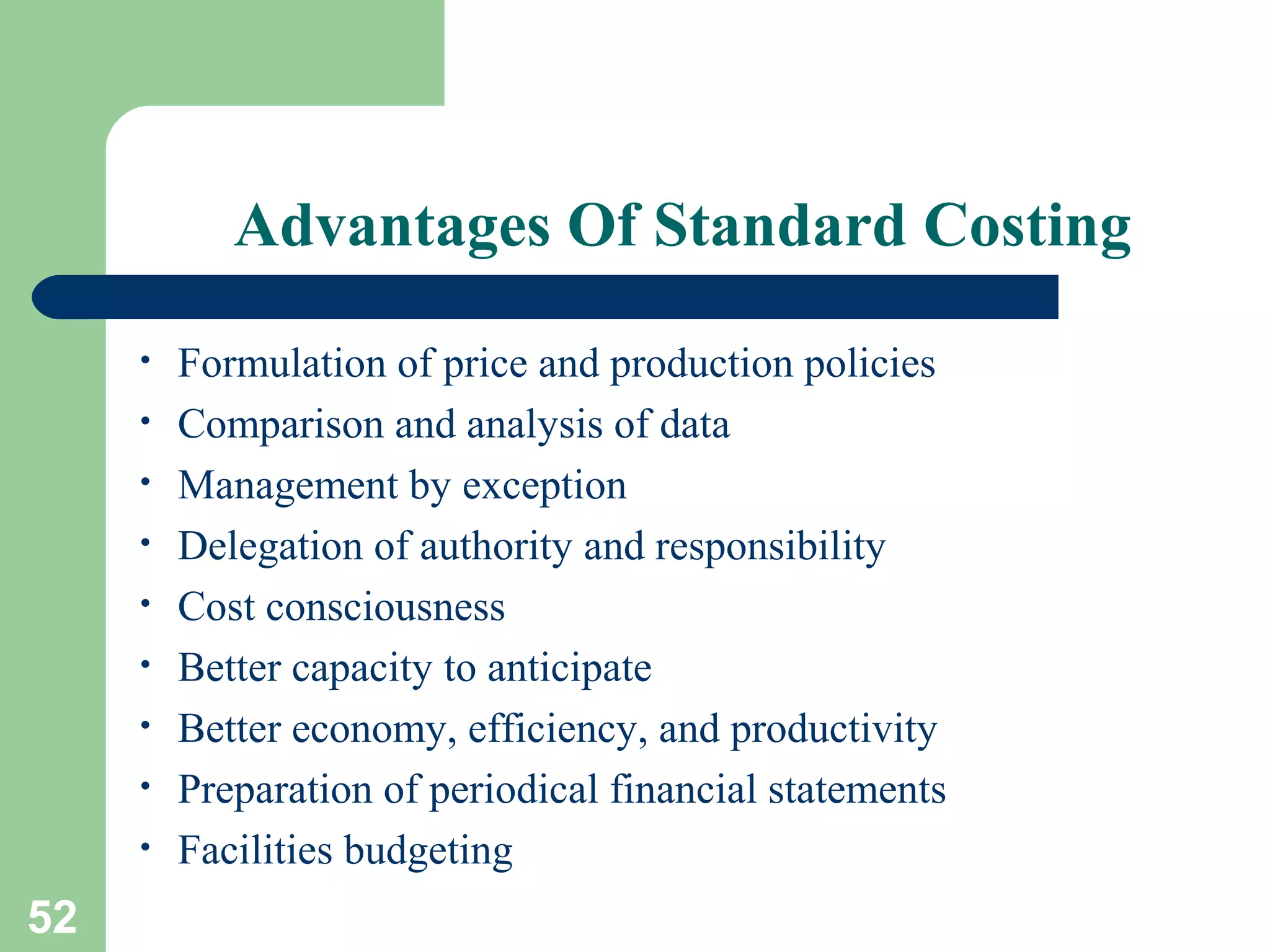
Advantages Of Standard Costing
•
•
•
•
•
•
•
•
•

52

Formulation of price and production policies
Comparison and analysis of data
Management by exception
Delegation of authority and responsibility
Cost consciousness
Better capacity to anticipate
Better economy, efficiency, and productivity
Preparation of periodical financial statements
Facilities budgeting
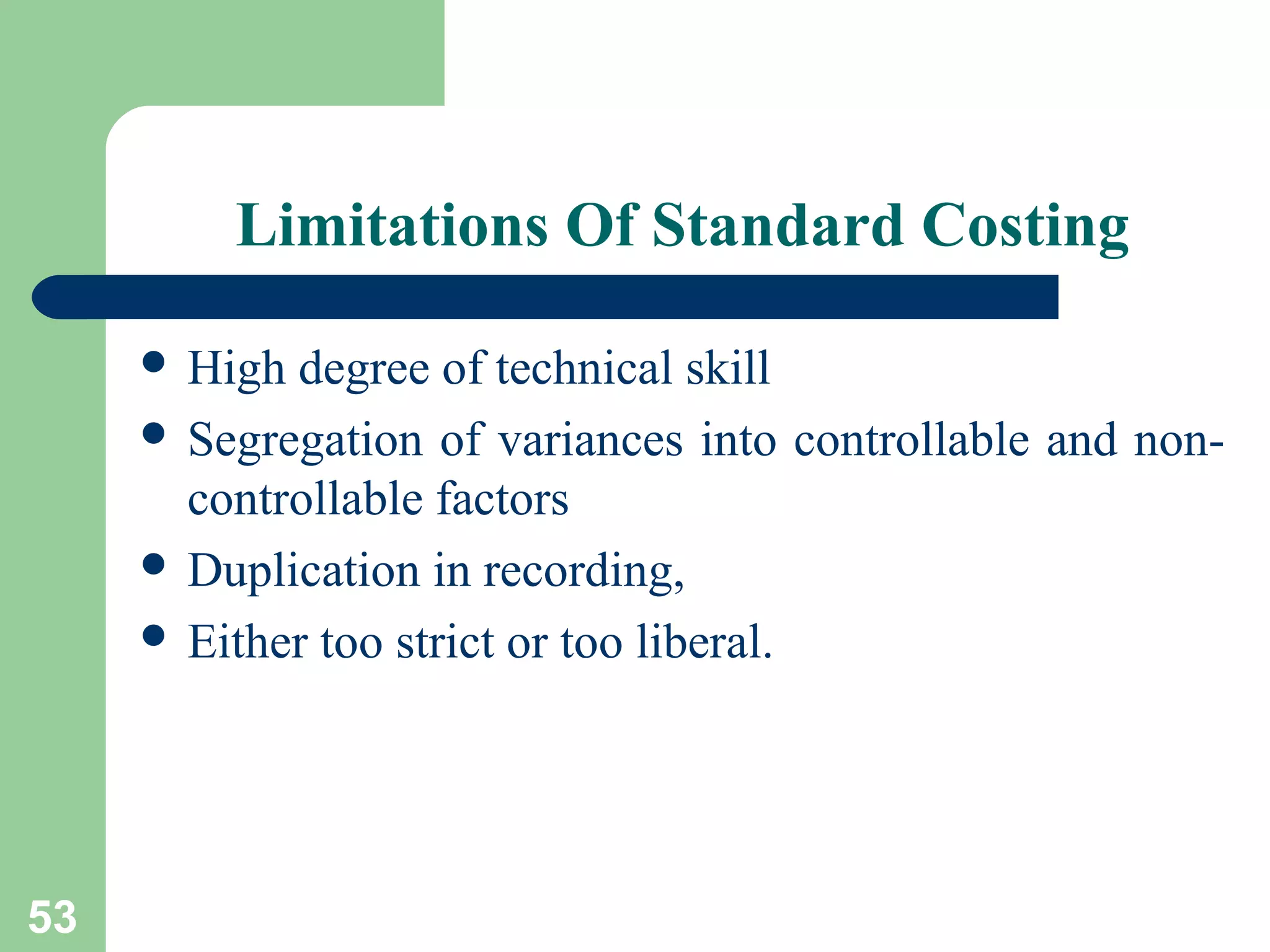
Limitations Of Standard Costing
 High

degree of technical skill
 Segregation of variances into controllable and noncontrollable factors
 Duplication in recording,
 Either too strict or too liberal.

53
“THANK YOU”

54

Standard costing presentation

  • 1.
  • 2.
    Standard  The word standardmeans a criterion (principle, measure).  A standard figure is one against which one can measure an actual figure to see the deviation. 2
  • 3.
    Standard Rate   The wordStandard Rate is the numerical proportion prevailing between two sets of things. A firm has three ‘standard of things’ available on which to base standard rates: Money, Physical inputs and Physical outputs. Money Money/output, e.g. Re./unit of materials Physical Inputs 3 Money/output, e.g. Re./unit of product Input/output, e.g. labour/machine hrs./unit of product Physical Outputs
  • 4.
    Standard Cost  Standard costis ‘a predetermined cost which is compared in advance of production on the basis of specifications of all the factors affecting costs and used in standard costing.’  In other words, standard cost is a predetermined cost that should be attained under a given set of operating conditions. 4
  • 5.
    Standard Costing     5 Standard costingis a technique which is used in many industries, where production is of repetitive nature. Standard costing is developed due to the shortcomings of historical costing. CIMA, London, defines standard costing ‘as the predetermined cost based on technical estimates of materials, labour and overheads for selected period of time and for the prescribed set of working conditions’. Standard costing is that technique in which the standard cost is determined before starting the production.
  • 6.
    Standard costing system The management evaluates the performance of a company by comparing it with some predetermined measures  Therefore, it can be used as a process of measuring and correcting actual performance to ensure that the plans are properly set and implemented 6
  • 7.
    Objectives Of StandardCosting  To establish control  To set standards for various elements of cost  To fix responsibility  To make budgetary control more effective 7
  • 8.
    Procedures of standardcosting system       8 Set the predetermined standards for sales margin and production costs Collect the information about the actual performance Compare the actual performance with the standards to arrive at the variance Analyze the variances and ascertaining the causes of variance Take corrective action to avoid adverse variance Adjust the budget in order to make the standards more realistic
  • 9.
    Functions of standardcosting system  Valuation – Assigning the standard cost to the actual output  Planning – Use the current standards to estimate future sales volume and future costs  Controlling – 9 Evaluating performance by determining how efficiently the current operations are being carried out
  • 10.
     Motivation – Notify thestaff of the management’s expectations  Setting 10 of selling price
  • 11.
  • 12.
    Variance analysis A variance isthe difference between the standards and the actual performance  When the actual results are better than the expected results, there will be a favourable variance (F)  If the actual results are worse than the expected results, there will be an adverse variance (A) 12
  • 13.
    Classification Of Variances Functional Basis  Measurement Basis  Result Basis  Controllability Basis 13
  • 14.
  • 15.
  • 16.
     Absolute variance: Differencebetween the standard cost and the actual cost in terms of money is known as absolute variance.  Relative variance: difference is expressed as a percentage of the standard cost, it is known as relative variance. 16
  • 17.
  • 18.
  • 19.
    Cost variance •Cost variance= Price variance + Quantity variance Cost variance is the difference between the standard cost and the Actual cost •Price variance = (standard price – actual price)*Actual quantity A price variance reflects the extent of the profit change resulting from the change in activity level 19 •Quantity variance = (standard quantity – actual quantity)* standard cost A quantity variance reflects the extent of the profit change resulting from the change in activity level
  • 20.
    Three types ofcost variance  Material cost variance  Labour cost variance  Variable overheads variance 20
  • 21.
  • 22.
  • 23.
  • 24.
    Material cost variance    24 Itis the difference between the standard direct material cost of the actual production volume and the actual cost of direct materials. Material cost variance = (Standard quantity of input for actual production × SP) – (Actual quantity of input × AP) Material cost variance = Material price variance + Material usage variance
  • 25.
    Material cost variance Materialprice variance = (standard price – actual price)*actual quantity = ($3 - $3.2)*2400 = $480 (A)  Material usage variance = (Standard quantity – actual quantity)* standard price = (Standard quantity for actual production – actual quantity production) * standard price 4000 units = (4*800 – 2400)*$3 1000 units = $2400 (F) 25 
  • 26.
    Material cost variance Material price variance  Material usage variance  Total Material cost variance 26 $480 (A) $2400 (F) $1920 (F)
  • 27.
    Material price variance This 27 is that portion of the material cost variance which is due to the difference between the standard price specified and the actual price paid.  If the actual price is higher than the standard price, it would result in adverse price variance and if the actual price is lower than standard price, the result is favorable price variance.  Material price variance = (standard price – actual price) x actual quantity of materials
  • 28.
    Material Usage Variance This 28 is that portion of material cost variance which is due to the difference between the standard quantity of actual production and the actual quantity used.  Material usage variance = (Standard quantity – actual quantity) x standard price = (Standard quantity for actual production – actual quantity production) x standard price
  • 29.
    Material Mix Variance This is that portion of usage variance which is due to the difference between the standard and actual composition of mixture.  Material Mixture Variance = Standard price [Actual quantity in standard mix (i.e. RSQ) – Actual quantity]  Revised Standard quantity = Total actual quantity consumed × 29
  • 30.
    Material Yield Variance This variance arises due to the difference between the standard yield specified and actual yield obtained.  Material yield variance = [(Standard loss in terms of actual input) – (Actual loss on actual input)] × (Average standard price)  Material yield variance = Material usage variance – Material mix variance 30
  • 31.
    Material Sub-usage Variance When a product is produced from a mixture of two or more kinds of material, there may arise material sub-usage variance.  Material sub-usage variance = (Standard Quantity – Revised Standard Quantity) × Standard Price  It can be seen from this formula that material subusage variance is the analysis of variance in basic standard quantity of each material. 31
  • 32.
  • 33.
    Formulas Of LabourVariances      33 Labour rate variance = (standard price – actual price) x actual hours Labour Idle Time Variance = [(actual hrs.- idle time) x standard price] – (actual hrs. x standard price) Labour Gang variance = [revised(actual hrs.- idle time) x standard price] – [(actual hrs.- idle time) x standard price] Labour Yield variance = [revised(actual hrs.- idle time) x standard price x (actual output/standard output)] - [revised(actual hrs.- idle time) x standard price] Labour sub-efficiency variance = (standard hrs. x standard price) - [revised(actual hrs.- idle time) x standard price x (actual output/standard output)]
  • 34.
       34 Labour Cost Variance= (standard hrs. x standard price) – (actual hrs. x actual price) Labour Usage variance = standard price x (standard hrs. – actual hrs.) Labour efficiency variance = (standard hrs. x standard price) [revised(actual hrs.- idle time) x standard price]
  • 35.
    Labour Rate Variance This is that portion of the labour cost variance which is caused by the use of actual wage rate other than predetermined.  Labour rate variance = Actual labour time (Standard wage rate – Actual wage rate) 35
  • 36.
    Labour Efficiency Variance It is the difference between the standard time and the actual time spent multiplied by standard wage rate.  Labour efficiency variance = Standard wage rate (Standard labour time – Actual labour time) 36
  • 37.
    Labour Idle TimeVariance  It is that portion of labour cost variance which is due to the abnormal idle time of workers.  While calculating labour efficiency variance, abnormal idle time is deducted from the actual time spent to determine the real efficiency of the workers.  Idle 37 time variance = Abnormal idle time × Standard wage rate
  • 38.
    Labour Gang Variance This variance arises due to the change in the composition or mix of a group of workers as compared to the standard composition or mix.  Labour gang variance = (Revised standard time – Idle time) × Standard rate per hour  Here, RST= Total actual time x 38
  • 39.
    Labour Yield Variance It is computed on the basis of the increase or decrease in the actual yield or output when compared to the standard.  Labour Yield Variance = [Actual yield – Standard yield in units expected from the actual hours worked] × Standard labour cost per unit 39
  • 40.
    Labour Usage Variance Labour Usage Variance is the measure of difference between standard hours and actual hours,multiplied by the standard rate.  Labour Usage variance = (standard hrs. – actual hrs.) x standard price 40
  • 41.
    Labour Cost Variance Labor cost variance can be defined as the deviation of the actual direct wages paid from the direct wages specified for the standard output.  Labour Cost Variance= (Standard time x Standard price)-(Actual time x Actual price) 41
  • 42.
  • 43.
    I. Variable Production Overhead Variance Standard Variable Overheads= Actual Production * Standard Rate  Standard Rate = Budgeted Variable Overheads/Budgeted Production 43
  • 44.
    II. Fixed ProductionOverhead Variances 44
  • 45.
     Fixed Production OverheadCost or Total Variance Total Variance =( Actual Production * Standard Recovery Rate)- Actual Overheads  Fixed Production Overhead Expenditure Variance Expenditure Variance=( Standard Recovery rate * Budgeted Production)- Actual Overhead 45
  • 46.
     Fixed Production OverheadVolume Variance Volume Variance = Standard Fixed OverheadBudgeted fixed Overhead 46
  • 47.
    SALES  Sales variances anb calculated in two ways: A. The turnover or the volume method B. The profit or the margin method 47
  • 48.
    A. The Turnoveror The Value Method 48
  • 49.
     Value Variance= ActualSales- Budgeted Sales  Price Variance= Actual Sales – Standard Sales  Volume Variance= Standard Sales- Budgeted Sales  Quantity Variance= Revised Standard Sales – Budgeted Sales  Mixed Variance= Standard Sales – Revised Standard Sales 49
  • 50.
  • 51.
    Application Of StandardCosting  Process industries  Service industries  Engineering industries  Textile industries  Extraction industries 51
  • 52.
    Advantages Of StandardCosting • • • • • • • • • 52 Formulation of price and production policies Comparison and analysis of data Management by exception Delegation of authority and responsibility Cost consciousness Better capacity to anticipate Better economy, efficiency, and productivity Preparation of periodical financial statements Facilities budgeting
  • 53.
    Limitations Of StandardCosting  High degree of technical skill  Segregation of variances into controllable and noncontrollable factors  Duplication in recording,  Either too strict or too liberal. 53
  • 54.