Inventories
IAS – 2
Objective
The objective of this standard is to
prescribe the accounting treatment for
inventories.
Scope
IAS 2 excludes certain inventories:
• work in process arising under construction
contracts (see IAS 11 Construction Contracts)
• financial instruments (see IAS 39 Financial
Instruments: Recognition and Measurement)
• biological assets related to agricultural activity
and agricultural produce at the point of harvest
(see IAS 41 Agriculture).
Definitions
Inventories are assets:
• Held for sale in ordinary course of business
• In the process of production for such sales
• Material or supplies used in production
process or to render services
Net Realizable Value
It is the estimated selling price less the cost to
complete and sell
Measurement of inventory
• Inventory should be measured at lower of
cost or net realizable value
Realisable value
Realisable value is, of course, the price the
organisation receives for its inventory from the
market.
• However, getting this inventory to market may
involve
– additional expense and
– effort in repackaging,
– advertising, delivery and
– even repairing of damaged inventory.
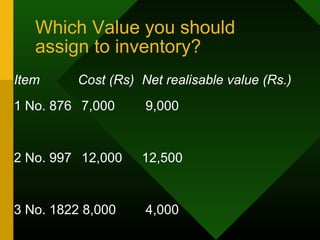
Which Value you should
assign to inventory?
Item Cost (Rs) Net realisable value (Rs.)
1 No. 876 7,000 9,000
2 No. 997 12,000 12,500
3 No. 1822 8,000 4,000
Cost of inventories
Cost should include all:
• costs of purchase (including taxes,
transport, and handling) net of trade
discounts received
• costs of conversion (including fixed and
variable manufacturing overheads) and
• other costs incurred in bringing the
inventories to their present location and
condition
Costs not to be included in the
inventory cost
• Abnormal losses of material, labor etc
• Storage costs
• Administrative overheads that are not to bring
the inventories at present location or condition
• Selling costs
• Borrowing costs (with some exceptions)
• foreign exchange differences arising directly on
the recent acquisition of inventories invoiced in
a foreign currency
Techniques of measurement of
cost
• Standard cost method
• Retail method
Cost Formulas
• Items which are not ordinarily
interchangeable should be valued at
individual cost basis
• FIFO and WAVC are benchmark
treatment
• LIFO is no longer allowed
Recognition as an expense
• The inventory cost should be recognized
as an expense in the period in which their
revenue is recognized
Disclosure
• Policy to measure inventories including cost formula
• Total carrying amount of inventory with classification
• Carrying amount of inventory carried at net
realizable value
• The amount of any reversal of any write-down of
inventory that is recognized as revenue in the period
• The circumstances and events that have caused
this reversal
• Carrying amount of inventories pledged as security
against a liability
Activity
1. Value the following items of inventory:
– Material costing $12,000 bought for processing and
assembly for a profitable special order. Since
buying these items, the cost price has fallen to $
10,000
– Equipment constructed for customer for an agreed
price of $ 18,000. This has recently been
completed at a cost of $ 16,800. It has now been
discovered that , in order to meet certain
regulations, conversion with an extra cost of $
4,200 will be required. The customer has accepted
partial responsibility and agreed to meet half the
extra cost.
Practise Question
• Q1. The cost of inventories held by
Bonus Ltd. is Rs. 350,000. The estimated
selling price of inventories is Rs.
300,000. The company pays Rs. 5%
commission on sales to manager.
• You are required to calculate the value at
which inventories should appear in the
Statement of Financial Position.

Ias 2

  • 1.
  • 2.
    Objective The objective ofthis standard is to prescribe the accounting treatment for inventories.
  • 3.
    Scope IAS 2 excludescertain inventories: • work in process arising under construction contracts (see IAS 11 Construction Contracts) • financial instruments (see IAS 39 Financial Instruments: Recognition and Measurement) • biological assets related to agricultural activity and agricultural produce at the point of harvest (see IAS 41 Agriculture).
  • 4.
    Definitions Inventories are assets: •Held for sale in ordinary course of business • In the process of production for such sales • Material or supplies used in production process or to render services Net Realizable Value It is the estimated selling price less the cost to complete and sell
  • 5.
    Measurement of inventory •Inventory should be measured at lower of cost or net realizable value
  • 6.
    Realisable value Realisable valueis, of course, the price the organisation receives for its inventory from the market. • However, getting this inventory to market may involve – additional expense and – effort in repackaging, – advertising, delivery and – even repairing of damaged inventory.
  • 7.
    Which Value youshould assign to inventory? Item Cost (Rs) Net realisable value (Rs.) 1 No. 876 7,000 9,000 2 No. 997 12,000 12,500 3 No. 1822 8,000 4,000
  • 8.
    Cost of inventories Costshould include all: • costs of purchase (including taxes, transport, and handling) net of trade discounts received • costs of conversion (including fixed and variable manufacturing overheads) and • other costs incurred in bringing the inventories to their present location and condition
  • 9.
    Costs not tobe included in the inventory cost • Abnormal losses of material, labor etc • Storage costs • Administrative overheads that are not to bring the inventories at present location or condition • Selling costs • Borrowing costs (with some exceptions) • foreign exchange differences arising directly on the recent acquisition of inventories invoiced in a foreign currency
  • 10.
    Techniques of measurementof cost • Standard cost method • Retail method
  • 11.
    Cost Formulas • Itemswhich are not ordinarily interchangeable should be valued at individual cost basis • FIFO and WAVC are benchmark treatment • LIFO is no longer allowed
  • 12.
    Recognition as anexpense • The inventory cost should be recognized as an expense in the period in which their revenue is recognized
  • 13.
    Disclosure • Policy tomeasure inventories including cost formula • Total carrying amount of inventory with classification • Carrying amount of inventory carried at net realizable value • The amount of any reversal of any write-down of inventory that is recognized as revenue in the period • The circumstances and events that have caused this reversal • Carrying amount of inventories pledged as security against a liability
  • 14.
    Activity 1. Value thefollowing items of inventory: – Material costing $12,000 bought for processing and assembly for a profitable special order. Since buying these items, the cost price has fallen to $ 10,000 – Equipment constructed for customer for an agreed price of $ 18,000. This has recently been completed at a cost of $ 16,800. It has now been discovered that , in order to meet certain regulations, conversion with an extra cost of $ 4,200 will be required. The customer has accepted partial responsibility and agreed to meet half the extra cost.
  • 15.
    Practise Question • Q1.The cost of inventories held by Bonus Ltd. is Rs. 350,000. The estimated selling price of inventories is Rs. 300,000. The company pays Rs. 5% commission on sales to manager. • You are required to calculate the value at which inventories should appear in the Statement of Financial Position.