PUNJAB COLLEGE OF TECHNICAL EDUCATION, LUDHIANA
              COURSE BREAK UP 2010


Name of Instructor: Mr. Swapan Chanana             Subject Name:BusinessMathematics
Ms.NidhiVerma, Ms. Prabhjot Arora                  Subject Code: BB102
Total No. of Lectures: 63


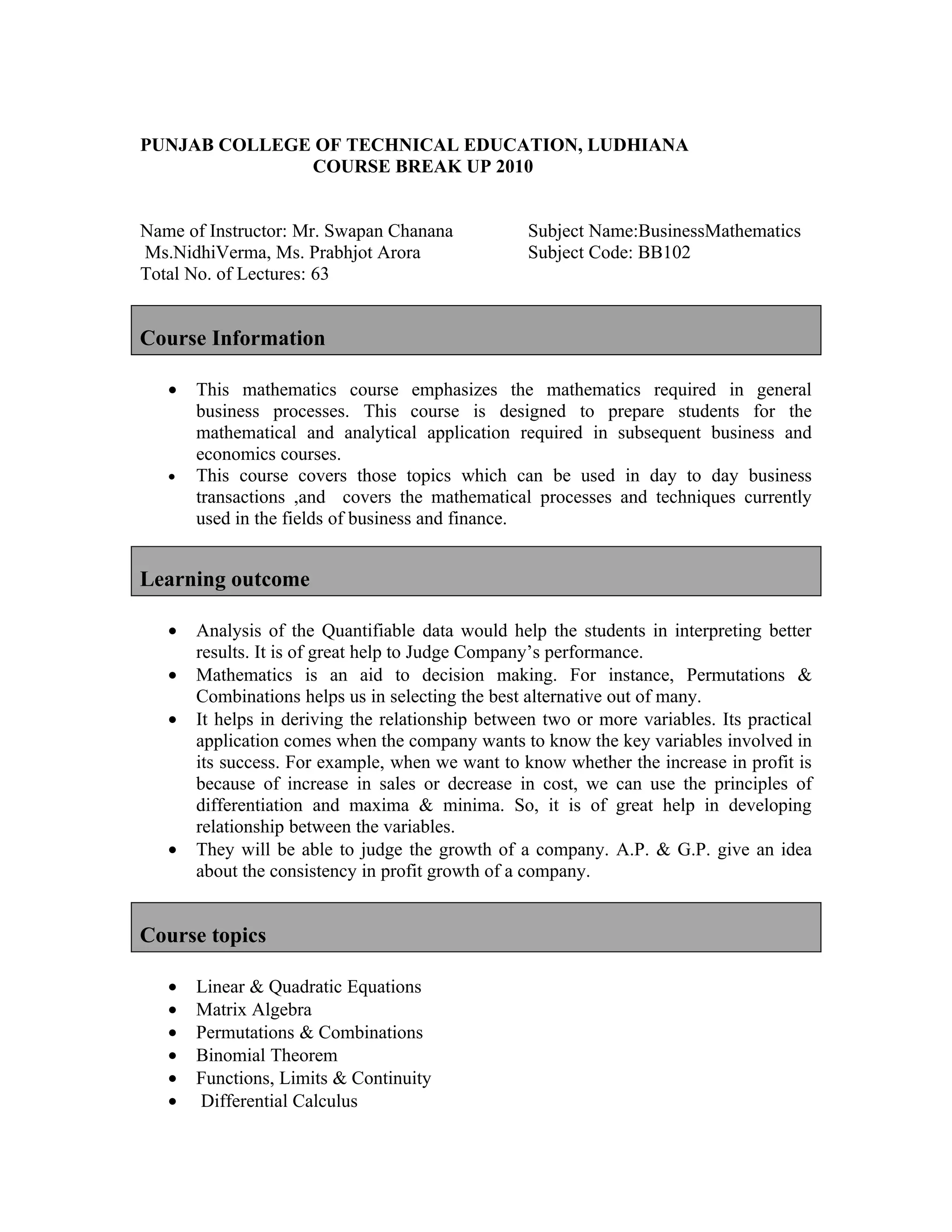
Course Information

   •   This mathematics course emphasizes the mathematics required in general
       business processes. This course is designed to prepare students for the
       mathematical and analytical application required in subsequent business and
       economics courses.
   •   This course covers those topics which can be used in day to day business
       transactions ,and covers the mathematical processes and techniques currently
       used in the fields of business and finance.


Learning outcome

   •   Analysis of the Quantifiable data would help the students in interpreting better
       results. It is of great help to Judge Company’s performance.
   •   Mathematics is an aid to decision making. For instance, Permutations &
       Combinations helps us in selecting the best alternative out of many.
   •   It helps in deriving the relationship between two or more variables. Its practical
       application comes when the company wants to know the key variables involved in
       its success. For example, when we want to know whether the increase in profit is
       because of increase in sales or decrease in cost, we can use the principles of
       differentiation and maxima & minima. So, it is of great help in developing
       relationship between the variables.
   •   They will be able to judge the growth of a company. A.P. & G.P. give an idea
       about the consistency in profit growth of a company.


Course topics

   •   Linear & Quadratic Equations
   •   Matrix Algebra
   •   Permutations & Combinations
   •   Binomial Theorem
   •   Functions, Limits & Continuity
   •   Differential Calculus
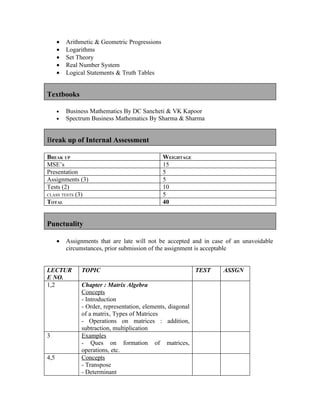
•   Arithmetic & Geometric Progressions
      •   Logarithms
      •   Set Theory
      •   Real Number System
      •   Logical Statements & Truth Tables


Textbooks

      •   Business Mathematics By DC Sancheti & VK Kapoor
      •   Spectrum Business Mathematics By Sharma & Sharma


Break up of Internal Assessment

BREAK UP                                        WEIGHTAGE
MSE’s                                           15
Presentation                                    5
Assignments (3)                                 5
Tests (2)                                       10
CLASS TESTS (3)                                 5
TOTAL                                           40


Punctuality

      •   Assignments that are late will not be accepted and in case of an unavoidable
          circumstances, prior submission of the assignment is acceptable


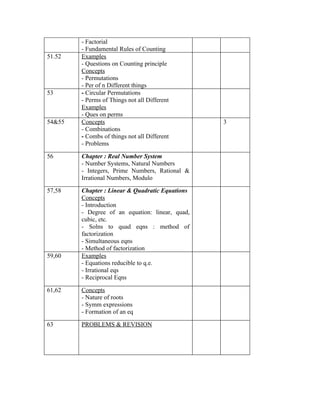
LECTUR         TOPIC                                         TEST   ASSGN
E NO.
1,2            Chapter : Matrix Algebra
               Concepts
               - Introduction
               - Order, representation, elements, diagonal
               of a matrix, Types of Matrices
               - Operations on matrices : addition,
               subtraction, multiplication
3              Examples
               - Ques on formation of matrices,
               operations, etc.
4,5            Concepts
               - Transpose
               - Determinant
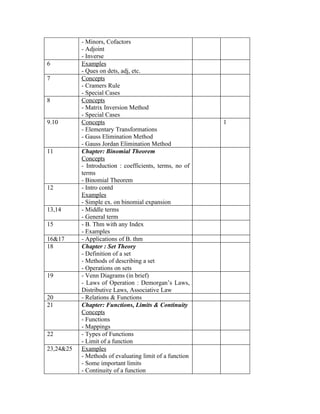
- Minors, Cofactors
           - Adjoint
           - Inverse
6          Examples
           - Ques on dets, adj, etc.
7          Concepts
           - Cramers Rule
           - Special Cases
8          Concepts
           - Matrix Inversion Method
           - Special Cases
9.10       Concepts                                      1
           - Elementary Transformations
           - Gauss Elimination Method
           - Gauss Jordan Elimination Method
11         Chapter: Binomial Theorem
           Concepts
           - Introduction : coefficients, terms, no of
           terms
           - Binomial Theorem
12         - Intro contd
           Examples
           - Simple ex. on binomial expansion
13,14      - Middle terms
           - General term
15         - B. Thm with any Index
           - Examples
16&17      - Applications of B. thm
18         Chapter : Set Theory
           - Definition of a set
           - Methods of describing a set
           - Operations on sets
19         - Venn Diagrams (in brief)
           - Laws of Operation : Demorgan’s Laws,
           Distributive Laws, Associative Law
20         - Relations & Functions
21         Chapter: Functions, Limits & Continuity
           Concepts
           - Functions
           - Mappings
22         - Types of Functions
           - Limit of a function
23,24&25   Examples
           - Methods of evaluating limit of a function
           - Some important limits
           - Continuity of a function
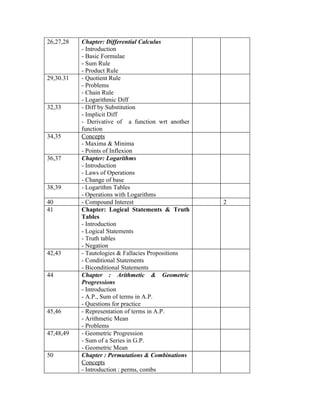
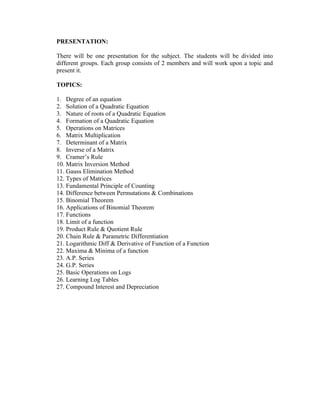
26,27,28   Chapter: Differential Calculus
           - Introduction
           - Basic Formulae
           - Sum Rule
           - Product Rule
29,30.31   - Quotient Rule
           - Problems
           - Chain Rule
           - Logarithmic Diff
32,33      - Diff by Substitution
           - Implicit Diff
           - Derivative of a function wrt another
           function
34,35      Concepts
           - Maxima & Minima
           - Points of Inflexion
36,37      Chapter: Logarithms
           - Introduction
           - Laws of Operations
           - Change of base
38,39      - Logarithm Tables
           - Operations with Logarithms
40         - Compound Interest                      2
41         Chapter: Logical Statements & Truth
           Tables
           - Introduction
           - Logical Statements
           - Truth tables
           - Negation
42,43      - Tautologies & Fallacies Propositions
           - Conditional Statements
           - Biconditional Statements
44         Chapter : Arithmetic & Geometric
           Progressions
           - Introduction
           - A.P., Sum of terms in A.P.
           - Questions for practice
45,46      - Representation of terms in A.P.
           - Arithmetic Mean
           - Problems
47,48,49   - Geometric Progression
           - Sum of a Series in G.P.
           - Geometric Mean
50         Chapter : Permutations & Combinations
           Concepts
           - Introduction : perms, combs
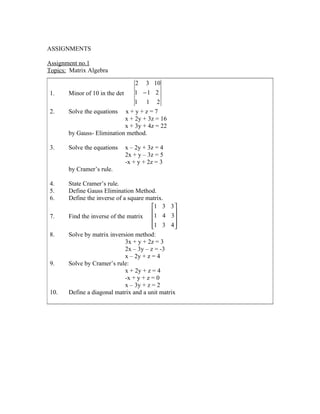
- Factorial
        - Fundamental Rules of Counting
51.52   Examples
        - Questions on Counting principle
        Concepts
        - Permutations
        - Per of n Different things
53      - Circular Permutations
        - Perms of Things not all Different
        Examples
        - Ques on perms
54&55   Concepts                                 3
        - Combinations
        - Combs of things not all Different
        - Problems

56      Chapter : Real Number System
        - Number Systems, Natural Numbers
        - Integers, Prime Numbers, Rational &
        Irrational Numbers, Modulo

57,58   Chapter : Linear & Quadratic Equations
        Concepts
        - Introduction
        - Degree of an equation: linear, quad,
        cubic, etc.
        - Solns to quad eqns : method of
        factorization
        - Simultaneous eqns
        - Method of factorization
59,60   Examples
        - Equations reducible to q.e.
        - Irrational eqs
        - Reciprocal Eqns

61,62   Concepts
        - Nature of roots
        - Symm expressions
        - Formation of an eq

63      PROBLEMS & REVISION
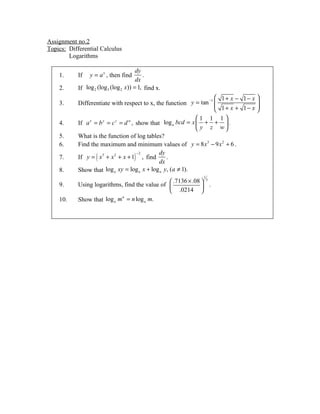
PRESENTATION:

There will be one presentation for the subject. The students will be divided into
different groups. Each group consists of 2 members and will work upon a topic and
present it.

TOPICS:

1. Degree of an equation
2. Solution of a Quadratic Equation
3. Nature of roots of a Quadratic Equation
4. Formation of a Quadratic Equation
5. Operations on Matrices
6. Matrix Multiplication
7. Determinant of a Matrix
8. Inverse of a Matrix
9. Cramer’s Rule
10. Matrix Inversion Method
11. Gauss Elimination Method
12. Types of Matrices
13. Fundamental Principle of Counting
14. Difference between Permutations & Combinations
15. Binomial Theorem
16. Applications of Binomial Theorem
17. Functions
18. Limit of a function
19. Product Rule & Quotient Rule
20. Chain Rule & Parametric Differentiation
21. Logarithmic Diff & Derivative of Function of a Function
22. Maxima & Minima of a function
23. A.P. Series
24. G.P. Series
25. Basic Operations on Logs
26. Learning Log Tables
27. Compound Interest and Depreciation
ASSIGNMENTS

Assignment no.1
Topics: Matrix Algebra

                                   2 3 10
1.     Minor of 10 in the det      1 −1 2
                                   1 1 2
2.     Solve the equations  x+y+z=7
                            x + 2y + 3z = 16
                            x + 3y + 4z = 22
       by Gauss- Elimination method.

3.     Solve the equations      x – 2y + 3z = 4
                                2x + y – 3z = 5
                                -x + y + 2z = 3
       by Cramer’s rule.

4.     State Cramer’s rule.
5.     Define Gauss Elimination Method.
6.     Define the inverse of a square matrix.
                                         1 3 3 
                                                
7.     Find the inverse of the matrix 1 4 3
                                         1 3 4 
                                                
8.     Solve by matrix inversion method:
                              3x + y + 2z = 3
                              2x – 3y – z = -3
                              x – 2y + z = 4
9.     Solve by Cramer’s rule:
                              x + 2y + z = 4
                              -x + y + z = 0
                              x – 3y + z = 2
10.    Define a diagonal matrix and a unit matrix
Assignment no.2
Topics: Differential Calculus
        Logarithms

                                        dy
    1.      If   y = a x , then find       .
                                        dx
    2.      If log 2 (log 3 (log 2 x)) = 1, find x.
                                                                   −1
                                                                       1+ x − 1− x 
    3.      Differentiate with respect to x, the function y = tan     1+ x + 1− x 
                                                                                    
                                                                                   
                                                               1 1 1
    4.      If a x = b y = c z = d w , show that log a bcd = x  + +  .
                                                                y z w
    5.      What is the function of log tables?
    6.      Find the maximum and minimum values of y = 8 x 3 − 9 x 2 + 6 .
                                                dy
            If y = ( x 3 + x 2 + x + 1) , find
                                       −2
    7.                                             .
                                                dx
    8.      Show that log a xy = log a x + log a y , (a ≠ 1).
                                                              1
                                                  .7136 × .08  3
    9.      Using logarithms, find the value of 
                                                              .
                                                 .0214 
            Show that log a m = n log a m.
                             n
    10.
Assignment no.3
Logical Statements&Truth Tables, A.P. & G.P and Permutations & Combinations

1.       Simplify               : ( p ∨ q) .
2.       Prove that             p → (q ∧ r ) = ( p → q) ∧ ( p → r ) .
3.     How many numbers are there between 100 and 1000 such that every digit is either
       2 or 3?
4.     Construct the truth table for the statement ( p ∧ q ) ∨ (: r ) .
5.     In how many ways, the letters of the word ‘RAM’ can be arranged?
6.     Show that [( p ⇒ q ) ∧ ( q ⇒ r ) ⇒ ( p ⇒ r )] is a tautology.
7.     How many different committees can be formed consisting of 4 men & 3 women out
         of 7 men & 5 women?
8.     Show that p ∧ ( p ∨ q ) = p , where p, q are logical statements.
9.     What do you mean by permutations?
                                     n
10. Find the value of Cn −3 .
   11.      Find the sum of the series                72 + 70 + 60 + …… + 40
                                       th   th
12.      If a, b, c are the p , q and r terms of a G.P., then prove that
                                                   th


          a q −r br − p c p −q = 1
13.      Find the sum of 50 terms of the seqn.               7, 7.7, 7.77, 7.777,……..
14.      If the m term of an A.P. is 1/n and n term is 1/m, then show that the mnth term
                       th                               th

         is 1.
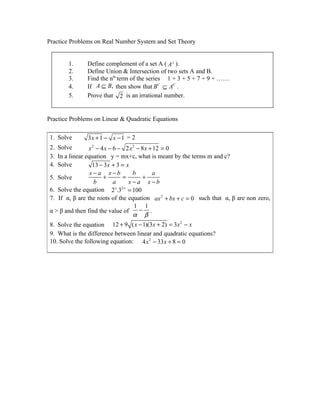
Practice Problems on Real Number System and Set Theory


        1.     Define complement of a set A ( A⊥ ).
        2.     Define Union & Intersection of two sets A and B.
        3.     Find the nth term of the series 1 + 3 + 5 + 7 + 9 + ……
        4.     If A ⊆ B, then show that B C ⊆ AC .
        5.     Prove that 2 is an irrational number.


Practice Problems on Linear & Quadratic Equations

 1. Solve       3x + 1 − x − 1 = 2
 2. Solve        x 2 − 4 x − 6 − 2 x 2 − 8 x + 12 = 0
 3. In a linear equation y = mx+c, what is meant by the terms m and c?
 4. Solve          13 − 3 x + 3 = x
                  x−a x−b            b        a
 5. Solve               +        =       +
                    b        a     x−a x−b
 6. Solve the equation 2 .3 = 100
                              x 2x


 7. If α, β are the roots of the equation ax 2 + bx + c = 0 such that α, β are non zero,
                                      1 1
 α > β and then find the value of       − .
                                     α β
 8. Solve the equation 12 + 9 ( x − 1)(3x + 2) = 3 x 2 − x
 9. What is the difference between linear and quadratic equations?
 10. Solve the following equation: 4 x 2 − 33 x + 8 = 0
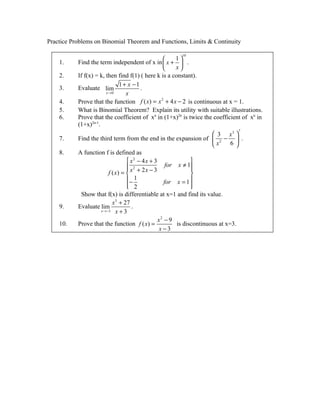
Practice Problems on Binomial Theorem and Functions, Limits & Continuity

                                                       10
                                                     1
    1.     Find the term independent of x in  x +  .
                                                     x
    2.     If f(x) = k, then find f(1) ( here k is a constant).
                             1+ x −1
    3.     Evaluate lim               .
                        x→0     x
    4.     Prove that the function f ( x) = x 2 + 4 x − 2 is continuous at x = 1.
    5.     What is Binomial Theorem? Explain its utility with suitable illustrations.
    6.     Prove that the coefficient of xn in (1+x)2n is twice the coefficient of xn in
           (1+x)2n-1.
                                                                               7
                                                                       3 x3 
    7.     Find the third term from the end in the expansion of  2 −  .
                                                                      x      6 
    8.     A function f is defined as
                                  x2 − 4 x + 3               
                                  2                for x ≠ 1
                                                             
                        f ( x) =  x + 2 x − 3                
                                 − 1              for x = 1 
                                  2
                                                             
                                                              
            Show that f(x) is differentiable at x=1 and find its value.
                          x 3 + 27
    9.     Evaluate lim             .
                    x →−3 x + 3

                                                x2 − 9
    10.    Prove that the function f ( x) =             is discontinuous at x=3.
                                                x−3

C:\Documents And Settings\Pen Drive\Desktop\Maths Module

  • 1.
    PUNJAB COLLEGE OFTECHNICAL EDUCATION, LUDHIANA COURSE BREAK UP 2010 Name of Instructor: Mr. Swapan Chanana Subject Name:BusinessMathematics Ms.NidhiVerma, Ms. Prabhjot Arora Subject Code: BB102 Total No. of Lectures: 63 Course Information • This mathematics course emphasizes the mathematics required in general business processes. This course is designed to prepare students for the mathematical and analytical application required in subsequent business and economics courses. • This course covers those topics which can be used in day to day business transactions ,and covers the mathematical processes and techniques currently used in the fields of business and finance. Learning outcome • Analysis of the Quantifiable data would help the students in interpreting better results. It is of great help to Judge Company’s performance. • Mathematics is an aid to decision making. For instance, Permutations & Combinations helps us in selecting the best alternative out of many. • It helps in deriving the relationship between two or more variables. Its practical application comes when the company wants to know the key variables involved in its success. For example, when we want to know whether the increase in profit is because of increase in sales or decrease in cost, we can use the principles of differentiation and maxima & minima. So, it is of great help in developing relationship between the variables. • They will be able to judge the growth of a company. A.P. & G.P. give an idea about the consistency in profit growth of a company. Course topics • Linear & Quadratic Equations • Matrix Algebra • Permutations & Combinations • Binomial Theorem • Functions, Limits & Continuity • Differential Calculus
  • 2.
    Arithmetic & Geometric Progressions • Logarithms • Set Theory • Real Number System • Logical Statements & Truth Tables Textbooks • Business Mathematics By DC Sancheti & VK Kapoor • Spectrum Business Mathematics By Sharma & Sharma Break up of Internal Assessment BREAK UP WEIGHTAGE MSE’s 15 Presentation 5 Assignments (3) 5 Tests (2) 10 CLASS TESTS (3) 5 TOTAL 40 Punctuality • Assignments that are late will not be accepted and in case of an unavoidable circumstances, prior submission of the assignment is acceptable LECTUR TOPIC TEST ASSGN E NO. 1,2 Chapter : Matrix Algebra Concepts - Introduction - Order, representation, elements, diagonal of a matrix, Types of Matrices - Operations on matrices : addition, subtraction, multiplication 3 Examples - Ques on formation of matrices, operations, etc. 4,5 Concepts - Transpose - Determinant
  • 3.
    - Minors, Cofactors - Adjoint - Inverse 6 Examples - Ques on dets, adj, etc. 7 Concepts - Cramers Rule - Special Cases 8 Concepts - Matrix Inversion Method - Special Cases 9.10 Concepts 1 - Elementary Transformations - Gauss Elimination Method - Gauss Jordan Elimination Method 11 Chapter: Binomial Theorem Concepts - Introduction : coefficients, terms, no of terms - Binomial Theorem 12 - Intro contd Examples - Simple ex. on binomial expansion 13,14 - Middle terms - General term 15 - B. Thm with any Index - Examples 16&17 - Applications of B. thm 18 Chapter : Set Theory - Definition of a set - Methods of describing a set - Operations on sets 19 - Venn Diagrams (in brief) - Laws of Operation : Demorgan’s Laws, Distributive Laws, Associative Law 20 - Relations & Functions 21 Chapter: Functions, Limits & Continuity Concepts - Functions - Mappings 22 - Types of Functions - Limit of a function 23,24&25 Examples - Methods of evaluating limit of a function - Some important limits - Continuity of a function
  • 4.
    26,27,28 Chapter: Differential Calculus - Introduction - Basic Formulae - Sum Rule - Product Rule 29,30.31 - Quotient Rule - Problems - Chain Rule - Logarithmic Diff 32,33 - Diff by Substitution - Implicit Diff - Derivative of a function wrt another function 34,35 Concepts - Maxima & Minima - Points of Inflexion 36,37 Chapter: Logarithms - Introduction - Laws of Operations - Change of base 38,39 - Logarithm Tables - Operations with Logarithms 40 - Compound Interest 2 41 Chapter: Logical Statements & Truth Tables - Introduction - Logical Statements - Truth tables - Negation 42,43 - Tautologies & Fallacies Propositions - Conditional Statements - Biconditional Statements 44 Chapter : Arithmetic & Geometric Progressions - Introduction - A.P., Sum of terms in A.P. - Questions for practice 45,46 - Representation of terms in A.P. - Arithmetic Mean - Problems 47,48,49 - Geometric Progression - Sum of a Series in G.P. - Geometric Mean 50 Chapter : Permutations & Combinations Concepts - Introduction : perms, combs
  • 5.
    - Factorial - Fundamental Rules of Counting 51.52 Examples - Questions on Counting principle Concepts - Permutations - Per of n Different things 53 - Circular Permutations - Perms of Things not all Different Examples - Ques on perms 54&55 Concepts 3 - Combinations - Combs of things not all Different - Problems 56 Chapter : Real Number System - Number Systems, Natural Numbers - Integers, Prime Numbers, Rational & Irrational Numbers, Modulo 57,58 Chapter : Linear & Quadratic Equations Concepts - Introduction - Degree of an equation: linear, quad, cubic, etc. - Solns to quad eqns : method of factorization - Simultaneous eqns - Method of factorization 59,60 Examples - Equations reducible to q.e. - Irrational eqs - Reciprocal Eqns 61,62 Concepts - Nature of roots - Symm expressions - Formation of an eq 63 PROBLEMS & REVISION
  • 6.
    PRESENTATION: There will beone presentation for the subject. The students will be divided into different groups. Each group consists of 2 members and will work upon a topic and present it. TOPICS: 1. Degree of an equation 2. Solution of a Quadratic Equation 3. Nature of roots of a Quadratic Equation 4. Formation of a Quadratic Equation 5. Operations on Matrices 6. Matrix Multiplication 7. Determinant of a Matrix 8. Inverse of a Matrix 9. Cramer’s Rule 10. Matrix Inversion Method 11. Gauss Elimination Method 12. Types of Matrices 13. Fundamental Principle of Counting 14. Difference between Permutations & Combinations 15. Binomial Theorem 16. Applications of Binomial Theorem 17. Functions 18. Limit of a function 19. Product Rule & Quotient Rule 20. Chain Rule & Parametric Differentiation 21. Logarithmic Diff & Derivative of Function of a Function 22. Maxima & Minima of a function 23. A.P. Series 24. G.P. Series 25. Basic Operations on Logs 26. Learning Log Tables 27. Compound Interest and Depreciation
  • 7.
    ASSIGNMENTS Assignment no.1 Topics: MatrixAlgebra 2 3 10 1. Minor of 10 in the det 1 −1 2 1 1 2 2. Solve the equations x+y+z=7 x + 2y + 3z = 16 x + 3y + 4z = 22 by Gauss- Elimination method. 3. Solve the equations x – 2y + 3z = 4 2x + y – 3z = 5 -x + y + 2z = 3 by Cramer’s rule. 4. State Cramer’s rule. 5. Define Gauss Elimination Method. 6. Define the inverse of a square matrix. 1 3 3    7. Find the inverse of the matrix 1 4 3 1 3 4    8. Solve by matrix inversion method: 3x + y + 2z = 3 2x – 3y – z = -3 x – 2y + z = 4 9. Solve by Cramer’s rule: x + 2y + z = 4 -x + y + z = 0 x – 3y + z = 2 10. Define a diagonal matrix and a unit matrix
  • 8.
    Assignment no.2 Topics: DifferentialCalculus Logarithms dy 1. If y = a x , then find . dx 2. If log 2 (log 3 (log 2 x)) = 1, find x. −1  1+ x − 1− x  3. Differentiate with respect to x, the function y = tan   1+ x + 1− x     1 1 1 4. If a x = b y = c z = d w , show that log a bcd = x  + +  .  y z w 5. What is the function of log tables? 6. Find the maximum and minimum values of y = 8 x 3 − 9 x 2 + 6 . dy If y = ( x 3 + x 2 + x + 1) , find −2 7. . dx 8. Show that log a xy = log a x + log a y , (a ≠ 1). 1 .7136 × .08  3 9. Using logarithms, find the value of    .  .0214  Show that log a m = n log a m. n 10.
  • 9.
    Assignment no.3 Logical Statements&TruthTables, A.P. & G.P and Permutations & Combinations 1. Simplify : ( p ∨ q) . 2. Prove that p → (q ∧ r ) = ( p → q) ∧ ( p → r ) . 3. How many numbers are there between 100 and 1000 such that every digit is either 2 or 3? 4. Construct the truth table for the statement ( p ∧ q ) ∨ (: r ) . 5. In how many ways, the letters of the word ‘RAM’ can be arranged? 6. Show that [( p ⇒ q ) ∧ ( q ⇒ r ) ⇒ ( p ⇒ r )] is a tautology. 7. How many different committees can be formed consisting of 4 men & 3 women out of 7 men & 5 women? 8. Show that p ∧ ( p ∨ q ) = p , where p, q are logical statements. 9. What do you mean by permutations? n 10. Find the value of Cn −3 . 11. Find the sum of the series 72 + 70 + 60 + …… + 40 th th 12. If a, b, c are the p , q and r terms of a G.P., then prove that th a q −r br − p c p −q = 1 13. Find the sum of 50 terms of the seqn. 7, 7.7, 7.77, 7.777,…….. 14. If the m term of an A.P. is 1/n and n term is 1/m, then show that the mnth term th th is 1.
  • 10.
    Practice Problems onReal Number System and Set Theory 1. Define complement of a set A ( A⊥ ). 2. Define Union & Intersection of two sets A and B. 3. Find the nth term of the series 1 + 3 + 5 + 7 + 9 + …… 4. If A ⊆ B, then show that B C ⊆ AC . 5. Prove that 2 is an irrational number. Practice Problems on Linear & Quadratic Equations 1. Solve 3x + 1 − x − 1 = 2 2. Solve x 2 − 4 x − 6 − 2 x 2 − 8 x + 12 = 0 3. In a linear equation y = mx+c, what is meant by the terms m and c? 4. Solve 13 − 3 x + 3 = x x−a x−b b a 5. Solve + = + b a x−a x−b 6. Solve the equation 2 .3 = 100 x 2x 7. If α, β are the roots of the equation ax 2 + bx + c = 0 such that α, β are non zero, 1 1 α > β and then find the value of − . α β 8. Solve the equation 12 + 9 ( x − 1)(3x + 2) = 3 x 2 − x 9. What is the difference between linear and quadratic equations? 10. Solve the following equation: 4 x 2 − 33 x + 8 = 0
  • 11.
    Practice Problems onBinomial Theorem and Functions, Limits & Continuity 10  1 1. Find the term independent of x in  x +  .  x 2. If f(x) = k, then find f(1) ( here k is a constant). 1+ x −1 3. Evaluate lim . x→0 x 4. Prove that the function f ( x) = x 2 + 4 x − 2 is continuous at x = 1. 5. What is Binomial Theorem? Explain its utility with suitable illustrations. 6. Prove that the coefficient of xn in (1+x)2n is twice the coefficient of xn in (1+x)2n-1. 7  3 x3  7. Find the third term from the end in the expansion of  2 −  . x 6  8. A function f is defined as  x2 − 4 x + 3   2 for x ≠ 1   f ( x) =  x + 2 x − 3  − 1 for x = 1   2    Show that f(x) is differentiable at x=1 and find its value. x 3 + 27 9. Evaluate lim . x →−3 x + 3 x2 − 9 10. Prove that the function f ( x) = is discontinuous at x=3. x−3