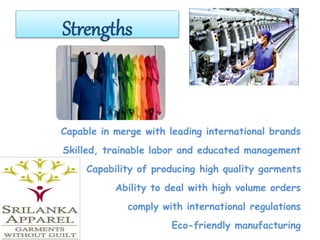
 Highest industrial employment generator and the highest foreign exchange earner.
 Produce a wide range of international branded clothing such as Victoria’s Secret, Pierre
Cardin, Nike, Gap etc.
 BOI approved ventures account for almost 90% of Sri Lanka’s total garment export.
 Sri Lanka’s textile and apparel industries could be categorized into 3 groups.
Apparel companies
Textile mills and finishing plants
Companies engaged in accessory manufacture
 Foreign Rivals
India
China
Bangladesh
Vietnam
Major export countries
European Union
USA
• The textile and clothing industry had emerged from a modest beginning in the
early 1950s.
• 1960- Industrial products (300 Categories) began to be manufactured locally.
Major item was textiles and readymade garments.
• Late1960’s that Sri Lanka’s readymade garments began to break into export
markets.
• 1970’s wage/ prices inflation and imposition of trade quotas on exports of
traditional Asian Suppliers of made-up garments.
• After the late 1970s saw a rapid expansion of the clothing industry in Sri Lanka.
– Market-oriented liberal economic policies (1977)
– Multi Fiber Arrangement
• Began to grow significantly in the 1980’s
• In 1985, Martin Trust, began working with Sri Lankan textile
and apparel companies.
• In 1986 and 1987 he established joint venture partnerships
with the Omar Group and the Amelean Group.
• In 2010, most of the exports to the US are from Sri Lanka (MAS
OR Brandix)
• Apparel is the second largest sub-sector in the index
(FIPI)
• Increase in new orders (unstable situation in
Bangladesh)
• Green manufacturing and waste management
methods
• Increase demand for local fabrics
• Apparel industry
Industrial exports :- 60%
Total exports :- 40%
• Textiles and Garment Industry has an important place in Sri
Lanka’s economy.
• The textiles & garment industry began in 1950.
• Economic liberalization policies in 1977 paved the way for
local handloom & garment industry to enter the world
market.
• It has become the Sri Lanka’s largest export industry since
1986 & also largest net foreign exchange earner since 1992
 In the world economy , the textile &
garment sector contributed nearly
6% to the world merchandise
exports.
 World trade in textiles & garments
takes place in a highly protected
market with tariffs & quantitative
restrictions.
• This is a system of export restrictions imposed by
developed countries on textiles & garment exports
originating in developing countries to protect the
garment industry in developed countries.
• Sri Lanka’s garment exports have been largely
governed by MFA since 1978.
• According to the new rules, the sector is to be
fully integrated in to normal rules of WTO.
• Sri Lanka has already fulfilled its
commitments.
• Economic liberalization policies in 1977 paved the way
to the market friendly economic environment.
• Under the schemes introduced by this policies, Export
of textiles & garments from Sri Lanka under the quota
system started in 1978.
• 1992 – administration of the quota system became
the responsibility of the Textile Quota Board (TQB)
• TQB was constituted as a statutory body by the Textile
Quota Board Act , No 33 of 1996
• BOI & the Textile division of the ministry
of enterprises development, industrial
policy & investment promotion issues
export license. (export visa)
• Recent measures in the 2014 budget
 National regulatory framework for nano technology
innovation & applications – national science foundation
 Joint Apparel Association Forum (JAAF)
 Commercial Hub 2013 – legal frame work to develop Sri
Lanka.
 Finance Act – Commercial Hub regulation No 01 of 2013
 Export Development Board - promote exports during 2013
source: Annual Report , Central Bank of Sri Lanka. 2013
• Sri Lanka has strong labour policies , clearly stipulates
the working hours, age limits, prohibition of child
labour, safety & salaries etc..
 Industrial disputes Act No 43/1950
 Factories Ordinance No 45/ 1942
 Trade Unions Ordinance No 14/1935
 Wages Board Ordinance No 27/1941
 Termination of Employment No 45/1971
 Employees Provident Fund Act No 15/1958
 Employees Trust Fund Act No 46/1980
• Import & Export Control Act 1969 – regulates the
international business in Sri Lanka
• Intellectual Property Rights – ensure a satisfactory
income & job security for fashion designers, within the
fashion industry , IP is not enforced, still Sri Lanka
could not come up with a suitable law to protect
fashion designers.
• RIGIDITY IN LABOUR LAWS
-our regulations are sometimes not in compliance with
international standards.
-restrictions in overtime for female workers
-Lose competitiveness to those countries which have flexible
labour legislations
• INTERNATIONAL TREATISES
-Trade Agreements
-North American Free Trade Agreements
-the African Growth & Opportunity Act
-Agreement between EU & SL
-WTO practices
• Flexible Labour Policies.
-wage policies should contain provisions to link wages with
productivity
-revised to suit the requirements of modern economies
-termination of employment , dispute settlement & other
matters should be amended
• Compliance with international instruments.
• Take actions to protect IP Rights of Fashion designers.
• Implement programmes & projects to increase high
tech industrial exports.
• Today, the textile industry occupies a pre-eminent position in Sri
Lanka, producing high quality textiles combined with an
industry which is flexible and uniquely capable in servicing
leading international brands such as Gap, Next, Jones New York,
Nike, Tommy Hilfiger, Speedo, Abercrombie & Fitch, Land’s End,
Marks & Spencer etc.
• A wide range of apparel for men, women, girls, boys, children
and babies in the categories of fashion-wear, sportswear, work-
wear, rain-wear, swim-wear is manufactured and exported with
the flexibility of catering to the specific seasons to many
countries around the world. USA and UK are the top markets for
Sri Lankan apparel through out the decades.
 ERP system looks in to all the process from receiving the order to
delivering it. It will have several modules that the company has to
buy according to their need. And then they can implement it. For
example, SAP has mobile platform for mobile phones. It has a CRM
(Customer Relationship Management) module.
 Some organizations prefer to have a separate CRM software which
is distinct to the main ERP system. Therefore, they can implement
CRM softwares like SugarCRM and Pivotel.
 Planing department needs a different set of softwares to do their
work.
 These software are specially designed to achieve that task...
FastReact is one of the world’s best planing tools for textile industry
SLINTEC’s research into textiles focuses on high-
end fabric, ‘smart’ yarn and other technologies
aimed at improving the competitiveness of the
island’s apparel industry, such as material that
lasts longer, is durable and self-cleaning.
According to Professor K.M. Nalin de Silva, Science
Team Leader at SLINTEC, nanotechnology can
help meet the demand for ‘comfort materials’ and
materials for newer applications.
At a time of climate change, with scarcity of power
and growing water shortages, people are demanding
apparel that’s more comfortable in extreme weather
conditions and those with self-cleaning fabrics or
where frequency of washing can be extended.
SLINTEC’s research is trying to develop textiles to
meet these requirements.
Body scanning systems will be used to create digital
body models that allow digital products to be draped
over them.
THERMOCOOL fiber is produced using nanotechnology
which work with the body’s natural thermal capabilities
through smart fiber cross-sections. This THERMOCOOL
textile is mainly targeted for Tropical countries
THERMOCOOL fiber rapidly evaporates moisture
thanks to its unique fiber mix. The fibers are designed
to provide added evaporative surface, outstanding
moisture transport and allow enhanced air
circulation focusing energy on the evaporation
process.
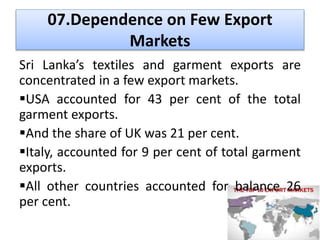
USA
44%
EU
21%ITALY
9%
OTHER
26%
EXPORT
Labour Deficiency
Withdrawal of GSP+ facility
Lack of Technology
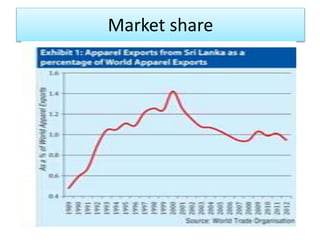
Reduced global market share
Branding Issues
Competition from other countries
Dependence on few Export market
Dependence on imported raw material
Increased financial difficulty of Small firms
Increase the global market share
Free Trade Agreement
Improve the Technology
Initiate steps to get the GSP+
Establish Brand for Sri Lanka
Provide Financial Support for SME
Improve efficiency of workforce
srilankan apparel industry

srilankan apparel industry

  • 2.
     Highest industrialemployment generator and the highest foreign exchange earner.  Produce a wide range of international branded clothing such as Victoria’s Secret, Pierre Cardin, Nike, Gap etc.  BOI approved ventures account for almost 90% of Sri Lanka’s total garment export.  Sri Lanka’s textile and apparel industries could be categorized into 3 groups. Apparel companies Textile mills and finishing plants Companies engaged in accessory manufacture  Foreign Rivals India China Bangladesh Vietnam Major export countries European Union USA
  • 3.
    • The textileand clothing industry had emerged from a modest beginning in the early 1950s. • 1960- Industrial products (300 Categories) began to be manufactured locally. Major item was textiles and readymade garments. • Late1960’s that Sri Lanka’s readymade garments began to break into export markets. • 1970’s wage/ prices inflation and imposition of trade quotas on exports of traditional Asian Suppliers of made-up garments. • After the late 1970s saw a rapid expansion of the clothing industry in Sri Lanka. – Market-oriented liberal economic policies (1977) – Multi Fiber Arrangement
  • 5.
    • Began togrow significantly in the 1980’s • In 1985, Martin Trust, began working with Sri Lankan textile and apparel companies. • In 1986 and 1987 he established joint venture partnerships with the Omar Group and the Amelean Group. • In 2010, most of the exports to the US are from Sri Lanka (MAS OR Brandix)
  • 6.
    • Apparel isthe second largest sub-sector in the index (FIPI) • Increase in new orders (unstable situation in Bangladesh) • Green manufacturing and waste management methods • Increase demand for local fabrics • Apparel industry Industrial exports :- 60% Total exports :- 40%
  • 7.
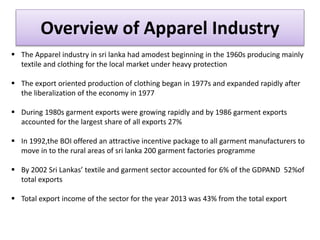
    • Textiles andGarment Industry has an important place in Sri Lanka’s economy. • The textiles & garment industry began in 1950. • Economic liberalization policies in 1977 paved the way for local handloom & garment industry to enter the world market. • It has become the Sri Lanka’s largest export industry since 1986 & also largest net foreign exchange earner since 1992
  • 8.
     In theworld economy , the textile & garment sector contributed nearly 6% to the world merchandise exports.  World trade in textiles & garments takes place in a highly protected market with tariffs & quantitative restrictions.
  • 9.
    • This isa system of export restrictions imposed by developed countries on textiles & garment exports originating in developing countries to protect the garment industry in developed countries. • Sri Lanka’s garment exports have been largely governed by MFA since 1978.
  • 10.
    • According tothe new rules, the sector is to be fully integrated in to normal rules of WTO. • Sri Lanka has already fulfilled its commitments.
  • 11.
    • Economic liberalizationpolicies in 1977 paved the way to the market friendly economic environment. • Under the schemes introduced by this policies, Export of textiles & garments from Sri Lanka under the quota system started in 1978. • 1992 – administration of the quota system became the responsibility of the Textile Quota Board (TQB) • TQB was constituted as a statutory body by the Textile Quota Board Act , No 33 of 1996
  • 12.
    • BOI &the Textile division of the ministry of enterprises development, industrial policy & investment promotion issues export license. (export visa) • Recent measures in the 2014 budget  National regulatory framework for nano technology innovation & applications – national science foundation  Joint Apparel Association Forum (JAAF)  Commercial Hub 2013 – legal frame work to develop Sri Lanka.  Finance Act – Commercial Hub regulation No 01 of 2013  Export Development Board - promote exports during 2013 source: Annual Report , Central Bank of Sri Lanka. 2013
  • 13.
    • Sri Lankahas strong labour policies , clearly stipulates the working hours, age limits, prohibition of child labour, safety & salaries etc..  Industrial disputes Act No 43/1950  Factories Ordinance No 45/ 1942  Trade Unions Ordinance No 14/1935  Wages Board Ordinance No 27/1941  Termination of Employment No 45/1971  Employees Provident Fund Act No 15/1958  Employees Trust Fund Act No 46/1980
  • 14.
    • Import &Export Control Act 1969 – regulates the international business in Sri Lanka • Intellectual Property Rights – ensure a satisfactory income & job security for fashion designers, within the fashion industry , IP is not enforced, still Sri Lanka could not come up with a suitable law to protect fashion designers.
  • 15.
    • RIGIDITY INLABOUR LAWS -our regulations are sometimes not in compliance with international standards. -restrictions in overtime for female workers -Lose competitiveness to those countries which have flexible labour legislations • INTERNATIONAL TREATISES -Trade Agreements -North American Free Trade Agreements -the African Growth & Opportunity Act -Agreement between EU & SL -WTO practices
  • 16.
    • Flexible LabourPolicies. -wage policies should contain provisions to link wages with productivity -revised to suit the requirements of modern economies -termination of employment , dispute settlement & other matters should be amended • Compliance with international instruments. • Take actions to protect IP Rights of Fashion designers. • Implement programmes & projects to increase high tech industrial exports.
  • 19.
    • Today, thetextile industry occupies a pre-eminent position in Sri Lanka, producing high quality textiles combined with an industry which is flexible and uniquely capable in servicing leading international brands such as Gap, Next, Jones New York, Nike, Tommy Hilfiger, Speedo, Abercrombie & Fitch, Land’s End, Marks & Spencer etc. • A wide range of apparel for men, women, girls, boys, children and babies in the categories of fashion-wear, sportswear, work- wear, rain-wear, swim-wear is manufactured and exported with the flexibility of catering to the specific seasons to many countries around the world. USA and UK are the top markets for Sri Lankan apparel through out the decades.
  • 20.
     ERP systemlooks in to all the process from receiving the order to delivering it. It will have several modules that the company has to buy according to their need. And then they can implement it. For example, SAP has mobile platform for mobile phones. It has a CRM (Customer Relationship Management) module.  Some organizations prefer to have a separate CRM software which is distinct to the main ERP system. Therefore, they can implement CRM softwares like SugarCRM and Pivotel.  Planing department needs a different set of softwares to do their work.  These software are specially designed to achieve that task... FastReact is one of the world’s best planing tools for textile industry
  • 21.
    SLINTEC’s research intotextiles focuses on high- end fabric, ‘smart’ yarn and other technologies aimed at improving the competitiveness of the island’s apparel industry, such as material that lasts longer, is durable and self-cleaning. According to Professor K.M. Nalin de Silva, Science Team Leader at SLINTEC, nanotechnology can help meet the demand for ‘comfort materials’ and materials for newer applications.
  • 23.
    At a timeof climate change, with scarcity of power and growing water shortages, people are demanding apparel that’s more comfortable in extreme weather conditions and those with self-cleaning fabrics or where frequency of washing can be extended. SLINTEC’s research is trying to develop textiles to meet these requirements.
  • 24.
    Body scanning systemswill be used to create digital body models that allow digital products to be draped over them.
  • 25.
    THERMOCOOL fiber isproduced using nanotechnology which work with the body’s natural thermal capabilities through smart fiber cross-sections. This THERMOCOOL textile is mainly targeted for Tropical countries
  • 26.
    THERMOCOOL fiber rapidlyevaporates moisture thanks to its unique fiber mix. The fibers are designed to provide added evaporative surface, outstanding moisture transport and allow enhanced air circulation focusing energy on the evaporation process.
  • 27.
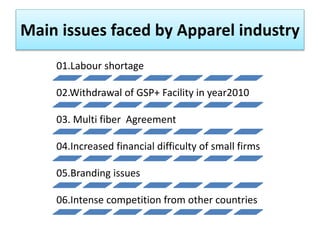
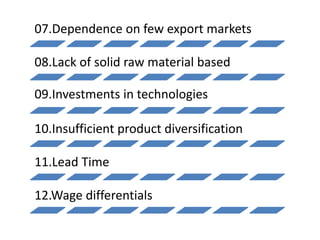
    USA 44% EU 21%ITALY 9% OTHER 26% EXPORT Labour Deficiency Withdrawal ofGSP+ facility Lack of Technology Reduced global market share Branding Issues Competition from other countries Dependence on few Export market Dependence on imported raw material Increased financial difficulty of Small firms
  • 28.
    Increase the globalmarket share Free Trade Agreement Improve the Technology Initiate steps to get the GSP+ Establish Brand for Sri Lanka Provide Financial Support for SME Improve efficiency of workforce