Correlation analysis
Correlation
• If two variable are so inter-related in such a
manner that change in one variable brings about
in other variable, then this type of relation of
variable known as correlation.
• If we change the value of one variable that will
make corresponding change in the value of other
variable on average then we can say two
variables are correlation.
• The value of correlation coefficient will vary from
-1 to +1.
Types of correlation
• Positive , negative and zero
correlation
• Linear and non linear correlation
• Simple, partial and multiple
correlation.
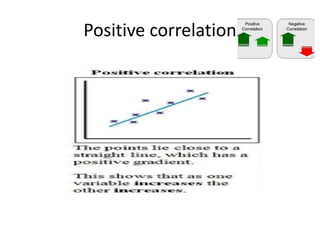
Positive correlation
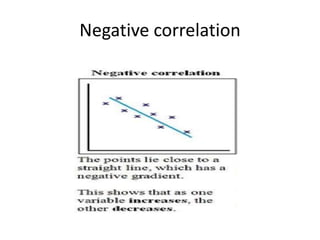
Negative correlation
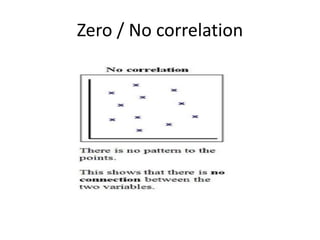
Zero / No correlation
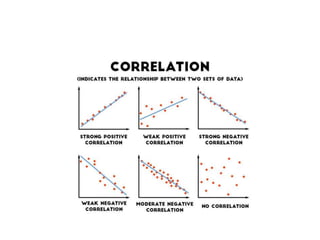
All points in correlation. The straight
line in upward direction [ left bottom
to right up]
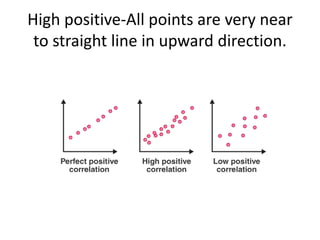
High positive-All points are very near
to straight line in upward direction.
Positive correlation-all points are near
to the straight line [ but not very near ]
correlation is positive.
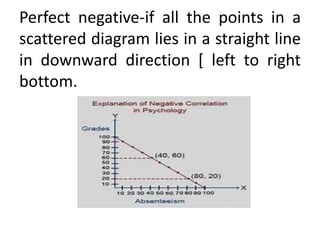
Perfect negative-if all the points in a
scattered diagram lies in a straight line
in downward direction [ left to right
bottom.
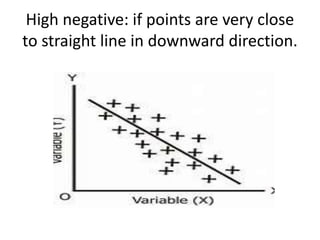
High negative: if points are very close
to straight line in downward direction.
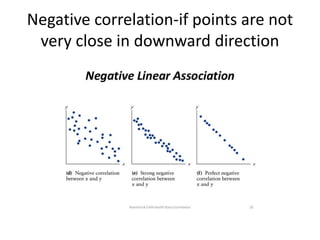
Negative correlation-if points are not
very close in downward direction
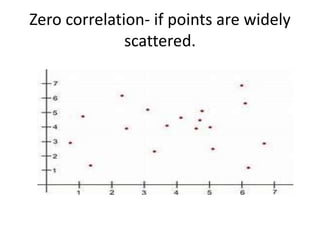
Zero correlation- if points are widely
scattered.
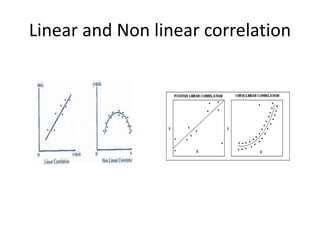
Linear and Non linear correlation
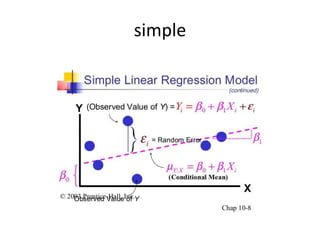
simple
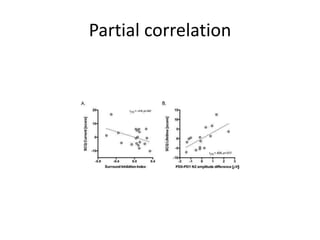
Partial correlation
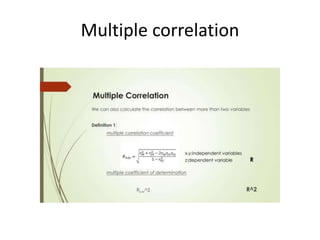
Multiple correlation
Bivariate data
• Bivariate data is concerned with
examining the relationship between two
variables.
• If two or more quantities vary in
sympathy so that the movements in one
tend to be accompanied by
corresponding movements in the other.
Positive and negative correlation
It is said to be positive , when
the variables move in the same
direction and negative when
they move in opposite.
uncorrelated
If the movement of one
variables does not effect
that of the other, the
variables are said to be
uncorrelated.
Correlation may be linear or non
linear.
If the amount of variation in x
bears a constant ratio to the
corresponding amount of variation
in y then the correlation between x
and y is said to be linear. Otherwise
it is non linear.
• The degree of a linear relationship between
two variables is measured by the karl
pearson’s coefficient of correlation or
correlation coefficient ‘r’.
• Correlation is meaningful when both the
variables x and y are the measured outcomes.
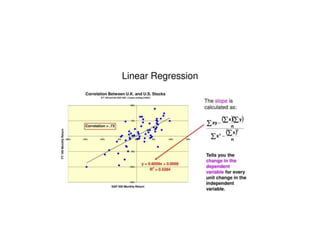
• If one variable is controlled by the researcher,
linear regression ought to be used instead of
correlation.
Pearson correlation coefficient
• Correlation analysis do not differentiate
between two variables but quantify the
relationship between them.
• Regression is to be chosen instead of
correlation if the variables x and y are clearly
defined.
Pearson correlation coefficient
• It is a measure of the linear relationship
between two attributes or column of data ‘r’.
• The non parametric spearman correlation
coefficient is rho ranges from +1 to -1
• If r and rho is far from zero. There are four
possible explanation.
Properties of pearson’s correlation
coefficient
• The value of r is dimensionless and can range
from -1 to +1 and is independent of the units
of measurement.
• Therefore the coefficient can be used to
compare different set of data.
• Pearson’s correlation coefficient is
independent of change of origin and scale.
Significance of Pearson’s correlation
coefficient
If r= 1 the x and y are positively correlated.
• The possible values of x and y all lie on a straight
line with a positive slope in the x,y plane.
• Example of perfect positive correlation are rare in
biological and social sciences.
• One example of perfect positive correlation is
charle’s law. When the volume of a gas is
constant , its pressure is directly proportional to
the temperature.
• If o < r then x and y have positive
correlation.
• Eg. It include age of husband and
wife ; educational level and age at
marriage ; and height and weight of
children.
Significance of Pearson’s correlation
coefficient
If r=0 then x and y are not
correlated. They do not have
apparent linear relationship.
However this does not mean that x
and y are statistically independent.
Significance of Pearson’s correlation
coefficient
If r < -1 then x and y have strong
negative correlation. Example of
negative correlation include infant
mortality rate and level of mothers
education; and fertility rates and
education level.
Significance of Pearson’s correlation
coefficient
• If r= -1 then x snd y are perfectly negatively
correlated.
• The possible values of x and y all lie in a
straight line with a negative slope in the x1y1
plane.
• Perfect negative slope in biological science is
rare one example is Boyle’s law . when the
temperature is kept constant pressure of gas is
inversely proportional to its volume.
Significance of Pearson’s correlation
coefficient
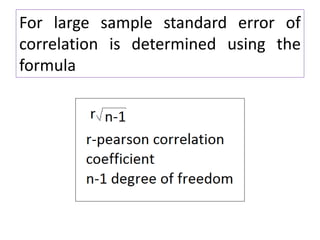
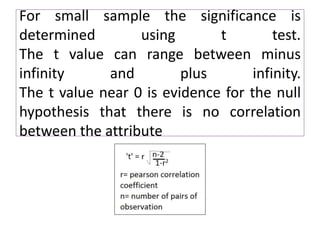
For large sample standard error of
correlation is determined using the
formula
For small sample the significance is
determined using t test.
The t value can range between minus
infinity and plus infinity.
The t value near 0 is evidence for the null
hypothesis that there is no correlation
between the attribute
Procedure for interpretation of
data/result
• Determine how the variables x and y vary
together.
• Consider the value of r or rho which quantifies
the correlation
• Consider the rho value
• Consider the confidence interval for ‘r’
• If P value is small correlation is not due to
mere coincidence, the true population ‘r’ lies
within the confidence interval.
• If p value is large , it means that there is no
compelling evidence that the correlation is
real and not a coincidence.
Method of correlation analysis
• Bivariate two way frequency table
It is the simplest method of obtaining
correlation between two variables but since it
only gives a rough estimate of the degree of
correlation. If it is not generally used.
• Scatter diagram
• Karl Pearson’s method
• Rank method
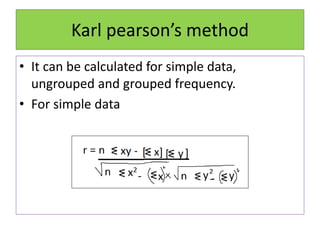
Karl pearson’s method
• It can be calculated for simple data,
ungrouped and grouped frequency.
• For simple data
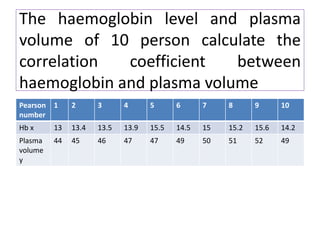
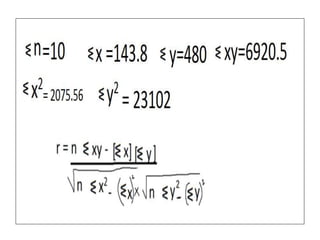
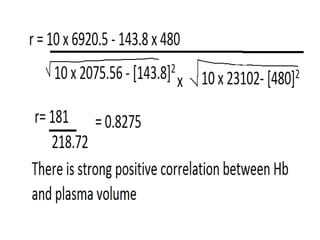
The haemoglobin level and plasma
volume of 10 person calculate the
correlation coefficient between
haemoglobin and plasma volume
Pearson
number
1 2 3 4 5 6 7 8 9 10
Hb x 13 13.4 13.5 13.9 15.5 14.5 15 15.2 15.6 14.2
Plasma
volume
y
44 45 46 47 47 49 50 51 52 49
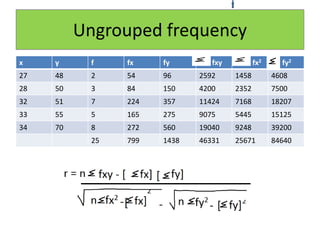
Ungrouped frequency
x y f fx fy fxy f fx2 fy2
27 48 2 54 96 2592 1458 4608
28 50 3 84 150 4200 2352 7500
32 51 7 224 357 11424 7168 18207
33 55 5 165 275 9075 5445 15125
34 70 8 272 560 19040 9248 39200
25 799 1438 46331 25671 84640
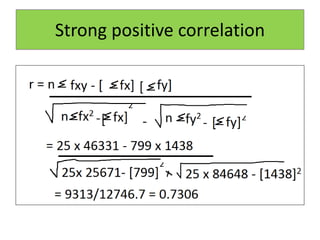
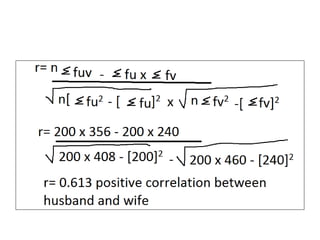
Strong positive correlation
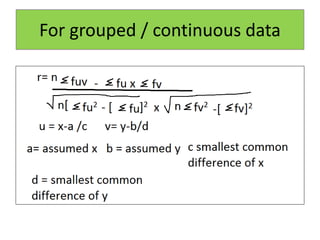
For grouped / continuous data
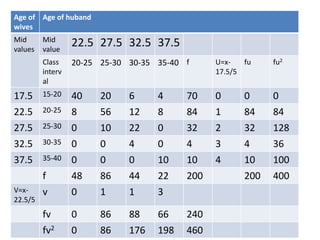
Age of
wives
Age of huband
Mid
values
Mid
value
22.5 27.5 32.5 37.5
Class
interv
al
20-25 25-30 30-35 35-40 f U=x-
17.5/5
fu fu2
17.5 15-20 40 20 6 4 70 0 0 0
22.5 20-25 8 56 12 8 84 1 84 84
27.5 25-30 0 10 22 0 32 2 32 128
32.5 30-35 0 0 4 0 4 3 4 36
37.5 35-40 0 0 0 10 10 4 10 100
f 48 86 44 22 200 200 400
V=x-
22.5/5
v 0 1 1 3
fv 0 86 88 66 240
fv2 0 86 176 198 460
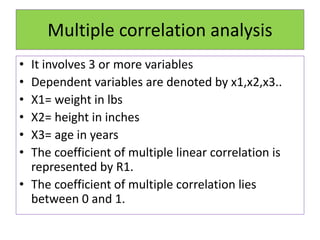
Multiple correlation analysis
• It involves 3 or more variables
• Dependent variables are denoted by x1,x2,x3..
• X1= weight in lbs
• X2= height in inches
• X3= age in years
• The coefficient of multiple linear correlation is
represented by R1.
• The coefficient of multiple correlation lies
between 0 and 1.
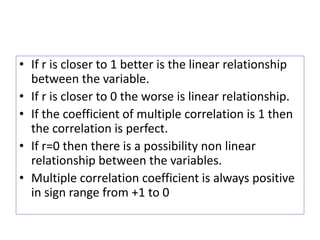
• If r is closer to 1 better is the linear relationship
between the variable.
• If r is closer to 0 the worse is linear relationship.
• If the coefficient of multiple correlation is 1 then
the correlation is perfect.
• If r=0 then there is a possibility non linear
relationship between the variables.
• Multiple correlation coefficient is always positive
in sign range from +1 to 0
Advantage
• It serve as a measure of the degree of association
between one variable taken as the dependent
variable and a group of other variables taken as
the independent variables.
• It also serve as a measure of goodness of fit of
the calculated plane of regression and
consequently as a measure of the general degree
of accuracy of estimates made by reference to
equation for the plane of regression.
Limitation
• It is based on assumption that the relationship
between the variables is linear.
• It requires much skill for calculation.
• Lack of understanding and resulting misuse
are due to the complexity of the method.
• In practice most relationships are not linear
but follow some pattern. This limits somewhat
the use of multiple correlation analysis
Correlation analysis

Correlation analysis

  • 1.
  • 2.
    Correlation • If twovariable are so inter-related in such a manner that change in one variable brings about in other variable, then this type of relation of variable known as correlation. • If we change the value of one variable that will make corresponding change in the value of other variable on average then we can say two variables are correlation. • The value of correlation coefficient will vary from -1 to +1.
  • 3.
    Types of correlation •Positive , negative and zero correlation • Linear and non linear correlation • Simple, partial and multiple correlation.
  • 4.
  • 5.
  • 6.
    Zero / Nocorrelation
  • 8.
    All points incorrelation. The straight line in upward direction [ left bottom to right up]
  • 9.
    High positive-All pointsare very near to straight line in upward direction.
  • 10.
    Positive correlation-all pointsare near to the straight line [ but not very near ] correlation is positive.
  • 11.
    Perfect negative-if allthe points in a scattered diagram lies in a straight line in downward direction [ left to right bottom.
  • 12.
    High negative: ifpoints are very close to straight line in downward direction.
  • 13.
    Negative correlation-if pointsare not very close in downward direction
  • 14.
    Zero correlation- ifpoints are widely scattered.
  • 16.
    Linear and Nonlinear correlation
  • 17.
  • 18.
  • 19.
  • 20.
    Bivariate data • Bivariatedata is concerned with examining the relationship between two variables. • If two or more quantities vary in sympathy so that the movements in one tend to be accompanied by corresponding movements in the other.
  • 21.
    Positive and negativecorrelation It is said to be positive , when the variables move in the same direction and negative when they move in opposite.
  • 22.
    uncorrelated If the movementof one variables does not effect that of the other, the variables are said to be uncorrelated.
  • 23.
    Correlation may belinear or non linear. If the amount of variation in x bears a constant ratio to the corresponding amount of variation in y then the correlation between x and y is said to be linear. Otherwise it is non linear.
  • 24.
    • The degreeof a linear relationship between two variables is measured by the karl pearson’s coefficient of correlation or correlation coefficient ‘r’. • Correlation is meaningful when both the variables x and y are the measured outcomes. • If one variable is controlled by the researcher, linear regression ought to be used instead of correlation. Pearson correlation coefficient
  • 25.
    • Correlation analysisdo not differentiate between two variables but quantify the relationship between them. • Regression is to be chosen instead of correlation if the variables x and y are clearly defined. Pearson correlation coefficient
  • 26.
    Pearson correlation coefficient •It is a measure of the linear relationship between two attributes or column of data ‘r’. • The non parametric spearman correlation coefficient is rho ranges from +1 to -1 • If r and rho is far from zero. There are four possible explanation.
  • 27.
    Properties of pearson’scorrelation coefficient • The value of r is dimensionless and can range from -1 to +1 and is independent of the units of measurement. • Therefore the coefficient can be used to compare different set of data. • Pearson’s correlation coefficient is independent of change of origin and scale.
  • 28.
    Significance of Pearson’scorrelation coefficient If r= 1 the x and y are positively correlated. • The possible values of x and y all lie on a straight line with a positive slope in the x,y plane. • Example of perfect positive correlation are rare in biological and social sciences. • One example of perfect positive correlation is charle’s law. When the volume of a gas is constant , its pressure is directly proportional to the temperature.
  • 29.
    • If o< r then x and y have positive correlation. • Eg. It include age of husband and wife ; educational level and age at marriage ; and height and weight of children. Significance of Pearson’s correlation coefficient
  • 30.
    If r=0 thenx and y are not correlated. They do not have apparent linear relationship. However this does not mean that x and y are statistically independent. Significance of Pearson’s correlation coefficient
  • 31.
    If r <-1 then x and y have strong negative correlation. Example of negative correlation include infant mortality rate and level of mothers education; and fertility rates and education level. Significance of Pearson’s correlation coefficient
  • 32.
    • If r=-1 then x snd y are perfectly negatively correlated. • The possible values of x and y all lie in a straight line with a negative slope in the x1y1 plane. • Perfect negative slope in biological science is rare one example is Boyle’s law . when the temperature is kept constant pressure of gas is inversely proportional to its volume. Significance of Pearson’s correlation coefficient
  • 33.
    For large samplestandard error of correlation is determined using the formula
  • 34.
    For small samplethe significance is determined using t test. The t value can range between minus infinity and plus infinity. The t value near 0 is evidence for the null hypothesis that there is no correlation between the attribute
  • 35.
    Procedure for interpretationof data/result • Determine how the variables x and y vary together. • Consider the value of r or rho which quantifies the correlation • Consider the rho value • Consider the confidence interval for ‘r’
  • 36.
    • If Pvalue is small correlation is not due to mere coincidence, the true population ‘r’ lies within the confidence interval. • If p value is large , it means that there is no compelling evidence that the correlation is real and not a coincidence.
  • 37.
    Method of correlationanalysis • Bivariate two way frequency table It is the simplest method of obtaining correlation between two variables but since it only gives a rough estimate of the degree of correlation. If it is not generally used. • Scatter diagram • Karl Pearson’s method • Rank method
  • 38.
    Karl pearson’s method •It can be calculated for simple data, ungrouped and grouped frequency. • For simple data
  • 39.
    The haemoglobin leveland plasma volume of 10 person calculate the correlation coefficient between haemoglobin and plasma volume Pearson number 1 2 3 4 5 6 7 8 9 10 Hb x 13 13.4 13.5 13.9 15.5 14.5 15 15.2 15.6 14.2 Plasma volume y 44 45 46 47 47 49 50 51 52 49
  • 42.
    Ungrouped frequency x yf fx fy fxy f fx2 fy2 27 48 2 54 96 2592 1458 4608 28 50 3 84 150 4200 2352 7500 32 51 7 224 357 11424 7168 18207 33 55 5 165 275 9075 5445 15125 34 70 8 272 560 19040 9248 39200 25 799 1438 46331 25671 84640
  • 43.
  • 44.
    For grouped /continuous data
  • 45.
    Age of wives Age ofhuband Mid values Mid value 22.5 27.5 32.5 37.5 Class interv al 20-25 25-30 30-35 35-40 f U=x- 17.5/5 fu fu2 17.5 15-20 40 20 6 4 70 0 0 0 22.5 20-25 8 56 12 8 84 1 84 84 27.5 25-30 0 10 22 0 32 2 32 128 32.5 30-35 0 0 4 0 4 3 4 36 37.5 35-40 0 0 0 10 10 4 10 100 f 48 86 44 22 200 200 400 V=x- 22.5/5 v 0 1 1 3 fv 0 86 88 66 240 fv2 0 86 176 198 460
  • 47.
    Multiple correlation analysis •It involves 3 or more variables • Dependent variables are denoted by x1,x2,x3.. • X1= weight in lbs • X2= height in inches • X3= age in years • The coefficient of multiple linear correlation is represented by R1. • The coefficient of multiple correlation lies between 0 and 1.
  • 48.
    • If ris closer to 1 better is the linear relationship between the variable. • If r is closer to 0 the worse is linear relationship. • If the coefficient of multiple correlation is 1 then the correlation is perfect. • If r=0 then there is a possibility non linear relationship between the variables. • Multiple correlation coefficient is always positive in sign range from +1 to 0
  • 49.
    Advantage • It serveas a measure of the degree of association between one variable taken as the dependent variable and a group of other variables taken as the independent variables. • It also serve as a measure of goodness of fit of the calculated plane of regression and consequently as a measure of the general degree of accuracy of estimates made by reference to equation for the plane of regression.
  • 50.
    Limitation • It isbased on assumption that the relationship between the variables is linear. • It requires much skill for calculation. • Lack of understanding and resulting misuse are due to the complexity of the method. • In practice most relationships are not linear but follow some pattern. This limits somewhat the use of multiple correlation analysis