By-Naveen Kumar Medapalli
iFEEL
INTRODUCTION
 Multiple regression analysis is a powerful technique used for predicting the
unknown value of a variable from the known value of two or more variables.
 It also called as predictors.
 Method used for studying the relationship between a dependent variable and two
or more independent variables.
 Purposes:
 Prediction
 Explanation
 Theory building
 The variable whose value is to be predicted is known as the dependent
variable.
 The ones whose known values are used for prediction are
known Independent (exploratory) variables.
Design Requirements:
 One dependent variable (criterion)
 Two or more independent variables (predictor variables).
 Sample size: ≤ 50 (at least 10 times as many cases as independent variables)
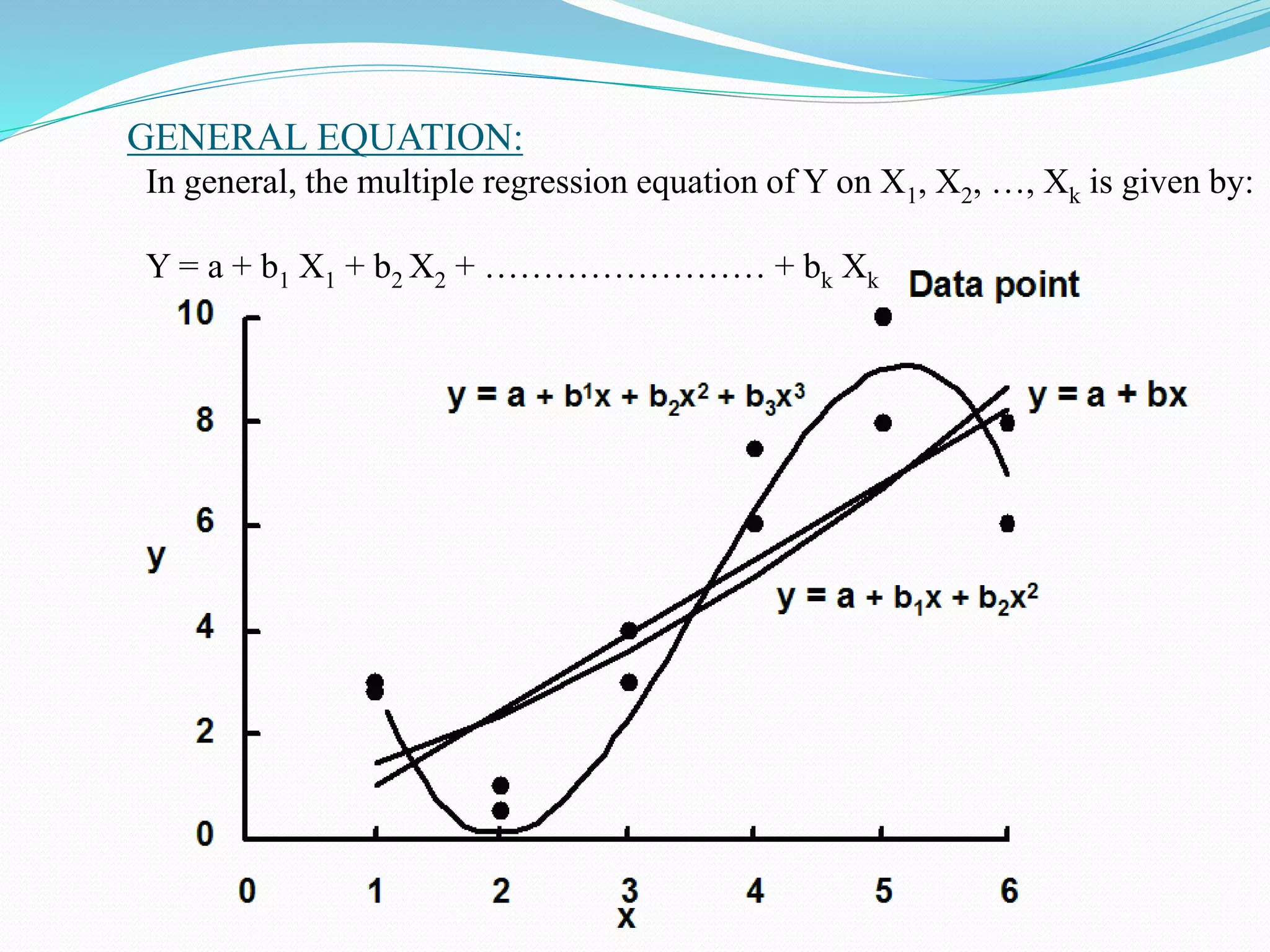
GENERAL EQUATION:
In general, the multiple regression equation of Y on X1, X2, …, Xk is given by:
Y = a + b1 X1 + b2 X2 + …………………… + bk Xk
Simple vs. Multiple Regression
 One dependent variable Y
predicted from one
independent variable X
 One regression coefficient
 r2: proportion of variation in
dependent variable Y
predictable from X
 One dependent variable Y
predicted from a set of
independent variables (X1,
X2 ….Xk)
 One regression coefficient
for each independent
variable
 R2: proportion of variation
in dependent variable Y
predictable by set of
independent variables (X’s)
ADVANTAGE:
 Once a multiple regression equation has been constructed, one can
check how good it is by examining the coefficient of
determination(R2). R2 always lies between 0 and 1.
 All software provides it whenever regression procedure is run. The
closer R2 is to 1, the better is the model and its prediction.
ASSUMPTIONS:
 Multiple regression technique does not test whether data is linear. On
the contrary, it proceeds by assuming that the relationship between the
Y and each of Xi's is linear. Hence as a rule, it is prudent to always look
at the scatter plots of (Y, Xi), i= 1, 2,…,k. If any plot suggests non
linearity, one may use a suitable transformation to attain linearity.
Multiple Regression Analysis (MRA)

Multiple Regression Analysis (MRA)

  • 1.
  • 2.
    INTRODUCTION  Multiple regressionanalysis is a powerful technique used for predicting the unknown value of a variable from the known value of two or more variables.  It also called as predictors.  Method used for studying the relationship between a dependent variable and two or more independent variables.  Purposes:  Prediction  Explanation  Theory building
  • 3.
     The variablewhose value is to be predicted is known as the dependent variable.  The ones whose known values are used for prediction are known Independent (exploratory) variables. Design Requirements:  One dependent variable (criterion)  Two or more independent variables (predictor variables).  Sample size: ≤ 50 (at least 10 times as many cases as independent variables)
  • 4.
    GENERAL EQUATION: In general,the multiple regression equation of Y on X1, X2, …, Xk is given by: Y = a + b1 X1 + b2 X2 + …………………… + bk Xk
  • 5.
    Simple vs. MultipleRegression  One dependent variable Y predicted from one independent variable X  One regression coefficient  r2: proportion of variation in dependent variable Y predictable from X  One dependent variable Y predicted from a set of independent variables (X1, X2 ….Xk)  One regression coefficient for each independent variable  R2: proportion of variation in dependent variable Y predictable by set of independent variables (X’s)
  • 6.
    ADVANTAGE:  Once amultiple regression equation has been constructed, one can check how good it is by examining the coefficient of determination(R2). R2 always lies between 0 and 1.  All software provides it whenever regression procedure is run. The closer R2 is to 1, the better is the model and its prediction. ASSUMPTIONS:  Multiple regression technique does not test whether data is linear. On the contrary, it proceeds by assuming that the relationship between the Y and each of Xi's is linear. Hence as a rule, it is prudent to always look at the scatter plots of (Y, Xi), i= 1, 2,…,k. If any plot suggests non linearity, one may use a suitable transformation to attain linearity.