Correlation Analysis
MISAB P.T
Ph.D Management
Definition of Correlation
 Correlation is the degree of association between two or
more variables.
 If two or more quantities vary so that movements in
one tend to be accompanied by movements in other,
then they are said to be correlated.
 Coefficient of correlation is a numerical measure of the
degree of association between two or more variables.
Meaning
 Correlation is the most popular statistical measure that
indicates the relationship between two or more
variables.
 It is concerned with finding:
 Whether or not the relationship exist?
 Degree of the correlation?
 Direction of relationship within the variables (Direct
or indirect)?
 Relationship is strong or Weak?
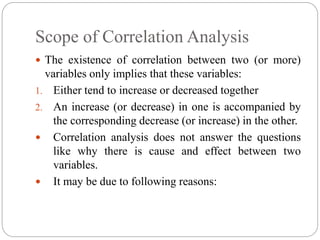
Examples
 Relationship between income and years of experience
 Relationship between amount of rainfall and yield of
rice
 Relationship between price and demand of a commodity
 Relationship between nature of work and motivation to
work
 Relationship between height and weight
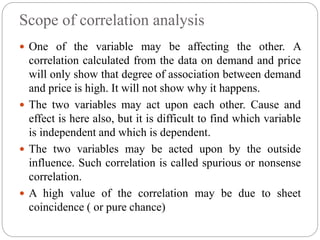
Scope of Correlation Analysis
 The existence of correlation between two (or more)
variables only implies that these variables:
1. Either tend to increase or decreased together
2. An increase (or decrease) in one is accompanied by
the corresponding decrease (or increase) in the other.
 Correlation analysis does not answer the questions
like why there is cause and effect between two
variables.
 It may be due to following reasons:
Scope of correlation analysis
 One of the variable may be affecting the other. A
correlation calculated from the data on demand and price
will only show that degree of association between demand
and price is high. It will not show why it happens.
 The two variables may act upon each other. Cause and
effect is here also, but it is difficult to find which variable
is independent and which is dependent.
 The two variables may be acted upon by the outside
influence. Such correlation is called spurious or nonsense
correlation.
 A high value of the correlation may be due to sheet
coincidence ( or pure chance)
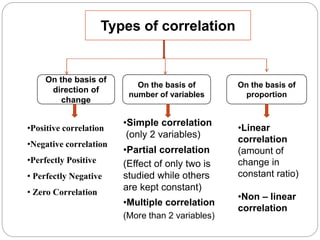
Types of correlation
On the basis of
direction of
change
On the basis of
number of variables
On the basis of
proportion
•Positive correlation
•Negative correlation
•Perfectly Positive
• Perfectly Negative
• Zero Correlation
•Simple correlation
(only 2 variables)
•Partial correlation
(Effect of only two is
studied while others
are kept constant)
•Multiple correlation
(More than 2 variables)
•Linear
correlation
(amount of
change in
constant ratio)
•Non – linear
correlation
Types of Correlation
Correlation on the basis of direction of change is as following:
(1) Positive Correlation
(2) Negative Correlation
(3) Perfectly Positive Correlation
(4) Perfectly Negative Correlation
(5) Zero Correlation
Positive Correlation
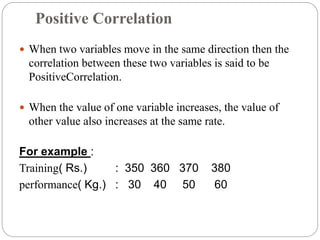
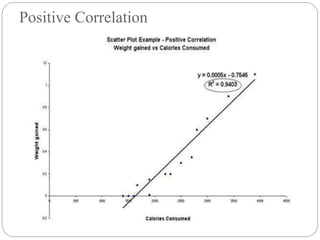
 When two variables move in the same direction then the
correlation between these two variables is said to be
PositiveCorrelation.
 When the value of one variable increases, the value of
other value also increases at the same rate.
For example :
Training( Rs.) : 350 360 370 380
performance( Kg.) : 30 40 50 60
Positive Correlation
Negative Correlation
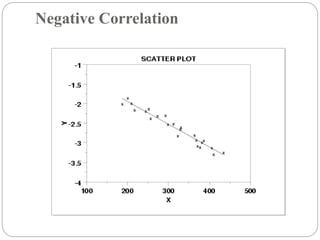
 In this type of correlation, the two variables move in the
opposite direction.
 When the value of one variable increases, the value of the
other variable decreases.
For example, the relationship between price and demand.
Negative Correlation
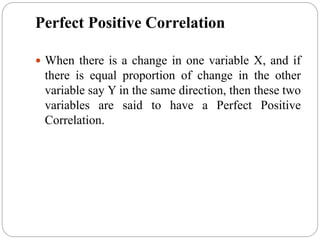
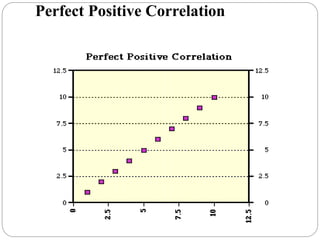
Perfect Positive Correlation
 When there is a change in one variable X, and if
there is equal proportion of change in the other
variable say Y in the same direction, then these two
variables are said to have a Perfect Positive
Correlation.
Perfect Positive Correlation
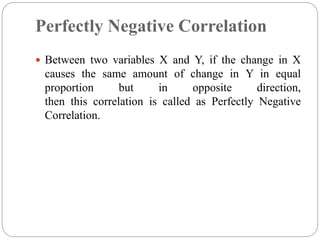
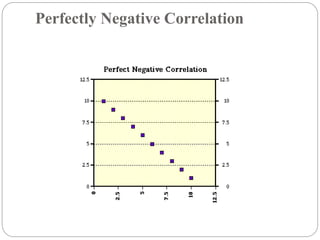
Perfectly Negative Correlation
 Between two variables X and Y, if the change in X
causes the same amount of change in Y in equal
proportion but in opposite direction,
then this correlation is called as Perfectly Negative
Correlation.
Perfectly Negative Correlation
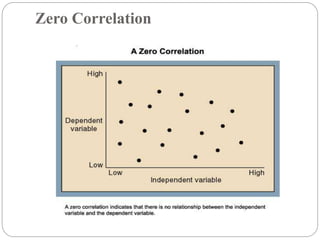
Zero Correlation
 When the two variables are independent and the
change in one variable has no effect in other
variable,
then the correlation between these two variable is
known as Zero Correlation.
Zero Correlation
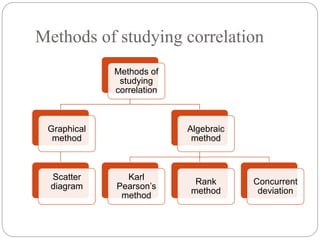
Methods of studying correlation
Methods of
studying
correlation
Graphical
method
Scatter
diagram
Algebraic
method
Karl
Pearson’s
method
Rank
method
Concurrent
deviation
Karl Pearson’s Coefficient of Correlation
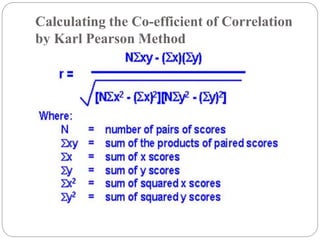
 It is the most widely used method of measuring linear
relationship between two variables.
 Assumptions of Karl Pearson’s Coefficient:
1. There is linear relationship between variables.
2. There is cause and effect relationship
Calculating the Co-efficient of Correlation
by Karl Pearson Method
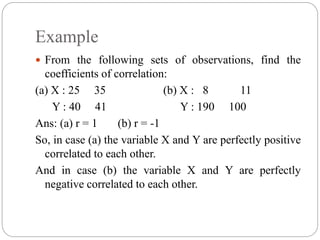
Example
 From the following sets of observations, find the
coefficients of correlation:
(a) X : 25 35 (b) X : 8 11
Y : 40 41 Y : 190 100
Ans: (a) r = 1 (b) r = -1
So, in case (a) the variable X and Y are perfectly positive
correlated to each other.
And in case (b) the variable X and Y are perfectly
negative correlated to each other.
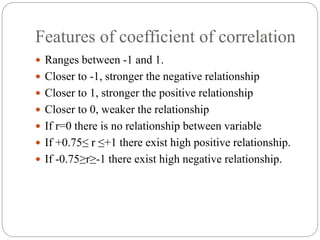
Features of coefficient of correlation
 Ranges between -1 and 1.
 Closer to -1, stronger the negative relationship
 Closer to 1, stronger the positive relationship
 Closer to 0, weaker the relationship
 If r=0 there is no relationship between variable
 If +0.75≤ r ≤+1 there exist high positive relationship.
 If -0.75≥r≥-1 there exist high negative relationship.
Scatter Diagram
 The first step in determining whether there is a
relationship between two variable is to examine the
graph of observed data.
 The graph or chart is called scatter diagram.
 A scatter diagram gives us information about patterns
that indicates that variables are related.
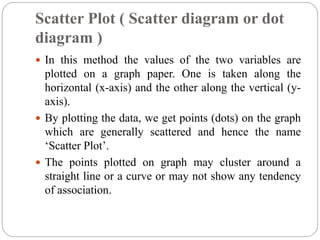
Scatter Plot ( Scatter diagram or dot
diagram )
 In this method the values of the two variables are
plotted on a graph paper. One is taken along the
horizontal (x-axis) and the other along the vertical (y-
axis).
 By plotting the data, we get points (dots) on the graph
which are generally scattered and hence the name
‘Scatter Plot’.
 The points plotted on graph may cluster around a
straight line or a curve or may not show any tendency
of association.
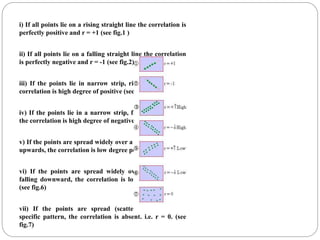
i) If all points lie on a rising straight line the correlation is
perfectly positive and r = +1 (see fig.1 )
ii) If all points lie on a falling straight line the correlation
is perfectly negative and r = -1 (see fig.2)
iii) If the points lie in narrow strip, rising upwards, the
correlation is high degree of positive (see fig.3)
iv) If the points lie in a narrow strip, falling downwards,
the correlation is high degree of negative (see fig.4)
v) If the points are spread widely over a broad strip, rising
upwards, the correlation is low degree positive (see fig.5)
vi) If the points are spread widely over a broad strip,
falling downward, the correlation is low degree negative
(see fig.6)
vii) If the points are spread (scattered) without any
specific pattern, the correlation is absent. i.e. r = 0. (see
fig.7)
Scatter diagram continue…
 A scatter diagram of the data helps in having a visual idea
about the nature of association between two variables.
 If the point cluster along the straight line the association
between variable is linear.
 If the points cluster along the a curve, the association is non-
linear or curvilinear.
 If the points neither cluster along a straight line nor along a
curve, there is absence of any association between the
variables.
 When the low/high value of one variable is associated with
low/high value of other variable respectively, the association is
called positive.
 In contrast if low/high value of one variable is associated with
high/low value of other variable respectively, the association is
called negative.
Example
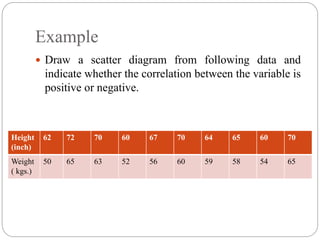
 Draw a scatter diagram from following data and
indicate whether the correlation between the variable is
positive or negative.
Height
(inch)
62 72 70 60 67 70 64 65 60 70
Weight
( kgs.)
50 65 63 52 56 60 59 58 54 65
Standard Error
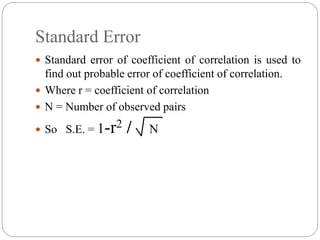
 Standard error of coefficient of correlation is used to
find out probable error of coefficient of correlation.
 Where r = coefficient of correlation
 N = Number of observed pairs
 So S.E. = 1-r2 / N
Probable Error
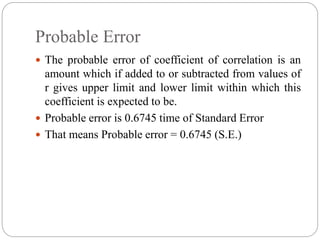
 The probable error of coefficient of correlation is an
amount which if added to or subtracted from values of
r gives upper limit and lower limit within which this
coefficient is expected to be.
 Probable error is 0.6745 time of Standard Error
 That means Probable error = 0.6745 (S.E.)
Use of probable error
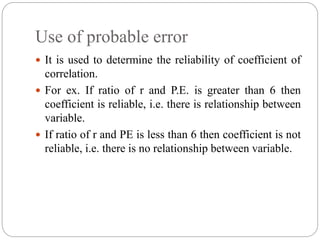
 It is used to determine the reliability of coefficient of
correlation.
 For ex. If ratio of r and P.E. is greater than 6 then
coefficient is reliable, i.e. there is relationship between
variable.
 If ratio of r and PE is less than 6 then coefficient is not
reliable, i.e. there is no relationship between variable.
Example
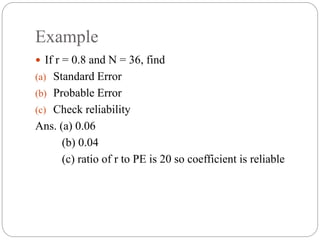
 If r = 0.8 and N = 36, find
(a) Standard Error
(b) Probable Error
(c) Check reliability
Ans. (a) 0.06
(b) 0.04
(c) ratio of r to PE is 20 so coefficient is reliable

Correlation analysis

  • 1.
  • 2.
    Definition of Correlation Correlation is the degree of association between two or more variables.  If two or more quantities vary so that movements in one tend to be accompanied by movements in other, then they are said to be correlated.  Coefficient of correlation is a numerical measure of the degree of association between two or more variables.
  • 3.
    Meaning  Correlation isthe most popular statistical measure that indicates the relationship between two or more variables.  It is concerned with finding:  Whether or not the relationship exist?  Degree of the correlation?  Direction of relationship within the variables (Direct or indirect)?  Relationship is strong or Weak?
  • 4.
    Examples  Relationship betweenincome and years of experience  Relationship between amount of rainfall and yield of rice  Relationship between price and demand of a commodity  Relationship between nature of work and motivation to work  Relationship between height and weight
  • 5.
    Scope of CorrelationAnalysis  The existence of correlation between two (or more) variables only implies that these variables: 1. Either tend to increase or decreased together 2. An increase (or decrease) in one is accompanied by the corresponding decrease (or increase) in the other.  Correlation analysis does not answer the questions like why there is cause and effect between two variables.  It may be due to following reasons:
  • 6.
    Scope of correlationanalysis  One of the variable may be affecting the other. A correlation calculated from the data on demand and price will only show that degree of association between demand and price is high. It will not show why it happens.  The two variables may act upon each other. Cause and effect is here also, but it is difficult to find which variable is independent and which is dependent.  The two variables may be acted upon by the outside influence. Such correlation is called spurious or nonsense correlation.  A high value of the correlation may be due to sheet coincidence ( or pure chance)
  • 7.
    Types of correlation Onthe basis of direction of change On the basis of number of variables On the basis of proportion •Positive correlation •Negative correlation •Perfectly Positive • Perfectly Negative • Zero Correlation •Simple correlation (only 2 variables) •Partial correlation (Effect of only two is studied while others are kept constant) •Multiple correlation (More than 2 variables) •Linear correlation (amount of change in constant ratio) •Non – linear correlation
  • 8.
    Types of Correlation Correlationon the basis of direction of change is as following: (1) Positive Correlation (2) Negative Correlation (3) Perfectly Positive Correlation (4) Perfectly Negative Correlation (5) Zero Correlation
  • 9.
    Positive Correlation  Whentwo variables move in the same direction then the correlation between these two variables is said to be PositiveCorrelation.  When the value of one variable increases, the value of other value also increases at the same rate. For example : Training( Rs.) : 350 360 370 380 performance( Kg.) : 30 40 50 60
  • 10.
  • 11.
    Negative Correlation  Inthis type of correlation, the two variables move in the opposite direction.  When the value of one variable increases, the value of the other variable decreases. For example, the relationship between price and demand.
  • 12.
  • 13.
    Perfect Positive Correlation When there is a change in one variable X, and if there is equal proportion of change in the other variable say Y in the same direction, then these two variables are said to have a Perfect Positive Correlation.
  • 14.
  • 15.
    Perfectly Negative Correlation Between two variables X and Y, if the change in X causes the same amount of change in Y in equal proportion but in opposite direction, then this correlation is called as Perfectly Negative Correlation.
  • 16.
  • 17.
    Zero Correlation  Whenthe two variables are independent and the change in one variable has no effect in other variable, then the correlation between these two variable is known as Zero Correlation.
  • 18.
  • 19.
    Methods of studyingcorrelation Methods of studying correlation Graphical method Scatter diagram Algebraic method Karl Pearson’s method Rank method Concurrent deviation
  • 20.
    Karl Pearson’s Coefficientof Correlation  It is the most widely used method of measuring linear relationship between two variables.  Assumptions of Karl Pearson’s Coefficient: 1. There is linear relationship between variables. 2. There is cause and effect relationship
  • 21.
    Calculating the Co-efficientof Correlation by Karl Pearson Method
  • 22.
    Example  From thefollowing sets of observations, find the coefficients of correlation: (a) X : 25 35 (b) X : 8 11 Y : 40 41 Y : 190 100 Ans: (a) r = 1 (b) r = -1 So, in case (a) the variable X and Y are perfectly positive correlated to each other. And in case (b) the variable X and Y are perfectly negative correlated to each other.
  • 23.
    Features of coefficientof correlation  Ranges between -1 and 1.  Closer to -1, stronger the negative relationship  Closer to 1, stronger the positive relationship  Closer to 0, weaker the relationship  If r=0 there is no relationship between variable  If +0.75≤ r ≤+1 there exist high positive relationship.  If -0.75≥r≥-1 there exist high negative relationship.
  • 24.
    Scatter Diagram  Thefirst step in determining whether there is a relationship between two variable is to examine the graph of observed data.  The graph or chart is called scatter diagram.  A scatter diagram gives us information about patterns that indicates that variables are related.
  • 25.
    Scatter Plot (Scatter diagram or dot diagram )  In this method the values of the two variables are plotted on a graph paper. One is taken along the horizontal (x-axis) and the other along the vertical (y- axis).  By plotting the data, we get points (dots) on the graph which are generally scattered and hence the name ‘Scatter Plot’.  The points plotted on graph may cluster around a straight line or a curve or may not show any tendency of association.
  • 26.
    i) If allpoints lie on a rising straight line the correlation is perfectly positive and r = +1 (see fig.1 ) ii) If all points lie on a falling straight line the correlation is perfectly negative and r = -1 (see fig.2) iii) If the points lie in narrow strip, rising upwards, the correlation is high degree of positive (see fig.3) iv) If the points lie in a narrow strip, falling downwards, the correlation is high degree of negative (see fig.4) v) If the points are spread widely over a broad strip, rising upwards, the correlation is low degree positive (see fig.5) vi) If the points are spread widely over a broad strip, falling downward, the correlation is low degree negative (see fig.6) vii) If the points are spread (scattered) without any specific pattern, the correlation is absent. i.e. r = 0. (see fig.7)
  • 27.
    Scatter diagram continue… A scatter diagram of the data helps in having a visual idea about the nature of association between two variables.  If the point cluster along the straight line the association between variable is linear.  If the points cluster along the a curve, the association is non- linear or curvilinear.  If the points neither cluster along a straight line nor along a curve, there is absence of any association between the variables.  When the low/high value of one variable is associated with low/high value of other variable respectively, the association is called positive.  In contrast if low/high value of one variable is associated with high/low value of other variable respectively, the association is called negative.
  • 28.
    Example  Draw ascatter diagram from following data and indicate whether the correlation between the variable is positive or negative. Height (inch) 62 72 70 60 67 70 64 65 60 70 Weight ( kgs.) 50 65 63 52 56 60 59 58 54 65
  • 29.
    Standard Error  Standarderror of coefficient of correlation is used to find out probable error of coefficient of correlation.  Where r = coefficient of correlation  N = Number of observed pairs  So S.E. = 1-r2 / N
  • 30.
    Probable Error  Theprobable error of coefficient of correlation is an amount which if added to or subtracted from values of r gives upper limit and lower limit within which this coefficient is expected to be.  Probable error is 0.6745 time of Standard Error  That means Probable error = 0.6745 (S.E.)
  • 31.
    Use of probableerror  It is used to determine the reliability of coefficient of correlation.  For ex. If ratio of r and P.E. is greater than 6 then coefficient is reliable, i.e. there is relationship between variable.  If ratio of r and PE is less than 6 then coefficient is not reliable, i.e. there is no relationship between variable.
  • 32.
    Example  If r= 0.8 and N = 36, find (a) Standard Error (b) Probable Error (c) Check reliability Ans. (a) 0.06 (b) 0.04 (c) ratio of r to PE is 20 so coefficient is reliable