INTRODUCTION TO
STATISTICS
Prepared By: Ms.R.Niruja
Lecturer
University of Jaffna
Overview
The Role of Statistics
The Research Process
Threats to Validity
Statistical Terminology
Scales of Measurement
Introduction to Descriptive and Inferential Statistics
13/07/2018 Introduction to Statistics 2
What is statistics?
• statistics is the methodology for collecting,
analyzing, interpreting and drawing conclusions
from information.
• Statistics consists of a body of methods for
collecting and analyzing data. (Agresti & Finlay,
1997)
13/07/2018 Introduction to Statistics 3
Statistical methods can be used to find answers
to the questions like:
• What kind and how much data need to be collected?
• How should we organize and summarize the data?
• How can we analyse the data and draw conclusions
from it?
• How can we assess the strength of the conclusions and
evaluate their uncertainty?
13/07/2018 Introduction to Statistics 4
The Role of Statistics
1. Design: Planning and carrying out research studies.
2. Description: Summarizing and exploring data.
3. Inference: Making predictions and generalizing
about phenomena represented by the data.
13/07/2018 Introduction to Statistics 5
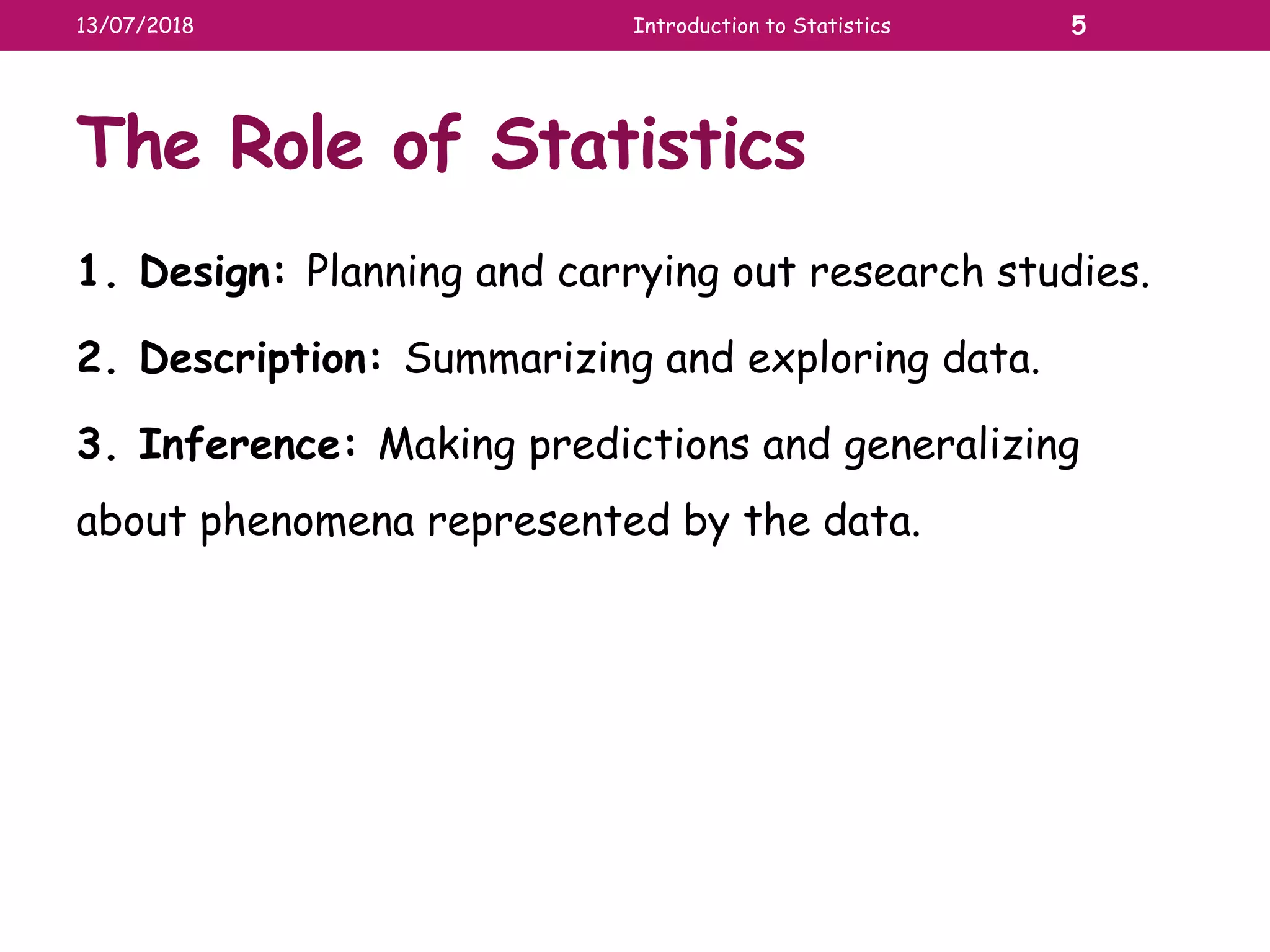
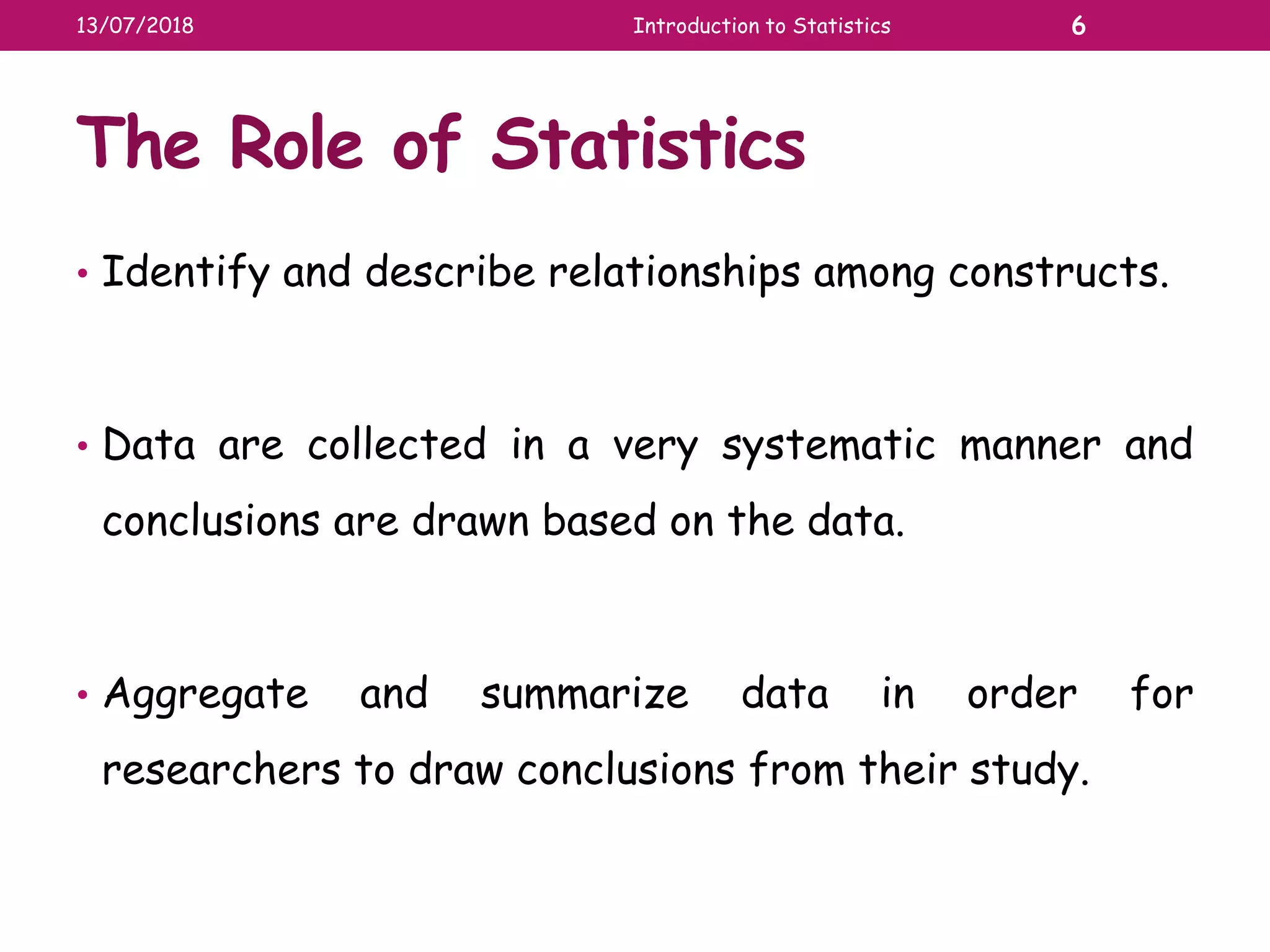
The Role of Statistics
• Identify and describe relationships among constructs.
• Data are collected in a very systematic manner and
conclusions are drawn based on the data.
• Aggregate and summarize data in order for
researchers to draw conclusions from their study.
13/07/2018 Introduction to Statistics 6
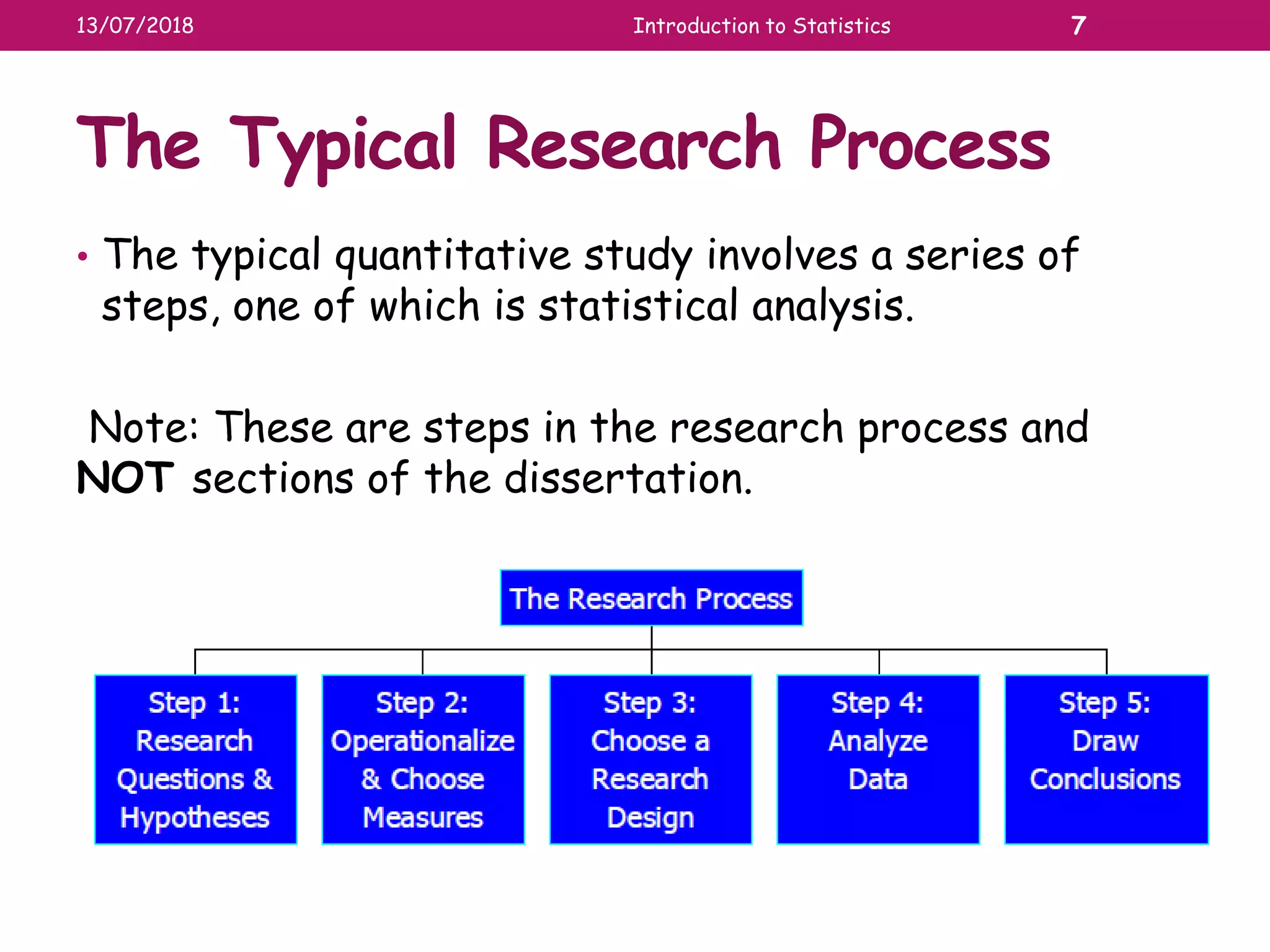
The Typical Research Process
• The typical quantitative study involves a series of
steps, one of which is statistical analysis.
Note: These are steps in the research process and
NOT sections of the dissertation.
13/07/2018 Introduction to Statistics 7
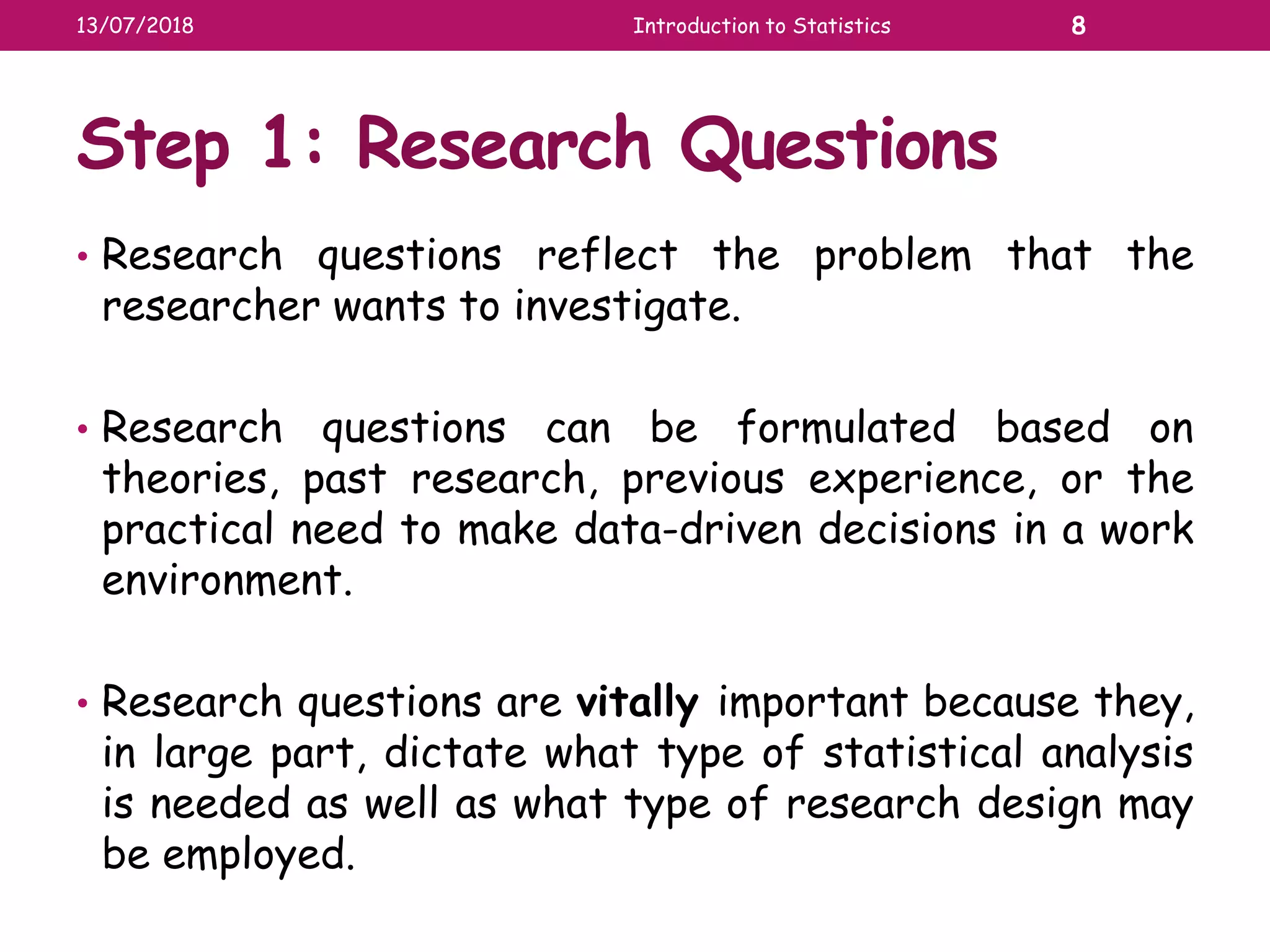
Step 1: Research Questions
• Research questions reflect the problem that the
researcher wants to investigate.
• Research questions can be formulated based on
theories, past research, previous experience, or the
practical need to make data-driven decisions in a work
environment.
• Research questions are vitally important because they,
in large part, dictate what type of statistical analysis
is needed as well as what type of research design may
be employed.
13/07/2018 Introduction to Statistics 8
Examples of Research Questions
• What extent corporate governance characteristics
impact on sustainability reporting?
• Are there any relationship between information
transparency and firm value?
13/07/2018 Introduction to Statistics 9
Hypotheses
• While research questions are fairly general, ypotheses
are specific predictions about the results, made prior
to data collection.
• As financial need increases, the likelihood of retention decreases.
• Personalized letters result in more inquiries than brochures.
• Males have higher levels of self-efficacy than females.
• Body image will improve as a result of the new curriculum.
13/07/2018 Introduction to Statistics 10
Step 2: Operationalize & Choose Measures
• Many variables of interest in education and psychology
are abstract concepts that cannot be directly measured.
• This doesn’t preclude us from studying these things,
but requires that we clearly define the specific
behaviors that are related to the concept of interest.
13/07/2018 Introduction to Statistics 11
Measuring Abstract Concepts
• How does one measure retention, inquiry rate, statistics
self-efficacy, and body image?
• The process of defining variables and choosing a reliable
and accurate measurement tool is called operationalizing
your variables.
• Good measurement is vital to the trustworthiness of
your results!
13/07/2018 Introduction to Statistics 12
Step 3: Choose a Research Design
• In Step 3, we develop a plan for collecting the data we
need (i.e., a blueprint for the study)
• This is called research design, and includes things such as:
• Who will participate in the study?
• Who will receive the intervention?
• Will there be a control group?
• Will data be collected longitudinally?
• What instrument will be used to collect data?
• What type of data will be collected?
13/07/2018 Introduction to Statistics 13
Threats to Validity
• Internal Validity:
Problems associated with the experimental
procedures or experiences of participants
• External Validity:
Problems that affect the generalizability of
the results
• The choice of design impacts the validity of
your final results
13/07/2018 Introduction to Statistics 14
Step 4: Analyze The Data
• Once the data have been collected, the results must
be organized and summarized so that we can answer
the research questions.
• This is the purpose of statistics
• The choice of analysis at this stage depends entirely
on two prior steps:
• The research questions
• How the variable is measured
13/07/2018 Introduction to Statistics 15
Step 5: Draw Conclusions
• After analyzing the data, we can make judgments
about our initial research questions and hypotheses.
• Are these results consistent with previous studies?
• The conclusions drawn from a study may provide a
starting point for new research.
13/07/2018 Introduction to Statistics 16
13/07/2018 Introduction to Statistics 17
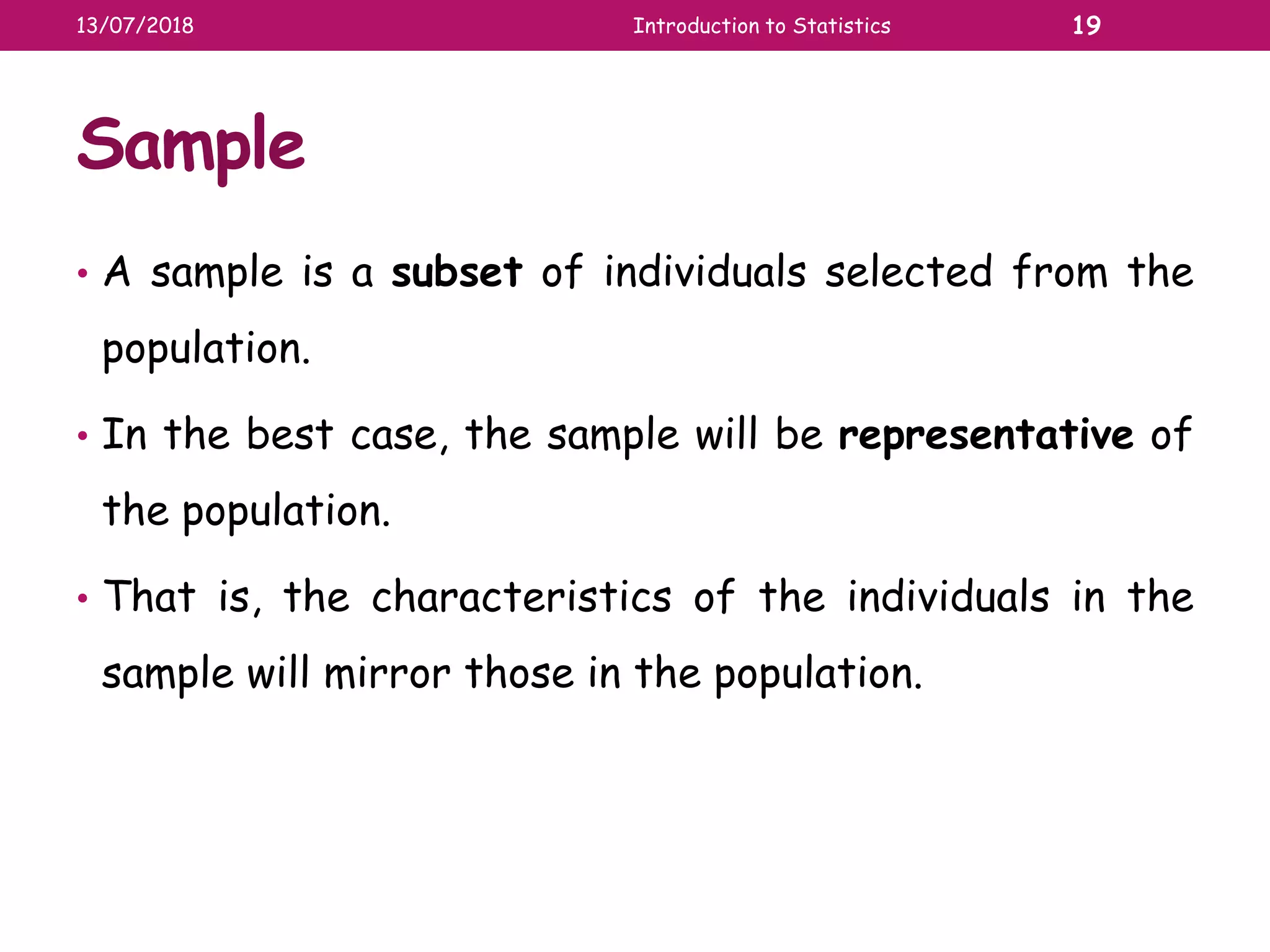
Population
• A population is the entire set of individuals that we
are interested in studying.
• This is the group that we want to generalize our
results to.
• Although populations can vary in size, they are usually
quite large.
• Thus, it is usually not feasible to collect data from the
entire population.
13/07/2018 Introduction to Statistics 18
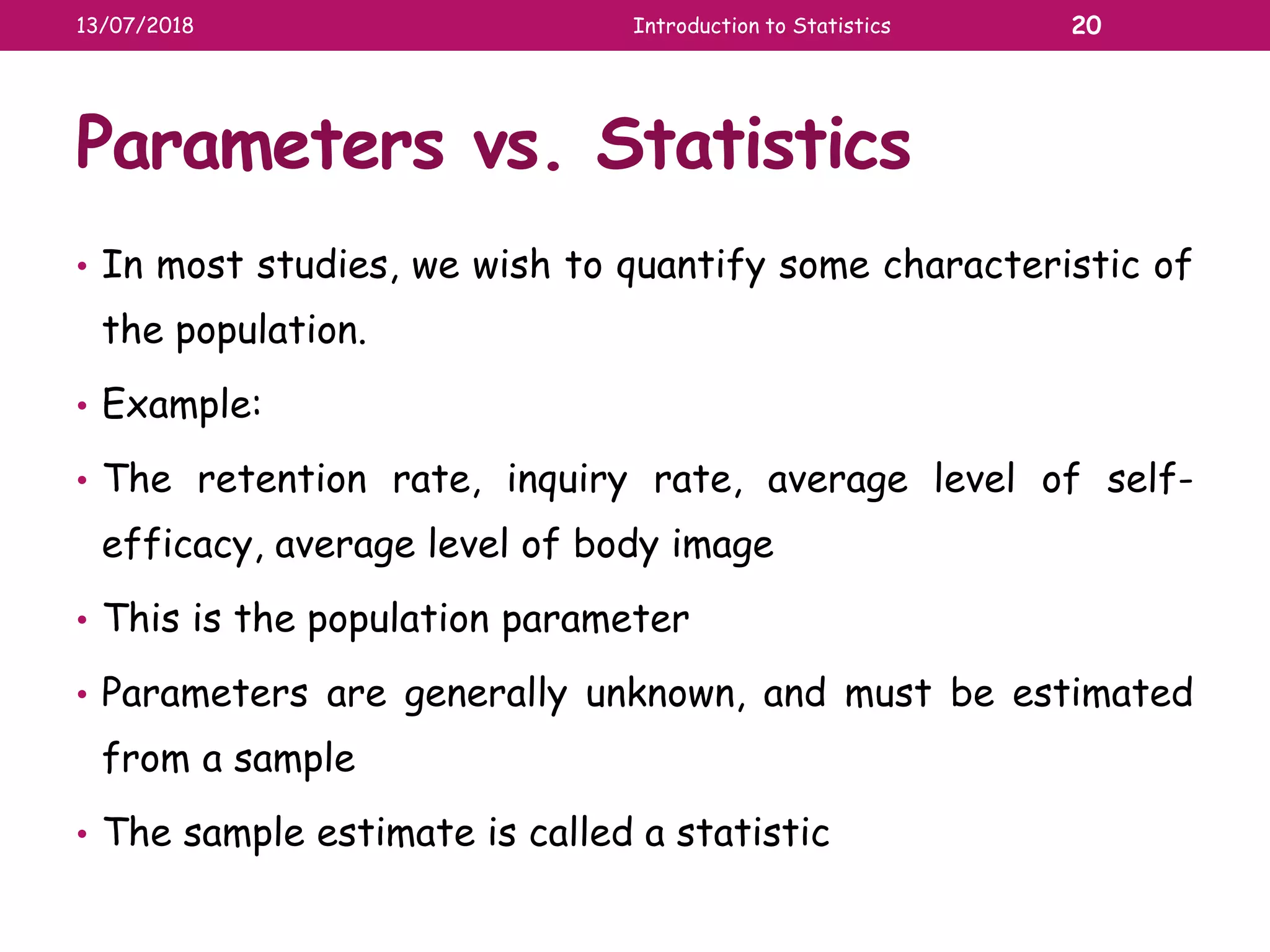
Sample
• A sample is a subset of individuals selected from the
population.
• In the best case, the sample will be representative of
the population.
• That is, the characteristics of the individuals in the
sample will mirror those in the population.
13/07/2018 Introduction to Statistics 19
Parameters vs. Statistics
• In most studies, we wish to quantify some characteristic of
the population.
• Example:
• The retention rate, inquiry rate, average level of self-
efficacy, average level of body image
• This is the population parameter
• Parameters are generally unknown, and must be estimated
from a sample
• The sample estimate is called a statistic
13/07/2018 Introduction to Statistics 20
Parameters vs. Statistics
• A parameter is a characteristic of a population.
• A statistic is a characteristic of a sample
13/07/2018 Introduction to Statistics 21
Variables
• A characteristic that takes on different values for
different individuals in a sample is called a variable.
• Examples:
• Gender
• Time spent to study
• Time spent to use social media
13/07/2018 Introduction to Statistics 22
Independent Variables (IV)
• The explanatory variable
• The variable that attempts to explain or is purported
to cause differences in a second variable.
• In experimental designs, the intervention is the IV.
• Example:
• Does a new curriculum improve body image?
• The curriculum is the IV
13/07/2018 Introduction to Statistics 23
Dependent Variables (DV)
• The outcome variable
• The variable that is thought to be influenced by the
independent variable
• Example:
• Does a new curriculum improve body image?
• Body image is the DV
13/07/2018 Introduction to Statistics 24
Examples
• Do students prefer learning statistics online or face to
face?
• What is the IV? DV?
• How do students who have never had statistics
compare to students who have previously had statistics
in terms of their anxiety levels?
• What is the IV? DV?
13/07/2018 Introduction to Statistics 25
Confounding Variables
• Researchers are usually only interested in the relationship
between the IV and DV.
• Confounding variables represent unwanted sources of
influence on the DV, and are sometimes referred to as
nuisance variables.
Example:
• Does a new curriculum improve body image?
• Such things as heredity, family background, previous
counseling experiences, etc. can also impact the DV.
13/07/2018 Introduction to Statistics 26
Controlling Confounding Variables
• Typically, researchers are interested in excluding, or
controlling for, the effects of confounding variables.
• This is generally not a statistical issue, but is
accomplished by the research design.
• Certain types of designs (e.g., experiments) better
control the effects of confounding variables.
13/07/2018 Introduction to Statistics 27
13/07/2018 Introduction to Statistics 28
Variable Measurement Scales
• For any given variable that we are interested in, there
maybe a variety of measurement scales that can be
used:
• What is your annual income? _________
• a. 10,000-20,000 b. 20,000-30,000 c. 30,000-40,000
d. 40,000-50,000 e. 50,000 or above
• Variable measurement is the second factor that
influences the choice of statistical procedure.
13/07/2018 Introduction to Statistics 29
Scales of Measurement
• Nominal
• Ordinal
• Interval
• Ratio
13/07/2018 Introduction to Statistics 30
Nominal Scale
• Observations fall into different categories or groups.
• Differences among categories are qualitative, not
quantitative.
Examples:
• Gender
• Ethnicity
• Counseling method (cognitive vs. humanistic)
• Retention (retained vs. not retained)
13/07/2018 Introduction to Statistics 31
Ordinal Scale
• Categories can be rank ordered in terms of amount or
magnitude.
• Categories possess an inherent order, but the amount
of difference between categories is unknown.
Examples:
• Class standing
• Letter grades (A,B,C,D,F)
• Likert-scale survey responses (SD, D, N, A, SA)
13/07/2018 Introduction to Statistics 32
Interval Scale
• Categories are ordered, but now the intervals for each
category are exactly the same size.
• That is, the distance between measurement points
represent equal magnitudes (e.g., the distance between
point A and B is the same as the distance between B and C).
Examples:
• Fahrenheit scale of measuring temperature
• Chronological scale of dates (1997 A.D.)
• Standard scores (z-scores)
13/07/2018 Introduction to Statistics 33
Ratio Scale
• Same properties as the interval scale, but with an additional
feature
• Ratio scale has an absolute 0 point.
• Absolute 0 point permits the use of ratios (e.g., A is twice
as large as B).
Examples:
• Number of children
• Weight
• Annual income
13/07/2018 Introduction to Statistics 34
Categorical vs. Continuous Variables
• In practice, it is not usually necessary to make such fine
distinctions between measurement scales.
• Two distinctions, categorical and continuous are usually
sufficient.
• Categorical variables consist of separate, indivisible
categories (i.e., men/women).
• Continuous variables yield values that fall on a numeric
continuum, and can (theoretically) take on an infinite
number of values.
13/07/2018 Introduction to Statistics 35
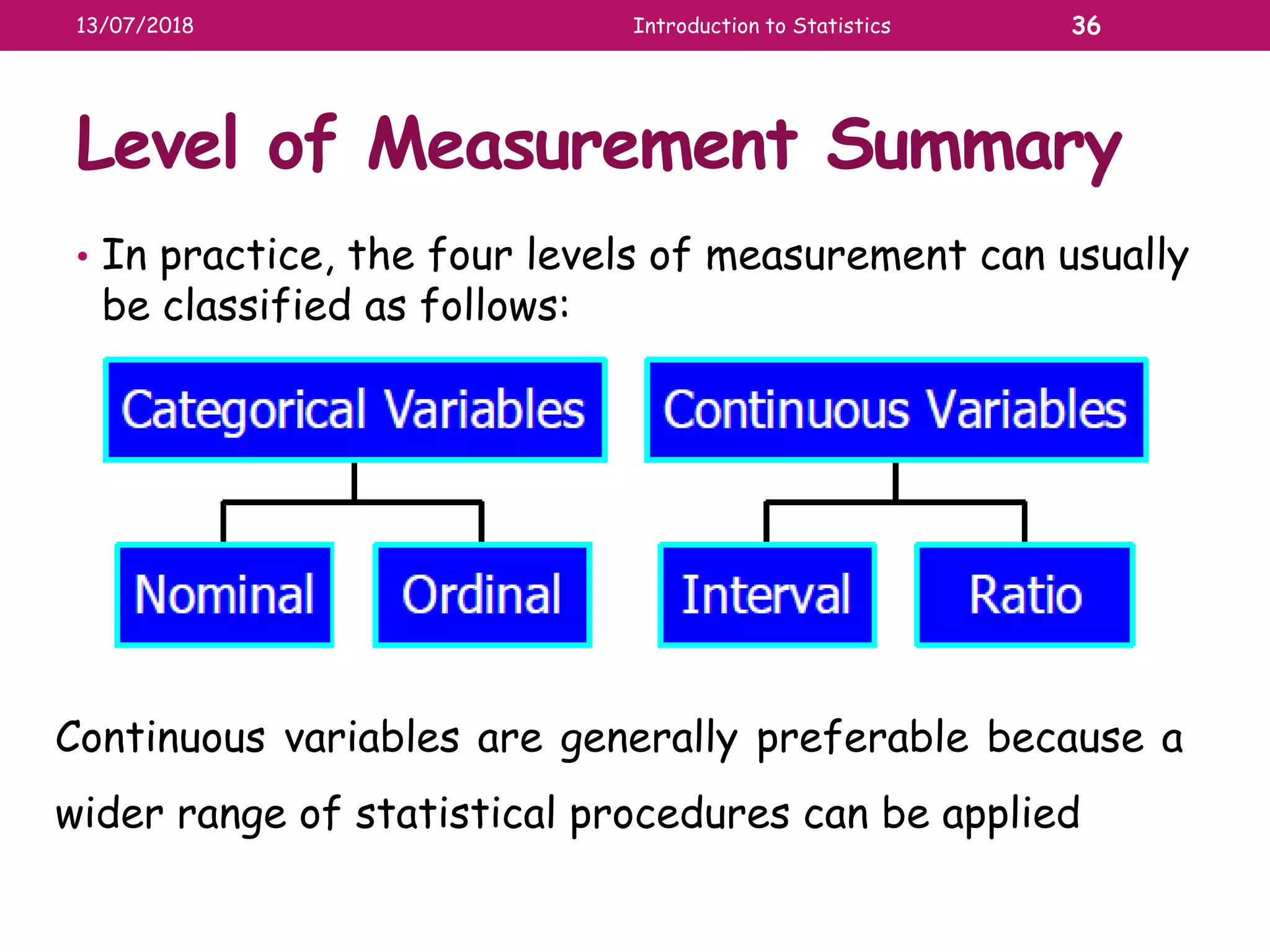
Level of Measurement Summary
• In practice, the four levels of measurement can usually
be classified as follows:
13/07/2018 Introduction to Statistics 36
Continuous variables are generally preferable because a
wider range of statistical procedures can be applied
Examples
• What is the level of measurement of
• Temperature ?
• Color?
• Income of professional baseball players?
• Degree of agree (1 = Strongly Disagree, 5 = Strongly
Agree)?
13/07/2018 Introduction to Statistics 37
Descriptive Statistics
• Procedures used to summarize, organize, and
simplify data (data being a collection of measurements
or observations) taken from a sample (i.e., mean,
median, mode).
Examples:
• The average score on the Rosenberg Self-Esteem
Scale was 7.5
• 63% of the sample described themselves as Caucasian
13/07/2018 Introduction to Statistics 38
Inferential Statistics
• Techniques that allow us to make inferences about a
population based on data that we gather from a sample.
• Study results will vary from sample to sample strictly
due to random chance (i.e., sampling error).
• Inferential statistics allow us to determine how likely
it is to obtain a set of results from a single sample.
• This is also known as testing for statistical
significance.
13/07/2018 Introduction to Statistics 39
13/07/2018 Introduction to Statistics 40
Data Presentation
13/07/2018 Introduction to Statistics 41

Intro to stats

  • 1.
    INTRODUCTION TO STATISTICS Prepared By:Ms.R.Niruja Lecturer University of Jaffna
  • 2.
    Overview The Role ofStatistics The Research Process Threats to Validity Statistical Terminology Scales of Measurement Introduction to Descriptive and Inferential Statistics 13/07/2018 Introduction to Statistics 2
  • 3.
    What is statistics? •statistics is the methodology for collecting, analyzing, interpreting and drawing conclusions from information. • Statistics consists of a body of methods for collecting and analyzing data. (Agresti & Finlay, 1997) 13/07/2018 Introduction to Statistics 3
  • 4.
    Statistical methods canbe used to find answers to the questions like: • What kind and how much data need to be collected? • How should we organize and summarize the data? • How can we analyse the data and draw conclusions from it? • How can we assess the strength of the conclusions and evaluate their uncertainty? 13/07/2018 Introduction to Statistics 4
  • 5.
    The Role ofStatistics 1. Design: Planning and carrying out research studies. 2. Description: Summarizing and exploring data. 3. Inference: Making predictions and generalizing about phenomena represented by the data. 13/07/2018 Introduction to Statistics 5
  • 6.
    The Role ofStatistics • Identify and describe relationships among constructs. • Data are collected in a very systematic manner and conclusions are drawn based on the data. • Aggregate and summarize data in order for researchers to draw conclusions from their study. 13/07/2018 Introduction to Statistics 6
  • 7.
    The Typical ResearchProcess • The typical quantitative study involves a series of steps, one of which is statistical analysis. Note: These are steps in the research process and NOT sections of the dissertation. 13/07/2018 Introduction to Statistics 7
  • 8.
    Step 1: ResearchQuestions • Research questions reflect the problem that the researcher wants to investigate. • Research questions can be formulated based on theories, past research, previous experience, or the practical need to make data-driven decisions in a work environment. • Research questions are vitally important because they, in large part, dictate what type of statistical analysis is needed as well as what type of research design may be employed. 13/07/2018 Introduction to Statistics 8
  • 9.
    Examples of ResearchQuestions • What extent corporate governance characteristics impact on sustainability reporting? • Are there any relationship between information transparency and firm value? 13/07/2018 Introduction to Statistics 9
  • 10.
    Hypotheses • While researchquestions are fairly general, ypotheses are specific predictions about the results, made prior to data collection. • As financial need increases, the likelihood of retention decreases. • Personalized letters result in more inquiries than brochures. • Males have higher levels of self-efficacy than females. • Body image will improve as a result of the new curriculum. 13/07/2018 Introduction to Statistics 10
  • 11.
    Step 2: Operationalize& Choose Measures • Many variables of interest in education and psychology are abstract concepts that cannot be directly measured. • This doesn’t preclude us from studying these things, but requires that we clearly define the specific behaviors that are related to the concept of interest. 13/07/2018 Introduction to Statistics 11
  • 12.
    Measuring Abstract Concepts •How does one measure retention, inquiry rate, statistics self-efficacy, and body image? • The process of defining variables and choosing a reliable and accurate measurement tool is called operationalizing your variables. • Good measurement is vital to the trustworthiness of your results! 13/07/2018 Introduction to Statistics 12
  • 13.
    Step 3: Choosea Research Design • In Step 3, we develop a plan for collecting the data we need (i.e., a blueprint for the study) • This is called research design, and includes things such as: • Who will participate in the study? • Who will receive the intervention? • Will there be a control group? • Will data be collected longitudinally? • What instrument will be used to collect data? • What type of data will be collected? 13/07/2018 Introduction to Statistics 13
  • 14.
    Threats to Validity •Internal Validity: Problems associated with the experimental procedures or experiences of participants • External Validity: Problems that affect the generalizability of the results • The choice of design impacts the validity of your final results 13/07/2018 Introduction to Statistics 14
  • 15.
    Step 4: AnalyzeThe Data • Once the data have been collected, the results must be organized and summarized so that we can answer the research questions. • This is the purpose of statistics • The choice of analysis at this stage depends entirely on two prior steps: • The research questions • How the variable is measured 13/07/2018 Introduction to Statistics 15
  • 16.
    Step 5: DrawConclusions • After analyzing the data, we can make judgments about our initial research questions and hypotheses. • Are these results consistent with previous studies? • The conclusions drawn from a study may provide a starting point for new research. 13/07/2018 Introduction to Statistics 16
  • 17.
  • 18.
    Population • A populationis the entire set of individuals that we are interested in studying. • This is the group that we want to generalize our results to. • Although populations can vary in size, they are usually quite large. • Thus, it is usually not feasible to collect data from the entire population. 13/07/2018 Introduction to Statistics 18
  • 19.
    Sample • A sampleis a subset of individuals selected from the population. • In the best case, the sample will be representative of the population. • That is, the characteristics of the individuals in the sample will mirror those in the population. 13/07/2018 Introduction to Statistics 19
  • 20.
    Parameters vs. Statistics •In most studies, we wish to quantify some characteristic of the population. • Example: • The retention rate, inquiry rate, average level of self- efficacy, average level of body image • This is the population parameter • Parameters are generally unknown, and must be estimated from a sample • The sample estimate is called a statistic 13/07/2018 Introduction to Statistics 20
  • 21.
    Parameters vs. Statistics •A parameter is a characteristic of a population. • A statistic is a characteristic of a sample 13/07/2018 Introduction to Statistics 21
  • 22.
    Variables • A characteristicthat takes on different values for different individuals in a sample is called a variable. • Examples: • Gender • Time spent to study • Time spent to use social media 13/07/2018 Introduction to Statistics 22
  • 23.
    Independent Variables (IV) •The explanatory variable • The variable that attempts to explain or is purported to cause differences in a second variable. • In experimental designs, the intervention is the IV. • Example: • Does a new curriculum improve body image? • The curriculum is the IV 13/07/2018 Introduction to Statistics 23
  • 24.
    Dependent Variables (DV) •The outcome variable • The variable that is thought to be influenced by the independent variable • Example: • Does a new curriculum improve body image? • Body image is the DV 13/07/2018 Introduction to Statistics 24
  • 25.
    Examples • Do studentsprefer learning statistics online or face to face? • What is the IV? DV? • How do students who have never had statistics compare to students who have previously had statistics in terms of their anxiety levels? • What is the IV? DV? 13/07/2018 Introduction to Statistics 25
  • 26.
    Confounding Variables • Researchersare usually only interested in the relationship between the IV and DV. • Confounding variables represent unwanted sources of influence on the DV, and are sometimes referred to as nuisance variables. Example: • Does a new curriculum improve body image? • Such things as heredity, family background, previous counseling experiences, etc. can also impact the DV. 13/07/2018 Introduction to Statistics 26
  • 27.
    Controlling Confounding Variables •Typically, researchers are interested in excluding, or controlling for, the effects of confounding variables. • This is generally not a statistical issue, but is accomplished by the research design. • Certain types of designs (e.g., experiments) better control the effects of confounding variables. 13/07/2018 Introduction to Statistics 27
  • 28.
  • 29.
    Variable Measurement Scales •For any given variable that we are interested in, there maybe a variety of measurement scales that can be used: • What is your annual income? _________ • a. 10,000-20,000 b. 20,000-30,000 c. 30,000-40,000 d. 40,000-50,000 e. 50,000 or above • Variable measurement is the second factor that influences the choice of statistical procedure. 13/07/2018 Introduction to Statistics 29
  • 30.
    Scales of Measurement •Nominal • Ordinal • Interval • Ratio 13/07/2018 Introduction to Statistics 30
  • 31.
    Nominal Scale • Observationsfall into different categories or groups. • Differences among categories are qualitative, not quantitative. Examples: • Gender • Ethnicity • Counseling method (cognitive vs. humanistic) • Retention (retained vs. not retained) 13/07/2018 Introduction to Statistics 31
  • 32.
    Ordinal Scale • Categoriescan be rank ordered in terms of amount or magnitude. • Categories possess an inherent order, but the amount of difference between categories is unknown. Examples: • Class standing • Letter grades (A,B,C,D,F) • Likert-scale survey responses (SD, D, N, A, SA) 13/07/2018 Introduction to Statistics 32
  • 33.
    Interval Scale • Categoriesare ordered, but now the intervals for each category are exactly the same size. • That is, the distance between measurement points represent equal magnitudes (e.g., the distance between point A and B is the same as the distance between B and C). Examples: • Fahrenheit scale of measuring temperature • Chronological scale of dates (1997 A.D.) • Standard scores (z-scores) 13/07/2018 Introduction to Statistics 33
  • 34.
    Ratio Scale • Sameproperties as the interval scale, but with an additional feature • Ratio scale has an absolute 0 point. • Absolute 0 point permits the use of ratios (e.g., A is twice as large as B). Examples: • Number of children • Weight • Annual income 13/07/2018 Introduction to Statistics 34
  • 35.
    Categorical vs. ContinuousVariables • In practice, it is not usually necessary to make such fine distinctions between measurement scales. • Two distinctions, categorical and continuous are usually sufficient. • Categorical variables consist of separate, indivisible categories (i.e., men/women). • Continuous variables yield values that fall on a numeric continuum, and can (theoretically) take on an infinite number of values. 13/07/2018 Introduction to Statistics 35
  • 36.
    Level of MeasurementSummary • In practice, the four levels of measurement can usually be classified as follows: 13/07/2018 Introduction to Statistics 36 Continuous variables are generally preferable because a wider range of statistical procedures can be applied
  • 37.
    Examples • What isthe level of measurement of • Temperature ? • Color? • Income of professional baseball players? • Degree of agree (1 = Strongly Disagree, 5 = Strongly Agree)? 13/07/2018 Introduction to Statistics 37
  • 38.
    Descriptive Statistics • Proceduresused to summarize, organize, and simplify data (data being a collection of measurements or observations) taken from a sample (i.e., mean, median, mode). Examples: • The average score on the Rosenberg Self-Esteem Scale was 7.5 • 63% of the sample described themselves as Caucasian 13/07/2018 Introduction to Statistics 38
  • 39.
    Inferential Statistics • Techniquesthat allow us to make inferences about a population based on data that we gather from a sample. • Study results will vary from sample to sample strictly due to random chance (i.e., sampling error). • Inferential statistics allow us to determine how likely it is to obtain a set of results from a single sample. • This is also known as testing for statistical significance. 13/07/2018 Introduction to Statistics 39
  • 40.
  • 41.