Coronary CT Angiography
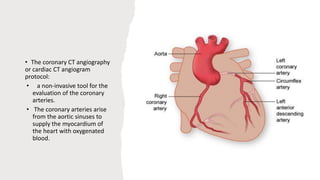
โ€ข The coronary CT angiography
or cardiac CT angiogram
protocol:
โ€ข a non-invasive tool for the
evaluation of the coronary
arteries.
โ€ข The coronary arteries arise
from the aortic sinuses to
supply the myocardium of
the heart with oxygenated
blood.
Indications :
โ–ช congenital coronary artery anomalies
โ–ช coronary artery disease
โ–ช visualization of cardiac veins
โ–ช Evaluation of chest pain in patients at low to intermediate
pretest probability of disease.
โ–ช Pulmonary vein evaluation.
โ–ช Evaluation of cardiac masses.
โ–ช Evaluation of pericardial disease.
โ–ช Pre surgical evaluation, particularly before redo open heart
surgery.
โ–ช Assessing graft patency after prior bypass surgery.
โ–ช Evaluation of aortic disease.
โ–ช Evaluation of suspected pulmonary embolism.
CONTRAINDICATIONS:
โ– Renal insufficiency:
Given the potential for contrast nephropathy, patients with
significant renal insufficiency (i.e., Cr > 1.6 mg/dL) should not
undergo contrast enhanced CT.
โ– Known history of anaphylactic contrast reactions :
A prior anaphylactic response to contrast is generally felt to be
an absolute contraindication to intravenous iodinated contrast
administration at many institutions.
โ– Pregnancy
โ– Clinical instability
โ– Severe coronary calcium
โ– Inability to breath hold for at least 10 seconds.
Technical requirements:
โœ“ 64-slice scanner .
Multidetector computed tomography (MDCT) has rapidly evolved from 4-detector row systems in
1998 to 256-slice and 320-detector row CT systems :
With smaller detector element size and faster gantry rotation speed
spatial and temporal resolution of the 64-detector MDCT scanners have made
coronary artery imaging a reliable clinical test.
โœ“ detector element width โ‰ค0.625 mm.
โœ“ option of cardiac CT and ECG-gated triggering .
Patient preparation
โ– patients should take their cardiac medications as usual .
โ– no food 3-4 hours before the scan .
โ– no caffeine for 12 hours Consuming caffeine can make the heart beat
faster, which will interfere with the imaging test. Prior to the test, we ask
that people avoid caffeinated food or beverages, including: coffee .
โ– instruction on how to breathe (breath hold is recommended )
โ– an electrocardiogram signal needs to be acquired
โ– heart rate control
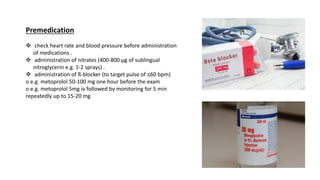
Premedication
โ– check heart rate and blood pressure before administration
of medications .
โ– administration of nitrates (400-800 ยตg of sublingual
nitroglycerin e.g. 1-2 sprays) .
โ– administration of รŸ-blocker (to target pulse of โ‰ค60 bpm)
o e.g. metoprolol 50-100 mg one hour before the exam
o e.g. metoprolol 5mg iv followed by monitoring for 5 min
repeatedly up to 15-20 mg
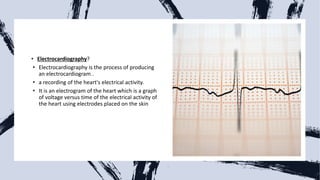
โ€ข Electrocardiography?
โ€ข Electrocardiography is the process of producing
an electrocardiogram .
โ€ข a recording of the heart's electrical activity.
โ€ข It is an electrogram of the heart which is a graph
of voltage versus time of the electrical activity of
the heart using electrodes placed on the skin
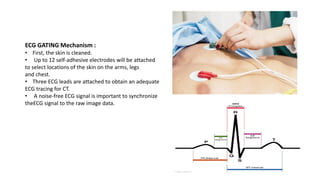
ECG GATING Mechanism :
โ€ข First, the skin is cleaned.
โ€ข Up to 12 self-adhesive electrodes will be attached
to select locations of the skin on the arms, legs
and chest.
โ€ข Three ECG leads are attached to obtain an adequate
ECG tracing for CT.
โ€ข A noise-free ECG signal is important to synchronize
theECG signal to the raw image data.
Technique
โ€ข patient position
supine with both arms above their head (as comfortably as
possible)
ECG placement
โ€ข tube potential
100 kVp if patientโ€™s weight โ‰ค100kg or BMI <30kg/m2
โ€ข tube current
use automated current adjustment mode
โ€ข scout
pulmonary apices to below the heart
โ€ข scan extent
o ideally to be determined by calcium scoring
o just below tracheal bifurcation to below the heart
โ€ข scan direction/craniocaudally
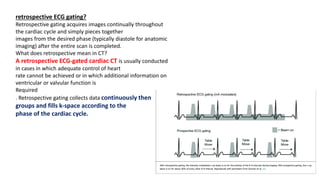
retrospective ECG gating?
Retrospective gating acquires images continually throughout
the cardiac cycle and simply pieces together
images from the desired phase (typically diastole for anatomic
imaging) after the entire scan is completed.
What does retrospective mean in CT?
A retrospective ECG-gated cardiac CT is usually conducted
in cases in which adequate control of heart
rate cannot be achieved or in which additional information on
ventricular or valvular function is
Required
. Retrospective gating collects data continuously then
groups and fills k-space according to the
phase of the cardiac cycle.
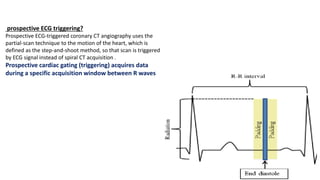
prospective ECG triggering?
Prospective ECG-triggered coronary CT angiography uses the
partial-scan technique to the motion of the heart, which is
defined as the step-and-shoot method, so that scan is triggered
by ECG signal instead of spiral CT acquisition .
Prospective cardiac gating (triggering) acquires data
during a specific acquisition window between R waves
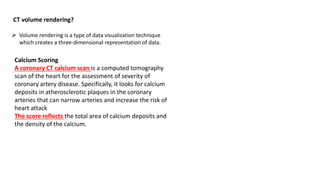
CT volume rendering?
โžข Volume rendering is a type of data visualization technique
which creates a three-dimensional representation of data.
Calcium Scoring
A coronary CT calcium scan is a computed tomography
scan of the heart for the assessment of severity of
coronary artery disease. Specifically, it looks for calcium
deposits in atherosclerotic plaques in the coronary
arteries that can narrow arteries and increase the risk of
heart attack
The score reflects the total area of calcium deposits and
the density of the calcium.
a good score for calcium scoring
A calcium score of 0 means there is no evidence of heart
disease.
1-10 is for minimal evidence of heart disease.
11-100 is for mild evidence of heart disease.
101-400 is for moderate evidence of heart disease
agatston calcium score
The result of the test is usually given as a number .
The score reflects the total area of calcium deposits and the
density of the calcium.
A score of zero means no calcium is seen in the heart.
It suggests a low chance of developing a heart attack in the
future .
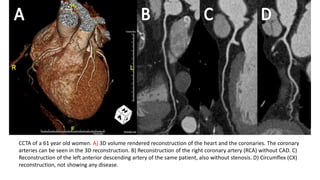
CCTA of a 61 year old women. A) 3D volume rendered reconstruction of the heart and the coronaries. The coronary
arteries can be seen in the 3D reconstruction. B) Reconstruction of the right coronary artery (RCA) without CAD. C)
Reconstruction of the left anterior descending artery of the same patient, also without stenosis. D) Circumflex (CX)
reconstruction, not showing any disease.
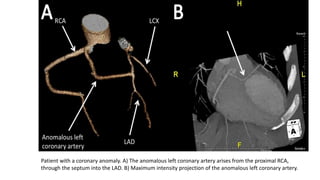
Patient with a coronary anomaly. A) The anomalous left coronary artery arises from the proximal RCA,
through the septum into the LAD. B) Maximum intensity projection of the anomalous left coronary artery.
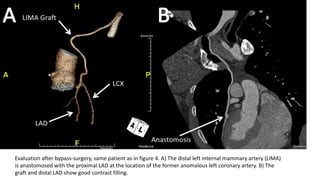
Evaluation after bypass-surgery, same patient as in figure 4. A) The distal left internal mammary artery (LIMA)
is anastomosed with the proximal LAD at the location of the former anomalous left coronary artery. B) The
graft and distal LAD show good contrast filling.
Coronary CT Angiography .dr aya.pdf

Coronary CT Angiography .dr aya.pdf

  • 1.
  • 2.
    โ€ข The coronaryCT angiography or cardiac CT angiogram protocol: โ€ข a non-invasive tool for the evaluation of the coronary arteries. โ€ข The coronary arteries arise from the aortic sinuses to supply the myocardium of the heart with oxygenated blood.
  • 4.
    Indications : โ–ช congenitalcoronary artery anomalies โ–ช coronary artery disease โ–ช visualization of cardiac veins โ–ช Evaluation of chest pain in patients at low to intermediate pretest probability of disease. โ–ช Pulmonary vein evaluation. โ–ช Evaluation of cardiac masses. โ–ช Evaluation of pericardial disease. โ–ช Pre surgical evaluation, particularly before redo open heart surgery. โ–ช Assessing graft patency after prior bypass surgery. โ–ช Evaluation of aortic disease. โ–ช Evaluation of suspected pulmonary embolism.
  • 5.
    CONTRAINDICATIONS: โ– Renal insufficiency: Giventhe potential for contrast nephropathy, patients with significant renal insufficiency (i.e., Cr > 1.6 mg/dL) should not undergo contrast enhanced CT. โ– Known history of anaphylactic contrast reactions : A prior anaphylactic response to contrast is generally felt to be an absolute contraindication to intravenous iodinated contrast administration at many institutions. โ– Pregnancy โ– Clinical instability โ– Severe coronary calcium โ– Inability to breath hold for at least 10 seconds.
  • 6.
    Technical requirements: โœ“ 64-slicescanner . Multidetector computed tomography (MDCT) has rapidly evolved from 4-detector row systems in 1998 to 256-slice and 320-detector row CT systems : With smaller detector element size and faster gantry rotation speed spatial and temporal resolution of the 64-detector MDCT scanners have made coronary artery imaging a reliable clinical test. โœ“ detector element width โ‰ค0.625 mm. โœ“ option of cardiac CT and ECG-gated triggering .
  • 7.
    Patient preparation โ– patientsshould take their cardiac medications as usual . โ– no food 3-4 hours before the scan . โ– no caffeine for 12 hours Consuming caffeine can make the heart beat faster, which will interfere with the imaging test. Prior to the test, we ask that people avoid caffeinated food or beverages, including: coffee . โ– instruction on how to breathe (breath hold is recommended ) โ– an electrocardiogram signal needs to be acquired โ– heart rate control
  • 8.
    Premedication โ– check heartrate and blood pressure before administration of medications . โ– administration of nitrates (400-800 ยตg of sublingual nitroglycerin e.g. 1-2 sprays) . โ– administration of รŸ-blocker (to target pulse of โ‰ค60 bpm) o e.g. metoprolol 50-100 mg one hour before the exam o e.g. metoprolol 5mg iv followed by monitoring for 5 min repeatedly up to 15-20 mg
  • 9.
    โ€ข Electrocardiography? โ€ข Electrocardiographyis the process of producing an electrocardiogram . โ€ข a recording of the heart's electrical activity. โ€ข It is an electrogram of the heart which is a graph of voltage versus time of the electrical activity of the heart using electrodes placed on the skin
  • 10.
    ECG GATING Mechanism: โ€ข First, the skin is cleaned. โ€ข Up to 12 self-adhesive electrodes will be attached to select locations of the skin on the arms, legs and chest. โ€ข Three ECG leads are attached to obtain an adequate ECG tracing for CT. โ€ข A noise-free ECG signal is important to synchronize theECG signal to the raw image data.
  • 11.
    Technique โ€ข patient position supinewith both arms above their head (as comfortably as possible) ECG placement โ€ข tube potential 100 kVp if patientโ€™s weight โ‰ค100kg or BMI <30kg/m2 โ€ข tube current use automated current adjustment mode โ€ข scout pulmonary apices to below the heart โ€ข scan extent o ideally to be determined by calcium scoring o just below tracheal bifurcation to below the heart โ€ข scan direction/craniocaudally
  • 12.
    retrospective ECG gating? Retrospectivegating acquires images continually throughout the cardiac cycle and simply pieces together images from the desired phase (typically diastole for anatomic imaging) after the entire scan is completed. What does retrospective mean in CT? A retrospective ECG-gated cardiac CT is usually conducted in cases in which adequate control of heart rate cannot be achieved or in which additional information on ventricular or valvular function is Required . Retrospective gating collects data continuously then groups and fills k-space according to the phase of the cardiac cycle.
  • 13.
    prospective ECG triggering? ProspectiveECG-triggered coronary CT angiography uses the partial-scan technique to the motion of the heart, which is defined as the step-and-shoot method, so that scan is triggered by ECG signal instead of spiral CT acquisition . Prospective cardiac gating (triggering) acquires data during a specific acquisition window between R waves
  • 14.
    CT volume rendering? โžขVolume rendering is a type of data visualization technique which creates a three-dimensional representation of data. Calcium Scoring A coronary CT calcium scan is a computed tomography scan of the heart for the assessment of severity of coronary artery disease. Specifically, it looks for calcium deposits in atherosclerotic plaques in the coronary arteries that can narrow arteries and increase the risk of heart attack The score reflects the total area of calcium deposits and the density of the calcium.
  • 15.
    a good scorefor calcium scoring A calcium score of 0 means there is no evidence of heart disease. 1-10 is for minimal evidence of heart disease. 11-100 is for mild evidence of heart disease. 101-400 is for moderate evidence of heart disease agatston calcium score The result of the test is usually given as a number . The score reflects the total area of calcium deposits and the density of the calcium. A score of zero means no calcium is seen in the heart. It suggests a low chance of developing a heart attack in the future .
  • 16.
    CCTA of a61 year old women. A) 3D volume rendered reconstruction of the heart and the coronaries. The coronary arteries can be seen in the 3D reconstruction. B) Reconstruction of the right coronary artery (RCA) without CAD. C) Reconstruction of the left anterior descending artery of the same patient, also without stenosis. D) Circumflex (CX) reconstruction, not showing any disease.
  • 17.
    Patient with acoronary anomaly. A) The anomalous left coronary artery arises from the proximal RCA, through the septum into the LAD. B) Maximum intensity projection of the anomalous left coronary artery.
  • 18.
    Evaluation after bypass-surgery,same patient as in figure 4. A) The distal left internal mammary artery (LIMA) is anastomosed with the proximal LAD at the location of the former anomalous left coronary artery. B) The graft and distal LAD show good contrast filling.