Taman kumar
BRIT 4rd sem
190528027
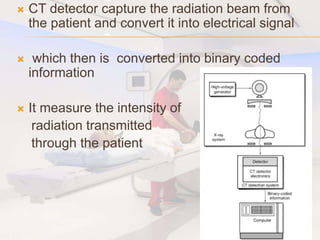
 CT detector capture the radiation beam from
the patient and convert it into electrical signal
 which then is converted into binary coded
information
 It measure the intensity of
radiation transmitted
through the patient
 High efficiency:- refers to the ability to
capture, and convert x-ray photons to
electrical signal
 Less Response time:- refers to the speed
with which the detector can detect x-rays
 High Dynamic range:- refers to the ratio of
the largest signal to be measured to the
smallest signal.
 No After glow:- refers to the persistence of
the image even after the radiation has
been turned off
 Small size :-size should be small but
resolution should be good
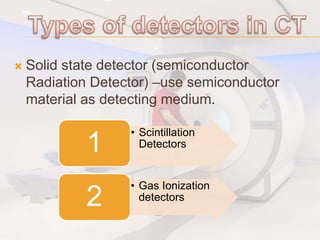
 Solid state detector (semiconductor
Radiation Detector) –use semiconductor
material as detecting medium.
• Scintillation
Detectors
1
• Gas Ionization
detectors
2
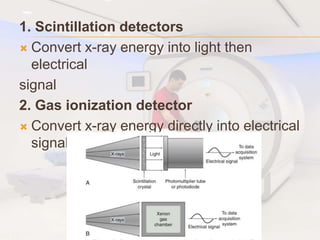
1. Scintillation detectors
 Convert x-ray energy into light then
electrical
signal
2. Gas ionization detector
 Convert x-ray energy directly into electrical
signal
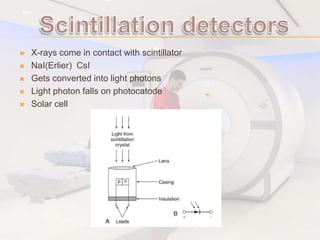
 X-rays come in contact with scintillator
 NaI(Erlier) CsI
 Gets converted into light photons
 Light photon falls on photocatode
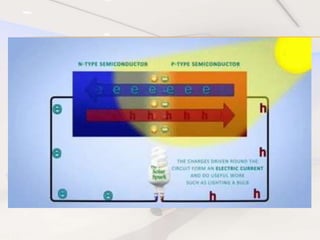
 Solar cell
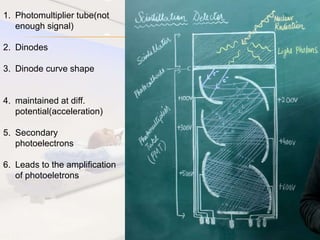
1. Photomultiplier tube(not
enough signal)
2. Dinodes
3. Dinode curve shape
4. maintained at diff.
potential(acceleration)
5. Secondary
photoelectrons
6. Leads to the amplification
of photoeletrons
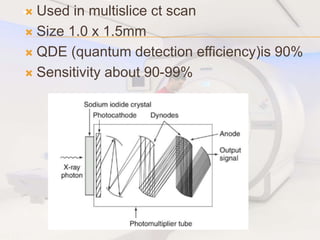
 Used in multislice ct scan
 Size 1.0 x 1.5mm
 QDE (quantum detection efficiency)is 90%
 Sensitivity about 90-99%
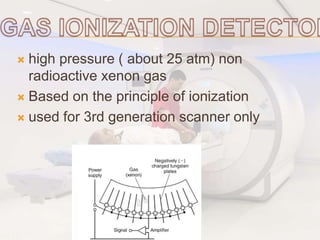
 high pressure ( about 25 atm) non
radioactive xenon gas
 Based on the principle of ionization
 used for 3rd generation scanner only
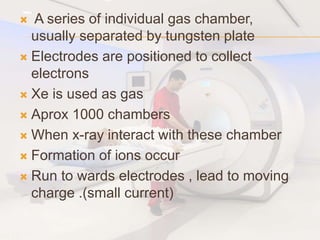
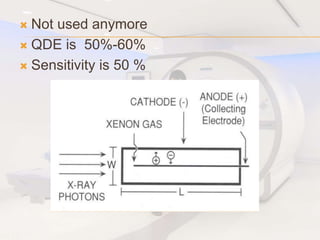
 A series of individual gas chamber,
usually separated by tungsten plate
 Electrodes are positioned to collect
electrons
 Xe is used as gas
 Aprox 1000 chambers
 When x-ray interact with these chamber
 Formation of ions occur
 Run to wards electrodes , lead to moving
charge .(small current)
 Not used anymore
 QDE is 50%-60%
 Sensitivity is 50 %
 Faster image
 Improve image quality
 Patient dose is less
 Low SNR
 Less afterglow
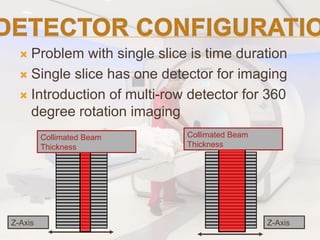
 Problem with single slice is time duration
 Single slice has one detector for imaging
 Introduction of multi-row detector for 360
degree rotation imaging
Collimated Beam
Thickness
Collimated Beam
Thickness
Z-Axis Z-Axis
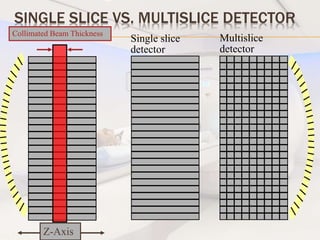
SINGLE SLICE VS. MULTISLICE DETECTOR
Z-Axis
Collimated Beam Thickness
Single slice
detector
Multislice
detector
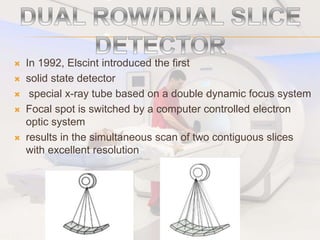
 In 1992, Elscint introduced the first
 solid state detector
 special x-ray tube based on a double dynamic focus system
 Focal spot is switched by a computer controlled electron
optic system
 results in the simultaneous scan of two contiguous slices
with excellent resolution
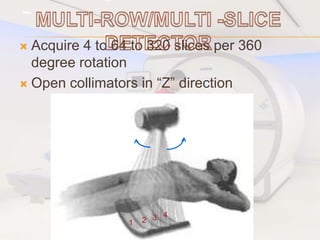
 Acquire 4 to 64 to 320 slices per 360
degree rotation
 Open collimators in “Z” direction
1 2 3 4
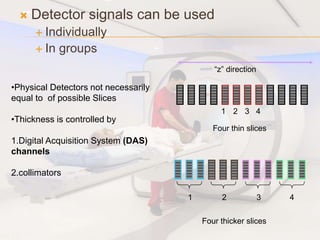
 Detector signals can be used
 Individually
 In groups
1 2 3 4
Four thin slices
1 2 3 4
Four thicker slices
“z” direction
•Physical Detectors not necessarily
equal to of possible Slices
•Thickness is controlled by
1.Digital Acquisition System (DAS)
channels
2.collimators
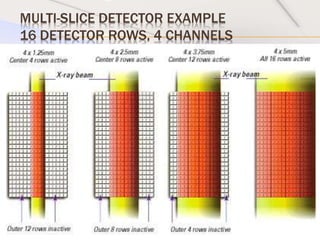
MULTI-SLICE DETECTOR EXAMPLE
16 DETECTOR ROWS, 4 CHANNELS
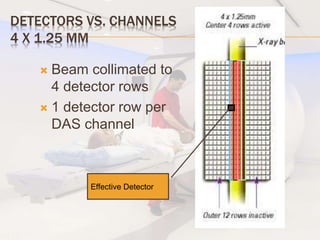
DETECTORS VS. CHANNELS
4 X 1.25 MM
 Beam collimated to
4 detector rows
 1 detector row per
DAS channel
Effective Detector
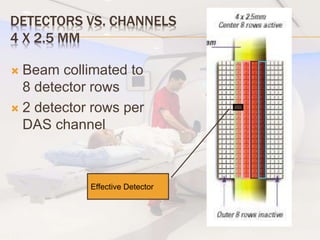
DETECTORS VS. CHANNELS
4 X 2.5 MM
 Beam collimated to
8 detector rows
 2 detector rows per
DAS channel
Effective Detector
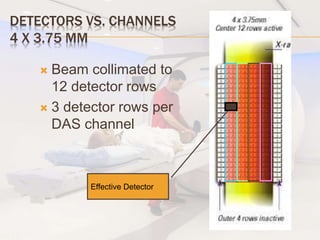
DETECTORS VS. CHANNELS
4 X 3.75 MM
 Beam collimated to
12 detector rows
 3 detector rows per
DAS channel
Effective Detector
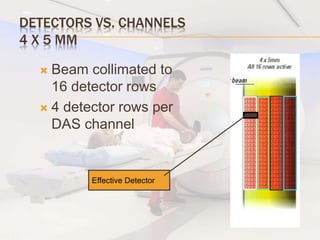
DETECTORS VS. CHANNELS
4 X 5 MM
 Beam collimated to
16 detector rows
 4 detector rows per
DAS channel
Effective Detector
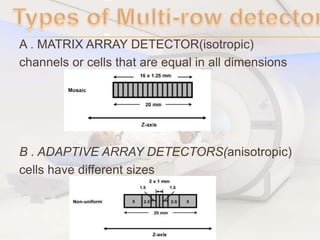
A . MATRIX ARRAY DETECTOR(isotropic)
channels or cells that are equal in all dimensions
B . ADAPTIVE ARRAY DETECTORS(anisotropic)
cells have different sizes
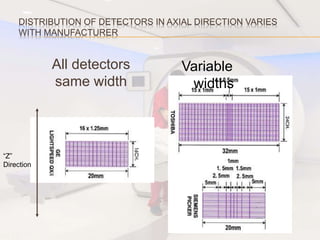
DISTRIBUTION OF DETECTORS IN AXIAL DIRECTION VARIES
WITH MANUFACTURER
All detectors
same width
“Z”
Direction
Variable
widths
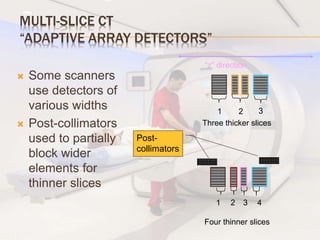
MULTI-SLICE CT
“ADAPTIVE ARRAY DETECTORS”
 Some scanners
use detectors of
various widths
 Post-collimators
used to partially
block wider
elements for
thinner slices
“z” direction
1 2 3
Three thicker slices
1 2 4
Four thinner slices
3
Post-
collimators
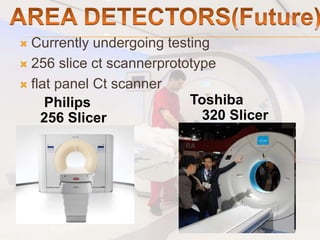
 Currently undergoing testing
 256 slice ct scannerprototype
 flat panel Ct scanner
Philips
256 Slicer
Toshiba
320 Slicer
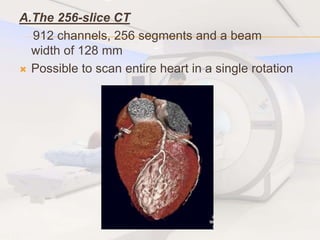
A.The 256-slice CT
912 channels, 256 segments and a beam
width of 128 mm
 Possible to scan entire heart in a single rotation
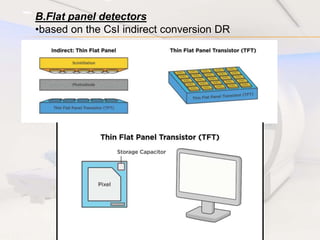
B.Flat panel detectors
•based on the CsI indirect conversion DR
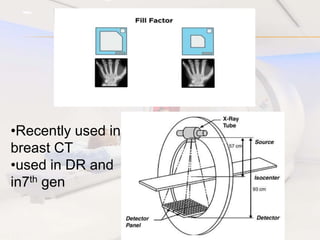
•Recently used in
breast CT
•used in DR and
in7th gen
CT detector technology

CT detector technology

  • 1.
    Taman kumar BRIT 4rdsem 190528027
  • 2.
     CT detectorcapture the radiation beam from the patient and convert it into electrical signal  which then is converted into binary coded information  It measure the intensity of radiation transmitted through the patient
  • 3.
     High efficiency:-refers to the ability to capture, and convert x-ray photons to electrical signal  Less Response time:- refers to the speed with which the detector can detect x-rays  High Dynamic range:- refers to the ratio of the largest signal to be measured to the smallest signal.
  • 4.
     No Afterglow:- refers to the persistence of the image even after the radiation has been turned off  Small size :-size should be small but resolution should be good
  • 5.
     Solid statedetector (semiconductor Radiation Detector) –use semiconductor material as detecting medium. • Scintillation Detectors 1 • Gas Ionization detectors 2
  • 6.
    1. Scintillation detectors Convert x-ray energy into light then electrical signal 2. Gas ionization detector  Convert x-ray energy directly into electrical signal
  • 7.
     X-rays comein contact with scintillator  NaI(Erlier) CsI  Gets converted into light photons  Light photon falls on photocatode  Solar cell
  • 9.
    1. Photomultiplier tube(not enoughsignal) 2. Dinodes 3. Dinode curve shape 4. maintained at diff. potential(acceleration) 5. Secondary photoelectrons 6. Leads to the amplification of photoeletrons
  • 10.
     Used inmultislice ct scan  Size 1.0 x 1.5mm  QDE (quantum detection efficiency)is 90%  Sensitivity about 90-99%
  • 11.
     high pressure( about 25 atm) non radioactive xenon gas  Based on the principle of ionization  used for 3rd generation scanner only
  • 12.
     A seriesof individual gas chamber, usually separated by tungsten plate  Electrodes are positioned to collect electrons  Xe is used as gas  Aprox 1000 chambers  When x-ray interact with these chamber  Formation of ions occur  Run to wards electrodes , lead to moving charge .(small current)
  • 13.
     Not usedanymore  QDE is 50%-60%  Sensitivity is 50 %
  • 14.
     Faster image Improve image quality  Patient dose is less  Low SNR  Less afterglow
  • 15.
     Problem withsingle slice is time duration  Single slice has one detector for imaging  Introduction of multi-row detector for 360 degree rotation imaging Collimated Beam Thickness Collimated Beam Thickness Z-Axis Z-Axis
  • 16.
    SINGLE SLICE VS.MULTISLICE DETECTOR Z-Axis Collimated Beam Thickness Single slice detector Multislice detector
  • 17.
     In 1992,Elscint introduced the first  solid state detector  special x-ray tube based on a double dynamic focus system  Focal spot is switched by a computer controlled electron optic system  results in the simultaneous scan of two contiguous slices with excellent resolution
  • 18.
     Acquire 4to 64 to 320 slices per 360 degree rotation  Open collimators in “Z” direction 1 2 3 4
  • 19.
     Detector signalscan be used  Individually  In groups 1 2 3 4 Four thin slices 1 2 3 4 Four thicker slices “z” direction •Physical Detectors not necessarily equal to of possible Slices •Thickness is controlled by 1.Digital Acquisition System (DAS) channels 2.collimators
  • 20.
    MULTI-SLICE DETECTOR EXAMPLE 16DETECTOR ROWS, 4 CHANNELS
  • 21.
    DETECTORS VS. CHANNELS 4X 1.25 MM  Beam collimated to 4 detector rows  1 detector row per DAS channel Effective Detector
  • 22.
    DETECTORS VS. CHANNELS 4X 2.5 MM  Beam collimated to 8 detector rows  2 detector rows per DAS channel Effective Detector
  • 23.
    DETECTORS VS. CHANNELS 4X 3.75 MM  Beam collimated to 12 detector rows  3 detector rows per DAS channel Effective Detector
  • 24.
    DETECTORS VS. CHANNELS 4X 5 MM  Beam collimated to 16 detector rows  4 detector rows per DAS channel Effective Detector
  • 25.
    A . MATRIXARRAY DETECTOR(isotropic) channels or cells that are equal in all dimensions B . ADAPTIVE ARRAY DETECTORS(anisotropic) cells have different sizes
  • 26.
    DISTRIBUTION OF DETECTORSIN AXIAL DIRECTION VARIES WITH MANUFACTURER All detectors same width “Z” Direction Variable widths
  • 27.
    MULTI-SLICE CT “ADAPTIVE ARRAYDETECTORS”  Some scanners use detectors of various widths  Post-collimators used to partially block wider elements for thinner slices “z” direction 1 2 3 Three thicker slices 1 2 4 Four thinner slices 3 Post- collimators
  • 28.
     Currently undergoingtesting  256 slice ct scannerprototype  flat panel Ct scanner Philips 256 Slicer Toshiba 320 Slicer
  • 29.
    A.The 256-slice CT 912channels, 256 segments and a beam width of 128 mm  Possible to scan entire heart in a single rotation
  • 30.
    B.Flat panel detectors •basedon the CsI indirect conversion DR
  • 31.
    •Recently used in breastCT •used in DR and in7th gen