
Contact Precautions
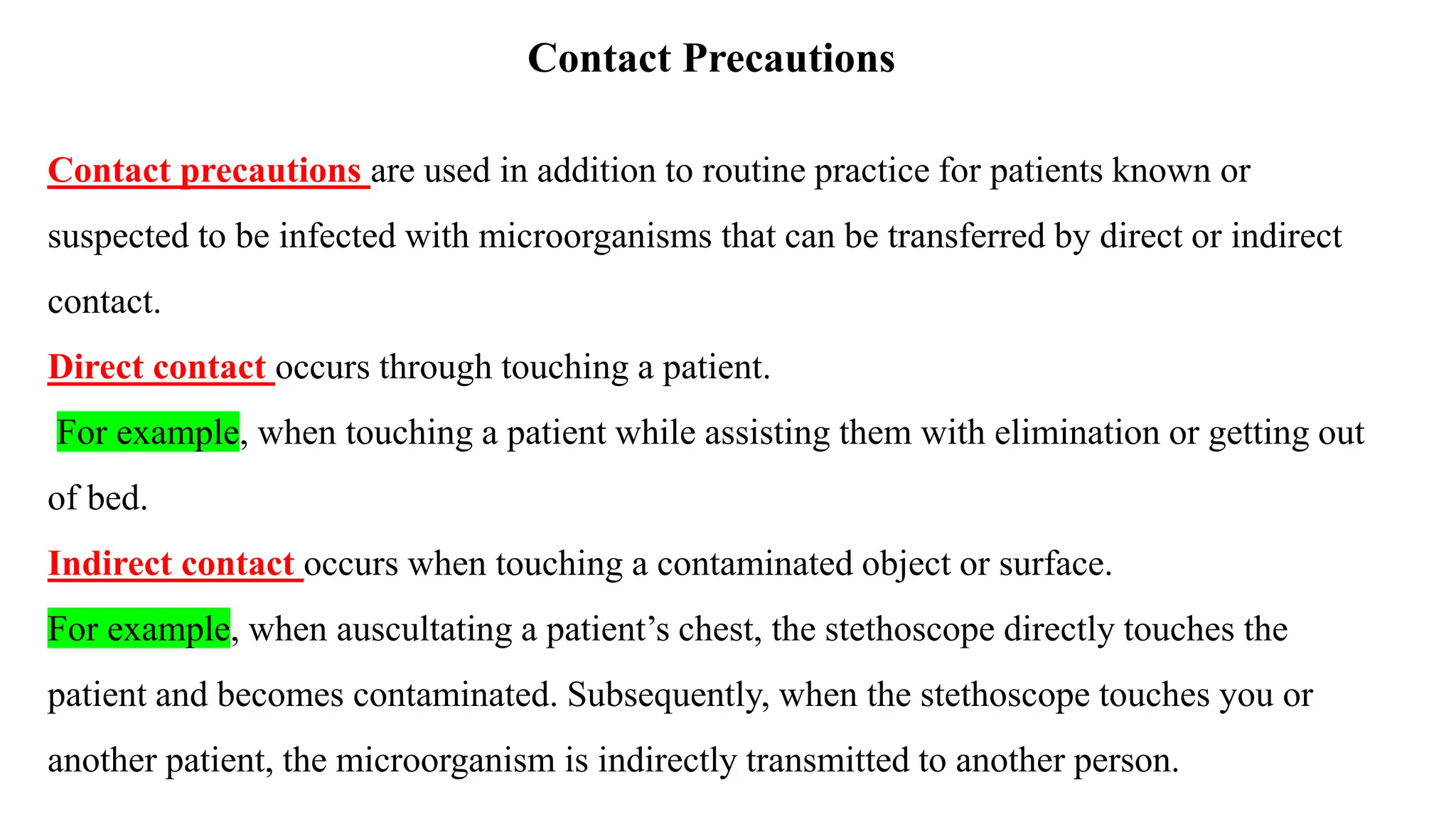
Contact precautions are used in addition to routine practice for patients known or
suspected to be infected with microorganisms that can be transferred by direct or indirect
contact.
Direct contact occurs through touching a patient.
For example, when touching a patient while assisting them with elimination or getting out
of bed.
Indirect contact occurs when touching a contaminated object or surface.
For example, when auscultating a patient’s chest, the stethoscope directly touches the
patient and becomes contaminated. Subsequently, when the stethoscope touches you or
another patient, the microorganism is indirectly transmitted to another person.
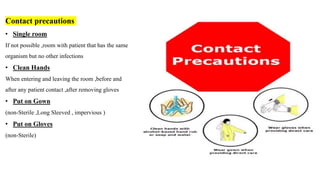
Contact precautions
• Single room
If not possible ,room with patient that has the same
organism but no other infections
• Clean Hands
When entering and leaving the room ,before and
after any patient contact ,after removing gloves
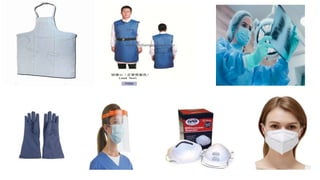
• Put on Gown
(non-Sterile ,Long Sleeved , impervious )
• Put on Gloves
(non-Sterile)
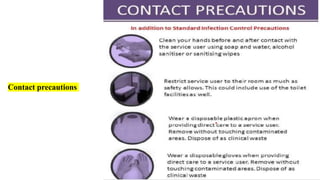
Contact precautions
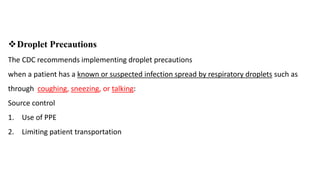
Droplet Precautions
The CDC recommends implementing droplet precautions
when a patient has a known or suspected infection spread by respiratory droplets such as
through coughing, sneezing, or talking:
Source control
1. Use of PPE
2. Limiting patient transportation
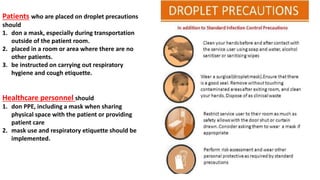
Patients who are placed on droplet precautions
should
1. don a mask, especially during transportation
outside of the patient room.
2. placed in a room or area where there are no
other patients.
3. be instructed on carrying out respiratory
hygiene and cough etiquette.
Healthcare personnel should
1. don PPE, including a mask when sharing
physical space with the patient or providing
patient care
2. mask use and respiratory etiquette should be
implemented.
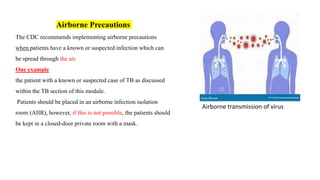
Airborne Precautions
The CDC recommends implementing airborne precautions
when patients have a known or suspected infection which can
be spread through the air.
One example
the patient with a known or suspected case of TB as discussed
within the TB section of this module.
Patients should be placed in an airborne infection isolation
room (AIIR), however, if this is not possible, the patients should
be kept in a closed-door private room with a mask.
Airborne transmission of virus
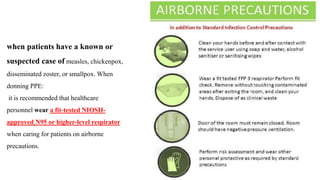
when patients have a known or
suspected case of measles, chickenpox,
disseminated zoster, or smallpox. When
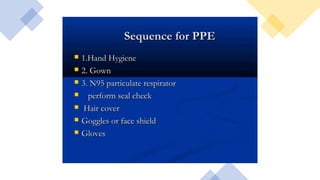
donning PPE:
it is recommended that healthcare
personnel wear a fit-tested NIOSH-
approved N95 or higher-level respirator
when caring for patients on airborne
precautions.
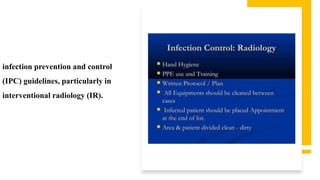
infection prevention and control
(IPC) guidelines, particularly in
interventional radiology (IR).
Section 4 infection  Dr-Aya.pptx

Section 4 infection Dr-Aya.pptx

  • 1.
    Contact Precautions Contact precautionsare used in addition to routine practice for patients known or suspected to be infected with microorganisms that can be transferred by direct or indirect contact. Direct contact occurs through touching a patient. For example, when touching a patient while assisting them with elimination or getting out of bed. Indirect contact occurs when touching a contaminated object or surface. For example, when auscultating a patient’s chest, the stethoscope directly touches the patient and becomes contaminated. Subsequently, when the stethoscope touches you or another patient, the microorganism is indirectly transmitted to another person.
  • 2.
    Contact precautions • Singleroom If not possible ,room with patient that has the same organism but no other infections • Clean Hands When entering and leaving the room ,before and after any patient contact ,after removing gloves • Put on Gown (non-Sterile ,Long Sleeved , impervious ) • Put on Gloves (non-Sterile)
  • 3.
  • 4.
    Droplet Precautions The CDCrecommends implementing droplet precautions when a patient has a known or suspected infection spread by respiratory droplets such as through coughing, sneezing, or talking: Source control 1. Use of PPE 2. Limiting patient transportation
  • 5.
    Patients who areplaced on droplet precautions should 1. don a mask, especially during transportation outside of the patient room. 2. placed in a room or area where there are no other patients. 3. be instructed on carrying out respiratory hygiene and cough etiquette. Healthcare personnel should 1. don PPE, including a mask when sharing physical space with the patient or providing patient care 2. mask use and respiratory etiquette should be implemented.
  • 6.
    Airborne Precautions The CDCrecommends implementing airborne precautions when patients have a known or suspected infection which can be spread through the air. One example the patient with a known or suspected case of TB as discussed within the TB section of this module. Patients should be placed in an airborne infection isolation room (AIIR), however, if this is not possible, the patients should be kept in a closed-door private room with a mask. Airborne transmission of virus
  • 7.
    when patients havea known or suspected case of measles, chickenpox, disseminated zoster, or smallpox. When donning PPE: it is recommended that healthcare personnel wear a fit-tested NIOSH- approved N95 or higher-level respirator when caring for patients on airborne precautions.
  • 8.
    infection prevention andcontrol (IPC) guidelines, particularly in interventional radiology (IR).