Azmir Latif
A letter of credit (LC), also known as a documentary credit, is a
written commitment by a bank on behalf of a buyer that
payment be made to a seller provided that the terms and
conditions stated therein have been met.
A written commitment to pay, by a buyer's or importer's bank
(called the issuing bank) to the seller's or exporter's bank (called
the accepting bank, negotiating bank, or paying bank).
A letter of credit guarantees payment of a specified sum in a
specified currency, provided the seller meets precisely-defined
conditions and submits the prescribed documents within a fixed
timeframe. These documents almost always include a clean bill
of lading or air waybill, commercial invoice, and certificate of
origin. To establish a letter of credit in favor of the seller or
exporter (called the beneficiary) the buyer (called the applicant
or account party) either pays the specified sum (plus service
charges) up front to the issuing bank, or negotiates credit.
Introduction
For any company entering the international
market, Letters of Credit is an important
payment mechanism which help to
eliminate certain risks.
L/C means Letter of Credit. A letter of credit is a
document issued by a financial institution, or a
similar party, assuring payment to a seller of goods
and/or services provided certain documents have
been presented to the bank. A key principle
underlying letter of credit (L/C) is that banks deal
only in documents and not in goods.
LC (Letter of Credit) is the familiar word in apparel
industry. L/C set up is the work of merchandising
section in garment factory. A merchandiser should
have clear concept on letter of credit. Letter of
Credit (L/C) also known as Documentary Credit .
 Abbreviations for 'letter of credit' include L/C, LC, and LOC
 Applicant - the buyer in a transaction.
 Beneficiary - the seller or ultimate recipient of funds.
 Issuing bank - the bank that promises to pay.
 Advising bank - helps the beneficiary use the. letter of credit.
 Irrevocable - the letter of credit cannot be changed or cancelled
without permission from everybody involved.
 Revocable Letter of Credit.
 Irrevocable Letter of Credit.
 Unconfirmed Letter of Credit.
 Confirmed Letter of Credit.
 Transferable Letter of Credit.
 Untransferable Letter of Crtedit.
 Assignment of Proceeds.
 Revolving Letter of Credit.
 Standby Letter of Credit.
 Import/Export Letter of Credit.
The same credit is termed as Import Letter of
Credit or Export Letter of Credit. It depends
on whose perspective it is being considered.
For the importer it is termed as Import Letter
of Credit and for the exporter it is termed
Export Letter of Credit.
Import/Export L/C Cycle
Documents
3. Letter of Credit
Applicant
Importer/Buyer
Exporter’s Bank/
Advising Bank
Importer’s Bank/
Issuing Bank
Buyer & Seller Agree
Docum
ents
Documents
1.
5. Product
is Shipped
2.
9.
10.
4.
Letter of
Credit
Beneficiary
Exporter/Seller
In this type of Credit, the exporter has
the right to transfer the credit to one or
more subsequent beneficiaries to
procure the goods and arrange them to
be sent to the buyer. Usually buying
houses prefer this type of letter of credit.
Seller/Exporters Bank
Advising Bank
Transferring BankManufacturer’s
Bank
Importer
Exporter/Seller
9. $50,000
Received6.
Documents
& BL
1. LC
Application
5. Product Shipped to Seller
or directly to Importer
Product
Importer’s Bank/
Issuing Bank
2. Transferable LC
$50,000
3. Transferable LC
$30,000
7.
Documents
& BL
8.
Documents
& BL
9.
Documents
& BL
10.
$30,000
Received
Transferable
Letter of Credit
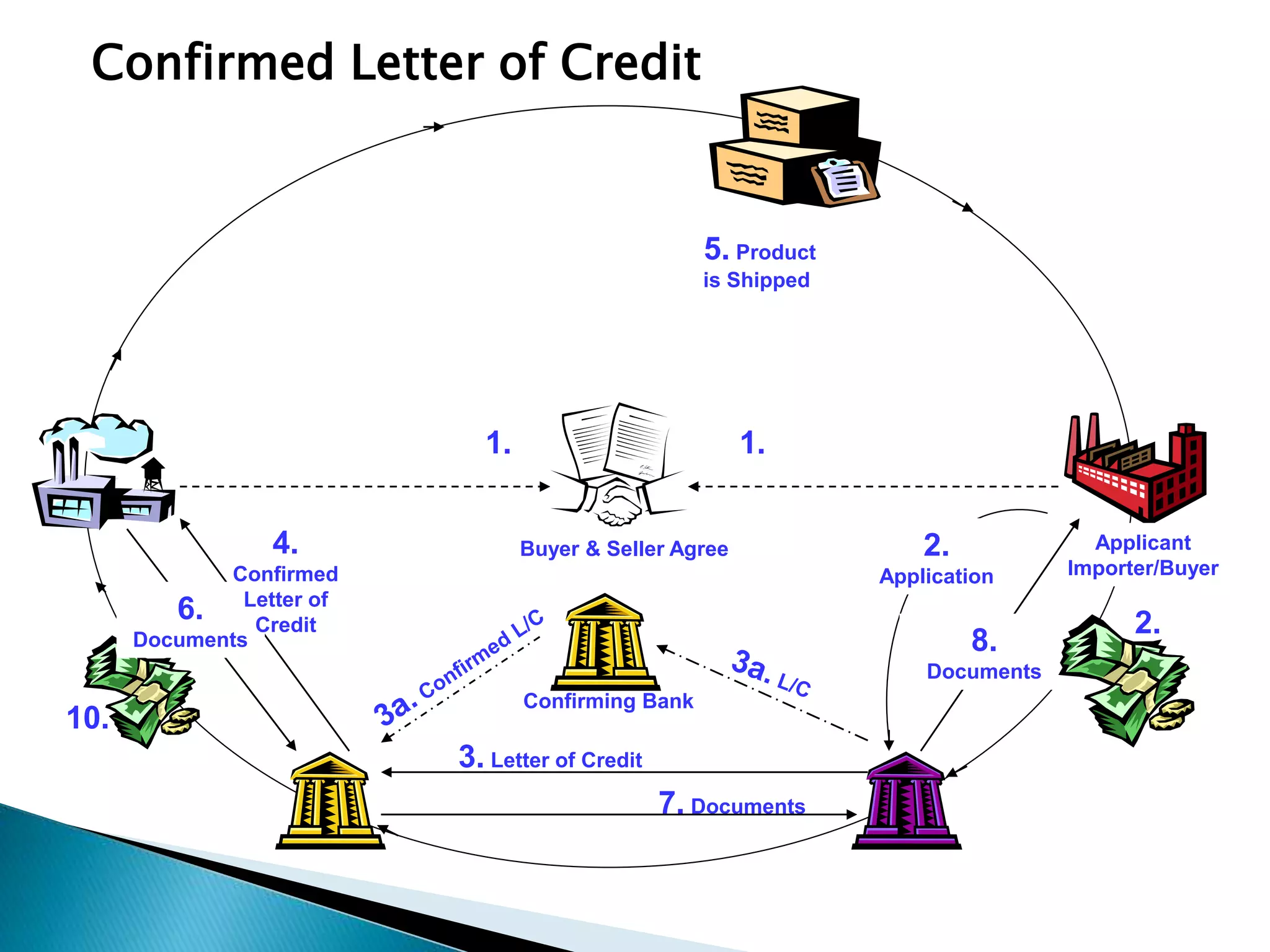
A confirmed letter of credit is typically used
when the issuing bank of the letter of credit
may have questionable creditworthiness and
the seller seeks to get a second guarantee to
assure payment.
Confirmed Letter of Credit
7. Documents
3. Letter of Credit
Applicant
Importer/Buyer
Buyer & Seller Agree
6.
Documents 8.
Documents
2.
Application
1. 1.
5. Product
is Shipped
2.
10.
4.
Confirmed
Letter of
Credit
Confirming Bank
 Revocable L/C — The buyer and the bank
that established the LC are able to
manipulate the LC or make corrections
without informing or getting permissions
from the seller. According to UCP 600, all
LCs are irrevocable, hence this type of LC is
obsolete.
 Irrevocable L/C— Any changes
(amendment) or cancellation of the LC
(except it is expired) is done by the
applicant through the issuing bank. It must
be approved by the beneficiary.
 Transferrable L/C —Credits are made
transferable when the original beneficiary is
a middleman and does not supply the
merchandise, but procures goods from
suppliers and arranges them to be sent to
the buyer and does not want the buyer and
supplier know each other.
 Untransferable L/C— A credit that the seller
cannot assign all or part of to another
party. In international commerce, all credits
are untransferable.
 At Sight L/C— A credit that the announcer
bank immediately pays after inspecting the
carriage documents from the seller.
 Applicant (Opener)
 Issuing Bank (Opening Bank)
 Beneficiary (seller of the goods)
 Advising Bank (Bank provides advice to
the beneficiary and takes the
responsibility for sending the
documents)
 Confirming Bank (adds its guarantee to
the credit )
 Negotiating Bank
 Second Beneficiary
 ETC
 The financial standing of the
importer
 The goods
 Exporter Risk
 Country Risk
 Foreign exchange risk
 ETC
 Financial Documents — Bill of Exchange, co-accepted
draft
 Commercial Documents — Invoice, packing list.
 Shipping Documents — Transport document,
insurance certificate, commercial, official or legal
documents etc
 Official Documents — License, embassy legalization,
origin certificate, inspection certificate etc.
 Transport Documents — Bill of lading (ocean or
multi-modal or charter party), airway bill, truck
receipt, railway receipt, etc
 Insurance documents — Insurance policy or
certificate
For Example a company imports fabrics from a
Indian manufacturer called Style Manufacturing,
which banks at First Style Bank. The company
currently banks at First American Bank . Here-
The Company : Applicant
Style Manufacturing : Beneficiary
First American Bank : Issuing Bank
First Style Bank : Advising Bank
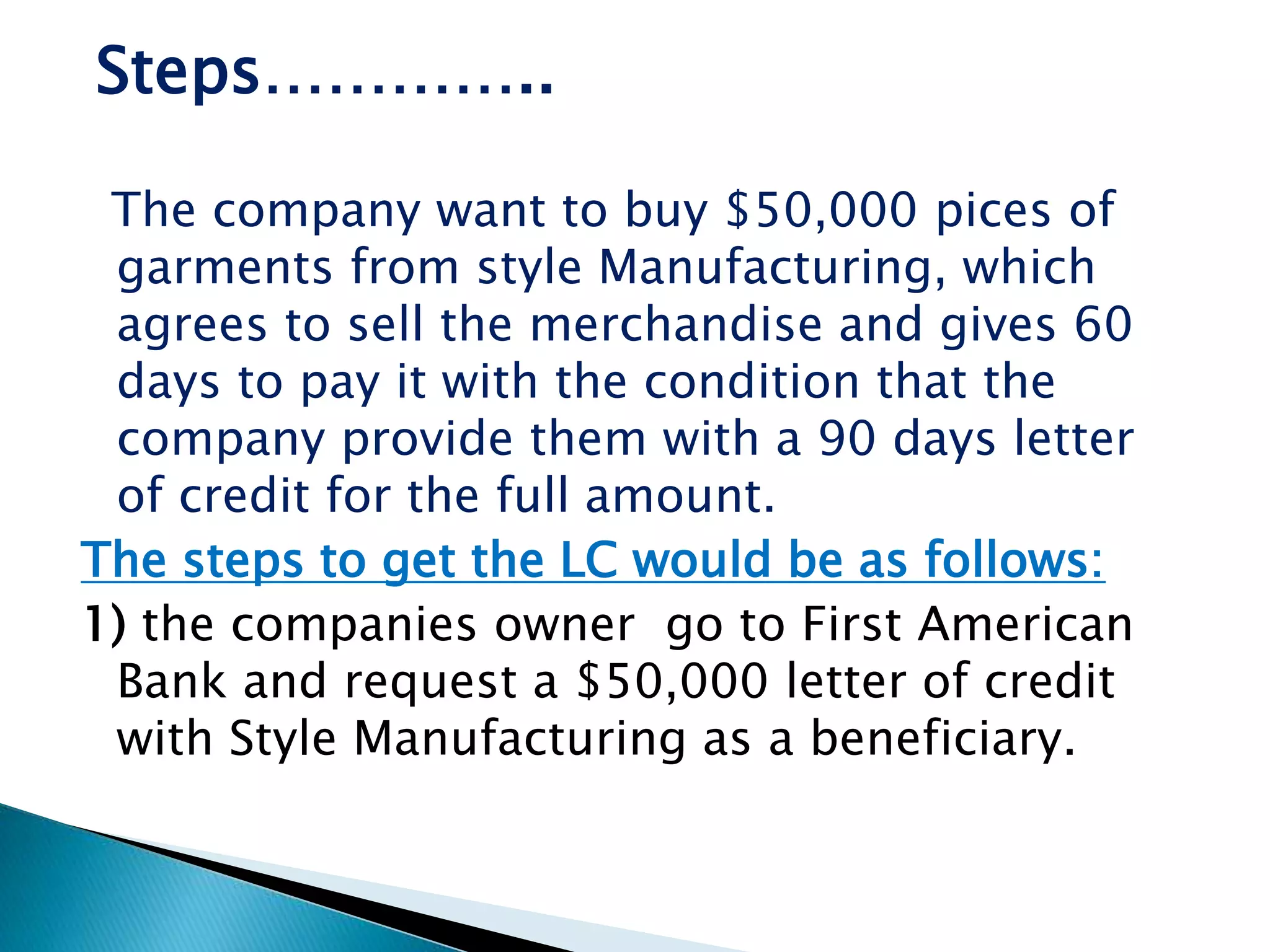
Steps…………..
The company want to buy $50,000 pices of
garments from style Manufacturing, which
agrees to sell the merchandise and gives 60
days to pay it with the condition that the
company provide them with a 90 days letter
of credit for the full amount.
The steps to get the LC would be as follows:
1) the companies owner go to First American
Bank and request a $50,000 letter of credit
with Style Manufacturing as a beneficiary.
Steps to get the L/C
2) The bank goes through its underwriting
process. Although the bank is not
advancing money, they are extending credit
on behalf of the company and are taking on
a contingent liability. If the company
qualifies from a credit standpoint the LC is
issued.
3) Even if the company does not qualify for
credit, it can still get an LC if the company
are willing to put cash collateral CD secured
letters of credit are very common for small
business .
4) The bank sends a copy of the letter of
credit to First Style Bank, which lets the
vendor knows and the merchandise is
shipped.
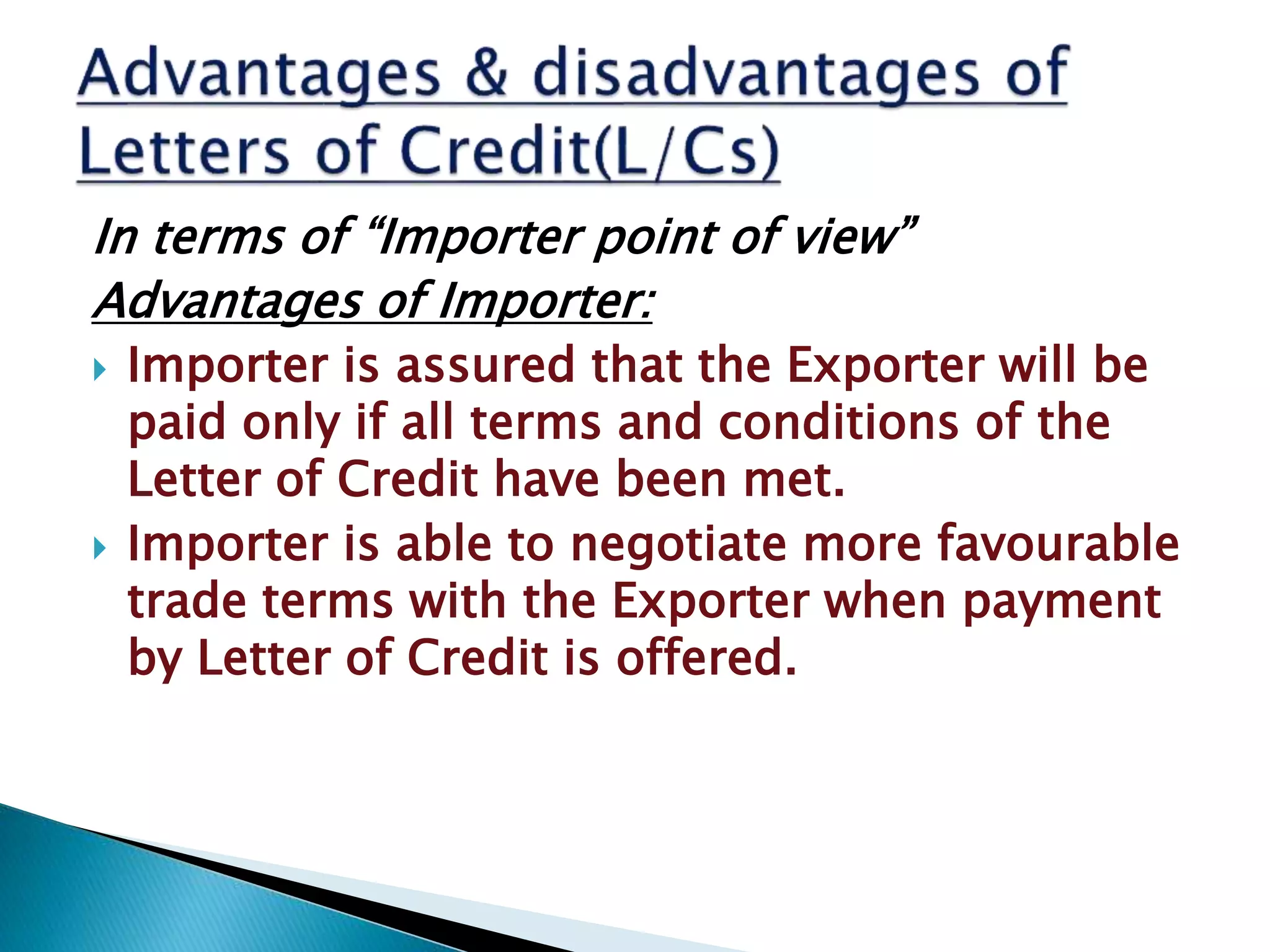
In terms of “Importer point of view”
Advantages of Importer:
 Importer is assured that the Exporter will be
paid only if all terms and conditions of the
Letter of Credit have been met.
 Importer is able to negotiate more favourable
trade terms with the Exporter when payment
by Letter of Credit is offered.
 A Letter of Credit does not offer protection to
the Importer against the Exporter shipping
inferior quality goods and/or a lesser
quantity of goods.
 It is necessary for the Importer to have a line
of credit with a bank before the bank is able
to issue a Letter of Credit.
Advantages to the Exporter:
 Exporter agrees in advance to all
requirements for payment under the Letter of
Credit.
 Exporter can further reduce foreign political
and bank credit risk.
Disadvantages to the Exporter:
 Documents must be prepared and presented in
strict compliance with the requirements
mentioned in the Letter of Credit.
• Some Importers may not be able to open
Letters of Credit due to the lack of credit
facilities with their bank which reduces export
growth.
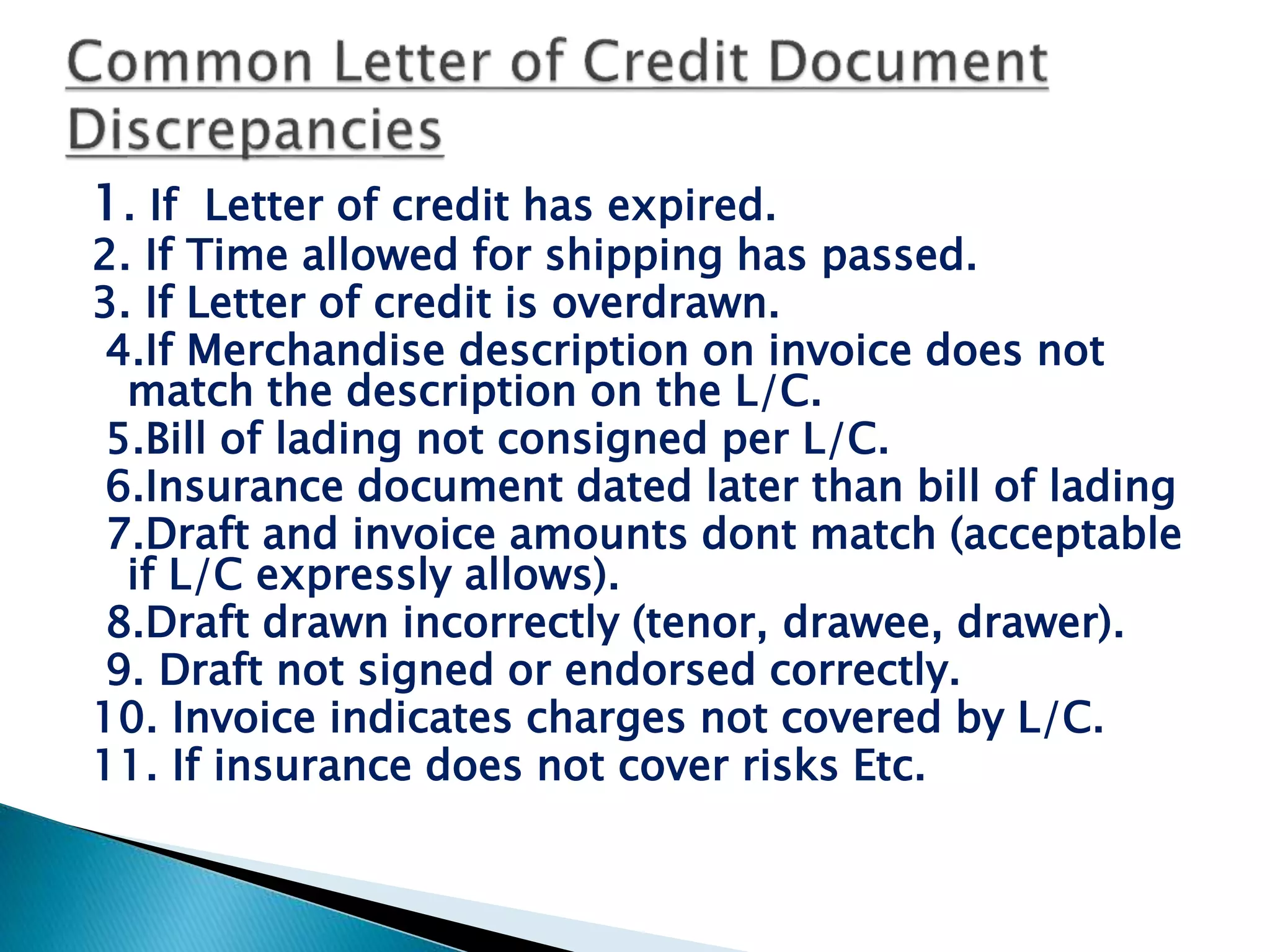
1. If Letter of credit has expired.
2. If Time allowed for shipping has passed.
3. If Letter of credit is overdrawn.
4.If Merchandise description on invoice does not
match the description on the L/C.
5.Bill of lading not consigned per L/C.
6.Insurance document dated later than bill of lading
7.Draft and invoice amounts dont match (acceptable
if L/C expressly allows).
8.Draft drawn incorrectly (tenor, drawee, drawer).
9. Draft not signed or endorsed correctly.
10. Invoice indicates charges not covered by L/C.
11. If insurance does not cover risks Etc.
In conclusion, the commercial utility of a
letter of credit is its prompt, certain, reliable,
efficient, and economical payment against
facially conforming documents.
To be a good merchandiser, be a successful
Textile Engineer, & all in all be a successful
business owner, a person must need
sufficient knowledge on Letter of Credit L/Cs.
THANKS TO
ALL

Letters of credit (L/C) in Textile Business

  • 1.
  • 2.
    A letter ofcredit (LC), also known as a documentary credit, is a written commitment by a bank on behalf of a buyer that payment be made to a seller provided that the terms and conditions stated therein have been met. A written commitment to pay, by a buyer's or importer's bank (called the issuing bank) to the seller's or exporter's bank (called the accepting bank, negotiating bank, or paying bank). A letter of credit guarantees payment of a specified sum in a specified currency, provided the seller meets precisely-defined conditions and submits the prescribed documents within a fixed timeframe. These documents almost always include a clean bill of lading or air waybill, commercial invoice, and certificate of origin. To establish a letter of credit in favor of the seller or exporter (called the beneficiary) the buyer (called the applicant or account party) either pays the specified sum (plus service charges) up front to the issuing bank, or negotiates credit.
  • 3.
    Introduction For any companyentering the international market, Letters of Credit is an important payment mechanism which help to eliminate certain risks.
  • 4.
    L/C means Letterof Credit. A letter of credit is a document issued by a financial institution, or a similar party, assuring payment to a seller of goods and/or services provided certain documents have been presented to the bank. A key principle underlying letter of credit (L/C) is that banks deal only in documents and not in goods. LC (Letter of Credit) is the familiar word in apparel industry. L/C set up is the work of merchandising section in garment factory. A merchandiser should have clear concept on letter of credit. Letter of Credit (L/C) also known as Documentary Credit .
  • 6.
     Abbreviations for'letter of credit' include L/C, LC, and LOC  Applicant - the buyer in a transaction.  Beneficiary - the seller or ultimate recipient of funds.  Issuing bank - the bank that promises to pay.  Advising bank - helps the beneficiary use the. letter of credit.  Irrevocable - the letter of credit cannot be changed or cancelled without permission from everybody involved.
  • 7.
     Revocable Letterof Credit.  Irrevocable Letter of Credit.  Unconfirmed Letter of Credit.  Confirmed Letter of Credit.  Transferable Letter of Credit.  Untransferable Letter of Crtedit.  Assignment of Proceeds.  Revolving Letter of Credit.  Standby Letter of Credit.  Import/Export Letter of Credit.
  • 8.
    The same creditis termed as Import Letter of Credit or Export Letter of Credit. It depends on whose perspective it is being considered. For the importer it is termed as Import Letter of Credit and for the exporter it is termed Export Letter of Credit.
  • 9.
    Import/Export L/C Cycle Documents 3.Letter of Credit Applicant Importer/Buyer Exporter’s Bank/ Advising Bank Importer’s Bank/ Issuing Bank Buyer & Seller Agree Docum ents Documents 1. 5. Product is Shipped 2. 9. 10. 4. Letter of Credit Beneficiary Exporter/Seller
  • 10.
    In this typeof Credit, the exporter has the right to transfer the credit to one or more subsequent beneficiaries to procure the goods and arrange them to be sent to the buyer. Usually buying houses prefer this type of letter of credit.
  • 11.
    Seller/Exporters Bank Advising Bank TransferringBankManufacturer’s Bank Importer Exporter/Seller 9. $50,000 Received6. Documents & BL 1. LC Application 5. Product Shipped to Seller or directly to Importer Product Importer’s Bank/ Issuing Bank 2. Transferable LC $50,000 3. Transferable LC $30,000 7. Documents & BL 8. Documents & BL 9. Documents & BL 10. $30,000 Received Transferable Letter of Credit
  • 12.
    A confirmed letterof credit is typically used when the issuing bank of the letter of credit may have questionable creditworthiness and the seller seeks to get a second guarantee to assure payment.
  • 13.
    Confirmed Letter ofCredit 7. Documents 3. Letter of Credit Applicant Importer/Buyer Buyer & Seller Agree 6. Documents 8. Documents 2. Application 1. 1. 5. Product is Shipped 2. 10. 4. Confirmed Letter of Credit Confirming Bank
  • 14.
     Revocable L/C— The buyer and the bank that established the LC are able to manipulate the LC or make corrections without informing or getting permissions from the seller. According to UCP 600, all LCs are irrevocable, hence this type of LC is obsolete.  Irrevocable L/C— Any changes (amendment) or cancellation of the LC (except it is expired) is done by the applicant through the issuing bank. It must be approved by the beneficiary.
  • 15.
     Transferrable L/C—Credits are made transferable when the original beneficiary is a middleman and does not supply the merchandise, but procures goods from suppliers and arranges them to be sent to the buyer and does not want the buyer and supplier know each other.  Untransferable L/C— A credit that the seller cannot assign all or part of to another party. In international commerce, all credits are untransferable.  At Sight L/C— A credit that the announcer bank immediately pays after inspecting the carriage documents from the seller.
  • 16.
     Applicant (Opener) Issuing Bank (Opening Bank)  Beneficiary (seller of the goods)  Advising Bank (Bank provides advice to the beneficiary and takes the responsibility for sending the documents)  Confirming Bank (adds its guarantee to the credit )  Negotiating Bank  Second Beneficiary  ETC
  • 17.
     The financialstanding of the importer  The goods  Exporter Risk  Country Risk  Foreign exchange risk  ETC
  • 18.
     Financial Documents— Bill of Exchange, co-accepted draft  Commercial Documents — Invoice, packing list.  Shipping Documents — Transport document, insurance certificate, commercial, official or legal documents etc  Official Documents — License, embassy legalization, origin certificate, inspection certificate etc.  Transport Documents — Bill of lading (ocean or multi-modal or charter party), airway bill, truck receipt, railway receipt, etc  Insurance documents — Insurance policy or certificate
  • 19.
    For Example acompany imports fabrics from a Indian manufacturer called Style Manufacturing, which banks at First Style Bank. The company currently banks at First American Bank . Here- The Company : Applicant Style Manufacturing : Beneficiary First American Bank : Issuing Bank First Style Bank : Advising Bank
  • 20.
    Steps………….. The company wantto buy $50,000 pices of garments from style Manufacturing, which agrees to sell the merchandise and gives 60 days to pay it with the condition that the company provide them with a 90 days letter of credit for the full amount. The steps to get the LC would be as follows: 1) the companies owner go to First American Bank and request a $50,000 letter of credit with Style Manufacturing as a beneficiary.
  • 21.
    Steps to getthe L/C 2) The bank goes through its underwriting process. Although the bank is not advancing money, they are extending credit on behalf of the company and are taking on a contingent liability. If the company qualifies from a credit standpoint the LC is issued. 3) Even if the company does not qualify for credit, it can still get an LC if the company are willing to put cash collateral CD secured letters of credit are very common for small business . 4) The bank sends a copy of the letter of credit to First Style Bank, which lets the vendor knows and the merchandise is shipped.
  • 22.
    In terms of“Importer point of view” Advantages of Importer:  Importer is assured that the Exporter will be paid only if all terms and conditions of the Letter of Credit have been met.  Importer is able to negotiate more favourable trade terms with the Exporter when payment by Letter of Credit is offered.
  • 23.
     A Letterof Credit does not offer protection to the Importer against the Exporter shipping inferior quality goods and/or a lesser quantity of goods.  It is necessary for the Importer to have a line of credit with a bank before the bank is able to issue a Letter of Credit.
  • 24.
    Advantages to theExporter:  Exporter agrees in advance to all requirements for payment under the Letter of Credit.  Exporter can further reduce foreign political and bank credit risk. Disadvantages to the Exporter:  Documents must be prepared and presented in strict compliance with the requirements mentioned in the Letter of Credit. • Some Importers may not be able to open Letters of Credit due to the lack of credit facilities with their bank which reduces export growth.
  • 25.
    1. If Letterof credit has expired. 2. If Time allowed for shipping has passed. 3. If Letter of credit is overdrawn. 4.If Merchandise description on invoice does not match the description on the L/C. 5.Bill of lading not consigned per L/C. 6.Insurance document dated later than bill of lading 7.Draft and invoice amounts dont match (acceptable if L/C expressly allows). 8.Draft drawn incorrectly (tenor, drawee, drawer). 9. Draft not signed or endorsed correctly. 10. Invoice indicates charges not covered by L/C. 11. If insurance does not cover risks Etc.
  • 26.
    In conclusion, thecommercial utility of a letter of credit is its prompt, certain, reliable, efficient, and economical payment against facially conforming documents. To be a good merchandiser, be a successful Textile Engineer, & all in all be a successful business owner, a person must need sufficient knowledge on Letter of Credit L/Cs.
  • 27.