
Study on characteristics of Air vortex sewing thread and its application
•
0 likes•3 views

https://www.irjet.net/archives/V9/i8/IRJET-V9I818.pdf

Recommended
More Related Content
Similar to Study on characteristics of Air vortex sewing thread and its application
Similar to Study on characteristics of Air vortex sewing thread and its application (20)
More from IRJET Journal
More from IRJET Journal (20)
Recently uploaded
Recently uploaded (20)
Study on characteristics of Air vortex sewing thread and its application
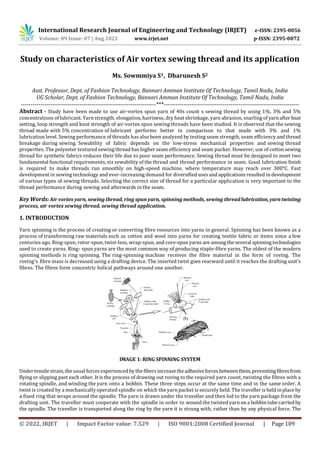
- 1. International Research Journal of Engineering and Technology (IRJET) e-ISSN: 2395-0056 Volume: 09 Issue: 07 | Aug 2022 www.irjet.net p-ISSN: 2395-0072 © 2022, IRJET | Impact Factor value: 7.529 | ISO 9001:2008 Certified Journal | Page 109 Study on characteristics of Air vortex sewing thread and its application Ms. Sowmmiya S1, Dharunesh S2 Asst. Professor, Dept. of Fashion Technology, Bannari Amman Institute Of Technology, Tamil Nadu, India UG Scholar, Dept. of Fashion Technology, Bannari Amman Institute Of Technology, Tamil Nadu, India ---------------------------------------------------------------------***--------------------------------------------------------------------- Abstract - Study have been made to use air-vortex spun yarn of 40s count s sewing thread by using 1%, 3% and 5% concentrations of lubricant. Yarn strength, elongation, hairiness, dry heat shrinkage, yarn abrasion, snarling of yarnafter heat setting, loop strength and knot strength of air-vortex spun sewing threads have been studied. It is observed that the sewing thread made with 5% concentration of lubricant performs better in comparison to that made with 3% and 1% lubrication level. Sewing performance of threads has also been analyzed by testing seam strength, seam efficiencyand thread breakage during sewing. Sewability of fabric depends on the low-stress mechanical properties and sewing thread properties. The polyester textured sewing thread has higher seam efficiency and seam pucker. However, use of cottonsewing thread for synthetic fabrics reduces their life due to poor seam performance. Sewing thread must be designed to meet two fundamental functional requirements, viz sewability of the thread and thread performance in seam. Good lubrication finish is required to make threads run smoothly on high-speed machine, where temperature may reach over 300°C. Fast development in sewing technology and ever-increasing demand for diversified uses and applications resulted in development of various types of sewing threads. Selecting the correct size of thread for a particular application is very important to the thread performance during sewing and afterwards in the seam. Key Words: Air vortex yarn, sewing thread, ring spun yarn, spinning methods, sewing thread lubrication,yarntwisting process, air vortex sewing thread, sewing thread application. 1. INTRODUCTION Yarn spinning is the process of creating or converting fibre resources into yarns in general. Spinning has been known as a process of transforming raw materials such as cotton and wool into yarns for creating textile fabric or items since a few centuries ago. Ring-spun, rotor-spun, twist-less, wrap-spun, and core-spunyarns are amongtheseveral spinningtechnologies used to create yarns. Ring- spun yarns are the most common way of producing staple-fibre yarns. The oldest of the modern spinning methods is ring spinning. The ring-spinning machine receives the fibre material in the form of roving. The roving's fibre mass is decreased using a drafting device. The inserted twist goes rearward until it reaches the drafting unit's fibres. The fibres form concentric helical pathways around one another. IMAGE 1: RING SPINNING SYSTEM Undertensilestrain,the usual forces experienced bythe fibers increasetheadhesiveforcesbetweenthem,preventingfibresfrom flying or slipping past each other. It is the process of drawing out roving to the required yarn count, twisting the fibres with a rotating spindle, and winding the yarn onto a bobbin. These three steps occur at the same time and in the same order. A twist is created by a mechanically operated spindle on which the yarn packet is securely held. The traveller is held in place by a fixed ring that wraps around the spindle. The yarn is drawn under the traveller and then led to the yarn package from the drafting unit. The traveller must cooperate with the spindle in order to wound the twisted yarnon a bobbintube carriedby the spindle. The traveller is transported along the ring by the yarn it is strung with, rather than by any physical force. The
- 2. International Research Journal of Engineering and Technology (IRJET) e-ISSN: 2395-0056 Volume: 09 Issue: 07 | Aug 2022 www.irjet.net p-ISSN: 2395-0072 © 2022, IRJET | Impact Factor value: 7.529 | ISO 9001:2008 Certified Journal | Page 110 traveller spins at a slower rate than the spindle, allowing for yarn winding on the tube. The shape of theyarnpacket, knownas a Cop or Bobbin, is determined by a regulated up and down movement of the ring. The yarn counts that can be produced by ring spinning technology are the most diverse. Due to its slower production speeds and theadditional procedures(roving and wrapping) required to produce ring spun yarns, ring spinning is a rather expensive operation. Ringspun yarns are high- quality yarns that are mostly made in the fine (60 Ne, 10 tex) to medium count (30 Ne, 20 tex) ranges, with a tiny number made in the coarse count (10 Ne, 60 tex). High-quality undergarments, shirting, and towels are examples of end applications. The ring yarn's fibres are very parallel and helical in character, and the fibre arrangement is consistent throughout the yarn's thickness.With no wrapping or looped fibres, the yarn has a compact structure. The self-locked structure iscaused byintense fibre migration, which is impacted by the spinning zone's triangular geometry and high spinning tensions. The yarn's remarkable axial strength is due to its unique self-locked structure. IMAGE 2: PRINCIPLE OF VORTEX SPINNING Vortex spinning is a yarn-spinning technique that employs an air vortex. The fibres created by these air fluxes have a distinct structure, which gives the yarn a wide range of functions. Vortex spinning uses a four-roller apron draftingmethod to draught pulled cotton sliver to the appropriate yarn count (fineness). The drafted fibres are then drawn into a nozzle, where they are swirled around the outside of a hollow stationary spindle by a high-speed air vortex. The fibres created by these air fluxes have a distinct structure, which gives the yarn a wide range of functions. Since it is possible to eliminate moveable elements such as the spindle and traveller in ring spinning or the centrifuge in rotor spinning, air-jet spinning systems have been developed. IMAGE 3: STRUCTURE OF VORTEX YARN The performance of the Murata vortex spinning (MVS) system, which isthe newest technology after all investigations of air-jet systems, has been very encouraging, particularly for the ability to spin 100 percent cotton at high speeds (500 m/min) and the yarn structure resembling ring yarns rather than rotor yarns. Murata vortex spinning (MVS) is based on Murata's current air-jet spinningtechnology, however it differs from Murata vortex spinning (MJS) in principle due to the geometry of the air-jet twisting device employed. A nozzle block with injectors for swirl flow creation, a needle holder, a hollow spindle, and a guide member make up this air-jet device. A sketched sliver is fed to a four-line drawing system in the MVS system.
- 3. International Research Journal of Engineering and Technology (IRJET) e-ISSN: 2395-0056 Volume: 09 Issue: 07 | Aug 2022 www.irjet.net p-ISSN: 2395-0072 © 2022, IRJET | Impact Factor value: 7.529 | ISO 9001:2008 Certified Journal | Page 111 IMAGE 4: NOZZLE BLOCK OF VORTEX SPINNING The fibres migrate to the air-jet nozzle after exiting the front rollers. The twisting motion tends to flowupward toward the front rollers of the drafting unit, even though the fibres are orientated to be twisted with the pressurized air effect; here, the guide element projecting from the fibre bundle passage prevents thisduringyarncreation.Thevortexchamber generatesa high-speed whirling air current into which the pressurized air is injected. The sections that will eventually become core fibres are dragged into the vortex spun yarn path. The higher sections of some fibres separated from the front rollers' nip point, on the other hand, are left open. After the trailing ends leave the nip point, they pass via the spiral fibre passage and, due to the whirling force of the air-jet stream, they twine around the hollow stationary spindle and become the wrapping fibres. 1.1 Materials & methodology Cotton (fiber length 32 mm and fineness 3.6 micronaire) and polyester (fiberlength40 mmanddenier1) wereblendedina 70 percent polyester/30 percent cotton ratio to make the sliver and roving. Then, using an air-vortex spinningmachine,these materials were employed to create yarns with counts of 30 Ne and 40 Ne. The sliver's hank was 0.14 Ne. The single yarn created by the air- vortex spinning method was wound and then turned into sewing thread. The vortex yarn was conditioned to eliminate snarling and provide zero liveliness to the yarn. Two vortex single yarns werewindedinparallel andjoinedinthe machine. When feeding single yarn directly into a ply twisting machine, parallel winding prevents the single yarn from knotting. In the TFO (Two For One) machine, the ply yarn twist was set at 14.2 TPI for 30 Ne and 15.36 TPI for 40 Ne. The dyeing was done according to the usual process parameters. The finishing process lubricates the yarn, resulting in a lower coefficient of friction. In this study, a commercial lubricant called "T23" with concentrations of 3 percent and 5 percent was employed. Previously, finishing was done on a winding machine, and the add-on % was altered by changingthe machine's settings. In this experiment, 2 g of thread was dried in a 110°C oven for 10 minutes before the weight was determined. The thread was then steeped in 100 mL petroleum ether for 15 minutes before drying fully. Thethreadweight wasmeasuredafter it had dried. The following formula was used to calculate the lubrication content; (Original sample weight – final dried sample weight) Lubrication content = *100 Original sample weight 2. Results PROPERTY 3% LUBRICANT 5% LUBRICANT 30s 40s 30s 40s Yarn strength, N 850 520 930 650 Yarn elongation, % 17 17 15.5 14 Dry heat shrinkage, % 5 5.2 3.5 4.3 Yarn snarl measure (before heat setting) / 25cm 13 15.5 7 9 Yarn snarl measure (before heat setting) / 25cm 5 5.2 3.5 4.3
- 4. International Research Journal of Engineering and Technology (IRJET) e-ISSN: 2395-0056 Volume: 09 Issue: 07 | Aug 2022 www.irjet.net p-ISSN: 2395-0072 © 2022, IRJET | Impact Factor value: 7.529 | ISO 9001:2008 Certified Journal | Page 112 TABLE 1: YARN PROPERTIES FOR YARN COUNT 30s AND 40s COUNT 3. Conclusion It has been discovered that as the lubricant concentration rises, yarn strength rises as well. This could be because the friction between the yarn is reduced, which enhances the load-sharing ability of the under-stressed yarn. 30S air- vortex spun yarns have a greater yarn strength rating than 40S air-vortex spun yarns. The internal parallel bundle is held tightly together by the number of wrappers. Vortex yarn has a greater strength value due to these underlying structural arrangements. Elongation percentage is influenced by the lubricant level. In this case, lubrication level of 3 percent leads in more sewing thread elongation. However, when the lubricant level is 5%, the sewing thread elongation is low,andthesurface of the sewing thread is smooth. However, due to the low elongation and smooth surface, no breakage occurs during sewing. At a lubricant level of 5 percent, heat generation in the needle during sewing is also reduced. For stitching,the elongation of the sewingthreadshould be kept to a minimum. The lower elongation values in the vortex yarn structure could be owing to a reduction in or prevention of slippage as a result of improved wrapper grip on the yarn surface, resulting in a lower elongation. Yarns with a lubricant level of 3 percent shrink more than those with a lubricant level of 5 percent.Normal ring-spunyarnhasatwistedstructurethathasa springy quality to it and is prone to shrinking. There is no twisted structure in Vortex yarn; As a result of this structural difference, the vortex yarn has a far lower shrinking problem. Due to its yarn structure, the vortex yarn has a lower snarl value than the other yarns. The yarn has very little snarling due to the untwisted core fibers. Because the untwisted fibers arecloselyfoldedtogether with the help of lubrication, yarn snarl is low at 5 percent lubricant concentration. Yarn in the 40s has a minimal yarn-to-yarn abrasion because it contains 3 percent lubricant. For 30s and 40s vortex yarns, 5 percent of lubricant results in a higher number of abrasion cycles. Since the sewing yarn goes through the needle at a rapid pace, heat builds up in the needle,causing the thread to break. As a result, the sewing thread treated with 5 percent lubrication level prevents thread breaking and runs smoothly during sewing. The higher yarn strength is responsible for the higher loop strength of 30s sewing threads. On the other hand, as the lubricant concentration rises, the loop strength for both 30s and 40s vortex yarns increases. The knot strength of a sewing thread is used to determine the thread's brittleness. The knot strength is also a reflection of the thread's performance after sewing. Knot strength increases as lubricant concentration rises for both 30s and 40s vortex yarns. In compared to 30s single yarn, 40s single yarn has less hairiness because the wrapper fibers are entirelyboundonthe surfacein 40s yarn, resulting in less hairiness. Hairiness decreases as the lubricant content rises in both 30s and 40s yarn. With an increase in lubricant content, the wrapped and projecting fibers are held tightly together, resulting in decreased hairiness. REFERENCES 1. Sowmmiya. s, Das, subrata. Application of air-vortex thread in sewing operation, http://op.niscair.res.in/index.php/IJFTR/article/view/31194 2. Gizem karakan günaydin and ali serkan soydan. Vortex Spinning System and Vortex Yarn Structure, https://www.intechopen.com/chapters/53651 3. Mazharul islam kiron. Murata Vortex Spinning (MVS) Process, Principle of Vortex Spinning Technology, https://textilelearner.net/vortex-spinning-system/ 4. Lekhani tripathi and Bijoya kumar behera. Comparative Studies on Ring, Compact and Vortex Yarns and Fabrics, https://irispublishers.com/jtsft/pdf/JTSFT.MS.ID.000646.pdf 5. Mayur s. choudhari, Saket totala and Akash s. deshmukh. Effect of ring and vortex spinning technologies, https://www.textiletechnology.net/technology/trendreports/dkte-societys-textile-and-engineering-institute-effect-of- ring-and-vortex-spinning-technologies-on-viscose-yarn-characteristics-30889 Abrasion tests, rubs 4800 2600 6900 3700 Loop length, N 60 40 90 65 Knot strength, N 5 4.5 5.2 5.7 Yarn hairiness index 5 4.5 4.1 3.3
- 5. International Research Journal of Engineering and Technology (IRJET) e-ISSN: 2395-0056 Volume: 09 Issue: 07 | Aug 2022 www.irjet.net p-ISSN: 2395-0072 © 2022, IRJET | Impact Factor value: 7.529 | ISO 9001:2008 Certified Journal | Page 113 6. Seval uyanik & Pinar duru baykal. Effects of fiber types and blend ratios on Murata Vortex yarn properties, https://www.researchgate.net/publication/321297004_Effects_of_fiber_types_and_blend_ratios_on_Murata_Vortex_yarn_p roperties 7. Seval uyanik & Pinar duru baykal.Effects of Fiber types and fiber blends ratio on vortex yarn properties, https://www.researchgate.net/publication/318882349_EFFECTS_OF_FIBER_TYPES_AND_FIBER_BLENDS_RATIO_ON_VOR TEX_YARN_PROPERTIES 8. Gunaydin karakan gizem. A research on tensile properties of vortex yarns, https://www.researchgate.net/publication/318582957_A_research_on_tensile_properties_of_vortex_yarns 9. Pranay dutta, Mohammed abu suffian. Effectofairpressureonthecotton/polyester blendedvortexspunyarnpropertiesin terms of uniform yarn count, https://www.researchgate.net/publication/350687243_EFFECT_OF_AIR_PRESSURE_ON_THE_COTTONPOLYESTER_BLEN DED_VORTEX_SPUN_YARN_PROPERTIES_IN_TERMS_OF_UNIFORM_YARN_COUNT 10. Guldemet Basal and William Oxenham. Vortex spun yarn vs. air-jet spun yarn, http://autexrj.com/cms/zalaczone_pliki/1- 03-3.pdf 11. Eva Mouckova, Iva Mertova. Properties Of Viscose Vortex Yarns Depending On Technological Parameters Of Spinning, https://www.researchgate.net/publication/276502351_Properties_Of_Viscose_Vortex_Yarns_Depending_On_Technologica l_Parameters_Of_Spinning 12. Nazan Erdumlu, Bulent Ozipeck. The structure and properties of carded cotton vortex yarns, https://journals.sagepub.com/doi/full/10.1177/0040517511433150 13. Subrata das, Sowmmiya. Study on the performance of air vortex sewing thread, https://www.researchgate.net/publication/349883098_Application_of_air-vortex_thread_in_sewing_operation 14. Yesilpinar S. Analysis of the Performance of Sewing Threads Manufactured from Conventional and Compact Ring-spun Yarns, https://www.researchgate.net/publication/298985108_Analysis_of_the_Performance_of_Sewing_Threads_Manufactured_f rom_Conventional_and_Compact_Ring-spun_Yarns