Made by Manishpal
NAME- MANISH PAL
CLASS- XI-A
SUB - BIOLGOY
TEACHER- POOJA MADAM
SRI LAL CONVENT SEN. SEC. SCHOOL
NEURAL CONTROL
&
COORDINATION
CHAPTER-21
BASED ON NCERT
Coordination is the process through which two or more organs interact and
complement the functions of one another. For example, when we do physical
exercises,all body part work with coordinate.
neural system and the endocrine system jointly coordinate and integrate all the
activities of the organs so that they function in a Synchronised Fashion.
21.1
NEURAL SYSTEM
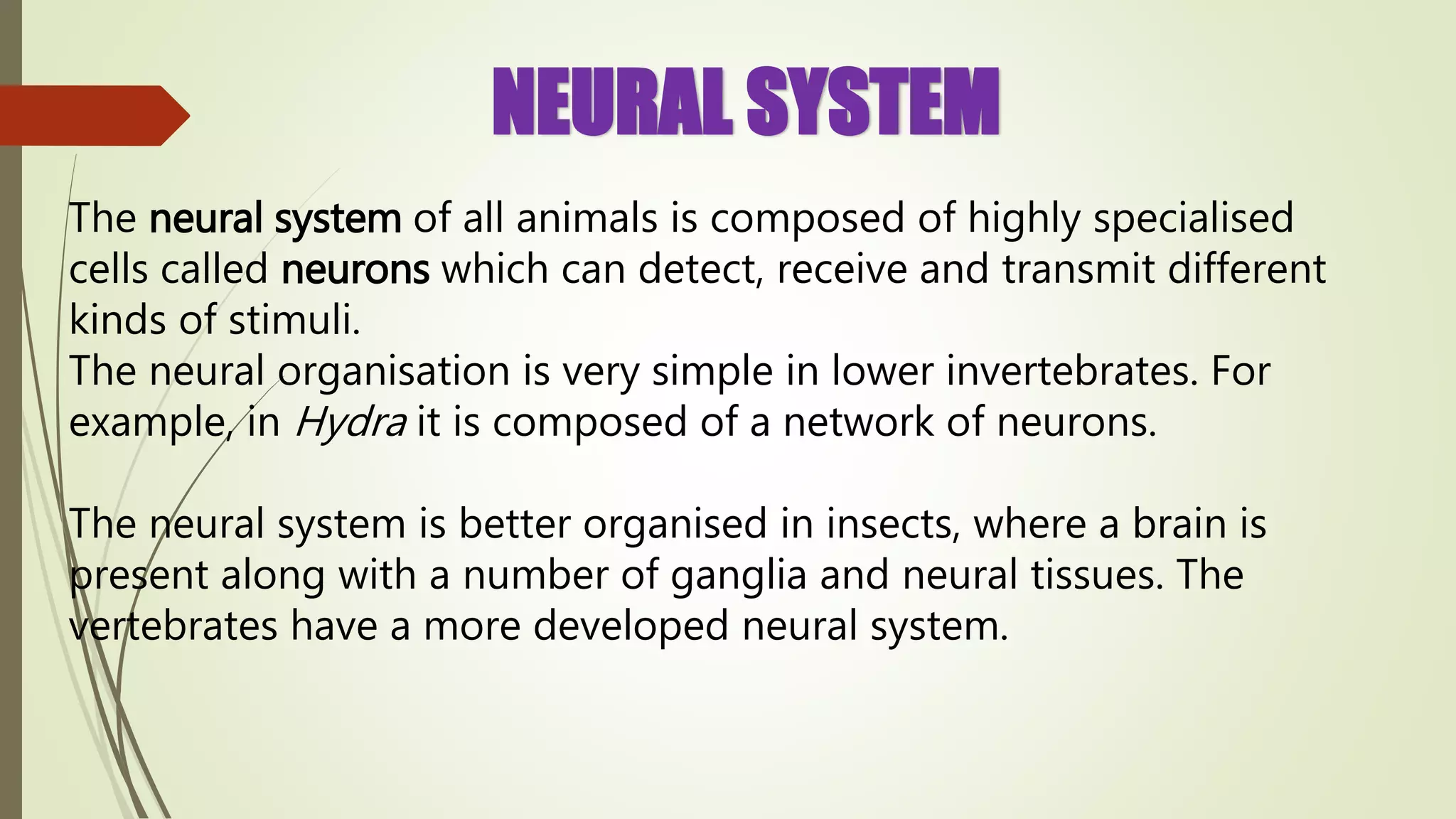
The neural system of all animals is composed of highly specialised
cells called neurons which can detect, receive and transmit different
kinds of stimuli.
The neural organisation is very simple in lower invertebrates. For
example, in Hydra it is composed of a network of neurons.
The neural system is better organised in insects, where a brain is
present along with a number of ganglia and neural tissues. The
vertebrates have a more developed neural system.
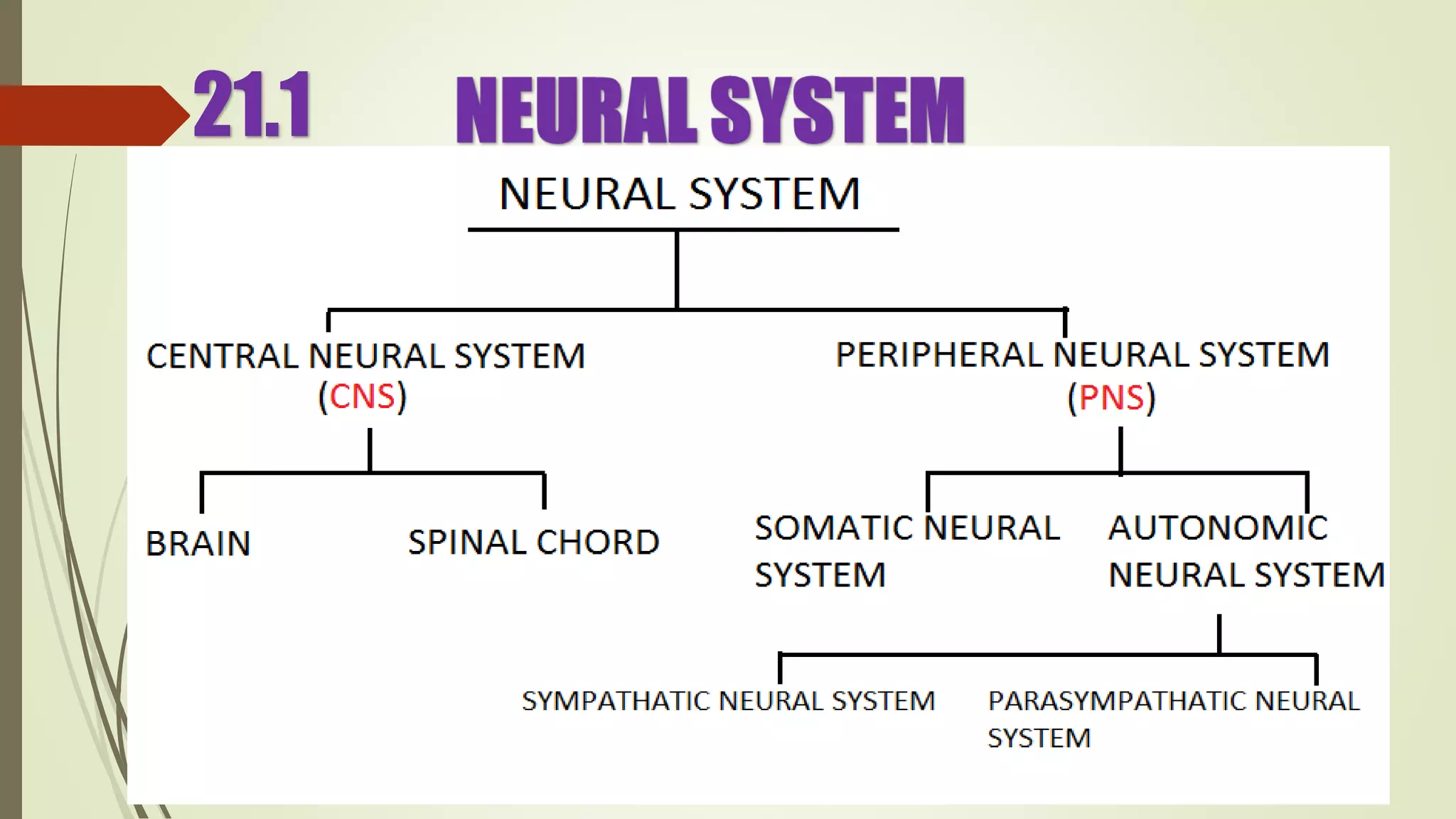
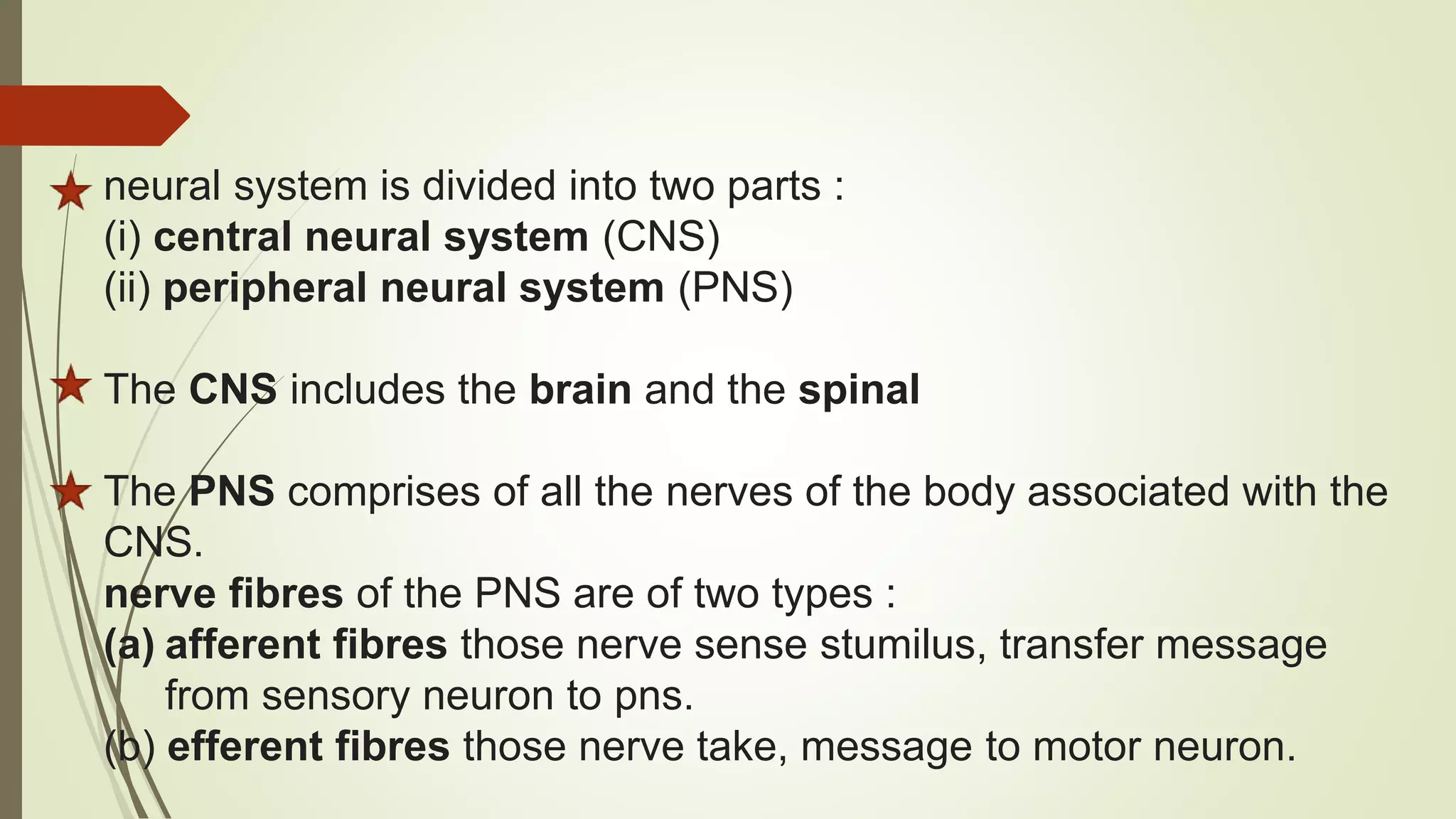
neural system is divided into two parts :
(i) central neural system (CNS)
(ii) peripheral neural system (PNS)
The CNS includes the brain and the spinal
The PNS comprises of all the nerves of the body associated with the
CNS.
nerve fibres of the PNS are of two types :
(a) afferent fibres those nerve sense stumilus, transfer message
from sensory neuron to pns.
(b) efferent fibres those nerve take, message to motor neuron.
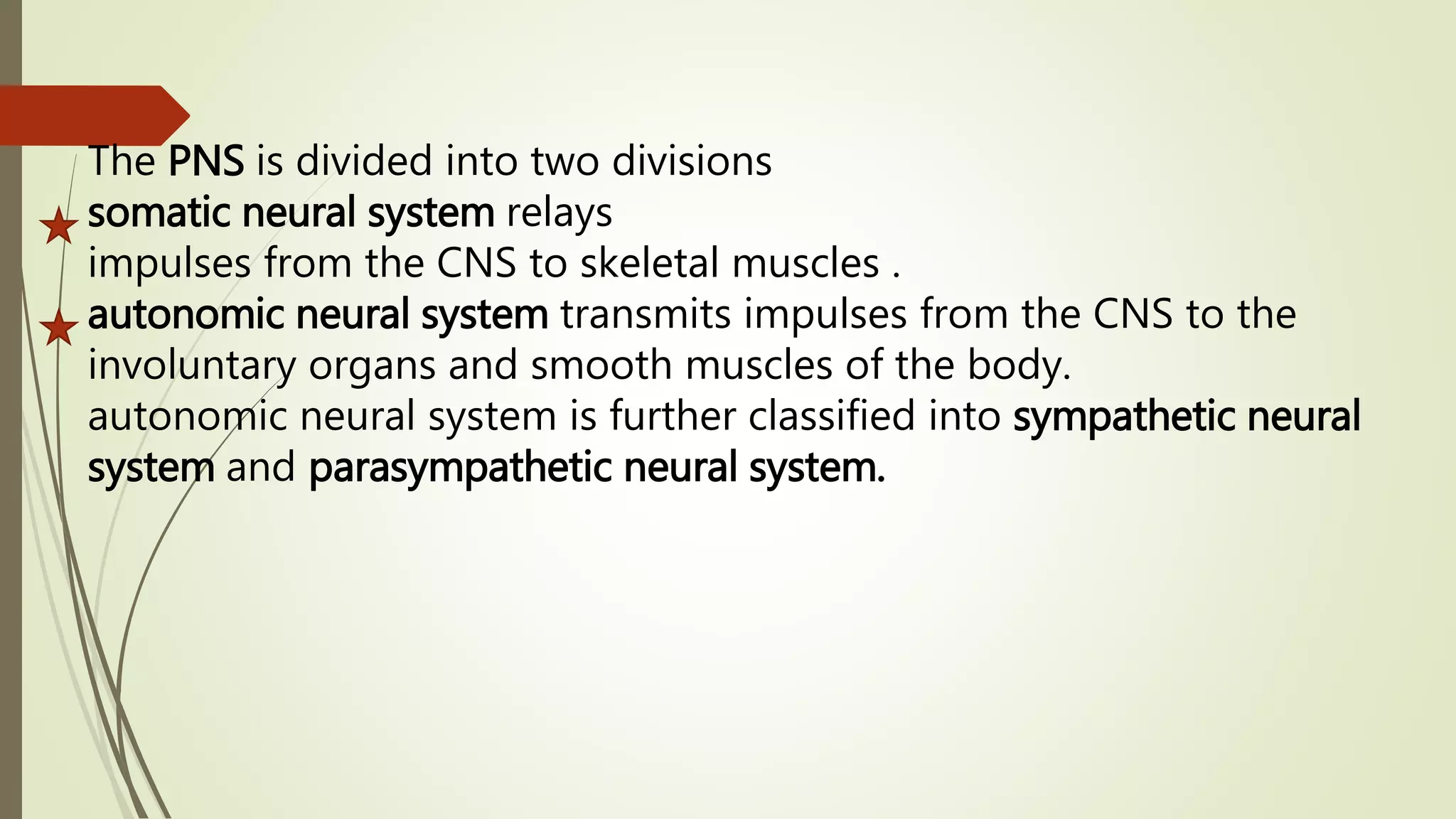
The PNS is divided into two divisions
somatic neural system relays
impulses from the CNS to skeletal muscles .
autonomic neural system transmits impulses from the CNS to the
involuntary organs and smooth muscles of the body.
autonomic neural system is further classified into sympathetic neural
system and parasympathetic neural system.
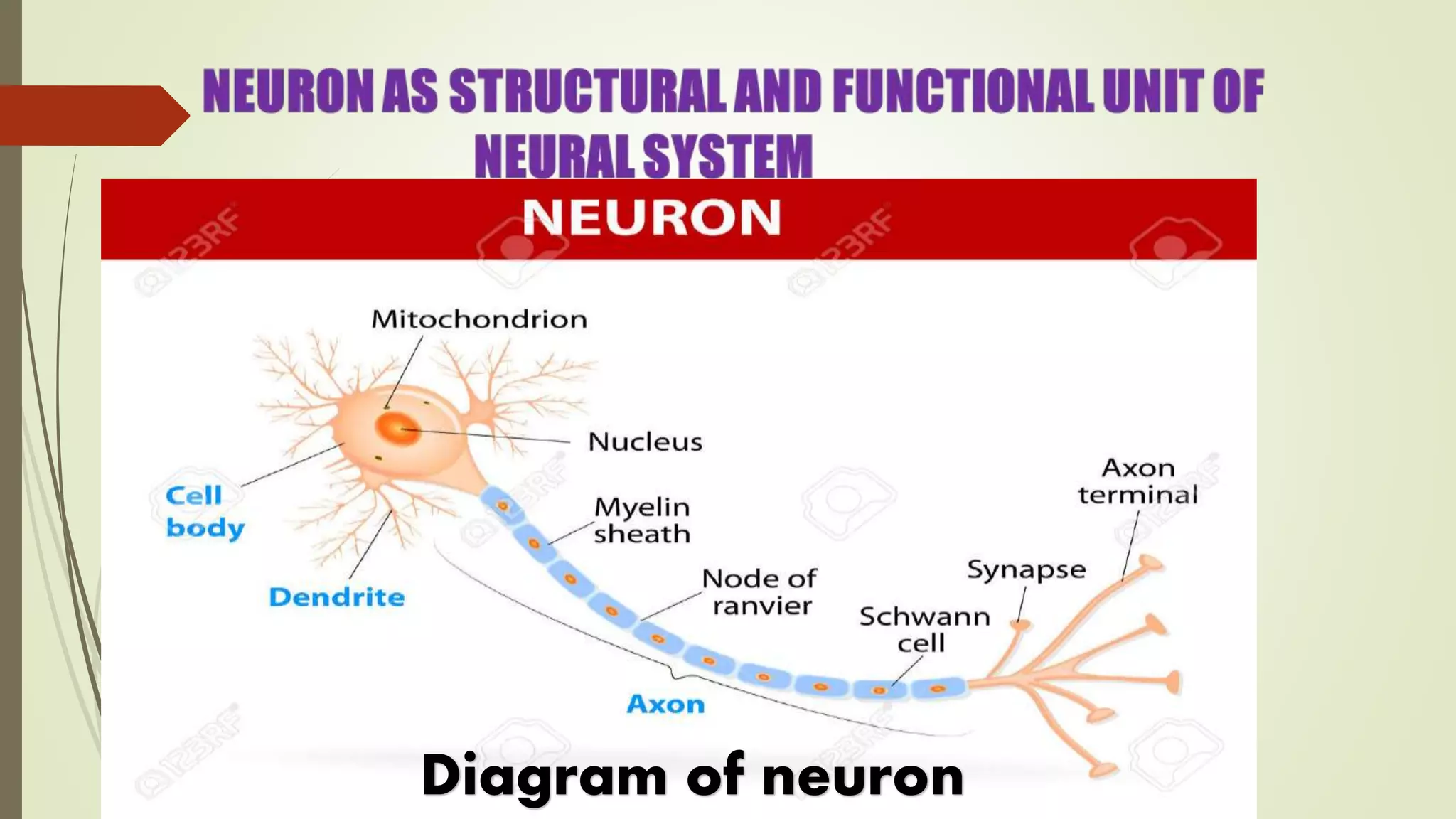
Diagram of neuron
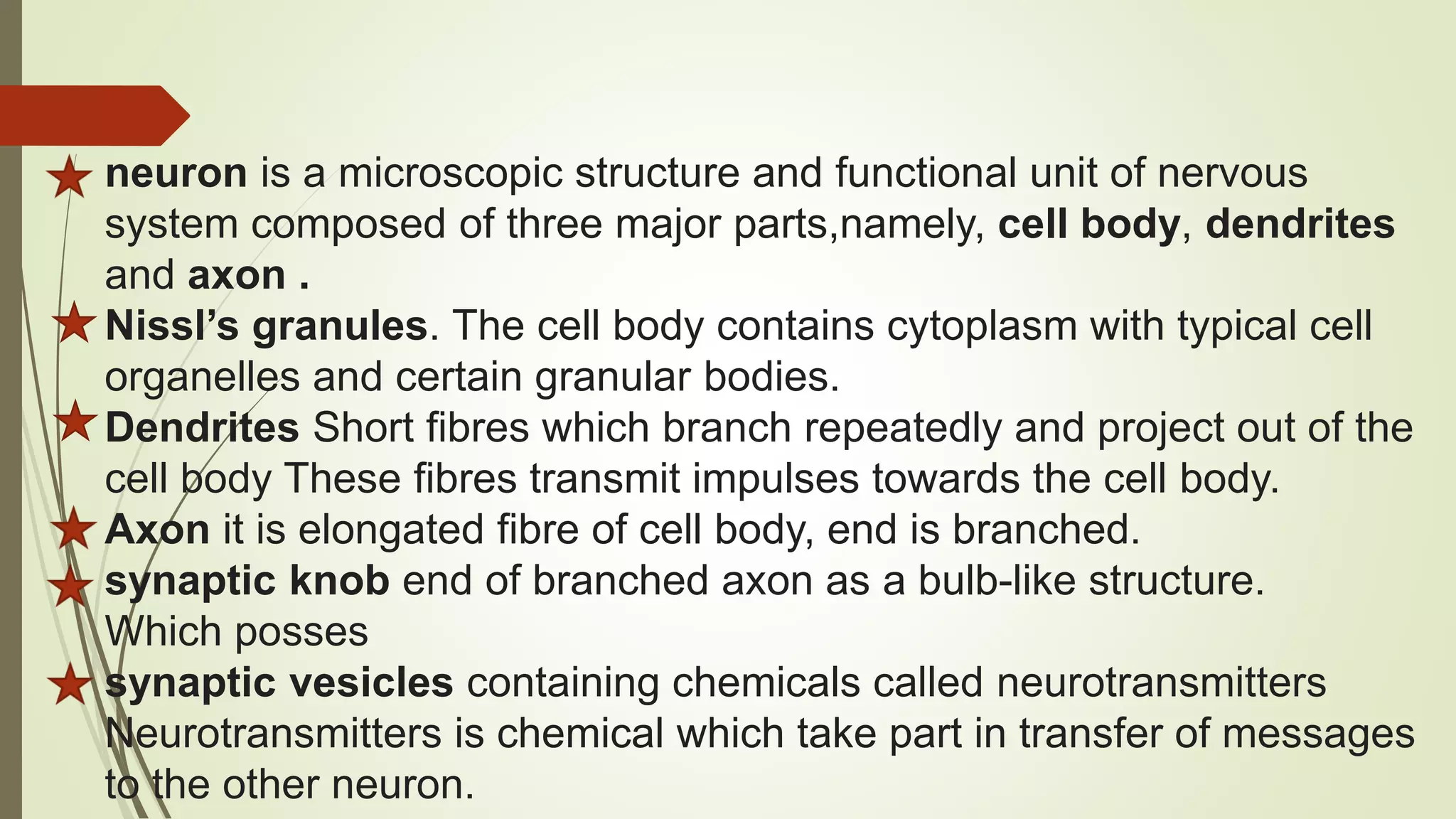
neuron is a microscopic structure and functional unit of nervous
system composed of three major parts,namely, cell body, dendrites
and axon .
Nissl’s granules. The cell body contains cytoplasm with typical cell
organelles and certain granular bodies.
Dendrites Short fibres which branch repeatedly and project out of the
cell body These fibres transmit impulses towards the cell body.
Axon it is elongated fibre of cell body, end is branched.
synaptic knob end of branched axon as a bulb-like structure.
Which posses
synaptic vesicles containing chemicals called neurotransmitters
Neurotransmitters is chemical which take part in transfer of messages
to the other neuron.
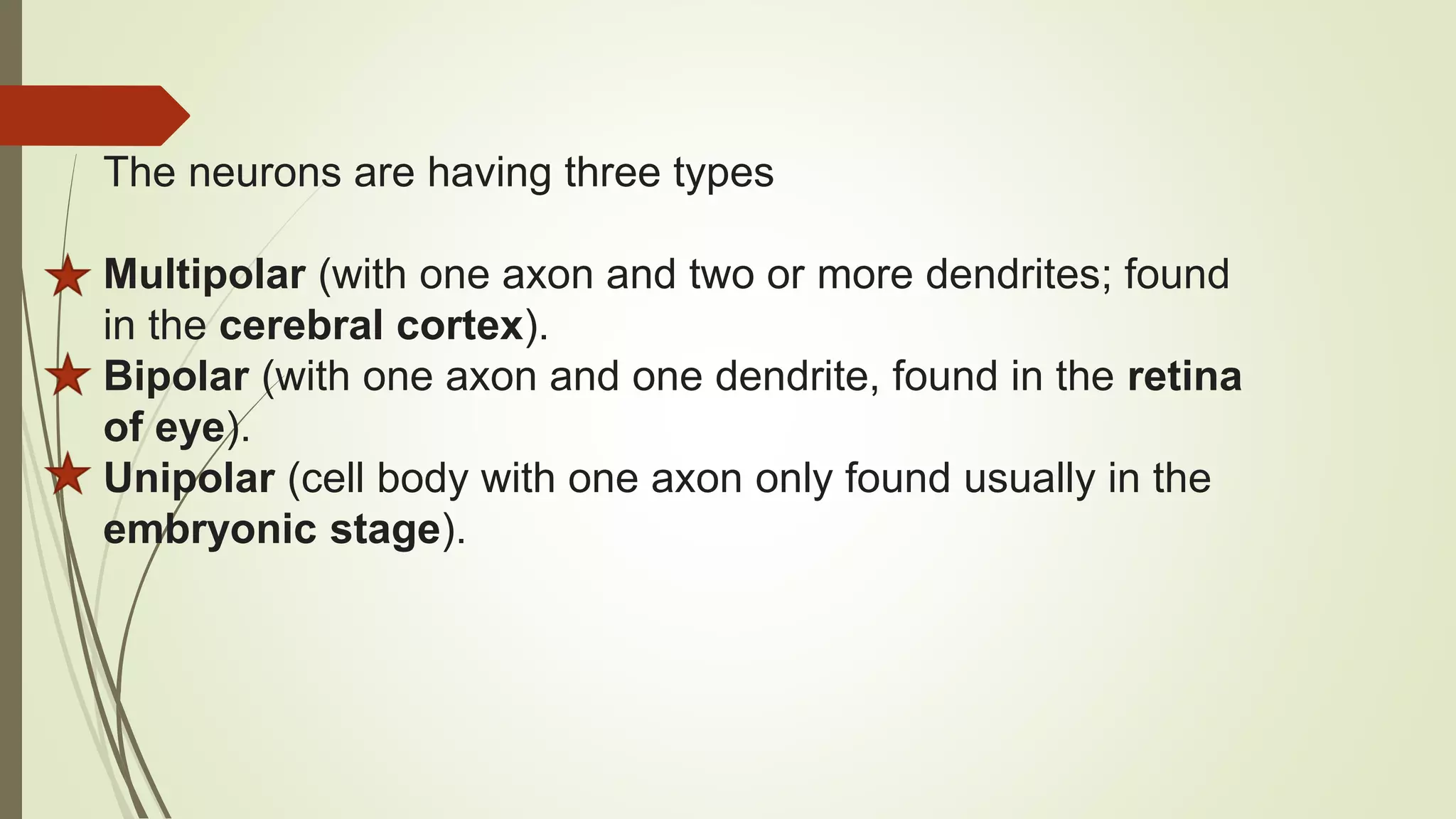
The neurons are having three types
Multipolar (with one axon and two or more dendrites; found
in the cerebral cortex).
Bipolar (with one axon and one dendrite, found in the retina
of eye).
Unipolar (cell body with one axon only found usually in the
embryonic stage).
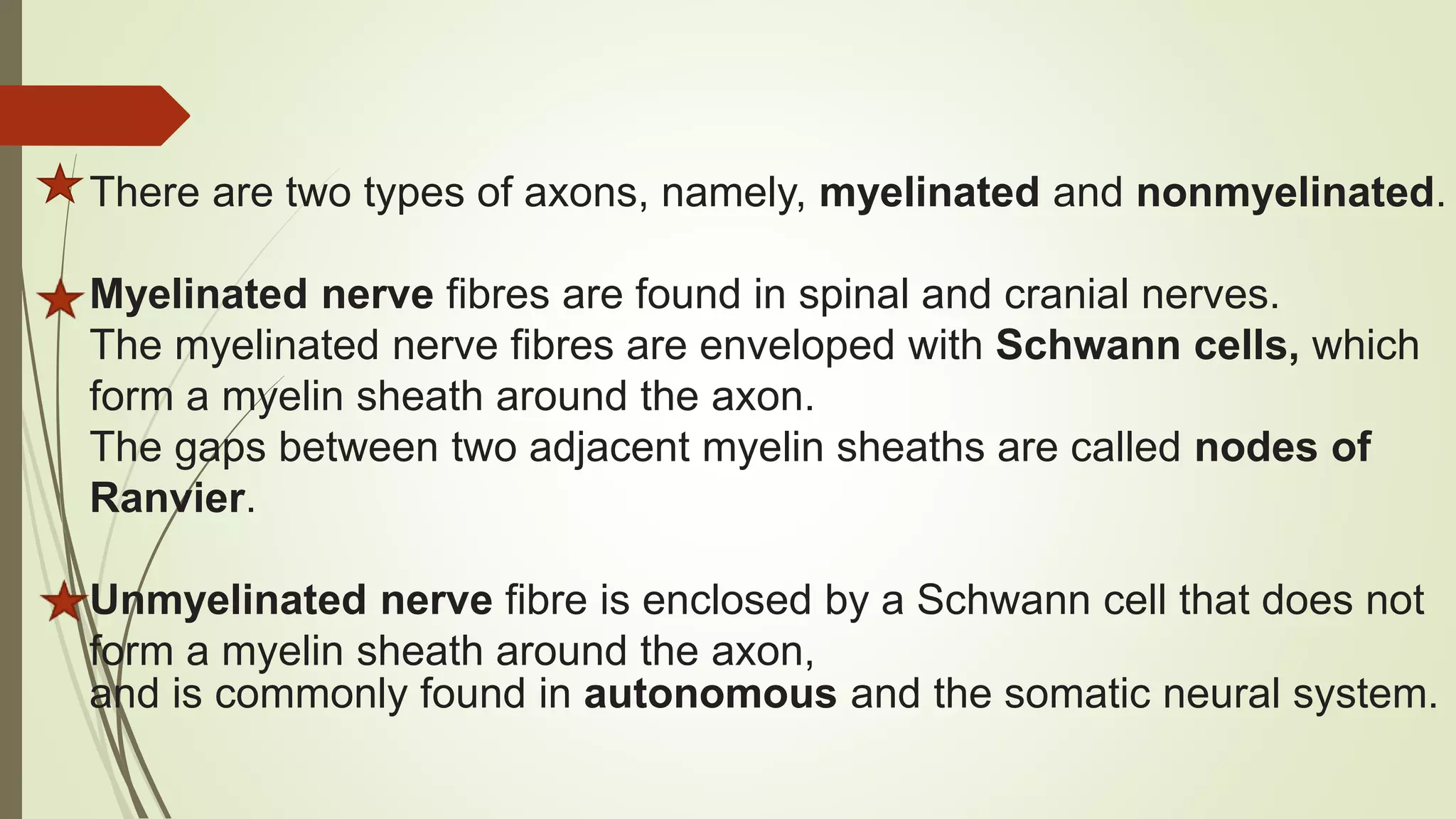
There are two types of axons, namely, myelinated and nonmyelinated.
Myelinated nerve fibres are found in spinal and cranial nerves.
The myelinated nerve fibres are enveloped with Schwann cells, which
form a myelin sheath around the axon.
The gaps between two adjacent myelin sheaths are called nodes of
Ranvier.
Unmyelinated nerve fibre is enclosed by a Schwann cell that does not
form a myelin sheath around the axon,
and is commonly found in autonomous and the somatic neural system.
21.3.1 Generation and Conduction of
Nerve Impulse
Neurons are excitable cells because their membranes are in a
polarised state.
Different types of ion channels are present on the neural membrane.
These ion channels are selectively permeable to different ions.
There are two types of state potential
1.The electrical
potential difference across the resting plasma membrane is called as the
resting potential.
2.The electrical potential
difference across the plasma membrane at the site A is called the
action potential.
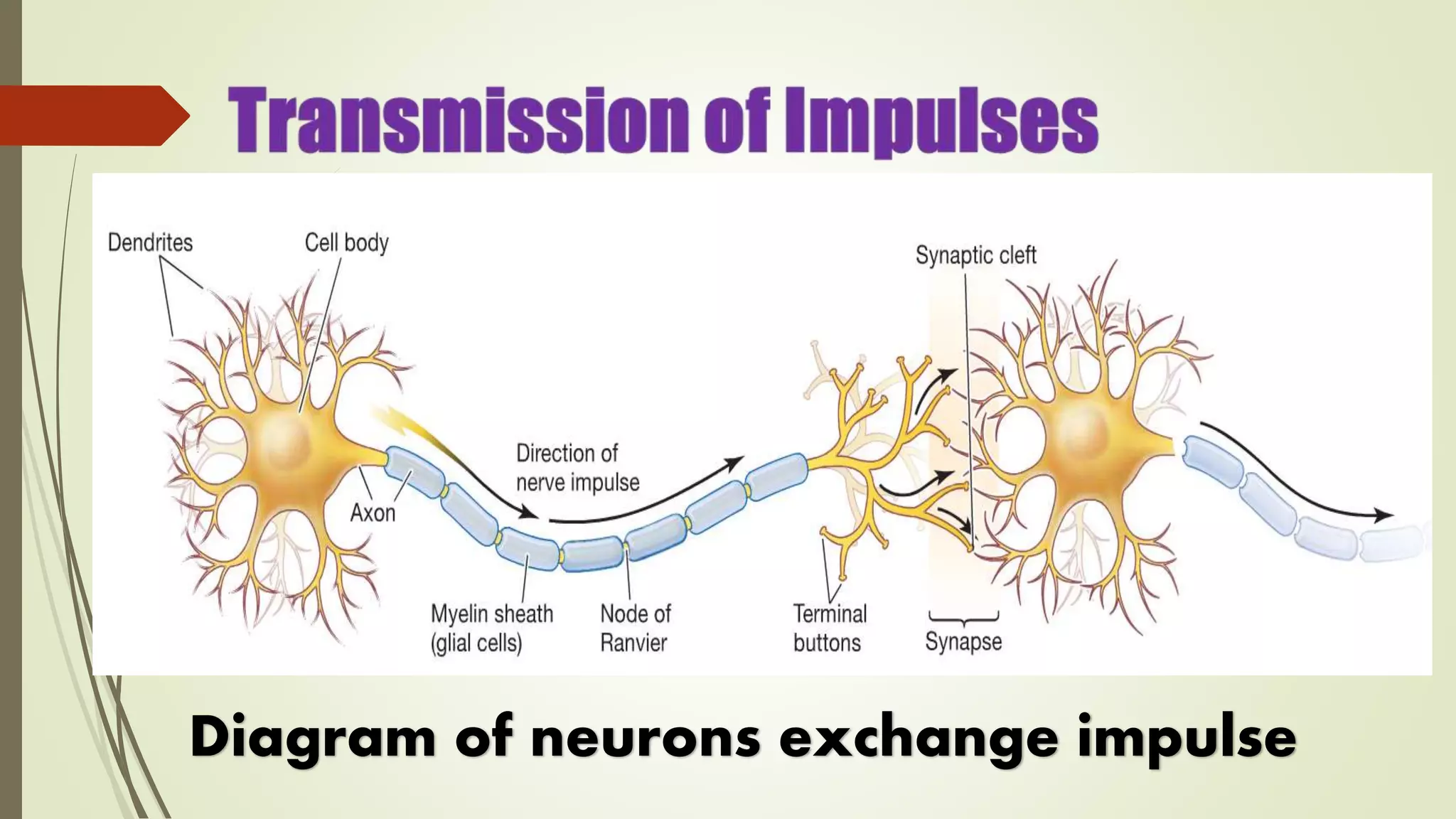
Diagram of neurons exchange impulse
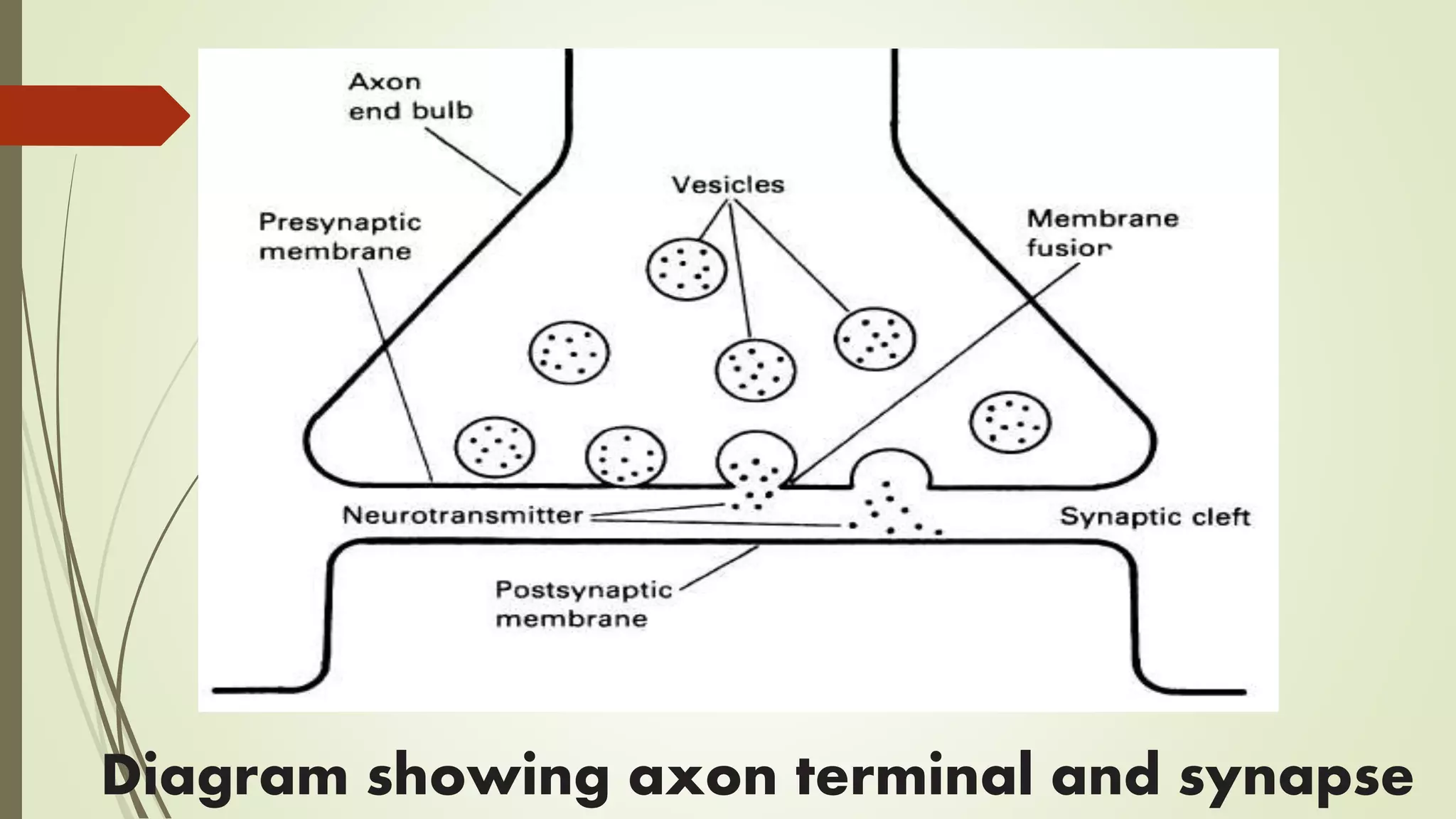
Diagram showing axon terminal and synapse
21.3.2 Transmission of Impulses
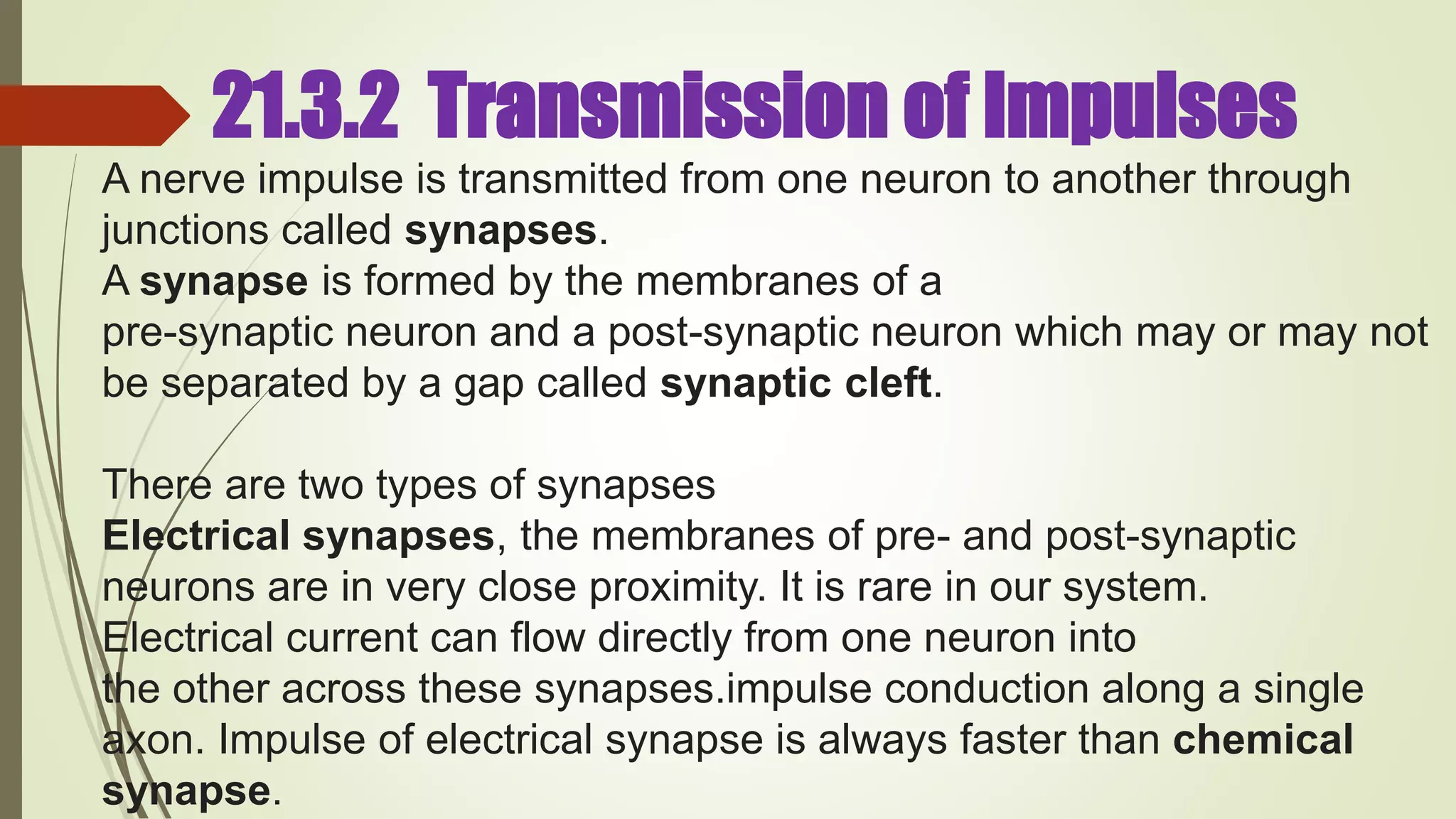
A nerve impulse is transmitted from one neuron to another through
junctions called synapses.
A synapse is formed by the membranes of a
pre-synaptic neuron and a post-synaptic neuron which may or may not
be separated by a gap called synaptic cleft.
There are two types of synapses
Electrical synapses, the membranes of pre- and post-synaptic
neurons are in very close proximity. It is rare in our system.
Electrical current can flow directly from one neuron into
the other across these synapses.impulse conduction along a single
axon. Impulse of electrical synapse is always faster than chemical
synapse.
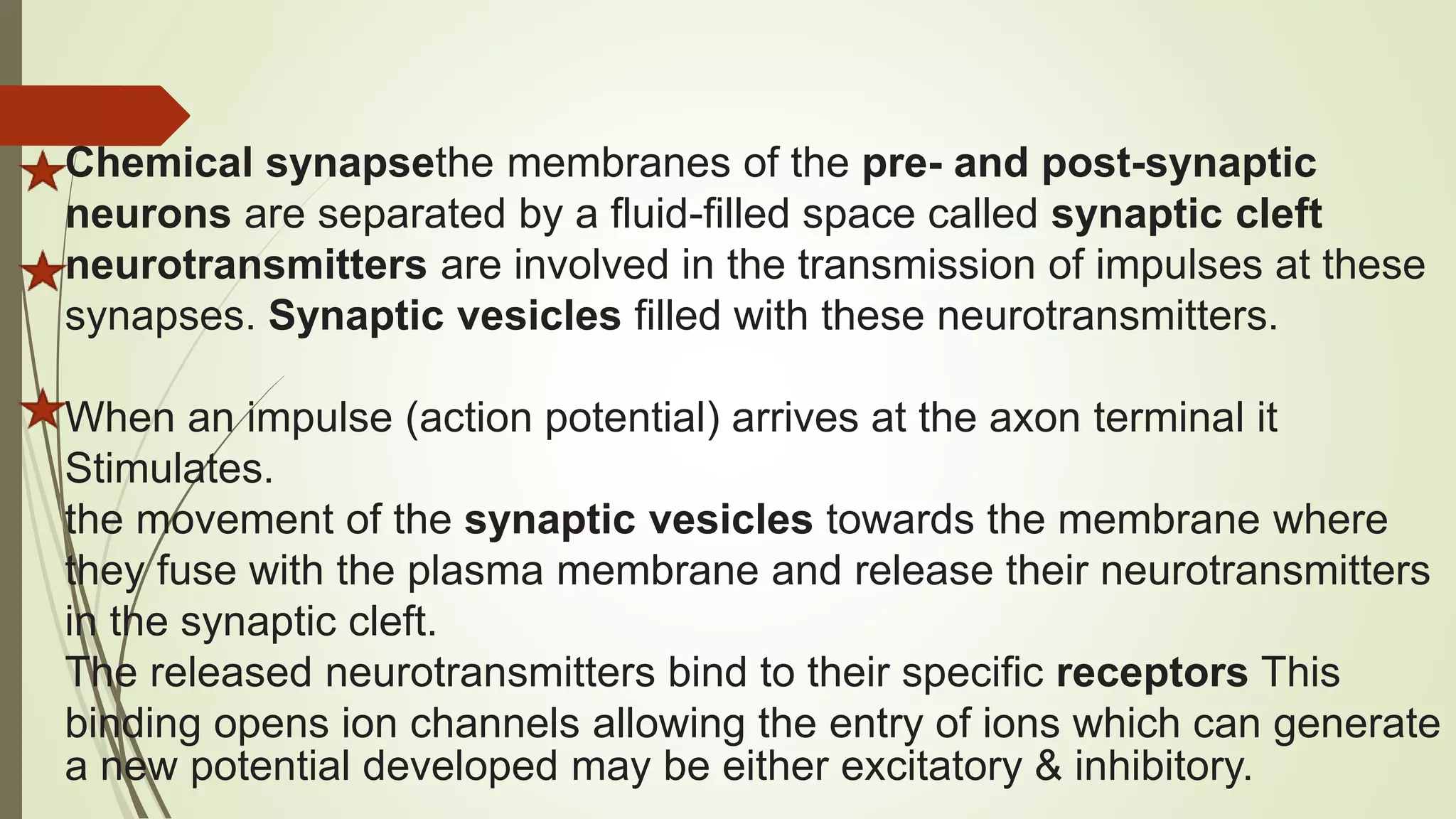
Chemical synapsethe membranes of the pre- and post-synaptic
neurons are separated by a fluid-filled space called synaptic cleft
neurotransmitters are involved in the transmission of impulses at these
synapses. Synaptic vesicles filled with these neurotransmitters.
When an impulse (action potential) arrives at the axon terminal it
Stimulates.
the movement of the synaptic vesicles towards the membrane where
they fuse with the plasma membrane and release their neurotransmitters
in the synaptic cleft.
The released neurotransmitters bind to their specific receptors This
binding opens ion channels allowing the entry of ions which can generate
a new potential developed may be either excitatory & inhibitory.
21.4 CENTRAL NEURAL SYSTEM
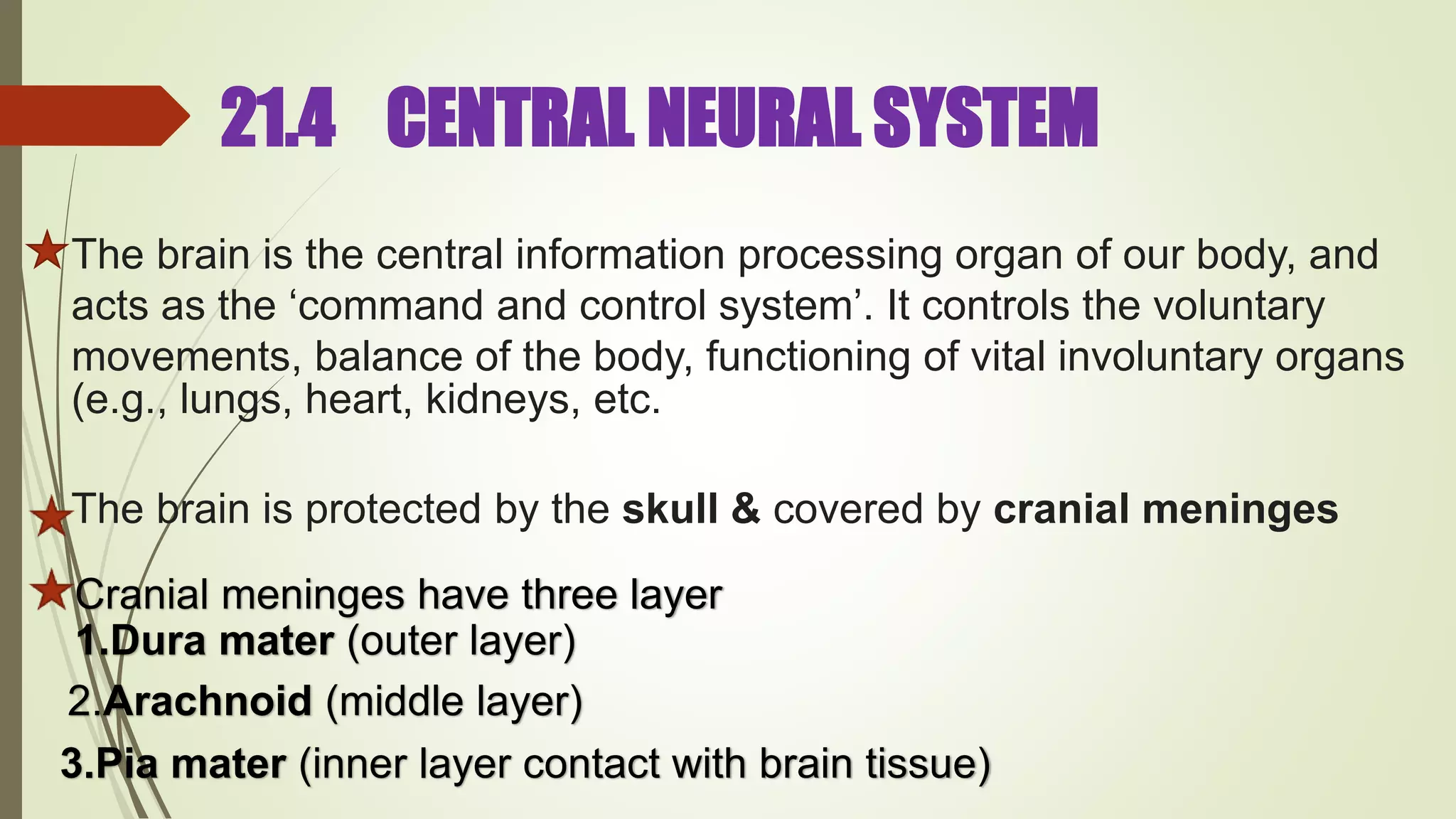
The brain is the central information processing organ of our body, and
acts as the ‘command and control system’. It controls the voluntary
movements, balance of the body, functioning of vital involuntary organs
(e.g., lungs, heart, kidneys, etc.
The brain is protected by the skull & covered by cranial meninges
Cranial meninges have three layer
1.Dura mater (outer layer)
2.Arachnoid (middle layer)
3.Pia mater (inner layer contact with brain tissue)
Brain
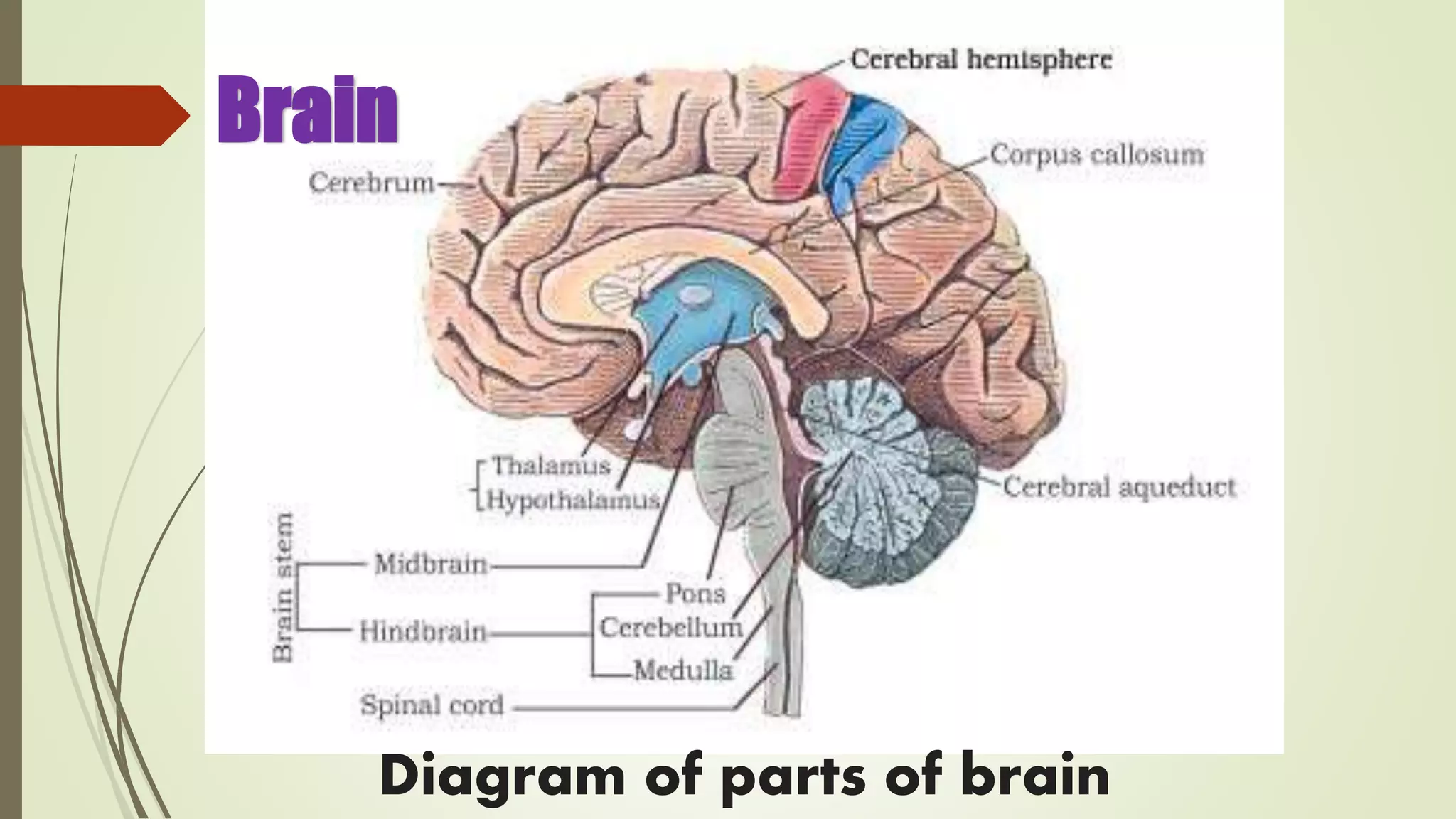
Diagram of parts of brain
Brain have three parts:-
Forebrain
They have three main part cerebrum, thalamus, hypothalamus
the cerebrum longitudinally into two halves, which are termed as
the left and right cerebral hemispheres.
they are connected by a tract of nerve fibres called corpus callosum.
The layer of cells which covers the cerebral hemisphere is called
cerebral cortex.
The cerebral cortex is referred to as the grey matter
due to its greyish appearance due to concentration of neuron.it contain
Motor,sensory areas and lager areas.
These regions called as the association areas are responsible
for complex functions like intersensory associations, memory and
communication.
Fibres of the tracts are covered with the myelin sheath inner part of
cerebral hemisphere an opaque white appearance layerwhite matter.
The cerebrum wraps around a structure called thalamus, which is a
majorcoordinating centre for sensory and motor signaling.
hypothalamus lies at the base of the thalamus. It contains a number of
centres which control body temperature, urge for eating and drinking.
It also contains several groups of neurosecretory cells, which secrete
hormones called hypothalamic hormones. the hypothalamus, it is
involved in the regulation of sexual behaviour, expression of emotional
reactions.
21.4.2 Midbrain
Midbrain located b/w the thalamus/hypothalamus.
A canal called the cerebral aqueduct passess through the midbrain.
The dorsal portion of the midbrain consists mainly of four round
swellings (lobes) called corpora quadrigemina.
Midbrain and hindbrain form the brain stem.
Pons consists of fibre tracts that interconnect different
regions of the brain.
Cerebellum has very convoluted surface theyprovide extra space for
many neurons.
Medulla of the brain is connected to the spinal cord.it control involuntary
action.
21.4.3 Hindbrain
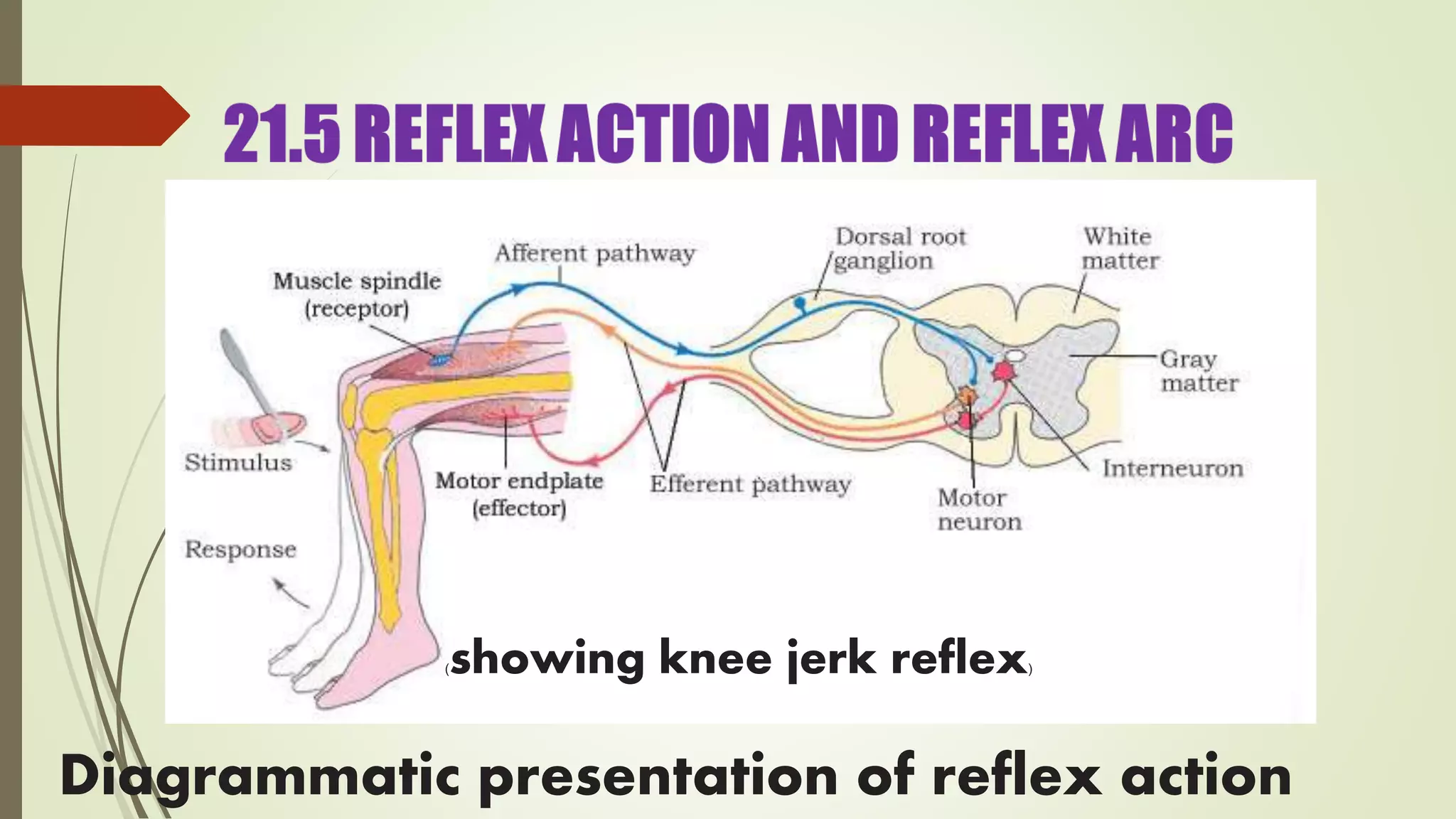
Diagrammatic presentation of reflex action
(showing knee jerk reflex)
The entire process of response to a peripheral nervous stimulation, that
occurs involuntarily,without requires the involvment of a part of the
central nervous system is called a reflex action.
The reflex pathway comprises at least one afferent neuron (receptor)
and one efferent (effector or excitor) neuron appropriately arranged in a
series is called reflex arc.
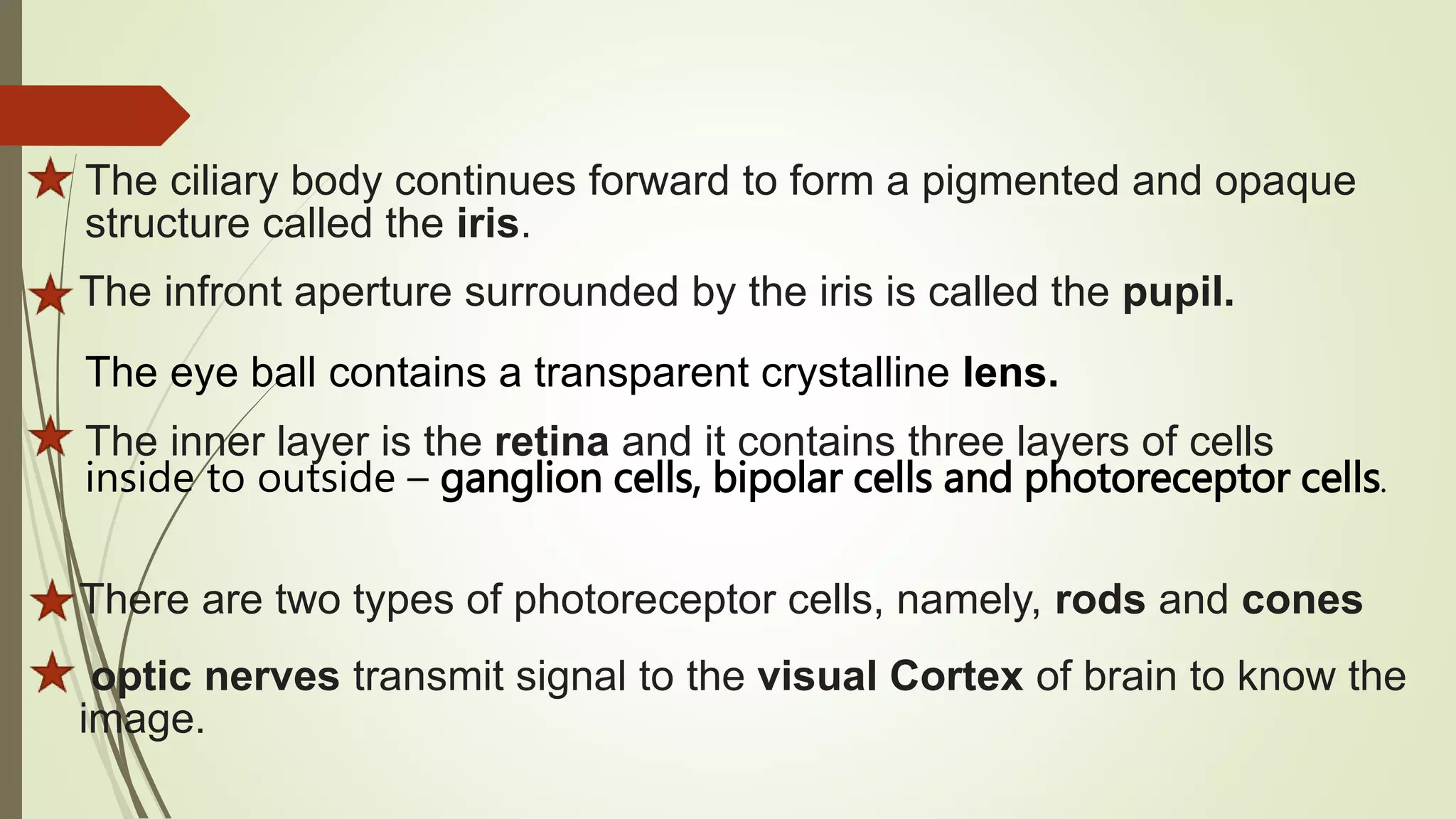
Diagrammatic presentation of eye
21.6.1 EYE
Our paired eyes are located in sockets of the skull called orbits
The wall of the eye ball have three layers .
Sclera is external layer is composed of a dense connective tissue
choroid the middle layer contains many blood vessels and looks
bluish in colour. it becomes thick in the anterior part to form the
ciliary body.
cornea is the anterior portion of this layer.
1.
2.
3.
The ciliary body continues forward to form a pigmented and opaque
structure called the iris.
The eye ball contains a transparent crystalline lens.
The infront aperture surrounded by the iris is called the pupil.
The inner layer is the retina and it contains three layers of cells
inside to outside – ganglion cells, bipolar cells and photoreceptor cells.
There are two types of photoreceptor cells, namely, rods and cones
optic nerves transmit signal to the visual Cortex of brain to know the
image.
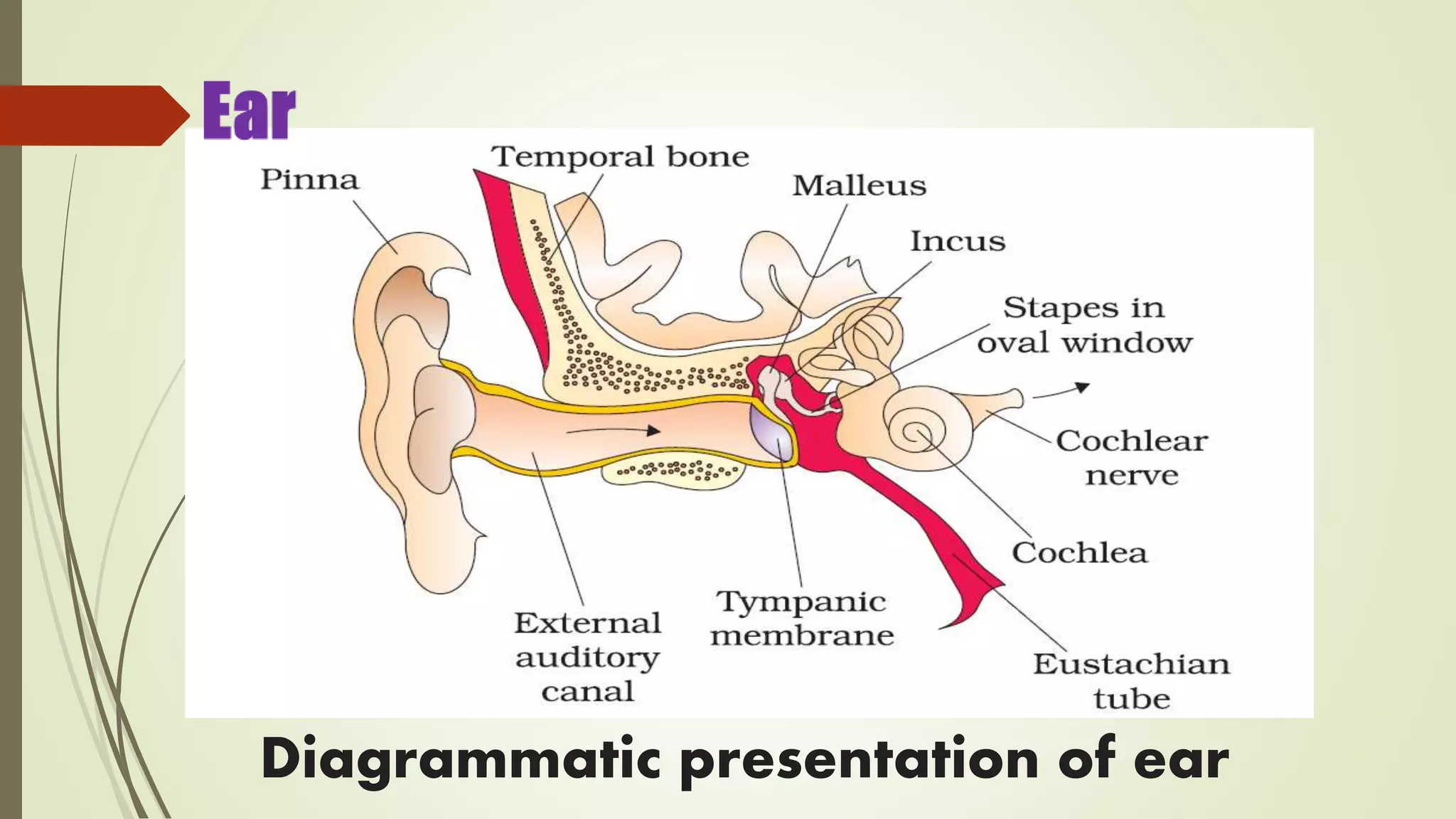
Diagrammatic presentation of ear
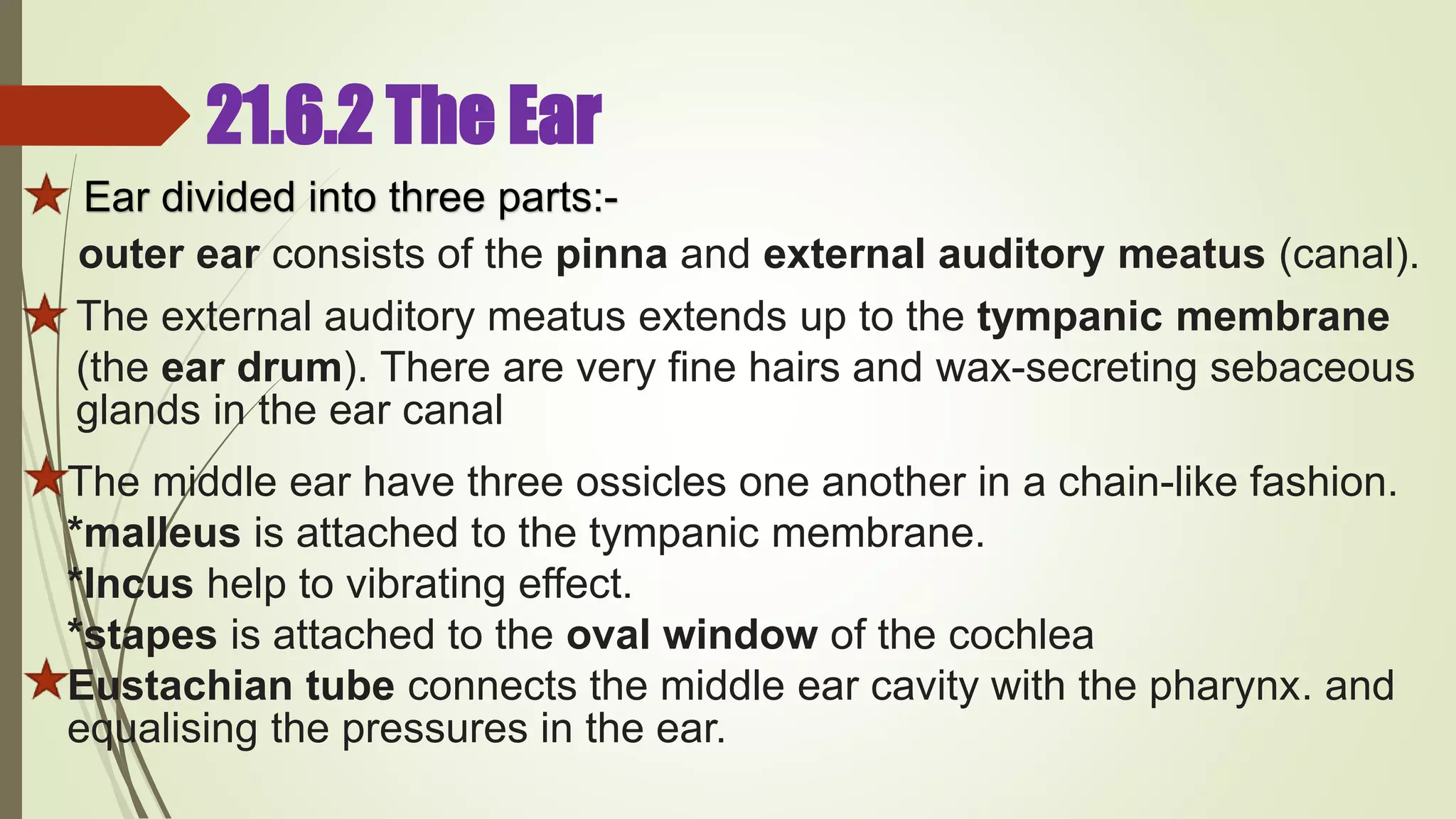
21.6.2 The Ear
Ear divided into three parts:-
outer ear consists of the pinna and external auditory meatus (canal).
The external auditory meatus extends up to the tympanic membrane
(the ear drum). There are very fine hairs and wax-secreting sebaceous
glands in the ear canal
The middle ear have three ossicles one another in a chain-like fashion.
*malleus is attached to the tympanic membrane.
*Incus help to vibrating effect.
*stapes is attached to the oval window of the cochlea
Eustachian tube connects the middle ear cavity with the pharynx. and
equalising the pressures in the ear.
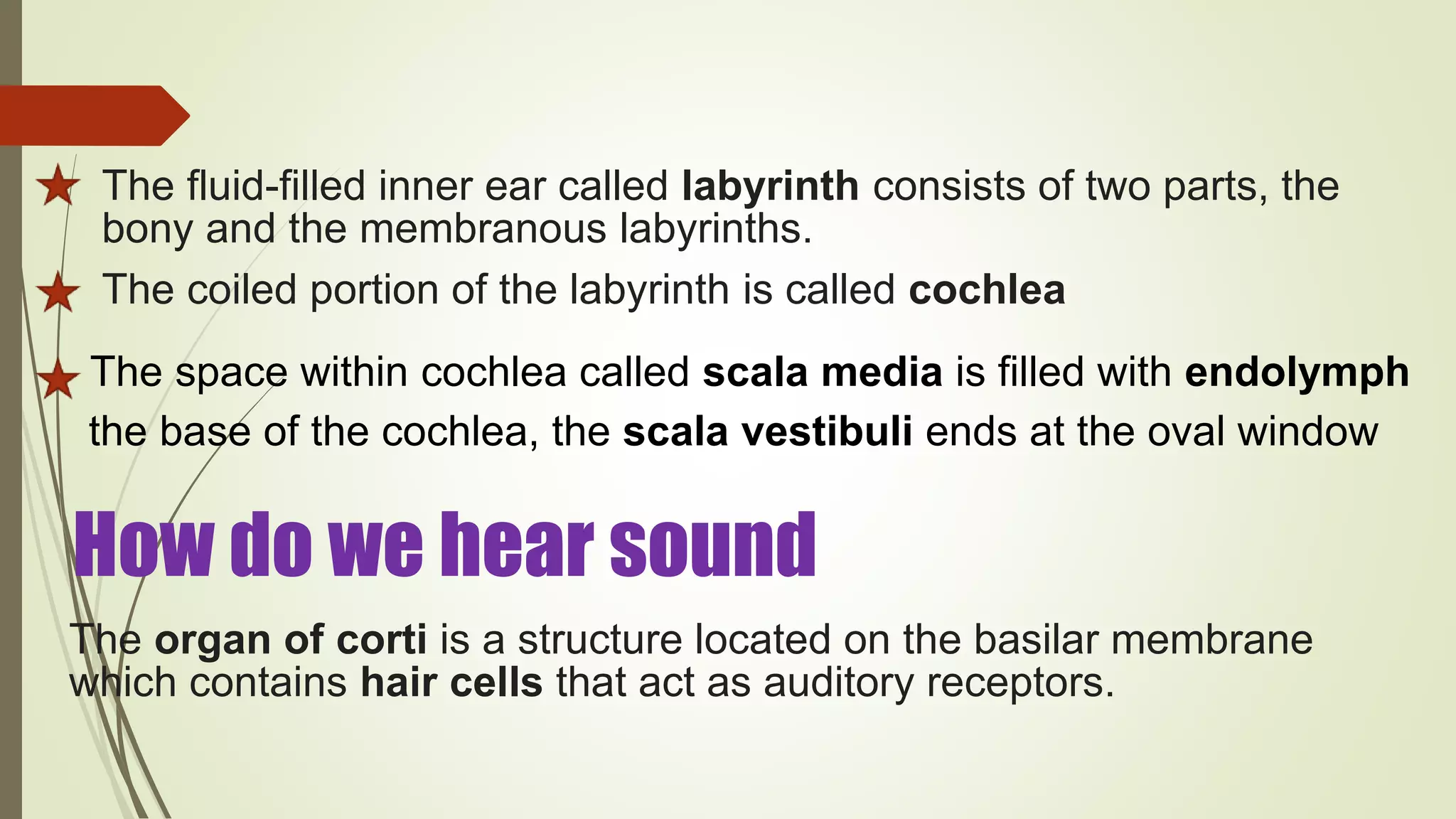
The fluid-filled inner ear called labyrinth consists of two parts, the
bony and the membranous labyrinths.
The coiled portion of the labyrinth is called cochlea
The space within cochlea called scala media is filled with endolymph
the base of the cochlea, the scala vestibuli ends at the oval window
The organ of corti is a structure located on the basilar membrane
which contains hair cells that act as auditory receptors.
How do we hear sound
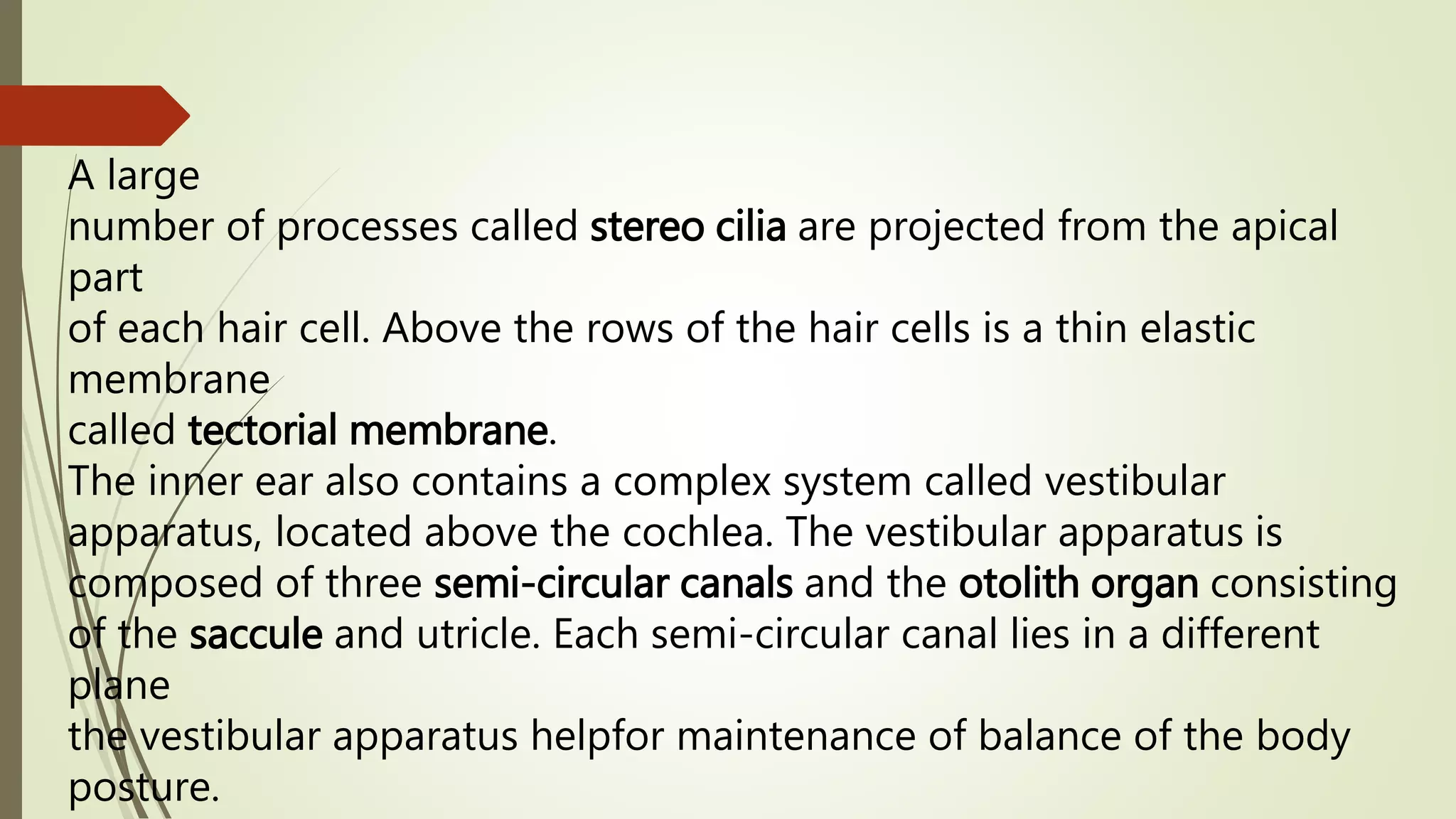
A large
number of processes called stereo cilia are projected from the apical
part
of each hair cell. Above the rows of the hair cells is a thin elastic
membrane
called tectorial membrane.
The inner ear also contains a complex system called vestibular
apparatus, located above the cochlea. The vestibular apparatus is
composed of three semi-circular canals and the otolith organ consisting
of the saccule and utricle. Each semi-circular canal lies in a different
plane
the vestibular apparatus helpfor maintenance of balance of the body
posture.
THANKYOU
FOR VEIWING
Made by Manishpal

Neural control and coordination ppt presentation class 11 biology ncert based

  • 1.
  • 2.
    NAME- MANISH PAL CLASS-XI-A SUB - BIOLGOY TEACHER- POOJA MADAM SRI LAL CONVENT SEN. SEC. SCHOOL
  • 3.
  • 4.
    Coordination is theprocess through which two or more organs interact and complement the functions of one another. For example, when we do physical exercises,all body part work with coordinate. neural system and the endocrine system jointly coordinate and integrate all the activities of the organs so that they function in a Synchronised Fashion.
  • 5.
  • 6.
    NEURAL SYSTEM The neuralsystem of all animals is composed of highly specialised cells called neurons which can detect, receive and transmit different kinds of stimuli. The neural organisation is very simple in lower invertebrates. For example, in Hydra it is composed of a network of neurons. The neural system is better organised in insects, where a brain is present along with a number of ganglia and neural tissues. The vertebrates have a more developed neural system.
  • 7.
    neural system isdivided into two parts : (i) central neural system (CNS) (ii) peripheral neural system (PNS) The CNS includes the brain and the spinal The PNS comprises of all the nerves of the body associated with the CNS. nerve fibres of the PNS are of two types : (a) afferent fibres those nerve sense stumilus, transfer message from sensory neuron to pns. (b) efferent fibres those nerve take, message to motor neuron.
  • 8.
    The PNS isdivided into two divisions somatic neural system relays impulses from the CNS to skeletal muscles . autonomic neural system transmits impulses from the CNS to the involuntary organs and smooth muscles of the body. autonomic neural system is further classified into sympathetic neural system and parasympathetic neural system.
  • 9.
  • 10.
    neuron is amicroscopic structure and functional unit of nervous system composed of three major parts,namely, cell body, dendrites and axon . Nissl’s granules. The cell body contains cytoplasm with typical cell organelles and certain granular bodies. Dendrites Short fibres which branch repeatedly and project out of the cell body These fibres transmit impulses towards the cell body. Axon it is elongated fibre of cell body, end is branched. synaptic knob end of branched axon as a bulb-like structure. Which posses synaptic vesicles containing chemicals called neurotransmitters Neurotransmitters is chemical which take part in transfer of messages to the other neuron.
  • 11.
    The neurons arehaving three types Multipolar (with one axon and two or more dendrites; found in the cerebral cortex). Bipolar (with one axon and one dendrite, found in the retina of eye). Unipolar (cell body with one axon only found usually in the embryonic stage).
  • 12.
    There are twotypes of axons, namely, myelinated and nonmyelinated. Myelinated nerve fibres are found in spinal and cranial nerves. The myelinated nerve fibres are enveloped with Schwann cells, which form a myelin sheath around the axon. The gaps between two adjacent myelin sheaths are called nodes of Ranvier. Unmyelinated nerve fibre is enclosed by a Schwann cell that does not form a myelin sheath around the axon, and is commonly found in autonomous and the somatic neural system.
  • 13.
    21.3.1 Generation andConduction of Nerve Impulse Neurons are excitable cells because their membranes are in a polarised state. Different types of ion channels are present on the neural membrane. These ion channels are selectively permeable to different ions.
  • 14.
    There are twotypes of state potential 1.The electrical potential difference across the resting plasma membrane is called as the resting potential. 2.The electrical potential difference across the plasma membrane at the site A is called the action potential.
  • 15.
    Diagram of neuronsexchange impulse
  • 16.
    Diagram showing axonterminal and synapse
  • 17.
    21.3.2 Transmission ofImpulses A nerve impulse is transmitted from one neuron to another through junctions called synapses. A synapse is formed by the membranes of a pre-synaptic neuron and a post-synaptic neuron which may or may not be separated by a gap called synaptic cleft. There are two types of synapses Electrical synapses, the membranes of pre- and post-synaptic neurons are in very close proximity. It is rare in our system. Electrical current can flow directly from one neuron into the other across these synapses.impulse conduction along a single axon. Impulse of electrical synapse is always faster than chemical synapse.
  • 18.
    Chemical synapsethe membranesof the pre- and post-synaptic neurons are separated by a fluid-filled space called synaptic cleft neurotransmitters are involved in the transmission of impulses at these synapses. Synaptic vesicles filled with these neurotransmitters. When an impulse (action potential) arrives at the axon terminal it Stimulates. the movement of the synaptic vesicles towards the membrane where they fuse with the plasma membrane and release their neurotransmitters in the synaptic cleft. The released neurotransmitters bind to their specific receptors This binding opens ion channels allowing the entry of ions which can generate a new potential developed may be either excitatory & inhibitory.
  • 19.
    21.4 CENTRAL NEURALSYSTEM The brain is the central information processing organ of our body, and acts as the ‘command and control system’. It controls the voluntary movements, balance of the body, functioning of vital involuntary organs (e.g., lungs, heart, kidneys, etc. The brain is protected by the skull & covered by cranial meninges Cranial meninges have three layer 1.Dura mater (outer layer) 2.Arachnoid (middle layer) 3.Pia mater (inner layer contact with brain tissue)
  • 20.
  • 21.
    Brain have threeparts:- Forebrain They have three main part cerebrum, thalamus, hypothalamus the cerebrum longitudinally into two halves, which are termed as the left and right cerebral hemispheres. they are connected by a tract of nerve fibres called corpus callosum. The layer of cells which covers the cerebral hemisphere is called cerebral cortex. The cerebral cortex is referred to as the grey matter due to its greyish appearance due to concentration of neuron.it contain Motor,sensory areas and lager areas. These regions called as the association areas are responsible for complex functions like intersensory associations, memory and communication.
  • 22.
    Fibres of thetracts are covered with the myelin sheath inner part of cerebral hemisphere an opaque white appearance layerwhite matter. The cerebrum wraps around a structure called thalamus, which is a majorcoordinating centre for sensory and motor signaling. hypothalamus lies at the base of the thalamus. It contains a number of centres which control body temperature, urge for eating and drinking. It also contains several groups of neurosecretory cells, which secrete hormones called hypothalamic hormones. the hypothalamus, it is involved in the regulation of sexual behaviour, expression of emotional reactions.
  • 23.
    21.4.2 Midbrain Midbrain locatedb/w the thalamus/hypothalamus. A canal called the cerebral aqueduct passess through the midbrain. The dorsal portion of the midbrain consists mainly of four round swellings (lobes) called corpora quadrigemina. Midbrain and hindbrain form the brain stem. Pons consists of fibre tracts that interconnect different regions of the brain. Cerebellum has very convoluted surface theyprovide extra space for many neurons. Medulla of the brain is connected to the spinal cord.it control involuntary action. 21.4.3 Hindbrain
  • 24.
    Diagrammatic presentation ofreflex action (showing knee jerk reflex)
  • 25.
    The entire processof response to a peripheral nervous stimulation, that occurs involuntarily,without requires the involvment of a part of the central nervous system is called a reflex action. The reflex pathway comprises at least one afferent neuron (receptor) and one efferent (effector or excitor) neuron appropriately arranged in a series is called reflex arc.
  • 26.
  • 27.
    21.6.1 EYE Our pairedeyes are located in sockets of the skull called orbits The wall of the eye ball have three layers . Sclera is external layer is composed of a dense connective tissue choroid the middle layer contains many blood vessels and looks bluish in colour. it becomes thick in the anterior part to form the ciliary body. cornea is the anterior portion of this layer. 1. 2. 3.
  • 28.
    The ciliary bodycontinues forward to form a pigmented and opaque structure called the iris. The eye ball contains a transparent crystalline lens. The infront aperture surrounded by the iris is called the pupil. The inner layer is the retina and it contains three layers of cells inside to outside – ganglion cells, bipolar cells and photoreceptor cells. There are two types of photoreceptor cells, namely, rods and cones optic nerves transmit signal to the visual Cortex of brain to know the image.
  • 29.
  • 30.
    21.6.2 The Ear Eardivided into three parts:- outer ear consists of the pinna and external auditory meatus (canal). The external auditory meatus extends up to the tympanic membrane (the ear drum). There are very fine hairs and wax-secreting sebaceous glands in the ear canal The middle ear have three ossicles one another in a chain-like fashion. *malleus is attached to the tympanic membrane. *Incus help to vibrating effect. *stapes is attached to the oval window of the cochlea Eustachian tube connects the middle ear cavity with the pharynx. and equalising the pressures in the ear.
  • 31.
    The fluid-filled innerear called labyrinth consists of two parts, the bony and the membranous labyrinths. The coiled portion of the labyrinth is called cochlea The space within cochlea called scala media is filled with endolymph the base of the cochlea, the scala vestibuli ends at the oval window The organ of corti is a structure located on the basilar membrane which contains hair cells that act as auditory receptors. How do we hear sound
  • 32.
    A large number ofprocesses called stereo cilia are projected from the apical part of each hair cell. Above the rows of the hair cells is a thin elastic membrane called tectorial membrane. The inner ear also contains a complex system called vestibular apparatus, located above the cochlea. The vestibular apparatus is composed of three semi-circular canals and the otolith organ consisting of the saccule and utricle. Each semi-circular canal lies in a different plane the vestibular apparatus helpfor maintenance of balance of the body posture.
  • 33.