CONTROL AND COORDINATION
Working together of various integrated body systems in response to
changes in the surrounding for the maintenance of bodily functions is
known as control and coordination.
Nervous system and endocrine system provide control and
coordination in animals.
Need Of Control And
Coordination In An imals:
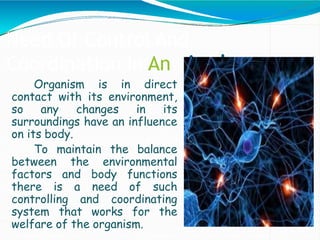
Organism is in direct
contact with its environment,
so any changes in its
surroundings have an influence
on its body.
To maintain the balance
between the environmental
factors and body functions
there is a need of such
controlling and coordinating
system that works for the
welfare of the organism.
1a)
Stimuli :-
The changes in the environment to which living
organisms respond are called stimuli.
Eg :- heat, cold, sound, smell, taste, touch, pressure,
gravity, water etc.
Living organisms respond to stimuli in the form of body
movements.
b) Coordination :-
For a proper response to a stimulus many organs in the
body should work together. The working together of
various organs in an organism to produce a proper
response to a stimulus is called coordination.
i) In animals control and co ordination is done by the
nervous system and endocrine system.
ii)In plants control and co ordination is done by chemical
substances called plant hormones or phytohormones.
2) Coordination in
animals :-
In animals control and co ordination is done by the nervous system
and endocrine system.
The nervous system consists of the brain, spinal cord and nerves.
a) Receptors :- are the sense organs which receive the stimuli and
pass the message to the brain or spinal cord through the sensory
nerves.
Eg :- Photoreceptors in the eyes to detect light.
Phonoreceptors in the ears to detect sound.
Olfactory receptors in the nose to detect smell.
Gustatory receptors in the tongue to detect taste.
Tangoreceptors in the skin to detect touch.
b) Effectors :- are the muscles and glands which respond to the
information from the brain and spinal cord through the motor nerves.
c) Sensory nerves :- are nerves which carry information from the
receptors (sense organs) to the brain and spinal cord.
d) Motor nerves :- are nerves which carry information from thebrain
and spinal cord to the effectors (muscles and glands).
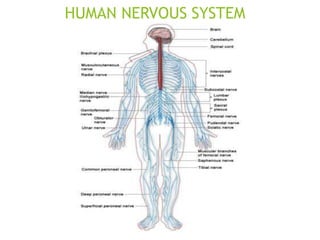
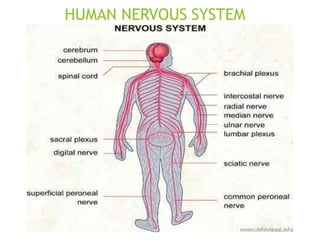
HUMAN NERVOUS SYSTEM
Do you know which organ make up the nervous
system?
The nervous system is made up of the brain ,spinal chord ,and nerve
cells or neurons.
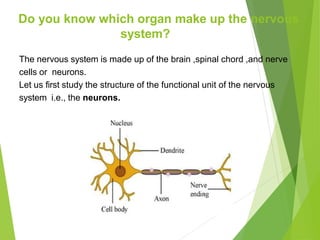
Let us first study the structure of the functional unit of the nervous
system i.e., the neurons.
3) Human nervous
system :-
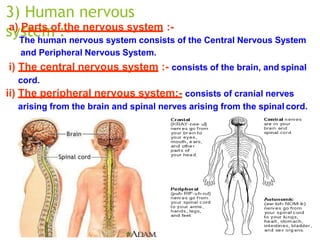
a) Parts of the nervous system :-
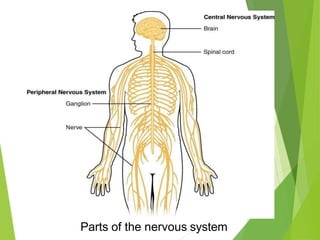
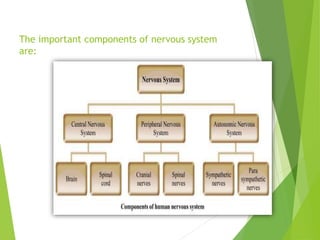
The human nervous system consists of the Central Nervous System
and Peripheral Nervous System.
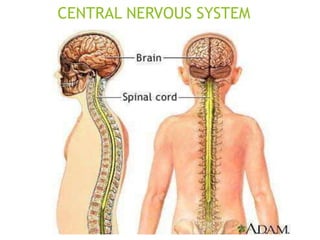
i) The central nervous system :- consists of the brain, and spinal
cord.
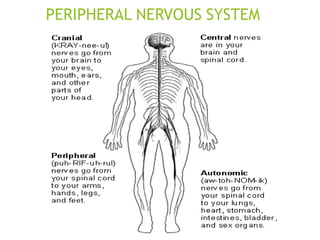
ii) The peripheral nervous system:- consists of cranial nerves
arising from the brain and spinal nerves arising from the spinal cord.
CENTRAL NERVOUS SYSTEM
PERIPHERAL NERVOUS SYSTEM
Parts of the nervous system
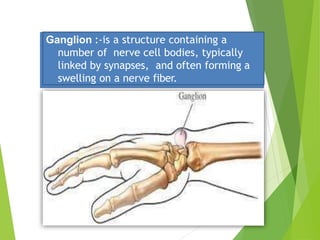
Ganglion :-is a structure containing a
number of nerve cell bodies, typically
linked by synapses, and often forming a
swelling on a nerve fiber.
b) Nerve cell
(Neuron) :-
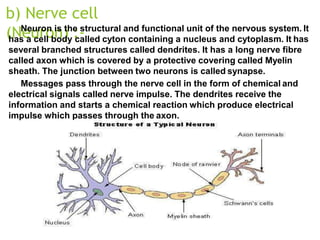
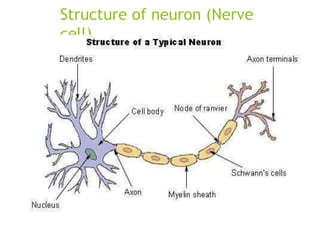
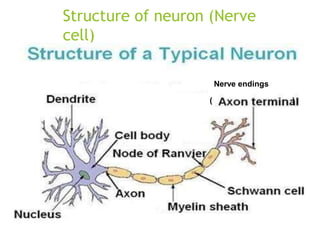
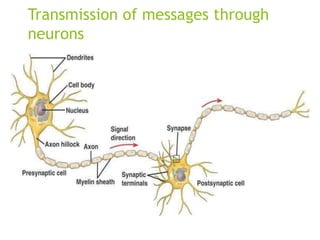
Neuron is the structural and functional unit of the nervous system. It
has a cell body called cyton containing a nucleus and cytoplasm. It has
several branched structures called dendrites. It has a long nerve fibre
called axon which is covered by a protective covering called Myelin
sheath. The junction between two neurons is called synapse.
Messages pass through the nerve cell in the form of chemical and
electrical signals called nerve impulse. The dendrites receive the
information and starts a chemical reaction which produce electrical
impulse which passes through the axon.
Structure of neuron (Nerve
cell)
Structure of neuron (Nerve
cell)
Nerve endings
( )
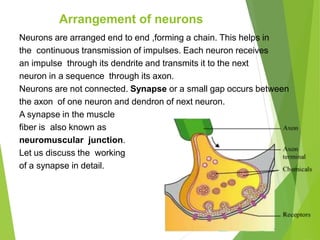
Arrangement of neurons
Neurons are arranged end to end ,forming a chain. This helps in
the continuous transmission of impulses. Each neuron receives
an impulse through its dendrite and transmits it to the next
neuron in a sequence through its axon.
Neurons are not connected. Synapse or a small gap occurs between
the axon of one neuron and dendron of next neuron.
A synapse in the muscle
fiber is also known as
neuromuscular junction.
Let us discuss the working
of a synapse in detail.
Transmission of messages through
neurons
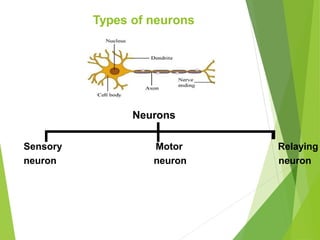
Types of neurons
Neurons
Sensory Motor Relaying
neuron neuron neuron
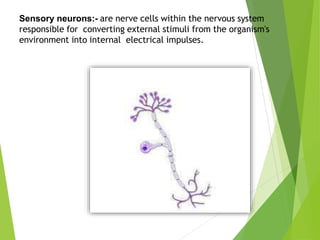
Sensory neurons:- are nerve cells within the nervous system
responsible for converting external stimuli from the organism's
environment into internal electrical impulses.
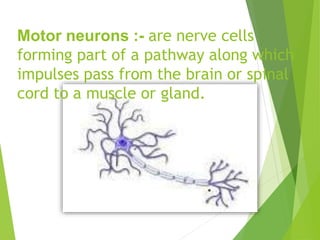
Motor neurons :- are nerve cells
forming part of a pathway along which
impulses pass from the brain or spinal
cord to a muscle or gland.
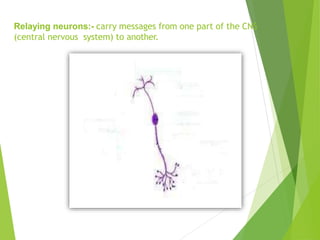
Relaying neurons:- carry messages from one part of the CNS
(central nervous system) to another.
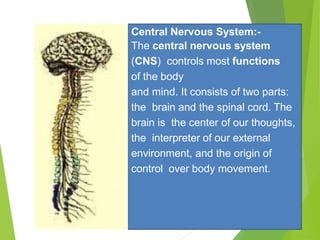
Central Nervous System:-
The central nervous system
(CNS) controls most functions
of the body
and mind. It consists of two parts:
the brain and the spinal cord. The
brain is the center of our thoughts,
the interpreter of our external
environment, and the origin of
control over body movement.
The central nervous
system
The central nervous system consists of the brain and the spinal cord.
The brain is enclosed in a boney box called the cranium and spinal
cord protected by vertebral column. The brain and spinal cord are
external covered by protected covering called meninges. It is made up
of three layers namely duramater (outer layer), arachnoid (middle
layer), piameter (inner layer). The space between meninges is filled by
watery fluid called cerebro- spinal fluid (CSF). This fluid flow from the
brain to spinal chord and then back to brain. It acts as a shock
absorbed and protects brain from injuries. It also provides nutrients to
the cells in brain and spinal cord.
How does a nerve impulse travel?
The dendrite end of the neuron collects information and triggers a
chemical reaction, which results in an electric impulse. This impulse
is transmitted from the dendrite to the cell body and then to the axon.
From the axon, the impulse travels to its end, where the electrical
impulse sets off the release of some more chemicals. The chemicals
cross the synapse and start a similar electrical impulse in the dendrite
of the next neuron. In this way, impulses are transmitted from one
neuron to another to finally reach the brain.
The body performs various activities. All these activities are
controlled by the brain. How does the brain control all
activities? Are there any division in the brain, which take
over the control of different activities?
Do you know which organ make up the nervous system?
The nervous system is divided into – central nervous
system(CNS) and peripheral nervous system(PNS). The
CNS consists of the brain and spinal chord while the PNS
consists of the nerves that connect the central nervous system
to different parts of the body.
The central nervous system receives information from all parts
of the body and also sends information to the muscles.
Communication between the CNS and body parts is facilitated
by the nerves of PNS.
RESPONSES OF THE NERVOUS
SYSTEM
What happens when the following takes place?
• Bright light is focused on our eyes.
• We accidentally touch a flame.
• We are hungry and we think about our favorite meal.
 For all the situations mentioned above, the response
would be quick and
 automatic. We would
• Close our eyes immediately when bright light is focused on
our eyes .
• Withdraw our hand from the flame.
• Start salivating on thinking about our favorite meal.
 This automatic action or response provoked by a stimulus
is known as reflex
 action.
The responses of the nervous system can be classified into
voluntary, involuntary and reflex actions.
The action that can be controlled voluntarily are called voluntary
actions.
The signal or message for these actions is passed to the brain.
Therefore, they are consciously controlled.
On the other hand, the movement of food in the alimentary canal or
the contraction and relaxation of the blood vessels are involuntary
action i.e. they cannot be consciously controlled.
The reflex actions, however, show sudden responses and do not
involve any thinking. This means that unlike involuntary actions, these
are not under the control of the brain.
Reflex Action:
It is a nerve mediated spontaneous, automatic
involuntary response to a stimulus without the will
of the organism. It is discovered by Marshall Hall
in 1833.
Example:-
If we accidentally touch a hot plate our hand
moves backward instantly without thinking of the
matter happening.
It occurs by the involvement of Spinal cord so
it happens very quickly as the receptors and
effectors are in direct contact with each other in
spinal cord.
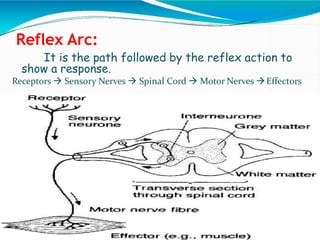
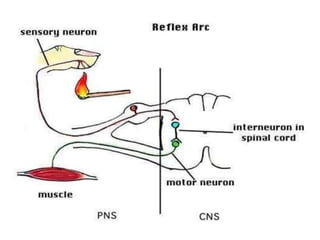
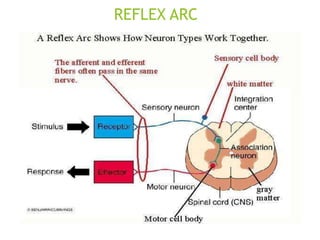
Reflex Arc:
It is the path followed by the reflex action to
show a response.
Receptors  Sensory Nerves  Spinal Cord  Motor Nerves Effectors
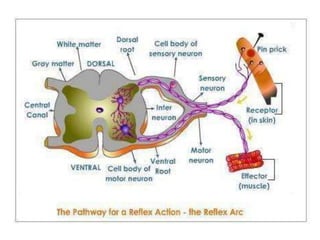
Reflex arc
When we accidentally touch a hot object, we withdraw our hands
immediately without thinking. If we do not do this, our hands will
burn.
The sensory nerves detect the heat. They are connected to the nerve,
which
move the muscles of the hand. Such a connection of detecting the
signal from
the nerves(input), and responding to it immediately(output), is called a
reflex arc. In other words it is the pathway along which nerve impulse
travels during the reflex action.
A reflex arc makes instant and automatic responses possible. It
connects the input nerve and output nerve, and meets in a bundle in
the spinal chord. In fact, nerve from all over the body meet in a
bundle in the spinal chord, on their way to brain. Therefore, the
information input reaches the brain.
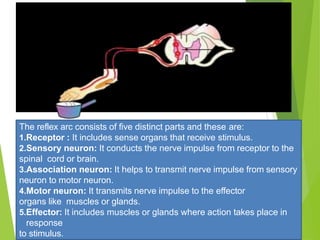
The reflex arc consists of five distinct parts and these are:
1.Receptor : It includes sense organs that receive stimulus.
2.Sensory neuron: It conducts the nerve impulse from receptor to the
spinal cord or brain.
3.Association neuron: It helps to transmit nerve impulse from sensory
neuron to motor neuron.
4.Motor neuron: It transmits nerve impulse to the effector
organs like muscles or glands.
5.Effector: It includes muscles or glands where action takes place in
response
to stimulus.
Types of reflexes
Ivan Pavlov classified all reflex responses in two categories:
Unconditional and Conditional reflexes.
Unconditional Reflex: these are inborn, unconscious responses to a
given stimuli which are transferred to the next generation as well.
some of the examples of such unconditional responses are blinking
of eyes when an object is brought very close to the eyes, etc.
Conditional Reflex: Such response are acquired during the life time
of an individual. These responses are different for different
organisms. These responses can be easily induced or lost
depending upon the environmental conditions.
Conditional reflex are controlled by cerebral cortex.
Some of the examples of conditional or acquired reflex are learning,
playing piano, typing on a computer, etc.
The important components of nervous system
are:
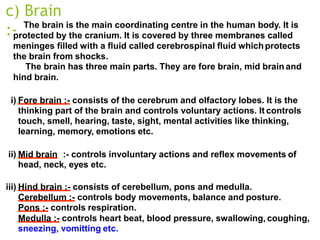
c) Brain
:- The brain is the main coordinating centre in the human body. It is
protected by the cranium. It is covered by three membranes called
meninges filled with a fluid called cerebrospinal fluid whichprotects
the brain from shocks.
The brain has three main parts. They are fore brain, mid brain and
hind brain.
i) Fore brain :- consists of the cerebrum and olfactory lobes. It is the
thinking part of the brain and controls voluntary actions. It controls
touch, smell, hearing, taste, sight, mental activities like thinking,
learning, memory, emotions etc.
ii) Mid brain :- controls involuntary actions and reflex movements of
head, neck, eyes etc.
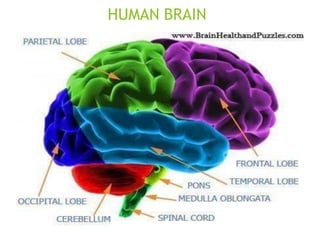
iii) Hind brain :- consists of cerebellum, pons and medulla.
Cerebellum :- controls body movements, balance and posture.
Pons :- controls respiration.
Medulla :- controls heart beat, blood pressure, swallowing, coughing,
sneezing, vomitting etc.
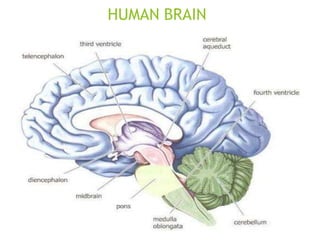
HUMAN BRAIN
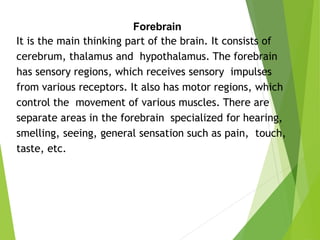
Forebrain
It is the main thinking part of the brain. It consists of
cerebrum, thalamus and hypothalamus. The forebrain
has sensory regions, which receives sensory impulses
from various receptors. It also has motor regions, which
control the movement of various muscles. There are
separate areas in the forebrain specialized for hearing,
smelling, seeing, general sensation such as pain, touch,
taste, etc.
Parts of
forebrain
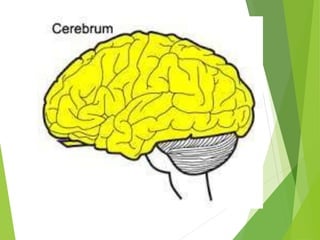
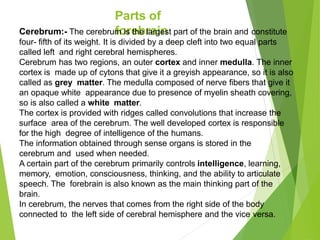
Cerebrum:- The cerebrum is the largest part of the brain and constitute
four- fifth of its weight. It is divided by a deep cleft into two equal parts
called left and right cerebral hemispheres.
Cerebrum has two regions, an outer cortex and inner medulla. The inner
cortex is made up of cytons that give it a greyish appearance, so it is also
called as grey matter. The medulla composed of nerve fibers that give it
an opaque white appearance due to presence of myelin sheath covering,
so is also called a white matter.
The cortex is provided with ridges called convolutions that increase the
surface area of the cerebrum. The well developed cortex is responsible
for the high degree of intelligence of the humans.
The information obtained through sense organs is stored in the
cerebrum and used when needed.
A certain part of the cerebrum primarily controls intelligence, learning,
memory, emotion, consciousness, thinking, and the ability to articulate
speech. The forebrain is also known as the main thinking part of the
brain.
In cerebrum, the nerves that comes from the right side of the body
connected to the left side of cerebral hemisphere and the vice versa.
HUMAN BRAIN
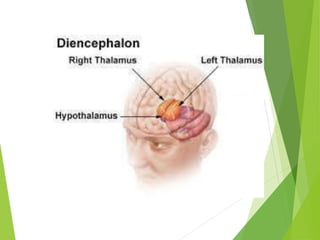
Diencephalon:- is a part of the forebrain
located below the cerebrum. It includes both
thalamus and hypothalamus.
Thalamus is situated between cerebral cortex and mid brain. It
receives the nerve impulses from sense organs and transmits them to
the upper region. It coordinates the sensor and motor signaling.
The hypothalamus contains many areas that control the body
temperature, urge for eating and drinking, etc. Some regions of the
cerebrum along with hypothalamus are involved in the regulation of
sexual behavior and expression of emotional reactions such as
excitement, pleasure, fear, etc.
Midbrain
It is the small region of the brain that
connects cerebrum with the hind
brain. It has regions that are
concerned with the sense of sight and
hearing. Some regions of the
midbrain transmit motor impulses to
the limbs.
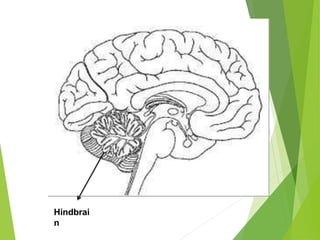
Hind brain
It consists of three parts namely pons varoli, cerebrum and medulla
oblongata. Pons varoli consists of the nerve fibers that connect various
portions like cerebrum, cerebellum and medulla oblongata of the brain. It
has the control centers for facial expression, respiration and mastication
etc. among the twelve pairs of cranial nerves, four pairs originate from
the pons varoli.
The cerebellum, which is a part of the hindbrain, is responsible for
maintaining the posture of the equilibrium of the body. It also
coordinates the voluntary muscles, according to the directions of the
cerebrum.
Medulla is the posterior most part of the brain and is connected to the
spinal cord. Most involuntary actions such as heart beat, blood pressure,
movement of food in the alimentary canal, salivation, etc. are controlled
by the medulla of the hindbrain.
Hindbrai
n
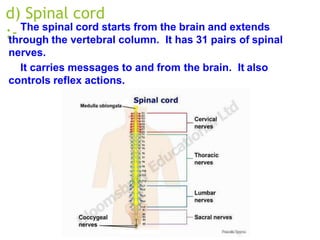
d) Spinal cord
:- The spinal cord starts from the brain and extends
through the vertebral column. It has 31 pairs of spinal
nerves.
It carries messages to and from the brain. It also
controls reflex actions.
Spinal Cord
It is the continuation of the medulla oblongata and runs through the
vertebral column. The spinal cord is made up of two similar halves
fused together to form a central canal containing the cerebrospinal
fluid. The outer portion of the spinal cord is known as the white matter,
which consists of nerve fibers and the inner portion contains the cell
bodies of the neurons and is known as the grey matter. There are
thirty one pairs of spinal nerves that arise from the spinal cord. These
nerves are divided into branches that reach to several parts of the body
like heart, lungs, stomach, urinary bladder etc. The movement of limbs
in the body controlled by the spinal cord through reflex actions.
The spinal cord tapers at the end at the vertebrae where from a
collection of
nerve roots originate, which are horsetail- like appearance and hence
called
the cauda equina.
Protection of the brain and the spinal
cord
The brain, being an important organ,
requires protection. Therefore, it is
enclosed in a bony box called
cranium. The brain inside the brain
box is also surrounded by a fluid- like
Do You
Know?
• The brain transmits messages at a rate of 240 miles per
hour!
• There are 10 million nerve cells in our brain.
• The brain uses more than 25% of the oxygen used by
the human body!
• As compared to other animals, the ant has largest brain in
relation to its body.
Peripheral Nervous
System
It consists of the nerves arising from the brain and the spinal cord,
which links the CNS to the rest of the body. It consists of two types of
nerves.
• Cranial nerves: There are 12 pairs of cranial nerves and they
emerge from
the brain and reach the organ in the head region.
• Spinal nerves: There are 31 pairs of spinal nerves that emerge
from the spinal cord and reach various parts of the body.
Messages are transferred from the brain to the spinal cord and then to
the rest of the body and similar messages from the rest of the body
reach the spinal cord from where they are transferred to the brain. The
spinal cord also controls all reflex actions.
Autonomic Nervous System
The autonomic nervous system helps to carry out the orders of the
medulla, which controls the vital body function.
It consists of two networks:
• Sympathetic system: The sympathetic nerves lead to all vital
internal organs and glands. They regulate the actions of smooth
muscles such as that of the stomach, intestine, and the heart.
• Parasympathetic system: This system is made up of the vagus
and the pelvic nerves.
The sympathetic system speeds up the body functions and prepares
the body for combat and escapes while the parasympathetic system
counteracts to that of the sympathetic system and slows down the
body functions.
In animals, control and coordination in governed by the nervous
system. However, plants do not have a nervous system.
Then, how do plants respond to stimuli?
Plants respond to stimuli by showing movement.
What is stimuli?
A thing or event that evokes a specific functional reaction in an organ or
tissue.
Have you ever seen any movement in plants?
•when you touch a sensitive plant such a touch-me-not(Mimosa
pudica), the plant folds its leafs.
•When a seed germinates, the root grows down in the soil ant stem
grows up . In the first example, by responding to the stimuli (touch)
shows movement by folding leafs.
In second example, the seed germinates and shows directional
movement.
In first example, movement is independent of growth. However, in the
second example, growth is dependent of growth.
Thus, plants exhibit both growth-dependent and growth dependent
Growth-independent
movements
In plants(like animals), the information is carried from cells by electro
chemical means. however., there is no specialized tissue for the
conduction of information. In fact, plants change their shape by
changing the amount of water in them. This results in swelling and
shrinking. This change of shape results in movement.
Touch me not plant showing growth-independent movement
Growth-dependent
movements
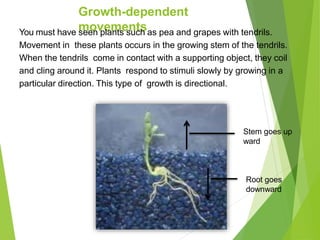
You must have seen plants such as pea and grapes with tendrils.
Movement in these plants occurs in the growing stem of the tendrils.
When the tendrils come in contact with a supporting object, they coil
and cling around it. Plants respond to stimuli slowly by growing in a
particular direction. This type of growth is directional.
Stem goes up
ward
Root goes
downward
Nastic movement in
plants
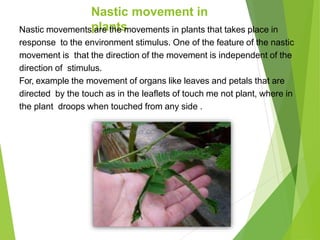
Nastic movements are the movements in plants that takes place in
response to the environment stimulus. One of the feature of the nastic
movement is that the direction of the movement is independent of the
direction of stimulus.
For, example the movement of organs like leaves and petals that are
directed by the touch as in the leaflets of touch me not plant, where in
the plant droops when touched from any side .
Do You
Know?
• The Venus flytrap is an insectivorous plant, in which leaves act as
trap
lobes?
• The movement of these lobes traps the insects. Hence, it is an
example of complex movement in plants.
Tropic movements in
plants
Tropism is the response to stimuli that comes from one direction.
If the movement of the plant part is towards the stimulus, then it is
known as
positive tropism. If the movement of the plant part is away
from the stimulus, then it is known as negative tropism.
Types of tropism:
• Phototropism
• Geotropism
• Chemotropism
• Hydrotropism
Phototropis
m
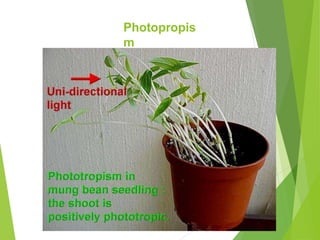
The growth movement in plants in response to light stimuli is
known as phototropism. For example, the flower head of a
sunflower positively phototropic as it moves from East to West,
along with the Sun.
The shoots show positive phototropism, while the root show
negative
phototropism.
Curiosity Corner
Why fruits like groundnuts are formed underground?
The ovary stalk of groundnut is positively phototropic before
fertilization, and becomes negatively phototropic after
fertilization. This is the reason why fruits like groundnuts are
formed underground.
Photopropis
m
Geotropis
m
The growth movement in plants in response to the force of gravity is
known as geotropism. In geotropism shoots grows up and roots
grows down the ground .
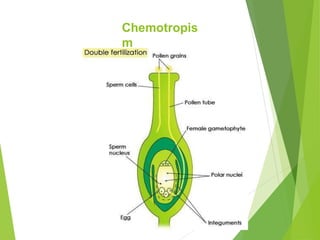
Chemotropism
The growth movement in plants in response to chemical stimuli is
known as chemotropism. For example, the growth of pollen tube
towards the ovule in the ovary is an example of positive
chemotropism.
Hydrotropism
The growth movement in plants in response to water is known as
hydrotropism. For example, the roots of some plants grow towards the
water source, even when the water source is not present directly below
it.
Chemotropis
m
Phytohormon
es
In plants, growth, development, and response to the environment is
controlled and coordinated by a special class of chemical substances
known as phytohormones. These hormones are produced in one
part of the plant body and are translocated to other parts. For
example, a hormone produced in the roots is translocated to other
parts where they are required.
Thus, the growth hormones of the plants are known as
phytohormones. These are naturally occurring organic substances.
They are synthesized in minute quantities in one part of the plant body
and are translocated to other parts where they are required.
Types of phytohormones
• Auxins
• Gibberellins
• Cytokinins
• Abscisic acid
• Ethylene
Auxin
s
When the growing parts of a phototropic plants detect sunlight, auxins
(synthesized at the soot tips) help the cells grow longer. When light falls
on one side of the plant, the auxins generally diffuse towards the
shaded side of the shoot. This stimulates the cells in the shaded area
to grow longer than the corresponding cells of the illuminated region.
This results in the curvature of the plant stem tip towards the light.
Gibberellins
They are produced in the roots of a plant. They promote stem
elongation by promoting cell division in the inter-nodal region.
Cytokinins
They promote cell division. Therefore, they are present in greater
concentration in those areas of the plants where rapid cell division
occurs. For example, tip of the shoot.
Abscisic
acid
It promotes seed dormancy by inhibit cell growth. It is involved in the
opening and closing of stomata. It is also responsible for the shedding
of leaves.
Ethylene
It regulates fruit ripening. It is produced during the ripening of fruits.
Fruit ripening
Ethrel (Ethephon) liquid is sprayed on plants to facilitates fruit ripening.
It contains a dilute solution of 2-chloroethylphosphonic acid, which
break down to release ethylene. It helps in the artificial ripening of
commercially grown fruits such as pineapples, mangoes, bananas etc.
How isover ripening prevent?
CO2 in high concentration prevents over ripening of fruits as it
inhibits the production of ethylene.
Do you know that a sixth category of plant hormones has
been
recently discovered? This new category is popularly
known as steroids. Steroids are not only involved in
growth , but also in the regulation of plant activities
such as responses to stress, invading pathogens, etc.
THE END
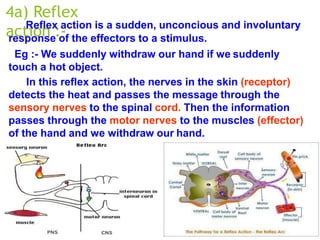
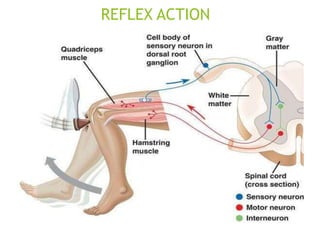
4a) Reflex
action :-
Reflex action is a sudden, unconcious and involuntary
response of the effectors to a stimulus.
Eg :- We suddenly withdraw our hand if we suddenly
touch a hot object.
In this reflex action, the nerves in the skin (receptor)
detects the heat and passes the message through the
sensory nerves to the spinal cord. Then the information
passes through the motor nerves to the muscles (effector)
of the hand and we withdraw our hand.
REFLEX ACTION
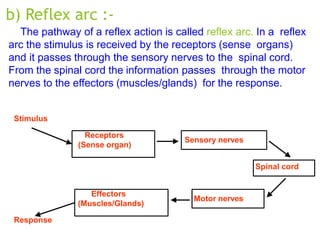
b) Reflex arc :-
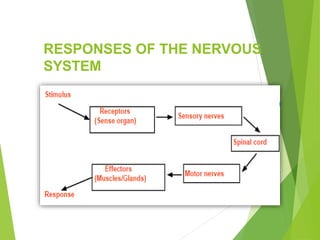
The pathway of a reflex action is called reflex arc. In a reflex
arc the stimulus is received by the receptors (sense organs)
and it passes through the sensory nerves to the spinal cord.
From the spinal cord the information passes through the motor
nerves to the effectors (muscles/glands) for the response.
Stimulus
Response
Receptors
(Sense organ)
Effectors
(Muscles/Glands)
Sensory nerves
Motor nerves
Spinal cord
REFLEX ARC
5) Coordination in
plants :-
In plants control and coordination is done by chemical
substances called plant hormones or phytohormones.
There are five main types of plant hormones. They are :-
Auxins, Gibberillins, Cytokinins, Abscisic acid and
Ethylene.
i) Auxins :- help in cell division, cell elongation and
growth.
ii) Gibberillins :- help in growth of stem and branches.
iii) Cytokinins:- help in cell division, formation of fruits and
seeds.
iv) Abscisic acid :- inhibits growth and affects wilting of
leaves.
vi) Ethylene :- helps in flowering and ripening of fruits.
6) Movements in
plants :-
Movements in plants are of two main types. They are :-Tropic
movements and Nastic movements.
a) Tropic movements :- are directional movements towardsor
away from the stimulus and it depends on growth. They are of
different types like Phototropism, Geotropism, Chemotropism,
Hydrotropism etc.
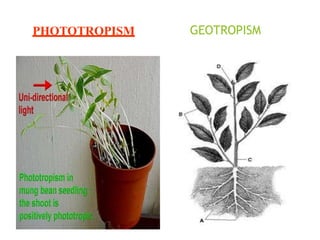
i) Phototropism :- is movement of plants in response to light. If it is
towards light, it is called positive phototropism. Eg:- Bending of
shoot towards light. If it is away from light, it is called negative
phototropism. Eg:- Bending of root away from light.
ii) Geotropism :- is the movement of plants in response to gravity. If it is
towards gravity it is called positive geotropism. Eg:- Downward
growth of roots. If it is away from gravity it is called negative
geotropism. Eg:- Upward growth of shoot.
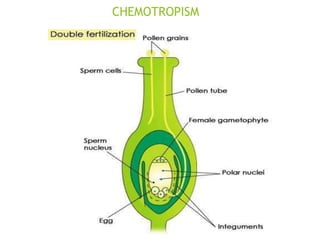
iii) Chemotropism :- is movement of plant in response to chemical
stimuli. Eg:- Growth of pollen tube towards the ovule.
iv) Hydrotropism :- is the movement of plants in response to water.
PHOTOTROPISM GEOTROPISM
CHEMOTROPISM
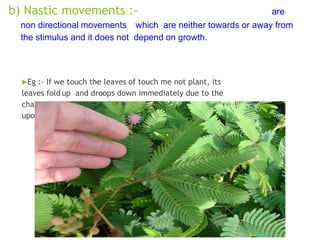
b) Nastic movements :- are
non directional movements which are neither towards or away from
the stimulus and it does not depend on growth.
Eg :- If we touch the leaves of touch me not plant, its
leaves fold up and droops down immediately due to the
change in the amount of water in the leaves. Depending
upon the amount of water in the leaves, it swells or shrinks.
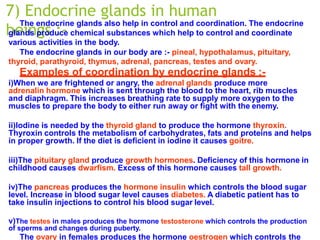
7) Endocrine glands in human
beings :-
The endocrine glands also help in control and coordination. The endocrine
glands produce chemical substances which help to control and coordinate
various activities in the body.
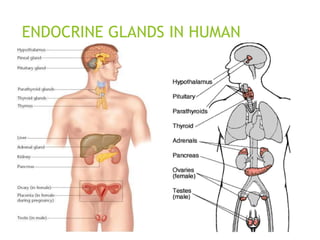
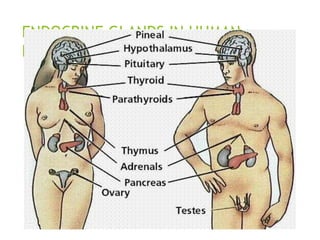
The endocrine glands in our body are :- pineal, hypothalamus, pituitary,
thyroid, parathyroid, thymus, adrenal, pancreas, testes and ovary.
Examples of coordination by endocrine glands :-
i)When we are frightened or angry, the adrenal glands produce more
adrenalin hormone which is sent through the blood to the heart, rib muscles
and diaphragm. This increases breathing rate to supply more oxygen to the
muscles to prepare the body to either run away or fight with the enemy.
ii)Iodine is needed by the thyroid gland to produce the hormone thyroxin.
Thyroxin controls the metabolism of carbohydrates, fats and proteins and helps
in proper growth. If the diet is deficient in iodine it causes goitre.
iii)The pituitary gland produce growth hormones. Deficiency of this hormone in
childhood causes dwarfism. Excess of this hormone causes tall growth.
iv)The pancreas produces the hormone insulin which controls the blood sugar
level. Increase in blood sugar level causes diabetes. A diabetic patient has to
take insulin injections to control his blood sugar level.
v)The testes in males produces the hormone testosterone which controls the production
of sperms and changes during puberty.
The ovary in females produces the hormone oestrogen which controls the
ENDOCRINE GLANDS IN HUMAN
BEINGS
ENDOCRINE GLANDS IN HUMAN
BEINGS

controlandcoordination-160912065553-converted.pptx

  • 2.
    CONTROL AND COORDINATION Workingtogether of various integrated body systems in response to changes in the surrounding for the maintenance of bodily functions is known as control and coordination. Nervous system and endocrine system provide control and coordination in animals.
  • 3.
    Need Of ControlAnd Coordination In An imals: Organism is in direct contact with its environment, so any changes in its surroundings have an influence on its body. To maintain the balance between the environmental factors and body functions there is a need of such controlling and coordinating system that works for the welfare of the organism.
  • 4.
    1a) Stimuli :- The changesin the environment to which living organisms respond are called stimuli. Eg :- heat, cold, sound, smell, taste, touch, pressure, gravity, water etc. Living organisms respond to stimuli in the form of body movements. b) Coordination :- For a proper response to a stimulus many organs in the body should work together. The working together of various organs in an organism to produce a proper response to a stimulus is called coordination. i) In animals control and co ordination is done by the nervous system and endocrine system. ii)In plants control and co ordination is done by chemical substances called plant hormones or phytohormones.
  • 5.
    2) Coordination in animals:- In animals control and co ordination is done by the nervous system and endocrine system. The nervous system consists of the brain, spinal cord and nerves. a) Receptors :- are the sense organs which receive the stimuli and pass the message to the brain or spinal cord through the sensory nerves. Eg :- Photoreceptors in the eyes to detect light. Phonoreceptors in the ears to detect sound. Olfactory receptors in the nose to detect smell. Gustatory receptors in the tongue to detect taste. Tangoreceptors in the skin to detect touch. b) Effectors :- are the muscles and glands which respond to the information from the brain and spinal cord through the motor nerves. c) Sensory nerves :- are nerves which carry information from the receptors (sense organs) to the brain and spinal cord. d) Motor nerves :- are nerves which carry information from thebrain and spinal cord to the effectors (muscles and glands).
  • 6.
  • 7.
  • 8.
    Do you knowwhich organ make up the nervous system? The nervous system is made up of the brain ,spinal chord ,and nerve cells or neurons. Let us first study the structure of the functional unit of the nervous system i.e., the neurons.
  • 9.
    3) Human nervous system:- a) Parts of the nervous system :- The human nervous system consists of the Central Nervous System and Peripheral Nervous System. i) The central nervous system :- consists of the brain, and spinal cord. ii) The peripheral nervous system:- consists of cranial nerves arising from the brain and spinal nerves arising from the spinal cord.
  • 10.
  • 11.
  • 12.
    Parts of thenervous system
  • 13.
    Ganglion :-is astructure containing a number of nerve cell bodies, typically linked by synapses, and often forming a swelling on a nerve fiber.
  • 14.
    b) Nerve cell (Neuron):- Neuron is the structural and functional unit of the nervous system. It has a cell body called cyton containing a nucleus and cytoplasm. It has several branched structures called dendrites. It has a long nerve fibre called axon which is covered by a protective covering called Myelin sheath. The junction between two neurons is called synapse. Messages pass through the nerve cell in the form of chemical and electrical signals called nerve impulse. The dendrites receive the information and starts a chemical reaction which produce electrical impulse which passes through the axon.
  • 15.
    Structure of neuron(Nerve cell)
  • 16.
    Structure of neuron(Nerve cell) Nerve endings ( )
  • 17.
    Arrangement of neurons Neuronsare arranged end to end ,forming a chain. This helps in the continuous transmission of impulses. Each neuron receives an impulse through its dendrite and transmits it to the next neuron in a sequence through its axon. Neurons are not connected. Synapse or a small gap occurs between the axon of one neuron and dendron of next neuron. A synapse in the muscle fiber is also known as neuromuscular junction. Let us discuss the working of a synapse in detail.
  • 18.
    Transmission of messagesthrough neurons
  • 19.
    Types of neurons Neurons SensoryMotor Relaying neuron neuron neuron
  • 20.
    Sensory neurons:- arenerve cells within the nervous system responsible for converting external stimuli from the organism's environment into internal electrical impulses.
  • 21.
    Motor neurons :-are nerve cells forming part of a pathway along which impulses pass from the brain or spinal cord to a muscle or gland.
  • 22.
    Relaying neurons:- carrymessages from one part of the CNS (central nervous system) to another.
  • 23.
    Central Nervous System:- Thecentral nervous system (CNS) controls most functions of the body and mind. It consists of two parts: the brain and the spinal cord. The brain is the center of our thoughts, the interpreter of our external environment, and the origin of control over body movement.
  • 24.
    The central nervous system Thecentral nervous system consists of the brain and the spinal cord. The brain is enclosed in a boney box called the cranium and spinal cord protected by vertebral column. The brain and spinal cord are external covered by protected covering called meninges. It is made up of three layers namely duramater (outer layer), arachnoid (middle layer), piameter (inner layer). The space between meninges is filled by watery fluid called cerebro- spinal fluid (CSF). This fluid flow from the brain to spinal chord and then back to brain. It acts as a shock absorbed and protects brain from injuries. It also provides nutrients to the cells in brain and spinal cord.
  • 25.
    How does anerve impulse travel? The dendrite end of the neuron collects information and triggers a chemical reaction, which results in an electric impulse. This impulse is transmitted from the dendrite to the cell body and then to the axon. From the axon, the impulse travels to its end, where the electrical impulse sets off the release of some more chemicals. The chemicals cross the synapse and start a similar electrical impulse in the dendrite of the next neuron. In this way, impulses are transmitted from one neuron to another to finally reach the brain.
  • 26.
    The body performsvarious activities. All these activities are controlled by the brain. How does the brain control all activities? Are there any division in the brain, which take over the control of different activities? Do you know which organ make up the nervous system? The nervous system is divided into – central nervous system(CNS) and peripheral nervous system(PNS). The CNS consists of the brain and spinal chord while the PNS consists of the nerves that connect the central nervous system to different parts of the body. The central nervous system receives information from all parts of the body and also sends information to the muscles. Communication between the CNS and body parts is facilitated by the nerves of PNS.
  • 27.
    RESPONSES OF THENERVOUS SYSTEM
  • 28.
    What happens whenthe following takes place? • Bright light is focused on our eyes. • We accidentally touch a flame. • We are hungry and we think about our favorite meal.  For all the situations mentioned above, the response would be quick and  automatic. We would • Close our eyes immediately when bright light is focused on our eyes . • Withdraw our hand from the flame. • Start salivating on thinking about our favorite meal.  This automatic action or response provoked by a stimulus is known as reflex  action.
  • 29.
    The responses ofthe nervous system can be classified into voluntary, involuntary and reflex actions. The action that can be controlled voluntarily are called voluntary actions. The signal or message for these actions is passed to the brain. Therefore, they are consciously controlled. On the other hand, the movement of food in the alimentary canal or the contraction and relaxation of the blood vessels are involuntary action i.e. they cannot be consciously controlled. The reflex actions, however, show sudden responses and do not involve any thinking. This means that unlike involuntary actions, these are not under the control of the brain.
  • 30.
    Reflex Action: It isa nerve mediated spontaneous, automatic involuntary response to a stimulus without the will of the organism. It is discovered by Marshall Hall in 1833. Example:- If we accidentally touch a hot plate our hand moves backward instantly without thinking of the matter happening. It occurs by the involvement of Spinal cord so it happens very quickly as the receptors and effectors are in direct contact with each other in spinal cord.
  • 31.
    Reflex Arc: It isthe path followed by the reflex action to show a response. Receptors  Sensory Nerves  Spinal Cord  Motor Nerves Effectors
  • 32.
    Reflex arc When weaccidentally touch a hot object, we withdraw our hands immediately without thinking. If we do not do this, our hands will burn. The sensory nerves detect the heat. They are connected to the nerve, which move the muscles of the hand. Such a connection of detecting the signal from the nerves(input), and responding to it immediately(output), is called a reflex arc. In other words it is the pathway along which nerve impulse travels during the reflex action. A reflex arc makes instant and automatic responses possible. It connects the input nerve and output nerve, and meets in a bundle in the spinal chord. In fact, nerve from all over the body meet in a bundle in the spinal chord, on their way to brain. Therefore, the information input reaches the brain.
  • 33.
    The reflex arcconsists of five distinct parts and these are: 1.Receptor : It includes sense organs that receive stimulus. 2.Sensory neuron: It conducts the nerve impulse from receptor to the spinal cord or brain. 3.Association neuron: It helps to transmit nerve impulse from sensory neuron to motor neuron. 4.Motor neuron: It transmits nerve impulse to the effector organs like muscles or glands. 5.Effector: It includes muscles or glands where action takes place in response to stimulus.
  • 34.
    Types of reflexes IvanPavlov classified all reflex responses in two categories: Unconditional and Conditional reflexes. Unconditional Reflex: these are inborn, unconscious responses to a given stimuli which are transferred to the next generation as well. some of the examples of such unconditional responses are blinking of eyes when an object is brought very close to the eyes, etc. Conditional Reflex: Such response are acquired during the life time of an individual. These responses are different for different organisms. These responses can be easily induced or lost depending upon the environmental conditions. Conditional reflex are controlled by cerebral cortex. Some of the examples of conditional or acquired reflex are learning, playing piano, typing on a computer, etc.
  • 35.
    The important componentsof nervous system are:
  • 36.
    c) Brain :- Thebrain is the main coordinating centre in the human body. It is protected by the cranium. It is covered by three membranes called meninges filled with a fluid called cerebrospinal fluid whichprotects the brain from shocks. The brain has three main parts. They are fore brain, mid brain and hind brain. i) Fore brain :- consists of the cerebrum and olfactory lobes. It is the thinking part of the brain and controls voluntary actions. It controls touch, smell, hearing, taste, sight, mental activities like thinking, learning, memory, emotions etc. ii) Mid brain :- controls involuntary actions and reflex movements of head, neck, eyes etc. iii) Hind brain :- consists of cerebellum, pons and medulla. Cerebellum :- controls body movements, balance and posture. Pons :- controls respiration. Medulla :- controls heart beat, blood pressure, swallowing, coughing, sneezing, vomitting etc.
  • 37.
  • 38.
    Forebrain It is themain thinking part of the brain. It consists of cerebrum, thalamus and hypothalamus. The forebrain has sensory regions, which receives sensory impulses from various receptors. It also has motor regions, which control the movement of various muscles. There are separate areas in the forebrain specialized for hearing, smelling, seeing, general sensation such as pain, touch, taste, etc.
  • 40.
    Parts of forebrain Cerebrum:- Thecerebrum is the largest part of the brain and constitute four- fifth of its weight. It is divided by a deep cleft into two equal parts called left and right cerebral hemispheres. Cerebrum has two regions, an outer cortex and inner medulla. The inner cortex is made up of cytons that give it a greyish appearance, so it is also called as grey matter. The medulla composed of nerve fibers that give it an opaque white appearance due to presence of myelin sheath covering, so is also called a white matter. The cortex is provided with ridges called convolutions that increase the surface area of the cerebrum. The well developed cortex is responsible for the high degree of intelligence of the humans. The information obtained through sense organs is stored in the cerebrum and used when needed. A certain part of the cerebrum primarily controls intelligence, learning, memory, emotion, consciousness, thinking, and the ability to articulate speech. The forebrain is also known as the main thinking part of the brain. In cerebrum, the nerves that comes from the right side of the body connected to the left side of cerebral hemisphere and the vice versa.
  • 41.
  • 42.
    Diencephalon:- is apart of the forebrain located below the cerebrum. It includes both thalamus and hypothalamus. Thalamus is situated between cerebral cortex and mid brain. It receives the nerve impulses from sense organs and transmits them to the upper region. It coordinates the sensor and motor signaling. The hypothalamus contains many areas that control the body temperature, urge for eating and drinking, etc. Some regions of the cerebrum along with hypothalamus are involved in the regulation of sexual behavior and expression of emotional reactions such as excitement, pleasure, fear, etc.
  • 44.
    Midbrain It is thesmall region of the brain that connects cerebrum with the hind brain. It has regions that are concerned with the sense of sight and hearing. Some regions of the midbrain transmit motor impulses to the limbs.
  • 45.
    Hind brain It consistsof three parts namely pons varoli, cerebrum and medulla oblongata. Pons varoli consists of the nerve fibers that connect various portions like cerebrum, cerebellum and medulla oblongata of the brain. It has the control centers for facial expression, respiration and mastication etc. among the twelve pairs of cranial nerves, four pairs originate from the pons varoli. The cerebellum, which is a part of the hindbrain, is responsible for maintaining the posture of the equilibrium of the body. It also coordinates the voluntary muscles, according to the directions of the cerebrum. Medulla is the posterior most part of the brain and is connected to the spinal cord. Most involuntary actions such as heart beat, blood pressure, movement of food in the alimentary canal, salivation, etc. are controlled by the medulla of the hindbrain.
  • 46.
  • 47.
    d) Spinal cord :-The spinal cord starts from the brain and extends through the vertebral column. It has 31 pairs of spinal nerves. It carries messages to and from the brain. It also controls reflex actions.
  • 48.
    Spinal Cord It isthe continuation of the medulla oblongata and runs through the vertebral column. The spinal cord is made up of two similar halves fused together to form a central canal containing the cerebrospinal fluid. The outer portion of the spinal cord is known as the white matter, which consists of nerve fibers and the inner portion contains the cell bodies of the neurons and is known as the grey matter. There are thirty one pairs of spinal nerves that arise from the spinal cord. These nerves are divided into branches that reach to several parts of the body like heart, lungs, stomach, urinary bladder etc. The movement of limbs in the body controlled by the spinal cord through reflex actions. The spinal cord tapers at the end at the vertebrae where from a collection of nerve roots originate, which are horsetail- like appearance and hence called the cauda equina.
  • 49.
    Protection of thebrain and the spinal cord The brain, being an important organ, requires protection. Therefore, it is enclosed in a bony box called cranium. The brain inside the brain box is also surrounded by a fluid- like
  • 50.
    Do You Know? • Thebrain transmits messages at a rate of 240 miles per hour! • There are 10 million nerve cells in our brain. • The brain uses more than 25% of the oxygen used by the human body! • As compared to other animals, the ant has largest brain in relation to its body.
  • 51.
    Peripheral Nervous System It consistsof the nerves arising from the brain and the spinal cord, which links the CNS to the rest of the body. It consists of two types of nerves. • Cranial nerves: There are 12 pairs of cranial nerves and they emerge from the brain and reach the organ in the head region. • Spinal nerves: There are 31 pairs of spinal nerves that emerge from the spinal cord and reach various parts of the body. Messages are transferred from the brain to the spinal cord and then to the rest of the body and similar messages from the rest of the body reach the spinal cord from where they are transferred to the brain. The spinal cord also controls all reflex actions.
  • 52.
    Autonomic Nervous System Theautonomic nervous system helps to carry out the orders of the medulla, which controls the vital body function. It consists of two networks: • Sympathetic system: The sympathetic nerves lead to all vital internal organs and glands. They regulate the actions of smooth muscles such as that of the stomach, intestine, and the heart. • Parasympathetic system: This system is made up of the vagus and the pelvic nerves. The sympathetic system speeds up the body functions and prepares the body for combat and escapes while the parasympathetic system counteracts to that of the sympathetic system and slows down the body functions.
  • 54.
    In animals, controland coordination in governed by the nervous system. However, plants do not have a nervous system. Then, how do plants respond to stimuli? Plants respond to stimuli by showing movement. What is stimuli? A thing or event that evokes a specific functional reaction in an organ or tissue. Have you ever seen any movement in plants? •when you touch a sensitive plant such a touch-me-not(Mimosa pudica), the plant folds its leafs. •When a seed germinates, the root grows down in the soil ant stem grows up . In the first example, by responding to the stimuli (touch) shows movement by folding leafs. In second example, the seed germinates and shows directional movement. In first example, movement is independent of growth. However, in the second example, growth is dependent of growth. Thus, plants exhibit both growth-dependent and growth dependent
  • 55.
    Growth-independent movements In plants(like animals),the information is carried from cells by electro chemical means. however., there is no specialized tissue for the conduction of information. In fact, plants change their shape by changing the amount of water in them. This results in swelling and shrinking. This change of shape results in movement. Touch me not plant showing growth-independent movement
  • 56.
    Growth-dependent movements You must haveseen plants such as pea and grapes with tendrils. Movement in these plants occurs in the growing stem of the tendrils. When the tendrils come in contact with a supporting object, they coil and cling around it. Plants respond to stimuli slowly by growing in a particular direction. This type of growth is directional. Stem goes up ward Root goes downward
  • 57.
    Nastic movement in plants Nasticmovements are the movements in plants that takes place in response to the environment stimulus. One of the feature of the nastic movement is that the direction of the movement is independent of the direction of stimulus. For, example the movement of organs like leaves and petals that are directed by the touch as in the leaflets of touch me not plant, where in the plant droops when touched from any side .
  • 58.
    Do You Know? • TheVenus flytrap is an insectivorous plant, in which leaves act as trap lobes? • The movement of these lobes traps the insects. Hence, it is an example of complex movement in plants.
  • 60.
    Tropic movements in plants Tropismis the response to stimuli that comes from one direction. If the movement of the plant part is towards the stimulus, then it is known as positive tropism. If the movement of the plant part is away from the stimulus, then it is known as negative tropism. Types of tropism: • Phototropism • Geotropism • Chemotropism • Hydrotropism
  • 61.
    Phototropis m The growth movementin plants in response to light stimuli is known as phototropism. For example, the flower head of a sunflower positively phototropic as it moves from East to West, along with the Sun. The shoots show positive phototropism, while the root show negative phototropism. Curiosity Corner Why fruits like groundnuts are formed underground? The ovary stalk of groundnut is positively phototropic before fertilization, and becomes negatively phototropic after fertilization. This is the reason why fruits like groundnuts are formed underground.
  • 62.
  • 63.
    Geotropis m The growth movementin plants in response to the force of gravity is known as geotropism. In geotropism shoots grows up and roots grows down the ground . Chemotropism The growth movement in plants in response to chemical stimuli is known as chemotropism. For example, the growth of pollen tube towards the ovule in the ovary is an example of positive chemotropism. Hydrotropism The growth movement in plants in response to water is known as hydrotropism. For example, the roots of some plants grow towards the water source, even when the water source is not present directly below it.
  • 64.
  • 66.
    Phytohormon es In plants, growth,development, and response to the environment is controlled and coordinated by a special class of chemical substances known as phytohormones. These hormones are produced in one part of the plant body and are translocated to other parts. For example, a hormone produced in the roots is translocated to other parts where they are required. Thus, the growth hormones of the plants are known as phytohormones. These are naturally occurring organic substances. They are synthesized in minute quantities in one part of the plant body and are translocated to other parts where they are required. Types of phytohormones • Auxins • Gibberellins • Cytokinins • Abscisic acid • Ethylene
  • 67.
    Auxin s When the growingparts of a phototropic plants detect sunlight, auxins (synthesized at the soot tips) help the cells grow longer. When light falls on one side of the plant, the auxins generally diffuse towards the shaded side of the shoot. This stimulates the cells in the shaded area to grow longer than the corresponding cells of the illuminated region. This results in the curvature of the plant stem tip towards the light. Gibberellins They are produced in the roots of a plant. They promote stem elongation by promoting cell division in the inter-nodal region. Cytokinins They promote cell division. Therefore, they are present in greater concentration in those areas of the plants where rapid cell division occurs. For example, tip of the shoot.
  • 68.
    Abscisic acid It promotes seeddormancy by inhibit cell growth. It is involved in the opening and closing of stomata. It is also responsible for the shedding of leaves. Ethylene It regulates fruit ripening. It is produced during the ripening of fruits. Fruit ripening Ethrel (Ethephon) liquid is sprayed on plants to facilitates fruit ripening. It contains a dilute solution of 2-chloroethylphosphonic acid, which break down to release ethylene. It helps in the artificial ripening of commercially grown fruits such as pineapples, mangoes, bananas etc. How isover ripening prevent? CO2 in high concentration prevents over ripening of fruits as it inhibits the production of ethylene.
  • 69.
    Do you knowthat a sixth category of plant hormones has been recently discovered? This new category is popularly known as steroids. Steroids are not only involved in growth , but also in the regulation of plant activities such as responses to stress, invading pathogens, etc.
  • 70.
  • 71.
    4a) Reflex action :- Reflexaction is a sudden, unconcious and involuntary response of the effectors to a stimulus. Eg :- We suddenly withdraw our hand if we suddenly touch a hot object. In this reflex action, the nerves in the skin (receptor) detects the heat and passes the message through the sensory nerves to the spinal cord. Then the information passes through the motor nerves to the muscles (effector) of the hand and we withdraw our hand.
  • 74.
  • 75.
    b) Reflex arc:- The pathway of a reflex action is called reflex arc. In a reflex arc the stimulus is received by the receptors (sense organs) and it passes through the sensory nerves to the spinal cord. From the spinal cord the information passes through the motor nerves to the effectors (muscles/glands) for the response. Stimulus Response Receptors (Sense organ) Effectors (Muscles/Glands) Sensory nerves Motor nerves Spinal cord
  • 76.
  • 77.
    5) Coordination in plants:- In plants control and coordination is done by chemical substances called plant hormones or phytohormones. There are five main types of plant hormones. They are :- Auxins, Gibberillins, Cytokinins, Abscisic acid and Ethylene. i) Auxins :- help in cell division, cell elongation and growth. ii) Gibberillins :- help in growth of stem and branches. iii) Cytokinins:- help in cell division, formation of fruits and seeds. iv) Abscisic acid :- inhibits growth and affects wilting of leaves. vi) Ethylene :- helps in flowering and ripening of fruits.
  • 78.
    6) Movements in plants:- Movements in plants are of two main types. They are :-Tropic movements and Nastic movements. a) Tropic movements :- are directional movements towardsor away from the stimulus and it depends on growth. They are of different types like Phototropism, Geotropism, Chemotropism, Hydrotropism etc. i) Phototropism :- is movement of plants in response to light. If it is towards light, it is called positive phototropism. Eg:- Bending of shoot towards light. If it is away from light, it is called negative phototropism. Eg:- Bending of root away from light. ii) Geotropism :- is the movement of plants in response to gravity. If it is towards gravity it is called positive geotropism. Eg:- Downward growth of roots. If it is away from gravity it is called negative geotropism. Eg:- Upward growth of shoot. iii) Chemotropism :- is movement of plant in response to chemical stimuli. Eg:- Growth of pollen tube towards the ovule. iv) Hydrotropism :- is the movement of plants in response to water.
  • 79.
  • 80.
  • 81.
    b) Nastic movements:- are non directional movements which are neither towards or away from the stimulus and it does not depend on growth. Eg :- If we touch the leaves of touch me not plant, its leaves fold up and droops down immediately due to the change in the amount of water in the leaves. Depending upon the amount of water in the leaves, it swells or shrinks.
  • 82.
    7) Endocrine glandsin human beings :- The endocrine glands also help in control and coordination. The endocrine glands produce chemical substances which help to control and coordinate various activities in the body. The endocrine glands in our body are :- pineal, hypothalamus, pituitary, thyroid, parathyroid, thymus, adrenal, pancreas, testes and ovary. Examples of coordination by endocrine glands :- i)When we are frightened or angry, the adrenal glands produce more adrenalin hormone which is sent through the blood to the heart, rib muscles and diaphragm. This increases breathing rate to supply more oxygen to the muscles to prepare the body to either run away or fight with the enemy. ii)Iodine is needed by the thyroid gland to produce the hormone thyroxin. Thyroxin controls the metabolism of carbohydrates, fats and proteins and helps in proper growth. If the diet is deficient in iodine it causes goitre. iii)The pituitary gland produce growth hormones. Deficiency of this hormone in childhood causes dwarfism. Excess of this hormone causes tall growth. iv)The pancreas produces the hormone insulin which controls the blood sugar level. Increase in blood sugar level causes diabetes. A diabetic patient has to take insulin injections to control his blood sugar level. v)The testes in males produces the hormone testosterone which controls the production of sperms and changes during puberty. The ovary in females produces the hormone oestrogen which controls the
  • 83.
    ENDOCRINE GLANDS INHUMAN BEINGS
  • 84.
    ENDOCRINE GLANDS INHUMAN BEINGS