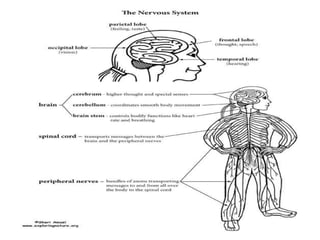
Chapter 15 The Nervous System
What does it mean when someone
says that something makes them
nervous?
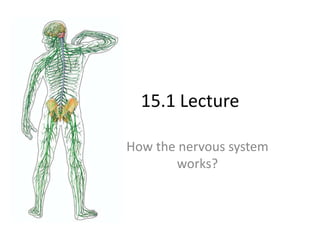
15.1 Lecture
How the nervous system
works?
Section 1: How the Nervous System
Works
What are the functions of the nervous system?
What is the structure of a neuron and what kinds
of neurons are found in the body?
How do nerve impulses travel from one neuron
to another?
• 7.5.b• 7.5.b Students know organ systems function
because of the contributions of individual
organs, tissues, and cells. The failure of any
part can affect the entire system.
Functions of the Nervous System
• Includes the brain, spinal chord, and nerves that
run throughout the body.
– It also includes sense organs, such as the eyes and
ears.
• Communication network
• The nervous system receives information about
what is happening both inside and outside your
body.
• It also directs the way in which your body
responds to this information.
• In addition, your nervous system helps maintain
homeostasis.
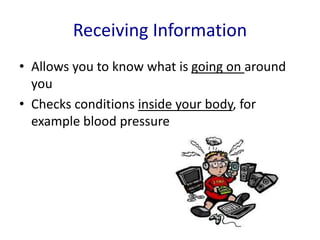
Receiving Information
• Allows you to know what is going on around
you
• Checks conditions inside your body, for
example blood pressure
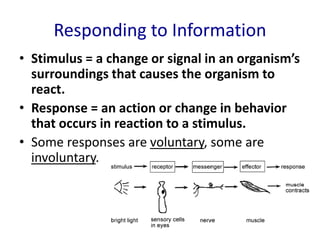
Responding to Information
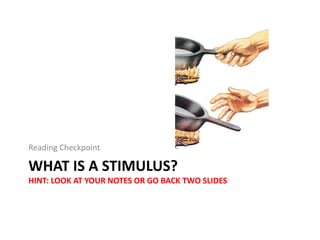
• Stimulus = a change or signal in an organism’s
surroundings that causes the organism to
react.
• Response = an action or change in behavior
that occurs in reaction to a stimulus.
• Some responses are voluntary, some are
involuntary.
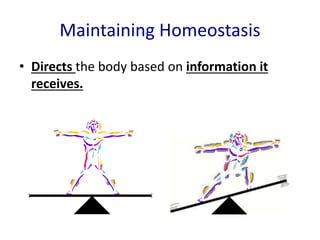
Maintaining Homeostasis
• Directs the body based on information it
receives.
WHAT IS A STIMULUS?
HINT: LOOK AT YOUR NOTES OR GO BACK TWO SLIDES
Reading Checkpoint
The Neuron
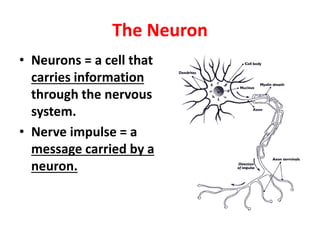
• Neurons = a cell that
carries information
through the nervous
system.
• Nerve impulse = a
message carried by a
neuron.
The Structure of a Neuron
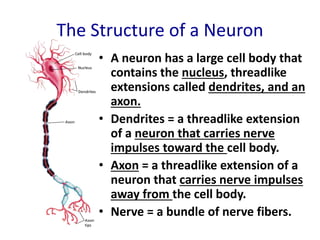
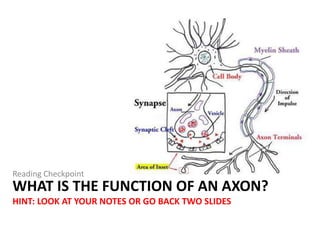
• A neuron has a large cell body that
contains the nucleus, threadlike
extensions called dendrites, and an
axon.
• Dendrites = a threadlike extension
of a neuron that carries nerve
impulses toward the cell body.
• Axon = a threadlike extension of a
neuron that carries nerve impulses
away from the cell body.
• Nerve = a bundle of nerve fibers.
Kinds of Neurons
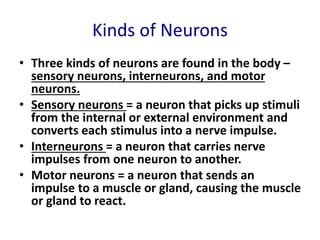
• Three kinds of neurons are found in the body –
sensory neurons, interneurons, and motor
neurons.
• Sensory neurons = a neuron that picks up stimuli
from the internal or external environment and
converts each stimulus into a nerve impulse.
• Interneurons = a neuron that carries nerve
impulses from one neuron to another.
• Motor neurons = a neuron that sends an
impulse to a muscle or gland, causing the muscle
or gland to react.
WHAT IS THE FUNCTION OF AN AXON?
HINT: LOOK AT YOUR NOTES OR GO BACK TWO SLIDES
Reading Checkpoint
How a Nerve Pulse Travels
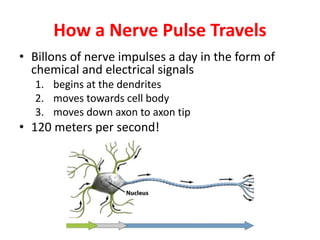
• Billons of nerve impulses a day in the form of
chemical and electrical signals
1. begins at the dendrites
2. moves towards cell body
3. moves down axon to axon tip
• 120 meters per second!
The Synapse
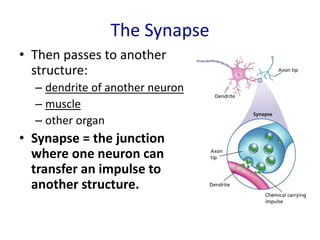
• Then passes to another
structure:
– dendrite of another neuron
– muscle
– other organ
• Synapse = the junction
where one neuron can
transfer an impulse to
another structure.
How an Impulse is Transferred
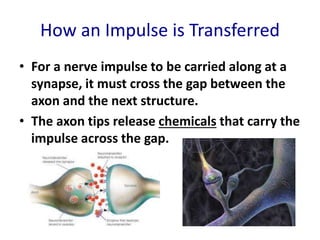
• For a nerve impulse to be carried along at a
synapse, it must cross the gap between the
axon and the next structure.
• The axon tips release chemicals that carry the
impulse across the gap.
15.1 lecture 2019

15.1 lecture 2019

  • 1.
    Chapter 15 TheNervous System What does it mean when someone says that something makes them nervous?
  • 2.
    15.1 Lecture How thenervous system works?
  • 3.
    Section 1: Howthe Nervous System Works What are the functions of the nervous system? What is the structure of a neuron and what kinds of neurons are found in the body? How do nerve impulses travel from one neuron to another? • 7.5.b• 7.5.b Students know organ systems function because of the contributions of individual organs, tissues, and cells. The failure of any part can affect the entire system.
  • 4.
    Functions of theNervous System • Includes the brain, spinal chord, and nerves that run throughout the body. – It also includes sense organs, such as the eyes and ears. • Communication network • The nervous system receives information about what is happening both inside and outside your body. • It also directs the way in which your body responds to this information. • In addition, your nervous system helps maintain homeostasis.
  • 5.
    Receiving Information • Allowsyou to know what is going on around you • Checks conditions inside your body, for example blood pressure
  • 6.
    Responding to Information •Stimulus = a change or signal in an organism’s surroundings that causes the organism to react. • Response = an action or change in behavior that occurs in reaction to a stimulus. • Some responses are voluntary, some are involuntary.
  • 7.
    Maintaining Homeostasis • Directsthe body based on information it receives.
  • 8.
    WHAT IS ASTIMULUS? HINT: LOOK AT YOUR NOTES OR GO BACK TWO SLIDES Reading Checkpoint
  • 9.
    The Neuron • Neurons= a cell that carries information through the nervous system. • Nerve impulse = a message carried by a neuron.
  • 10.
    The Structure ofa Neuron • A neuron has a large cell body that contains the nucleus, threadlike extensions called dendrites, and an axon. • Dendrites = a threadlike extension of a neuron that carries nerve impulses toward the cell body. • Axon = a threadlike extension of a neuron that carries nerve impulses away from the cell body. • Nerve = a bundle of nerve fibers.
  • 11.
    Kinds of Neurons •Three kinds of neurons are found in the body – sensory neurons, interneurons, and motor neurons. • Sensory neurons = a neuron that picks up stimuli from the internal or external environment and converts each stimulus into a nerve impulse. • Interneurons = a neuron that carries nerve impulses from one neuron to another. • Motor neurons = a neuron that sends an impulse to a muscle or gland, causing the muscle or gland to react.
  • 12.
    WHAT IS THEFUNCTION OF AN AXON? HINT: LOOK AT YOUR NOTES OR GO BACK TWO SLIDES Reading Checkpoint
  • 13.
    How a NervePulse Travels • Billons of nerve impulses a day in the form of chemical and electrical signals 1. begins at the dendrites 2. moves towards cell body 3. moves down axon to axon tip • 120 meters per second!
  • 14.
    The Synapse • Thenpasses to another structure: – dendrite of another neuron – muscle – other organ • Synapse = the junction where one neuron can transfer an impulse to another structure.
  • 15.
    How an Impulseis Transferred • For a nerve impulse to be carried along at a synapse, it must cross the gap between the axon and the next structure. • The axon tips release chemicals that carry the impulse across the gap.

Editor's Notes

  • #2 anxious, worried – different ways we react to our environment – nervous system allows people to react in different ways
  • #3 Why do you need to communicate when you play team sports? coach needs to call plays, players need to signal with one another
  • #6 fly buzzing around friend telling a joke
  • #7 buzzing fly – swat the fly see a baseball – catch it if you touched a hot object what would be the stimulus, what would be the response? heat from the object, jerking hand away when you run, how does your breathing change? breath faster and deeper
  • #8 hungry – eat soccer – adjust breathing and heart rate throughout the game
  • #9 a change or signal in the environment to which you react
  • #11 enables it to carry nerve impulses impulses begin at the dendrite many dendrites, only one axon