What We’ll Provide!
●Lectures
● Top 25 Questions
● Sample Papers
(NCERT Exercises Included)
4.
Topics We’ll Cover!
●Human Nervous System
● Peripheral Nervous System
● Neurons
● Brain
● Spinal Cord
● Three types of Responses
● Glands
● Pancreas
● Control and Coordination in Plants
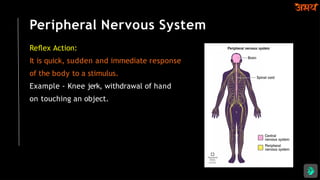
Peripheral Nervous System
ReflexAction:
It is quick, sudden and immediate response
of the body to a stimulus.
Example - Knee jerk, withdrawal of hand
on touching an object.
8.
Peripheral Nervous System
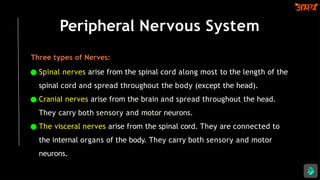
Threetypes of Nerves:
● Spinal nerves arise from the spinal cord along most to the length of the
spinal cord and spread throughout the body (except the head).
● Cranial nerves arise from the brain and spread throughout the head.
They carry both sensory and motor neurons.
● The visceral nerves arise from the spinal cord. They are connected to
the internal organs of the body. They carry both sensory and motor
neurons.
9.
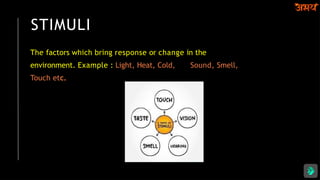
STIMULI
The factors whichbring response or change in the
environment. Example : Light, Heat, Cold, Sound, Smell,
Touch etc.
10.
Receptor and
E ector
ff
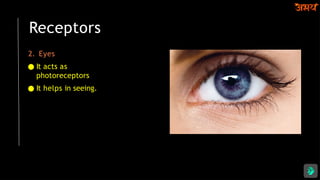
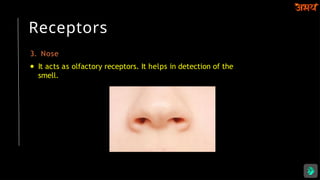
●A receptor is a cell (or a group of cells) in a sense organ which is sensitive to
a particular type of stimulus. Example: Nose and ears.
● An e ector
ff is a part of the body which can respond to a stimulus according to
the instructions sent from the nervous system (spinal cord and brain).
Example: Glands and muscles.
11.
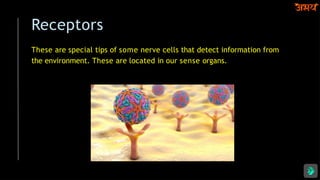
Receptors
These are specialtips of some nerve cells that detect information from
the environment. These are located in our sense organs.
12.
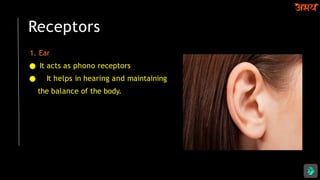
Receptors
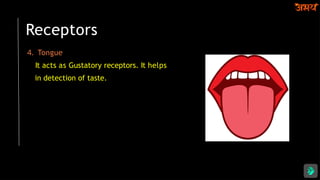
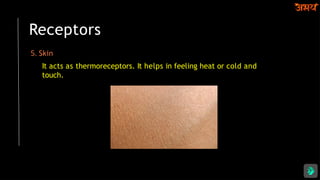
1. Ear
● Itacts as phono receptors
● It helps in hearing and maintaining
the balance of the body.
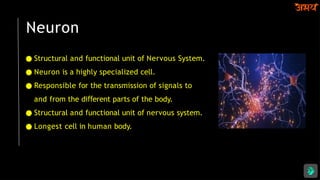
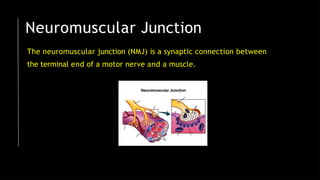
Neuron
● Structural andfunctional unit of Nervous System.
● Neuron is a highly specialized cell.
● Responsible for the transmission of signals to
and from the di erent
ff parts of the body.
● Structural and functional unit of nervous system.
● Longest cell in human body.
20.
Neuron
Parts of Neuron:
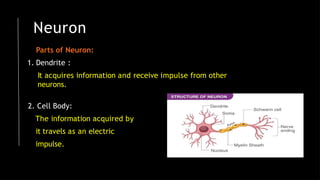
1.Dendrite :
It acquires information and receive impulse from other
neurons.
2. Cell Body:
The information acquired by
it travels as an electric
impulse.
21.
Neuron
Parts of Neuron:
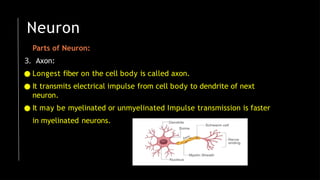
3.Axon:
● Longest fiber on the cell body is called axon.
● It transmits electrical impulse from cell body to dendrite of next
neuron.
● It may be myelinated or unmyelinated Impulse transmission is faster
in myelinated neurons.
22.
Functions of Neuron
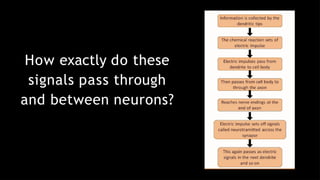
●The information or signals from receptors is acquired at the end of the
dendritic tip of a nerve cell as chemical reaction that creates an
electric impulse.
● This impulse travels from the dendrite to the cell body and then at the
end of the axon.
● There is a gap between two neurons called (Synapse ). These
chemicals cross the gap and transfers the same signal to next neuron.
● Chemicals are released at the end of the the axon by the e ect
ff of
electrical impulse.
23.
How exactly dothese
signals pass through
and between neurons?
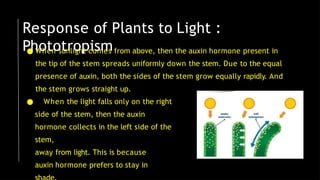
24.
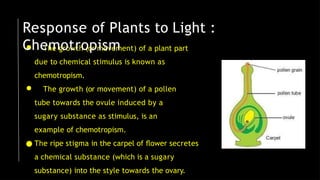
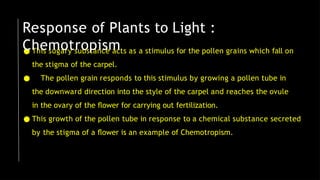
Nerve Impulse
● Nerveimpulses are wave of electrical and chemical signals carried
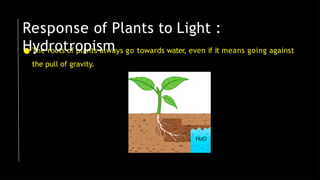
along nerves or neurons.
● Nerve impulses are initiated at receptor cells as a result of stimuli from
the environment.
25.
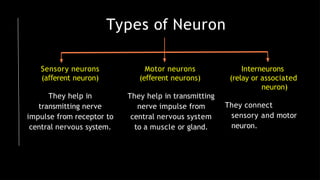
Types of Neuron
Sensoryneurons
(a erent
ff neuron)
They help in
transmitting nerve
impulse from receptor to
central nervous system.
Motor neurons
(e erent
ff neurons)
They help in transmitting
nerve impulse from
central nervous system
to a muscle or gland.
Interneurons
(relay or associated
neuron)
They connect
sensory and motor
neuron.
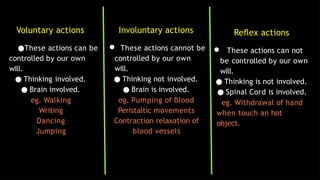
Voluntary actions
●These actionscan be
controlled by our own
will.
● Thinking involved.
● Brain involved.
eg. Walking
Writing
Dancing
Jumping
Involuntary actions
● These actions cannot be
controlled by our own
will.
● Thinking not involved.
● Brain is involved.
eg. Pumping of Blood
Peristaltic movements
Contraction relaxation of
blood vessels
Reflex actions
● These actions can not
be controlled by our own
will.
● Thinking is not involved.
● Spinal Cord is involved.
eg. Withdrawal of hand
when touch an hot
object.
28.
Brain
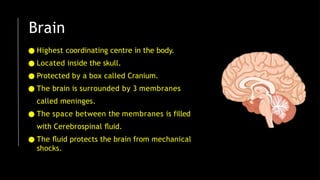
● Highest coordinatingcentre in the body.
● Located inside the skull.
● Protected by a box called Cranium.
● The brain is surrounded by 3 membranes
called meninges.
● The space between the membranes is filled
with Cerebrospinal fluid.
● The fluid protects the brain from mechanical
shocks.
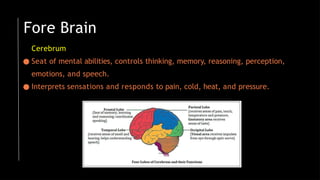
Fore Brain
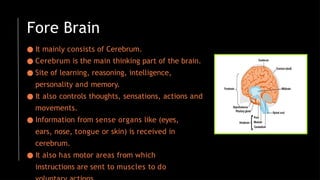
● Itmainly consists of Cerebrum.
● Cerebrum is the main thinking part of the brain.
● Site of learning, reasoning, intelligence,
personality and memory.
● It also controls thoughts, sensations, actions and
movements.
● Information from sense organs like (eyes,
ears, nose, tongue or skin) is received in
cerebrum.
● It also has motor areas from which
instructions are sent to muscles to do
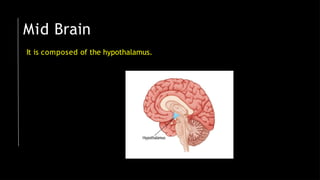
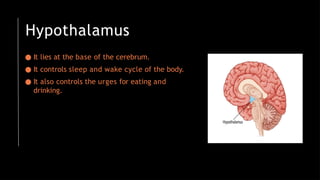
Hypothalamus
● It liesat the base of the cerebrum.
● It controls sleep and wake cycle of the body.
● It also controls the urges for eating and
drinking.
35.
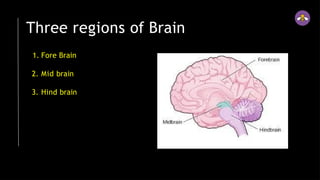
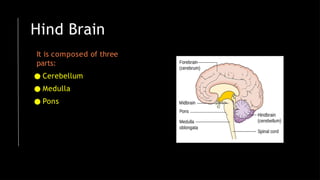
Hind Brain
It iscomposed of three
parts:
● Cerebellum
● Medulla
● Pons
36.
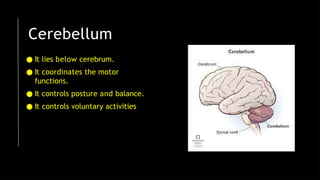
Cerebellum
● It liesbelow cerebrum.
● It coordinates the motor
functions.
● It controls posture and balance.
● It controls voluntary activities
37.
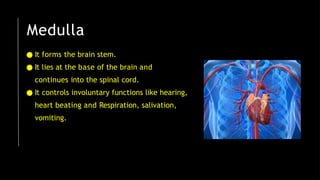
Medulla
● It formsthe brain stem.
● It lies at the base of the brain and
continues into the spinal cord.
● It controls involuntary functions like hearing,
heart beating and Respiration, salivation,
vomiting.
38.
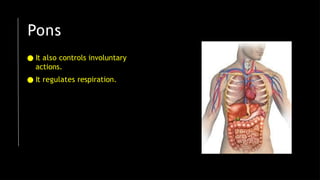
Pons
● It alsocontrols involuntary
actions.
● It regulates respiration.
39.
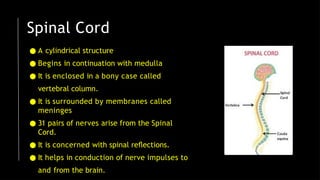
Spinal Cord
● Acylindrical structure
● Begins in continuation with medulla
● It is enclosed in a bony case called
vertebral column.
● It is surrounded by membranes called
meninges
● 31 pairs of nerves arise from the Spinal
Cord.
● It is concerned with spinal reflections.
● It helps in conduction of nerve impulses to
and from the brain.
40.
Q. How arenervous organs protected?
1. Protection of Brain:
● The brain is placed in a bony box called cranium and is a part of the skull.
● Brain is wrapped in three separate membranes called meninges.
● The space present between these layers is filled with cerebro-spinal
fluid(CSF).
● This fluid-filled balloon acts as a shock absorber/ spring/ cushion and
protects the brain from injuries and shocks.
41.
2.Protection of SpinalCord :
● Like brain, spinal cord is also wrapped in spinal meninges and consist
of Cerebrospinal fluid.
● The spinal cord is protected by the vertebral column or backbone.
● The vertebral column is formed by 33 individual bones called
vertebrae.
42.
Reflex Arc
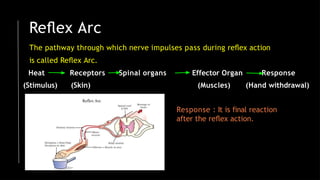
The pathwaythrough which nerve impulses pass during reflex action
is called Reflex Arc.
Heat
(Stimulus)
Receptors Spinal organs
(Skin)
Effector Organ Response
(Muscles) (Hand withdrawal)
Response : It is final reaction
after the reflex action.
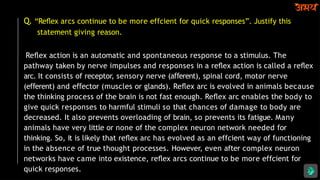
Q. “Reflex arcscontinue to be more effcient for quick responses”. Justify this
statement giving reason.
Reflex action is an automatic and spontaneous response to a stimulus. The
pathway taken by nerve impulses and responses in a reflex action is called a reflex
arc. It consists of receptor, sensory nerve (a erent),
ff spinal cord, motor nerve
(e erent)
ff and e ector
ff (muscles or glands). Reflex arc is evolved in animals because
the thinking process of the brain is not fast enough. Reflex arc enables the body to
give quick responses to harmful stimuli so that chances of damage to body are
decreased. It also prevents overloading of brain, so prevents its fatigue. Many
animals have very little or none of the complex neuron network needed for
thinking. So, it is likely that reflex arc has evolved as an effcient way of functioning
in the absence of true thought processes. However, even after complex neuron
networks have came into existence, reflex arcs continue to be more effcient for
quick responses.
45.
Q. How doesprocess of reflex action take place in human body?
The process of reflex action is like
● The stimuli is sensed by the sensory receptors and sensory neurons
generate impulses.
● These impulses reach the spinal cord
● The relay neuron in the spinal cord passes signals between neurons.
● The motor neurons pass the signals for response to the organ that needs
to respond to stimulus.
The information input also goes on to reach the brain. But it is not involved
in reflex action.
46.
Q. What isthe role of the brain in reflex action?
There is no direct involvement of brain in reflex actions.
When Reflex actions are generated in spinal cord the information also
reaches brain. This helps the brain to record this event and remember it
for future use.
Brain helps the person to get awareness of the stimulus and prevent himself
from that situation again in the future.
47.
Q. Which ofthe following does not involve thinking?
A. Peristaltic movement
B. Dancing
C. Withdrawing hand after touching hot
surface
D. Both A and C
48.
Q. Brain isa part
of?
A. CNS
B. PNS
C. Reflex Action
D. All of these
49.
Q. Which neuronlinks sensory and motor neurons?
A. NMJ
B. Neurotransmitter
C. Relay neuron
D. None of these
50.
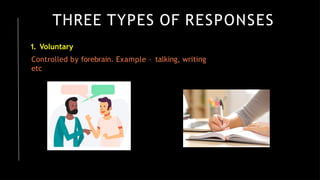
THREE TYPES OFRESPONSES
1. Voluntary
Controlled by forebrain. Example – talking, writing
etc
51.
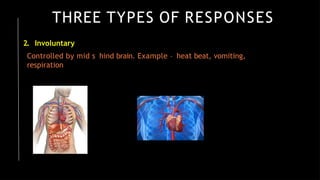
THREE TYPES OFRESPONSES
2. Involuntary
Controlled by mid s hind brain. Example – heat beat, vomiting,
respiration
52.
THREE TYPES OFRESPONSES
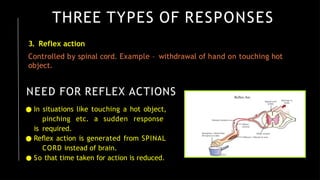
3. Reflex action
Controlled by spinal cord. Example – withdrawal of hand on touching hot
object.
NEED FOR REFLEX ACTIONS
● In situations like touching a hot object,
pinching etc. a sudden response
is required.
● Reflex action is generated from SPINAL
CORD instead of brain.
● So that time taken for action is reduced.
53.
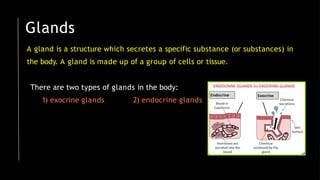
Glands
A gland isa structure which secretes a specific substance (or substances) in
the body. A gland is made up of a group of cells or tissue.
There are two types of glands in the body:
1) exocrine glands 2) endocrine glands
54.
Glands
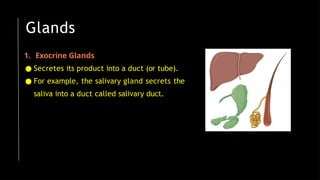
1. Exocrine Glands
●Secretes its product into a duct (or tube).
● For example, the salivary gland secrets the
saliva into a duct called salivary duct.
55.
Glands
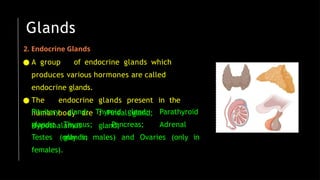
2. Endocrine Glands
●A group of endocrine glands which
produces various hormones are called
endocrine glands.
● The endocrine glands present in the
human body are : Pineal gland;
Hypothalamus gland;
Pituitary
glands;
gland; Thyroid gland; Parathyroid
Thymus; Pancreas; Adrenal
glands;
Testes (only in males) and Ovaries (only in
females).
56.
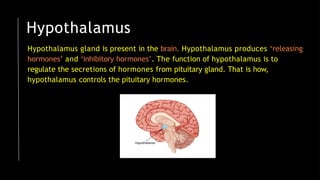
Hypothalamus
Hypothalamus gland ispresent in the brain. Hypothalamus produces ‘releasing
hormones’ and ‘inhibitory hormones’. The function of hypothalamus is to
regulate the secretions of hormones from pituitary gland. That is how,
hypothalamus controls the pituitary hormones.
57.
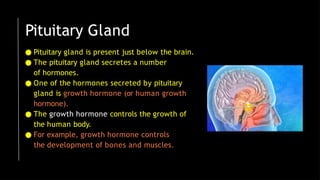
Pituitary Gland
● Pituitarygland is present just below the brain.
● The pituitary gland secretes a number
of hormones.
● One of the hormones secreted by pituitary
gland is growth hormone (or human growth
hormone).
● The growth hormone controls the growth of
the human body.
● For example, growth hormone controls
the development of bones and muscles.
58.
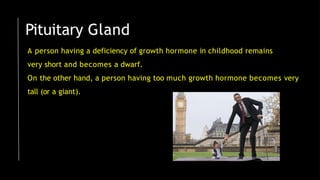
Pituitary Gland
A personhaving a deficiency of growth hormone in childhood remains
very short and becomes a dwarf.
On the other hand, a person having too much growth hormone becomes very
tall (or a giant).
59.
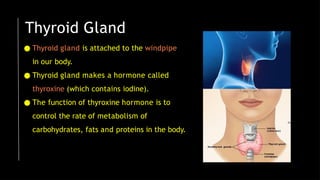
Thyroid Gland
● Thyroidgland is attached to the windpipe
in our body.
● Thyroid gland makes a hormone called
thyroxine (which contains iodine).
● The function of thyroxine hormone is to
control the rate of metabolism of
carbohydrates, fats and proteins in the body.
60.
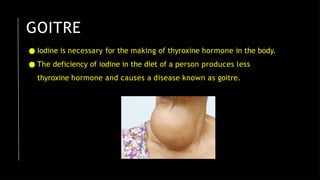
GOITRE
● Iodine isnecessary for the making of thyroxine hormone in the body.
● The deficiency of iodine in the diet of a person produces less
thyroxine hormone and causes a disease known as goitre.
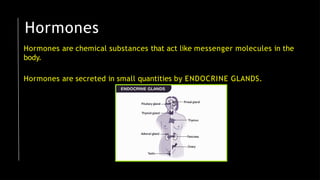
Hormones
Hormones are chemicalsubstances that act like messenger molecules in the
body.
Hormones are secreted in small quantities by ENDOCRINE GLANDS.
63.
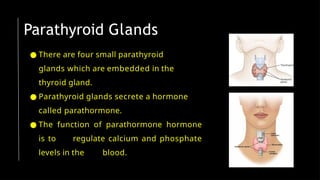
Parathyroid Glands
● Thereare four small parathyroid
glands which are embedded in the
thyroid gland.
● Parathyroid glands secrete a hormone
called parathormone.
● The function of parathormone hormone
is to regulate calcium and phosphate
levels in the blood.
64.
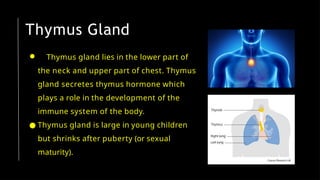
Thymus Gland
● Thymusgland lies in the lower part of
the neck and upper part of chest. Thymus
gland secretes thymus hormone which
plays a role in the development of the
immune system of the body.
● Thymus gland is large in young children
but shrinks after puberty (or sexual
maturity).
65.
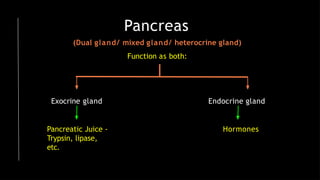
Pancreas
(Dual gland/ mixedgland/ heterocrine gland)
Function as both:
Exocrine gland Endocrine gland
Pancreatic Juice -
Trypsin, lipase,
etc.
Hormones
66.
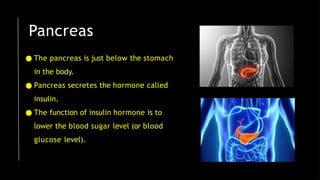
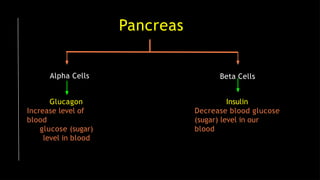
Pancreas
● The pancreasis just below the stomach
in the body.
● Pancreas secretes the hormone called
insulin.
● The function of insulin hormone is to
lower the blood sugar level (or blood
glucose level).
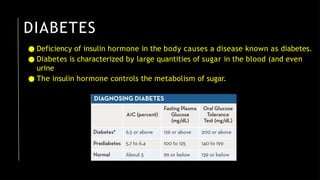
DIABETES
● Deficiency ofinsulin hormone in the body causes a disease known as diabetes.
● Diabetes is characterized by large quantities of sugar in the blood (and even
urine
● The insulin hormone controls the metabolism of sugar.
69.
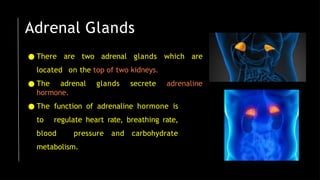
Adrenal Glands
● Thereare two adrenal glands which are
located on the top of two kidneys.
● The adrenal glands secrete adrenaline
hormone.
● The function of adrenaline hormone is
to regulate heart rate, breathing rate,
blood pressure and carbohydrate
metabolism.
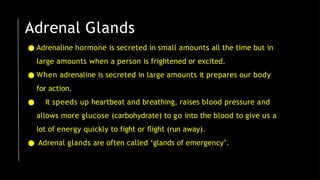
70.
● Adrenaline hormoneis secreted in small amounts all the time but in
large amounts when a person is frightened or excited.
● When adrenaline is secreted in large amounts it prepares our body
for action.
● It speeds up heartbeat and breathing, raises blood pressure and
allows more glucose (carbohydrate) to go into the blood to give us a
lot of energy quickly to fight or flight (run away).
● Adrenal glands are often called ‘glands of emergency’.
Adrenal Glands
71.
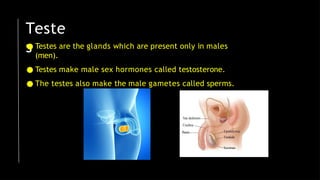
Teste
s
● Testes arethe glands which are present only in males
(men).
● Testes make male sex hormones called testosterone.
● The testes also make the male gametes called sperms.
72.
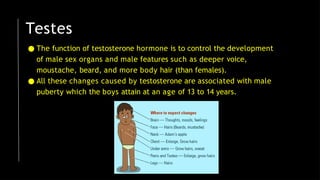
● The functionof testosterone hormone is to control the development
of male sex organs and male features such as deeper voice,
moustache, beard, and more body hair (than females).
● All these changes caused by testosterone are associated with male
puberty which the boys attain at an age of 13 to 14 years.
Testes
73.
Ovaries
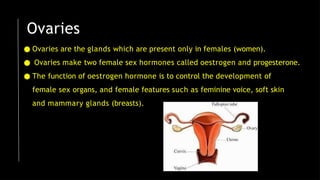
● Ovaries arethe glands which are present only in females (women).
● Ovaries make two female sex hormones called oestrogen and progesterone.
● The function of oestrogen hormone is to control the development of
female sex organs, and female features such as feminine voice, soft skin
and mammary glands (breasts).
74.
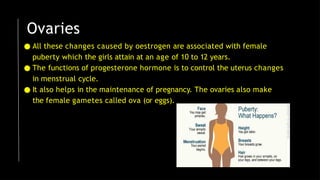
● All thesechanges caused by oestrogen are associated with female
puberty which the girls attain at an age of 10 to 12 years.
● The functions of progesterone hormone is to control the uterus changes
in menstrual cycle.
● It also helps in the maintenance of pregnancy. The ovaries also make
the female gametes called ova (or eggs).
Ovaries
75.
Feedback Mechanism
● Theexcess or deficiency of
hormones has a harmful e ect
ff on
our body.
● For example, the deficiency of insulin
hormone results in a disease called
diabetes whereas excess of insulin
in the body can lead to coma.
76.
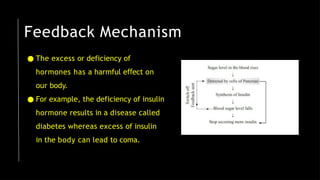
● The timingand amount of hormones released by various glands are
controlled by the ‘feedback mechanism’ which is in-built in our body.
For example, if the sugar level in the blood rises too much, they are
detected by the cells of pancreas which respond by producing and
secreting more insulin into blood. And as the blood sugar falls to a
certain level, the secretion of insulin is reduced automatically.
Feedback Mechanism
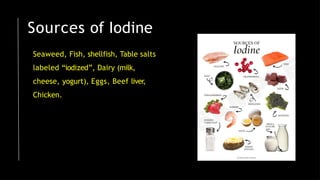
Q. Why isit advised to use iodised salt in our diet ?
Iodine stimulates the thyroid gland to produce thyroxine hormone. Deficiency
of this hormone results in the enlargement of the thyroid gland. This can
lead to goitre.
Feedback Mechanism - The timing and amount of hormone released in our
body is controlled by a mechanism called the feedback mechanism. It keeps
the secretion of hormones from glands in appropriate quantity. Eg- if sugar
levels in the blood rise, the insulin hormone is secreted by the pancreas and
if it falls then glycogen is broken down.
79.
Q. How doesour body respond when adrenaline is secreted into the blood?
It is secreted by the adrenal gland. At the time of emergency or stress, it is
released in large quantities. As a result, the heartbeat increases which result
in more supply of oxygen in muscles. All these responses together help the
animal to deal with an emergency.
80.
Q. Why isit advised to use iodised salt in our diet ?
All hormones secreted in our body are required in the appropriate amount.
Slightly more or less can lead to diff disorders.
Dwarfism- Growth hormone is responsible for regular growth and development
of the body. A deficiency of this leads to dwarfism.
Gigantism- Excess secretion of growth hormone leads to an abnormal
condition known as gigantism.
Goiter- Iodine is essential for releasing thyroxine hormone. In case, iodine is
deficient in the body, there occurs the possibility of goiter. One of the
major symptoms is a swollen neck.
Diabetes- It occurs when less amount of insulin is secreted by the pancreas. In
this condition, sugar is accumulated in the body causing harmful e ects.
ff
81.
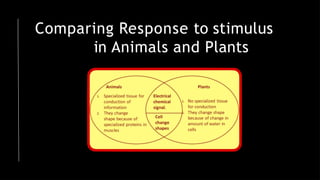
Control and Coordinationin
Plants
Movements Hormones
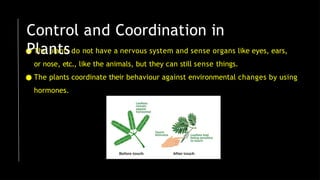
● The plants do not have a nervous system and sense organs like eyes, ears,
or nose, etc., like the animals, but they can still sense things.
● The plants coordinate their behaviour against environmental changes by using
hormones.
82.
● The plantsdo not have a nervous system and sense organs like eyes, ears,
or nose, etc., like the animals, but they can still sense things.
● The plants coordinate their behaviour against environmental changes by using
hormones.
Control and Coordination in
Plants
83.
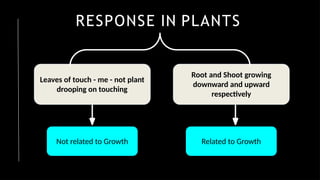
RESPONSE IN PLANTS
Leavesof touch - me - not plant
drooping on touching
Root and Shoot growing
downward and upward
respectively
Not related to Growth Related to Growth
Plant Hormones (Phytohormones)
●The control and coordination in plants is done by plant hormones
(or phytohormones).
● The growth of a plant can be divided into three stages:
1.Cell division
2.Cell enlargement
3.Cell di erentiation
ff (or cell specialization)
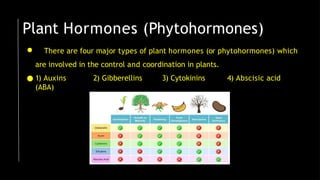
86.
● There arefour major types of plant hormones (or phytohormones) which
are involved in the control and coordination in plants.
● 1) Auxins 2) Gibberellins 3) Cytokinins 4) Abscisic acid
(ABA)
Plant Hormones (Phytohormones)
87.
1.Auxins
● Auxins arethe plant hormones which promote cell enlargement and
cell di erentiation
ff in plants. Auxins also promote fruit growth.
● Auxin hormone controls a plant’s response to light and gravity.
● Auxin is made by cells at the tip of stems and roots.
● Auxin moves away from light, and towards gravity.
● Auxin speeds up growth in stem but it slows down growth in roots.
● Synthetic auxins are applied in agriculture and horticulture.
Plant Hormones (Phytohormones)
88.
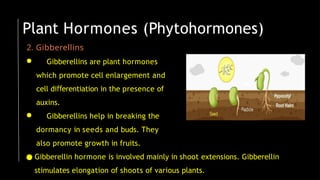
2. Gibberellins
● Gibberellinsare plant hormones
which promote cell enlargement and
cell di erentiation
ff in the presence of
auxins.
● Gibberellins help in breaking the
dormancy in seeds and buds. They
also promote growth in fruits.
● Gibberellin hormone is involved mainly in shoot extensions. Gibberellin
stimulates elongation of shoots of various plants.
Plant Hormones (Phytohormones)
89.
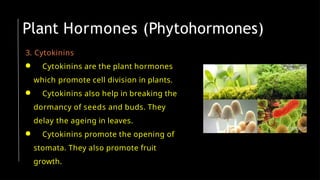
3. Cytokinins
● Cytokininsare the plant hormones
which promote cell division in plants.
● Cytokinins also help in breaking the
dormancy of seeds and buds. They
delay the ageing in leaves.
● Cytokinins promote the opening of
stomata. They also promote fruit
growth.
Plant Hormones (Phytohormones)
90.
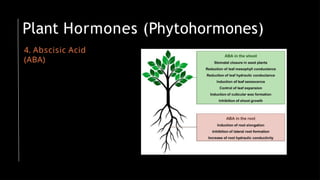
4. Abscisic Acid(ABA)
● Abscisic acid is a plant hormone which functions mainly as a
growth inhibitor.
● It promotes the dormancy in seeds and buds (this is the opposite
of breaking of dormancy). It also promotes the closing of stomata.
● It promotes the wilting and falling of leaves (which is called
abscission). It also causes the detachment of flowers and fruits from
the plants.
Plant Hormones (Phytohormones)
TROPISMS (OR TROPIC
MOVEMENTS)
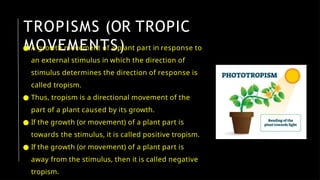
●A growth movement of a plant part in response to
an external stimulus in which the direction of
stimulus determines the direction of response is
called tropism.
● Thus, tropism is a directional movement of the
part of a plant caused by its growth.
● If the growth (or movement) of a plant part is
towards the stimulus, it is called positive tropism.
● If the growth (or movement) of a plant part is
away from the stimulus, then it is called negative
tropism.
93.
TYPES OF
TROPISMS
1.Phototropism:
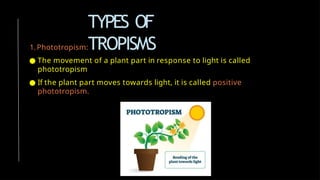
● Themovement of a plant part in response to light is called
phototropism
● If the plant part moves towards light, it is called positive
phototropism.
94.
Types of Tropisms
1.Phototropism:
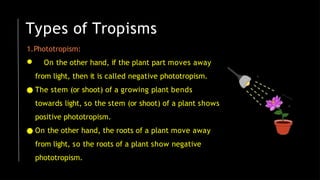
●On the other hand, if the plant part moves away
from light, then it is called negative phototropism.
● The stem (or shoot) of a growing plant bends
towards light, so the stem (or shoot) of a plant shows
positive phototropism.
● On the other hand, the roots of a plant move away
from light, so the roots of a plant show negative
phototropism.
95.
2.Geotropism
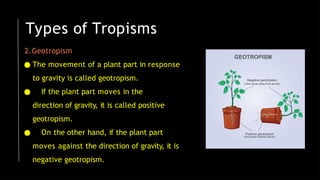
● The movementof a plant part in response
to gravity is called geotropism.
● If the plant part moves in the
direction of gravity, it is called positive
geotropism.
● On the other hand, if the plant part
moves against the direction of gravity, it is
negative geotropism.
Types of Tropisms
96.
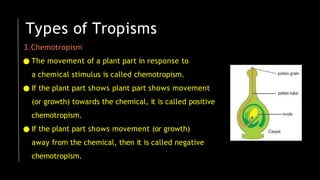
3.Chemotropism
● The movementof a plant part in response to
a chemical stimulus is called chemotropism.
● If the plant part shows plant part shows movement
(or growth) towards the chemical, it is called positive
chemotropism.
● If the plant part shows movement (or growth)
away from the chemical, then it is called negative
chemotropism.
Types of Tropisms
97.
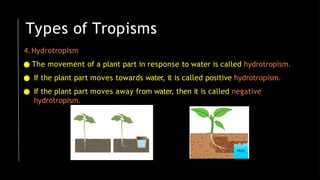
4.Hydrotropism
● The movementof a plant part in response to water is called hydrotropism.
● If the plant part moves towards water, it is called positive hydrotropism.
● If the plant part moves away from water, then it is called negative
hydrotropism.
Types of Tropisms
98.
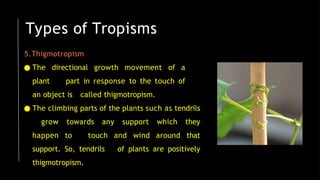
5.Thigmotropism
● The directionalgrowth movement of a
plant part in response to the touch of
an object is called thigmotropism.
● The climbing parts of the plants such as tendrils
grow towards any support which they
happen to touch and wind around that
support. So, tendrils of plants are positively
thigmotropism.
Types of Tropisms
99.
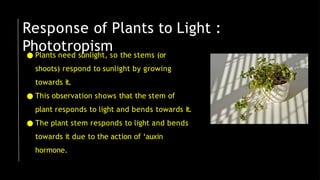
Response of Plantsto Light :
Phototropism
● Plants need sunlight, so the stems (or
shoots) respond to sunlight by growing
towards it.
● This observation shows that the stem of
plant responds to light and bends towards it.
● The plant stem responds to light and bends
towards it due to the action of ‘auxin
hormone.
100.
● When sunlightcomes from above, then the auxin hormone present in
the tip of the stem spreads uniformly down the stem. Due to the equal
presence of auxin, both the sides of the stem grow equally rapidly. And
the stem grows straight up.
● When the light falls only on the right
side of the stem, then the auxin
hormone collects in the left side of the
stem,
away from light. This is because
auxin hormone prefers to stay in
Response of Plants to Light :
Phototropism
101.
● The growth(or movement) of a plant part
due to chemical stimulus is known as
chemotropism.
● The growth (or movement) of a pollen
tube towards the ovule induced by a
sugary substance as stimulus, is an
example of chemotropism.
● The ripe stigma in the carpel of flower secretes
a chemical substance (which is a sugary
substance) into the style towards the ovary.
Response of Plants to Light :
Chemotropism
102.
● This sugarysubstance acts as a stimulus for the pollen grains which fall on
the stigma of the carpel.
● The pollen grain responds to this stimulus by growing a pollen tube in
the downward direction into the style of the carpel and reaches the ovule
in the ovary of the flower for carrying out fertilization.
● This growth of the pollen tube in response to a chemical substance secreted
by the stigma of a flower is an example of Chemotropism.
Response of Plants to Light :
Chemotropism
103.
● The rootsof plants always go towards water, even if it means going against
the pull of gravity.
Response of Plants to Light :
Hydrotropism
104.
Thigmotropism
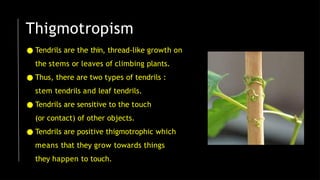
● Tendrils arethe thin, thread-like growth on
the stems or leaves of climbing plants.
● Thus, there are two types of tendrils :
stem tendrils and leaf tendrils.
● Tendrils are sensitive to the touch
(or contact) of other objects.
● Tendrils are positive thigmotrophic which
means that they grow towards things
they happen to touch.
105.
Nasties (OR NasticMovements)
● The movement of a plant part in response to an external stimulus in which
the direction of response is not determined by the direction of stimulus is
called nastic movement.
● The folding up of the leaves of a sensitive plant (Mimosa pudica) on
touching is an example of nastic movement. Here the stimulus is touch.
106.
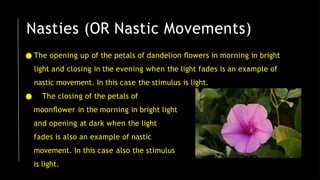
● The openingup of the petals of dandelion flowers in morning in bright
light and closing in the evening when the light fades is an example of
nastic movement. In this case the stimulus is light.
● The closing of the petals of
moonflower in the morning in bright light
and opening at dark when the light
fades is also an example of nastic
movement. In this case also the stimulus
is light.
Nasties (OR Nastic Movements)
108.
Thigmonasty
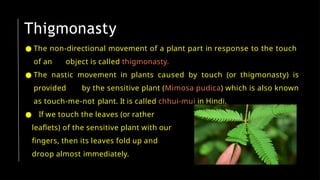
● The non-directionalmovement of a plant part in response to the touch
of an object is called thigmonasty.
● The nastic movement in plants caused by touch (or thigmonasty) is
provided by the sensitive plant (Mimosa pudica) which is also known
as touch-me-not plant. It is called chhui-mui in Hindi.
● If we touch the leaves (or rather
leaflets) of the sensitive plant with our
fingers, then its leaves fold up and
droop almost immediately.
109.
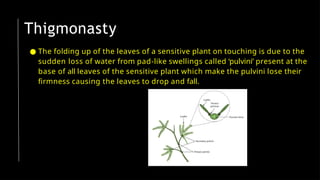
● The foldingup of the leaves of a sensitive plant on touching is due to the
sudden loss of water from pad-like swellings called ‘pulvini’ present at the
base of all leaves of the sensitive plant which make the pulvini lose their
firmness causing the leaves to drop and fall.
Thigmonasty
110.
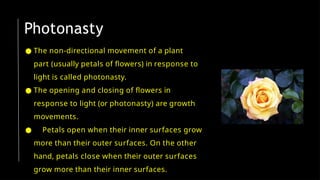
● The non-directionalmovement of a plant
part (usually petals of flowers) in response to
light is called photonasty.
● The opening and closing of flowers in
response to light (or photonasty) are growth
movements.
● Petals open when their inner surfaces grow
more than their outer surfaces. On the other
hand, petals close when their outer surfaces
grow more than their inner surfaces.
Photonasty
111.
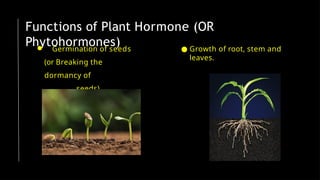
Functions of PlantHormone (OR
Phytohormones)
● Germination of seeds
(or Breaking the
dormancy of
seeds).
● Growth of root, stem and
leaves.
112.
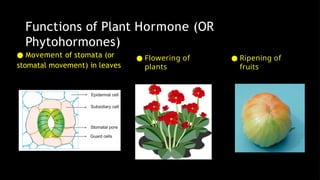
● Flowering of
plants
●Movement of stomata (or
stomatal movement) in leaves
● Ripening of
fruits
Functions of Plant Hormone (OR
Phytohormones)