Controlling Memory Footprint at All Layers:
         Linux Kernel, Applications,
          Libraries, and Toolchain


                      Xi Wang
                Broadcom Corporation


         Embedded Linux Conference 2011
Introduction
●   Search with more breadth and depth
     –   Visit more layers
           ●   This talk is not about vmlinux or kmalloc
     –   Not just reducing size. Goal is to add features
         without adding memory
           ●   E.g. improve system performance under low memory
               situation

●   About medium-sized embedded systems
     –   With DRAM + Flash, no swap partition
     –   Lightly configured kernel image fits in comfortably,
         but need more space for everything else
     –   Based on 2.6.2x, let me know if there are new
         changes
Introduction
                                                                              Kernel Dynamic Memory


                                    SLAB                                           Kernel Dynamic Data
                                                kmalloc
                                   Allocator
                                  (SLOB/SLUB
All Physical Memory                 Optional)
(Embedded System, ignoring
   Zones, NUMA here)                                                            Kernel Module Code Segment
                                                          vmalloc


                                                                                User Space Memory
                             alloc_pages
                                                                                       Environment

       Paged Memory                                                                       Stack

                                       Buddy                                         Shared Memory
                                       System
                                      Allocator
                               Reserved
                                Atomic                                                    Heap
                               Memory
         Early Statically
        Allocated Memory
                                                             Virtual Memory
      (add_memory_region)
                                                              Management
                                     Page
                                    Cache
                                    Reclaim                                          Shared Libraries
      Kernel Code and
        Static Data
         (vmlinux)


                                                                                          Code
Kernel Memory Lifecycle
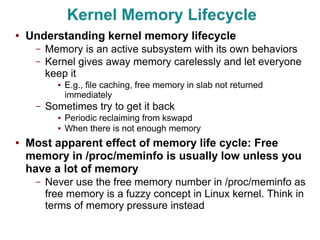
●   Understanding kernel memory lifecycle
     –   Memory is an active subsystem with its own behaviors
     –   Kernel gives away memory carelessly and let everyone
         keep it
           ●   E.g., file caching, free memory in slab not returned
               immediately
     –   Sometimes try to get it back
           ●   Periodic reclaiming from kswapd
           ●   When there is not enough memory
●   Most apparent effect of memory life cycle: Free
    memory in /proc/meminfo is usually low unless you
    have a lot of memory
     –   Never use the free memory number in /proc/meminfo as
         free memory is a fuzzy concept in Linux kernel. Think in
         terms of memory pressure instead
Improve System Low-Memory Behavior
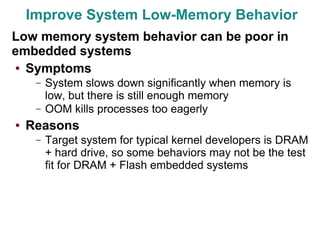
Low memory system behavior can be poor in
embedded systems
● Symptoms

     –   System slows down significantly when memory is
         low, but there is still enough memory
     –   OOM kills processes too eagerly
●   Reasons
     –   Target system for typical kernel developers is DRAM
         + hard drive, so some behaviors may not be the test
         fit for DRAM + Flash embedded systems
Improve System Low-Memory Behavior

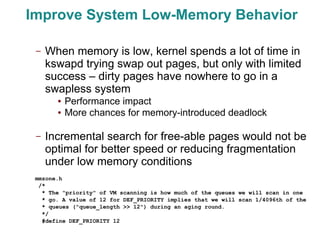
 –   When memory is low, kernel spends a lot of time in
     kswapd trying swap out pages, but only with limited
     success – dirty pages have nowhere to go in a
     swapless system
       ●   Performance impact
       ●   More chances for memory-introduced deadlock

 –   Incremental search for free-able pages would not be
     optimal for better speed or reducing fragmentation
     under low memory conditions
 mmzone.h
  /*
   * The "priority" of VM scanning is how much of the queues we will scan in one
   * go. A value of 12 for DEF_PRIORITY implies that we will scan 1/4096th of the
   * queues ("queue_length >> 12") during an aging round.
   */
   #define DEF_PRIORITY 12
Improve System Low-Memory Behavior
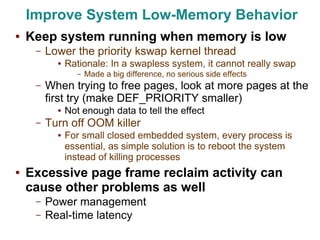
●   Keep system running when memory is low
     –   Lower the priority kswap kernel thread
           ●   Rationale: In a swapless system, it cannot really swap
                  –   Made a big difference, no serious side effects
     –   When trying to free pages, look at more pages at the
         first try (make DEF_PRIORITY smaller)
           ●   Not enough data to tell the effect
     –   Turn off OOM killer
           ●   For small closed embedded system, every process is
               essential, as simple solution is to reboot the system
               instead of killing processes
●   Excessive page frame reclaim activity can
    cause other problems as well
     –   Power management
     –   Real-time latency
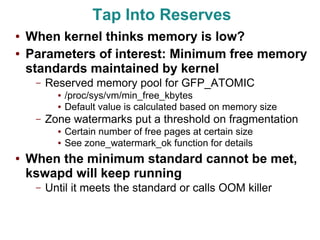
Tap Into Reserves
●   When kernel thinks memory is low?
●   Parameters of interest: Minimum free memory
    standards maintained by kernel
     –   Reserved memory pool for GFP_ATOMIC
           ●   /proc/sys/vm/min_free_kbytes
           ●   Default value is calculated based on memory size
     –   Zone watermarks put a threshold on fragmentation
           ●   Certain number of free pages at certain size
           ●   See zone_watermark_ok function for details
●   When the minimum standard cannot be met,
    kswapd will keep running
     –   Until it meets the standard or calls OOM killer
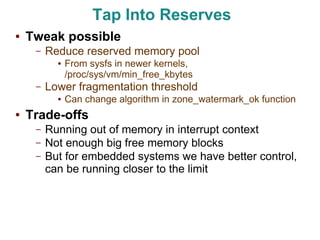
Tap Into Reserves
●   Tweak possible
     –   Reduce reserved memory pool
           ●   From sysfs in newer kernels,
               /proc/sys/vm/min_free_kbytes
     –   Lower fragmentation threshold
           ●   Can change algorithm in zone_watermark_ok function
●   Trade-offs
     –   Running out of memory in interrupt context
     –   Not enough big free memory blocks
     –   But for embedded systems we have better control,
         can be running closer to the limit
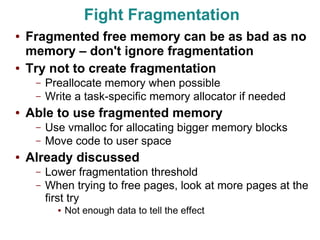
Fight Fragmentation
●   Fragmented free memory can be as bad as no
    memory – don't ignore fragmentation
●   Try not to create fragmentation
     –   Preallocate memory when possible
     –   Write a task-specific memory allocator if needed
●   Able to use fragmented memory
     –   Use vmalloc for allocating bigger memory blocks
     –   Move code to user space
●   Already discussed
     –   Lower fragmentation threshold
     –   When trying to free pages, look at more pages at the
         first try
           ●   Not enough data to tell the effect
More on Kernel Memory
●   Alternative allocators
     –   SLOB
     –   SLUB
●   Reference
     –   “Understanding the Linux Kernel” Bovet & Cesati.
         O'Reilly Media
System Design Issue:
           MMU Is An Advantage, Use It
uClinux may look like an interesting option, but
regular kernel with virtual memory is a better
bet if you have many user applications
●   The default behavior, read-only “swapping”
    between Flash and DRAM is beneficial
     –   More programs with less DRAM – load from Flash
         into DRAM when needed
     –   Slows down when overloaded, but graceful
         degradation
     –   Only possible with virtual memory
●   Execute in place may not be a good trade-off
     –   A lot more flash space for a little less DRAM space
Problems with Shared Library
Shifting focus into user space
● Lower code density of .so

     –   Function need to be ABI-compliant
     –   Position independent code
     –   Functions cannot be inlined
     –   Limit inter-function compiler optimizations
●   Need per-instance memory pages for dynamic
    linking
     –   Dynamic linking tables (GOT, PLT)
     –   Global variables
     –   Need to watch this overhead: If 10 processes in the
         system and each of them is linked to 10 shared
         libraries, ~400k of free memory is consumed by
         dynamic linking
Move Away From Shared Library
●   Tweak: Do not link unnecessary shared
    libraries
     –   Check your linker options

●   Better Tweak: Use client-server model in
    place of shared libraries when possible
     –   From: m application processes linked to n shared
         libraries
     –   To: Create a server process with n statically linked
         libraries. Use IPC mechanisms to connect m
         application processes to the server process
Toolchain Considerations
●   Plain old malloc allocator
     –   Two level memory allocation for user applications:
         malloc allocator on top of kernel page allocation
           ●   For performance reasons, malloc does not return all the
               free pages to kernel, it is done only when free memory
               exceed a threshold
                 –   These are dirty pages so kernel has no way to reuse it in a
                     swapless system
     –   Tweak: We can adjust parameters to make malloc
         allocator return unused pages to kernel more
         eagerly
           ●   libc: Call mallocopt function with M_TRIM_THRESHOLD
               as parameter
           ●   uClibc: No mallocopt function, change
               DEFAULT_TRIM_THRESHOLD at compile time
                 –   Default is 256K, too big for quite a few systems
Tools
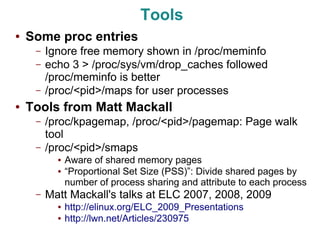
●   Some proc entries
     –   Ignore free memory shown in /proc/meminfo
     –   echo 3 > /proc/sys/vm/drop_caches followed
         /proc/meminfo is better
     –   /proc/<pid>/maps for user processes
●   Tools from Matt Mackall
     –   /proc/kpagemap, /proc/<pid>/pagemap: Page walk
         tool
     –   /proc/<pid>/smaps
           ●   Aware of shared memory pages
           ●   “Proportional Set Size (PSS)”: Divide shared pages by
               number of process sharing and attribute to each process
     –   Matt Mackall's talks at ELC 2007, 2008, 2009
           ●   http://elinux.org/ELC_2009_Presentations
           ●   http://lwn.net/Articles/230975
Tools
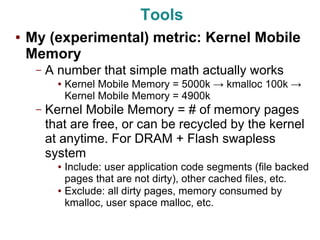
●   My (experimental) metric: Kernel Mobile
    Memory
     –   A number that simple math actually works
           ●   Kernel Mobile Memory = 5000k → kmalloc 100k →
               Kernel Mobile Memory = 4900k
     –   Kernel Mobile Memory = # of memory pages
         that are free, or can be recycled by the kernel
         at anytime. For DRAM + Flash swapless
         system
           ●   Include: user application code segments (file backed
               pages that are not dirty), other cached files, etc.
           ●   Exclude: all dirty pages, memory consumed by
               kmalloc, user space malloc, etc.
Tools

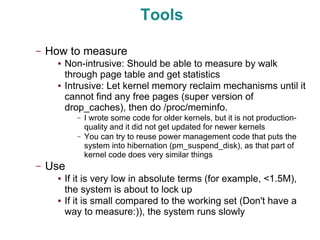
–   How to measure
      ●   Non-intrusive: Should be able to measure by walk
          through page table and get statistics
      ●   Intrusive: Let kernel memory reclaim mechanisms until it
          cannot find any free pages (super version of
          drop_caches), then do /proc/meminfo.
             –   I wrote some code for older kernels, but it is not production-
                 quality and it did not get updated for newer kernels
             –   You can try to reuse power management code that puts the
                 system into hibernation (pm_suspend_disk), as that part of
                 kernel code does very similar things
–   Use
      ●   If it is very low in absolute terms (for example, <1.5M),
          the system is about to lock up
      ●   If it is small compared to the working set (Don't have a
          way to measure:)), the system runs slowly
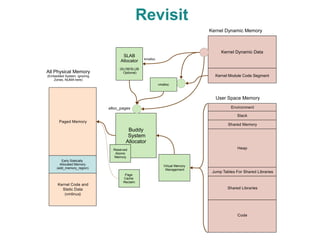
Revisit
                                                                              Kernel Dynamic Memory


                                                                                   Kernel Dynamic Data
                                    SLAB
                                                kmalloc
                                   Allocator
                                  (SLOB/SLUB
All Physical Memory                 Optional)
(Embedded System, ignoring                                                      Kernel Module Code Segment
   Zones, NUMA here)
                                                          vmalloc


                                                                                User Space Memory

                             alloc_pages                                                Environment

                                                                                            Stack
       Paged Memory
                                                                                       Shared Memory
                                       Buddy
                                       System
                                      Allocator
                               Reserved                                                     Heap
                                Atomic
                               Memory
        Early Statically
       Allocated Memory                                      Virtual Memory
     (add_memory_region)                                      Management
                                                                               Jump Tables For Shared Libraries
                                     Page
                                    Cache
                                    Reclaim
      Kernel Code and
        Static Data                                                                    Shared Libraries
         (vmlinux)


                                                                                            Code
Don't Forget the Basics
●   Squash + LZMA is usually an efficient read-
    only root memory system
●   Remove unused symbols in shared libraries
     –   Debian mklibs script
           ●   http://packages.debian.org/unstable/devel/mklibs
●   Turn off unused kernel options
●   Check all GCC options for your platform
     –   Choose an efficient ABI if available
●   These are low-level optimizations. Don't
    forget algorithm and data structure
    optimizations
     –   O(..) level improvements
     –   Use arrays instead of linked list, trees when possible
         to avoid overheads
Conclusion
●   This may be tedious work, but if we avoid
    eyesight fixation or tunnel vision, it can be
    interesting too
     –   Memory consumed by kmalloc is important, but not
         everything. Application layer malloc, shared libraries
         need to be considered
     –   Size is not everything. Fragmentation and low-
         memory CPU utilization are also important
     –   It is interesting to find out that client-server model
         can be preferred for memory reasons

Controlling Memory Footprint at All Layers: Linux Kernel, Applications, Libraries, and Toolchain

  • 1.
    Controlling Memory Footprintat All Layers: Linux Kernel, Applications, Libraries, and Toolchain Xi Wang Broadcom Corporation Embedded Linux Conference 2011
  • 2.
    Introduction ● Search with more breadth and depth – Visit more layers ● This talk is not about vmlinux or kmalloc – Not just reducing size. Goal is to add features without adding memory ● E.g. improve system performance under low memory situation ● About medium-sized embedded systems – With DRAM + Flash, no swap partition – Lightly configured kernel image fits in comfortably, but need more space for everything else – Based on 2.6.2x, let me know if there are new changes
  • 3.
    Introduction Kernel Dynamic Memory SLAB Kernel Dynamic Data kmalloc Allocator (SLOB/SLUB All Physical Memory Optional) (Embedded System, ignoring Zones, NUMA here) Kernel Module Code Segment vmalloc User Space Memory alloc_pages Environment Paged Memory Stack Buddy Shared Memory System Allocator Reserved Atomic Heap Memory Early Statically Allocated Memory Virtual Memory (add_memory_region) Management Page Cache Reclaim Shared Libraries Kernel Code and Static Data (vmlinux) Code
  • 4.
    Kernel Memory Lifecycle ● Understanding kernel memory lifecycle – Memory is an active subsystem with its own behaviors – Kernel gives away memory carelessly and let everyone keep it ● E.g., file caching, free memory in slab not returned immediately – Sometimes try to get it back ● Periodic reclaiming from kswapd ● When there is not enough memory ● Most apparent effect of memory life cycle: Free memory in /proc/meminfo is usually low unless you have a lot of memory – Never use the free memory number in /proc/meminfo as free memory is a fuzzy concept in Linux kernel. Think in terms of memory pressure instead
  • 5.
    Improve System Low-MemoryBehavior Low memory system behavior can be poor in embedded systems ● Symptoms – System slows down significantly when memory is low, but there is still enough memory – OOM kills processes too eagerly ● Reasons – Target system for typical kernel developers is DRAM + hard drive, so some behaviors may not be the test fit for DRAM + Flash embedded systems
  • 6.
    Improve System Low-MemoryBehavior – When memory is low, kernel spends a lot of time in kswapd trying swap out pages, but only with limited success – dirty pages have nowhere to go in a swapless system ● Performance impact ● More chances for memory-introduced deadlock – Incremental search for free-able pages would not be optimal for better speed or reducing fragmentation under low memory conditions mmzone.h /* * The "priority" of VM scanning is how much of the queues we will scan in one * go. A value of 12 for DEF_PRIORITY implies that we will scan 1/4096th of the * queues ("queue_length >> 12") during an aging round. */ #define DEF_PRIORITY 12
  • 7.
    Improve System Low-MemoryBehavior ● Keep system running when memory is low – Lower the priority kswap kernel thread ● Rationale: In a swapless system, it cannot really swap – Made a big difference, no serious side effects – When trying to free pages, look at more pages at the first try (make DEF_PRIORITY smaller) ● Not enough data to tell the effect – Turn off OOM killer ● For small closed embedded system, every process is essential, as simple solution is to reboot the system instead of killing processes ● Excessive page frame reclaim activity can cause other problems as well – Power management – Real-time latency
  • 8.
    Tap Into Reserves ● When kernel thinks memory is low? ● Parameters of interest: Minimum free memory standards maintained by kernel – Reserved memory pool for GFP_ATOMIC ● /proc/sys/vm/min_free_kbytes ● Default value is calculated based on memory size – Zone watermarks put a threshold on fragmentation ● Certain number of free pages at certain size ● See zone_watermark_ok function for details ● When the minimum standard cannot be met, kswapd will keep running – Until it meets the standard or calls OOM killer
  • 9.
    Tap Into Reserves ● Tweak possible – Reduce reserved memory pool ● From sysfs in newer kernels, /proc/sys/vm/min_free_kbytes – Lower fragmentation threshold ● Can change algorithm in zone_watermark_ok function ● Trade-offs – Running out of memory in interrupt context – Not enough big free memory blocks – But for embedded systems we have better control, can be running closer to the limit
  • 10.
    Fight Fragmentation ● Fragmented free memory can be as bad as no memory – don't ignore fragmentation ● Try not to create fragmentation – Preallocate memory when possible – Write a task-specific memory allocator if needed ● Able to use fragmented memory – Use vmalloc for allocating bigger memory blocks – Move code to user space ● Already discussed – Lower fragmentation threshold – When trying to free pages, look at more pages at the first try ● Not enough data to tell the effect
  • 11.
    More on KernelMemory ● Alternative allocators – SLOB – SLUB ● Reference – “Understanding the Linux Kernel” Bovet & Cesati. O'Reilly Media
  • 12.
    System Design Issue: MMU Is An Advantage, Use It uClinux may look like an interesting option, but regular kernel with virtual memory is a better bet if you have many user applications ● The default behavior, read-only “swapping” between Flash and DRAM is beneficial – More programs with less DRAM – load from Flash into DRAM when needed – Slows down when overloaded, but graceful degradation – Only possible with virtual memory ● Execute in place may not be a good trade-off – A lot more flash space for a little less DRAM space
  • 13.
    Problems with SharedLibrary Shifting focus into user space ● Lower code density of .so – Function need to be ABI-compliant – Position independent code – Functions cannot be inlined – Limit inter-function compiler optimizations ● Need per-instance memory pages for dynamic linking – Dynamic linking tables (GOT, PLT) – Global variables – Need to watch this overhead: If 10 processes in the system and each of them is linked to 10 shared libraries, ~400k of free memory is consumed by dynamic linking
  • 14.
    Move Away FromShared Library ● Tweak: Do not link unnecessary shared libraries – Check your linker options ● Better Tweak: Use client-server model in place of shared libraries when possible – From: m application processes linked to n shared libraries – To: Create a server process with n statically linked libraries. Use IPC mechanisms to connect m application processes to the server process
  • 15.
    Toolchain Considerations ● Plain old malloc allocator – Two level memory allocation for user applications: malloc allocator on top of kernel page allocation ● For performance reasons, malloc does not return all the free pages to kernel, it is done only when free memory exceed a threshold – These are dirty pages so kernel has no way to reuse it in a swapless system – Tweak: We can adjust parameters to make malloc allocator return unused pages to kernel more eagerly ● libc: Call mallocopt function with M_TRIM_THRESHOLD as parameter ● uClibc: No mallocopt function, change DEFAULT_TRIM_THRESHOLD at compile time – Default is 256K, too big for quite a few systems
  • 16.
    Tools ● Some proc entries – Ignore free memory shown in /proc/meminfo – echo 3 > /proc/sys/vm/drop_caches followed /proc/meminfo is better – /proc/<pid>/maps for user processes ● Tools from Matt Mackall – /proc/kpagemap, /proc/<pid>/pagemap: Page walk tool – /proc/<pid>/smaps ● Aware of shared memory pages ● “Proportional Set Size (PSS)”: Divide shared pages by number of process sharing and attribute to each process – Matt Mackall's talks at ELC 2007, 2008, 2009 ● http://elinux.org/ELC_2009_Presentations ● http://lwn.net/Articles/230975
  • 17.
    Tools ● My (experimental) metric: Kernel Mobile Memory – A number that simple math actually works ● Kernel Mobile Memory = 5000k → kmalloc 100k → Kernel Mobile Memory = 4900k – Kernel Mobile Memory = # of memory pages that are free, or can be recycled by the kernel at anytime. For DRAM + Flash swapless system ● Include: user application code segments (file backed pages that are not dirty), other cached files, etc. ● Exclude: all dirty pages, memory consumed by kmalloc, user space malloc, etc.
  • 18.
    Tools – How to measure ● Non-intrusive: Should be able to measure by walk through page table and get statistics ● Intrusive: Let kernel memory reclaim mechanisms until it cannot find any free pages (super version of drop_caches), then do /proc/meminfo. – I wrote some code for older kernels, but it is not production- quality and it did not get updated for newer kernels – You can try to reuse power management code that puts the system into hibernation (pm_suspend_disk), as that part of kernel code does very similar things – Use ● If it is very low in absolute terms (for example, <1.5M), the system is about to lock up ● If it is small compared to the working set (Don't have a way to measure:)), the system runs slowly
  • 19.
    Revisit Kernel Dynamic Memory Kernel Dynamic Data SLAB kmalloc Allocator (SLOB/SLUB All Physical Memory Optional) (Embedded System, ignoring Kernel Module Code Segment Zones, NUMA here) vmalloc User Space Memory alloc_pages Environment Stack Paged Memory Shared Memory Buddy System Allocator Reserved Heap Atomic Memory Early Statically Allocated Memory Virtual Memory (add_memory_region) Management Jump Tables For Shared Libraries Page Cache Reclaim Kernel Code and Static Data Shared Libraries (vmlinux) Code
  • 20.
    Don't Forget theBasics ● Squash + LZMA is usually an efficient read- only root memory system ● Remove unused symbols in shared libraries – Debian mklibs script ● http://packages.debian.org/unstable/devel/mklibs ● Turn off unused kernel options ● Check all GCC options for your platform – Choose an efficient ABI if available ● These are low-level optimizations. Don't forget algorithm and data structure optimizations – O(..) level improvements – Use arrays instead of linked list, trees when possible to avoid overheads
  • 21.
    Conclusion ● This may be tedious work, but if we avoid eyesight fixation or tunnel vision, it can be interesting too – Memory consumed by kmalloc is important, but not everything. Application layer malloc, shared libraries need to be considered – Size is not everything. Fragmentation and low- memory CPU utilization are also important – It is interesting to find out that client-server model can be preferred for memory reasons