9/3/2012   1
Agenda

              Introduction to windows os

              Virtual memory

              Virtual address translation

              Page files / page faults

              Working set

              Physical memory

              Conclusion

9/3/2012                                     2
Introduction to windows os

  Microsoft Windows is a series of graphical interface operating systems
     developed, marketed, and sold by Microsoft.

  Microsoft Windows came to dominate the world's personal computer
     market.

  Microsoft introduced an operating environment named /Windows/ on
     November 20, 1985 as an add-on to MS-DOS in response to the growing
     interest in graphical user interfaces.

  The most recent version of Windows is Windows 7.


9/3/2012                                                                    3
 Windows uses demand paging with Clustering.

  Clustering handles page faults by bringing in not only the
     faulting page but also the multiple pages surrounding the
     faulting page.

  Windows uses clock algorithm.


9/3/2012                                                         4
What is Virtual Memory?

        CPU can address up to 3GB of memory, using its full 32 bits.

        This is normally far more than the RAM of the machine.

        The hardware provides for programs to operate in terms of as

           much as they wish of this full 4GB space as Virtual Memory, those
           parts of the program and data which are currently active being
           loaded into Physical Random Access Memory (RAM).


9/3/2012                                                                       5
Why virtual memory?

  The first is to allow the use of programs that are too big to
     physically fit in memory.

  The other reason is to allow for multitasking – multiple
     programs running at once.


9/3/2012                                                           6
Virtual Memory in Windows
  In Windows the processor manages the mapping in terms of pages of
     4 Kilobytes each a size that has implications for managing virtual
     memory by the system.

  Only some parts of the program and data that are currently in active
     use need to be held in physical RAM.

  Other parts are then held in a swap file(in as it’s called in Windows
     95/98/ME: Win386.swp )or page file(in Windows NT versions
     including Windows 2000 and XP).


9/3/2012                                                                   7
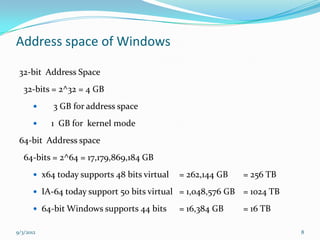
Address space of Windows

 32-bit Address Space
   32-bits = 2^32 = 4 GB
           3 GB for address space
          1 GB for kernel mode
 64-bit Address space
   64-bits = 2^64 = 17,179,869,184 GB
        x64 today supports 48 bits virtual   = 262,144 GB    = 256 TB
        IA-64 today support 50 bits virtual = 1,048,576 GB   = 1024 TB
        64-bit Windows supports 44 bits      = 16,384 GB     = 16 TB

9/3/2012                                                                  8
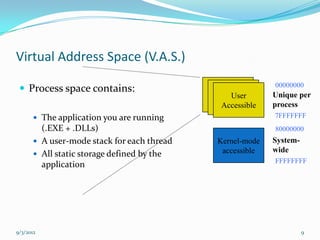
Virtual Address Space (V.A.S.)
                                                           00000000
  Process space contains:
                                               User        Unique per
                                             Accessible    process
        The application you are running                   7FFFFFFF
         (.EXE + .DLLs)                                    80000000
        A user-mode stack for each thread   Kernel-mode   System-
                                              accessible   wide
        All static storage defined by the
                                                           FFFFFFFF
         application


9/3/2012                                                             9
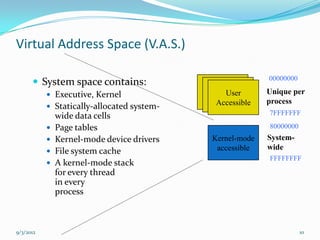
Virtual Address Space (V.A.S.)

                                                          00000000
       System space contains:
            Executive, Kernel                User        Unique per
                                            Accessible    process
            Statically-allocated system-
               wide data cells                            7FFFFFFF

              Page tables                                80000000
              Kernel-mode device drivers   Kernel-mode   System-
                                             accessible   wide
              File system cache
                                                          FFFFFFFF
              A kernel-mode stack
               for every thread
               in every
               process


9/3/2012                                                             10
What is loaded in RAM?
 Items of RAM can be divided into two parts :

     -Non paged area

       •   Parts of system which are very important . This cannot

           be paged out.

     -page pool

       •   Program code, Data pages that had actual data written

           to them.


9/3/2012                                                            11
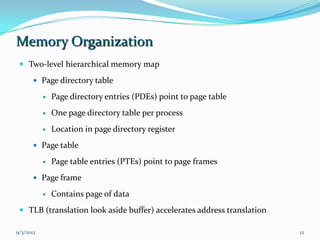
Memory Organization
  Two-level hierarchical memory map

        Page directory table

              Page directory entries (PDEs) point to page table
              One page directory table per process
              Location in page directory register
        Page table

              Page table entries (PTEs) point to page frames
        Page frame

              Contains page of data
  TLB (translation look aside buffer) accelerates address translation

9/3/2012                                                                 12
Virtual Address Translation

  Hardware converts each valid virtual address to a physical
     address


                                           virtual address
                             Virtual page number        Byte within page
             Page
           Directory
                                    Address translation
                                       (hardware) If page                  Page
                                                     not valid             fault
             Page
            Tables
                                  Physical page number Byte within page
               Translation                    physical address
               Lookaside
                 Buffer
9/3/2012                                                                           13
Virtual address translation
                        .


9/3/2012                       14
 Page file
              The page file is a hidden file called pagefile.sys.

              It is regenerated at each boot .

              there is no need to include it in a backup


9/3/2012                                                             15
The paging file and the RAM
  The VMM creates a file on the hard disk that holds the extra memory that
     is needed by the O.S.

  This file is called a paging file (also known as a swap file), and plays an
     important role in virtual memory.

  The paging file combined with the RAM accounts for all of the memory.

  Whenever the O.S. needs a ‘block’ of memory that’s not in the real (RAM)
     memory, the VMM takes a block from the real memory that hasn’t been
     used recently, writes it to the paging file.

  Then it reads the block of memory that the O.S. needs from the paging
     file.


9/3/2012                                                                         16
The paging file and the RAM
  The VMM then takes the block of memory from the paging file, and
     moves it into the real memory – in place of the old block.

  This process is called swapping (also known as paging),

  The blocks of memory that are swapped are called pages.


9/3/2012                                                              17
Page fault

  When the program needs the page which is not in main
     memory the page fault interrupt will be invoked.

  If the this is available on disk then it will be swapped.

  If it is not available due to some hardware problems the
     system will have ‘invalid page fault error’.

  It may manifest itself as a ‘blue screen’ failure with a STOP
     code.

9/3/2012                                                           18
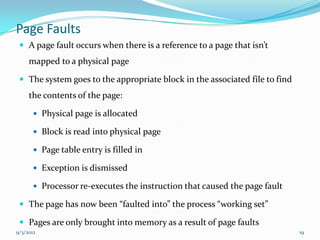
Page Faults
  A page fault occurs when there is a reference to a page that isn’t
     mapped to a physical page

  The system goes to the appropriate block in the associated file to find
     the contents of the page:

        Physical page is allocated

        Block is read into physical page

        Page table entry is filled in

        Exception is dismissed

        Processor re-executes the instruction that caused the page fault

  The page has now been “faulted into” the process “working set”

  Pages are only brought into memory as a result of page faults
9/3/2012                                                                     19
Disadvantages of virtual memory

  Virtual memory can slow down performance.

  If the size of virtual memory is quite large in comparison to the real
     memory, then more swapping to and from the hard disk will occur as a
     result.

  Accessing the hard disk is far slower than using system memory.

  Using too many programs at once in a system with an insufficient
     amount of RAM results in constant disk swapping – also
     called thrashing.


9/3/2012                                                                    20
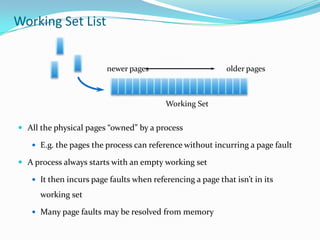
Working Set List


                        newer pages                        older pages


                                         Working Set


 All the physical pages “owned” by a process

    E.g. the pages the process can reference without incurring a page fault

 A process always starts with an empty working set

    It then incurs page faults when referencing a page that isn’t in its

      working set

    Many page faults may be resolved from memory
Working Set

 Each process has a default working set minimum and maximum

    Can change with SetProcessWorkingSet

    Working set minimum controls maximum number of locked

     pages (VirtualLock)

    Minimum is also reserved from RAM as a guarantee to the

     process

    Working set maximum is ignored

 If there’s ample memory, process working set represents all the
  memory it has referenced (but not freed)
Working Set Replacement

                                                                 To standby
                                                                or modified
                                                                   page list


                               Working Set

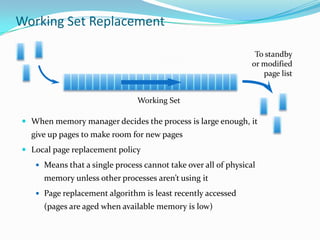
 When memory manager decides the process is large enough, it
  give up pages to make room for new pages
 Local page replacement policy
    Means that a single process cannot take over all of physical
     memory unless other processes aren’t using it
    Page replacement algorithm is least recently accessed
     (pages are aged when available memory is low)
Working Set Breakdown

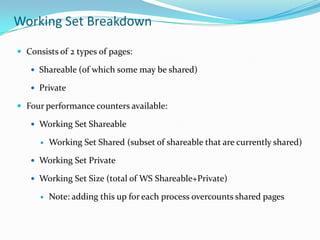
 Consists of 2 types of pages:

    Shareable (of which some may be shared)

    Private

 Four performance counters available:

    Working Set Shareable

         Working Set Shared (subset of shareable that are currently shared)

    Working Set Private

    Working Set Size (total of WS Shareable+Private)

         Note: adding this up for each process overcounts shared pages
Managing Physical Memory

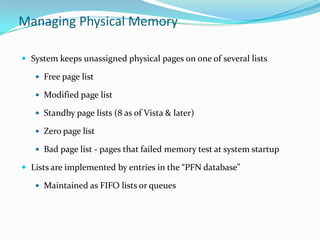
 System keeps unassigned physical pages on one of several lists

    Free page list

    Modified page list

    Standby page lists (8 as of Vista & later)

    Zero page list

    Bad page list - pages that failed memory test at system startup

 Lists are implemented by entries in the “PFN database”

    Maintained as FIFO lists or queues
Standby and Modified Page Lists

 Modified pages go to modified (dirty) list

    Avoids writing pages back to disk too soon

 Unmodified pages go to standby (clean) lists

 They form a system-wide cache of “pages likely to be needed again”

    Pages can be faulted back into a process from the standby and

     modified page list

    These are counted as page faults, but not page reads
Modified Page Writer

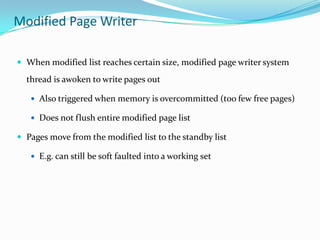
 When modified list reaches certain size, modified page writer system

  thread is awoken to write pages out

    Also triggered when memory is overcommitted (too few free pages)

    Does not flush entire modified page list

 Pages move from the modified list to the standby list

    E.g. can still be soft faulted into a working set
Free and Zero Page Lists
 Free Page List

    Used for page reads

    Private modified pages go here on process exit

    Pages contain junk in them (e.g. not zeroed)

    On most busy systems, this is empty

 Zero Page List

    Used to satisfy demand zero page faults

         References to private pages that have not been created yet
    When free page list has 8 or more pages, a priority zero thread is awoken
      to zero them
    On most busy systems, this is empty too
Super Fetch
 Superfetch proactively repopulates RAM with the most useful data

    Sets priority of pages to optimal value, based on the page history and

     other analysis that it performs

    Takes into account frequency of page usage, usage of page in context

     of other pages in memory

 Scenarios SuperFetch improves include

    Resume from hibernate and suspend

    Fast user switching

    Performance after infrequent or low priority tasks execute

    Application launch
Conclusion


9/3/2012                30
Thank you


9/3/2012               31

Windows memory management

  • 1.
  • 2.
    Agenda  Introduction to windows os  Virtual memory  Virtual address translation  Page files / page faults  Working set  Physical memory  Conclusion 9/3/2012 2
  • 3.
    Introduction to windowsos  Microsoft Windows is a series of graphical interface operating systems developed, marketed, and sold by Microsoft.  Microsoft Windows came to dominate the world's personal computer market.  Microsoft introduced an operating environment named /Windows/ on November 20, 1985 as an add-on to MS-DOS in response to the growing interest in graphical user interfaces.  The most recent version of Windows is Windows 7. 9/3/2012 3
  • 4.
     Windows usesdemand paging with Clustering.  Clustering handles page faults by bringing in not only the faulting page but also the multiple pages surrounding the faulting page.  Windows uses clock algorithm. 9/3/2012 4
  • 5.
    What is VirtualMemory?  CPU can address up to 3GB of memory, using its full 32 bits.  This is normally far more than the RAM of the machine.  The hardware provides for programs to operate in terms of as much as they wish of this full 4GB space as Virtual Memory, those parts of the program and data which are currently active being loaded into Physical Random Access Memory (RAM). 9/3/2012 5
  • 6.
    Why virtual memory?  The first is to allow the use of programs that are too big to physically fit in memory.  The other reason is to allow for multitasking – multiple programs running at once. 9/3/2012 6
  • 7.
    Virtual Memory inWindows  In Windows the processor manages the mapping in terms of pages of 4 Kilobytes each a size that has implications for managing virtual memory by the system.  Only some parts of the program and data that are currently in active use need to be held in physical RAM.  Other parts are then held in a swap file(in as it’s called in Windows 95/98/ME: Win386.swp )or page file(in Windows NT versions including Windows 2000 and XP). 9/3/2012 7
  • 8.
    Address space ofWindows 32-bit Address Space 32-bits = 2^32 = 4 GB  3 GB for address space  1 GB for kernel mode 64-bit Address space 64-bits = 2^64 = 17,179,869,184 GB  x64 today supports 48 bits virtual = 262,144 GB = 256 TB  IA-64 today support 50 bits virtual = 1,048,576 GB = 1024 TB  64-bit Windows supports 44 bits = 16,384 GB = 16 TB 9/3/2012 8
  • 9.
    Virtual Address Space(V.A.S.) 00000000  Process space contains: User Unique per Accessible process  The application you are running 7FFFFFFF (.EXE + .DLLs) 80000000  A user-mode stack for each thread Kernel-mode System- accessible wide  All static storage defined by the FFFFFFFF application 9/3/2012 9
  • 10.
    Virtual Address Space(V.A.S.) 00000000  System space contains:  Executive, Kernel User Unique per Accessible process  Statically-allocated system- wide data cells 7FFFFFFF  Page tables 80000000  Kernel-mode device drivers Kernel-mode System- accessible wide  File system cache FFFFFFFF  A kernel-mode stack for every thread in every process 9/3/2012 10
  • 11.
    What is loadedin RAM? Items of RAM can be divided into two parts : -Non paged area • Parts of system which are very important . This cannot be paged out. -page pool • Program code, Data pages that had actual data written to them. 9/3/2012 11
  • 12.
    Memory Organization Two-level hierarchical memory map  Page directory table  Page directory entries (PDEs) point to page table  One page directory table per process  Location in page directory register  Page table  Page table entries (PTEs) point to page frames  Page frame  Contains page of data  TLB (translation look aside buffer) accelerates address translation 9/3/2012 12
  • 13.
    Virtual Address Translation  Hardware converts each valid virtual address to a physical address virtual address Virtual page number Byte within page Page Directory Address translation (hardware) If page Page not valid fault Page Tables Physical page number Byte within page Translation physical address Lookaside Buffer 9/3/2012 13
  • 14.
  • 15.
     Page file  The page file is a hidden file called pagefile.sys.  It is regenerated at each boot .  there is no need to include it in a backup 9/3/2012 15
  • 16.
    The paging fileand the RAM  The VMM creates a file on the hard disk that holds the extra memory that is needed by the O.S.  This file is called a paging file (also known as a swap file), and plays an important role in virtual memory.  The paging file combined with the RAM accounts for all of the memory.  Whenever the O.S. needs a ‘block’ of memory that’s not in the real (RAM) memory, the VMM takes a block from the real memory that hasn’t been used recently, writes it to the paging file.  Then it reads the block of memory that the O.S. needs from the paging file. 9/3/2012 16
  • 17.
    The paging fileand the RAM  The VMM then takes the block of memory from the paging file, and moves it into the real memory – in place of the old block.  This process is called swapping (also known as paging),  The blocks of memory that are swapped are called pages. 9/3/2012 17
  • 18.
    Page fault When the program needs the page which is not in main memory the page fault interrupt will be invoked.  If the this is available on disk then it will be swapped.  If it is not available due to some hardware problems the system will have ‘invalid page fault error’.  It may manifest itself as a ‘blue screen’ failure with a STOP code. 9/3/2012 18
  • 19.
    Page Faults A page fault occurs when there is a reference to a page that isn’t mapped to a physical page  The system goes to the appropriate block in the associated file to find the contents of the page:  Physical page is allocated  Block is read into physical page  Page table entry is filled in  Exception is dismissed  Processor re-executes the instruction that caused the page fault  The page has now been “faulted into” the process “working set”  Pages are only brought into memory as a result of page faults 9/3/2012 19
  • 20.
    Disadvantages of virtualmemory  Virtual memory can slow down performance.  If the size of virtual memory is quite large in comparison to the real memory, then more swapping to and from the hard disk will occur as a result.  Accessing the hard disk is far slower than using system memory.  Using too many programs at once in a system with an insufficient amount of RAM results in constant disk swapping – also called thrashing. 9/3/2012 20
  • 21.
    Working Set List newer pages older pages Working Set  All the physical pages “owned” by a process  E.g. the pages the process can reference without incurring a page fault  A process always starts with an empty working set  It then incurs page faults when referencing a page that isn’t in its working set  Many page faults may be resolved from memory
  • 22.
    Working Set  Eachprocess has a default working set minimum and maximum  Can change with SetProcessWorkingSet  Working set minimum controls maximum number of locked pages (VirtualLock)  Minimum is also reserved from RAM as a guarantee to the process  Working set maximum is ignored  If there’s ample memory, process working set represents all the memory it has referenced (but not freed)
  • 23.
    Working Set Replacement To standby or modified page list Working Set  When memory manager decides the process is large enough, it give up pages to make room for new pages  Local page replacement policy  Means that a single process cannot take over all of physical memory unless other processes aren’t using it  Page replacement algorithm is least recently accessed (pages are aged when available memory is low)
  • 24.
    Working Set Breakdown Consists of 2 types of pages:  Shareable (of which some may be shared)  Private  Four performance counters available:  Working Set Shareable  Working Set Shared (subset of shareable that are currently shared)  Working Set Private  Working Set Size (total of WS Shareable+Private)  Note: adding this up for each process overcounts shared pages
  • 25.
    Managing Physical Memory System keeps unassigned physical pages on one of several lists  Free page list  Modified page list  Standby page lists (8 as of Vista & later)  Zero page list  Bad page list - pages that failed memory test at system startup  Lists are implemented by entries in the “PFN database”  Maintained as FIFO lists or queues
  • 26.
    Standby and ModifiedPage Lists  Modified pages go to modified (dirty) list  Avoids writing pages back to disk too soon  Unmodified pages go to standby (clean) lists  They form a system-wide cache of “pages likely to be needed again”  Pages can be faulted back into a process from the standby and modified page list  These are counted as page faults, but not page reads
  • 27.
    Modified Page Writer When modified list reaches certain size, modified page writer system thread is awoken to write pages out  Also triggered when memory is overcommitted (too few free pages)  Does not flush entire modified page list  Pages move from the modified list to the standby list  E.g. can still be soft faulted into a working set
  • 28.
    Free and ZeroPage Lists  Free Page List  Used for page reads  Private modified pages go here on process exit  Pages contain junk in them (e.g. not zeroed)  On most busy systems, this is empty  Zero Page List  Used to satisfy demand zero page faults  References to private pages that have not been created yet  When free page list has 8 or more pages, a priority zero thread is awoken to zero them  On most busy systems, this is empty too
  • 29.
    Super Fetch  Superfetchproactively repopulates RAM with the most useful data  Sets priority of pages to optimal value, based on the page history and other analysis that it performs  Takes into account frequency of page usage, usage of page in context of other pages in memory  Scenarios SuperFetch improves include  Resume from hibernate and suspend  Fast user switching  Performance after infrequent or low priority tasks execute  Application launch
  • 30.
  • 31.