Maternal Screening –Maternal Screening –
Update on Laboratory testsUpdate on Laboratory tests
DR RAJESH V BENDRE
Chief Pathologist,
MD(path), DNB(path), DPB
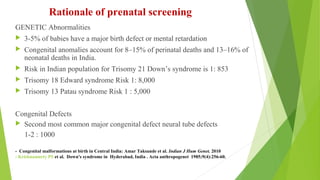
GENETIC Abnormalities
 3-5% of babies have a major birth defect or mental retardation
 Congenital anomalies account for 8–15% of perinatal deaths and 13–16% of
neonatal deaths in India.
 Risk in Indian population for Trisomy 21 Down’s syndrome is 1: 853
 Trisomy 18 Edward syndrome Risk 1: 8,000
 Trisomy 13 Patau syndrome Risk 1 : 5,000
Congenital Defects
 Second most common major congenital defect neural tube defects
1-2 : 1000
- Congenital malformations at birth in Central India: Amar Taksande et al. Indian J Hum Genet. 2010
- Krishnamurty PS et al. Down's syndrome in Hyderabad, India . Acta anthropogenet 1985;9(4):256-60.
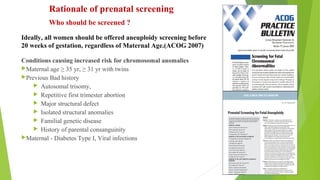
Rationale of prenatal screening
Who should be screened ?
Conditions causing increased risk for chromosomal anomalies
Maternal age ≥ 35 yr, ≥ 31 yr with twins
Previous Bad history
 Autosomal trisomy,
 Repetitive first trimester abortion
 Major structural defect
 Isolated structural anomalies
 Familial genetic disease
 History of parental consanguinity
Maternal - Diabetes Type I, Viral infections
Rationale of prenatal screening
Ideally, all women should be offered aneuploidy screening before
20 weeks of gestation, regardless of Maternal Age.(ACOG 2007)
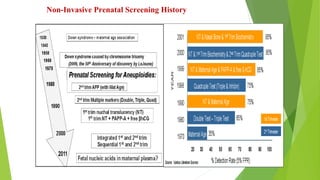
Non-Invasive Prenatal Screening History
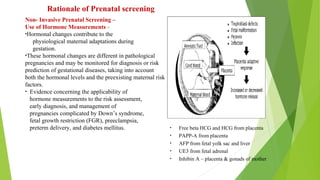
Non- Invasive Prenatal Screening –
Use of Hormone Measurements -
•Hormonal changes contribute to the
physiological maternal adaptations during
gestation.
•These hormonal changes are different in pathological
pregnancies and may be monitored for diagnosis or risk
prediction of gestational diseases, taking into account
both the hormonal levels and the preexisting maternal risk
factors.
• Evidence concerning the applicability of
hormone measurements to the risk assessment,
early diagnosis, and management of
pregnancies complicated by Down’s syndrome,
fetal growth restriction (FGR), preeclampsia,
preterm delivery, and diabetes mellitus.
Rationale of Prenatal screening
• Free beta HCG and HCG from placenta
• PAPP-A from placenta
• AFP from fetal yolk sac and liver
• UE3 from fetal adrenal
• Inhibin A – placenta & gonads of mother
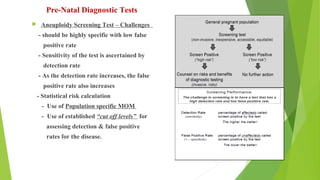
Pre-Natal Diagnostic Tests
 Aneuploidy Screening Test – Challenges
- should be highly specific with low false
positive rate
- Sensitivity of the test is ascertained by
detection rate
- As the detection rate increases, the false
positive rate also increases
- Statistical risk calculation
- Use of Population specific MOM
- Use of established “cut off levels” for
assessing detection & false positive
rates for the disease.
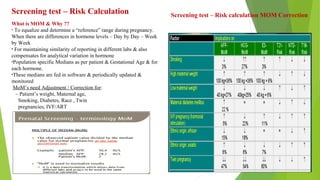
Screening test – Risk Calculation
What is MOM & Why ??
• To equalize and determine a “reference” range during pregnancy.
When there are differences in hormone levels – Day by Day – Week
by Week
• For maintaining similarity of reporting in different labs & also
compensates for analytical variation in hormone
•Population specific Medians as per patient & Gestational Age & for
each hormone.
•These medians are fed in software & periodically updated &
monitored
MoM’s need Adjustment / Correction for:
– Patient’s weight, Maternal age,
Smoking, Diabetes, Race , Twin
pregnancies, IVF/ART
Screening test – Risk calculation MOM Correction
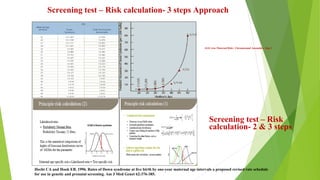
Hecht CA and Hook EB. 1996. Rates of Down syndrome at live birth by one-year maternal age intervals a proposed revised rate schedule
for use in genetic and prenatal screening. Am J Med Genet 62:376-385.
AGE wise Maternal Risk– Chromosomal Anomalies- Step 1
Screening test – Risk calculation- 3 steps Approach
Screening test – Risk
calculation- 2 & 3 steps
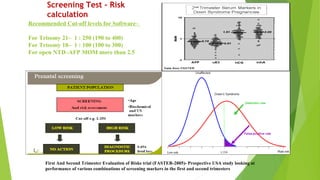
Recommended Cut-off levels for Software–
For Trisomy 21– 1 : 250 (190 to 400)
For Trisomy 18– 1 : 100 (100 to 300)
For open NTD–AFP MOM more than 2.5
Screening Test – Risk
calculation
First And Second Trimester Evaluation of Risks trial (FASTER-2005)- Prospective USA study looking at
performance of various combinations of screening markers in the first and second trimesters
PRENATAL SCREENING
Clinical Information Needed
 Date of Birth: for age related risk
 Gestation: by LMP or by ultrasound recommended
 Maternal Weight: marker levels decrease with increasing maternal weight,
most important for AFP
 Diabetic Status: maternal IDDM increases risk of ONTD while MSAFP
tends towards lower levels
 Race: Blacks have higher MSAFP and lower population prevalence of
ONTD
 USG Findings: for NT, CRL, Multiple Gestation- AFP increases with
number of babies; serum screening for DS not available for multiples
Laboratory QC Criteria
Alpha-Fetoprotein [AFP] Assay
• The coefficient of variation should not exceed 5%. The
accuracy should be within 3% from lot to lot.
Chorionic Gonadotropin [hCG] Assay
• The coefficient of variation should not exceed 5%. The
accuracy should be within 3% from lot to lot.
Unconjugated Estriol [uE3], PAPP-A, Free B-HCG Assay
• The coefficient of variation should not exceed 7%. The
accuracy should be within 5% from lot to lot.
-Monthly monitoring of individual parameter MOM
- Monthly monitoring of positivity rates for T21, T13/18,
NTD
- Quarterly monitoring of individual parameter MOM in
comparison with shared database, there by updating the
MOM as per Indian population
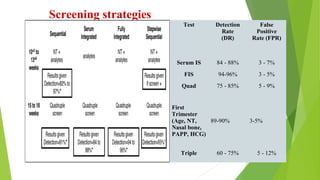
Screening strategies
Test Detection
Rate
(DR)
False
Positive
Rate (FPR)
Serum IS 84 - 88% 3 - 7%
FIS 94-96% 3 - 5%
Quad 75 - 85% 5 - 9%
First
Trimester
(Age, NT,
Nasal bone,
PAPP, HCG)
89-90% 3-5%
Triple 60 - 75% 5 - 12%
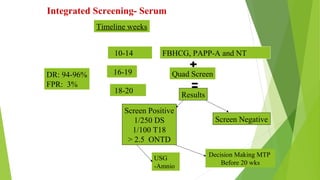
Integrated Screening- Serum
FBHCG, PAPP-A and NT
Quad Screen
Screen Positive
1/250 DS
1/100 T18
> 2.5 ONTD
Screen Negative
USG
-Amnio
10-14
16-19
Results
18-20
Timeline weeks
Decision Making MTP
Before 20 wks
+
=
DR: 94-96%
FPR: 3%
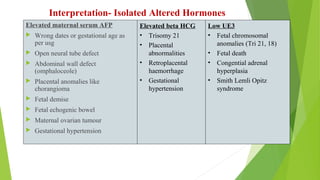
Interpretation- Isolated Altered Hormones
Elevated maternal serum AFP
 Wrong dates or gestational age as
per usg
 Open neural tube defect
 Abdominal wall defect
(omphaloceole)
 Placental anomalies like
chorangioma
 Fetal demise
 Fetal echogenic bowel
 Maternal ovarian tumour
 Gestational hypertension
Elevated beta HCG
• Trisomy 21
• Placental
abnormalities
• Retroplacental
haemorrhage
• Gestational
hypertension
Low UE3
• Fetal chromosomal
anomalies (Tri 21, 18)
• Fetal death
• Congential adrenal
hyperplasia
• Smith Lemli Opitz
syndrome
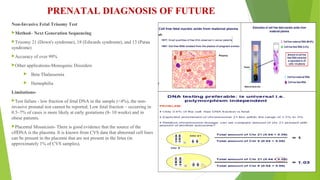
PRENATAL DIAGNOSIS OF FUTURE
Non-Invasive Fetal Trisomy Test
Method– Next Generation Sequencing
Trisomy 21 (Down's syndrome), 18 (Edwards syndrome), and 13 (Patau
syndrome)
Accuracy of over 99%
Other applications-Monogenic Disorders
 Beta Thalassemia
 Hemophilia
Limitations-
Test failure - low fraction of fetal DNA in the sample (<4%), the non-
invasive prenatal test cannot be reported. Low fetal fraction – occurring in
0.5–7% of cases is more likely at early gestations (8- 10 weeks) and in
obese patients.
Placental Mosaicism- There is good evidence that the source of the
cffDNA is the placenta. It is known from CVS data that abnormal cell lines
can be present in the placenta that are not present in the fetus (in
approximately 1% of CVS samples),
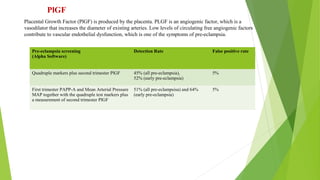
PlGF
Pre-eclampsia screening
(Alpha Software)
Detection Rate False positive rate
Quadruple markers plus second trimester PlGF 45% (all pre-eclampsia),
52% (early pre-eclampsia)
5%
First trimester PAPP-A and Mean Arterial Pressure
MAP together with the quadruple test markers plus
a measurement of second trimester PlGF
51% (all pre-eclampsisa) and 64%
(early pre-eclampsia)
5%
Placental Growth Factor (PlGF) is produced by the placenta. PLGF is an angiogenic factor, which is a
vasodilator that increases the diameter of existing arteries. Low levels of circulating free angiogenic factors
contribute to vascular endothelial dysfunction, which is one of the symptoms of pre-eclampsia.
Maternal screening for fetal Aneuploidy- Update on Laboratory Tests

Maternal screening for fetal Aneuploidy- Update on Laboratory Tests

  • 1.
    Maternal Screening –MaternalScreening – Update on Laboratory testsUpdate on Laboratory tests DR RAJESH V BENDRE Chief Pathologist, MD(path), DNB(path), DPB
  • 2.
    GENETIC Abnormalities  3-5%of babies have a major birth defect or mental retardation  Congenital anomalies account for 8–15% of perinatal deaths and 13–16% of neonatal deaths in India.  Risk in Indian population for Trisomy 21 Down’s syndrome is 1: 853  Trisomy 18 Edward syndrome Risk 1: 8,000  Trisomy 13 Patau syndrome Risk 1 : 5,000 Congenital Defects  Second most common major congenital defect neural tube defects 1-2 : 1000 - Congenital malformations at birth in Central India: Amar Taksande et al. Indian J Hum Genet. 2010 - Krishnamurty PS et al. Down's syndrome in Hyderabad, India . Acta anthropogenet 1985;9(4):256-60. Rationale of prenatal screening
  • 3.
    Who should bescreened ? Conditions causing increased risk for chromosomal anomalies Maternal age ≥ 35 yr, ≥ 31 yr with twins Previous Bad history  Autosomal trisomy,  Repetitive first trimester abortion  Major structural defect  Isolated structural anomalies  Familial genetic disease  History of parental consanguinity Maternal - Diabetes Type I, Viral infections Rationale of prenatal screening Ideally, all women should be offered aneuploidy screening before 20 weeks of gestation, regardless of Maternal Age.(ACOG 2007)
  • 4.
  • 5.
    Non- Invasive PrenatalScreening – Use of Hormone Measurements - •Hormonal changes contribute to the physiological maternal adaptations during gestation. •These hormonal changes are different in pathological pregnancies and may be monitored for diagnosis or risk prediction of gestational diseases, taking into account both the hormonal levels and the preexisting maternal risk factors. • Evidence concerning the applicability of hormone measurements to the risk assessment, early diagnosis, and management of pregnancies complicated by Down’s syndrome, fetal growth restriction (FGR), preeclampsia, preterm delivery, and diabetes mellitus. Rationale of Prenatal screening • Free beta HCG and HCG from placenta • PAPP-A from placenta • AFP from fetal yolk sac and liver • UE3 from fetal adrenal • Inhibin A – placenta & gonads of mother
  • 6.
    Pre-Natal Diagnostic Tests Aneuploidy Screening Test – Challenges - should be highly specific with low false positive rate - Sensitivity of the test is ascertained by detection rate - As the detection rate increases, the false positive rate also increases - Statistical risk calculation - Use of Population specific MOM - Use of established “cut off levels” for assessing detection & false positive rates for the disease.
  • 7.
    Screening test –Risk Calculation What is MOM & Why ?? • To equalize and determine a “reference” range during pregnancy. When there are differences in hormone levels – Day by Day – Week by Week • For maintaining similarity of reporting in different labs & also compensates for analytical variation in hormone •Population specific Medians as per patient & Gestational Age & for each hormone. •These medians are fed in software & periodically updated & monitored MoM’s need Adjustment / Correction for: – Patient’s weight, Maternal age, Smoking, Diabetes, Race , Twin pregnancies, IVF/ART Screening test – Risk calculation MOM Correction
  • 8.
    Hecht CA andHook EB. 1996. Rates of Down syndrome at live birth by one-year maternal age intervals a proposed revised rate schedule for use in genetic and prenatal screening. Am J Med Genet 62:376-385. AGE wise Maternal Risk– Chromosomal Anomalies- Step 1 Screening test – Risk calculation- 3 steps Approach Screening test – Risk calculation- 2 & 3 steps
  • 9.
    Recommended Cut-off levelsfor Software– For Trisomy 21– 1 : 250 (190 to 400) For Trisomy 18– 1 : 100 (100 to 300) For open NTD–AFP MOM more than 2.5 Screening Test – Risk calculation First And Second Trimester Evaluation of Risks trial (FASTER-2005)- Prospective USA study looking at performance of various combinations of screening markers in the first and second trimesters
  • 10.
    PRENATAL SCREENING Clinical InformationNeeded  Date of Birth: for age related risk  Gestation: by LMP or by ultrasound recommended  Maternal Weight: marker levels decrease with increasing maternal weight, most important for AFP  Diabetic Status: maternal IDDM increases risk of ONTD while MSAFP tends towards lower levels  Race: Blacks have higher MSAFP and lower population prevalence of ONTD  USG Findings: for NT, CRL, Multiple Gestation- AFP increases with number of babies; serum screening for DS not available for multiples
  • 11.
    Laboratory QC Criteria Alpha-Fetoprotein[AFP] Assay • The coefficient of variation should not exceed 5%. The accuracy should be within 3% from lot to lot. Chorionic Gonadotropin [hCG] Assay • The coefficient of variation should not exceed 5%. The accuracy should be within 3% from lot to lot. Unconjugated Estriol [uE3], PAPP-A, Free B-HCG Assay • The coefficient of variation should not exceed 7%. The accuracy should be within 5% from lot to lot. -Monthly monitoring of individual parameter MOM - Monthly monitoring of positivity rates for T21, T13/18, NTD - Quarterly monitoring of individual parameter MOM in comparison with shared database, there by updating the MOM as per Indian population
  • 12.
    Screening strategies Test Detection Rate (DR) False Positive Rate(FPR) Serum IS 84 - 88% 3 - 7% FIS 94-96% 3 - 5% Quad 75 - 85% 5 - 9% First Trimester (Age, NT, Nasal bone, PAPP, HCG) 89-90% 3-5% Triple 60 - 75% 5 - 12%
  • 13.
    Integrated Screening- Serum FBHCG,PAPP-A and NT Quad Screen Screen Positive 1/250 DS 1/100 T18 > 2.5 ONTD Screen Negative USG -Amnio 10-14 16-19 Results 18-20 Timeline weeks Decision Making MTP Before 20 wks + = DR: 94-96% FPR: 3%
  • 14.
    Interpretation- Isolated AlteredHormones Elevated maternal serum AFP  Wrong dates or gestational age as per usg  Open neural tube defect  Abdominal wall defect (omphaloceole)  Placental anomalies like chorangioma  Fetal demise  Fetal echogenic bowel  Maternal ovarian tumour  Gestational hypertension Elevated beta HCG • Trisomy 21 • Placental abnormalities • Retroplacental haemorrhage • Gestational hypertension Low UE3 • Fetal chromosomal anomalies (Tri 21, 18) • Fetal death • Congential adrenal hyperplasia • Smith Lemli Opitz syndrome
  • 15.
    PRENATAL DIAGNOSIS OFFUTURE Non-Invasive Fetal Trisomy Test Method– Next Generation Sequencing Trisomy 21 (Down's syndrome), 18 (Edwards syndrome), and 13 (Patau syndrome) Accuracy of over 99% Other applications-Monogenic Disorders  Beta Thalassemia  Hemophilia Limitations- Test failure - low fraction of fetal DNA in the sample (<4%), the non- invasive prenatal test cannot be reported. Low fetal fraction – occurring in 0.5–7% of cases is more likely at early gestations (8- 10 weeks) and in obese patients. Placental Mosaicism- There is good evidence that the source of the cffDNA is the placenta. It is known from CVS data that abnormal cell lines can be present in the placenta that are not present in the fetus (in approximately 1% of CVS samples),
  • 16.
    PlGF Pre-eclampsia screening (Alpha Software) DetectionRate False positive rate Quadruple markers plus second trimester PlGF 45% (all pre-eclampsia), 52% (early pre-eclampsia) 5% First trimester PAPP-A and Mean Arterial Pressure MAP together with the quadruple test markers plus a measurement of second trimester PlGF 51% (all pre-eclampsisa) and 64% (early pre-eclampsia) 5% Placental Growth Factor (PlGF) is produced by the placenta. PLGF is an angiogenic factor, which is a vasodilator that increases the diameter of existing arteries. Low levels of circulating free angiogenic factors contribute to vascular endothelial dysfunction, which is one of the symptoms of pre-eclampsia.

Editor's Notes

  • #4 Hence above mentioned history is required