
Interpretative Comments & Notes
In Laboratory Reports
Dr Rajesh Bendre
MD(Path), DNB, DPB
 Interpretation of laboratory tests is a complex post-analytical activity calling for
the understanding of the analytical processes involved in generating results and
therefore the knowledge of performance characteristics of the method used,
recognition of potential pre- and intra-analytical errors, and correlation of
results with the clinical status of the patient.
 The ultimate goal is to assure the appropriate interpretation and utilization of
laboratory information for an effective clinical decision-making process and
valuable patient management.
INTRODUCTION
 Current demand for interpretative comments and its desirability spring from
clinical, technical and financial catalysts.
 Evidence has accumulated to demonstrate the risk of errors due to
misinterpretation of diagnostic tests in different clinical settings (e.g.
primary care, emergency departments, internal medicine) and their impact
on patient safety. The inclusion of interpretative comments in laboratory
reports could decrease error rates, thus improving the quality of laboratory
information and patient safety.
 There is a specific requirement in the International Standard for laboratory
accreditation International Standards Organization (ISO 15189: 2012) for
Laboratory Directors to provide clinical advice in the interpretation of
examination results, including the inclusion of “interpretative comments on
results” and “where applicable”. The addition of interpretative comments
has been recommended in several clinical guidelines to improve the
utilization of laboratory data.
Need for interpretative comments
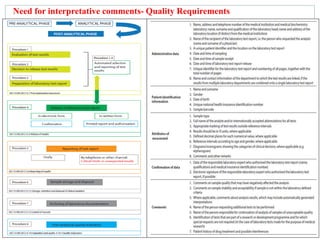
Need for interpretative comments- Quality Requirements
 New and complex tests represent a major driver for the inclusion of
interpretative comments in the laboratory report. This is particularly true in some
diagnostic areas such as coagulation, autoimmunity, allergy testing, and
molecular diagnostics that present major challenges due to the need of advanced
expertise for the correct interpretation of the laboratory data. In addition,
interpretative comments are increasingly welcomed by the requesting physicians
particularly when they provide clinical advice on “what to do next”.
 The lack of harmonization of the laboratory information, not only in analytical
methodology but also in measurement units, reference intervals and decision
limits, is a further driver for the inclusion of interpretative comments.
 Current evidence highlights that medical education on laboratory testing is
inadequate and that junior doctors do not feel confident in interpreting even
common laboratory tests, at least in part because many medical schools have
moved toward newer ways of undergraduate teaching which have reduced the
time available for teaching the pathology disciplines.
Need for interpretative comments
 Increasing competition between clinical laboratories that is predominantly based
on costs could be better addressed if other variables that provide evidence of the
quality of laboratory services are considered. The availability of interpretative
comments could represent “added value” to requesting physicians and users.
 The need to reduce cost of healthcare, specifically, costs related to laboratory
testing, should shift the focus from volume reduction to the reduction of
inappropriate requests and, even more important, inappropriate utilization of
laboratory information. Current evidence highlights the huge percentage of
laboratory results that are poorly acknowledged and misinterpreted, leading to
missed or delayed diagnoses and treatments.
 Physician satisfaction of interpretative service is backed by evidence;
contributing factors include a significant reduction of errors and improvement of
clinical outcomes.
Need for interpretative comments
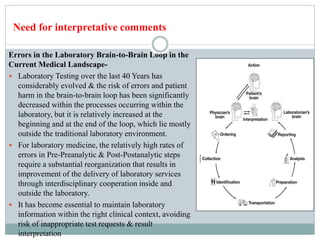
Errors in the Laboratory Brain-to-Brain Loop in the
Current Medical Landscape-
 Laboratory Testing over the last 40 Years has
considerably evolved & the risk of errors and patient
harm in the brain-to-brain loop has been significantly
decreased within the processes occurring within the
laboratory, but it is relatively increased at the
beginning and at the end of the loop, which lie mostly
outside the traditional laboratory environment.
 For laboratory medicine, the relatively high rates of
errors in Pre-Preanalytic & Post-Postanalytic steps
require a substantial reorganization that results in
improvement of the delivery of laboratory services
through interdisciplinary cooperation inside and
outside the laboratory.
 It has become essential to maintain laboratory
information within the right clinical context, avoiding
risk of inappropriate test requests & result
interpretation
Need for interpretative comments
APPLICATION-
 The objective is to aid clinicians in the interpretation of complex data, and
comments will probably be of particular value when –
 dynamic or uncommon tests are reported,
 where significant abnormalities are present, or
 where analytical or preanalytical factors (often not fully appreciated by the
clinician) may impinge on the interpretation of the results.
 Regarding appropriateness, the proposal is to add interpretative comments:
 a) for particular tests/test panels that cannot be interpreted by numeric data
alone
 b) in patient-specific situations — when a particular laboratory finding has
been obtained and there some additional explanatory comments are required,
particularly in some diagnostic areas such as allergy, autoimmune and
coagulation testing;
 c) when requested by clinicians — when a specific clinical question is asked
on requesting a laboratory examination, and after receipt of the laboratory
report.
APPLICATION-
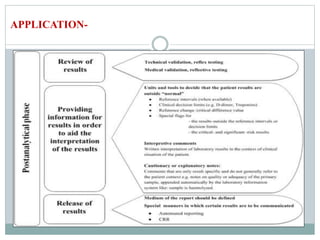
 Interpretative commenting acts in the post-analytical phase when the analytical
results (or data) is assessed against other available laboratory and clinical data.
 Interpretive comments on lab reports span a wide range, from a basic decision
limit, to delta checks for serial results, to a definitive clinical diagnosis, (Mario
Plebani,et al)).
 This spectrum contains everything from a canned single-sentence comment
attached automatically to every result of a particular test, to individualized
paragraphs that describe the clinical situation in a detailed & narrative style.
 Typically, interpretive reports might include one or more of the following:
 Description of the abnormal result
 Possible reasons for an abnormal result
 Suggestions for further testing
 Statement of need for immediate treatment
CONTENT-
 Qualitative abnormalities of lymphoid cells- “reactive lymphocytes” should be used to
describe lymphocytes only when benign etiology is almost certain, whilst the definition of
“atypical lymphocytes”, with an accompanying description of cells, should be used to
describe lymphocytes with likely malignant or clonal etiology. When doubts remain about
the reactive or neoplastic, caution must be used and the specific comment
“immunophenotyping is recommended” may be added
 Persistence of monocytosis or lymphocytosis should prompt further clinical and
diagnostic investigations
 Persistence of increased numbers of large granular lymphocytes & Smudge cells (more
than 2%) should prompt further clinical and diagnostic investigations
 RBC agglutination, possibly attributable to cold agglutinins, and disappearing after
warming at 37 °C Additional clinical and diagnostic investigations are recommended
 Pseudothrombocytopenia due to platelet clumping; The phenomenon is not clinically
significant. Accurate platelet counting should be carried out using a different blood
specimen (citrate)
CONTENT- Hematology examples
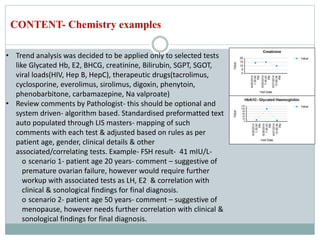
• Trend analysis was decided to be applied only to selected tests
like Glycated Hb, E2, BHCG, creatinine, Bilirubin, SGPT, SGOT,
viral loads(HIV, Hep B, HepC), therapeutic drugs(tacrolimus,
cyclosporine, everolimus, sirolimus, digoxin, phenytoin,
phenobarbitone, carbamazepine, Na valproate)
• Review comments by Pathologist- this should be optional and
system driven- algorithm based. Standardised preformatted text
auto populated through LIS masters- mapping of such
comments with each test & adjusted based on rules as per
patient age, gender, clinical details & other
associated/correlating tests. Example- FSH result- 41 mIU/L-
o scenario 1- patient age 20 years- comment – suggestive of
premature ovarian failure, however would require further
workup with associated tests as LH, E2 & correlation with
clinical & sonological findings for final diagnosis.
o scenario 2- patient age 50 years- comment – suggestive of
menopause, however needs further correlation with clinical &
sonological findings for final diagnosis.
CONTENT- Chemistry examples
Problems with LIS rules applications
There are some fundamental issues that prevent more effective use of LIS-type rules.
Collectively, these problems have been dubbed the “knowledge engineering bottleneck” and
remain the subject of ongoing research.
 Bottleneck 1: Implementing interpretative comments as and when required, applying the
logic differentially as per referring doctor/ profile
 Bottleneck 2: Rule structure - as collections of rules grow, interactions between the rules
rapidly becomes a serious issue. Increasing complexity causes conflicting behaviour that
can be very difficult to resolve.
 Bottleneck 3: Understanding the expert - coding rules requires that an expert specify all the
contexts in which that rule should and should not apply. This apparently simple
requirement is in practice a notoriously difficult one. It is virtually impossible for an expert
clinical biochemist to specify all of the criteria for appending Comment A, and the
circumstances under which Comment A is supplanted by Comment B.
 Bottleneck 4: Keeping the rules current – laboratory medicine requires that the rules
change to keep pace with growth in knowledge, new tests, altered reference intervals, and
updated guidelines.
CHALLENGES-
 Concern about the dangers of providing inappropriate advice in the absence of complete
clinical information.
 Fear of specialist response that this would be perceived as an invasion of “clinical turf”.
 Providing such comments may delay the release of results by the laboratory to the
detriment of patients, although results can be released when analytically validated, with
the addition of individualised comments soon afterwards and before the release of a final
report.
 Report by Lim et al. clearly shows that unless those with extensive knowledge in a
clinical area provide the interpretations, there will be too many mistakes in what is said,
and this will surely doom an important, value-added service to failure.
CONCERNS-
 There is a growing consensus that the need for patient-specific clinical
laboratory narrative interpretations exists, but the mechanism by which
such interpretations can be provided remains undefined.
 Also it is clear that the narrative comments should be phrased cautiously
& by those with extensive knowledge in a clinical area, otherwise an
important, value-added service can backfire leading to failure.
 Quality Assurance programs in interpretative commenting may help in
education and continuing professional development in this regard and in
monitoring performance in the future.
 Perhaps, future LISs will include the ability to rapidly and easily prepare
the patients’ reports including result trend chart & test specific
interpretative comments
CONCLUSION-
Interpretative Lab reports

Interpretative Lab reports

  • 1.
    Interpretative Comments &Notes In Laboratory Reports Dr Rajesh Bendre MD(Path), DNB, DPB
  • 2.
     Interpretation oflaboratory tests is a complex post-analytical activity calling for the understanding of the analytical processes involved in generating results and therefore the knowledge of performance characteristics of the method used, recognition of potential pre- and intra-analytical errors, and correlation of results with the clinical status of the patient.  The ultimate goal is to assure the appropriate interpretation and utilization of laboratory information for an effective clinical decision-making process and valuable patient management. INTRODUCTION
  • 3.
     Current demandfor interpretative comments and its desirability spring from clinical, technical and financial catalysts.  Evidence has accumulated to demonstrate the risk of errors due to misinterpretation of diagnostic tests in different clinical settings (e.g. primary care, emergency departments, internal medicine) and their impact on patient safety. The inclusion of interpretative comments in laboratory reports could decrease error rates, thus improving the quality of laboratory information and patient safety.  There is a specific requirement in the International Standard for laboratory accreditation International Standards Organization (ISO 15189: 2012) for Laboratory Directors to provide clinical advice in the interpretation of examination results, including the inclusion of “interpretative comments on results” and “where applicable”. The addition of interpretative comments has been recommended in several clinical guidelines to improve the utilization of laboratory data. Need for interpretative comments
  • 4.
    Need for interpretativecomments- Quality Requirements
  • 5.
     New andcomplex tests represent a major driver for the inclusion of interpretative comments in the laboratory report. This is particularly true in some diagnostic areas such as coagulation, autoimmunity, allergy testing, and molecular diagnostics that present major challenges due to the need of advanced expertise for the correct interpretation of the laboratory data. In addition, interpretative comments are increasingly welcomed by the requesting physicians particularly when they provide clinical advice on “what to do next”.  The lack of harmonization of the laboratory information, not only in analytical methodology but also in measurement units, reference intervals and decision limits, is a further driver for the inclusion of interpretative comments.  Current evidence highlights that medical education on laboratory testing is inadequate and that junior doctors do not feel confident in interpreting even common laboratory tests, at least in part because many medical schools have moved toward newer ways of undergraduate teaching which have reduced the time available for teaching the pathology disciplines. Need for interpretative comments
  • 6.
     Increasing competitionbetween clinical laboratories that is predominantly based on costs could be better addressed if other variables that provide evidence of the quality of laboratory services are considered. The availability of interpretative comments could represent “added value” to requesting physicians and users.  The need to reduce cost of healthcare, specifically, costs related to laboratory testing, should shift the focus from volume reduction to the reduction of inappropriate requests and, even more important, inappropriate utilization of laboratory information. Current evidence highlights the huge percentage of laboratory results that are poorly acknowledged and misinterpreted, leading to missed or delayed diagnoses and treatments.  Physician satisfaction of interpretative service is backed by evidence; contributing factors include a significant reduction of errors and improvement of clinical outcomes. Need for interpretative comments
  • 7.
    Errors in theLaboratory Brain-to-Brain Loop in the Current Medical Landscape-  Laboratory Testing over the last 40 Years has considerably evolved & the risk of errors and patient harm in the brain-to-brain loop has been significantly decreased within the processes occurring within the laboratory, but it is relatively increased at the beginning and at the end of the loop, which lie mostly outside the traditional laboratory environment.  For laboratory medicine, the relatively high rates of errors in Pre-Preanalytic & Post-Postanalytic steps require a substantial reorganization that results in improvement of the delivery of laboratory services through interdisciplinary cooperation inside and outside the laboratory.  It has become essential to maintain laboratory information within the right clinical context, avoiding risk of inappropriate test requests & result interpretation Need for interpretative comments
  • 8.
  • 9.
     The objectiveis to aid clinicians in the interpretation of complex data, and comments will probably be of particular value when –  dynamic or uncommon tests are reported,  where significant abnormalities are present, or  where analytical or preanalytical factors (often not fully appreciated by the clinician) may impinge on the interpretation of the results.  Regarding appropriateness, the proposal is to add interpretative comments:  a) for particular tests/test panels that cannot be interpreted by numeric data alone  b) in patient-specific situations — when a particular laboratory finding has been obtained and there some additional explanatory comments are required, particularly in some diagnostic areas such as allergy, autoimmune and coagulation testing;  c) when requested by clinicians — when a specific clinical question is asked on requesting a laboratory examination, and after receipt of the laboratory report. APPLICATION-
  • 10.
     Interpretative commentingacts in the post-analytical phase when the analytical results (or data) is assessed against other available laboratory and clinical data.  Interpretive comments on lab reports span a wide range, from a basic decision limit, to delta checks for serial results, to a definitive clinical diagnosis, (Mario Plebani,et al)).  This spectrum contains everything from a canned single-sentence comment attached automatically to every result of a particular test, to individualized paragraphs that describe the clinical situation in a detailed & narrative style.  Typically, interpretive reports might include one or more of the following:  Description of the abnormal result  Possible reasons for an abnormal result  Suggestions for further testing  Statement of need for immediate treatment CONTENT-
  • 11.
     Qualitative abnormalitiesof lymphoid cells- “reactive lymphocytes” should be used to describe lymphocytes only when benign etiology is almost certain, whilst the definition of “atypical lymphocytes”, with an accompanying description of cells, should be used to describe lymphocytes with likely malignant or clonal etiology. When doubts remain about the reactive or neoplastic, caution must be used and the specific comment “immunophenotyping is recommended” may be added  Persistence of monocytosis or lymphocytosis should prompt further clinical and diagnostic investigations  Persistence of increased numbers of large granular lymphocytes & Smudge cells (more than 2%) should prompt further clinical and diagnostic investigations  RBC agglutination, possibly attributable to cold agglutinins, and disappearing after warming at 37 °C Additional clinical and diagnostic investigations are recommended  Pseudothrombocytopenia due to platelet clumping; The phenomenon is not clinically significant. Accurate platelet counting should be carried out using a different blood specimen (citrate) CONTENT- Hematology examples
  • 12.
    • Trend analysiswas decided to be applied only to selected tests like Glycated Hb, E2, BHCG, creatinine, Bilirubin, SGPT, SGOT, viral loads(HIV, Hep B, HepC), therapeutic drugs(tacrolimus, cyclosporine, everolimus, sirolimus, digoxin, phenytoin, phenobarbitone, carbamazepine, Na valproate) • Review comments by Pathologist- this should be optional and system driven- algorithm based. Standardised preformatted text auto populated through LIS masters- mapping of such comments with each test & adjusted based on rules as per patient age, gender, clinical details & other associated/correlating tests. Example- FSH result- 41 mIU/L- o scenario 1- patient age 20 years- comment – suggestive of premature ovarian failure, however would require further workup with associated tests as LH, E2 & correlation with clinical & sonological findings for final diagnosis. o scenario 2- patient age 50 years- comment – suggestive of menopause, however needs further correlation with clinical & sonological findings for final diagnosis. CONTENT- Chemistry examples
  • 13.
    Problems with LISrules applications There are some fundamental issues that prevent more effective use of LIS-type rules. Collectively, these problems have been dubbed the “knowledge engineering bottleneck” and remain the subject of ongoing research.  Bottleneck 1: Implementing interpretative comments as and when required, applying the logic differentially as per referring doctor/ profile  Bottleneck 2: Rule structure - as collections of rules grow, interactions between the rules rapidly becomes a serious issue. Increasing complexity causes conflicting behaviour that can be very difficult to resolve.  Bottleneck 3: Understanding the expert - coding rules requires that an expert specify all the contexts in which that rule should and should not apply. This apparently simple requirement is in practice a notoriously difficult one. It is virtually impossible for an expert clinical biochemist to specify all of the criteria for appending Comment A, and the circumstances under which Comment A is supplanted by Comment B.  Bottleneck 4: Keeping the rules current – laboratory medicine requires that the rules change to keep pace with growth in knowledge, new tests, altered reference intervals, and updated guidelines. CHALLENGES-
  • 14.
     Concern aboutthe dangers of providing inappropriate advice in the absence of complete clinical information.  Fear of specialist response that this would be perceived as an invasion of “clinical turf”.  Providing such comments may delay the release of results by the laboratory to the detriment of patients, although results can be released when analytically validated, with the addition of individualised comments soon afterwards and before the release of a final report.  Report by Lim et al. clearly shows that unless those with extensive knowledge in a clinical area provide the interpretations, there will be too many mistakes in what is said, and this will surely doom an important, value-added service to failure. CONCERNS-
  • 15.
     There isa growing consensus that the need for patient-specific clinical laboratory narrative interpretations exists, but the mechanism by which such interpretations can be provided remains undefined.  Also it is clear that the narrative comments should be phrased cautiously & by those with extensive knowledge in a clinical area, otherwise an important, value-added service can backfire leading to failure.  Quality Assurance programs in interpretative commenting may help in education and continuing professional development in this regard and in monitoring performance in the future.  Perhaps, future LISs will include the ability to rapidly and easily prepare the patients’ reports including result trend chart & test specific interpretative comments CONCLUSION-