
External Quality Assurance of
Serological Testing
Dr. G.D.A. Samaranayaka
Key elements of quality system
• Organizational management, including:
• Quality policy and plan
• Clear organizational structure
• Designated individual(s) with responsibility for
establishing managing the quality system
• Job descriptions for all staff
• National or international standards
• Documentation, including standard operating
procedures (SOPs), and document control
• Training of all staff
• Assessment, including:
• Evaluation, validation, calibration and maintenance
• Internal quality control
• Audit
• External quality assessment.
• Of particular importance to the blood
transfusion laboratory are:
• Use of standard operating procedures
• Staff training
• Accurate and complete documentation
• Validation of equipment, reagents,
techniques and, where applicable,
software.
Assessment
• Continuous quality improvement requires ongoing assessment and
review of the effectiveness of all elements of the quality system
• using both internal and external mechanisms
• To ensure that the defined quality standards are being met
consistently.
Accuracy vs Precision
• Accuracy is the degree of
closeness to true value.
• Precision is the degree to
which an instrument or
process will repeat the
same value.
• In other words, accuracy is
the degree of veracity while
precision is the degree of
reproducibility.
Internal assessment of the quality system
• Full validation of all activities, processes, procedures, equipment, reagents
and software prior to their introduction and use
• Regular monitoring of all critical activities where continuous measurement
of the outcomes is both possible and appropriate
• Use of specific control measures, such as quality control samples,
• to monitor the performance of critical activities
• Staff competency assessment
• Development of an internal audit system, using relevant standards or other
regulatory/licensing requirements
• Development of a system for the reporting, investigation and analysis of
errors, with effective corrective and preventive action.
External assessment of the quality system in
the laboratory
• Participation in an external quality assessment scheme
• External audit by a recognized, independent body.
Definition
• EQA is an external assessment
of a laboratory’s performance
in testing samples of known,
but undisclosed, content and
comparison with the
performance of other
laboratories.
• Maintains accuracy
EXTERNAL QUALITY ASSESSMENT
• effective way of identifying process problems within the laboratory
• provides the laboratory with an objective view of its performance relative
to other laboratories.
• Participation in EQA involves testing sets of samples of known, but
undisclosed, content that are sent to participating centres by the EQA
scheme.
• Each participating laboratory receives an identical set of samples which
should be processed in the same way as routine clinical samples
• Following the collation and analysis of results, each centre receives its own
results, together with the anonymized results for all other participating
centres, which enables it to compare its performance with other centres.
Objectives of EQA
• Improve standards of performance in blood transfusion laboratories
by
• raising awareness of the need for improvement
• demonstrating the benefits of best practice
• providing information, education and support for improvement.
Benefits to participating laboratories
• Comparison of their own performance with the performance of other
participating laboratories
• Identification of problems relating to laboratory processes,
techniques and reagents
• Provision of information and education to improve performance
• Encouragement of best practice
• Opportunities to enhance the credibility of the laboratory and
increase public confidence
• Access to a network of laboratories for the exchange of information.
Benefits to health and regulatory authorities
• Establishment of a network of blood transfusion laboratories with a
known standard of performance
• Provision of useful information to assist in:
• Setting standards
• Reviewing testing strategies and technologies
• Using resources effectively
• Improving public confidence in the blood transfusion service
• Supporting systems of accreditation.
EQA SCHEMES
• EQA should be organized as a
formal and structured scheme
in order to ensure effective
planning and organization.
• This will ensure the uniform
provision of samples for
testing and a standardized
approach to both the analysis
and reporting of results and
the monitoring of the
performance of participating
laboratories. Network of NEQUAS scheme
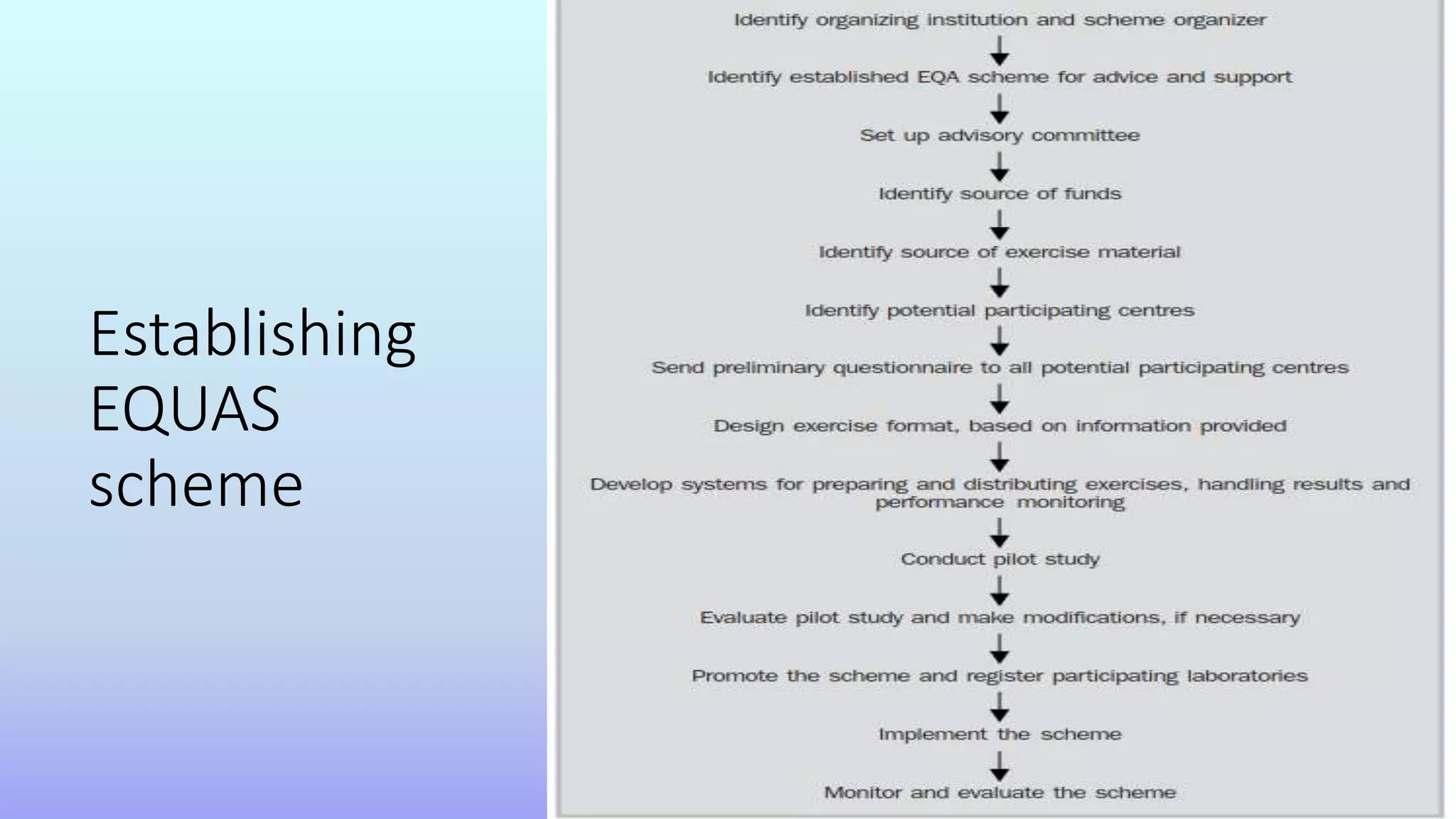
Establishing
EQUAS
scheme
References
• WHO EQUAS guideline
Thank You

External Quality Assurance of Serological Testing

  • 1.
    External Quality Assuranceof Serological Testing Dr. G.D.A. Samaranayaka
  • 2.
    Key elements ofquality system • Organizational management, including: • Quality policy and plan • Clear organizational structure • Designated individual(s) with responsibility for establishing managing the quality system • Job descriptions for all staff • National or international standards • Documentation, including standard operating procedures (SOPs), and document control • Training of all staff • Assessment, including: • Evaluation, validation, calibration and maintenance • Internal quality control • Audit • External quality assessment. • Of particular importance to the blood transfusion laboratory are: • Use of standard operating procedures • Staff training • Accurate and complete documentation • Validation of equipment, reagents, techniques and, where applicable, software.
  • 3.
    Assessment • Continuous qualityimprovement requires ongoing assessment and review of the effectiveness of all elements of the quality system • using both internal and external mechanisms • To ensure that the defined quality standards are being met consistently.
  • 4.
    Accuracy vs Precision •Accuracy is the degree of closeness to true value. • Precision is the degree to which an instrument or process will repeat the same value. • In other words, accuracy is the degree of veracity while precision is the degree of reproducibility.
  • 5.
    Internal assessment ofthe quality system • Full validation of all activities, processes, procedures, equipment, reagents and software prior to their introduction and use • Regular monitoring of all critical activities where continuous measurement of the outcomes is both possible and appropriate • Use of specific control measures, such as quality control samples, • to monitor the performance of critical activities • Staff competency assessment • Development of an internal audit system, using relevant standards or other regulatory/licensing requirements • Development of a system for the reporting, investigation and analysis of errors, with effective corrective and preventive action.
  • 6.
    External assessment ofthe quality system in the laboratory • Participation in an external quality assessment scheme • External audit by a recognized, independent body.
  • 7.
    Definition • EQA isan external assessment of a laboratory’s performance in testing samples of known, but undisclosed, content and comparison with the performance of other laboratories. • Maintains accuracy
  • 8.
    EXTERNAL QUALITY ASSESSMENT •effective way of identifying process problems within the laboratory • provides the laboratory with an objective view of its performance relative to other laboratories. • Participation in EQA involves testing sets of samples of known, but undisclosed, content that are sent to participating centres by the EQA scheme. • Each participating laboratory receives an identical set of samples which should be processed in the same way as routine clinical samples • Following the collation and analysis of results, each centre receives its own results, together with the anonymized results for all other participating centres, which enables it to compare its performance with other centres.
  • 9.
    Objectives of EQA •Improve standards of performance in blood transfusion laboratories by • raising awareness of the need for improvement • demonstrating the benefits of best practice • providing information, education and support for improvement.
  • 10.
    Benefits to participatinglaboratories • Comparison of their own performance with the performance of other participating laboratories • Identification of problems relating to laboratory processes, techniques and reagents • Provision of information and education to improve performance • Encouragement of best practice • Opportunities to enhance the credibility of the laboratory and increase public confidence • Access to a network of laboratories for the exchange of information.
  • 11.
    Benefits to healthand regulatory authorities • Establishment of a network of blood transfusion laboratories with a known standard of performance • Provision of useful information to assist in: • Setting standards • Reviewing testing strategies and technologies • Using resources effectively • Improving public confidence in the blood transfusion service • Supporting systems of accreditation.
  • 12.
    EQA SCHEMES • EQAshould be organized as a formal and structured scheme in order to ensure effective planning and organization. • This will ensure the uniform provision of samples for testing and a standardized approach to both the analysis and reporting of results and the monitoring of the performance of participating laboratories. Network of NEQUAS scheme
  • 13.
  • 14.
  • 15.