Group Members:
Roxcine Whyte
Court-nee Bernard
Nordia-kaye Moore
Davina Irving
SYSTEMS
Markavia Williams

THEORY
WHAT IS THE SYSTEM THEORY
 The system theory is the transdisciplinary

study of the abstract organization of
phenomena, independent of their substance,
type, or spatial or temporal scale of existence.
It is also a management methodology as it is
a way of analyzing and thinking about
organizations and also an alternative
approach
THE PREMISES OF THE SYSTEM
THEORY

The systems theory puts forth the premise that
organizations, like living organisms, are made up
of numerous component subsystems that must
work together in harmony for the larger system
to succeed. Systems theory states that
organizational success relies on synergy,
interrelations and interdependence between
different subsystems. As arguably the most
valuable component of a company, employees
make up various vital subsystems within an
organization. Departments, work groups,
business units, facilities and individual
employees can all be considered component
systems of the organizations
CHARACTERISTICS/FEACTURES OF
THE SYSTEMS THEORY
 Communication

Communication mechanisms must be put in place for
organizational systems to exchange relevant
information with its environment.
Communication provides for the flow of information
among the subsystems.
Systems, subsystems and supersystem
Systems are a set interrelated parte that turn inputs to
outputs through processing.
Subsystems is the step that does the processing of the
objectives within an organization.
Super systems are other systems in environment of
which the survival of the focal system id dependent.
CHARACTERISTICS/FEACTURES OF
THE SYSTEMS THEORY
 Boundaries

The part of the system that separates it from its
environment. The four types of boundaries
involved in the process are
physical, linquistical, systematic and
psychological boundaries.
Goal-directedness
systems are goal oriented and engage in feedback
in order to meet the goals of the organisation.
Also, every part of the system is interdependent
with each other working together towards the
ADVANTAGES OF THE SYSTEMS
THEORY

 It focuses on the environment and

how changes can impact the
organisation.
 Broadens the theoretical aspects for
viewing the behaviour of
organizations.
 It is designed to deal with complex
tasks
DISADVANTAGES OF THE SYSTEMS
THEORY
 The systems theory doesn’t focus on specific

task functions
 Doesn’t provide for detailed focus.
 The theory changes in environment directly
affect the structure and function of the
organisation
 Doesn’t directly explore the impact of
interpersonal relationships and loyalty on
productively.
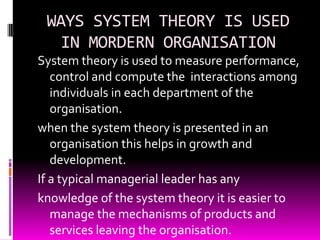
WAYS SYSTEM THEORY IS USED
IN MORDERN ORGANISATION
System theory is used to measure performance,
control and compute the interactions among
individuals in each department of the
organisation.
when the system theory is presented in an
organisation this helps in growth and
development.
If a typical managerial leader has any
knowledge of the system theory it is easier to
manage the mechanisms of products and
services leaving the organisation.
QUESTIONS AND ANSWERS

Systems theory ppt

  • 1.
    Group Members: Roxcine Whyte Court-neeBernard Nordia-kaye Moore Davina Irving SYSTEMS Markavia Williams THEORY
  • 2.
    WHAT IS THESYSTEM THEORY  The system theory is the transdisciplinary study of the abstract organization of phenomena, independent of their substance, type, or spatial or temporal scale of existence. It is also a management methodology as it is a way of analyzing and thinking about organizations and also an alternative approach
  • 3.
    THE PREMISES OFTHE SYSTEM THEORY The systems theory puts forth the premise that organizations, like living organisms, are made up of numerous component subsystems that must work together in harmony for the larger system to succeed. Systems theory states that organizational success relies on synergy, interrelations and interdependence between different subsystems. As arguably the most valuable component of a company, employees make up various vital subsystems within an organization. Departments, work groups, business units, facilities and individual employees can all be considered component systems of the organizations
  • 4.
    CHARACTERISTICS/FEACTURES OF THE SYSTEMSTHEORY  Communication Communication mechanisms must be put in place for organizational systems to exchange relevant information with its environment. Communication provides for the flow of information among the subsystems. Systems, subsystems and supersystem Systems are a set interrelated parte that turn inputs to outputs through processing. Subsystems is the step that does the processing of the objectives within an organization. Super systems are other systems in environment of which the survival of the focal system id dependent.
  • 5.
    CHARACTERISTICS/FEACTURES OF THE SYSTEMSTHEORY  Boundaries The part of the system that separates it from its environment. The four types of boundaries involved in the process are physical, linquistical, systematic and psychological boundaries. Goal-directedness systems are goal oriented and engage in feedback in order to meet the goals of the organisation. Also, every part of the system is interdependent with each other working together towards the
  • 6.
    ADVANTAGES OF THESYSTEMS THEORY  It focuses on the environment and how changes can impact the organisation.  Broadens the theoretical aspects for viewing the behaviour of organizations.  It is designed to deal with complex tasks
  • 7.
    DISADVANTAGES OF THESYSTEMS THEORY  The systems theory doesn’t focus on specific task functions  Doesn’t provide for detailed focus.  The theory changes in environment directly affect the structure and function of the organisation  Doesn’t directly explore the impact of interpersonal relationships and loyalty on productively.
  • 8.
    WAYS SYSTEM THEORYIS USED IN MORDERN ORGANISATION System theory is used to measure performance, control and compute the interactions among individuals in each department of the organisation. when the system theory is presented in an organisation this helps in growth and development. If a typical managerial leader has any knowledge of the system theory it is easier to manage the mechanisms of products and services leaving the organisation.
  • 9.