Kirilka Angelova
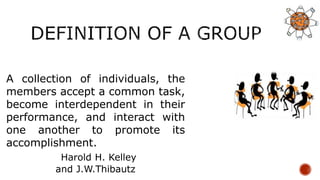
A collection of individuals, the
members accept a common task,
become interdependent in their
performance, and interact with
one another to promote its
accomplishment.
Harold H. Kelley
and J.W.Thibautz
Three views:
Normative views describes how a
group is to be organized and how its
activities are to be carried out.
Group dynamics consists of a set of
techniques.
Regarding internal nature of groups.
 Theory of Propinquity – People associate
with one another due to geographical
proximity.
 Balance Theory – People who have similar
attitudes toward certain objects and goals tend
to form a group.
 Exchange Theory – The reward-cost
outcomes of interactions serve as the basis for
group formation
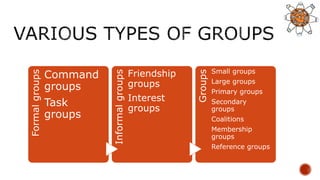
Formalgroups
Command
groups
Task
groups Informalgroups
Friendship
groups
Interest
groups
Groups
Small groups
Large groups
Primary groups
Secondary
groups
Coalitions
Membership
groups
Reference groups
These groups are formed by the organization
to carry out specific tasks.
It includes two types – command group and
task group.
Command Group
Represented in the organization chart.
Permanent in nature.
Members report to common supervisors.
Functional reporting relationship exists.
Task groups:
Formed to carry out specific tasks.
Temporary in nature
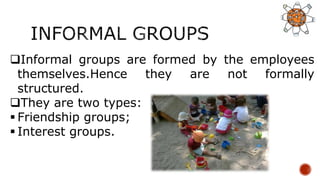
Informal groups are formed by the employees
themselves.Hence they are not formally
structured.
They are two types:
 Friendship groups;
 Interest groups.
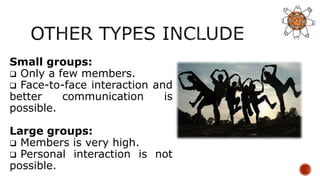
Small groups:
 Only a few members.
 Face-to-face interaction and
better communication is
possible.
Large groups:
 Members is very high.
 Personal interaction is not
possible.
Primary group:
It is made up of members who have similar
and loyalties and has a feeling of friendship
towards each other.
Secondary groups:
They share same values and beliefs, but
because of the size of the group, they do not
interact often with each other
Coalitions:
They are created by members for a specific
purposed and do not have a formal structure.
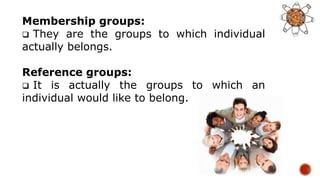
Membership groups:
 They are the groups to which individual
actually belongs.
Reference groups:
 It is actually the groups to which an
individual would like to belong.
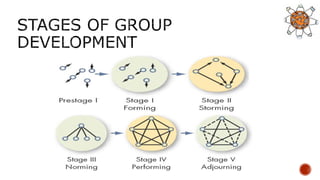
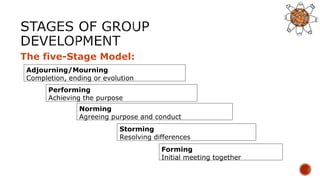
The five-Stage Model:
Adjourning/Mourning
Completion, ending or evolution
Performing
Achieving the purpose
Norming
Agreeing purpose and conduct
Storming
Resolving differences
Forming
Initial meeting together
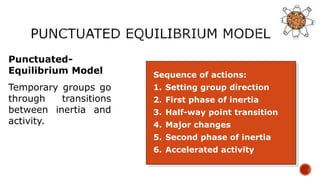
Punctuated-
Equilibrium Model
Temporary groups go
through transitions
between inertia and
activity.
Sequence of actions:
1. Setting group direction
2. First phase of inertia
3. Half-way point transition
4. Major changes
5. Second phase of inertia
6. Accelerated activity
 It helps shape the behavior of its
members, predict the behavior and
guide the performance of the group as
a whole.
Set of behavior pattern which an
individual occupying a certain position in
society is expected to display.
Dimensions of role are:
 Role Identity
Role perception
Role Expectations
Role Conflict
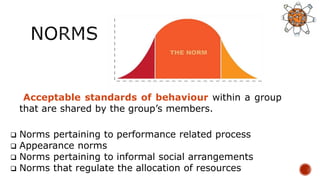
Acceptable standards of behaviour within a group
that are shared by the group’s members.
 Norms pertaining to performance related process
 Appearance norms
 Norms pertaining to informal social arrangements
 Norms that regulate the allocation of resources
Groups of 5-7 members exercise the best
elements of both small and large groups.
Social Loafing
The tendency for individuals to expend
less effort when working collectively than
when working individually.
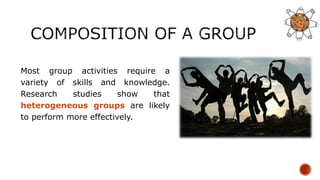
Most group activities require a
variety of skills and knowledge.
Research studies show that
heterogeneous groups are likely
to perform more effectively.
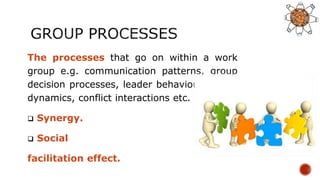
The processes that go on within a work
group e.g. communication patterns, group
decision processes, leader behaviour, power
dynamics, conflict interactions etc.
 Synergy.
 Social
facilitation effect.
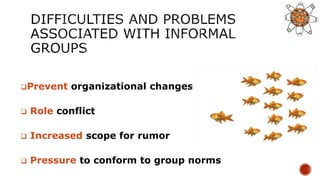
Prevent organizational changes
 Role conflict
 Increased scope for rumor
 Pressure to conform to group norms
Foundations of group behavior

Foundations of group behavior

  • 1.
  • 2.
    A collection ofindividuals, the members accept a common task, become interdependent in their performance, and interact with one another to promote its accomplishment. Harold H. Kelley and J.W.Thibautz
  • 3.
    Three views: Normative viewsdescribes how a group is to be organized and how its activities are to be carried out. Group dynamics consists of a set of techniques. Regarding internal nature of groups.
  • 4.
     Theory ofPropinquity – People associate with one another due to geographical proximity.  Balance Theory – People who have similar attitudes toward certain objects and goals tend to form a group.  Exchange Theory – The reward-cost outcomes of interactions serve as the basis for group formation
  • 5.
    Formalgroups Command groups Task groups Informalgroups Friendship groups Interest groups Groups Small groups Largegroups Primary groups Secondary groups Coalitions Membership groups Reference groups
  • 6.
    These groups areformed by the organization to carry out specific tasks. It includes two types – command group and task group.
  • 7.
    Command Group Represented inthe organization chart. Permanent in nature. Members report to common supervisors. Functional reporting relationship exists. Task groups: Formed to carry out specific tasks. Temporary in nature
  • 8.
    Informal groups areformed by the employees themselves.Hence they are not formally structured. They are two types:  Friendship groups;  Interest groups.
  • 9.
    Small groups:  Onlya few members.  Face-to-face interaction and better communication is possible. Large groups:  Members is very high.  Personal interaction is not possible.
  • 10.
    Primary group: It ismade up of members who have similar and loyalties and has a feeling of friendship towards each other. Secondary groups: They share same values and beliefs, but because of the size of the group, they do not interact often with each other Coalitions: They are created by members for a specific purposed and do not have a formal structure.
  • 11.
    Membership groups:  Theyare the groups to which individual actually belongs. Reference groups:  It is actually the groups to which an individual would like to belong.
  • 13.
    The five-Stage Model: Adjourning/Mourning Completion,ending or evolution Performing Achieving the purpose Norming Agreeing purpose and conduct Storming Resolving differences Forming Initial meeting together
  • 14.
    Punctuated- Equilibrium Model Temporary groupsgo through transitions between inertia and activity. Sequence of actions: 1. Setting group direction 2. First phase of inertia 3. Half-way point transition 4. Major changes 5. Second phase of inertia 6. Accelerated activity
  • 15.
     It helpsshape the behavior of its members, predict the behavior and guide the performance of the group as a whole.
  • 16.
    Set of behaviorpattern which an individual occupying a certain position in society is expected to display. Dimensions of role are:  Role Identity Role perception Role Expectations Role Conflict
  • 17.
    Acceptable standards ofbehaviour within a group that are shared by the group’s members.  Norms pertaining to performance related process  Appearance norms  Norms pertaining to informal social arrangements  Norms that regulate the allocation of resources
  • 18.
    Groups of 5-7members exercise the best elements of both small and large groups. Social Loafing The tendency for individuals to expend less effort when working collectively than when working individually.
  • 19.
    Most group activitiesrequire a variety of skills and knowledge. Research studies show that heterogeneous groups are likely to perform more effectively.
  • 20.
    The processes thatgo on within a work group e.g. communication patterns, group decision processes, leader behaviour, power dynamics, conflict interactions etc.  Synergy.  Social facilitation effect.
  • 21.
    Prevent organizational changes Role conflict  Increased scope for rumor  Pressure to conform to group norms