By 
WaleedAbdEl-MalekEl-Refaey 
Ass. Lecturer of Internal Medicine and Nephrology 
Faculty of Medicine 
Tanta University
•Contrast-inducednephropathy(CIN)isagenerallyreversibleformofacutekidneyinjury(AKI)thatoccurssoonaftertheadministrationofradiocontrastmedia. 
•AfterintravascularCMinjection,immediaterenaltoxicitymayoccur,andinmostcasesitremainsfortunatelyfreeofsignificantclinicalconsequences. 
Sandler CM. Contrast-agent-induced acute renal dysfunction –is iodixanolthe answer? N EnglJ Med. 2003;348(6):551–3.
of CIN includes: 
MehranR, NikolskyE. Contrast-induced nephropathy: definition, epidemiology, and patients at risk. Kidney IntSuppl. 2006(100):S11–5. 
an absolute increase in serum creatinineof ≥0.5 mg/dLor a ≥25% relative increase in serum creatininefrom the baseline value 
at 48–72 hours after exposure to contrast agent, peaks at 3–5 days 
in the absence of alternative causes for acute kidney injury
1 2 3 4 Weeks 
Serum 
Creatinine 
In most cases, the decline in renal function is mild and transient 
S. Cr. usually returns 
to the baseline value 
after 1–3 weeksSome patients have a persistent decline in renal function and require RRT (in patients with CIN risk factors)
Incidence of CIN 
Risk Factors 
Contrast Dose 
Type of Radiologic procedure 
Contrast Type
•AccordingtotheUSFDA,theincidenceofrenalfailureaftercontrastadministration,rangedfrom0.6%to2.3%. 
•However,ratesofCINmaybeashighas50%,dependingonthepresenceofwellcharacterizedriskfactors,themostimportantofwhicharebaselinechronicrenalinsufficiencyandDM. 
RihalCS, TextorSC, Grill DE, et al. Incidence and prognostic importance 
of acute renal failure after percutaneouscoronary intervention. 
Circulation. 2002;105(19):2259–2264.
•The Pathogenesis of CIN is multifactorial.
Risk factors for the development of CIN
•Adecreasedincidenceofcontrastnephropathyappearstobeassociatedwithnonionicagents,which,areeitherlowosmolal(500to850mosmol/kg)oriso-osmolal(approximately290mosmol/kg). 
LautinEM, Freeman NJ, SchoenfeldAH, et al. Radiocontrast-associated renal dysfunction: a comparison of lower- osmolalityand conventional high-osmolalitycontrast media. AJR Am J Roentgenol1991;157:59.
Iodine containing agents 
Iodine content 
Osmolarity 
Degree of polymerization 
Level of ionization 
Viscosity
Iodixanol,theonlycurrentlyavailableiso-osmolalnonioniccontrastagent(approximately290mosmol/kg),maybeassociatedwithalowerriskofnephropathythansomelow-osmolalagents,particularlyiohexol
•MostofthestudiesindicatethatthehighervolumeofCMisespeciallydeleteriousinthepresenceofotherriskfactors,withlowerdosesofcontrastbeingsafer,butnotfreeofrisk. 
•Evenrelativelylowdosesofcontrast(lessthan100ml)caninducepermanentrenalfailureandtheneedfordialysisinpatientswithchronickidneydisease. 
VlietstraRE, Nunn CM, NarvarteJ, Browne KF. Contrast nephropathy after coronary angioplasty in chronic renal insufficiency. Am Heart J 1996; 132: 1049–1050.
•In this study, low dose was defined by a formula as: 
•However, diabetic patients with a serum creatinineconcentration >5 mg/dL(440 micromol/L) may be at risk from as little as 20 to 30 mLof contrast.
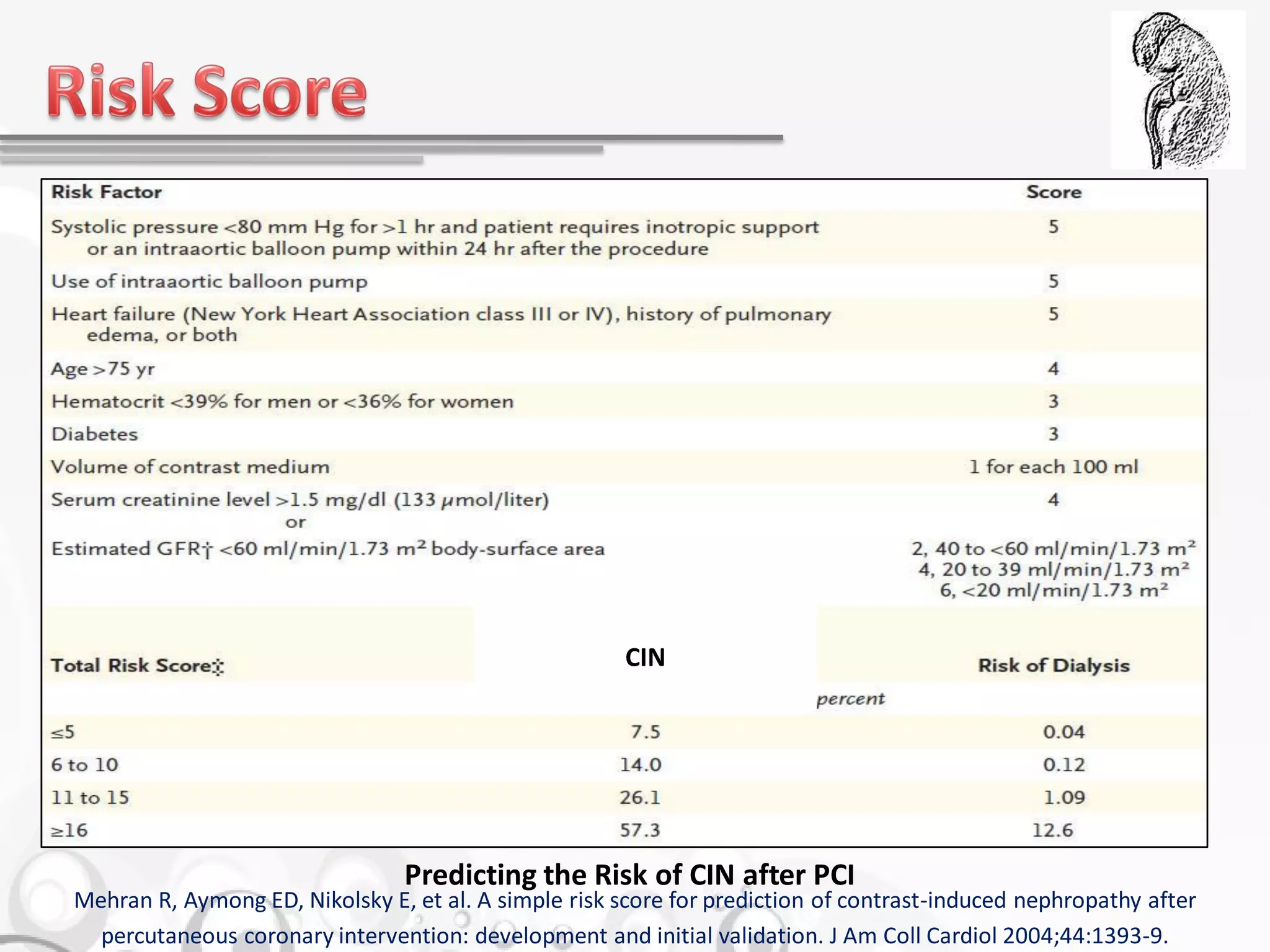
Toassessthecumulativeriskofseveralvariablesonrenalfunction,asimpleCINriskscorethatcouldbereadilyappliedwasdeveloped.
MehranR, AymongED, NikolskyE, et al. A simple risk score for prediction of contrast-induced nephropathy after 
percutaneouscoronary intervention: development and initial validation. J Am CollCardiol2004;44:1393-9. 
Predicting the Risk of CIN after PCI 
CIN
•ThereisnospecifictreatmentonceCI-AKIdevelops,andmanagementmustbeasforanycauseofATN,withthefocusonmaintainingfluidandelectrolytebalance. 
•Thebesttreatmentofcontrast-inducedkidneyinjuryisprevention.
Indication for contrast-based procedures 
potential 
risk of CIN
•ConsideralternateImagingstudiesnotrequiringiodinatedcontrastmedium. 
•Theuseoflowerdosesoflow-oriso-osmolalnonioniccontrastagentsandavoidanceofrepetitivestudiesthatarecloselyspaced(within48to72hours). 
•Avoidanceofvolumedepletion.
•ConcomitantnephrotoxicdrugssuchasNSAIDandnephrotoxicantibiotics,ACEIanddiureticsshouldbediscontinued48hourspriortocontrastadministration. 
•MetforminshouldbediscontinuedonthedayoftheproposedCMadministrationandforthesubsequent48hours.
Goals of Hydration 
Maintenance of sufficient intravascular volume to increase renal perfusion 
Establishment of adequate diuresisprior to contrast media 
Avoidance of hypotension
•Isotonicsalineissuperiortoone-halfisotonicsalinesinceisotonicsalineisamoreeffectivevolumeexpander. 
•InastudybyMuelleretal,intravenousadministrationofisotonicsalinewasfoundtobesuperior,comparedwithhalf-isotonicsaline,inreducingtheratesofCINafterpercutaneouscoronaryintervention(0.7%versus2%,respectively). 
Mueller C, Buerkle G, Buettner HJ, et al. Prevention of contrast media-associated nephropathy: randomized comparison of 2 hydration regimens in 1620 patients undergoing coronary angioplasty. Arch Intern Med. 2002;162(3):329–336.
•Since alkalinizationmay protect against free radical injury, the possibility that sodium bicarbonate may be superior to isotonic saline has been examined in a number of randomized trials and meta-analyses. 
•The results were conflictingas some showed a significantly lower rate of contrast-induced nephropathy with sodium bicarbonate, while others found equivalentrates. 
•BriguoriC, AiroldiF, D'AndreaD, et al. Renal Insufficiency Following Contrast Media Administration Trial (REMEDIAL): a randomized comparison of 3 preventive strategies. Circulation 2007; 115:1211. 
•Vasheghani-FarahaniA, SadighG, KassaianSE, et al. Sodium bicarbonate plus isotonic saline versus saline for prevention of contrast-induced nephropathy in patients undergoing coronary angiography: a randomized controlled trial. Am J Kidney Dis2009; 54:610.
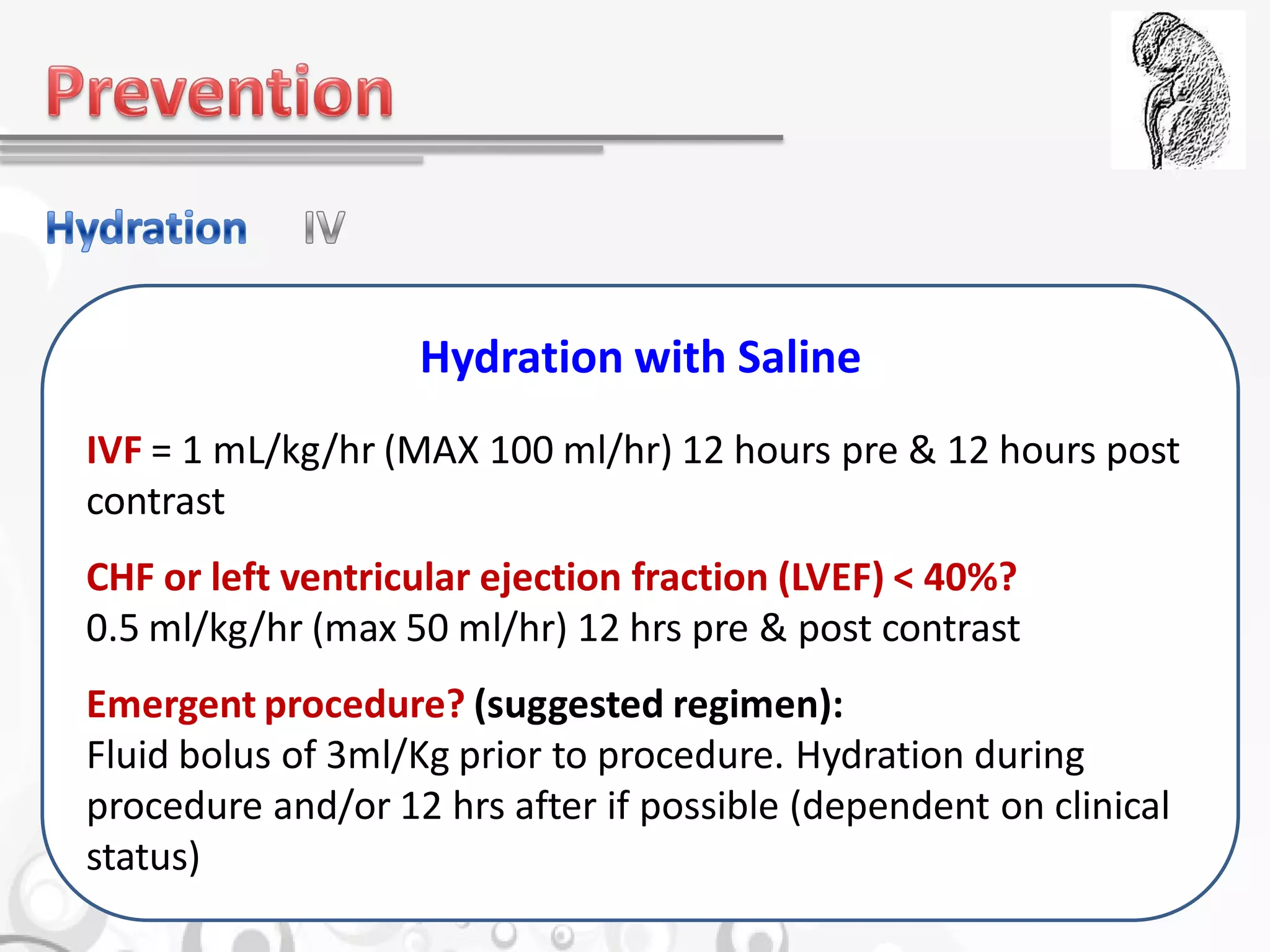
Hydration with Saline 
IVF= 1 mL/kg/hr (MAX 100 ml/hr) 12 hours pre & 12 hours post contrast 
CHF or left ventricular ejection fraction (LVEF) < 40%? 
0.5 ml/kg/hr(max 50 ml/hr) 12 hrspre& post contrast 
Emergent procedure? (suggested regimen): 
Fluid bolus of 3ml/Kg prior to procedure. Hydration during procedure and/or 12 hrs after if possible (dependent on clinical status)
•Giventhatanincreasingnumberofindividualsreceivecontrastasoutpatients,thistrialhasevaluatedtheeffectivenessoforalhydrationinpreventingcontrastnephropathy. 
•53patientswererandomlyassignedtoeitherunrestrictedoralfluidsortonormalsalineat1mL/kgperhourfor24hoursbeginning12hourspriortothescheduledcatheterization.AKIwassignificantlymorecommonwithoralhydration(35versus4%).
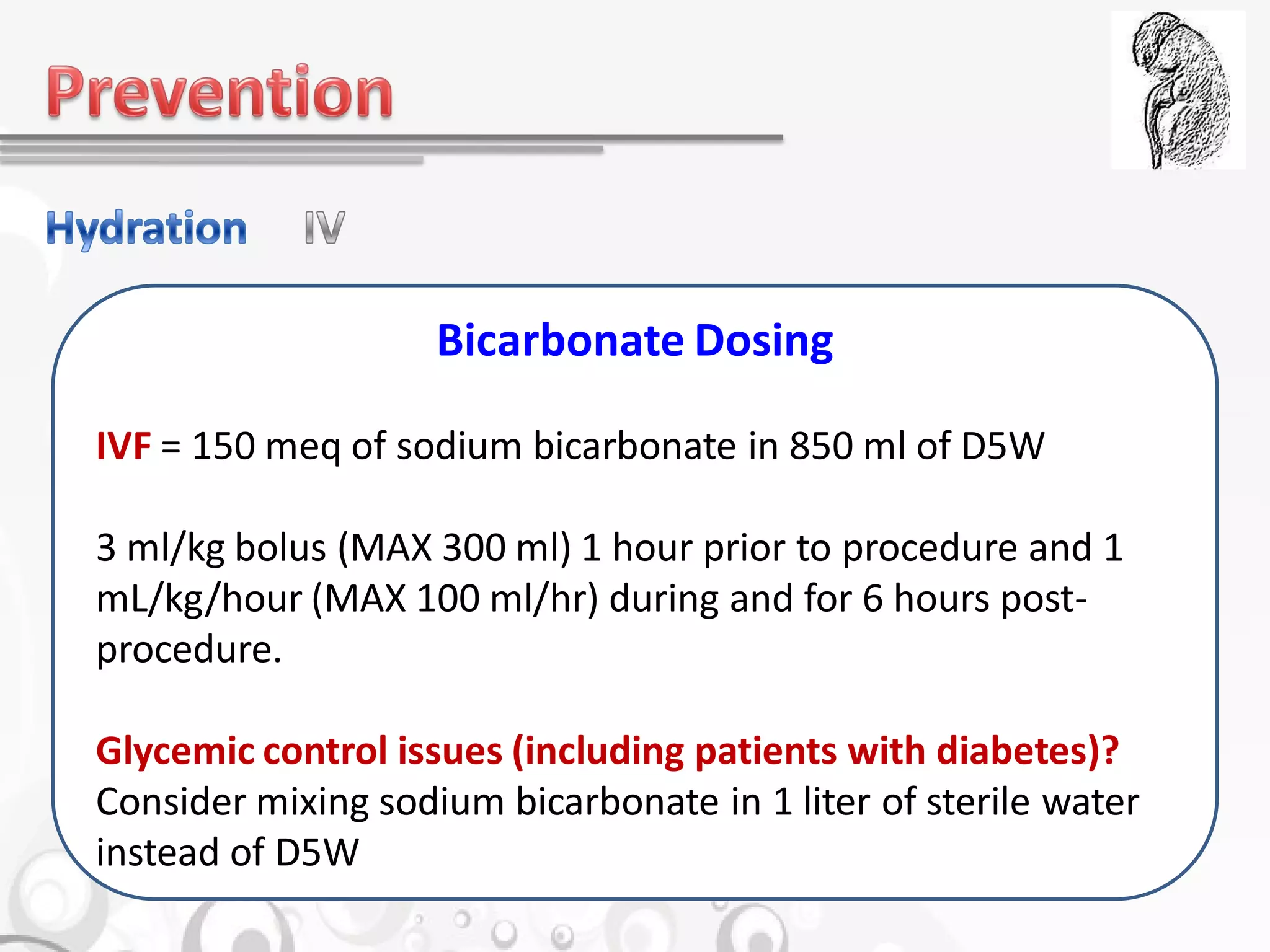
Bicarbonate Dosing 
IVF= 150 meqof sodium bicarbonate in 850 ml of D5W 
3 ml/kg bolus (MAX 300 ml) 1 hour prior to procedure and 1 mL/kg/hour (MAX 100 ml/hr) during and for 6 hours post- procedure. 
Glycemiccontrol issues (including patients with diabetes)? 
Consider mixing sodium bicarbonate in 1 liter of sterile water instead of D5W
Methods to guide fluid repletion 
Left ventricular end- diastolic pressure 
RenalGuardSystem 
•BrarSS, AharonianV, MansukhaniP, et al. Haemodynamic-guided fluid administration for the prevention of contrast- induced acute kidney injury: the POSEIDON randomisedcontrolled trial. Lancet 2014; 383:1814. 
•BriguoriC, Visconti G, FocaccioA, et al. Renal Insufficiency After Contrast Media Administration Trial II (REMEDIAL II): RenalGuardSystem in high-risk patients for contrast-induced acute kidney injury. Circulation 2011; 124:1260.
Left ventricular (LV) end-diastolic pressure
Leftventricular(LV)end-diastolicpressure 
•ArandomizedtrialtestedthebenefitofafluidreplacementprotocolguidedbyLVend-diastolicpressureamongpatientswithCKDandotherriskfactorsforCIN. 
•Inthistrial,350patientswereassignedtoLVend-diastolicpressure- guidedfluidmanagementortoacontrolgroup. 
•Allpatientsreceivedintravenousisotonicsaline3mL/kgforonehourpriortocardiaccatheterization.LVend-diastolicpressurewasdeterminedinallpatientspriortoadministrationofcontrast.
Left ventricular (LV) end-diastolic pressure 
•Both groups received intravenous fluid throughout and for four hours following the procedure. 
IV infusion rate 
LV end-diastolic pressure 
<13 mmHg 
5 mL/kg/hour 
13 -18 mmHg 
3 mL/Kg/hour 
>18 mmHg 
1.5 mL/Kg/hour 
Control 
1.5 mL/kg/hourContrast-induced AKI occurred less frequently in the LV end-diastolic pressure group, compared with control (6.7 versus 16.3, respectively).
RenalGuardsystem
RenalGuardsystem 
•TheRenalGuard™Systemisareal-timemeasurementandmatchedfluidreplacementdevicedesignedtoaccommodatetheRenalGuardtherapy,whichisbasedonthetheorythatcreatingandmaintainingahighurineoutputisbeneficialbyallowingaquickeliminationofcontrastmedia,and,therefore,reducingitstoxiceffects. Patients with eGFR≤30 mL/min or a risk score ≥11 
Control group 
NaHco3 + NACRenalGuardgroupIsotonic saline + NAC + furosemide
RenalGuardsystem 
•Contrast-induced acute kidney injury occurred in 16 of 146 patients in the RenalGuardgroup (11%) and in 30 of 146 patients in the control group (20.5%). 
•Conclusion: 
RenalGuardtherapy, including hydrationwith normal saline plus high doses of NACin combination with a limited (0.25 mg/kg) dose of furosemide, seems to be an effective renoprotectivestrategy for patients at high risk for CI-AKI.
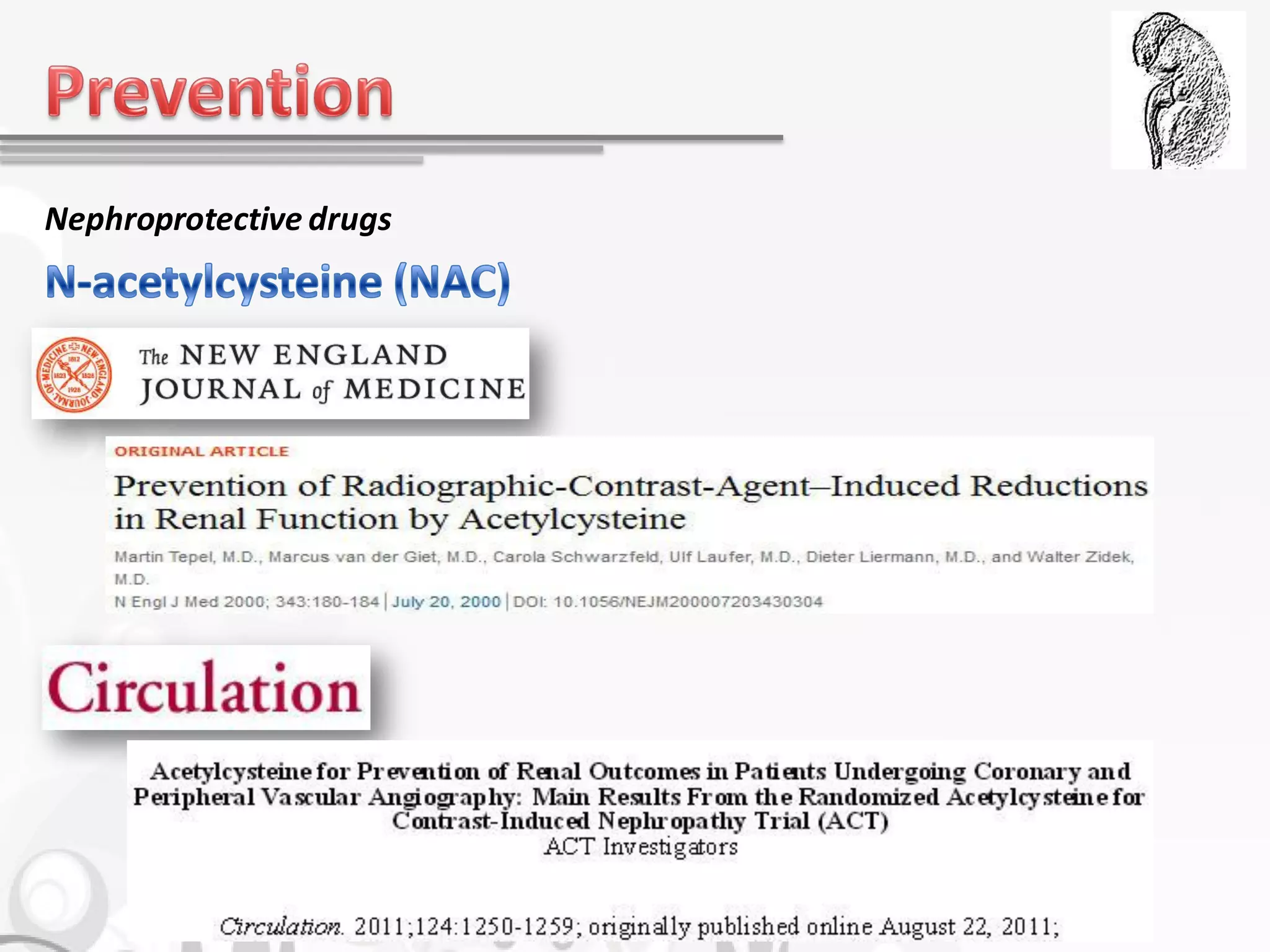
Nephroprotectivedrugs 
•Therearegreatheterogeneityandconflictingresultsintheavailableclinicaltrialsandmeta-analysesexaminingtheeffectivenessofacetylcysteineinthepreventionofcontrastnephropathy. 
•Beingaprecursorforglutathionesynthesis,NAChasthepotentialtodiminishoxidativestressbydirectlyscavengingsuperoxideradicalsandincreasingintracellularglutathione. 
Drager LF, Andrade L, Barros de Toledo JF, Laurindo FR, Machado Cesar LA, SeguroAC. Renal effects of N acetylcysteinein patients at risk for contrast nephropathy: decrease in oxidant stress-mediated renal tubular injury. NephrolDial Transplant. 2004;19(7):1803–7.
Nephroprotectivedrugs
Nephroprotectivedrugs 
•Thistrialstudied83patientswithchronicrenalinsufficiencywhowereundergoingcomputedtomography. 
•Patientswererandomlyassignedeithertoreceivetheantioxidantacetylcysteine(600mgorallytwicedaily)and0.45percentsalineintravenously,beforeandafteradministrationofthecontrastagent,ortoreceiveplaceboandsaline. 
•Conclusion: 
Prophylacticoraladministrationofacetylcysteine,alongwithhydration,preventsthereductioninrenalfunctioninducedbythecontrast.
Nephroprotectivedrugs 
•2308patientsundergoingangiographyreceivedeitheracetylcysteine(1200mgorallytwicedaily)orplaceboonthedaybeforeandafterangiogram. 
•Patientshadatleastoneofthefollowingriskfactors:age>70years,CKD,diabetesmellitus,heartfailureorLVejectionfraction<45percent,orshock. 
•TherewasnodifferenceinthedevelopmentofCI-AKI(12.7percentinbothgroups).
Nephroprotectivedrugs 
Sincetheagentispotentiallybeneficial,welltolerated,andrelativelyinexpensive,2012KDIGOguidelinesthatsuggestadministrationofacetylcysteinetopatientsathighrisk. AcetylcysteineDosingTolerating PO intake? 600-1200 mg capsules PO Q12h X 4 doses2 doses pre-contrast and 2 doses post-contrast is optimalEmergent Procedure? 1 dose before and 3 doses post cathor procedure is acceptable (Q12h x 4 doses total) IV Acetylcysteine? 600-1200 mg IV x 1 over 15 minutes, then 600-1200 mg PO/PT q12h x 4 doses post-procedure: For a high risk patient undergoing cardiac catheterization or PE protocol CT scan with no PO access
Nephroprotectivedrugs 
•Statinsmayimproveendothelialfunction,reducearterialstiffness,andreduceinflammationandoxidativestress. 
•Therearenosufficientdatatosupporttheuseofstatinssolelyforthepreventionofcontrastnephropathy. 
Sugiyama M, OhashiM, TakaseH, et al. Effects of atorvastatinon inflammation and oxidative stress. Heart Vessels 2005; 20:133.
Nephroprotectivedrugs 
•2998patientswithtype2diabetesandCKDwereassignedtoreceiverosuvastatinortoacontrolgrouppriortoadiagnosticangiogramwithorwithoutpercutaneousintervention. 
•Patientsassignedtorosuvastatinreceived10mgdailytwodayspriorandthreedaysafterthescheduledprocedure. 
•Contrast-inducedwaslesscommonamongpatientsassignedtorosuvastatincomparedwithcontrol(2.3versus3.9percent, respectively).
Nephroprotectivedrugs 
•Aprospective,single-centerstudyof304patientswithbaselineestimatedcreatinineclearance<60ml/minwererandomizedtoreceiveatorvastatin80mg/dayorplacebofor48hoursbeforeand48hoursaftercontrastmediumadministration. 
•AllpatientsreceivedintravenoussalinehydrationandoralN- acetylcysteine1,200mg2times/day. 
•CINoccurredin31patients,16(11%)intheplacebogroupand15(10%) intheatorvastatingroup(nobenefitofatorvastatincomparedwithplacebo).
Vasoactivedrugs 
•Low-dosedopaminefailedtoshowaprotectiveeffectonrenalfunctioninpatientsundergoingcontrastmediaexposure,andwasevenassociatedwithadeleteriouseffectontheseverityofrenalfailureanditsduration. 
GareM, HavivYS, Ben-YehudaA, et al. The renal effect of low-dose dopamine in high-risk patients undergoing coronary angiography. J Am CollCardiol. 1999;34(6):1682–1688.
Vasoactivedrugs 
•Fenoldopamis a specific dopamine-1 receptor agonist that augments renal plasma flow while decreasing systemic vascular resistance. 
•A prospective randomized trial (CONTRAST) assessed the effectiveness of fenoldopamin 315 patients undergoing a cardiovascular procedure who had CKD with an estimated creatinineclearance <60 mL/min. 
•Unfortunately it also fails to reduce CIN incidence in CKD patients.
Vasoactivedrugs 
•Inaretrospectiveseriesof285patients, Weiszetal.reporteda71%decreasedinCINincidencewithlocalfenoldopamtherapy(0.05–0.8μg/kg/min). 
WeiszG, FilbySJ, Cohen MG, Allie DE, WeinstockBS, KyriazisD, et al. Safety and performance of targeted renal therapy: the Be- RITe! Registry. J EndovascTher. 2009;16(1):1–12.
Vasoactivedrugs 
•Theclinicalbenefitofthecompetitiveadenosineantagonisttheophyllineisdebated. 
•InarandomizedstudybyHuberetal,prophylacticintravenousadministrationoftheophylline200mgreducedtheincidenceofCINin100patientsatrisk,ascomparedwithplacebo(4%versus16%). 
•However,inotherrandomizedstudies,administrationoftheophyllinedidnotprovideanybenefitinreductionofCINratescomparedwithplacebo. 
•HuberW,IlgmannK,PageM,etal.Effectoftheophyllineoncontrastmaterial-nephropathyinpatientswithchronicrenalinsufficiency:controlled,randomized,double-blindedstudy.Radiology.2002;223(3):772–779. 
•ShammasNW,KapalisMJ,HarrisM,McKinneyD,CoyneEP.Aminophyllinedoesnotprotectagainstradiocontrastnephropathyinpatientsundergoingpercutaneousangiographicprocedures.JInvasiveCardiol.2001;13(11):738– 740.
Vasoactivedrugs 
•A 20 ng/kg/min PGE1 infusion has a significant protective effect on post-PCI SCrelevation, 
•But higher infusion rates are not associated with increased benefits, probably due to the associated decrease in systemic blood pressure. 
Koch JA, Plum J, GrabenseeB, Modder U. Prostaglandin E1: a new agent for the prevention of renal dysfunction in high risk patients caused by radiocontrastmedia? PGE1 Study Group. NephrolDial Transplant. 2000;15(1):43–9.
Vasoactivedrugs 
•In a small, randomized, placebo controlled study of 35 patients, eGFRwas preservedin patients treated with nitrendipinebut decreased in patients that received placebo. 
NeumayerHH, JungeW, KufnerA, WenningA. Prevention of radiocontrast-media-induced nephrotoxicityby the calcium channel blocker nitrendipine: a prospective randomisedclinical trial. NephrolDial Transplant. 1989;4(12):1030–1036. 
•By contrast, in three other studies, the change in serum creatininelevel did not differ significantly with calcium antagonists. 
CarraroM, Mancini W, ArteroM, et al. Dose effect of nitrendipineon urinary enzymes and microproteinsfollowing non-ionic radiocontrastadministration. NephrolDial Transplant. 1996;11(3):444–448.
Hemodialysis 
•Iodinatedcontrastagentsarereadilydialyzable. 
•Theplasmaclearanceofmostmoderncontrastmediais50–70mL/ min,withmorethan80%removedfromtheplasmawithin4–5hoursofhemodialysis. 
•However,ReductionofCINwithdialysisisalsonotbiologicallyplausiblesincetheCMwouldreachthekidneyswithinoneortwocardiaccycle. 
•SubsequentremovalofCMisunlikelytostopthecascadeofrenalinjury,whichwouldhavealreadybegun. 
Dawson P. Contrast agents in patients on dialysis. SeminDial. 2002;15(4):232–236.
Hemofiltration 
•Inpatientswithchronicrenalfailurewhoareundergoingpercutaneouscoronaryinterventions, 
•periproceduralhemofiltrationgiveninanICUsettingappearstobeeffectiveinpreventingthedeteriorationofrenalfunctionduetoCIN 
•andisassociatedwithimprovedin-hospitalandlong-termoutcomes. 
MarenziG, Marana I, LauriG, et al. The prevention of radiocontrast-agent-induced nephropathy by hemofiltration. N EnglJ Med 2003; 349:1333.
•A 2012 meta-analysis that included eight studies of hemodialysisand three studies of hemofiltration/hemodiafiltrationshowed no benefit of RRT. 
•Routine hemofiltrationor hemodialysisfor the prevention of contrast nephropathy in patients with CKD is not recommended. 
Cruz DN, GohCY, MarenziG, et al. Renal replacement therapies for prevention of radiocontrast- induced nephropathy: a systematic review. Am J Med 2012; 125:66.
Contrast Induced Nephropathy

Contrast Induced Nephropathy