Your presentation begins here
contrast induced
nephropathy
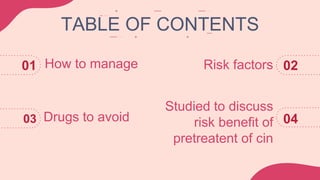
How to manage
Drugs to avoid
Risk factors
Studied to discuss
risk benefit of
pretreatent of cin
TABLE OF CONTENTS
01
03
02
04
CONTRAST
INDUCED
NEPHROPATHY
CONTENTS OF THIS
TEMPLATE
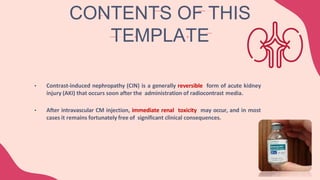
• Contrast-induced nephropathy (CIN) is a generally reversible form of acute kidney
injury (AKI) that occurs soon after the administration of radiocontrast media.
• After intravascular CM injection, immediate renal toxicity may occur, and in most
cases it remains fortunately free of significant clinical consequences.
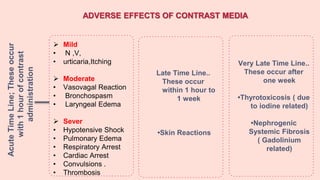
Late Time Line..
These occur
within 1 hour to
1 week
•Skin Reactions
 Mild
• N ,V,
• urticaria,Itching
 Moderate
• Vasovagal Reaction
• Bronchospasm
• Laryngeal Edema
 Sever
• Hypotensive Shock
• Pulmonary Edema
• Respiratory Arrest
• Cardiac Arrest
• Convulsions .
• Thrombosis
Very Late Time Line..
These occur after
one week
•Thyrotoxicosis ( due
to iodine related)
•Nephrogenic
Systemic Fibrosis
( Gadolinium
related)
Acute
Time
Line;
These
occur
with
1
hour
of
contrast
administration
ADVERSE EFFECTS OF CONTRAST MEDIA
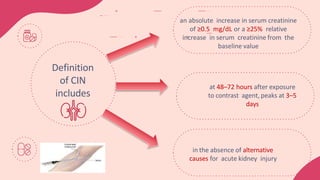
in the absence of alternative
causes for acute kidney injury
at 48–72 hours after exposure
to contrast agent, peaks at 3–5
days
an absolute increase in serum creatinine
of ≥0.5 mg/dL or a ≥25% relative
increase in serum creatinine from the
baseline value
Definition
of CIN
includes
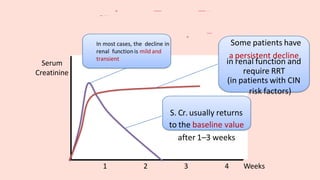
1 2 3 4 Weeks
Serum
Creatinine
Some patients have
a persistent decline
in renal function and
require RRT
(in patients with CIN
risk factors)
S. Cr. usually returns
to the baseline value
after 1–3 weeks
In most cases, the decline in
renal function is mild and
transient
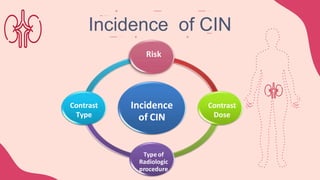
Incidence
of CIN
Risk
Incidence of CIN
Contrast
Dose
Type of
Radiologic
procedure
Contrast
Type
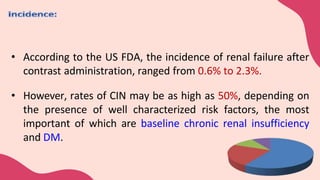
• According to the US FDA, the incidence of renal failure after
contrast administration, ranged from 0.6% to 2.3%.
• However, rates of CIN may be as high as 50%, depending on
the presence of well characterized risk factors, the most
important of which are baseline chronic renal insufficiency
and DM.
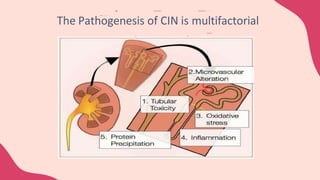
The Pathogenesis of CIN is multifactorial
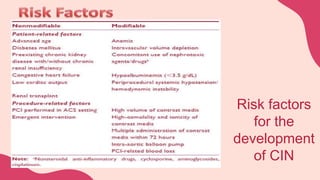
Risk factors
for the
development
of CIN
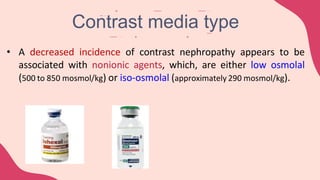
• A decreased incidence of contrast nephropathy appears to be
associated with nonionic agents, which, are either low osmolal
(500 to 850 mosmol/kg) or iso-osmolal (approximately 290 mosmol/kg).
Contrast media type
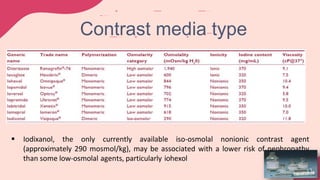
 Iodixanol, the only currently available iso-osmolal nonionic contrast agent
(approximately 290 mosmol/kg), may be associated with a lower risk of nephropathy
than some low-osmolal agents, particularly iohexol
Contrast media type
• Most of the studies indicate that the higher volume of CM is
especially deleterious in the presence of other risk factors , with
lower doses of contrast being safer, but not free of risk.
• Even relatively low doses of contrast (less than 100 ml) can induce
permanent renal failure and the need for dialysis in patients with
chronic kidney disease.
Contrast media dose
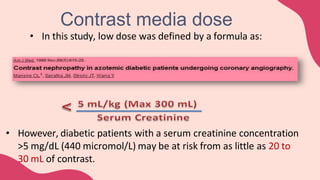
• In this study, low dose was defined by a formula as:
• However, diabetic patients with a serum creatinine concentration
>5 mg/dL (440 micromol/L) may be at risk from as little as 20 to
30 mL of contrast.
Contrast media dose
CREDITS: This presentation template was created by
Slidesgo, including icons by Flaticon, and infographics
& images by Freepik
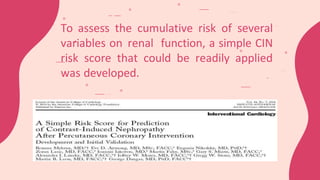
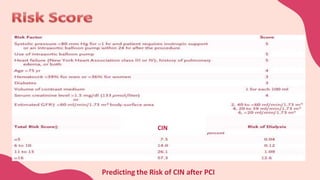
To assess the cumulative risk of several
variables on renal function, a simple CIN
risk score that could be readily applied
was developed.
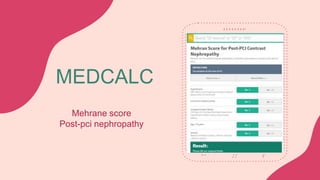
Mehrane score
Post-pci nephropathy
MEDCALC
Predicting the Risk of CIN after PCI
CIN
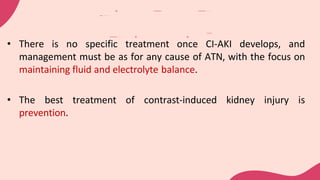
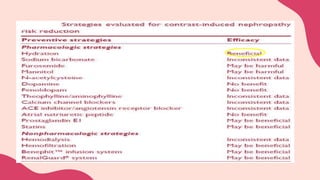
• There is no specific treatment once CI-AKI develops, and
management must be as for any cause of ATN, with the focus on
maintaining fluid and electrolyte balance.
• The best treatment of contrast-induced kidney injury is
prevention.
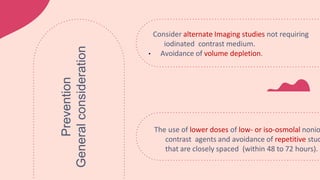
The use of lower doses of low- or iso-osmolal nonio
contrast agents and avoidance of repetitive stud
that are closely spaced (within 48 to 72 hours).
Consider alternate Imaging studies not requiring
iodinated contrast medium.
• Avoidance of volume depletion.
Prevention
General
consideration
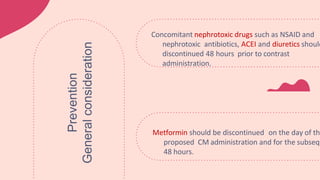
Metformin should be discontinued on the day of the
proposed CM administration and for the subsequ
48 hours.
Concomitant nephrotoxic drugs such as NSAID and
nephrotoxic antibiotics, ACEI and diuretics should
discontinued 48 hours prior to contrast
administration.
Prevention
General
consideration
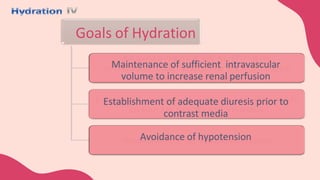
Goals of Hydration
Maintenance of sufficient intravascular
volume to increase renal perfusion
Establishment of adequate diuresis prior to
contrast media
Avoidance of hypotension
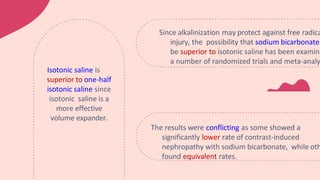
The results were conflicting as some showed a
significantly lower rate of contrast-induced
nephropathy with sodium bicarbonate, while oth
found equivalent rates.
Since alkalinization may protect against free radica
injury, the possibility that sodium bicarbonate
be superior to isotonic saline has been examine
a number of randomized trials and meta-analy
Isotonic saline is
superior to one-half
isotonic saline since
isotonic saline is a
more effective
volume expander.
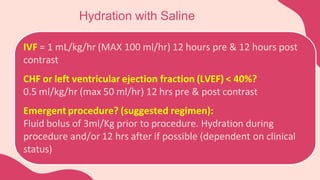
Hydration with Saline
IVF = 1 mL/kg/hr (MAX 100 ml/hr) 12 hours pre & 12 hours post
contrast
CHF or left ventricular ejection fraction (LVEF) < 40%?
0.5 ml/kg/hr (max 50 ml/hr) 12 hrs pre & post contrast
Emergent procedure? (suggested regimen):
Fluid bolus of 3ml/Kg prior to procedure. Hydration during
procedure and/or 12 hrs after if possible (dependent on clinical
status)
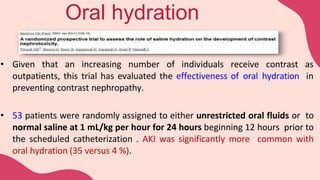
• Given that an increasing number of individuals receive contrast as
outpatients, this trial has evaluated the effectiveness of oral hydration in
preventing contrast nephropathy.
• 53 patients were randomly assigned to either unrestricted oral fluids or to
normal saline at 1 mL/kg per hour for 24 hours beginning 12 hours prior to
the scheduled catheterization . AKI was significantly more common with
oral hydration (35 versus 4 %).
Oral hydration
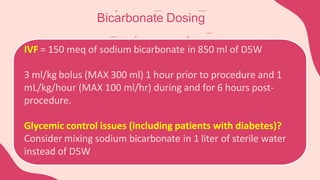
Bicarbonate Dosing
IVF = 150 meq of sodium bicarbonate in 850 ml of D5W
3 ml/kg bolus (MAX 300 ml) 1 hour prior to procedure and 1
mL/kg/hour (MAX 100 ml/hr) during and for 6 hours post-
procedure.
Glycemic control issues (including patients with diabetes)?
Consider mixing sodium bicarbonate in 1 liter of sterile water
instead of D5W
• There are great heterogeneity and conflicting
available clinical trials and meta-analyses examining
results in the
the
effectiveness of acetylcysteine in the prevention of contrast
nephropathy .
• Being a precursor for glutathione synthesis, NAC has the potential
to diminish oxidative stress by directly scavenging superoxide
radicals and increasing intracellular glutathione.
N-ACETYLCYSEINE NAC
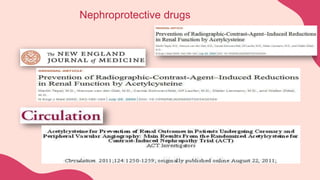
Nephroprotective drugs
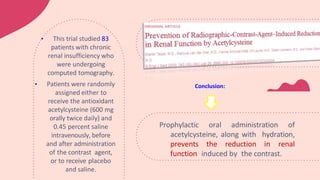
Prophylactic oral administration of
acetylcysteine, along with hydration,
prevents the reduction in renal
function induced by the contrast.
• This trial studied 83
patients with chronic
renal insufficiency who
were undergoing
computed tomography.
• Patients were randomly
assigned either to
receive the antioxidant
acetylcysteine (600 mg
orally twice daily) and
0.45 percent saline
intravenously, before
and after administration
of the contrast agent,
or to receive placebo
and saline.
Conclusion:
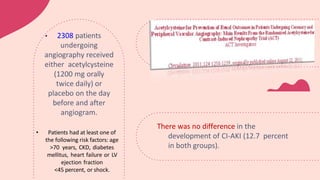
There was no difference in the
development of CI-AKI (12.7 percent
in both groups).
• 2308 patients
undergoing
angiography received
either acetylcysteine
(1200 mg orally
twice daily) or
placebo on the day
before and after
angiogram.
• Patients had at least one of
the following risk factors: age
>70 years, CKD, diabetes
mellitus, heart failure or LV
ejection fraction
<45 percent, or shock.
IVAcetylcysteine?
600-1200mgIVx1over15minutes,then600-1200mgPO/PTq12hx4dos
post-procedure:ForahighriskpatientundergoingcardiaccatheterizationorPEp
CTscanwithnoPOaccess
Since the agent is potentially
beneficial, well tolerated, and
relatively inexpensive, 2012
KDIGO guidelines that suggest
administration of
acetylcysteine to patients at
high risk.
Tolerating PO intake?
600-1200 mg capsules PO Q12h X 4 doses
2 doses pre-contrast and 2 doses post-contrast is optima
Acetylcysteine Dosing
EmergentProcedure?
1dosebeforeand3dosespostcathorprocedureisacceptable(Q12hx4dose
STATINS
Statins may improve
endothelial function,
reduce arterial
stiffness, and reduce
inflammation and
oxidative stress.
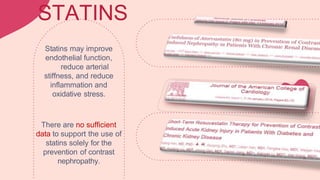
There are no sufficient
data to support the use of
statins solely for the
prevention of contrast
nephropathy.
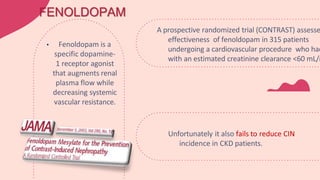
Unfortunately it also fails to reduce CIN
incidence in CKD patients.
FENOLDOPAM
• Fenoldopam is a
specific dopamine-
1 receptor agonist
that augments renal
plasma flow while
decreasing systemic
vascular resistance.
A prospective randomized trial (CONTRAST) assesse
effectiveness of fenoldopam in 315 patients
undergoing a cardiovascular procedure who had
with an estimated creatinine clearance <60 mL/m
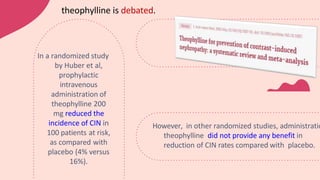
theophylline is debated.
However, in other randomized studies, administratio
theophylline did not provide any benefit in
reduction of CIN rates compared with placebo.
In a randomized study
by Huber et al,
prophylactic
intravenous
administration of
theophylline 200
mg reduced the
incidence of CIN in
100 patients at risk,
as compared with
placebo (4% versus
16%).
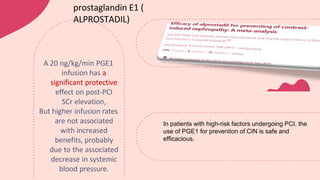
A 20 ng/kg/min PGE1
infusion has a
significant protective
effect on post-PCI
SCr elevation,
But higher infusion rates
are not associated
with increased
benefits, probably
due to the associated
decrease in systemic
blood pressure.
prostaglandin E1 (
ALPROSTADIL)
In patients with high-risk factors undergoing PCI, the
use of PGE1 for prevention of CIN is safe and
efficacious.
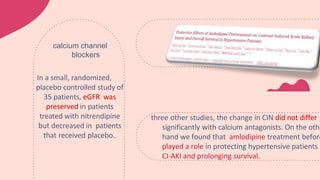
three other studies, the change in CIN did not differ
significantly with calcium antagonists. On the othe
hand we found that amlodipine treatment before
played a role in protecting hypertensive patients f
CI-AKI and prolonging survival.
In a small, randomized,
placebo controlled study of
35 patients, eGFR was
preserved in patients
treated with nitrendipine
but decreased in patients
that received placebo..
calcium channel
blockers
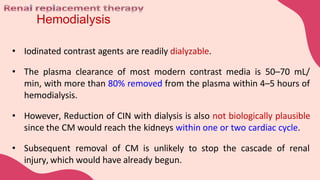
Hemodialysis
• Iodinated contrast agents are readily dialyzable.
• The plasma clearance of most modern contrast media is 50–70 mL/
min, with more than 80% removed from the plasma within 4–5 hours of
hemodialysis.
• However, Reduction of CIN with dialysis is also not biologically plausible
since the CM would reach the kidneys within one or two cardiac cycle.
• Subsequent removal of CM is unlikely to stop the cascade of renal
injury, which would have already begun.
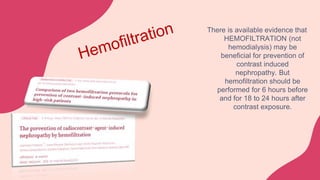
Hemofiltration
• In patients with chronic renal failure who are undergoing
percutaneous coronary interventions,
• periprocedural hemofiltration given in an ICU setting appears to
be effective in preventing the deterioration of renal function due
to CIN
• and is associated with improved in-hospital and long-term
outcomes.
There is available evidence that
HEMOFILTRATION (not
hemodialysis) may be
beneficial for prevention of
contrast induced
nephropathy. But
hemofiltration should be
performed for 6 hours before
and for 18 to 24 hours after
contrast exposure.
CREDITS: This presentation template was created by
Slidesgo, including icons by Flaticon, and infographics
& images by Freepik
THANK YOU

CIN.pptx

  • 1.
    Your presentation beginshere contrast induced nephropathy
  • 2.
    How to manage Drugsto avoid Risk factors Studied to discuss risk benefit of pretreatent of cin TABLE OF CONTENTS 01 03 02 04
  • 3.
  • 4.
    CONTENTS OF THIS TEMPLATE •Contrast-induced nephropathy (CIN) is a generally reversible form of acute kidney injury (AKI) that occurs soon after the administration of radiocontrast media. • After intravascular CM injection, immediate renal toxicity may occur, and in most cases it remains fortunately free of significant clinical consequences.
  • 5.
    Late Time Line.. Theseoccur within 1 hour to 1 week •Skin Reactions  Mild • N ,V, • urticaria,Itching  Moderate • Vasovagal Reaction • Bronchospasm • Laryngeal Edema  Sever • Hypotensive Shock • Pulmonary Edema • Respiratory Arrest • Cardiac Arrest • Convulsions . • Thrombosis Very Late Time Line.. These occur after one week •Thyrotoxicosis ( due to iodine related) •Nephrogenic Systemic Fibrosis ( Gadolinium related) Acute Time Line; These occur with 1 hour of contrast administration ADVERSE EFFECTS OF CONTRAST MEDIA
  • 6.
    in the absenceof alternative causes for acute kidney injury at 48–72 hours after exposure to contrast agent, peaks at 3–5 days an absolute increase in serum creatinine of ≥0.5 mg/dL or a ≥25% relative increase in serum creatinine from the baseline value Definition of CIN includes
  • 7.
    1 2 34 Weeks Serum Creatinine Some patients have a persistent decline in renal function and require RRT (in patients with CIN risk factors) S. Cr. usually returns to the baseline value after 1–3 weeks In most cases, the decline in renal function is mild and transient
  • 8.
    Incidence of CIN Risk Incidence ofCIN Contrast Dose Type of Radiologic procedure Contrast Type
  • 9.
    • According tothe US FDA, the incidence of renal failure after contrast administration, ranged from 0.6% to 2.3%. • However, rates of CIN may be as high as 50%, depending on the presence of well characterized risk factors, the most important of which are baseline chronic renal insufficiency and DM.
  • 10.
    The Pathogenesis ofCIN is multifactorial
  • 11.
  • 12.
    • A decreasedincidence of contrast nephropathy appears to be associated with nonionic agents, which, are either low osmolal (500 to 850 mosmol/kg) or iso-osmolal (approximately 290 mosmol/kg). Contrast media type
  • 13.
     Iodixanol, theonly currently available iso-osmolal nonionic contrast agent (approximately 290 mosmol/kg), may be associated with a lower risk of nephropathy than some low-osmolal agents, particularly iohexol Contrast media type
  • 14.
    • Most ofthe studies indicate that the higher volume of CM is especially deleterious in the presence of other risk factors , with lower doses of contrast being safer, but not free of risk. • Even relatively low doses of contrast (less than 100 ml) can induce permanent renal failure and the need for dialysis in patients with chronic kidney disease. Contrast media dose
  • 15.
    • In thisstudy, low dose was defined by a formula as: • However, diabetic patients with a serum creatinine concentration >5 mg/dL (440 micromol/L) may be at risk from as little as 20 to 30 mL of contrast. Contrast media dose
  • 16.
    CREDITS: This presentationtemplate was created by Slidesgo, including icons by Flaticon, and infographics & images by Freepik To assess the cumulative risk of several variables on renal function, a simple CIN risk score that could be readily applied was developed.
  • 17.
  • 18.
    Predicting the Riskof CIN after PCI CIN
  • 19.
    • There isno specific treatment once CI-AKI develops, and management must be as for any cause of ATN, with the focus on maintaining fluid and electrolyte balance. • The best treatment of contrast-induced kidney injury is prevention.
  • 20.
    The use oflower doses of low- or iso-osmolal nonio contrast agents and avoidance of repetitive stud that are closely spaced (within 48 to 72 hours). Consider alternate Imaging studies not requiring iodinated contrast medium. • Avoidance of volume depletion. Prevention General consideration
  • 21.
    Metformin should bediscontinued on the day of the proposed CM administration and for the subsequ 48 hours. Concomitant nephrotoxic drugs such as NSAID and nephrotoxic antibiotics, ACEI and diuretics should discontinued 48 hours prior to contrast administration. Prevention General consideration
  • 23.
    Goals of Hydration Maintenanceof sufficient intravascular volume to increase renal perfusion Establishment of adequate diuresis prior to contrast media Avoidance of hypotension
  • 24.
    The results wereconflicting as some showed a significantly lower rate of contrast-induced nephropathy with sodium bicarbonate, while oth found equivalent rates. Since alkalinization may protect against free radica injury, the possibility that sodium bicarbonate be superior to isotonic saline has been examine a number of randomized trials and meta-analy Isotonic saline is superior to one-half isotonic saline since isotonic saline is a more effective volume expander.
  • 25.
    Hydration with Saline IVF= 1 mL/kg/hr (MAX 100 ml/hr) 12 hours pre & 12 hours post contrast CHF or left ventricular ejection fraction (LVEF) < 40%? 0.5 ml/kg/hr (max 50 ml/hr) 12 hrs pre & post contrast Emergent procedure? (suggested regimen): Fluid bolus of 3ml/Kg prior to procedure. Hydration during procedure and/or 12 hrs after if possible (dependent on clinical status)
  • 26.
    • Given thatan increasing number of individuals receive contrast as outpatients, this trial has evaluated the effectiveness of oral hydration in preventing contrast nephropathy. • 53 patients were randomly assigned to either unrestricted oral fluids or to normal saline at 1 mL/kg per hour for 24 hours beginning 12 hours prior to the scheduled catheterization . AKI was significantly more common with oral hydration (35 versus 4 %). Oral hydration
  • 27.
    Bicarbonate Dosing IVF =150 meq of sodium bicarbonate in 850 ml of D5W 3 ml/kg bolus (MAX 300 ml) 1 hour prior to procedure and 1 mL/kg/hour (MAX 100 ml/hr) during and for 6 hours post- procedure. Glycemic control issues (including patients with diabetes)? Consider mixing sodium bicarbonate in 1 liter of sterile water instead of D5W
  • 28.
    • There aregreat heterogeneity and conflicting available clinical trials and meta-analyses examining results in the the effectiveness of acetylcysteine in the prevention of contrast nephropathy . • Being a precursor for glutathione synthesis, NAC has the potential to diminish oxidative stress by directly scavenging superoxide radicals and increasing intracellular glutathione. N-ACETYLCYSEINE NAC
  • 29.
  • 30.
    Prophylactic oral administrationof acetylcysteine, along with hydration, prevents the reduction in renal function induced by the contrast. • This trial studied 83 patients with chronic renal insufficiency who were undergoing computed tomography. • Patients were randomly assigned either to receive the antioxidant acetylcysteine (600 mg orally twice daily) and 0.45 percent saline intravenously, before and after administration of the contrast agent, or to receive placebo and saline. Conclusion:
  • 31.
    There was nodifference in the development of CI-AKI (12.7 percent in both groups). • 2308 patients undergoing angiography received either acetylcysteine (1200 mg orally twice daily) or placebo on the day before and after angiogram. • Patients had at least one of the following risk factors: age >70 years, CKD, diabetes mellitus, heart failure or LV ejection fraction <45 percent, or shock.
  • 32.
    IVAcetylcysteine? 600-1200mgIVx1over15minutes,then600-1200mgPO/PTq12hx4dos post-procedure:ForahighriskpatientundergoingcardiaccatheterizationorPEp CTscanwithnoPOaccess Since the agentis potentially beneficial, well tolerated, and relatively inexpensive, 2012 KDIGO guidelines that suggest administration of acetylcysteine to patients at high risk. Tolerating PO intake? 600-1200 mg capsules PO Q12h X 4 doses 2 doses pre-contrast and 2 doses post-contrast is optima Acetylcysteine Dosing EmergentProcedure? 1dosebeforeand3dosespostcathorprocedureisacceptable(Q12hx4dose
  • 33.
    STATINS Statins may improve endothelialfunction, reduce arterial stiffness, and reduce inflammation and oxidative stress. There are no sufficient data to support the use of statins solely for the prevention of contrast nephropathy.
  • 34.
    Unfortunately it alsofails to reduce CIN incidence in CKD patients. FENOLDOPAM • Fenoldopam is a specific dopamine- 1 receptor agonist that augments renal plasma flow while decreasing systemic vascular resistance. A prospective randomized trial (CONTRAST) assesse effectiveness of fenoldopam in 315 patients undergoing a cardiovascular procedure who had with an estimated creatinine clearance <60 mL/m
  • 35.
    theophylline is debated. However,in other randomized studies, administratio theophylline did not provide any benefit in reduction of CIN rates compared with placebo. In a randomized study by Huber et al, prophylactic intravenous administration of theophylline 200 mg reduced the incidence of CIN in 100 patients at risk, as compared with placebo (4% versus 16%).
  • 36.
    A 20 ng/kg/minPGE1 infusion has a significant protective effect on post-PCI SCr elevation, But higher infusion rates are not associated with increased benefits, probably due to the associated decrease in systemic blood pressure. prostaglandin E1 ( ALPROSTADIL) In patients with high-risk factors undergoing PCI, the use of PGE1 for prevention of CIN is safe and efficacious.
  • 37.
    three other studies,the change in CIN did not differ significantly with calcium antagonists. On the othe hand we found that amlodipine treatment before played a role in protecting hypertensive patients f CI-AKI and prolonging survival. In a small, randomized, placebo controlled study of 35 patients, eGFR was preserved in patients treated with nitrendipine but decreased in patients that received placebo.. calcium channel blockers
  • 38.
    Hemodialysis • Iodinated contrastagents are readily dialyzable. • The plasma clearance of most modern contrast media is 50–70 mL/ min, with more than 80% removed from the plasma within 4–5 hours of hemodialysis. • However, Reduction of CIN with dialysis is also not biologically plausible since the CM would reach the kidneys within one or two cardiac cycle. • Subsequent removal of CM is unlikely to stop the cascade of renal injury, which would have already begun.
  • 39.
    Hemofiltration • In patientswith chronic renal failure who are undergoing percutaneous coronary interventions, • periprocedural hemofiltration given in an ICU setting appears to be effective in preventing the deterioration of renal function due to CIN • and is associated with improved in-hospital and long-term outcomes.
  • 40.
    There is availableevidence that HEMOFILTRATION (not hemodialysis) may be beneficial for prevention of contrast induced nephropathy. But hemofiltration should be performed for 6 hours before and for 18 to 24 hours after contrast exposure.
  • 41.
    CREDITS: This presentationtemplate was created by Slidesgo, including icons by Flaticon, and infographics & images by Freepik THANK YOU