Genre-Approaches
Rodgers {2001)
One of the major trends
along with other
functionally- based
approaches to language
teaching.
Hyland (2002)
Have a considerable
impact on the way
we see language use
and on literacy
education.
Johns (2002)
Refers to a major
paradigm shift
towards a more
social, contextual
approach based on
genre theory.
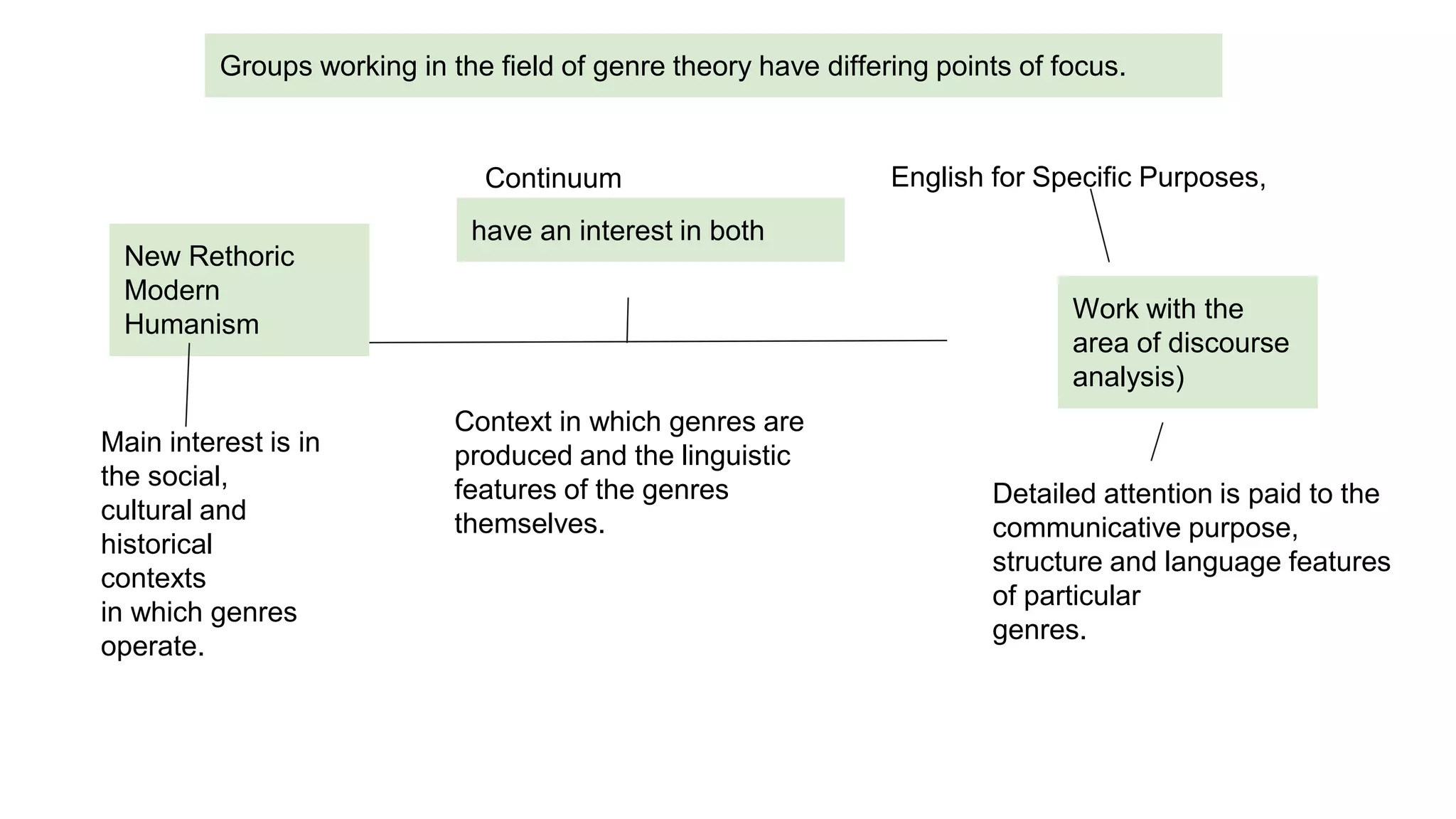
New Rethoric
Modern
Humanism
Work with the
area of discourse
analysis)
Continuum
Main interest is in
the social,
cultural and
historical
contexts
in which genres
operate.
Detailed attention is paid to the
communicative purpose,
structure and language features
of particular
genres.
English for Specific Purposes,
have an interest in both
Groups working in the field of genre theory have differing points of focus.
Context in which genres are
produced and the linguistic
features of the genres
themselves.
What do we mean by Genre
Go beyond the literary speech events literary contexts to include all purposeful uses of
language:
Genres are social practices that have evolved to enable us achieve our goals (Martin
1985; Painter 2001).
As members of particular social groups and cultures, we recognize the generic
expectations of various situations and are able to respond by deploying the appropriate
genre.
A further issue is the use of the terms ’genre’ and ’text type’.
Some
writers use these terms interchangeably.
Focus on Text
In genre-based approaches the emphasis is
on the creation of meaning at the level of the whole text. Rather than
dealing
with discrete instances of language, there is a recognition that meaning
accumulates and evolves over a stretch of text.
Focus on Purpose
Genre theory starts from the premise that
language use is goal-oriented.
First, in many cases, they
have
come to be taught as
‘items’ in a syllabus or
textbook. Rather than
asking
’what is my purpose in this
situation?’,
Secondly, it is often the case
that only a small handful of
genres are
taught across the years of
schooling, as if these were the
only ones that
students would encounter.
Thirdly, the stages of a
genre are often taught
prescriptively as if they
were ‘given’-structures
imposed upon a text rather
than moves arising
naturally because of their
functionality.
According to Melrose (1995), contemporary notions of genre emphasize
the flexible and rhetorical nature of genres rather than formulaic and static
rules or conventions, but when recontextualized into the classroom, genre
theory is rendered more digestible by diluting its descriptive richness.
In order to accomplish their purpose, genres generally move through a
number of stages (Martin 1985).
Focus on Meaning and Choice
Meanings being created in each stage
(and how they differ from stage to stage)
The textual resources
necessary to create
cohesive and coherent
texts.
Language is seen as a
dynamic, open network
of
interrelated systems.
The role of the teacher is seen as extending the learners’ repertoire of
grammatical choices, both in their construction of meaning in texts and
their comprehension of meaning in texts.
Language in Context
While genre theory stresses the notion of language as a
system of choices,
it recognizes that such choice is constrained by the
cultural and situational
context in which the genre is used.
Contextual
Analysis
Planning Implementation
Reference
Derewianka, B. (2003). Trends and Issues in Genre-Based Approaches. RELC Journal, 34(2), 133–154. https://doi.org/10.1177/003368820303400202

Genre based approach

  • 1.
    Genre-Approaches Rodgers {2001) One ofthe major trends along with other functionally- based approaches to language teaching. Hyland (2002) Have a considerable impact on the way we see language use and on literacy education. Johns (2002) Refers to a major paradigm shift towards a more social, contextual approach based on genre theory.
  • 2.
    New Rethoric Modern Humanism Work withthe area of discourse analysis) Continuum Main interest is in the social, cultural and historical contexts in which genres operate. Detailed attention is paid to the communicative purpose, structure and language features of particular genres. English for Specific Purposes, have an interest in both Groups working in the field of genre theory have differing points of focus. Context in which genres are produced and the linguistic features of the genres themselves.
  • 3.
    What do wemean by Genre Go beyond the literary speech events literary contexts to include all purposeful uses of language: Genres are social practices that have evolved to enable us achieve our goals (Martin 1985; Painter 2001). As members of particular social groups and cultures, we recognize the generic expectations of various situations and are able to respond by deploying the appropriate genre.
  • 4.
    A further issueis the use of the terms ’genre’ and ’text type’. Some writers use these terms interchangeably.
  • 5.
    Focus on Text Ingenre-based approaches the emphasis is on the creation of meaning at the level of the whole text. Rather than dealing with discrete instances of language, there is a recognition that meaning accumulates and evolves over a stretch of text.
  • 6.
    Focus on Purpose Genretheory starts from the premise that language use is goal-oriented. First, in many cases, they have come to be taught as ‘items’ in a syllabus or textbook. Rather than asking ’what is my purpose in this situation?’, Secondly, it is often the case that only a small handful of genres are taught across the years of schooling, as if these were the only ones that students would encounter. Thirdly, the stages of a genre are often taught prescriptively as if they were ‘given’-structures imposed upon a text rather than moves arising naturally because of their functionality.
  • 7.
    According to Melrose(1995), contemporary notions of genre emphasize the flexible and rhetorical nature of genres rather than formulaic and static rules or conventions, but when recontextualized into the classroom, genre theory is rendered more digestible by diluting its descriptive richness.
  • 9.
    In order toaccomplish their purpose, genres generally move through a number of stages (Martin 1985).
  • 12.
    Focus on Meaningand Choice Meanings being created in each stage (and how they differ from stage to stage) The textual resources necessary to create cohesive and coherent texts. Language is seen as a dynamic, open network of interrelated systems.
  • 13.
    The role ofthe teacher is seen as extending the learners’ repertoire of grammatical choices, both in their construction of meaning in texts and their comprehension of meaning in texts.
  • 14.
    Language in Context Whilegenre theory stresses the notion of language as a system of choices, it recognizes that such choice is constrained by the cultural and situational context in which the genre is used.
  • 17.
  • 19.
    Reference Derewianka, B. (2003).Trends and Issues in Genre-Based Approaches. RELC Journal, 34(2), 133–154. https://doi.org/10.1177/003368820303400202