
English for Specific Purpose 
The Syllabus 
Presented by: Asif Ali Raza 
asifalirazzza@yahoo.com 
+92-300-4-62-62-34
Points to be discussed 
• What do you mean by syllabus? 
 Further layers of interpretations 
• Why should we have syllabus? 
 Hidden reasons for having a syllabus 
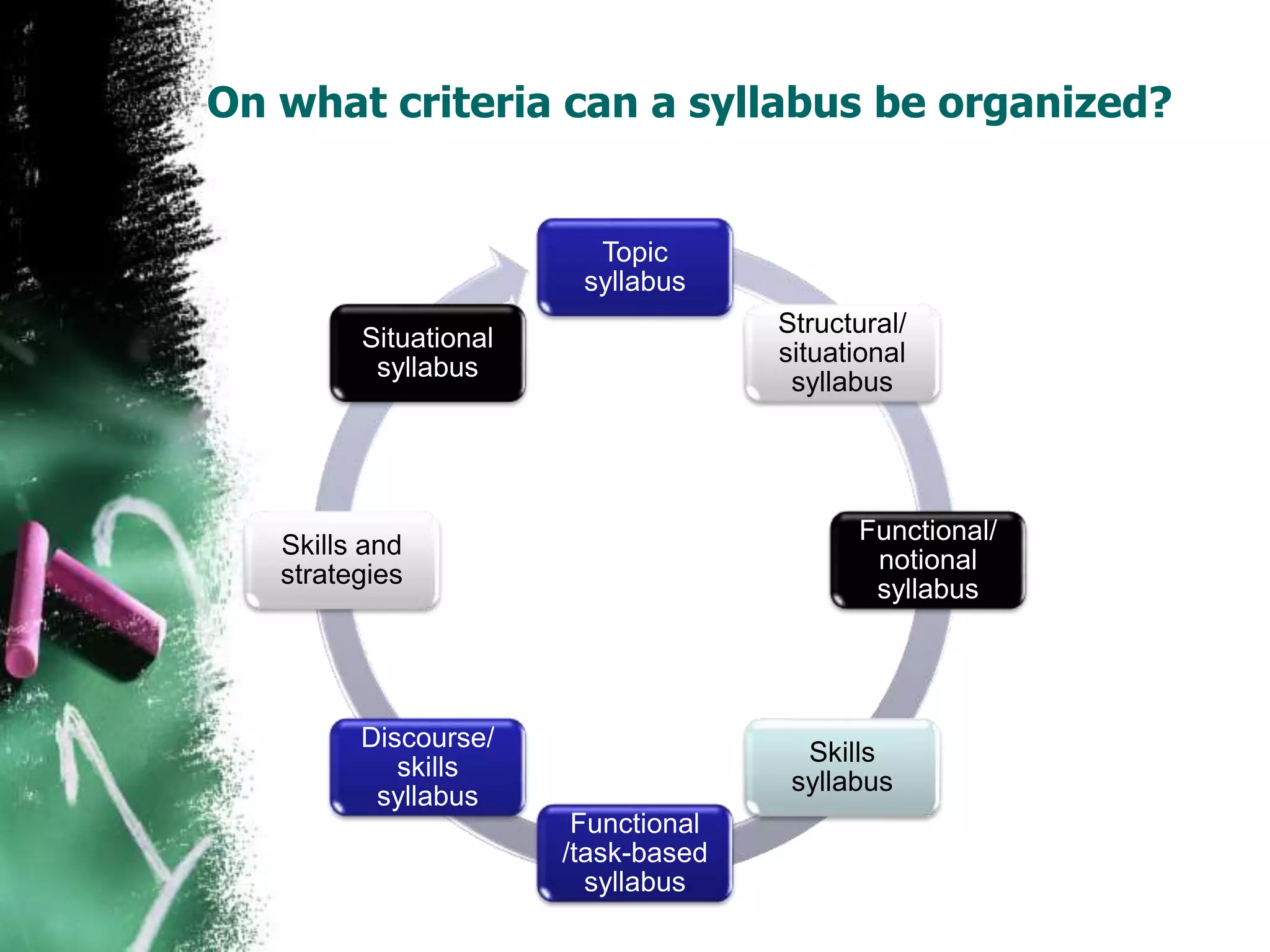
• On what criteria can a syllabus be organized? 
 Different criteria 
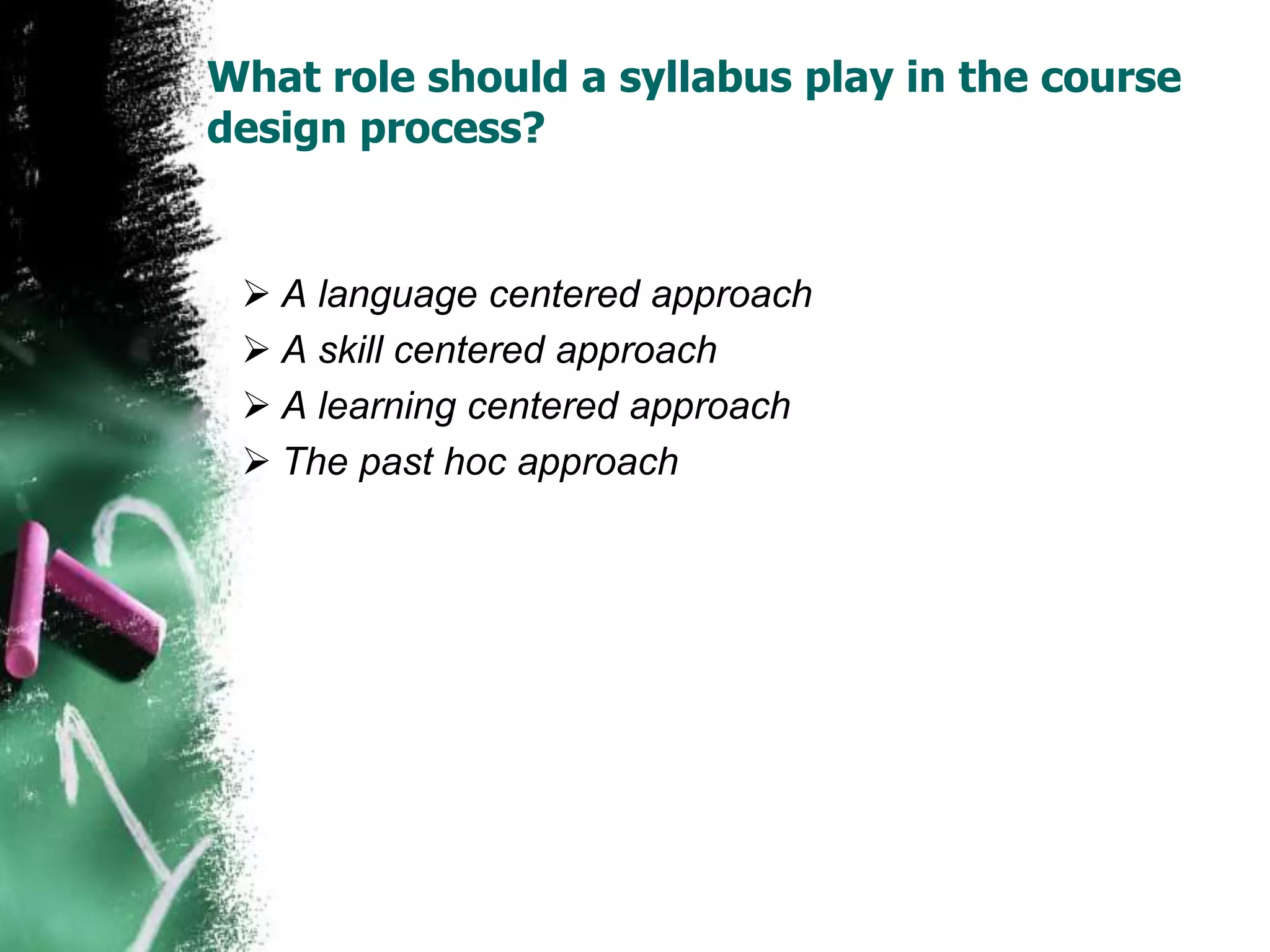
• What role should a syllabus play in the course 
design process? 
 approaches 
• Conclusion and summary
What do you mean bt a syllabus? 
• A syllabus (pl. syllabuses or syllabi) is 
an outline and summary of topics to be covered 
in an education or training course. It is 
descriptive (unlike the prescriptive or 
specific curriculum). A syllabus is often either 
set out by an exam board, or prepared by 
the professor who supervises or controls the 
course quality. It may be provided in paper form 
or online. 
• A syllabus is a document which says what will 
(or at least what should) be learnt. 
• Syllabus is, simply, a statement of what is to be 
learnt.
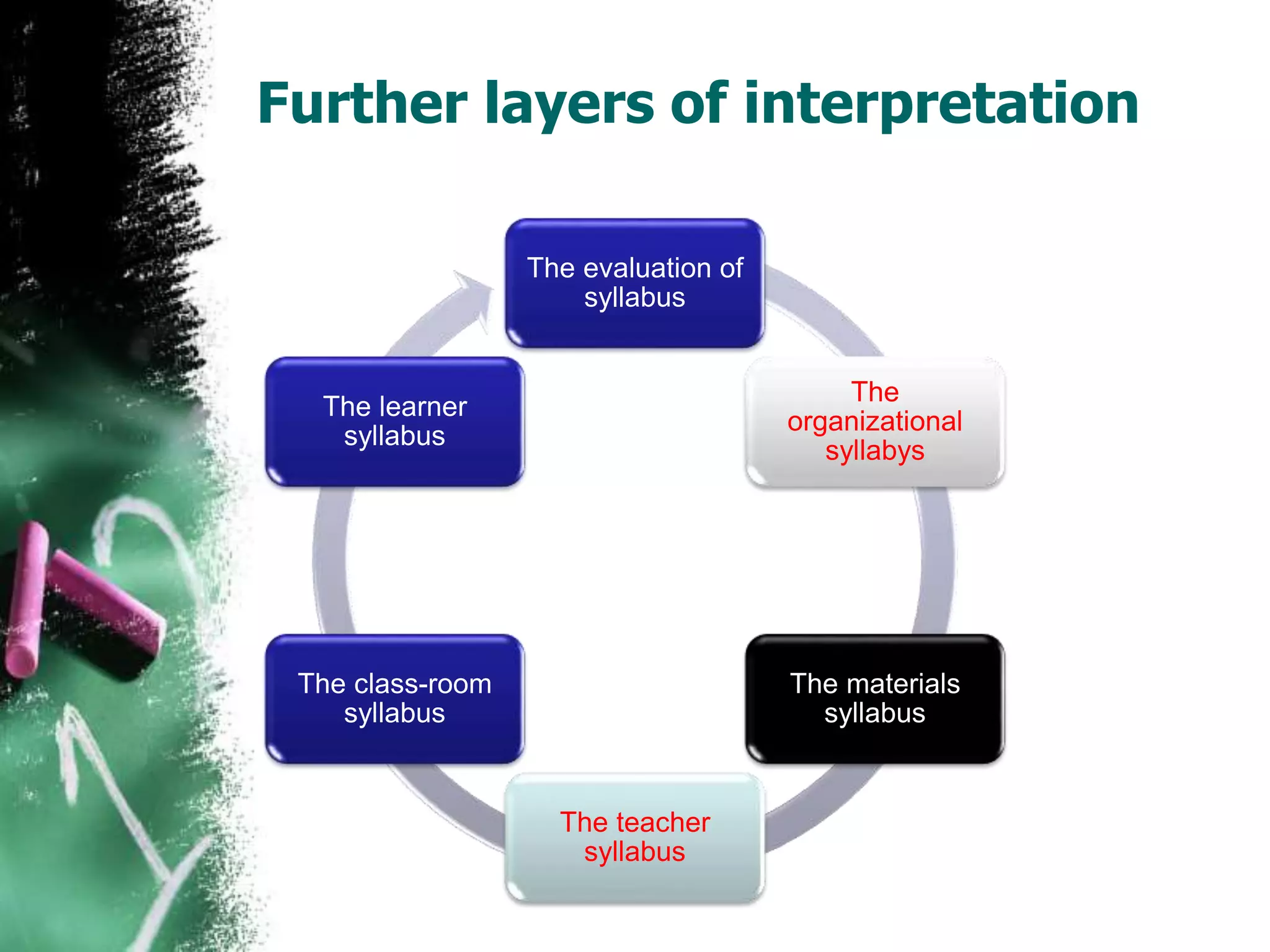
Further layers of interpretation 
The evaluation of 
syllabus 
The 
organizational 
syllabys 
The materials 
syllabus 
The teacher 
syllabus 
The learner 
syllabus 
The class-room 
syllabus
Further layers of interpretation... 
The evaluation of syllabus 
It has following traits: 
 This kind of syllabus will be most familiar as the 
document that is handed down by ministries or 
other regulating bodies. 
 It stresses what the successful learner will know 
by the end of the course. 
 In effect, it puts on record the basis on which 
success or failure will be evaluated. 
 It reflects an official assumption as to the nature 
of language and linguistic performance.
Further layers of interpretation... 
The organizational syllabus 
It has following traits: 
 A syllabus can also state the order in which it is to be 
learnt. 
 The organizational syllabus is an implicit statement 
about the nature of language and learning. 
 The organizational syllabus differs from the 
evaluation syllabus in that: 
• it carries assumptions about the nature of learning as 
well as language in organizing its items in a syllabus. 
• It is necessary to consider factors which depend upon a 
view of how people learn. 
• E.g. what is more easily learnt?, what is more 
fundamental to learning? Are some items needed in 
order to learn other items?
Further layers of interpretation... 
The materials syllabus 
It has following traits: 
 A syllabus can also state the order in which it is to be 
learnt. 
 The organizational syllabus is an implicit statement 
about the nature of language and learning. 
 The organizational syllabus differs from the 
evaluation syllabus in that: 
• it carries assumptions about the nature of learning as 
well as language in organizing its items in a syllabus. 
• It is necessary to consider factors which depend upon a 
view of how people learn. 
• E.g. what is more easily learnt?, what is more 
fundamental to learning? Are some items needed in 
order to learn other items?
Further layers of interpretation... 
The teacher syllabus 
The second stage of interpretation usually comes 
through the teacher. This type of syllabus: 
 The great majority of students in the world learn 
through the mediation of a teacher . 
 Teacher can influence the clarity, intensity and 
frequency of any item and affect the image that the 
learners receive. 
 Stevick (1984) recounts how an inexperience teacher 
would finish in two minutes an activity that he would 
spend twenty minutes on. 
• This kind of variability affect the degree of learning.
Further layers of interpretation... 
The classroom syllabus 
The classroom is not simply a neutral channel for 
the passage of information from teacher to learner. 
It is a dynamic, interactive environment which 
affects the nature both of what is taught and what is 
learnt. A teacher knows two different things happen 
in the classroom: 
 A lesson is a communicative event which is created 
by the interaction of a number of forces. 
 The classroom too creates conditions which will 
affect the nature of a planned lesson. 
• Hot weather, noise from outside, interruptions to deal 
with administrative matters, a visitor. 
• Students may be tired, asking irrelevant questions etc.
Further layers of interpretation... 
The learner syllabus 
The syllabuses discussed yet are normally 
considered to be external syllabuses. The learners 
might participate in their creation to some extent, 
but essentially they are external to the learner. 
 It is a retrospective record of what has been learnt 
rather than a prospective plan of what will be learnt. 
 It is for this reason that the learners must be taken 
into account on a continuing basis through every 
stage of the course design process.
Why should we have a syllabus? 
There are acknowledged and hidden reasons for 
having a syllabus: 
 Language is a complex entity. It cannot be learnt in 
one go. 
 We have to break down complex into manageable 
units. 
 In practical benefits, a syllabus gives moral support to 
the teachers and learner. 
 A syllabus specially in ESP has cosmetic role. 
Sponsors and students will want their investments to 
be worthwhile. 
 The syllabus can be seen a statement of projected 
routes, so that both the learners and teachers may 
know where they are going.
Continued… 
Why should we have a syllabus? 
 A syllabus provides a set of criteria for material 
selection and writing. It defines the kind of texts to 
look for or produce, the items to focus on in exercises 
etc. This is probably one of the commonest uses for a 
syllabus, but it can be one of the most damaging to 
the course, if wrongly used. 
 Uniformity is a necessary condition of any 
institutionalized activity, such as education. A 
syllabus is one way in which standardization is 
achieved. 
 Syllabuses cannot take into account of individual 
differences.
On what criteria can a syllabus be organized? 
Topic 
syllabus 
Structural/ 
situational 
syllabus 
Functional/ 
notional 
syllabus 
Skills 
syllabus 
Functional 
/task-based 
syllabus 
Situational 
syllabus 
Skills and 
strategies 
Discourse/ 
skills 
syllabus
What role should a syllabus play in the course 
design process? 
 A language centered approach 
 A skill centered approach 
 A learning centered approach 
 The past hoc approach
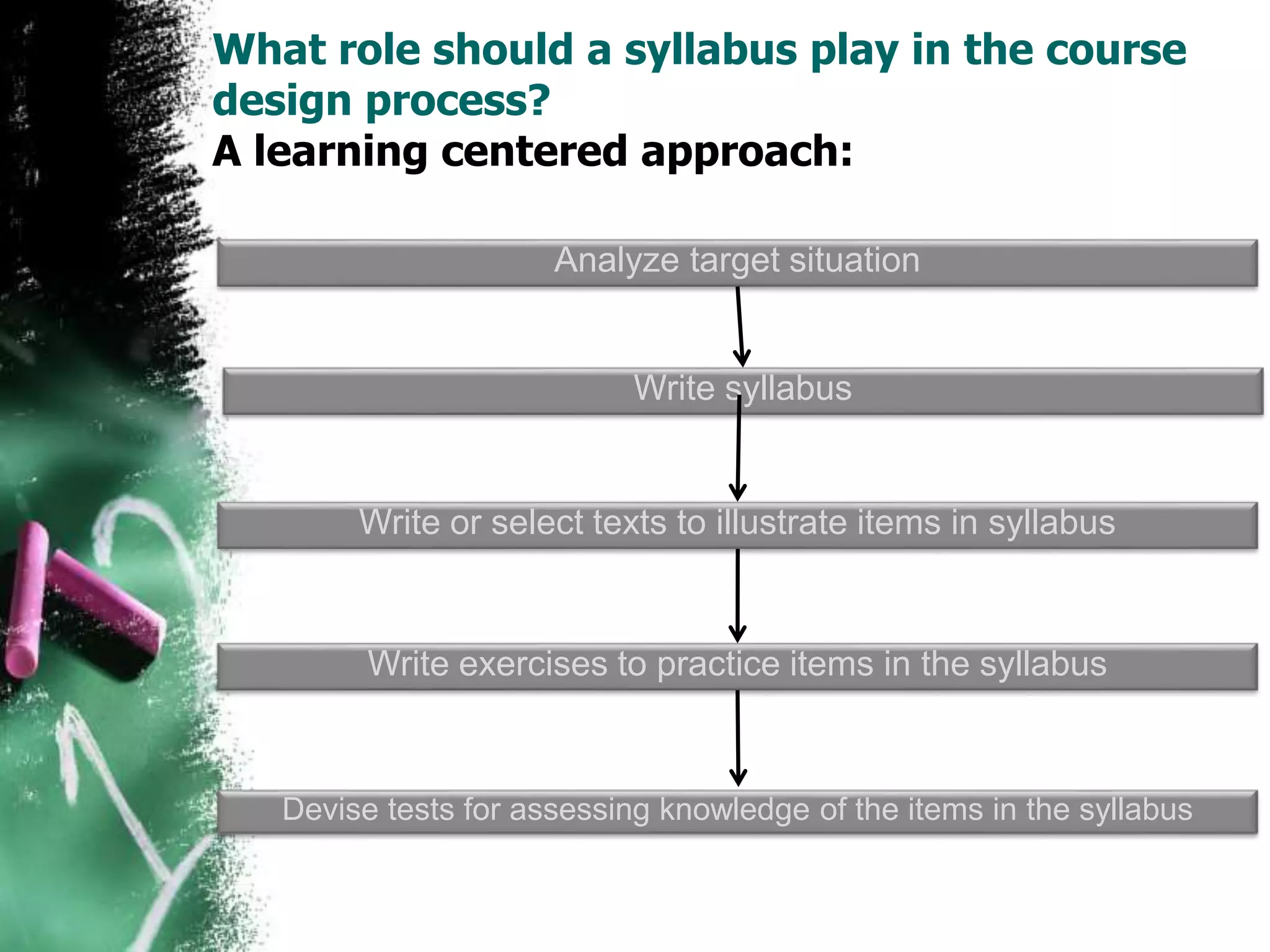
What role should a syllabus play in the course 
design process? 
A learning centered approach: 
Analyze target situation 
Write syllabus 
Write or select texts to illustrate items in syllabus 
Write exercises to practice items in the syllabus 
Devise tests for assessing knowledge of the items in the syllabus
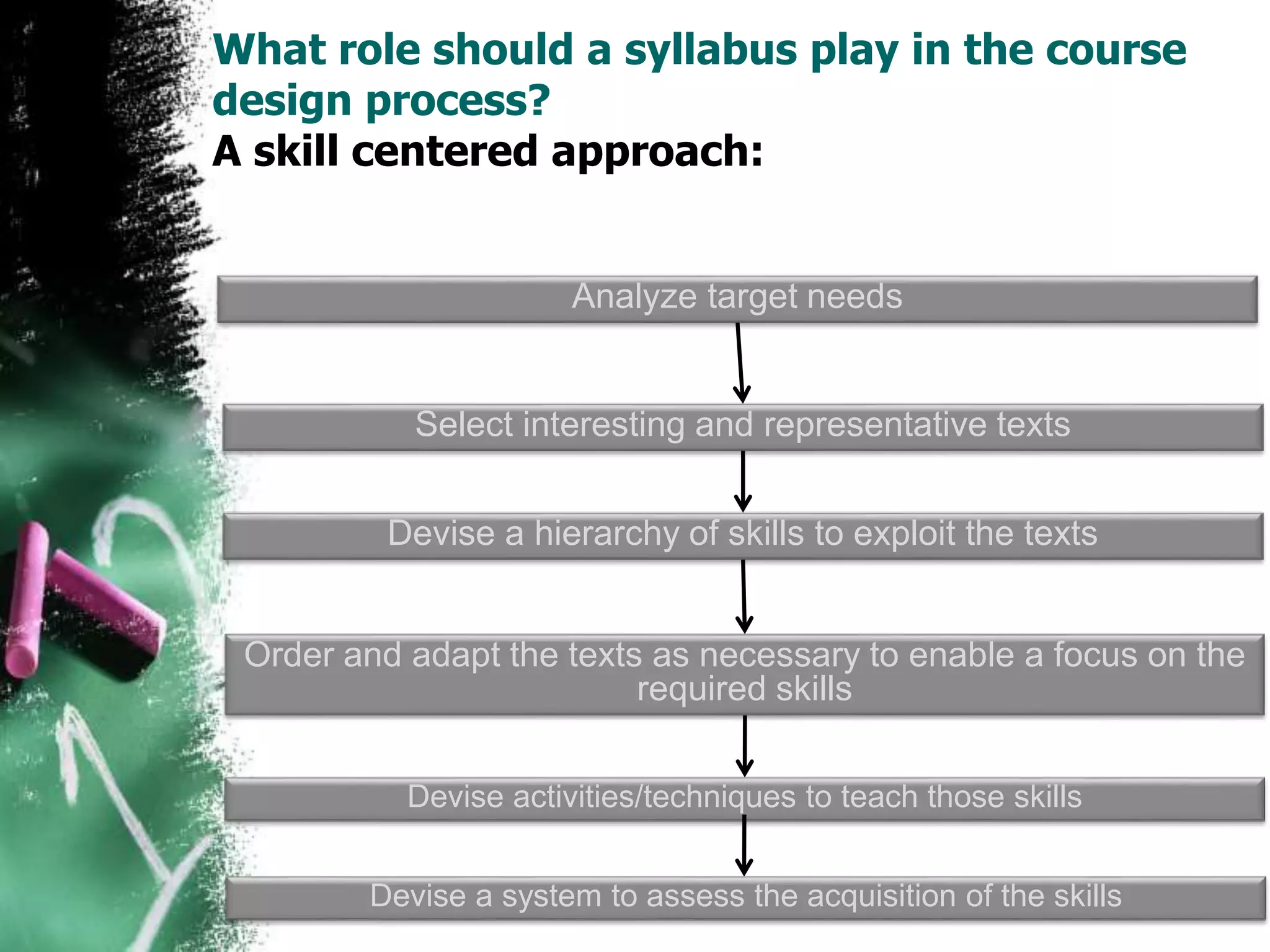
What role should a syllabus play in the course 
design process? 
A skill centered approach: 
Analyze target needs 
Select interesting and representative texts 
Devise a hierarchy of skills to exploit the texts 
Order and adapt the texts as necessary to enable a focus on the 
required skills 
Devise activities/techniques to teach those skills 
Devise a system to assess the acquisition of the skills
What role should a syllabus play in the course 
design process? 
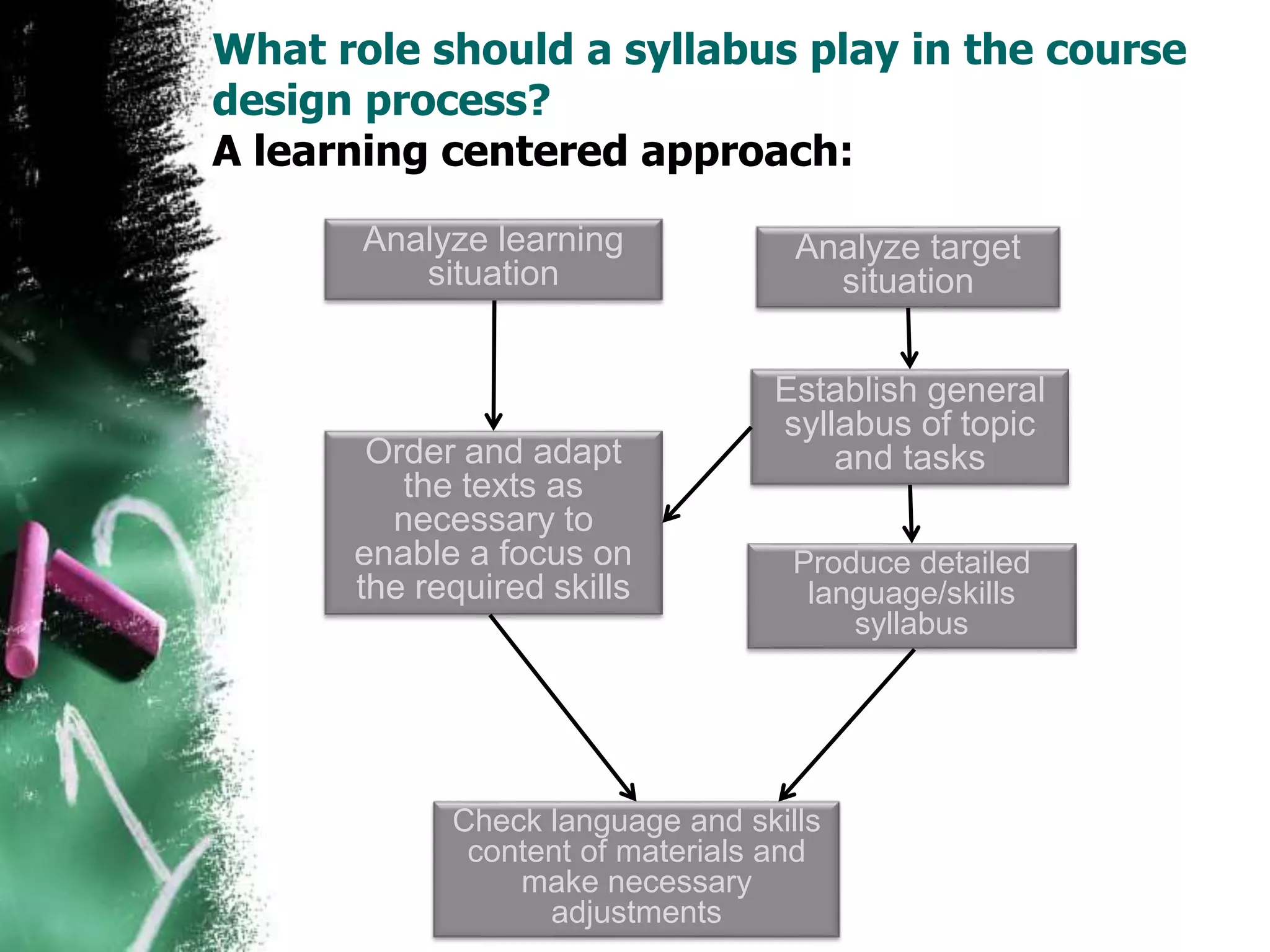
A learning centered approach: 
Analyze target 
situation 
Analyze learning 
situation 
Establish general 
syllabus of topic 
Order and adapt and tasks 
the texts as 
necessary to 
enable a focus on 
the required skills 
Produce detailed 
language/skills 
syllabus 
Check language and skills 
content of materials and 
make necessary 
adjustments
What role should a syllabus play in the course 
design process? 
A post hoc approach: 
Write materials on 
undefined criteria 
Write cosmetic 
syllabus to satisfy 
sponsors, teachers, 
students etc.

Approaches to course design

  • 1.
    English for SpecificPurpose The Syllabus Presented by: Asif Ali Raza asifalirazzza@yahoo.com +92-300-4-62-62-34
  • 2.
    Points to bediscussed • What do you mean by syllabus?  Further layers of interpretations • Why should we have syllabus?  Hidden reasons for having a syllabus • On what criteria can a syllabus be organized?  Different criteria • What role should a syllabus play in the course design process?  approaches • Conclusion and summary
  • 3.
    What do youmean bt a syllabus? • A syllabus (pl. syllabuses or syllabi) is an outline and summary of topics to be covered in an education or training course. It is descriptive (unlike the prescriptive or specific curriculum). A syllabus is often either set out by an exam board, or prepared by the professor who supervises or controls the course quality. It may be provided in paper form or online. • A syllabus is a document which says what will (or at least what should) be learnt. • Syllabus is, simply, a statement of what is to be learnt.
  • 4.
    Further layers ofinterpretation The evaluation of syllabus The organizational syllabys The materials syllabus The teacher syllabus The learner syllabus The class-room syllabus
  • 5.
    Further layers ofinterpretation... The evaluation of syllabus It has following traits:  This kind of syllabus will be most familiar as the document that is handed down by ministries or other regulating bodies.  It stresses what the successful learner will know by the end of the course.  In effect, it puts on record the basis on which success or failure will be evaluated.  It reflects an official assumption as to the nature of language and linguistic performance.
  • 6.
    Further layers ofinterpretation... The organizational syllabus It has following traits:  A syllabus can also state the order in which it is to be learnt.  The organizational syllabus is an implicit statement about the nature of language and learning.  The organizational syllabus differs from the evaluation syllabus in that: • it carries assumptions about the nature of learning as well as language in organizing its items in a syllabus. • It is necessary to consider factors which depend upon a view of how people learn. • E.g. what is more easily learnt?, what is more fundamental to learning? Are some items needed in order to learn other items?
  • 7.
    Further layers ofinterpretation... The materials syllabus It has following traits:  A syllabus can also state the order in which it is to be learnt.  The organizational syllabus is an implicit statement about the nature of language and learning.  The organizational syllabus differs from the evaluation syllabus in that: • it carries assumptions about the nature of learning as well as language in organizing its items in a syllabus. • It is necessary to consider factors which depend upon a view of how people learn. • E.g. what is more easily learnt?, what is more fundamental to learning? Are some items needed in order to learn other items?
  • 8.
    Further layers ofinterpretation... The teacher syllabus The second stage of interpretation usually comes through the teacher. This type of syllabus:  The great majority of students in the world learn through the mediation of a teacher .  Teacher can influence the clarity, intensity and frequency of any item and affect the image that the learners receive.  Stevick (1984) recounts how an inexperience teacher would finish in two minutes an activity that he would spend twenty minutes on. • This kind of variability affect the degree of learning.
  • 9.
    Further layers ofinterpretation... The classroom syllabus The classroom is not simply a neutral channel for the passage of information from teacher to learner. It is a dynamic, interactive environment which affects the nature both of what is taught and what is learnt. A teacher knows two different things happen in the classroom:  A lesson is a communicative event which is created by the interaction of a number of forces.  The classroom too creates conditions which will affect the nature of a planned lesson. • Hot weather, noise from outside, interruptions to deal with administrative matters, a visitor. • Students may be tired, asking irrelevant questions etc.
  • 10.
    Further layers ofinterpretation... The learner syllabus The syllabuses discussed yet are normally considered to be external syllabuses. The learners might participate in their creation to some extent, but essentially they are external to the learner.  It is a retrospective record of what has been learnt rather than a prospective plan of what will be learnt.  It is for this reason that the learners must be taken into account on a continuing basis through every stage of the course design process.
  • 11.
    Why should wehave a syllabus? There are acknowledged and hidden reasons for having a syllabus:  Language is a complex entity. It cannot be learnt in one go.  We have to break down complex into manageable units.  In practical benefits, a syllabus gives moral support to the teachers and learner.  A syllabus specially in ESP has cosmetic role. Sponsors and students will want their investments to be worthwhile.  The syllabus can be seen a statement of projected routes, so that both the learners and teachers may know where they are going.
  • 12.
    Continued… Why shouldwe have a syllabus?  A syllabus provides a set of criteria for material selection and writing. It defines the kind of texts to look for or produce, the items to focus on in exercises etc. This is probably one of the commonest uses for a syllabus, but it can be one of the most damaging to the course, if wrongly used.  Uniformity is a necessary condition of any institutionalized activity, such as education. A syllabus is one way in which standardization is achieved.  Syllabuses cannot take into account of individual differences.
  • 13.
    On what criteriacan a syllabus be organized? Topic syllabus Structural/ situational syllabus Functional/ notional syllabus Skills syllabus Functional /task-based syllabus Situational syllabus Skills and strategies Discourse/ skills syllabus
  • 14.
    What role shoulda syllabus play in the course design process?  A language centered approach  A skill centered approach  A learning centered approach  The past hoc approach
  • 15.
    What role shoulda syllabus play in the course design process? A learning centered approach: Analyze target situation Write syllabus Write or select texts to illustrate items in syllabus Write exercises to practice items in the syllabus Devise tests for assessing knowledge of the items in the syllabus
  • 16.
    What role shoulda syllabus play in the course design process? A skill centered approach: Analyze target needs Select interesting and representative texts Devise a hierarchy of skills to exploit the texts Order and adapt the texts as necessary to enable a focus on the required skills Devise activities/techniques to teach those skills Devise a system to assess the acquisition of the skills
  • 17.
    What role shoulda syllabus play in the course design process? A learning centered approach: Analyze target situation Analyze learning situation Establish general syllabus of topic Order and adapt and tasks the texts as necessary to enable a focus on the required skills Produce detailed language/skills syllabus Check language and skills content of materials and make necessary adjustments
  • 18.
    What role shoulda syllabus play in the course design process? A post hoc approach: Write materials on undefined criteria Write cosmetic syllabus to satisfy sponsors, teachers, students etc.