ENVIRONMENTAL  ANALYSIS  AND  FORECASTING
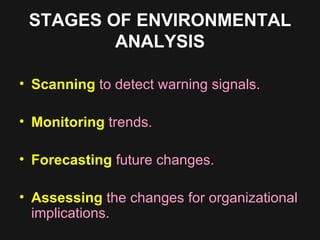
STAGES OF ENVIRONMENTAL ANALYSIS Scanning  to detect warning signals.  Monitoring  trends.  Forecasting  future changes.  Assessing  the changes for organizational implications.
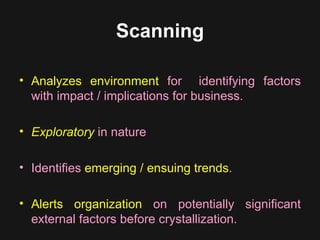
Scanning Analyzes environment  for  identifying factors with impact / implications for business.  Exploratory   in nature Identifies  emerging / ensuing trends .  Alerts organization  on potentially significant external factors before crystallization.
Monitoring Focused & systematic in-depth analysis  of relevant environmental trends.  Gather data to  determine emerging patterns  Outputs of monitoring :  1. Environmental patterns to be forecast  2. Trends for further monitoring 3. Patterns requiring further scanning.
Forecasting… Anticipating  trends in future changes  Pinpoint critical variables  emerging / declining Give  more concrete views on threats and opportunities  Help  formulate strategic plans .
Assessment Assess/Evaluate  the  impact on organization's business.  Draws up  implications / possible impacts.  What  foreshadow  environment holds for  the organization
Environmental Analysis:   APPROACHES   Inside-out (micro) –  narrow view of environment, forecast the immediate future environment Outside-in (macro) scenario  analysis –  broad view of BE, long term perspective, develop alternative scenarios
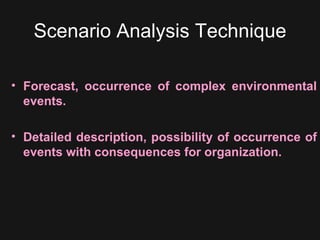
Scenario Analysis Technique Forecast, occurrence of complex environmental events.  Detailed description, possibility of occurrence of events with consequences for organization.
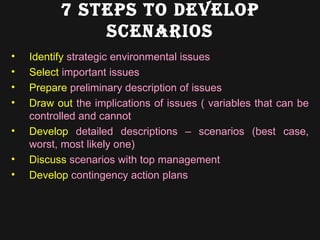
7 steps to develop scenarios Identify  strategic environmental issues Select  important issues  Prepare  preliminary description of issues  Draw   out  the implications of issues ( variables that can be controlled and cannot  Develop  detailed descriptions – scenarios (best case, worst, most likely one) Discuss  scenarios with top management  Develop  contingency action plans
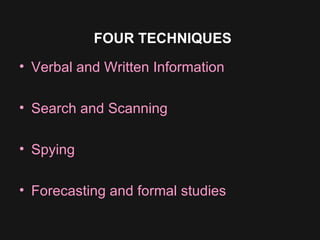
FOUR TECHNIQUES Verbal and Written Information Search and Scanning Spying Forecasting and formal studies
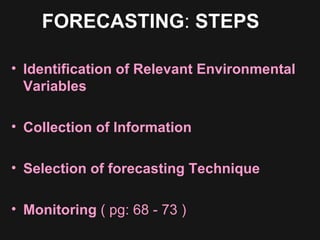
FORECASTING :  STEPS   Identification of Relevant Environmental Variables   Collection of Information   Selection of forecasting Technique   Monitoring  ( pg: 68 - 73 )

Environmental analysis & forecasting

  • 1.
    ENVIRONMENTAL ANALYSIS AND FORECASTING
  • 2.
    STAGES OF ENVIRONMENTALANALYSIS Scanning to detect warning signals. Monitoring trends. Forecasting future changes. Assessing the changes for organizational implications.
  • 3.
    Scanning Analyzes environment for identifying factors with impact / implications for business. Exploratory in nature Identifies emerging / ensuing trends . Alerts organization on potentially significant external factors before crystallization.
  • 4.
    Monitoring Focused &systematic in-depth analysis of relevant environmental trends. Gather data to determine emerging patterns Outputs of monitoring : 1. Environmental patterns to be forecast 2. Trends for further monitoring 3. Patterns requiring further scanning.
  • 5.
    Forecasting… Anticipating trends in future changes Pinpoint critical variables emerging / declining Give more concrete views on threats and opportunities Help formulate strategic plans .
  • 6.
    Assessment Assess/Evaluate the impact on organization's business. Draws up implications / possible impacts. What foreshadow environment holds for the organization
  • 7.
    Environmental Analysis: APPROACHES Inside-out (micro) – narrow view of environment, forecast the immediate future environment Outside-in (macro) scenario analysis – broad view of BE, long term perspective, develop alternative scenarios
  • 8.
    Scenario Analysis TechniqueForecast, occurrence of complex environmental events. Detailed description, possibility of occurrence of events with consequences for organization.
  • 9.
    7 steps todevelop scenarios Identify strategic environmental issues Select important issues Prepare preliminary description of issues Draw out the implications of issues ( variables that can be controlled and cannot Develop detailed descriptions – scenarios (best case, worst, most likely one) Discuss scenarios with top management Develop contingency action plans
  • 10.
    FOUR TECHNIQUES Verbaland Written Information Search and Scanning Spying Forecasting and formal studies
  • 11.
    FORECASTING : STEPS Identification of Relevant Environmental Variables Collection of Information Selection of forecasting Technique Monitoring ( pg: 68 - 73 )