
Organizing the Course
ANNAS SURDYANTO
Organizing a Course
 Determining the organizing principles (themes, genres, tasks)
 Determining and sequencing the units
 Organizing unit contents
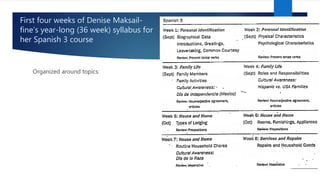
Organized around topics:
First four weeks of Denise Maksail-
fine’s year-long (36 week) syllabus for
her Spanish 3 course
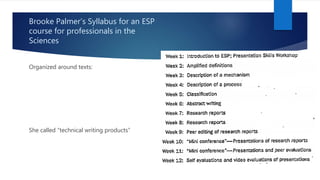
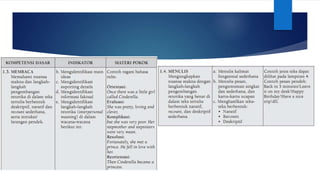
Organized around texts:
She called “technical writing products”
Brooke Palmer’s Syllabus for an ESP
course for professionals in the
Sciences
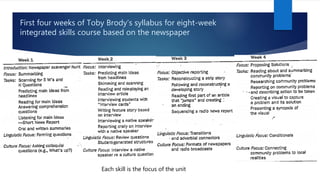
First four weeks of Toby Brody’s syllabus for eight-week
integrated skills course based on the newspaper
Each skill is the focus of the unit
 Syllabus design can be defined as selection and organization of instructional
content including suggested strategy for presenting content and evaluation (
Brown, 1995)
 Hutchinson and Waters (1987:80) define syllabus as follows: “At its simplest level
a syllabus can be described as a statement of what is to be learnt. It reflects
language and linguistic performance”.
 This is a rather traditional interpretation of syllabus focusing on outcomes rather
than process. However, a syllabus can also be seen as a "summary of the content
to which learners will be exposed" (Yalden.1987).
Structural
Structural syllabus: Grammatical and phonological structures are the organizing
principles –sequenced from easy to difficult or frequent to less frequent.
Situational
Situational syllabus: Situations (such as at the school, at a restaurant, at the
supermarket etc.) form the organizing principle – sequenced by the likelihood
students will encounter them.
Ex:
 At the school
 At a restaurant
 Food at the Supermarket
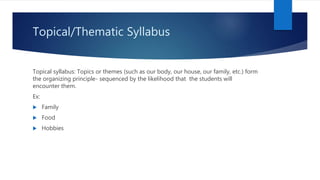
Topical/Thematic Syllabus
Topical syllabus: Topics or themes (such as our body, our house, our family, etc.) form
the organizing principle- sequenced by the likelihood that the students will
encounter them.
Ex:
 Family
 Food
 Hobbies
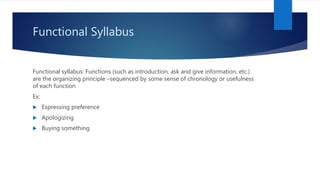
Functional Syllabus
Functional syllabus: Functions (such as introduction, ask and give information, etc.)
are the organizing principle –sequenced by some sense of chronology or usefulness
of each function
Ex:
 Expressing preference
 Apologizing
 Buying something
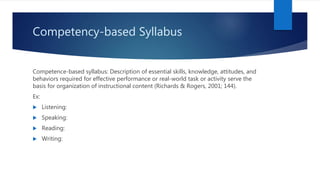
Competency-based Syllabus
Competence-based syllabus: Description of essential skills, knowledge, attitudes, and
behaviors required for effective performance or real-world task or activity serve the
basis for organization of instructional content (Richards & Rogers, 2001; 144).
Ex:
 Listening:
 Speaking:
 Reading:
 Writing:
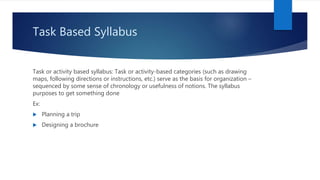
Task Based Syllabus
Task or activity based syllabus: Task or activity-based categories (such as drawing
maps, following directions or instructions, etc.) serve as the basis for organization –
sequenced by some sense of chronology or usefulness of notions. The syllabus
purposes to get something done
Ex:
 Planning a trip
 Designing a brochure
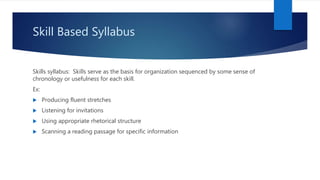
Skill Based Syllabus
Skills syllabus: Skills serve as the basis for organization sequenced by some sense of
chronology or usefulness for each skill.
Ex:
 Producing fluent stretches
 Listening for invitations
 Using appropriate rhetorical structure
 Scanning a reading passage for specific information
Group project
 Write the goals and objectives of the course.
 Find an English course book regarding the goals and objectives. It may be English
for elementary school, adults, ESP or reading, writing, listening, and speaking
courses.
 Copy the table of content and guide for teachers (if any).
 Mention the type of syllabus and explain the way teacher should teach by using
the book briefly.
 Brown, JD.1996. The Elements of Language Curriculum; A Systematic Approach to
Program Development. Boston, Mass.: Heinle & Heinle Publishers
 Nation, I.S.P. & Macalister, J. 2010. Language Curriculum Design. Oxon: Routledge.
 Krahnke, Karl.1987. Approaches to Syllabus Design for Foreign Language Teaching.
Englewood Cliffs, NJ: Prentice Hall Regents
 Hadley, Alice Omaggio.2001. Teaching Language in Context. Boston: Heinle & Heinle
Publishers.
 Richards & Rogers. 2001. Approaches and methods. Cambridge: Cambridge University
Press.
 Graves, Kathleen. 2000. Designing Language Courses: a Guide for Teachers. Boston:
Heinle & Heinle Publishers.

Organizing a Course

  • 1.
  • 2.
    Organizing a Course Determining the organizing principles (themes, genres, tasks)  Determining and sequencing the units  Organizing unit contents
  • 3.
    Organized around topics: Firstfour weeks of Denise Maksail- fine’s year-long (36 week) syllabus for her Spanish 3 course
  • 4.
    Organized around texts: Shecalled “technical writing products” Brooke Palmer’s Syllabus for an ESP course for professionals in the Sciences
  • 5.
    First four weeksof Toby Brody’s syllabus for eight-week integrated skills course based on the newspaper Each skill is the focus of the unit
  • 6.
     Syllabus designcan be defined as selection and organization of instructional content including suggested strategy for presenting content and evaluation ( Brown, 1995)  Hutchinson and Waters (1987:80) define syllabus as follows: “At its simplest level a syllabus can be described as a statement of what is to be learnt. It reflects language and linguistic performance”.  This is a rather traditional interpretation of syllabus focusing on outcomes rather than process. However, a syllabus can also be seen as a "summary of the content to which learners will be exposed" (Yalden.1987).
  • 7.
    Structural Structural syllabus: Grammaticaland phonological structures are the organizing principles –sequenced from easy to difficult or frequent to less frequent.
  • 8.
    Situational Situational syllabus: Situations(such as at the school, at a restaurant, at the supermarket etc.) form the organizing principle – sequenced by the likelihood students will encounter them. Ex:  At the school  At a restaurant  Food at the Supermarket
  • 9.
    Topical/Thematic Syllabus Topical syllabus:Topics or themes (such as our body, our house, our family, etc.) form the organizing principle- sequenced by the likelihood that the students will encounter them. Ex:  Family  Food  Hobbies
  • 10.
    Functional Syllabus Functional syllabus:Functions (such as introduction, ask and give information, etc.) are the organizing principle –sequenced by some sense of chronology or usefulness of each function Ex:  Expressing preference  Apologizing  Buying something
  • 11.
    Competency-based Syllabus Competence-based syllabus:Description of essential skills, knowledge, attitudes, and behaviors required for effective performance or real-world task or activity serve the basis for organization of instructional content (Richards & Rogers, 2001; 144). Ex:  Listening:  Speaking:  Reading:  Writing:
  • 14.
    Task Based Syllabus Taskor activity based syllabus: Task or activity-based categories (such as drawing maps, following directions or instructions, etc.) serve as the basis for organization – sequenced by some sense of chronology or usefulness of notions. The syllabus purposes to get something done Ex:  Planning a trip  Designing a brochure
  • 15.
    Skill Based Syllabus Skillssyllabus: Skills serve as the basis for organization sequenced by some sense of chronology or usefulness for each skill. Ex:  Producing fluent stretches  Listening for invitations  Using appropriate rhetorical structure  Scanning a reading passage for specific information
  • 16.
    Group project  Writethe goals and objectives of the course.  Find an English course book regarding the goals and objectives. It may be English for elementary school, adults, ESP or reading, writing, listening, and speaking courses.  Copy the table of content and guide for teachers (if any).  Mention the type of syllabus and explain the way teacher should teach by using the book briefly.
  • 17.
     Brown, JD.1996.The Elements of Language Curriculum; A Systematic Approach to Program Development. Boston, Mass.: Heinle & Heinle Publishers  Nation, I.S.P. & Macalister, J. 2010. Language Curriculum Design. Oxon: Routledge.  Krahnke, Karl.1987. Approaches to Syllabus Design for Foreign Language Teaching. Englewood Cliffs, NJ: Prentice Hall Regents  Hadley, Alice Omaggio.2001. Teaching Language in Context. Boston: Heinle & Heinle Publishers.  Richards & Rogers. 2001. Approaches and methods. Cambridge: Cambridge University Press.  Graves, Kathleen. 2000. Designing Language Courses: a Guide for Teachers. Boston: Heinle & Heinle Publishers.