PEOPLE'S DEMOCRATIC REPUBLIC OF ALGERIA
MINISTRY OF HIGHER EDUCATION AND SCIENTIFIC RESEARCH
EL TARF –UNIVERSITY –ENGLISH DEPARTMENT
ESP :NEEDS ANALYSIS
GROUP MEMBERS:
ATI N
ATI A S
ALAYAT H
BOULEBNAN A M
ADJIM M M
3RD YEAR :GROUP 1
TUTOR: OUIS
2016/2017
OUTLINE:
 Introduction
 Brief History
 Definition of needs analysis.
 Procedures for conducting needs analysis
 data collection devices
 The purpose of needs analysis
 Importance of needs analysis in Esp
 Conclusion
BRIEF HISTORY
 Needs analysis procedure in the field of language teaching
was first used by Michael West in a survey report published in
1926 (White, 1988). In the following decades, however, little if
any attention was given to needs analysis. This can be
explained largely by the influence that the traditional structural
view of the language continued to exert on the field of English
language teaching (ELT). The term “Need Analysis” re-
emerged during the 1970‟s as a result of intensive studies
conducted by the Council of Europe team. Research and
studies conducted by the Council of Europe team resulted in
the emergence of the communicative approach to language
learning which replaced the situational approach dominant in
language teaching and learning at that time. The Council of
Europe team felt that successful language learning resulted
not from mastering linguistic elements, but from determining
exactly what the learner needed to do with the target
language.
 The idea of focusing on learners’ needs originated
in the 1970s resulting from the interest in the design
of language courses that could satisfy individual
and social needs (Palacios Martínez 1992:135). Its
development evolved in association with the
teaching of languages for specific purposes.
DEFINITION OF NEEDS ANALYSIS
 A needs analysis refers to the activities involved in
collecting the necessary information for developing
an effective curriculum that meets students'
particular needs (Iwai et al., 1999)
 In order for this to take place, the teacher must
identify learner’s needs, and make a determining
distinction between “target” and “learning" needs:
 Learning needs: Refer to the background linguistic
knowledge the learner needs to have in order to
master the further abilities he will need to perform
in the target situation.
TARGET NEEDS:
 learner's "lacks", "needs" and "wants".
 Wants: The learner’s personal view about the
needs or lacks he has.
 Lacks: The “gap” existing between the target
proficiency and the current proficiency of the
learners.
LEARNING NEEDS:
 Refer to the background linguistic knowledge the
learner needs to have in order to master the further
abilities he will need to perform in the target
situation. How can we identify needs, lacks and
wants? We can administer a needs analysis
procedure through questionnaires, interviews,
observations, data collection or informal
consultations to learners, tutors or sponsors.
 Being aware of the needs of the learners influences not
only the content of the language course but also what
potential can be exploited through such course. Needs
analysis is a complex process which has to take into
account what Hutchinson and Waters (1987:54-63)
define as “target needs”, what learners need to do in the
target situation – i.e. language use, and “learning
needs”, what learners need to do in order to learn – i.e.
language learning. In a more modern view, we should
not only take into account “target needs” and “learning
needs” – i.e. objective needs – but also learners’
subjective needs, that is, their affective needs, such as
their interests, wishes, expectations and preferences
(Nunan 1988)
PROCEDURES FOR CONDUCTING NEEDS ANALYSIS:
 When performing a need analysis, the ESP practitioner can
pick out numerous strategies, but needs to keep in mind that
every procedure affects the type of the information obtained
(Richards, 2002). Schutz and Derwing (1981), introduced
eight detailed stages to perform a needs assessment. These
stages are: to determine goals, to set the limits for target
population, to delimit the framework of examination, to choose
a data collecting device, to gather evidence, to evaluate data,
to decipher outcome, and to criticize the research.
 ) Determining if the goal is directly related to establishing the
purpose of the study specifically in order to determine
appropriate outcome.
 2) By setting the limits on the target population, the
researcher is able to specify the target population of the
investigation in order to carry out more pragmatic decision
regarding costs, place and length of the project.
 3) Delimiting the framework of examination involves outlining
the limitations of the research mainly to increase its potency.
 4) Choosing the data collecting device includes picking out
proper information gathering instruments. Deciding the data
collecting device relies upon the environment, range and
goals of the research.
 5) Gathering evidence consists of compiling the necessary
information via the data collecting device that will be used in
this process. Distinctive kinds of data collecting device, like
distributing surveys, performing personal interviews, or
conducting observations depend upon a different type of
approach and subsequently changing the upcoming stages.
 6) Evaluating the data, the analyst can use numerous aids in the
form of computerassisted
 investigation methods or simply based on his own observations
and calculations. Applying computer-assisted investigation
methods to interpret the data is more practical as it significantly
decreases time and the amount of work, in contrast with
observations and personal calculation that demand lengthened
contact with the target contexts and qualitative analysis of the
outcome.
 7) By deciphering the outcome, the analyst interprets the data
developed from the technique of information analysis. Afterwards,
the analyst seeks to deduce suggestions regarding the learners'
language requirements by using the product of data
investigation.
 8) Lastly, the criticism of the research portion
involves writing down recommendations for
additional studies and clarifying the drawbacks of
the research.
 Clearly this is not the only available method to
conduct an appropriate needs analysis.
Nevertheless, it has been applied numerous times
and the ESP practitioner willing to use it will not be
compelled to deal with additional errors arising from
using a different method.
DATA COLLECTION DEVICES
 • Questionnaires
 • Self-ratings
 • Interviews
 • Meetings
 • Observation
 • Collecting learner language samples
 • Task analysis
 • Case studies
 • Analysis of available information
THE QUESTIONNAIRE
 The questionnaire is considered as the most
common tool used for gathering information about a
specific topic using set of clear questions sent for a
specific population. According to Brown (2001) a
questionnaire is “any written instrument that
presents respondents with a series of questions or
statements to which they are to react either by
writing out their answers or selecting from among
existing answers”
 disadvantages of Questionnaires:
 • The information obtained may be fairly
superficial or imprecise.
 • The information will often need follow-up to
gain a fuller understanding.
SELF-RATINGS
 Self-ratings :Self-ratings might be included as part
of a questionnaire.
 • Disadvantage: It provides only
impressionistic information.
INTERVIEWS
 Interviews are discussions, usually one-on-one
between an interviewer and an individual, meant to
gather information on a specific set of topics.
Interviews can be conducted in person or over the
phone. Interviews differ from surveys by the level of
structure placed on the interaction.
 • Advantage:
 * Allow for a more in-depth exploration of issue
 * may be useful at the preliminary stage of designing a
questionnaire.
 • Disadvantage:
 * Take longer to administer
 * Only feasible for smaller groups
MEETINGS :
 Advantage:
 * Allows a large amount of information to be
collected in a fairly short time.
 Disadvantage:
 * Information may be impressionistic and
subjective
OBSERVATION :
 may either involve counting the number of times that a
particular phenomenon occurs, such as how often a
particular word is used in interviews, or coding
observational data to translate it into numbers.
 Take into account:
 * People often do not perform well when they are
observed.
 * The skill of observer.
COLLECTING LEARNER LANGUAGE SAMPLES
 Language samples may be collected through:
 Written or oral tasks
 Simulations or role plays
 Performance tests
 Achievement tests
THE PURPOSE OF NEEDS ANALYSIS :
 Needs analysis in language teaching may be used for a
number of different purposes :
 • to find out what language skills a learner needs in
order to perform a particular role, such as sales
manager, tour guide, or university student.
 • to help determine if an existing course adequately
addresses the needs of potential students.
 • to determine which students from a group are most
in need of training in particular language skills.
 •
 to identify a change of direction that people in a
reference group feel is important.
 • to identify a gap between what students are
able to do and what they need to be able to do.
 to collect information about a particular problem
learners are experiencing.
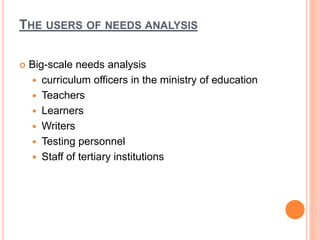
THE USERS OF NEEDS ANALYSIS
 Big-scale needs analysis
 curriculum officers in the ministry of education
 Teachers
 Learners
 Writers
 Testing personnel
 Staff of tertiary institutions
 Small-scale needs analysis
 Teacher
 Program coordinator
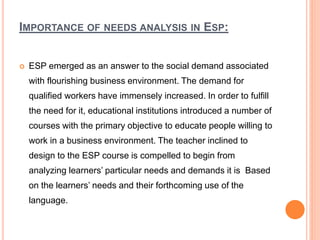
IMPORTANCE OF NEEDS ANALYSIS IN ESP:
 ESP emerged as an answer to the social demand associated
with flourishing business environment. The demand for
qualified workers have immensely increased. In order to fulfill
the need for it, educational institutions introduced a number of
courses with the primary objective to educate people willing to
work in a business environment. The teacher inclined to
design to the ESP course is compelled to begin from
analyzing learners’ particular needs and demands it is Based
on the learners’ needs and their forthcoming use of the
language.
 ESP is not just about teaching English, it’s about
teaching the specific English the students need to
operate successfully in their chosen field. Whether
students are from the oil industry or the construction
industry, this principle remains the same.A number of
linguists, (e.g. Strevens (1977),Swales(1990),
Hutchinson and Waters (1987), Jordan(1997),
Flowerdew and Peacock (2001), and Basturkmen
(2006)) laid emphasis on needs analysis as an
insinuating point for devising syllabuses, courses,
materials for specific audiences. Needs analysis is
important to investigate students’ needs and wants in
order to make an effective ESP course syllabus.
CONCLUSION
 In conclusion, the results of the needs analysis help us
as teachers to identify the students’ prospective
professional needs, the students’ needs in terms of
language skills and the students’ deficiencies in the area
of language skills. Only after analyzing the students’
needs and determining the objectives of the language
course, we can select a material that meets the needs of
the students. Thus, needs analysis is the foundation on
which we can develop curriculum content, teaching
materials and methods that can lead to increasing the
learners ’motivation and success.
REFERENCES:
 Adeel Khalid Needs Assessment in ESP: A Review
Vol. 12, No. 6, 2016, pp. 38-46
 Evan Frendo ,On the importance of needs
analysis© , 2012
 Lidia Gómez García - Universidade de Santiago de
Compostela
 Sebastian Jeczelewski Needs Analysis, Course
Design and Evaluation of Business English 2016
 Sophia Yar-ling Tsai, Needs AnalysisShou
University, Taiwan , 2008
 The importance of needs analysis in syllabus and
course design. The CMC_E project: a case in point
THANK YOU

Needs analysis

  • 1.
    PEOPLE'S DEMOCRATIC REPUBLICOF ALGERIA MINISTRY OF HIGHER EDUCATION AND SCIENTIFIC RESEARCH EL TARF –UNIVERSITY –ENGLISH DEPARTMENT ESP :NEEDS ANALYSIS GROUP MEMBERS: ATI N ATI A S ALAYAT H BOULEBNAN A M ADJIM M M 3RD YEAR :GROUP 1 TUTOR: OUIS 2016/2017
  • 2.
    OUTLINE:  Introduction  BriefHistory  Definition of needs analysis.  Procedures for conducting needs analysis  data collection devices  The purpose of needs analysis  Importance of needs analysis in Esp  Conclusion
  • 3.
    BRIEF HISTORY  Needsanalysis procedure in the field of language teaching was first used by Michael West in a survey report published in 1926 (White, 1988). In the following decades, however, little if any attention was given to needs analysis. This can be explained largely by the influence that the traditional structural view of the language continued to exert on the field of English language teaching (ELT). The term “Need Analysis” re- emerged during the 1970‟s as a result of intensive studies conducted by the Council of Europe team. Research and studies conducted by the Council of Europe team resulted in the emergence of the communicative approach to language learning which replaced the situational approach dominant in language teaching and learning at that time. The Council of Europe team felt that successful language learning resulted not from mastering linguistic elements, but from determining exactly what the learner needed to do with the target language.
  • 4.
     The ideaof focusing on learners’ needs originated in the 1970s resulting from the interest in the design of language courses that could satisfy individual and social needs (Palacios Martínez 1992:135). Its development evolved in association with the teaching of languages for specific purposes.
  • 5.
    DEFINITION OF NEEDSANALYSIS  A needs analysis refers to the activities involved in collecting the necessary information for developing an effective curriculum that meets students' particular needs (Iwai et al., 1999)  In order for this to take place, the teacher must identify learner’s needs, and make a determining distinction between “target” and “learning" needs:  Learning needs: Refer to the background linguistic knowledge the learner needs to have in order to master the further abilities he will need to perform in the target situation.
  • 6.
    TARGET NEEDS:  learner's"lacks", "needs" and "wants".  Wants: The learner’s personal view about the needs or lacks he has.  Lacks: The “gap” existing between the target proficiency and the current proficiency of the learners.
  • 7.
    LEARNING NEEDS:  Referto the background linguistic knowledge the learner needs to have in order to master the further abilities he will need to perform in the target situation. How can we identify needs, lacks and wants? We can administer a needs analysis procedure through questionnaires, interviews, observations, data collection or informal consultations to learners, tutors or sponsors.
  • 8.
     Being awareof the needs of the learners influences not only the content of the language course but also what potential can be exploited through such course. Needs analysis is a complex process which has to take into account what Hutchinson and Waters (1987:54-63) define as “target needs”, what learners need to do in the target situation – i.e. language use, and “learning needs”, what learners need to do in order to learn – i.e. language learning. In a more modern view, we should not only take into account “target needs” and “learning needs” – i.e. objective needs – but also learners’ subjective needs, that is, their affective needs, such as their interests, wishes, expectations and preferences (Nunan 1988)
  • 9.
    PROCEDURES FOR CONDUCTINGNEEDS ANALYSIS:  When performing a need analysis, the ESP practitioner can pick out numerous strategies, but needs to keep in mind that every procedure affects the type of the information obtained (Richards, 2002). Schutz and Derwing (1981), introduced eight detailed stages to perform a needs assessment. These stages are: to determine goals, to set the limits for target population, to delimit the framework of examination, to choose a data collecting device, to gather evidence, to evaluate data, to decipher outcome, and to criticize the research.
  • 10.
     ) Determiningif the goal is directly related to establishing the purpose of the study specifically in order to determine appropriate outcome.  2) By setting the limits on the target population, the researcher is able to specify the target population of the investigation in order to carry out more pragmatic decision regarding costs, place and length of the project.  3) Delimiting the framework of examination involves outlining the limitations of the research mainly to increase its potency.
  • 11.
     4) Choosingthe data collecting device includes picking out proper information gathering instruments. Deciding the data collecting device relies upon the environment, range and goals of the research.  5) Gathering evidence consists of compiling the necessary information via the data collecting device that will be used in this process. Distinctive kinds of data collecting device, like distributing surveys, performing personal interviews, or conducting observations depend upon a different type of approach and subsequently changing the upcoming stages.
  • 12.
     6) Evaluatingthe data, the analyst can use numerous aids in the form of computerassisted  investigation methods or simply based on his own observations and calculations. Applying computer-assisted investigation methods to interpret the data is more practical as it significantly decreases time and the amount of work, in contrast with observations and personal calculation that demand lengthened contact with the target contexts and qualitative analysis of the outcome.  7) By deciphering the outcome, the analyst interprets the data developed from the technique of information analysis. Afterwards, the analyst seeks to deduce suggestions regarding the learners' language requirements by using the product of data investigation.
  • 13.
     8) Lastly,the criticism of the research portion involves writing down recommendations for additional studies and clarifying the drawbacks of the research.  Clearly this is not the only available method to conduct an appropriate needs analysis. Nevertheless, it has been applied numerous times and the ESP practitioner willing to use it will not be compelled to deal with additional errors arising from using a different method.
  • 14.
    DATA COLLECTION DEVICES • Questionnaires  • Self-ratings  • Interviews  • Meetings  • Observation  • Collecting learner language samples  • Task analysis  • Case studies  • Analysis of available information
  • 15.
    THE QUESTIONNAIRE  Thequestionnaire is considered as the most common tool used for gathering information about a specific topic using set of clear questions sent for a specific population. According to Brown (2001) a questionnaire is “any written instrument that presents respondents with a series of questions or statements to which they are to react either by writing out their answers or selecting from among existing answers”
  • 16.
     disadvantages ofQuestionnaires:  • The information obtained may be fairly superficial or imprecise.  • The information will often need follow-up to gain a fuller understanding.
  • 17.
    SELF-RATINGS  Self-ratings :Self-ratingsmight be included as part of a questionnaire.  • Disadvantage: It provides only impressionistic information.
  • 18.
    INTERVIEWS  Interviews arediscussions, usually one-on-one between an interviewer and an individual, meant to gather information on a specific set of topics. Interviews can be conducted in person or over the phone. Interviews differ from surveys by the level of structure placed on the interaction.
  • 19.
     • Advantage: * Allow for a more in-depth exploration of issue  * may be useful at the preliminary stage of designing a questionnaire.  • Disadvantage:  * Take longer to administer  * Only feasible for smaller groups
  • 20.
    MEETINGS :  Advantage: * Allows a large amount of information to be collected in a fairly short time.  Disadvantage:  * Information may be impressionistic and subjective
  • 21.
    OBSERVATION :  mayeither involve counting the number of times that a particular phenomenon occurs, such as how often a particular word is used in interviews, or coding observational data to translate it into numbers.  Take into account:  * People often do not perform well when they are observed.  * The skill of observer.
  • 22.
    COLLECTING LEARNER LANGUAGESAMPLES  Language samples may be collected through:  Written or oral tasks  Simulations or role plays  Performance tests  Achievement tests
  • 23.
    THE PURPOSE OFNEEDS ANALYSIS :  Needs analysis in language teaching may be used for a number of different purposes :  • to find out what language skills a learner needs in order to perform a particular role, such as sales manager, tour guide, or university student.  • to help determine if an existing course adequately addresses the needs of potential students.  • to determine which students from a group are most in need of training in particular language skills.  •
  • 24.
     to identifya change of direction that people in a reference group feel is important.  • to identify a gap between what students are able to do and what they need to be able to do.  to collect information about a particular problem learners are experiencing.
  • 25.
    THE USERS OFNEEDS ANALYSIS  Big-scale needs analysis  curriculum officers in the ministry of education  Teachers  Learners  Writers  Testing personnel  Staff of tertiary institutions
  • 26.
     Small-scale needsanalysis  Teacher  Program coordinator
  • 27.
    IMPORTANCE OF NEEDSANALYSIS IN ESP:  ESP emerged as an answer to the social demand associated with flourishing business environment. The demand for qualified workers have immensely increased. In order to fulfill the need for it, educational institutions introduced a number of courses with the primary objective to educate people willing to work in a business environment. The teacher inclined to design to the ESP course is compelled to begin from analyzing learners’ particular needs and demands it is Based on the learners’ needs and their forthcoming use of the language.
  • 28.
     ESP isnot just about teaching English, it’s about teaching the specific English the students need to operate successfully in their chosen field. Whether students are from the oil industry or the construction industry, this principle remains the same.A number of linguists, (e.g. Strevens (1977),Swales(1990), Hutchinson and Waters (1987), Jordan(1997), Flowerdew and Peacock (2001), and Basturkmen (2006)) laid emphasis on needs analysis as an insinuating point for devising syllabuses, courses, materials for specific audiences. Needs analysis is important to investigate students’ needs and wants in order to make an effective ESP course syllabus.
  • 29.
    CONCLUSION  In conclusion,the results of the needs analysis help us as teachers to identify the students’ prospective professional needs, the students’ needs in terms of language skills and the students’ deficiencies in the area of language skills. Only after analyzing the students’ needs and determining the objectives of the language course, we can select a material that meets the needs of the students. Thus, needs analysis is the foundation on which we can develop curriculum content, teaching materials and methods that can lead to increasing the learners ’motivation and success.
  • 30.
    REFERENCES:  Adeel KhalidNeeds Assessment in ESP: A Review Vol. 12, No. 6, 2016, pp. 38-46  Evan Frendo ,On the importance of needs analysis© , 2012  Lidia Gómez García - Universidade de Santiago de Compostela  Sebastian Jeczelewski Needs Analysis, Course Design and Evaluation of Business English 2016  Sophia Yar-ling Tsai, Needs AnalysisShou University, Taiwan , 2008  The importance of needs analysis in syllabus and course design. The CMC_E project: a case in point
  • 31.