GROUP ASSIGNMENT
By: Iricenia Guevara
Jose Adames
Zuleima Palacio
1. How are different proficiency levels
characterized and distinguished in a Course or
program you are familiar with?
Proficiency levels
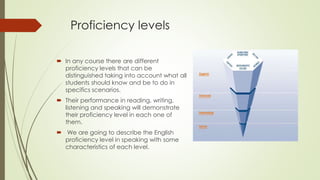
 In any course there are different
proficiency levels that can be
distinguished taking into account what all
students should know and be to do in
specifics scenarios.
 Their performance in reading, writing,
listening and speaking will demonstrate
their proficiency level in each one of
them.
 We are going to describe the English
proficiency level in speaking with some
characteristics of each level.
Proficiency levels
Level I (prefunctional - low)
 Students have little to zero understanding of
English.
 Does not yet produce speech
 They respond nonverbally to simple commands
and statements.
 Internalizes significant parts of information
 They begin to imitate the verbalizations of others
by using simple words or phrases
 Asks one or two word questions
 Initiates conversations by using single and easy
words
 Predominantly uses of memorized phrases
Level II Beginning
 Begins speaking in phrases and short
sentences
 Makes many errors of grammar and
syntax
 Uses language with lack of tense, number
and agreement
 Has little or no academic vocabulary
 Responds to questions usually with one or
two word answers
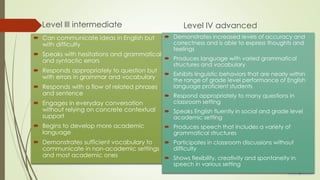
Level III intermediate
 Can communicate ideas in English but
with difficulty
 Speaks with hesitations and grammatical
and syntactic errors
 Responds appropriately to question but
with errors in grammar and vocabulary
 Responds with a flow of related phrases
and sentence
 Engages in everyday conversation
without relying on concrete contextual
support
 Begins to develop more academic
language
 Demonstrates sufficient vocabulary to
communicate in non-academic settings
and most academic ones
Level IV advanced
 Demonstrates increased levels of accuracy and
correctness and is able to express thoughts and
feelings
 Produces language with varied grammatical
structures and vocabulary
 Exhibits linguistic behaviors that are nearly within
the range of grade level performance of English
language proficient students
 Respond appropriately to many questions in
classroom setting
 Speaks English fluently in social and grade level
academic setting
 Produces speech that includes a variety of
grammatical structures
 Participates in classroom discussions without
difficulty
 Shows flexibility, creativity and spontaneity in
speech in various setting
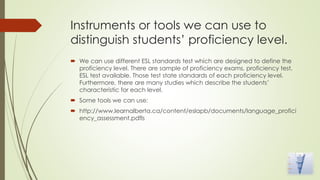
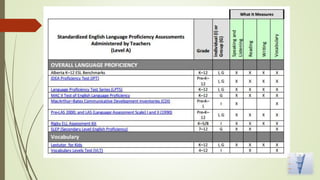
Instruments or tools we can use to
distinguish students’ proficiency level.
 We can use different ESL standards test which are designed to define the
proficiency level. There are sample of proficiency exams, proficiency test,
ESL test available. Those test state standards of each proficiency level.
Furthermore, there are many studies which describe the students’
characteristic for each level.
 Some tools we can use:
 http://www.learnalberta.ca/content/eslapb/documents/language_profici
ency_assessment.pdfls
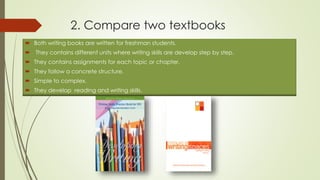
2. Compare two textbooks
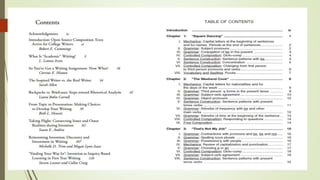
 Both writing books are written for freshman students.
 They contains different units where writing skills are develop step by step.
 They contains assignments for each topic or chapter.
 They follow a concrete structure.
 Simple to complex.
 They develop reading and writing skills.
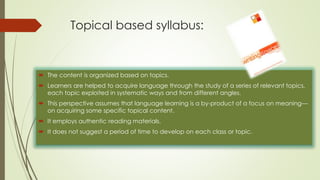
Topical based syllabus:
 The content is organized based on topics.
 Learners are helped to acquire language through the study of a series of relevant topics,
each topic exploited in systematic ways and from different angles.
 This perspective assumes that language learning is a by-product of a focus on meaning—
on acquiring some specific topical content.
 It employs authentic reading materials.
 It does not suggest a period of time to develop on each class or topic.
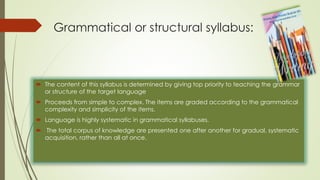
Grammatical or structural syllabus:
 The content of this syllabus is determined by giving top priority to teaching the grammar
or structure of the target language
 Proceeds from simple to complex. The items are graded according to the grammatical
complexity and simplicity of the items.
 Language is highly systematic in grammatical syllabuses.
 The total corpus of knowledge are presented one after another for gradual, systematic
acquisition, rather than all at once.
3. Approaches to syllabus design:
advantages and limitations
 A reading course: content based syllabus
 A speaking course: situational syllabus
 A writing course: task based syllabus
A reading course: content based syllabus
Advantages:
 It facilitates learning not merely through
language but with language
 When students are given multiple
opportunities to interact with authentic,
meaningful, and challenging material,
the result is better learning
 It helps students acquire the linguistic
and communicative skills
 Meaningful information leads to deeper
processing and better learning
 Content-based pedagogy promotes
synthesizing and evaluating.
 By selecting subject areas, the syllabus is
given a logic and coherence format.
Disadvantages:
 Subjective selection about what content is
best for the reading class.
 Balance between topics and text
 Standardized test fair to all students.
 Relation between a list of topics and items to
focus on.
A speaking course: situational syllabus
Advantages:
 This type of syllabus is more efficient and
more motivating because it hinges round
practical needs rather than abstract
analysis.
 It is a learner-centered syllabus, since it
takes account of the learner and his needs.
 It enables the learners to behave
appropriately in various social contexts.
 The Situational Syllabus offers guidelines for
organizing language teaching materials on
a relatively limited scope, yet it has proven
to be beneficial in several ways:
 It pays more attention to learners’ speaking
ability
Disadvantages:
 It is difficult to guarantee that one specific
situation will be useful in another.
 Thus determining the appropriate list of
situations for a general class is difficult.
 The Situational Syllabus may result in gaps in
learners’ grammatical knowledge.
 The Situational Syllabus does not provide us
with clearly defined criteria for the
sequencing of teaching items
 It is generally used as the component of a
Multi Syllabus rather than as the central
organizing principle for a general language
syllabus design.
 The situational syllabus cultural difference
may be a factor influencing the learner.
A writing course: task based syllabus
Advantages:
 It requires students to engage in interaction in order
to fulfill a task.
 When the students learn English, they have specific
things to do.
 During the process of performing the task students
develop the language.
 It has a high percentage of effectiveness.
 Structure can be learned when attention is focused
on meaning.
 They consider the process and activities of language
learning.
 The tasks which are designed according to input
data with precise goals that can be rearranged and
graded in various ways.
Disadvantages:
 The tasks must be adapted to the students
need, not too difficult and not too simple.
 The difficulty is really important to promote
positive effect.
 It is hard to find clear criteria for the selection
and grading of tasks.
 In task-based teaching, how can we deal
with language knowledge? Should grammar
be taught in it? The status of grammar is not
clear.
 Outcomes are not emphasized.
 It’s difficult to link classroom processes and
real-world communicative goals.
4.Examine two textbooks in a particular skill or
area what approach to the selection and
sequencing of content does each book
adopt?
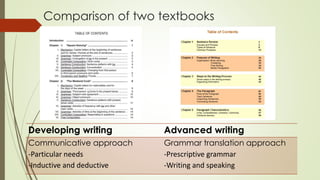
Comparison of two textbooks
Developing writing Advanced writing
Communicative approach
-Particular needs
-Inductive and deductive
Grammar translation approach
-Prescriptive grammar
-Writing and speaking
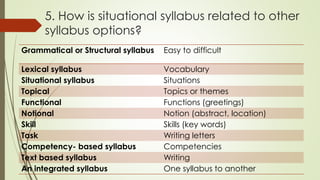
5. How is situational syllabus related to other
syllabus options?
Grammatical or Structural syllabus Easy to difficult
Lexical syllabus Vocabulary
Situational syllabus Situations
Topical Topics or themes
Functional Functions (greetings)
Notional Notion (abstract, location)
Skill Skills (key words)
Task Writing letters
Competency- based syllabus Competencies
Text based syllabus Writing
An integrated syllabus One syllabus to another
 It should be kept in mind that the question is not which
type to choose but which types and how to connect
them with each other” (Mohseni, 2008).
6. Basic English Grammar
For English Language Learners
By
Anne Seaton Y. H. Mew
VS
Understanding and Using English
Grammar
By
Betty Schrampfer Azar
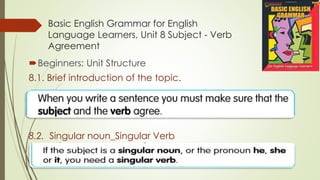
Basic English Grammar for English
Language Learners, Unit 8 Subject - Verb
Agreement
Beginners: Unit Structure
8.1. Brief introduction of the topic.
8.2. Singular noun_Singular Verb
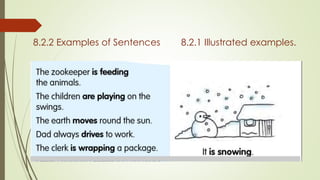
8.2.2 Examples of Sentences 8.2.1 Illustrated examples.
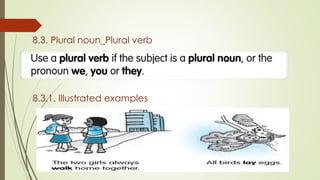
8.3. Plural noun_Plural verb
8.3.1. Illustrated examples
8.3.2 Examples of sentences
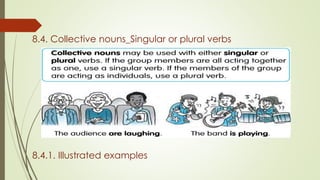
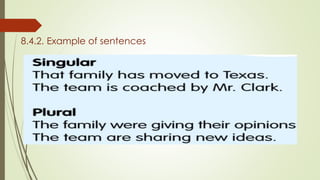
8.4. Collective nouns_Singular or plural verbs
8.4.1. Illustrated examples
8.4.2. Example of sentences
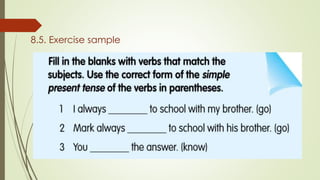
8.5. Exercise sample
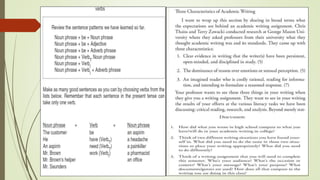
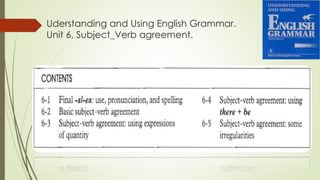
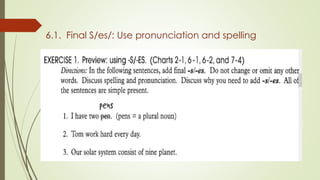
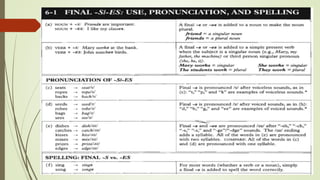
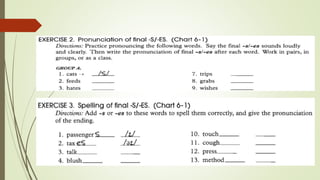
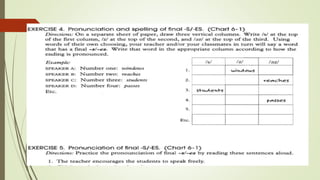
Uderstanding and Using English Grammar.
Unit 6, Subject_Verb agreement.
6.1. Final S/es/: Use pronunciation and spelling
7. Unit Elaboration
Advanced English Course: Conversation
Lesson 1. Today´s Technology
1. Watch the following video and discuss with your partners about the
importance of technology in people´s lives according to the video.
2. Useful phrases for debating about technology
I agree with you but…
I don´t agree with you because…
I see your point but…
I don´t get what you are saying…
Etc….
2.1. Activity
Debate. Prepare a debate based on
the advantages and disadvantages
of using technology
Activity 2 . Video clip.
 Record a short video presenting and explaining your own idea
of a technological invention launched this coming year.
3. Modal Auxiliaries
Will, would, could, can, may, might, and so forth.
I would love to buy that incredible phone.
She will learn about electronic device pretty soon.
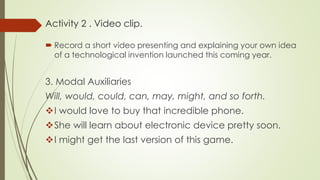
I might get the last version of this game.
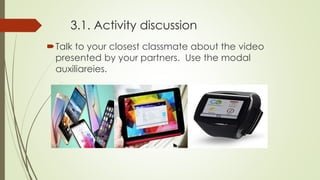
3.1. Activity discussion
Talk to your closest classmate about the video
presented by your partners. Use the modal
auxiliareies.
Assessment
 Oral presentation: Each students will be asked to choose
a technological item and explain its:
Uses
Characteristics
Function
Advantages
Disadvantages
 Recorded video

MA Group assignment Adames Guevara Palacio

  • 1.
    GROUP ASSIGNMENT By: IriceniaGuevara Jose Adames Zuleima Palacio
  • 2.
    1. How aredifferent proficiency levels characterized and distinguished in a Course or program you are familiar with?
  • 3.
    Proficiency levels  Inany course there are different proficiency levels that can be distinguished taking into account what all students should know and be to do in specifics scenarios.  Their performance in reading, writing, listening and speaking will demonstrate their proficiency level in each one of them.  We are going to describe the English proficiency level in speaking with some characteristics of each level.
  • 4.
    Proficiency levels Level I(prefunctional - low)  Students have little to zero understanding of English.  Does not yet produce speech  They respond nonverbally to simple commands and statements.  Internalizes significant parts of information  They begin to imitate the verbalizations of others by using simple words or phrases  Asks one or two word questions  Initiates conversations by using single and easy words  Predominantly uses of memorized phrases Level II Beginning  Begins speaking in phrases and short sentences  Makes many errors of grammar and syntax  Uses language with lack of tense, number and agreement  Has little or no academic vocabulary  Responds to questions usually with one or two word answers
  • 5.
    Level III intermediate Can communicate ideas in English but with difficulty  Speaks with hesitations and grammatical and syntactic errors  Responds appropriately to question but with errors in grammar and vocabulary  Responds with a flow of related phrases and sentence  Engages in everyday conversation without relying on concrete contextual support  Begins to develop more academic language  Demonstrates sufficient vocabulary to communicate in non-academic settings and most academic ones Level IV advanced  Demonstrates increased levels of accuracy and correctness and is able to express thoughts and feelings  Produces language with varied grammatical structures and vocabulary  Exhibits linguistic behaviors that are nearly within the range of grade level performance of English language proficient students  Respond appropriately to many questions in classroom setting  Speaks English fluently in social and grade level academic setting  Produces speech that includes a variety of grammatical structures  Participates in classroom discussions without difficulty  Shows flexibility, creativity and spontaneity in speech in various setting
  • 6.
    Instruments or toolswe can use to distinguish students’ proficiency level.  We can use different ESL standards test which are designed to define the proficiency level. There are sample of proficiency exams, proficiency test, ESL test available. Those test state standards of each proficiency level. Furthermore, there are many studies which describe the students’ characteristic for each level.  Some tools we can use:  http://www.learnalberta.ca/content/eslapb/documents/language_profici ency_assessment.pdfls
  • 8.
    2. Compare twotextbooks  Both writing books are written for freshman students.  They contains different units where writing skills are develop step by step.  They contains assignments for each topic or chapter.  They follow a concrete structure.  Simple to complex.  They develop reading and writing skills.
  • 11.
    Topical based syllabus: The content is organized based on topics.  Learners are helped to acquire language through the study of a series of relevant topics, each topic exploited in systematic ways and from different angles.  This perspective assumes that language learning is a by-product of a focus on meaning— on acquiring some specific topical content.  It employs authentic reading materials.  It does not suggest a period of time to develop on each class or topic.
  • 12.
    Grammatical or structuralsyllabus:  The content of this syllabus is determined by giving top priority to teaching the grammar or structure of the target language  Proceeds from simple to complex. The items are graded according to the grammatical complexity and simplicity of the items.  Language is highly systematic in grammatical syllabuses.  The total corpus of knowledge are presented one after another for gradual, systematic acquisition, rather than all at once.
  • 13.
    3. Approaches tosyllabus design: advantages and limitations  A reading course: content based syllabus  A speaking course: situational syllabus  A writing course: task based syllabus
  • 14.
    A reading course:content based syllabus Advantages:  It facilitates learning not merely through language but with language  When students are given multiple opportunities to interact with authentic, meaningful, and challenging material, the result is better learning  It helps students acquire the linguistic and communicative skills  Meaningful information leads to deeper processing and better learning  Content-based pedagogy promotes synthesizing and evaluating.  By selecting subject areas, the syllabus is given a logic and coherence format. Disadvantages:  Subjective selection about what content is best for the reading class.  Balance between topics and text  Standardized test fair to all students.  Relation between a list of topics and items to focus on.
  • 15.
    A speaking course:situational syllabus Advantages:  This type of syllabus is more efficient and more motivating because it hinges round practical needs rather than abstract analysis.  It is a learner-centered syllabus, since it takes account of the learner and his needs.  It enables the learners to behave appropriately in various social contexts.  The Situational Syllabus offers guidelines for organizing language teaching materials on a relatively limited scope, yet it has proven to be beneficial in several ways:  It pays more attention to learners’ speaking ability Disadvantages:  It is difficult to guarantee that one specific situation will be useful in another.  Thus determining the appropriate list of situations for a general class is difficult.  The Situational Syllabus may result in gaps in learners’ grammatical knowledge.  The Situational Syllabus does not provide us with clearly defined criteria for the sequencing of teaching items  It is generally used as the component of a Multi Syllabus rather than as the central organizing principle for a general language syllabus design.  The situational syllabus cultural difference may be a factor influencing the learner.
  • 16.
    A writing course:task based syllabus Advantages:  It requires students to engage in interaction in order to fulfill a task.  When the students learn English, they have specific things to do.  During the process of performing the task students develop the language.  It has a high percentage of effectiveness.  Structure can be learned when attention is focused on meaning.  They consider the process and activities of language learning.  The tasks which are designed according to input data with precise goals that can be rearranged and graded in various ways. Disadvantages:  The tasks must be adapted to the students need, not too difficult and not too simple.  The difficulty is really important to promote positive effect.  It is hard to find clear criteria for the selection and grading of tasks.  In task-based teaching, how can we deal with language knowledge? Should grammar be taught in it? The status of grammar is not clear.  Outcomes are not emphasized.  It’s difficult to link classroom processes and real-world communicative goals.
  • 17.
    4.Examine two textbooksin a particular skill or area what approach to the selection and sequencing of content does each book adopt?
  • 18.
    Comparison of twotextbooks Developing writing Advanced writing Communicative approach -Particular needs -Inductive and deductive Grammar translation approach -Prescriptive grammar -Writing and speaking
  • 19.
    5. How issituational syllabus related to other syllabus options? Grammatical or Structural syllabus Easy to difficult Lexical syllabus Vocabulary Situational syllabus Situations Topical Topics or themes Functional Functions (greetings) Notional Notion (abstract, location) Skill Skills (key words) Task Writing letters Competency- based syllabus Competencies Text based syllabus Writing An integrated syllabus One syllabus to another
  • 20.
     It shouldbe kept in mind that the question is not which type to choose but which types and how to connect them with each other” (Mohseni, 2008).
  • 21.
    6. Basic EnglishGrammar For English Language Learners By Anne Seaton Y. H. Mew VS Understanding and Using English Grammar By Betty Schrampfer Azar
  • 22.
    Basic English Grammarfor English Language Learners, Unit 8 Subject - Verb Agreement Beginners: Unit Structure 8.1. Brief introduction of the topic. 8.2. Singular noun_Singular Verb
  • 23.
    8.2.2 Examples ofSentences 8.2.1 Illustrated examples.
  • 24.
    8.3. Plural noun_Pluralverb 8.3.1. Illustrated examples
  • 25.
  • 26.
    8.4. Collective nouns_Singularor plural verbs 8.4.1. Illustrated examples
  • 27.
  • 28.
  • 29.
    Uderstanding and UsingEnglish Grammar. Unit 6, Subject_Verb agreement.
  • 30.
    6.1. Final S/es/:Use pronunciation and spelling
  • 34.
    7. Unit Elaboration AdvancedEnglish Course: Conversation
  • 35.
    Lesson 1. Today´sTechnology 1. Watch the following video and discuss with your partners about the importance of technology in people´s lives according to the video.
  • 36.
    2. Useful phrasesfor debating about technology I agree with you but… I don´t agree with you because… I see your point but… I don´t get what you are saying… Etc…. 2.1. Activity Debate. Prepare a debate based on the advantages and disadvantages of using technology
  • 37.
    Activity 2 .Video clip.  Record a short video presenting and explaining your own idea of a technological invention launched this coming year. 3. Modal Auxiliaries Will, would, could, can, may, might, and so forth. I would love to buy that incredible phone. She will learn about electronic device pretty soon. I might get the last version of this game.
  • 38.
    3.1. Activity discussion Talkto your closest classmate about the video presented by your partners. Use the modal auxiliareies.
  • 39.
    Assessment  Oral presentation:Each students will be asked to choose a technological item and explain its: Uses Characteristics Function Advantages Disadvantages  Recorded video