{ MatchingTest Items
In general, matching items consist
of a column of stimuli presented on the
left side of the exam page and a column
of responses placed on the right side of
the page.
Students are required to match the
response associated with a given
stimulus.
Directions: On the line to the left of each
factual statement, write the letter of the
principle which best explains the statement’s
occurrence. Each principle may be used more
than once.
Example:
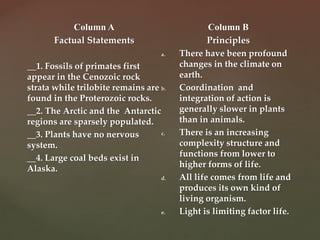
Column A
Factual Statements
__1. Fossils of primates first
appear in the Cenozoic rock
strata while trilobite remains are
found in the Proterozoic rocks.
__2. The Arctic and the Antarctic
regions are sparsely populated.
__3. Plants have no nervous
system.
__4. Large coal beds exist in
Alaska.
Column B
Principles
a. There have been profound
changes in the climate on
earth.
b. Coordination and
integration of action is
generally slower in plants
than in animals.
c. There is an increasing
complexity structure and
functions from lower to
higher forms of life.
d. All life comes from life and
produces its own kind of
living organism.
e. Light is limiting factor life.
In matching items, a good practice is
to switch to the matching format only
when it becomes apparent that the same
alternatives are being repeated in several
multiple choice items.
Which test item is least useful for educational diagnosis?
a. True-false item*
b. Short-answer item
c. Multiple choice item
Which test item provides the highest score by guessing?
a. True-false item*
b. Short-answer item
c. Multiple choice item
Which test item is difficult to score objectively?
a. True-false item
b. Short-answer item*
c. Multiple choice item
Which test item measures the greatest variety of learning outcomes?
a. True-false item
b. Short-answer item
c. Multiple choice item*
Examples:
1. Require short period of reading and
response time, allowing the teacher to
cover more content.
2. Provide objective measurement of student
achievement or ability.
3. Provide highly reliable test score.
4. Provide scoring efficiency and accuracy.
Advantages of Using
Matching Test Items
1. Have difficulty measuring learning objectives
requiring more than simple recall of
information.
2. Are difficult to construct due to the problem of
selecting a common set of stimuli and responses.
Disadvantages of Using Matching
Test Items
1. Include directions which clearly state the basis
for matching the stimuli with the responses.
Explain whether or not a response can be used
more than once and indicate where to write the
answer.
Poor: Directions: Match the following:
Better: Directions: On the line to the left of each
identifying location and characteristics in Column
I, write the letter of the country in column II that is
best defined. Each country in column II may be
used more than once.
Suggestions for Writing
Matching Test Items
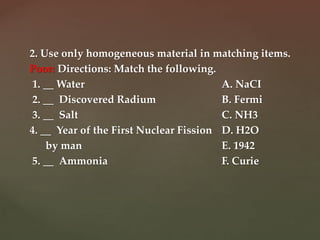
2. Use only homogeneous material in matching items.
Poor: Directions: Match the following.
1. __ Water A. NaCI
2. __ Discovered Radium B. Fermi
3. __ Salt C. NH3
4. __ Year of the First Nuclear Fission D. H2O
by man E. 1942
5. __ Ammonia F. Curie
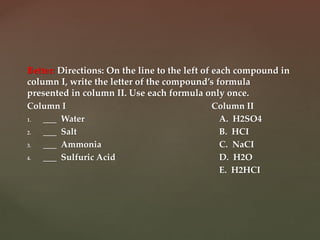
Better: Directions: On the line to the left of each compound in
column I, write the letter of the compound’s formula
presented in column II. Use each formula only once.
Column I Column II
1. ___ Water A. H2SO4
2. ___ Salt B. HCI
3. ___ Ammonia C. NaCI
4. ___ Sulfuric Acid D. H2O
E. H2HCI
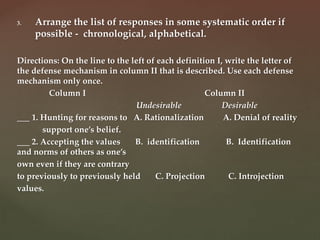
3. Arrange the list of responses in some systematic order if
possible - chronological, alphabetical.
Directions: On the line to the left of each definition I, write the letter of
the defense mechanism in column II that is described. Use each defense
mechanism only once.
Column I Column II
Undesirable Desirable
___ 1. Hunting for reasons to A. Rationalization A. Denial of reality
support one’s belief.
___ 2. Accepting the values B. identification B. Identification
and norms of others as one’s
own even if they are contrary
to previously to previously held C. Projection C. Introjection
values.
___ 3. Attributing to other’s D. Introjection D. Projection own
unacceptable impulses
thoughts and desires.
___ 4. Ignoring disagreeable E. Denial of realty E. Rationalization
situations, thoughts
and desires.
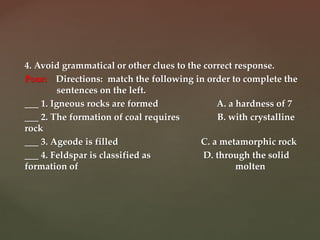
4. Avoid grammatical or other clues to the correct response.
Poor: Directions: match the following in order to complete the
sentences on the left.
___ 1. Igneous rocks are formed A. a hardness of 7
___ 2. The formation of coal requires B. with crystalline
rock
___ 3. Ageode is filled C. a metamorphic rock
___ 4. Feldspar is classified as D. through the solid
formation of molten
Better: Avoid sentence completion due to grammatical clues.
Note:
1. Keep matching items brief, limiting the list of stimuli
to under 10.
2. Include more responses than stimuli to help prevent
answering through the process of elimination.
. 3. When possible, reduce the amount of reading time by
including only
short phrases or single words in the response list.

Matching test items

  • 1.
  • 2.
    In general, matchingitems consist of a column of stimuli presented on the left side of the exam page and a column of responses placed on the right side of the page. Students are required to match the response associated with a given stimulus.
  • 3.
    Directions: On theline to the left of each factual statement, write the letter of the principle which best explains the statement’s occurrence. Each principle may be used more than once. Example:
  • 4.
    Column A Factual Statements __1.Fossils of primates first appear in the Cenozoic rock strata while trilobite remains are found in the Proterozoic rocks. __2. The Arctic and the Antarctic regions are sparsely populated. __3. Plants have no nervous system. __4. Large coal beds exist in Alaska. Column B Principles a. There have been profound changes in the climate on earth. b. Coordination and integration of action is generally slower in plants than in animals. c. There is an increasing complexity structure and functions from lower to higher forms of life. d. All life comes from life and produces its own kind of living organism. e. Light is limiting factor life.
  • 5.
    In matching items,a good practice is to switch to the matching format only when it becomes apparent that the same alternatives are being repeated in several multiple choice items.
  • 6.
    Which test itemis least useful for educational diagnosis? a. True-false item* b. Short-answer item c. Multiple choice item Which test item provides the highest score by guessing? a. True-false item* b. Short-answer item c. Multiple choice item Which test item is difficult to score objectively? a. True-false item b. Short-answer item* c. Multiple choice item Which test item measures the greatest variety of learning outcomes? a. True-false item b. Short-answer item c. Multiple choice item* Examples:
  • 7.
    1. Require shortperiod of reading and response time, allowing the teacher to cover more content. 2. Provide objective measurement of student achievement or ability. 3. Provide highly reliable test score. 4. Provide scoring efficiency and accuracy. Advantages of Using Matching Test Items
  • 8.
    1. Have difficultymeasuring learning objectives requiring more than simple recall of information. 2. Are difficult to construct due to the problem of selecting a common set of stimuli and responses. Disadvantages of Using Matching Test Items
  • 9.
    1. Include directionswhich clearly state the basis for matching the stimuli with the responses. Explain whether or not a response can be used more than once and indicate where to write the answer. Poor: Directions: Match the following: Better: Directions: On the line to the left of each identifying location and characteristics in Column I, write the letter of the country in column II that is best defined. Each country in column II may be used more than once. Suggestions for Writing Matching Test Items
  • 10.
    2. Use onlyhomogeneous material in matching items. Poor: Directions: Match the following. 1. __ Water A. NaCI 2. __ Discovered Radium B. Fermi 3. __ Salt C. NH3 4. __ Year of the First Nuclear Fission D. H2O by man E. 1942 5. __ Ammonia F. Curie
  • 11.
    Better: Directions: Onthe line to the left of each compound in column I, write the letter of the compound’s formula presented in column II. Use each formula only once. Column I Column II 1. ___ Water A. H2SO4 2. ___ Salt B. HCI 3. ___ Ammonia C. NaCI 4. ___ Sulfuric Acid D. H2O E. H2HCI
  • 12.
    3. Arrange thelist of responses in some systematic order if possible - chronological, alphabetical. Directions: On the line to the left of each definition I, write the letter of the defense mechanism in column II that is described. Use each defense mechanism only once. Column I Column II Undesirable Desirable ___ 1. Hunting for reasons to A. Rationalization A. Denial of reality support one’s belief. ___ 2. Accepting the values B. identification B. Identification and norms of others as one’s own even if they are contrary to previously to previously held C. Projection C. Introjection values.
  • 13.
    ___ 3. Attributingto other’s D. Introjection D. Projection own unacceptable impulses thoughts and desires. ___ 4. Ignoring disagreeable E. Denial of realty E. Rationalization situations, thoughts and desires.
  • 14.
    4. Avoid grammaticalor other clues to the correct response. Poor: Directions: match the following in order to complete the sentences on the left. ___ 1. Igneous rocks are formed A. a hardness of 7 ___ 2. The formation of coal requires B. with crystalline rock ___ 3. Ageode is filled C. a metamorphic rock ___ 4. Feldspar is classified as D. through the solid formation of molten
  • 15.
    Better: Avoid sentencecompletion due to grammatical clues. Note: 1. Keep matching items brief, limiting the list of stimuli to under 10. 2. Include more responses than stimuli to help prevent answering through the process of elimination. . 3. When possible, reduce the amount of reading time by including only short phrases or single words in the response list.