MODULE 4
 Development of
Assessment Tools
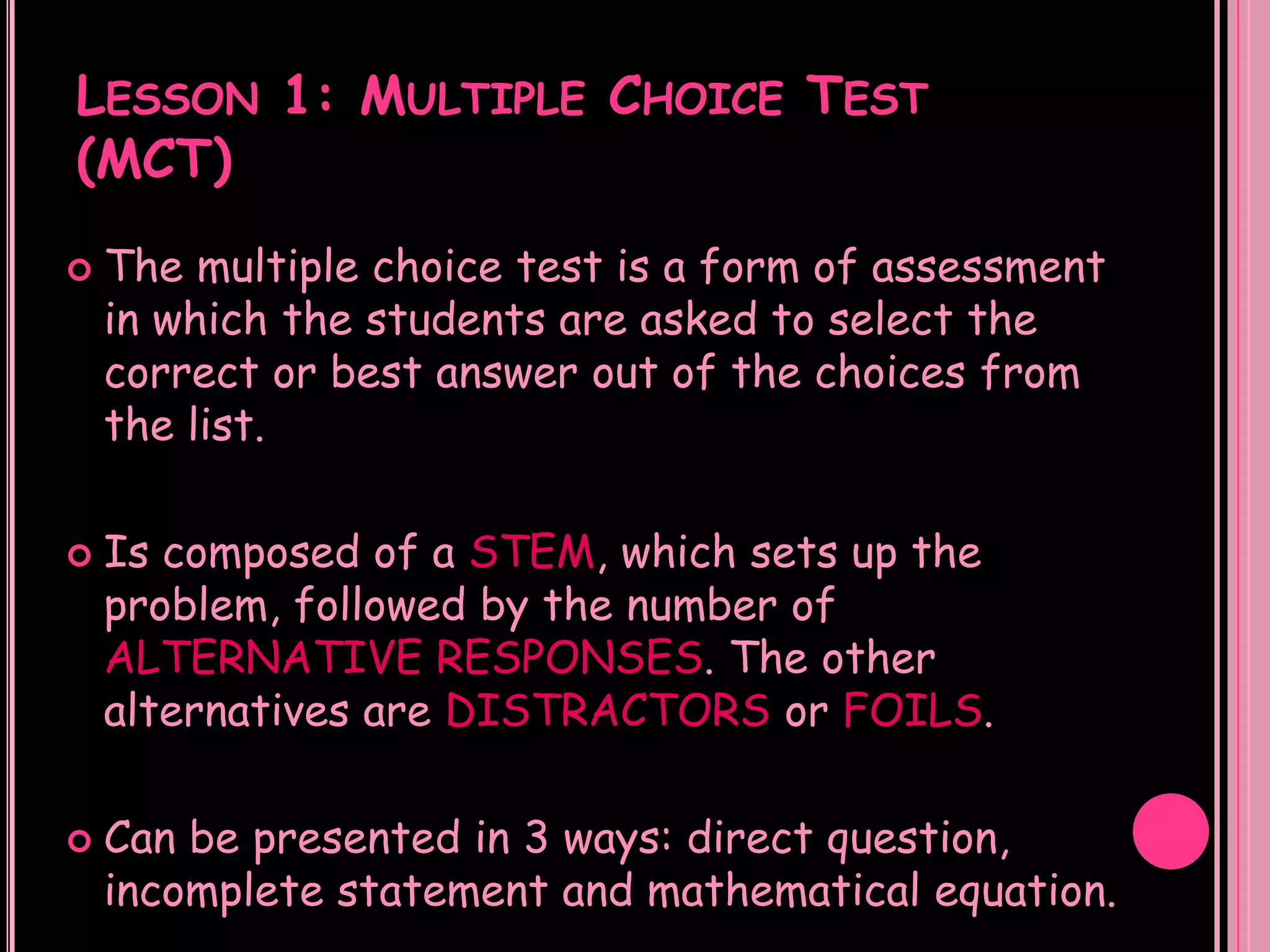
LESSON 1: MULTIPLE CHOICE TEST
(MCT)
   The multiple choice test is a form of assessment
    in which the students are asked to select the
    correct or best answer out of the choices from
    the list.

   Is composed of a STEM, which sets up the
    problem, followed by the number of
    ALTERNATIVE RESPONSES. The other
    alternatives are DISTRACTORS or FOILS.

   Can be presented in 3 ways: direct question,
    incomplete statement and mathematical equation.
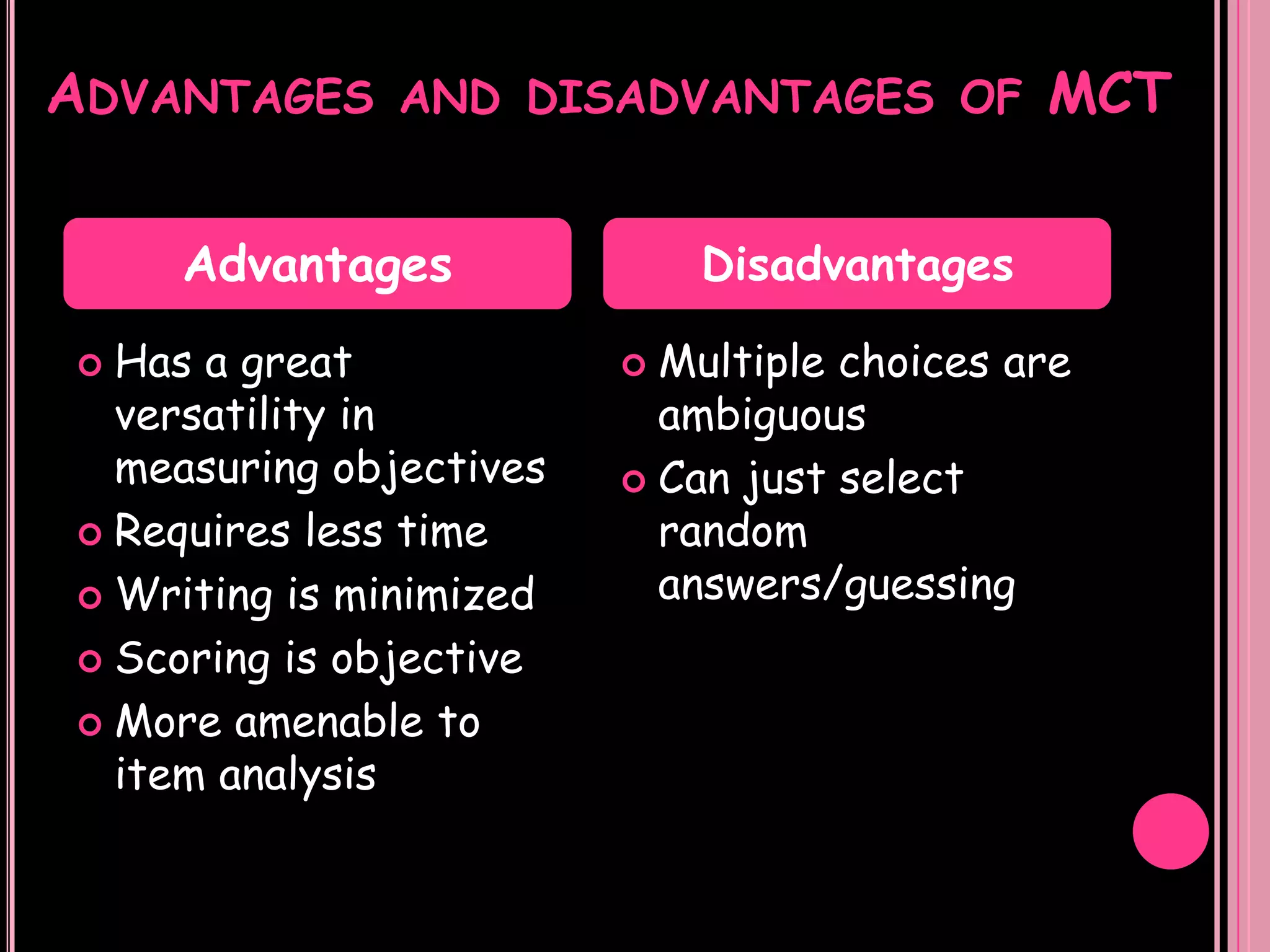
ADVANTAGES     AND DISADVANTAGES OF          MCT

    Advantages               Disadvantages

 Has a great             Multiple choices are
  versatility in           ambiguous
  measuring objectives    Can just select
 Requires less time       random
 Writing is minimized     answers/guessing
 Scoring is objective

 More amenable to
  item analysis
REFERENCES:


   Reganit, Arnulfo, Elicay, Ronaldo, & Laguerta,
    Cresencial (2010). Assessment of Student
    Learning 1 (Cognitive Learning). C & E Publishing,
    Inc.

   Garcia, Carlito D. (2008). Measuring & Evaluating
    Educational Outcomes. Books atbp. Publishing
    Corp., Mandaluyong
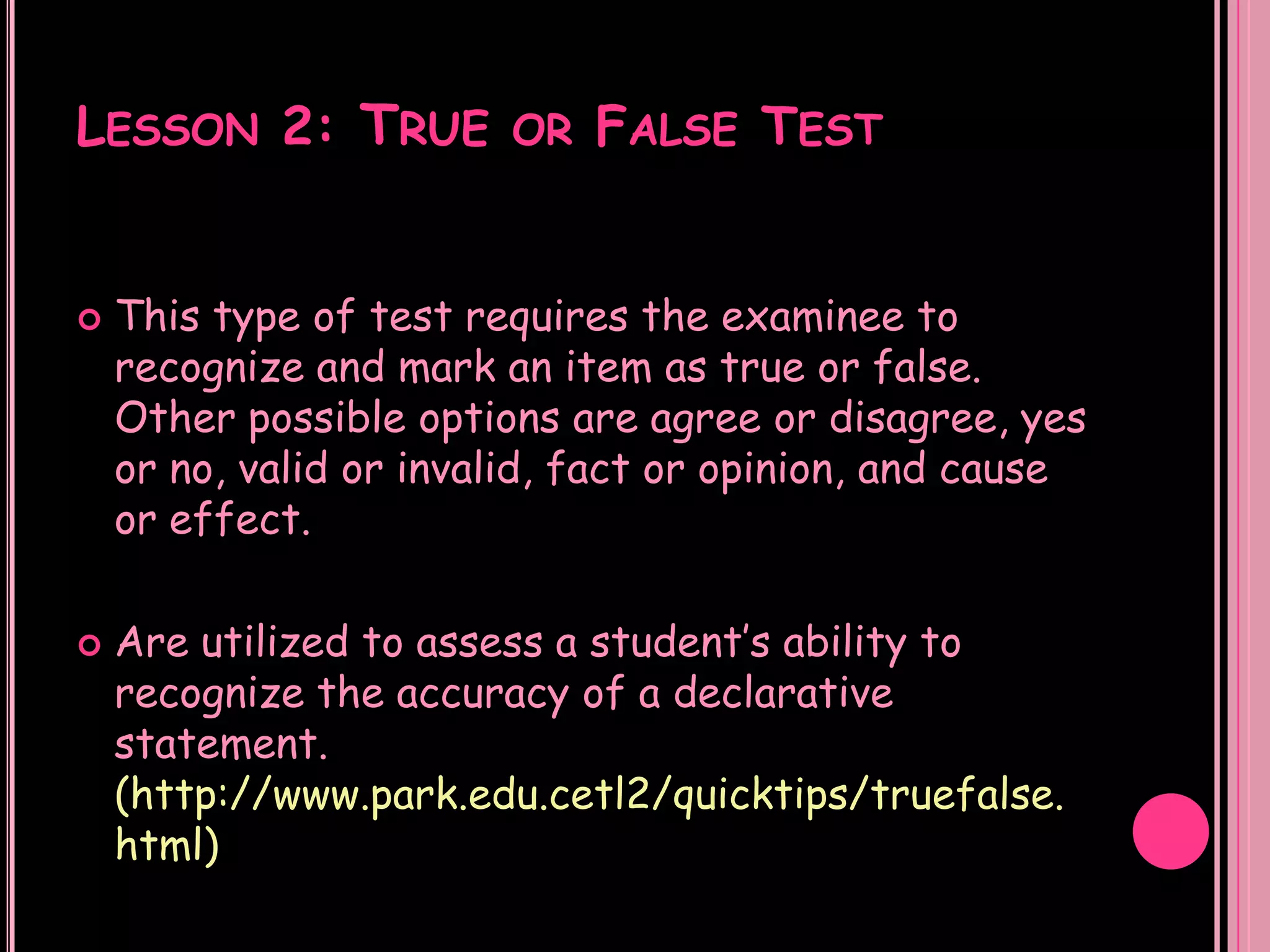
LESSON 2: TRUE OR FALSE TEST


   This type of test requires the examinee to
    recognize and mark an item as true or false.
    Other possible options are agree or disagree, yes
    or no, valid or invalid, fact or opinion, and cause
    or effect.

   Are utilized to assess a student’s ability to
    recognize the accuracy of a declarative
    statement.
    (http://www.park.edu.cetl2/quicktips/truefalse.
    html)
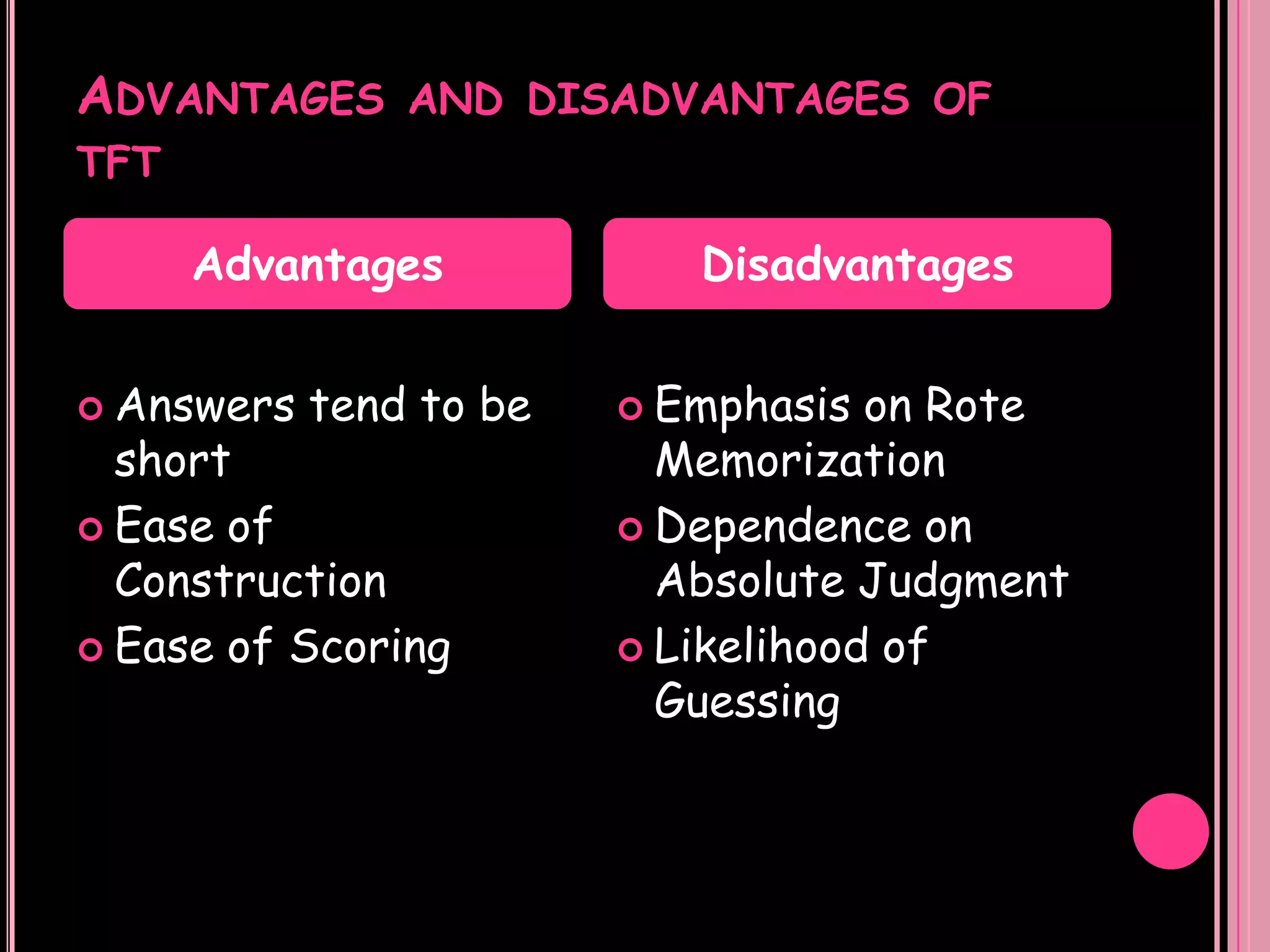
ADVANTAGES AND DISADVANTAGES OF
TFT

      Advantages            Disadvantages


 Answers   tend to be    Emphasis  on Rote
  short                    Memorization
 Ease of                 Dependence on
  Construction             Absolute Judgment
 Ease of Scoring         Likelihood of
                           Guessing
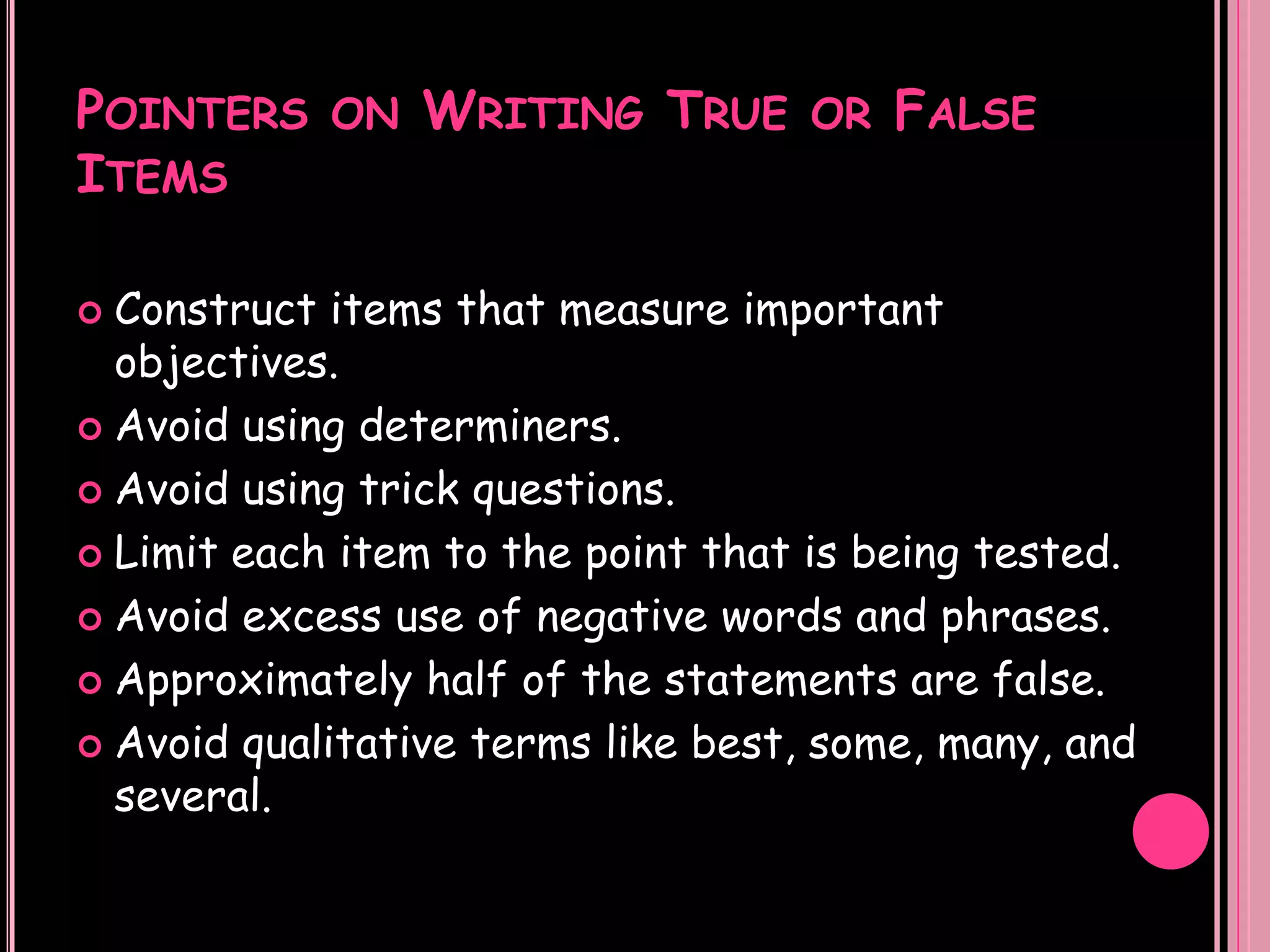
POINTERS ON WRITING TRUE OR FALSE
ITEMS

 Construct items that measure important
  objectives.
 Avoid using determiners.

 Avoid using trick questions.

 Limit each item to the point that is being tested.

 Avoid excess use of negative words and phrases.

 Approximately half of the statements are false.

 Avoid qualitative terms like best, some, many, and
  several.
LESSON 3: MATCHING-TYPE TEST
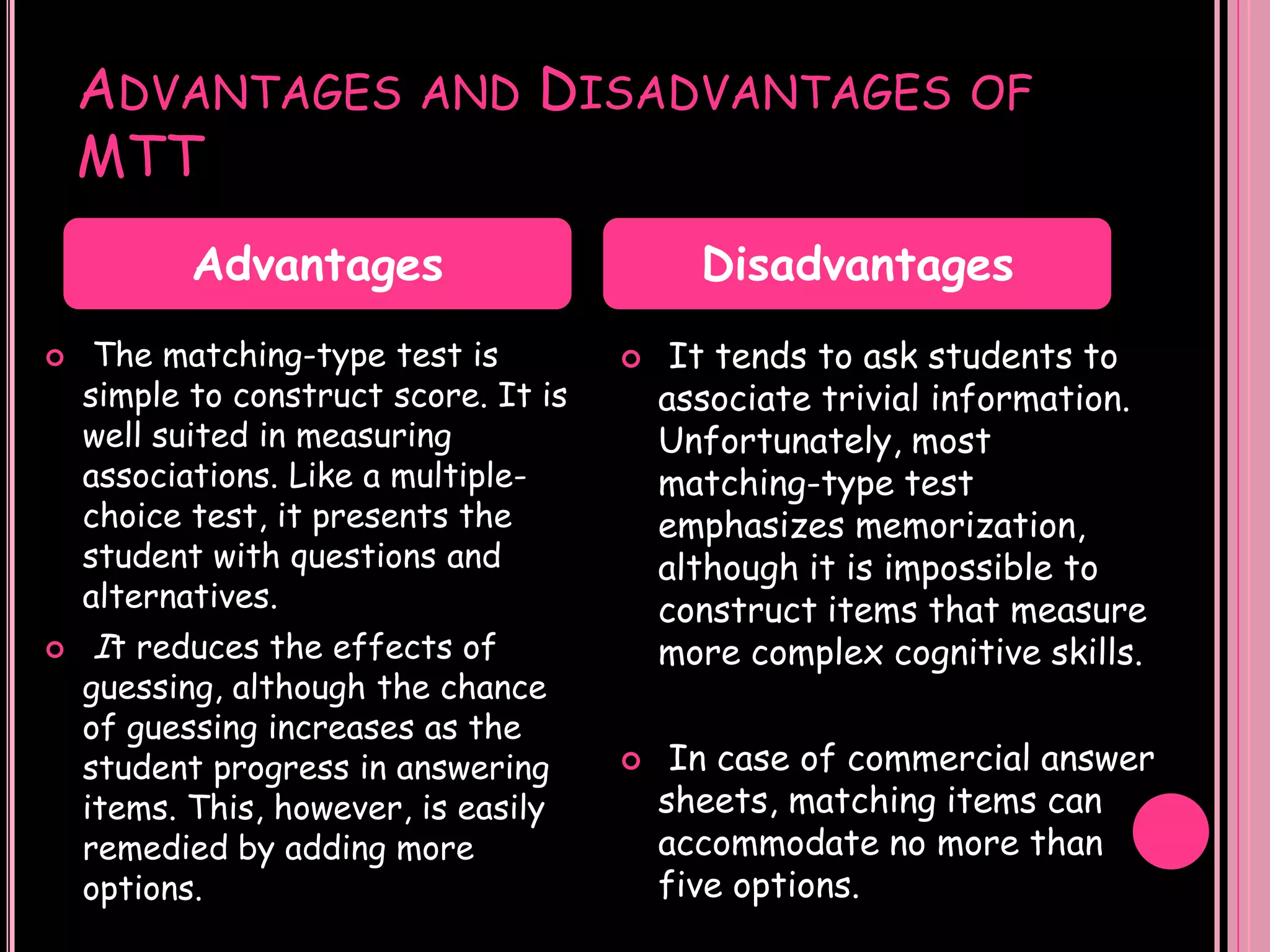
ADVANTAGES            AND     DISADVANTAGES               OF
    MTT
           Advantages                        Disadvantages
    The matching-type test is             It tends to ask students to
    simple to construct score. It is       associate trivial information.
    well suited in measuring               Unfortunately, most
    associations. Like a multiple-         matching-type test
    choice test, it presents the           emphasizes memorization,
    student with questions and             although it is impossible to
    alternatives.                          construct items that measure
   It reduces the effects of              more complex cognitive skills.
    guessing, although the chance
    of guessing increases as the
    student progress in answering          In case of commercial answer
    items. This, however, is easily        sheets, matching items can
    remedied by adding more                accommodate no more than
    options.                               five options.
POINTERS ON WRITING MATCHING-TYPE TESTS

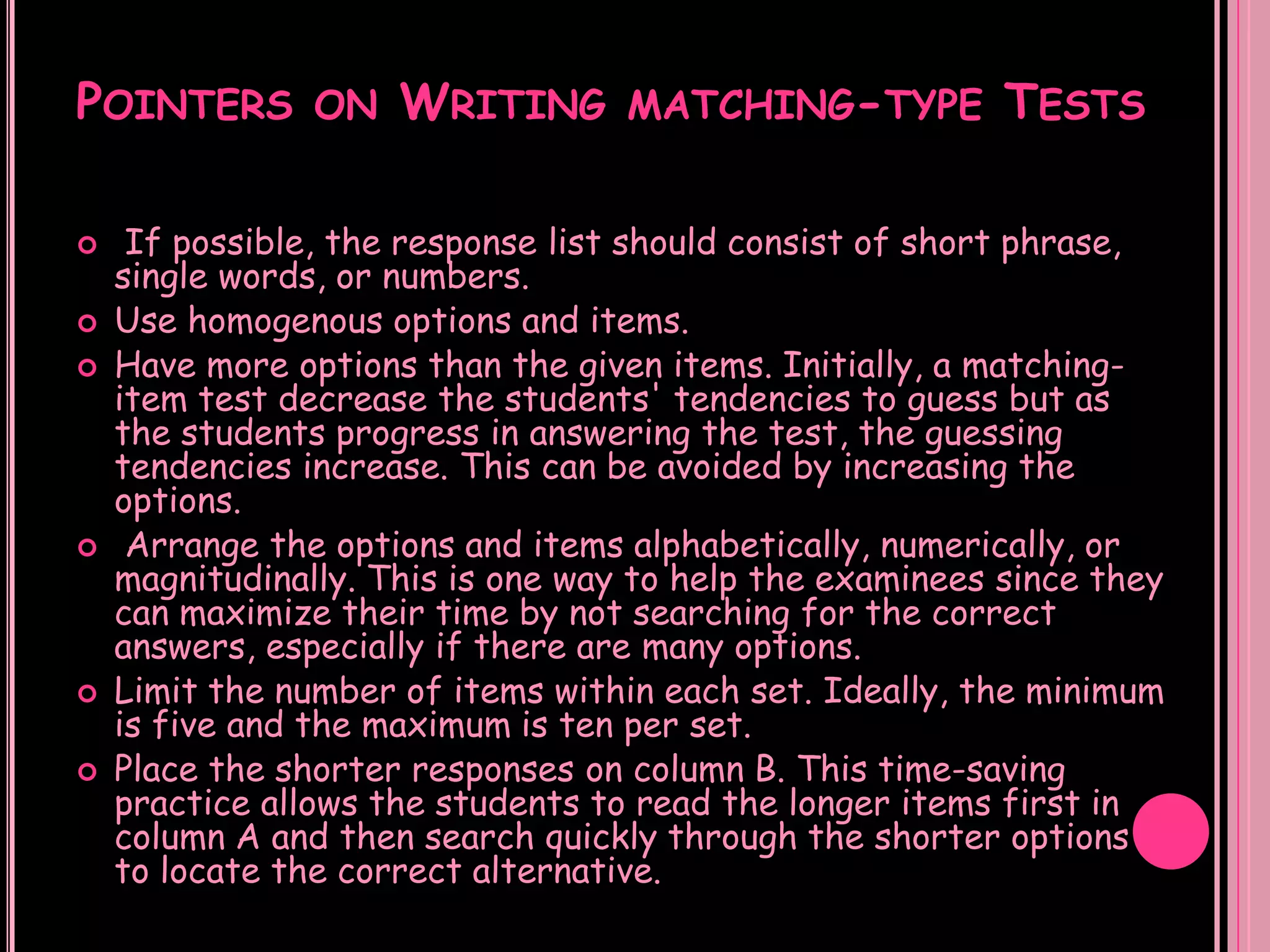
    If possible, the response list should consist of short phrase,
    single words, or numbers.
   Use homogenous options and items.
   Have more options than the given items. Initially, a matching-
    item test decrease the students' tendencies to guess but as
    the students progress in answering the test, the guessing
    tendencies increase. This can be avoided by increasing the
    options.
    Arrange the options and items alphabetically, numerically, or
    magnitudinally. This is one way to help the examinees since they
    can maximize their time by not searching for the correct
    answers, especially if there are many options.
   Limit the number of items within each set. Ideally, the minimum
    is five and the maximum is ten per set.
   Place the shorter responses on column B. This time-saving
    practice allows the students to read the longer items first in
    column A and then search quickly through the shorter options
    to locate the correct alternative.
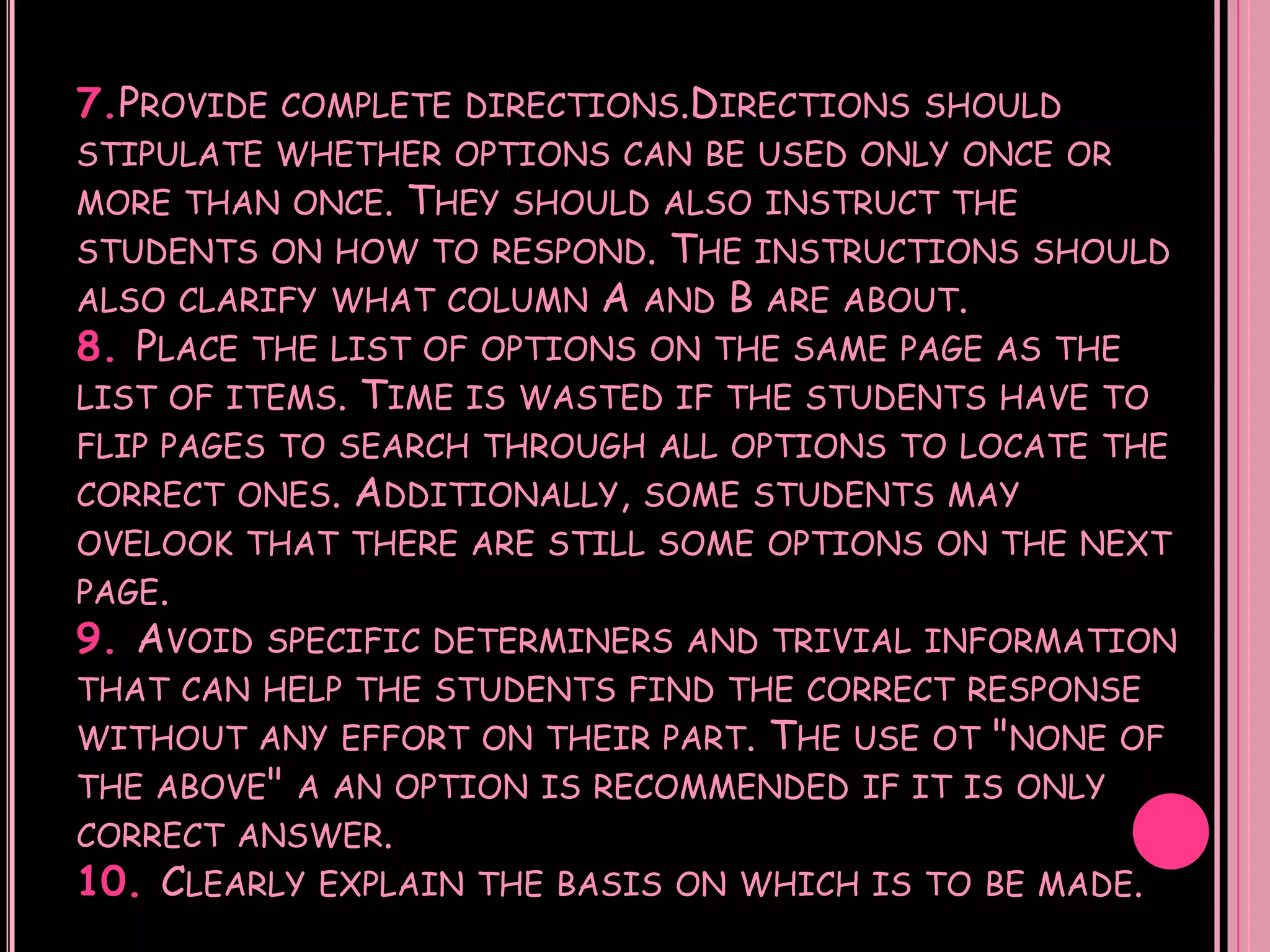
7.PROVIDE   COMPLETE DIRECTIONS.DIRECTIONS SHOULD
STIPULATE WHETHER OPTIONS CAN BE USED ONLY ONCE OR
MORE THAN ONCE.  THEY SHOULD ALSO INSTRUCT THE
STUDENTS ON HOW TO RESPOND. THE INSTRUCTIONS SHOULD
ALSO CLARIFY WHAT COLUMN A AND B ARE ABOUT.
8. PLACE THE LIST OF OPTIONS ON THE SAME PAGE AS THE
LIST OF ITEMS. TIME IS WASTED IF THE STUDENTS HAVE TO
FLIP PAGES TO SEARCH THROUGH ALL OPTIONS TO LOCATE THE
CORRECT ONES.   ADDITIONALLY,   SOME STUDENTS MAY
OVELOOK THAT THERE ARE STILL SOME OPTIONS ON THE NEXT
PAGE.
9. AVOID   SPECIFIC DETERMINERS AND TRIVIAL INFORMATION
THAT CAN HELP THE STUDENTS FIND THE CORRECT RESPONSE
WITHOUT ANY EFFORT ON THEIR PART.    THE USE OT "NONE   OF
THE ABOVE" A AN OPTION IS RECOMMENDED IF IT IS ONLY
CORRECT ANSWER.
10. CLEARLY   EXPLAIN THE BASIS ON WHICH IS TO BE MADE.
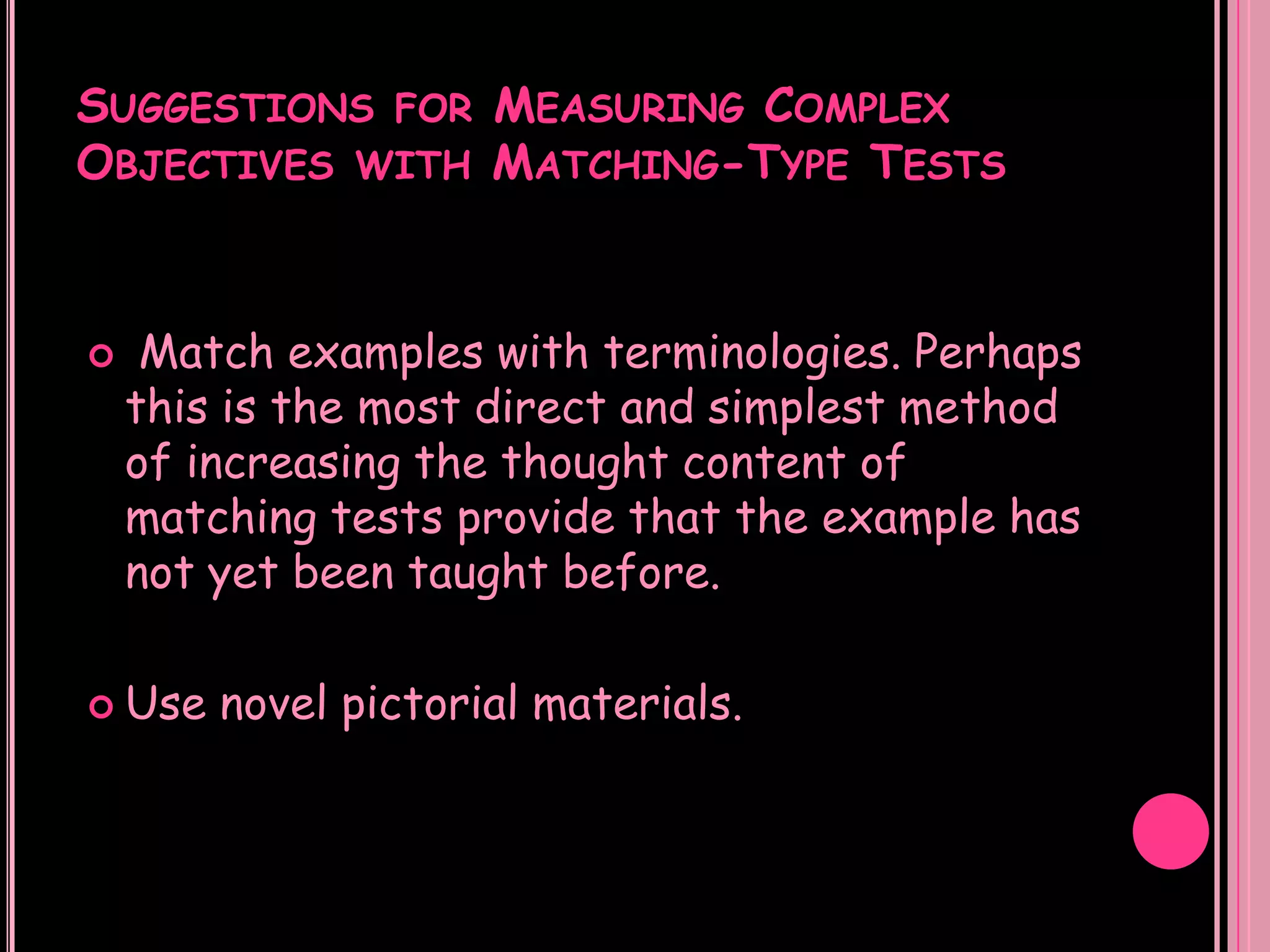
SUGGESTIONS FOR MEASURING COMPLEX
OBJECTIVES WITH MATCHING-TYPE TESTS


    Match examples with terminologies. Perhaps
    this is the most direct and simplest method
    of increasing the thought content of
    matching tests provide that the example has
    not yet been taught before.

 Use   novel pictorial materials.
LESSON 4: COMPLETION TEST


Acompletion test is a format of
testing that requires the
students to complete with the
correct word or phrase.
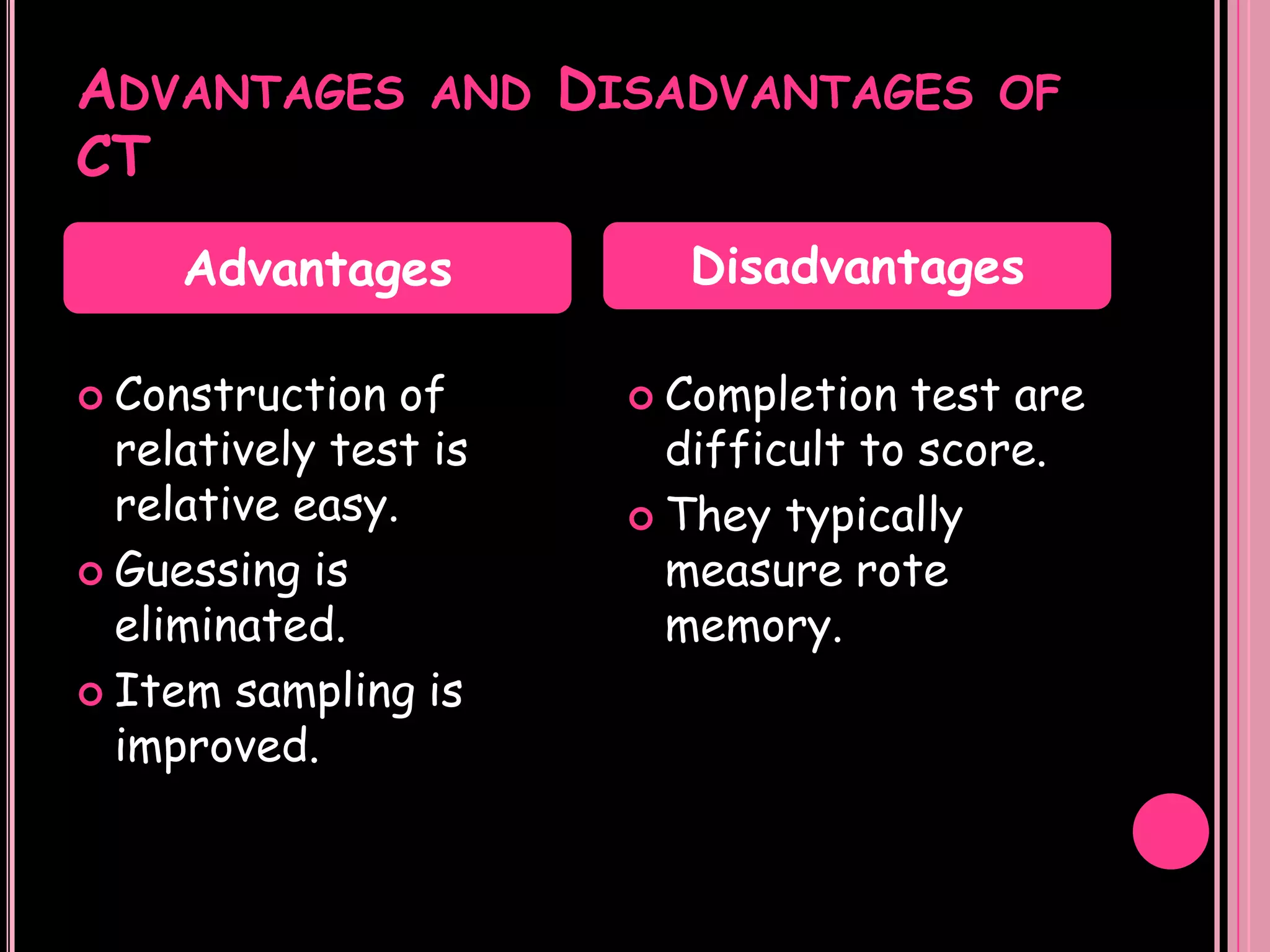
ADVANTAGES        AND   DISADVANTAGES      OF
CT
     Advantages              Disadvantages

 Construction   of        Completion  test are
  relatively test is        difficult to score.
  relative easy.           They typically
 Guessing is               measure rote
  eliminated.               memory.
 Item sampling is
  improved.
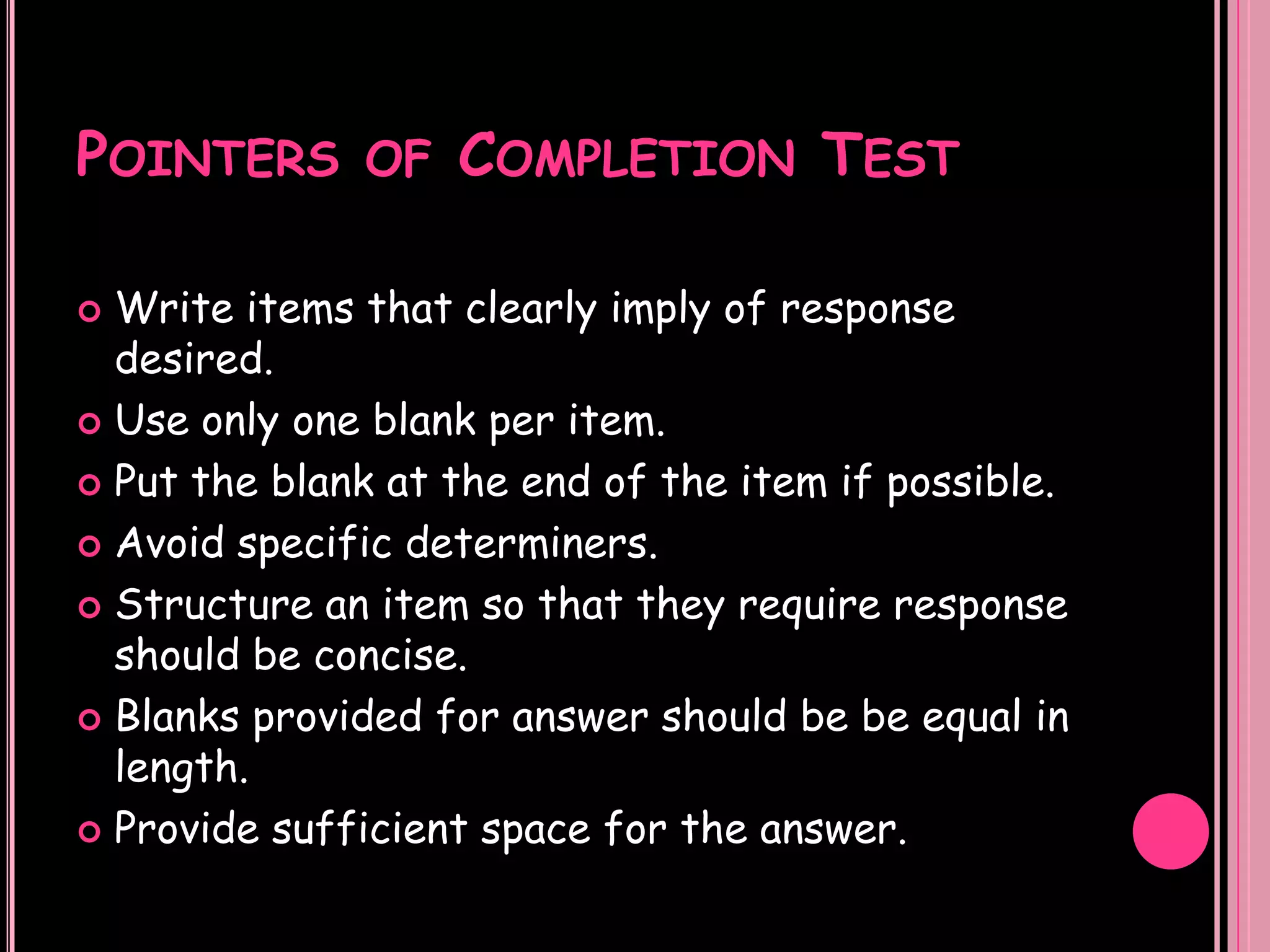
POINTERS OF COMPLETION TEST

 Write items that clearly imply of response
  desired.
 Use only one blank per item.

 Put the blank at the end of the item if possible.

 Avoid specific determiners.

 Structure an item so that they require response
  should be concise.
 Blanks provided for answer should be be equal in
  length.
 Provide sufficient space for the answer.
REFERENCES:

Gracia, Carlito D. (2008). Measuring and
Evalauting Outcomes. Books Atbp. Publishing
Corp.,Mandaluyong

Reganit, Artulfo, Elicay, Ronaldo & Laguerta,
Cresencia (2010)

http://www.businessdictionary.com/definition/compl
etiontest

http://ph.adsfn.com/money-
wordsterm6490completion test
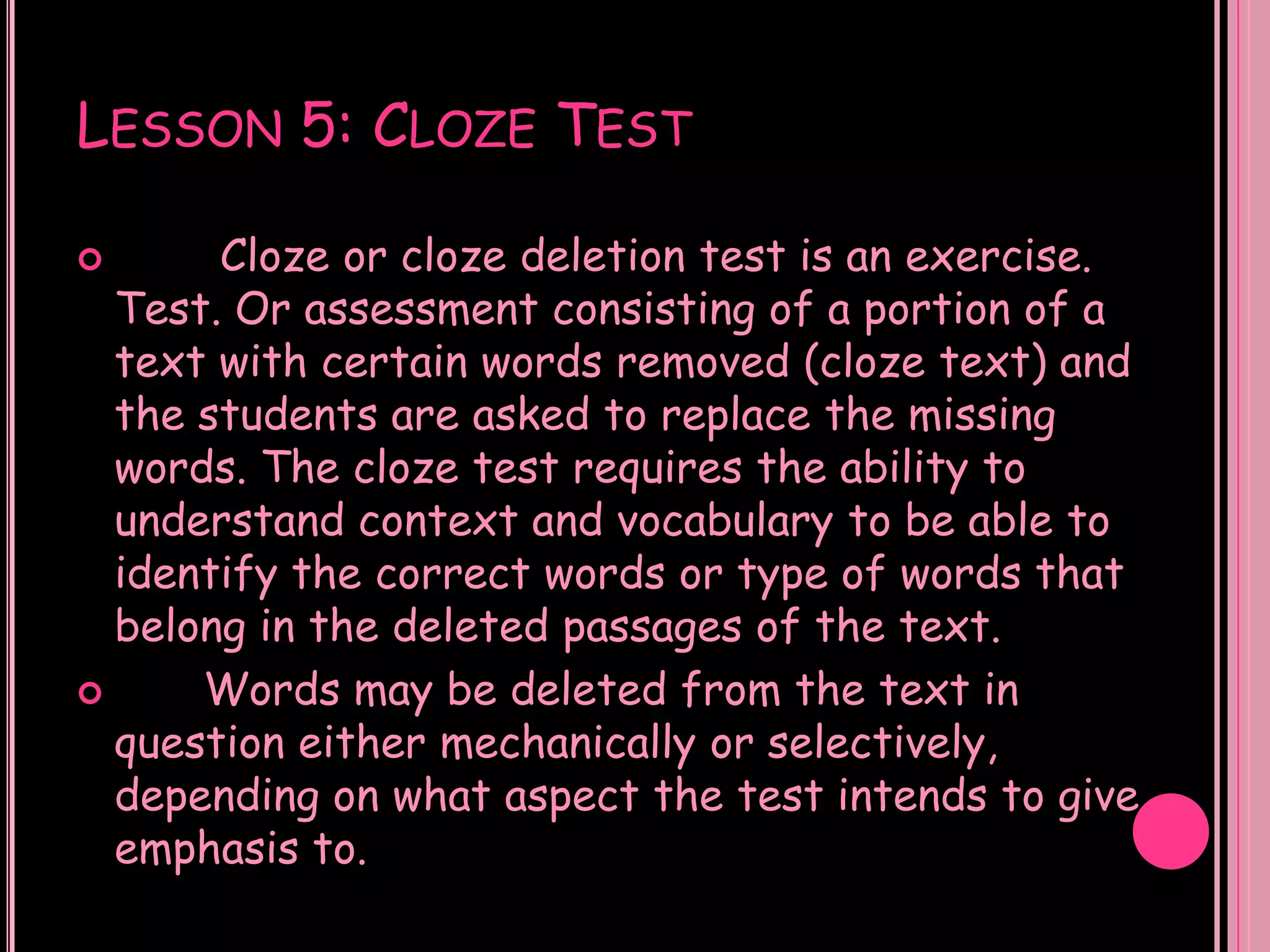
LESSON 5: CLOZE TEST

      Cloze or cloze deletion test is an exercise.
  Test. Or assessment consisting of a portion of a
  text with certain words removed (cloze text) and
  the students are asked to replace the missing
  words. The cloze test requires the ability to
  understand context and vocabulary to be able to
  identify the correct words or type of words that
  belong in the deleted passages of the text.
     Words may be deleted from the text in
  question either mechanically or selectively,
  depending on what aspect the test intends to give
  emphasis to.
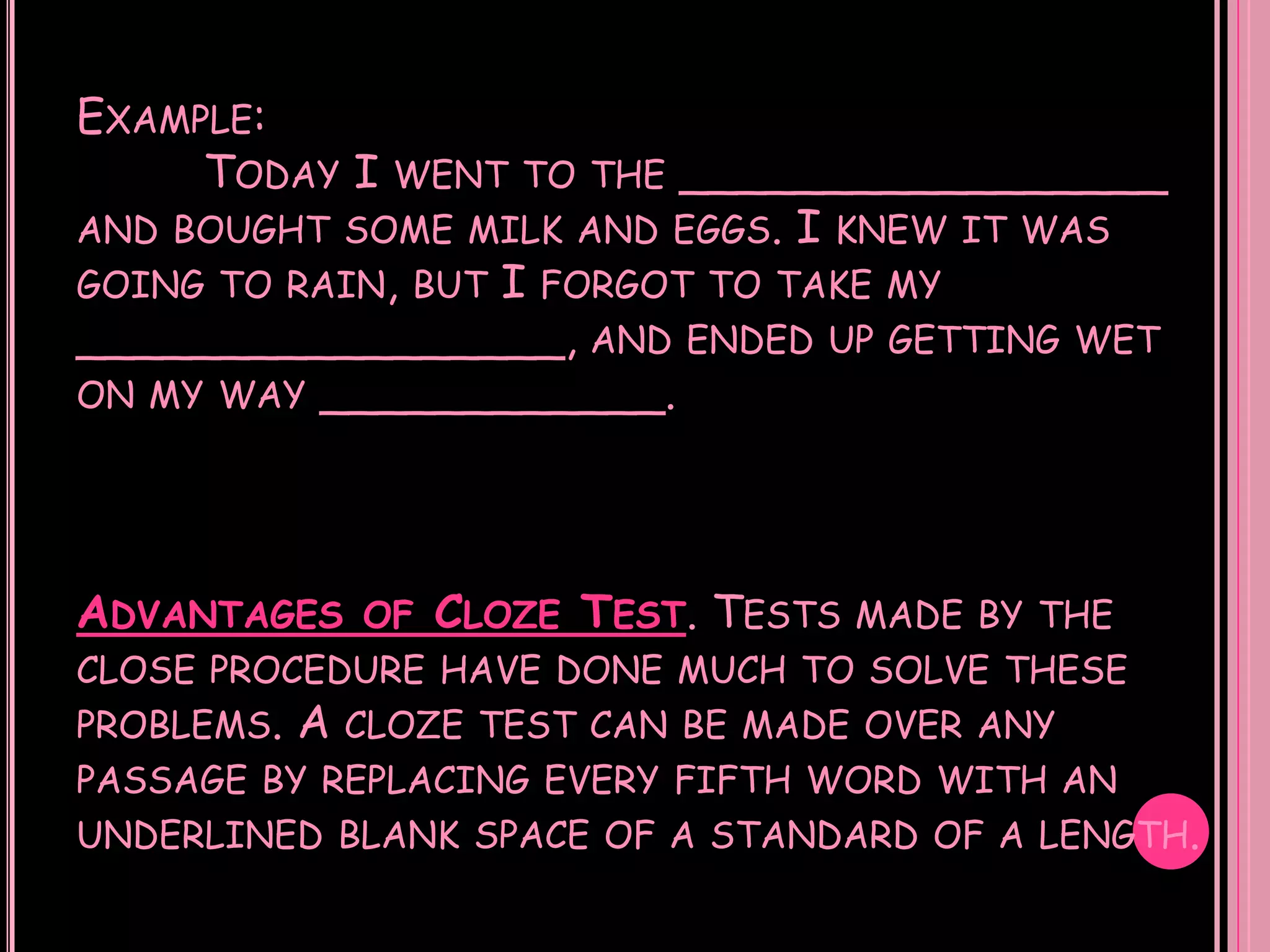
EXAMPLE:
     TODAY I    WENT TO THE   _________________
AND BOUGHT SOME MILK AND      EGGS. I KNEW IT WAS
GOING TO RAIN, BUT
                I FORGOT TO TAKE MY
_________________, AND ENDED UP GETTING           WET
ON MY WAY ____________.


ADVANTAGES    OF   CLOZE TEST. TESTS MADE   BY THE
CLOSE PROCEDURE HAVE DONE MUCH TO SOLVE THESE
PROBLEMS.   A CLOZE   TEST CAN BE MADE OVER ANY
PASSAGE BY REPLACING EVERY FIFTH WORD WITH AN
UNDERLINED BLANK SPACE OF A STANDARD OF A LENGTH.
REFERENCES:


*ASSESSMENT OF STUDENT LEARNING 1
*JOURNAL OF EDUCATIONAL
MEASUREMENT
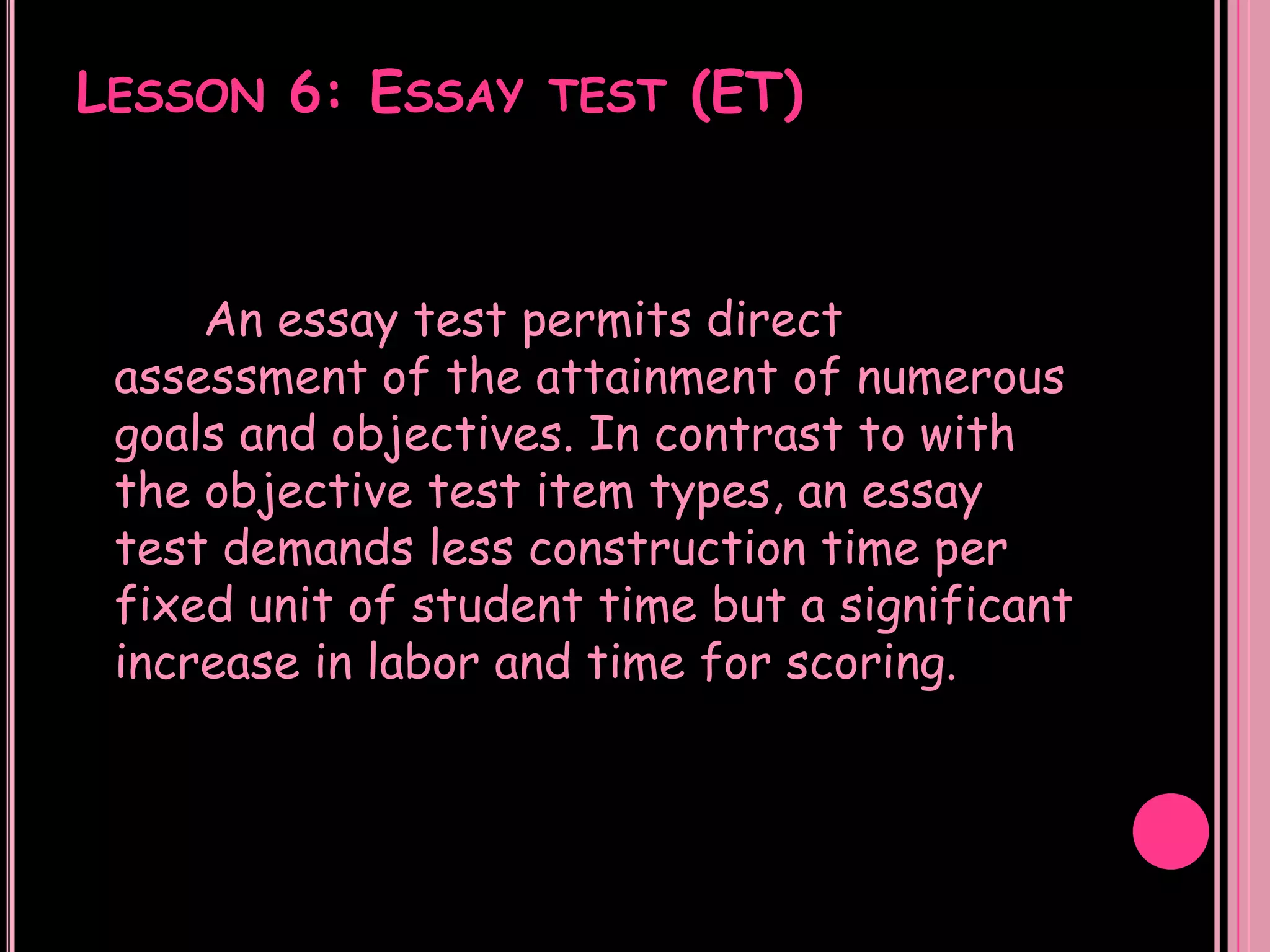
LESSON 6: ESSAY TEST (ET)


     An essay test permits direct
 assessment of the attainment of numerous
 goals and objectives. In contrast to with
 the objective test item types, an essay
 test demands less construction time per
 fixed unit of student time but a significant
 increase in labor and time for scoring.
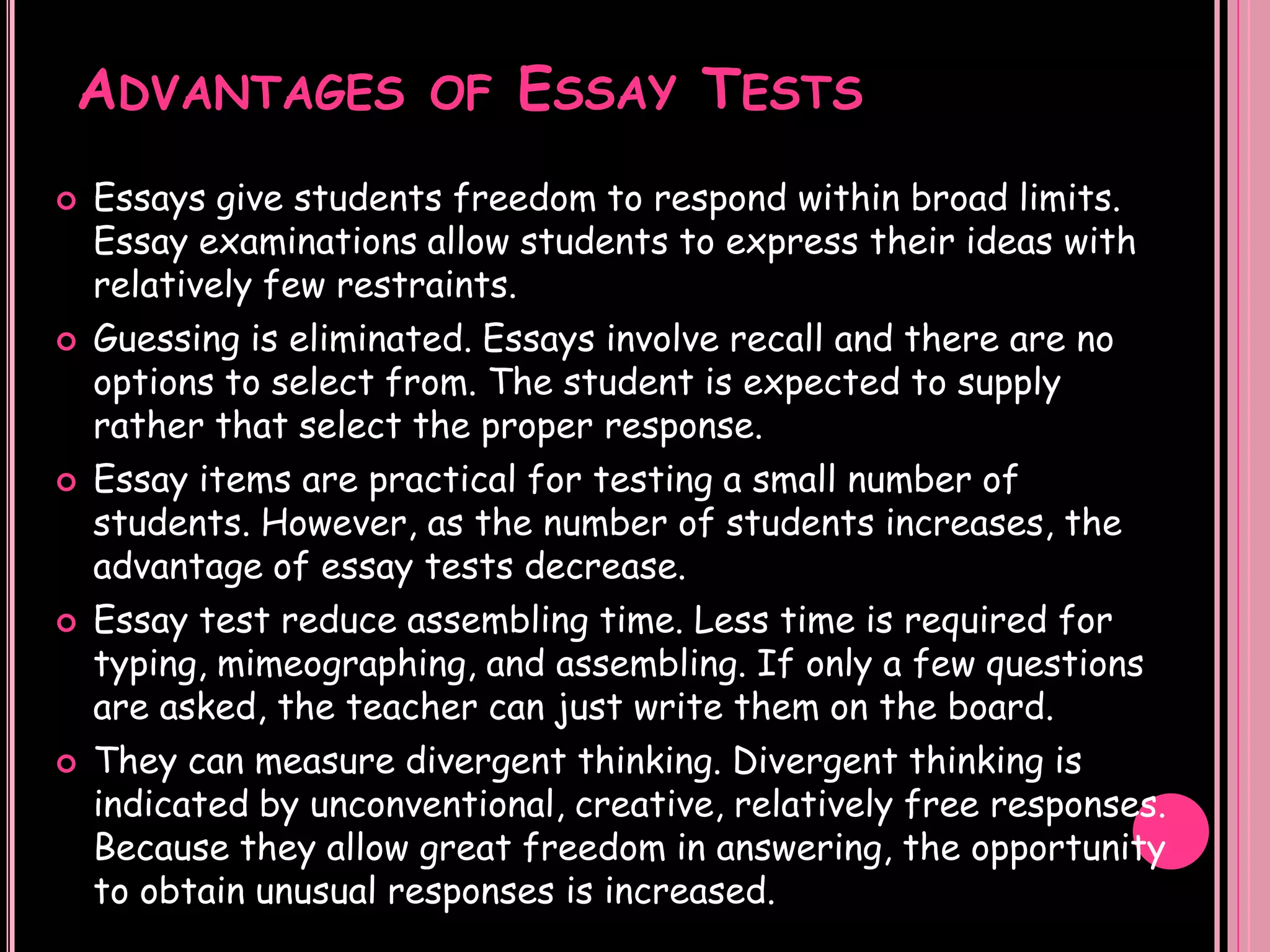
ADVANTAGES              OF   ESSAY TESTS
   Essays give students freedom to respond within broad limits.
    Essay examinations allow students to express their ideas with
    relatively few restraints.
   Guessing is eliminated. Essays involve recall and there are no
    options to select from. The student is expected to supply
    rather that select the proper response.
   Essay items are practical for testing a small number of
    students. However, as the number of students increases, the
    advantage of essay tests decrease.
   Essay test reduce assembling time. Less time is required for
    typing, mimeographing, and assembling. If only a few questions
    are asked, the teacher can just write them on the board.
   They can measure divergent thinking. Divergent thinking is
    indicated by unconventional, creative, relatively free responses.
    Because they allow great freedom in answering, the opportunity
    to obtain unusual responses is increased.
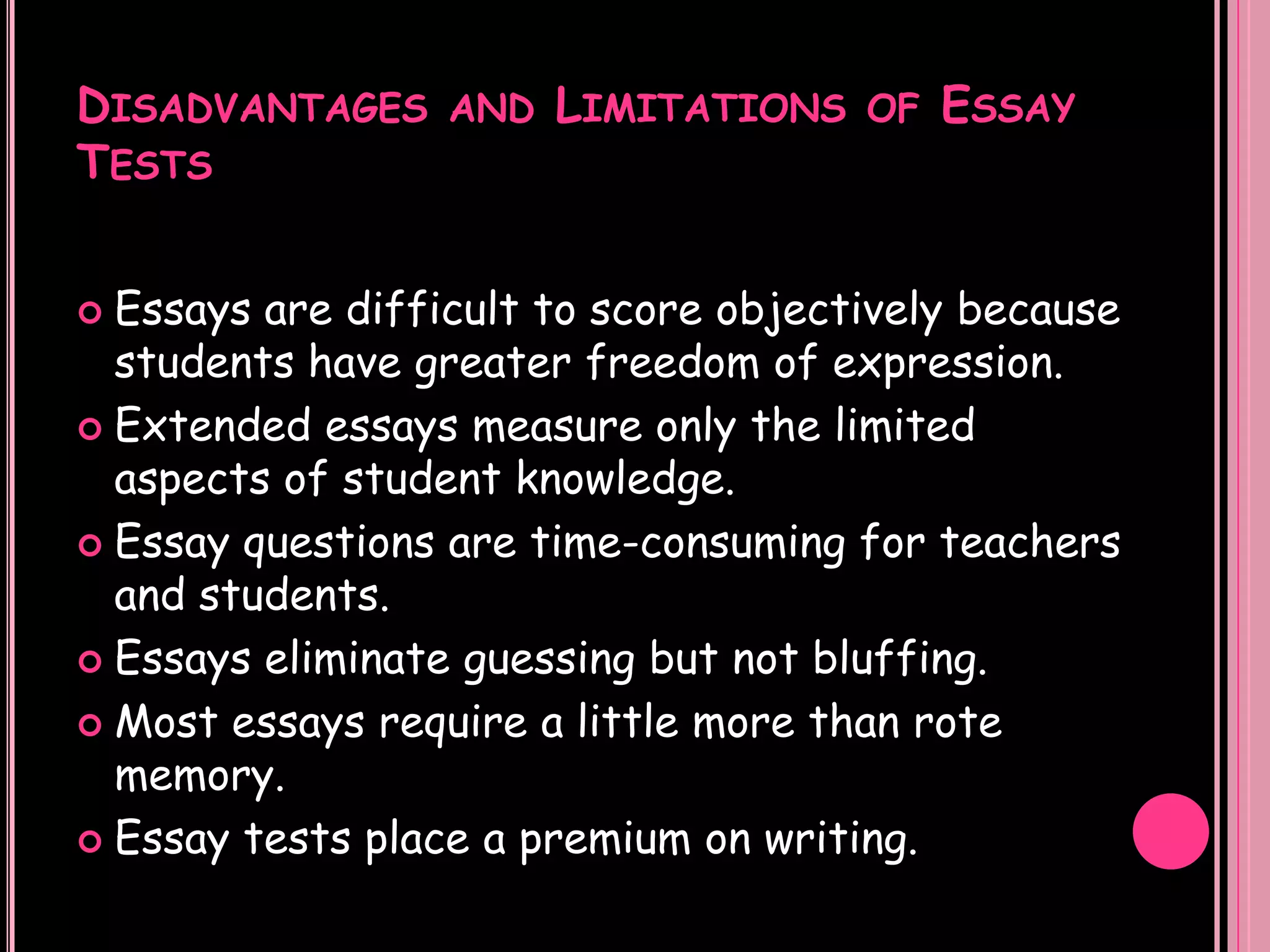
DISADVANTAGES AND LIMITATIONS OF ESSAY
TESTS


 Essays are difficult to score objectively because
  students have greater freedom of expression.
 Extended essays measure only the limited
  aspects of student knowledge.
 Essay questions are time-consuming for teachers
  and students.
 Essays eliminate guessing but not bluffing.

 Most essays require a little more than rote
  memory.
 Essay tests place a premium on writing.
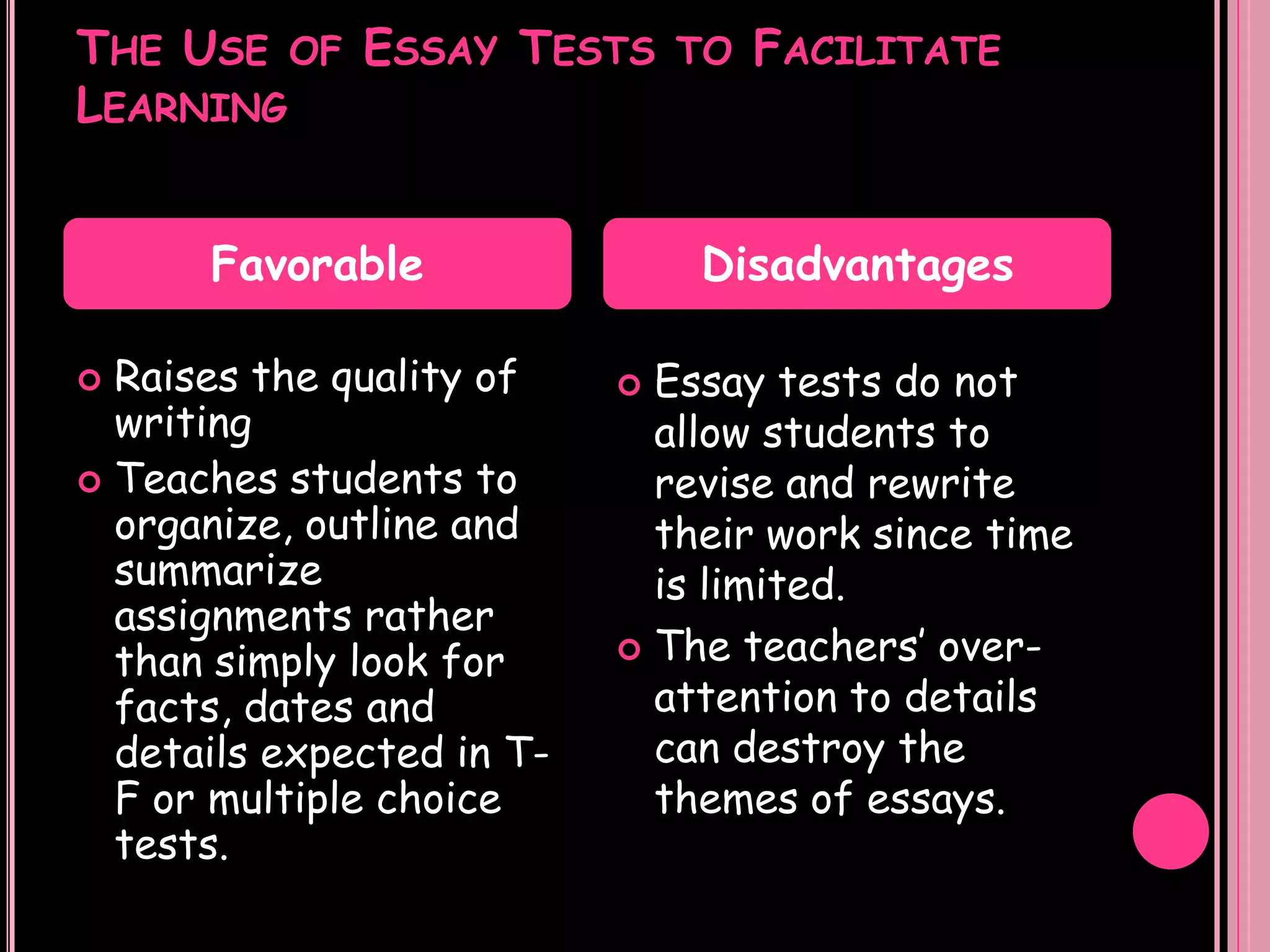
THE USE OF ESSAY TESTS TO FACILITATE
LEARNING


      Favorable                Disadvantages

 Raises the quality of     Essay tests do not
  writing                    allow students to
 Teaches students to        revise and rewrite
  organize, outline and      their work since time
  summarize                  is limited.
  assignments rather
                            The teachers’ over-
  than simply look for
  facts, dates and           attention to details
  details expected in T-     can destroy the
  F or multiple choice       themes of essays.
  tests.
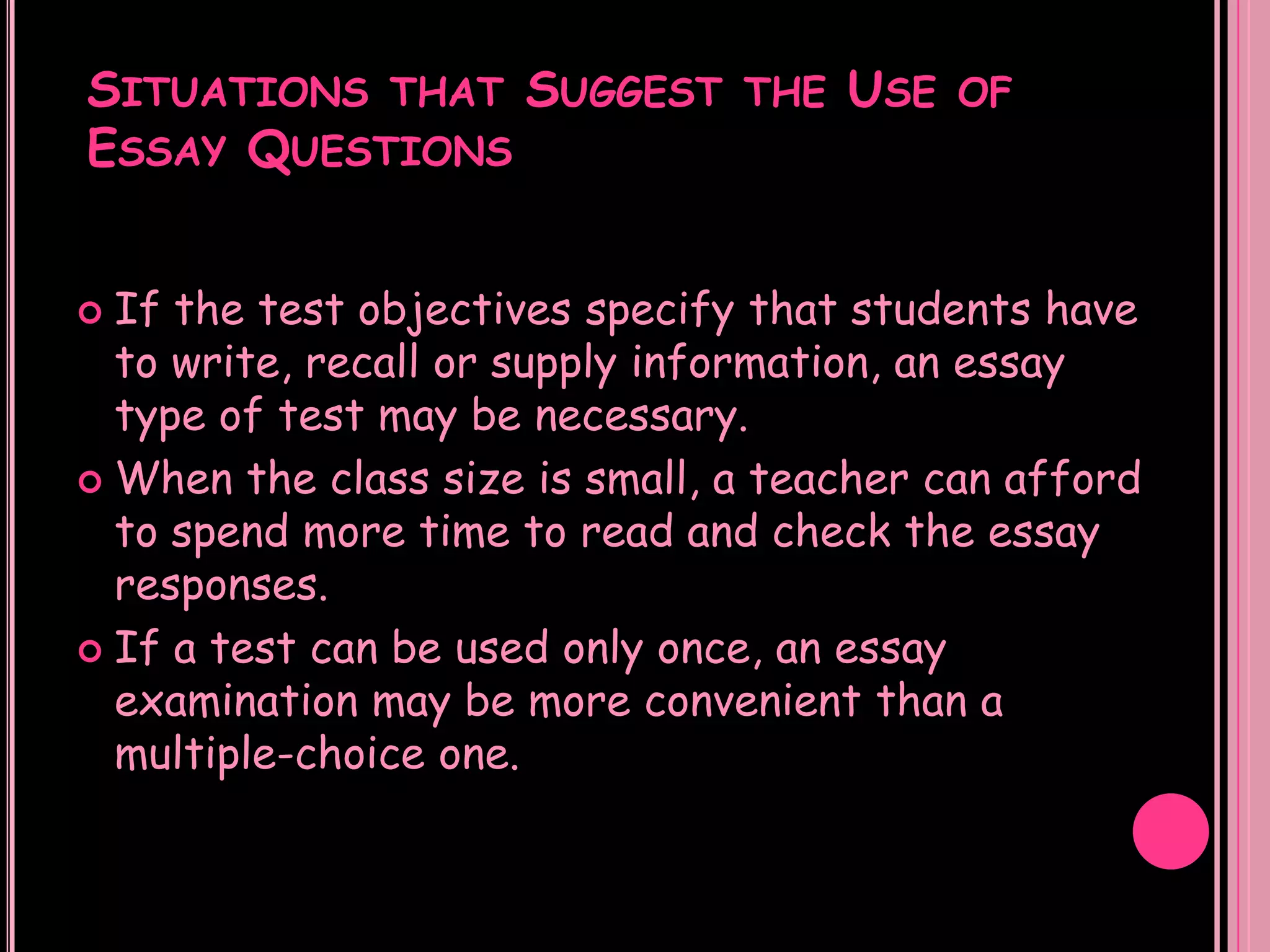
SITUATIONS THAT SUGGEST THE USE OF
ESSAY QUESTIONS


 If the test objectives specify that students have
  to write, recall or supply information, an essay
  type of test may be necessary.
 When the class size is small, a teacher can afford
  to spend more time to read and check the essay
  responses.
 If a test can be used only once, an essay
  examination may be more convenient than a
  multiple-choice one.
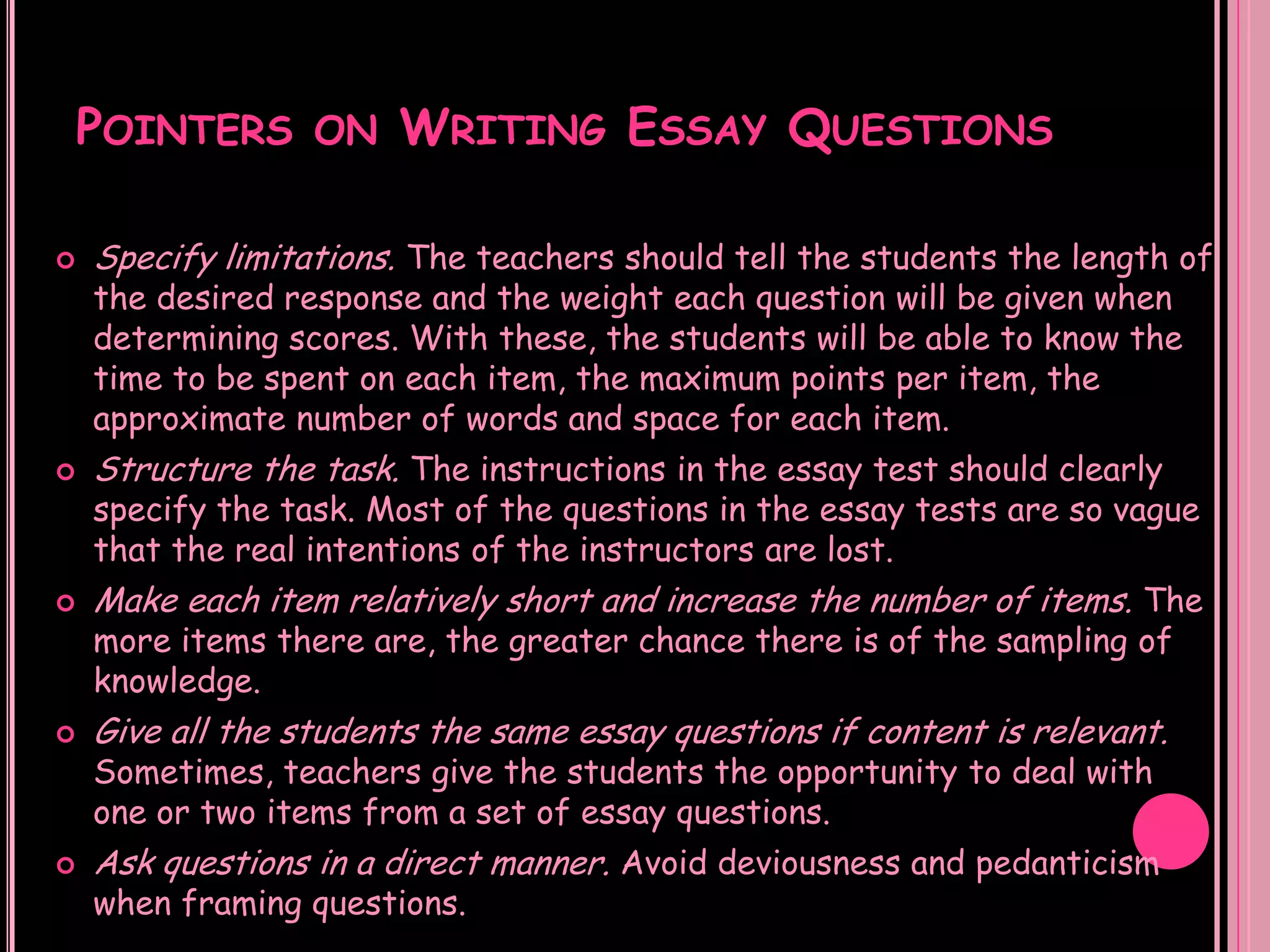
POINTERS ON WRITING ESSAY QUESTIONS

   Specify limitations. The teachers should tell the students the length of
    the desired response and the weight each question will be given when
    determining scores. With these, the students will be able to know the
    time to be spent on each item, the maximum points per item, the
    approximate number of words and space for each item.
   Structure the task. The instructions in the essay test should clearly
    specify the task. Most of the questions in the essay tests are so vague
    that the real intentions of the instructors are lost.
   Make each item relatively short and increase the number of items. The
    more items there are, the greater chance there is of the sampling of
    knowledge.
   Give all the students the same essay questions if content is relevant.
    Sometimes, teachers give the students the opportunity to deal with
    one or two items from a set of essay questions.
   Ask questions in a direct manner. Avoid deviousness and pedanticism
    when framing questions.
Module 4 slides

  • 1.
    MODULE 4 Developmentof Assessment Tools
  • 2.
    LESSON 1: MULTIPLECHOICE TEST (MCT)  The multiple choice test is a form of assessment in which the students are asked to select the correct or best answer out of the choices from the list.  Is composed of a STEM, which sets up the problem, followed by the number of ALTERNATIVE RESPONSES. The other alternatives are DISTRACTORS or FOILS.  Can be presented in 3 ways: direct question, incomplete statement and mathematical equation.
  • 3.
    ADVANTAGES AND DISADVANTAGES OF MCT Advantages Disadvantages  Has a great  Multiple choices are versatility in ambiguous measuring objectives  Can just select  Requires less time random  Writing is minimized answers/guessing  Scoring is objective  More amenable to item analysis
  • 4.
    REFERENCES:  Reganit, Arnulfo, Elicay, Ronaldo, & Laguerta, Cresencial (2010). Assessment of Student Learning 1 (Cognitive Learning). C & E Publishing, Inc.  Garcia, Carlito D. (2008). Measuring & Evaluating Educational Outcomes. Books atbp. Publishing Corp., Mandaluyong
  • 5.
    LESSON 2: TRUEOR FALSE TEST  This type of test requires the examinee to recognize and mark an item as true or false. Other possible options are agree or disagree, yes or no, valid or invalid, fact or opinion, and cause or effect.  Are utilized to assess a student’s ability to recognize the accuracy of a declarative statement. (http://www.park.edu.cetl2/quicktips/truefalse. html)
  • 6.
    ADVANTAGES AND DISADVANTAGESOF TFT Advantages Disadvantages  Answers tend to be  Emphasis on Rote short Memorization  Ease of  Dependence on Construction Absolute Judgment  Ease of Scoring  Likelihood of Guessing
  • 7.
    POINTERS ON WRITINGTRUE OR FALSE ITEMS  Construct items that measure important objectives.  Avoid using determiners.  Avoid using trick questions.  Limit each item to the point that is being tested.  Avoid excess use of negative words and phrases.  Approximately half of the statements are false.  Avoid qualitative terms like best, some, many, and several.
  • 8.
  • 9.
    ADVANTAGES AND DISADVANTAGES OF MTT Advantages Disadvantages  The matching-type test is  It tends to ask students to simple to construct score. It is associate trivial information. well suited in measuring Unfortunately, most associations. Like a multiple- matching-type test choice test, it presents the emphasizes memorization, student with questions and although it is impossible to alternatives. construct items that measure  It reduces the effects of more complex cognitive skills. guessing, although the chance of guessing increases as the student progress in answering  In case of commercial answer items. This, however, is easily sheets, matching items can remedied by adding more accommodate no more than options. five options.
  • 10.
    POINTERS ON WRITINGMATCHING-TYPE TESTS  If possible, the response list should consist of short phrase, single words, or numbers.  Use homogenous options and items.  Have more options than the given items. Initially, a matching- item test decrease the students' tendencies to guess but as the students progress in answering the test, the guessing tendencies increase. This can be avoided by increasing the options.  Arrange the options and items alphabetically, numerically, or magnitudinally. This is one way to help the examinees since they can maximize their time by not searching for the correct answers, especially if there are many options.  Limit the number of items within each set. Ideally, the minimum is five and the maximum is ten per set.  Place the shorter responses on column B. This time-saving practice allows the students to read the longer items first in column A and then search quickly through the shorter options to locate the correct alternative.
  • 11.
    7.PROVIDE COMPLETE DIRECTIONS.DIRECTIONS SHOULD STIPULATE WHETHER OPTIONS CAN BE USED ONLY ONCE OR MORE THAN ONCE. THEY SHOULD ALSO INSTRUCT THE STUDENTS ON HOW TO RESPOND. THE INSTRUCTIONS SHOULD ALSO CLARIFY WHAT COLUMN A AND B ARE ABOUT. 8. PLACE THE LIST OF OPTIONS ON THE SAME PAGE AS THE LIST OF ITEMS. TIME IS WASTED IF THE STUDENTS HAVE TO FLIP PAGES TO SEARCH THROUGH ALL OPTIONS TO LOCATE THE CORRECT ONES. ADDITIONALLY, SOME STUDENTS MAY OVELOOK THAT THERE ARE STILL SOME OPTIONS ON THE NEXT PAGE. 9. AVOID SPECIFIC DETERMINERS AND TRIVIAL INFORMATION THAT CAN HELP THE STUDENTS FIND THE CORRECT RESPONSE WITHOUT ANY EFFORT ON THEIR PART. THE USE OT "NONE OF THE ABOVE" A AN OPTION IS RECOMMENDED IF IT IS ONLY CORRECT ANSWER. 10. CLEARLY EXPLAIN THE BASIS ON WHICH IS TO BE MADE.
  • 12.
    SUGGESTIONS FOR MEASURINGCOMPLEX OBJECTIVES WITH MATCHING-TYPE TESTS  Match examples with terminologies. Perhaps this is the most direct and simplest method of increasing the thought content of matching tests provide that the example has not yet been taught before.  Use novel pictorial materials.
  • 13.
    LESSON 4: COMPLETIONTEST Acompletion test is a format of testing that requires the students to complete with the correct word or phrase.
  • 14.
    ADVANTAGES AND DISADVANTAGES OF CT Advantages Disadvantages  Construction of  Completion test are relatively test is difficult to score. relative easy.  They typically  Guessing is measure rote eliminated. memory.  Item sampling is improved.
  • 15.
    POINTERS OF COMPLETIONTEST  Write items that clearly imply of response desired.  Use only one blank per item.  Put the blank at the end of the item if possible.  Avoid specific determiners.  Structure an item so that they require response should be concise.  Blanks provided for answer should be be equal in length.  Provide sufficient space for the answer.
  • 16.
    REFERENCES: Gracia, Carlito D.(2008). Measuring and Evalauting Outcomes. Books Atbp. Publishing Corp.,Mandaluyong Reganit, Artulfo, Elicay, Ronaldo & Laguerta, Cresencia (2010) http://www.businessdictionary.com/definition/compl etiontest http://ph.adsfn.com/money- wordsterm6490completion test
  • 17.
    LESSON 5: CLOZETEST  Cloze or cloze deletion test is an exercise. Test. Or assessment consisting of a portion of a text with certain words removed (cloze text) and the students are asked to replace the missing words. The cloze test requires the ability to understand context and vocabulary to be able to identify the correct words or type of words that belong in the deleted passages of the text.  Words may be deleted from the text in question either mechanically or selectively, depending on what aspect the test intends to give emphasis to.
  • 18.
    EXAMPLE: TODAY I WENT TO THE _________________ AND BOUGHT SOME MILK AND EGGS. I KNEW IT WAS GOING TO RAIN, BUT I FORGOT TO TAKE MY _________________, AND ENDED UP GETTING WET ON MY WAY ____________. ADVANTAGES OF CLOZE TEST. TESTS MADE BY THE CLOSE PROCEDURE HAVE DONE MUCH TO SOLVE THESE PROBLEMS. A CLOZE TEST CAN BE MADE OVER ANY PASSAGE BY REPLACING EVERY FIFTH WORD WITH AN UNDERLINED BLANK SPACE OF A STANDARD OF A LENGTH.
  • 19.
    REFERENCES: *ASSESSMENT OF STUDENTLEARNING 1 *JOURNAL OF EDUCATIONAL MEASUREMENT
  • 20.
    LESSON 6: ESSAYTEST (ET) An essay test permits direct assessment of the attainment of numerous goals and objectives. In contrast to with the objective test item types, an essay test demands less construction time per fixed unit of student time but a significant increase in labor and time for scoring.
  • 21.
    ADVANTAGES OF ESSAY TESTS  Essays give students freedom to respond within broad limits. Essay examinations allow students to express their ideas with relatively few restraints.  Guessing is eliminated. Essays involve recall and there are no options to select from. The student is expected to supply rather that select the proper response.  Essay items are practical for testing a small number of students. However, as the number of students increases, the advantage of essay tests decrease.  Essay test reduce assembling time. Less time is required for typing, mimeographing, and assembling. If only a few questions are asked, the teacher can just write them on the board.  They can measure divergent thinking. Divergent thinking is indicated by unconventional, creative, relatively free responses. Because they allow great freedom in answering, the opportunity to obtain unusual responses is increased.
  • 22.
    DISADVANTAGES AND LIMITATIONSOF ESSAY TESTS  Essays are difficult to score objectively because students have greater freedom of expression.  Extended essays measure only the limited aspects of student knowledge.  Essay questions are time-consuming for teachers and students.  Essays eliminate guessing but not bluffing.  Most essays require a little more than rote memory.  Essay tests place a premium on writing.
  • 23.
    THE USE OFESSAY TESTS TO FACILITATE LEARNING Favorable Disadvantages  Raises the quality of  Essay tests do not writing allow students to  Teaches students to revise and rewrite organize, outline and their work since time summarize is limited. assignments rather  The teachers’ over- than simply look for facts, dates and attention to details details expected in T- can destroy the F or multiple choice themes of essays. tests.
  • 24.
    SITUATIONS THAT SUGGESTTHE USE OF ESSAY QUESTIONS  If the test objectives specify that students have to write, recall or supply information, an essay type of test may be necessary.  When the class size is small, a teacher can afford to spend more time to read and check the essay responses.  If a test can be used only once, an essay examination may be more convenient than a multiple-choice one.
  • 25.
    POINTERS ON WRITINGESSAY QUESTIONS  Specify limitations. The teachers should tell the students the length of the desired response and the weight each question will be given when determining scores. With these, the students will be able to know the time to be spent on each item, the maximum points per item, the approximate number of words and space for each item.  Structure the task. The instructions in the essay test should clearly specify the task. Most of the questions in the essay tests are so vague that the real intentions of the instructors are lost.  Make each item relatively short and increase the number of items. The more items there are, the greater chance there is of the sampling of knowledge.  Give all the students the same essay questions if content is relevant. Sometimes, teachers give the students the opportunity to deal with one or two items from a set of essay questions.  Ask questions in a direct manner. Avoid deviousness and pedanticism when framing questions.