MODULE 7
Administering, Analyzing, and
Improving the Test
Objectives:
At the end of this module, you will be able to:
1. Discuss the guidelines in assembling a test
2. Discuss the importance of proper administration of the test
3. Illustrate the procedure of item analysis
4. Differentiate the discrimination from difficulty index
Lesson 1:
Test Assembly
Lesson 1: Test Assembly
After writing the test items, the teacher should consider that
proper test assembly which affects the reliability of the test.
This includes Packaging the Test and Reproducing the Test
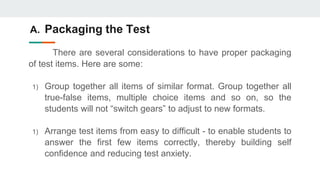
A. Packaging the Test
There are several considerations to have proper packaging
of test items. Here are some:
1) Group together all items of similar format. Group together all
true-false items, multiple choice items and so on, so the
students will not “switch gears” to adjust to new formats.
1) Arrange test items from easy to difficult - to enable students to
answer the first few items correctly, thereby building self
confidence and reducing test anxiety.
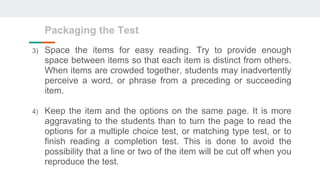
Packaging the Test
3) Space the items for easy reading. Try to provide enough
space between items so that each item is distinct from others.
When items are crowded together, students may inadvertently
perceive a word, or phrase from a preceding or succeeding
item.
4) Keep the item and the options on the same page. It is more
aggravating to the students than to turn the page to read the
options for a multiple choice test, or matching type test, or to
finish reading a completion test. This is done to avoid the
possibility that a line or two of the item will be cut off when you
reproduce the test.
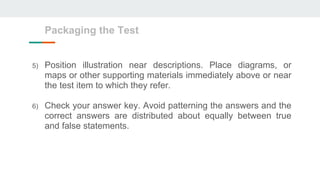
5) Position illustration near descriptions. Place diagrams, or
maps or other supporting materials immediately above or near
the test item to which they refer.
6) Check your answer key. Avoid patterning the answers and the
correct answers are distributed about equally between true
and false statements.
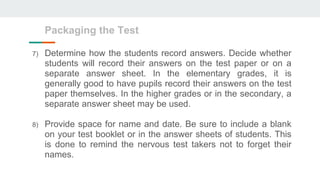
Packaging the Test
7) Determine how the students record answers. Decide whether
students will record their answers on the test paper or on a
separate answer sheet. In the elementary grades, it is
generally good to have pupils record their answers on the test
paper themselves. In the higher grades or in the secondary, a
separate answer sheet may be used.
8) Provide space for name and date. Be sure to include a blank
on your test booklet or in the answer sheets of students. This
is done to remind the nervous test takers not to forget their
names.
Packaging the Test
9) Check test directions. Directions should specify the following:
the number of items to which they apply; how to record the
answer; basis on which to select answers; and criteria for
scoring.
10) Proofread the test. This is done to ensure that there are no
typographical and grammatical errors before reproducing the
test and to avoid unnecessary corrections to the class while
the test is going on, to avoid waste of time and to inhibit
students concentration.
Packaging the Test
REPRODUCING
THE TEST
How the test is reproduced affects
the results. The quality of copies
vary tremendously, depending on
the kind of copying machine used.
Here are some reminders:
1. Know the ditto or photocopying
machine. Be sure you or the
person designated to do the
reproduction understands how to
operate the ditto or photocopying
machine.
2.Make extra copies. Always
make an extra copies of each
page of the test when using ditto
machine, since they have
tendency to count pages they fail
to print.
3. Specify copying instructions. If
someone will doo the reproduction, ask
him to inspect every tenth copy for
legibility, while running the copies and
be alert for blanking pages, while
collating, ordering and stapling the
pages.
4. Avoid common pitfalls such as
fine print/ font; finely detailed
maps or drawings; barely legible
originals (if you can barely read
the original). The copies will not
readable.
5. File the original copy if you
want to use some items later.
C. Test
Administration
How to help students
psychologically
prepare for the test.
1. Maintain a positive attitude
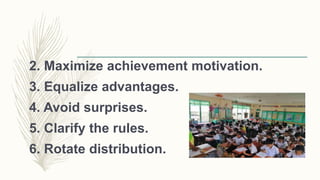
2. Maximize achievement motivation.
3. Equalize advantages.
4. Avoid surprises.
5. Clarify the rules.
6. Rotate distribution.

7. Remind students to check their copies.
8.Monitor students while taking the test.
9. Minimize distractions.
10. Give time warnings.
11. Collect test uniformly.
D. SCORING THE TEST
Here are some guidelines in
scoring test papers:
1. Prepare answer key.
Prepare answer in advance to save time and to help you identify questions
that need rewording or need to be eliminated. When constructing the answer
key, teacher should get an idea of how long will it takes students to compare the
test and whether the time given is appropriate or not.
2. Check the answer key.
3. Score blindly.
This means try to keep students name out of sight to prevent your
knowledge about, or expectations of, the student from influencing the
score.
Here are some guidelines in
scoring test papers:
4. Check the machine scored answered sheets.
If machine scoring is used, check each answer sheet for stray
marks, multiple answers or marks that maybe too light to be
picked by the scoring machine.
5. Double check your scoring.
6. Records scores.
TWO KINDS OF ITEM ANALYSIS
•QUANTITATIVE ANALYSIS
•QUALITATIVE ANALYSIS
QUANTITATIVE ANALYSIS:
o Is a technique that enables one to find out whether the item
is functioning well or not
o It helps identify the frequency of pupils’ error in each item
o It identifies items which are correctly or incorrectly answered
by students or, which particular option or choices in a multiple
choice test was chosen by the student
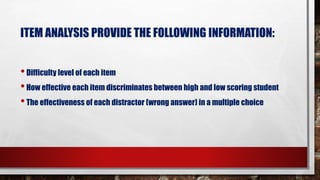
ITEM ANALYSIS PROVIDE THE FOLLOWING INFORMATION:
•Difficulty level of each item
•How effective each item discriminates between high and low scoring student
•The effectiveness of each distractor (wrong answer) in a multiple choice
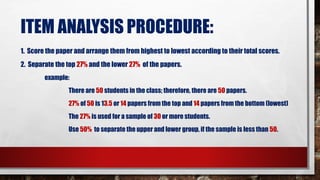
ITEM ANALYSIS PROCEDURE:
1. Score the paper and arrange them from highest to lowest according to their total scores.
2. Separate the top 27% and the lower 27% of the papers.
example:
There are 50 students in the class; therefore, there are 50 papers.
27% of 50 is 13.5 or 14 papers from the top and 14 papers from the bottom (lowest)
The 27% is used for a sample of 30 or more students.
Use 50% to separate the upper and lower group, if the sample is less than 50.
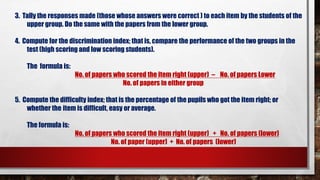
3. Tally the responses made (those whose answers were correct ) to each item by the students of the
upper group. Do the same with the papers from the lower group.
4. Compute for the discrimination index; that is, compare the performance of the two groups in the
test (high scoring and low scoring students).
The formula is:
No. of papers who scored the item right (upper) – No. of papers Lower
No. of papers in either group
5. Compute the difficulty index; that is the percentage of the pupils who got the item right; or
whether the item is difficult, easy or average.
The formula is:
No. of papers who scored the item right (upper) + No. of papers (lower)
No. of paper (upper) + No. of papers (lower)
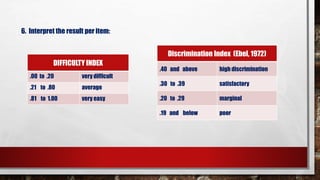
6. Interpret the result per item:
DIFFICULTY INDEX
.00 to .20 very difficult
.21 to .80 average
.81 to 1.00 very easy
Discrimination Index (Ebel, 1972)
.40 and above high discrimination
.30 to .39 satisfactory
.20 to .29 marginal
.19 and below poor
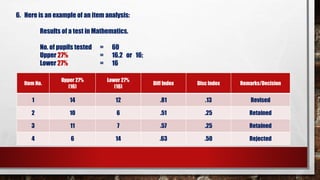
6. Here is an example of an item analysis:
Results of a test in Mathematics.
No. of pupils tested = 60
Upper 27% = 16.2 or 16;
Lower 27% = 16
Item No.
Upper 27%
(16)
Lower 27%
(16)
Diff Index Disc Index Remarks/Decision
1 14 12 .81 .13 Revised
2 10 6 .51 .25 Retained
3 11 7 .57 .25 Retained
4 6 14 .63 .50 Rejected
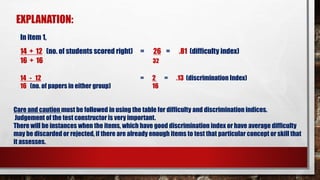
EXPLANATION:
In item 1,
14 + 12 (no. of students scored right) = 26 = .81 (difficulty index)
16 + 16 32
14 - 12 = 2 = .13 (discrimination Index)
16 (no. of papers in either group) 16
Care and caution must be followed in using the table for difficulty and discrimination indices.
Judgement of the test constructor is very important.
There will be instances when the items, which have good discrimination index or have average difficulty
may be discarded or rejected, if there are already enough items to test that particular concept or skill that
it assesses.
Quantitative Analysis
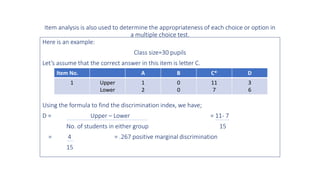
Item analysis is also used to determine the appropriateness of each choice or option in
a multiple choice test.
Here is an example:
Class size=30 pupils
Let’s assume that the correct answer in this item is letter C.
Using the formula to find the discrimination index, we have;
D = Upper – Lower = 11- 7
No. of students in either group 15
= 4 = .267 positive marginal discrimination
15
Item No. A B C* D
1 Upper
Lower
1
2
0
0
11
7
3
6
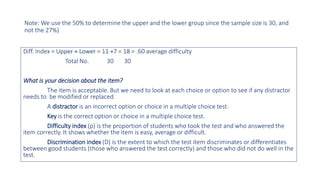
Note: We use the 50% to determine the upper and the lower group since the sample size is 30, and
not the 27%)
Diff. Index = Upper + Lower = 11 +7 = 18 = .60 average difficulty
Total No. 30 30
What is your decision about the item?
The item is acceptable. But we need to look at each choice or option to see if any distractor
needs to be modified or replaced.
A distractor is an incorrect option or choice in a multiple choice test.
Key is the correct option or choice in a multiple choice test.
Difficulty index (p) is the proportion of students who took the test and who answered the
item correctly. It shows whether the item is easy, average or difficult.
Discrimination index (D) is the extent to which the test item discriminates or differentiates
between good students (those who answered the test correctly) and those who did not do well in the
test.
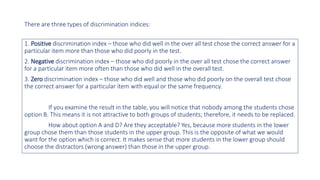
There are three types of discrimination indices:
1. Positive discrimination index – those who did well in the over all test chose the correct answer for a
particular item more than those who did poorly in the test.
2. Negative discrimination index – those who did poorly in the over all test chose the correct answer
for a particular item more often than those who did well in the overall test.
3. Zero discrimination index – those who did well and those who did poorly on the overall test chose
the correct answer for a particular item with equal or the same frequency.
If you examine the result in the table, you will notice that nobody among the students chose
option B. This means it is not attractive to both groups of students; therefore, it needs to be replaced.
How about option A and D? Are they acceptable? Yes, because more students in the lower
group chose them than those students in the upper group. This is the opposite of what we would
want for the option which is correct. It makes sense that more students in the lower group should
choose the distractors (wrong answer) than those in the upper group.
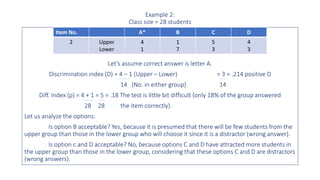
Example 2:
Class size = 28 students
Let’s assume correct answer is letter A.
Discrimination index (D) = 4 – 1 (Upper – Lower) = 3 = .214 positive D
14 (No. in either group) 14
Diff. Index (p) = 4 + 1 = 5 = .18 The test is little bit difficult (only 18% of the group answered
28 28 the item correctly).
Let us analyze the options:
Is option B acceptable? Yes, because it is presumed that there will be few students from the
upper group than those in the lower group who will choose it since it is a distractor (wrong answer).
Is option c and D acceptable? No, because options C and D have attracted more students in
the upper group than those in the lower group, considering that these options C and D are distractors
(wrong answers).
Item No. A* B C D
2 Upper
Lower
4
1
1
7
5
3
4
3
QUALITATIVE ITEM
ANALYSIS
Is matching items with objectives and, editing
poorly written items.
 Inspite of best intention, we end up pressed by time and construct
poorly written items, overlooking such things as grammatical
cues, specific determiners, and other aspect which are part of the
guidelines in writing best items.
 Qualitative item analysis tries to complement the quantitative item
analysis, since the latter can only point out items that are not
good, but can’t tell what causes these problems
 It is possible that an item has an acceptable difficulty index and
can discriminate positively, but it fails to match an instructional
objective that has taught.
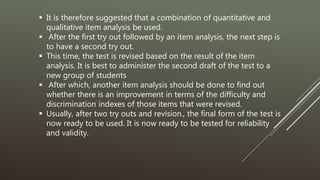
 It is therefore suggested that a combination of quantitative and
qualitative item analysis be used.
 After the first try out followed by an item analysis, the next step is
to have a second try out.
 This time, the test is revised based on the result of the item
analysis. It is best to administer the second draft of the test to a
new group of students
 After which, another item analysis should be done to find out
whether there is an improvement in terms of the difficulty and
discrimination indexes of those items that were revised.
 Usually, after two try outs and revision., the final form of the test is
now ready to be used. It is now ready to be tested for reliability
and validity.

MODULE 7.pptx

  • 1.
    MODULE 7 Administering, Analyzing,and Improving the Test
  • 2.
    Objectives: At the endof this module, you will be able to: 1. Discuss the guidelines in assembling a test 2. Discuss the importance of proper administration of the test 3. Illustrate the procedure of item analysis 4. Differentiate the discrimination from difficulty index
  • 3.
  • 4.
    Lesson 1: TestAssembly After writing the test items, the teacher should consider that proper test assembly which affects the reliability of the test. This includes Packaging the Test and Reproducing the Test
  • 5.
    A. Packaging theTest There are several considerations to have proper packaging of test items. Here are some: 1) Group together all items of similar format. Group together all true-false items, multiple choice items and so on, so the students will not “switch gears” to adjust to new formats. 1) Arrange test items from easy to difficult - to enable students to answer the first few items correctly, thereby building self confidence and reducing test anxiety.
  • 6.
    Packaging the Test 3)Space the items for easy reading. Try to provide enough space between items so that each item is distinct from others. When items are crowded together, students may inadvertently perceive a word, or phrase from a preceding or succeeding item. 4) Keep the item and the options on the same page. It is more aggravating to the students than to turn the page to read the options for a multiple choice test, or matching type test, or to finish reading a completion test. This is done to avoid the possibility that a line or two of the item will be cut off when you reproduce the test.
  • 7.
    5) Position illustrationnear descriptions. Place diagrams, or maps or other supporting materials immediately above or near the test item to which they refer. 6) Check your answer key. Avoid patterning the answers and the correct answers are distributed about equally between true and false statements. Packaging the Test
  • 8.
    7) Determine howthe students record answers. Decide whether students will record their answers on the test paper or on a separate answer sheet. In the elementary grades, it is generally good to have pupils record their answers on the test paper themselves. In the higher grades or in the secondary, a separate answer sheet may be used. 8) Provide space for name and date. Be sure to include a blank on your test booklet or in the answer sheets of students. This is done to remind the nervous test takers not to forget their names. Packaging the Test
  • 9.
    9) Check testdirections. Directions should specify the following: the number of items to which they apply; how to record the answer; basis on which to select answers; and criteria for scoring. 10) Proofread the test. This is done to ensure that there are no typographical and grammatical errors before reproducing the test and to avoid unnecessary corrections to the class while the test is going on, to avoid waste of time and to inhibit students concentration. Packaging the Test
  • 10.
  • 11.
    How the testis reproduced affects the results. The quality of copies vary tremendously, depending on the kind of copying machine used. Here are some reminders:
  • 12.
    1. Know theditto or photocopying machine. Be sure you or the person designated to do the reproduction understands how to operate the ditto or photocopying machine.
  • 13.
    2.Make extra copies.Always make an extra copies of each page of the test when using ditto machine, since they have tendency to count pages they fail to print.
  • 14.
    3. Specify copyinginstructions. If someone will doo the reproduction, ask him to inspect every tenth copy for legibility, while running the copies and be alert for blanking pages, while collating, ordering and stapling the pages.
  • 15.
    4. Avoid commonpitfalls such as fine print/ font; finely detailed maps or drawings; barely legible originals (if you can barely read the original). The copies will not readable.
  • 16.
    5. File theoriginal copy if you want to use some items later.
  • 17.
    C. Test Administration How tohelp students psychologically prepare for the test.
  • 18.
    1. Maintain apositive attitude
  • 19.
    2. Maximize achievementmotivation. 3. Equalize advantages. 4. Avoid surprises. 5. Clarify the rules. 6. Rotate distribution.
  • 20.
    7. Remind studentsto check their copies. 8.Monitor students while taking the test. 9. Minimize distractions. 10. Give time warnings. 11. Collect test uniformly.
  • 21.
  • 22.
    Here are someguidelines in scoring test papers: 1. Prepare answer key. Prepare answer in advance to save time and to help you identify questions that need rewording or need to be eliminated. When constructing the answer key, teacher should get an idea of how long will it takes students to compare the test and whether the time given is appropriate or not. 2. Check the answer key. 3. Score blindly. This means try to keep students name out of sight to prevent your knowledge about, or expectations of, the student from influencing the score.
  • 23.
    Here are someguidelines in scoring test papers: 4. Check the machine scored answered sheets. If machine scoring is used, check each answer sheet for stray marks, multiple answers or marks that maybe too light to be picked by the scoring machine. 5. Double check your scoring. 6. Records scores.
  • 25.
    TWO KINDS OFITEM ANALYSIS •QUANTITATIVE ANALYSIS •QUALITATIVE ANALYSIS
  • 26.
    QUANTITATIVE ANALYSIS: o Isa technique that enables one to find out whether the item is functioning well or not o It helps identify the frequency of pupils’ error in each item o It identifies items which are correctly or incorrectly answered by students or, which particular option or choices in a multiple choice test was chosen by the student
  • 27.
    ITEM ANALYSIS PROVIDETHE FOLLOWING INFORMATION: •Difficulty level of each item •How effective each item discriminates between high and low scoring student •The effectiveness of each distractor (wrong answer) in a multiple choice
  • 28.
    ITEM ANALYSIS PROCEDURE: 1.Score the paper and arrange them from highest to lowest according to their total scores. 2. Separate the top 27% and the lower 27% of the papers. example: There are 50 students in the class; therefore, there are 50 papers. 27% of 50 is 13.5 or 14 papers from the top and 14 papers from the bottom (lowest) The 27% is used for a sample of 30 or more students. Use 50% to separate the upper and lower group, if the sample is less than 50.
  • 29.
    3. Tally theresponses made (those whose answers were correct ) to each item by the students of the upper group. Do the same with the papers from the lower group. 4. Compute for the discrimination index; that is, compare the performance of the two groups in the test (high scoring and low scoring students). The formula is: No. of papers who scored the item right (upper) – No. of papers Lower No. of papers in either group 5. Compute the difficulty index; that is the percentage of the pupils who got the item right; or whether the item is difficult, easy or average. The formula is: No. of papers who scored the item right (upper) + No. of papers (lower) No. of paper (upper) + No. of papers (lower)
  • 30.
    6. Interpret theresult per item: DIFFICULTY INDEX .00 to .20 very difficult .21 to .80 average .81 to 1.00 very easy Discrimination Index (Ebel, 1972) .40 and above high discrimination .30 to .39 satisfactory .20 to .29 marginal .19 and below poor
  • 31.
    6. Here isan example of an item analysis: Results of a test in Mathematics. No. of pupils tested = 60 Upper 27% = 16.2 or 16; Lower 27% = 16 Item No. Upper 27% (16) Lower 27% (16) Diff Index Disc Index Remarks/Decision 1 14 12 .81 .13 Revised 2 10 6 .51 .25 Retained 3 11 7 .57 .25 Retained 4 6 14 .63 .50 Rejected
  • 32.
    EXPLANATION: In item 1, 14+ 12 (no. of students scored right) = 26 = .81 (difficulty index) 16 + 16 32 14 - 12 = 2 = .13 (discrimination Index) 16 (no. of papers in either group) 16 Care and caution must be followed in using the table for difficulty and discrimination indices. Judgement of the test constructor is very important. There will be instances when the items, which have good discrimination index or have average difficulty may be discarded or rejected, if there are already enough items to test that particular concept or skill that it assesses.
  • 33.
  • 34.
    Item analysis isalso used to determine the appropriateness of each choice or option in a multiple choice test. Here is an example: Class size=30 pupils Let’s assume that the correct answer in this item is letter C. Using the formula to find the discrimination index, we have; D = Upper – Lower = 11- 7 No. of students in either group 15 = 4 = .267 positive marginal discrimination 15 Item No. A B C* D 1 Upper Lower 1 2 0 0 11 7 3 6
  • 35.
    Note: We usethe 50% to determine the upper and the lower group since the sample size is 30, and not the 27%) Diff. Index = Upper + Lower = 11 +7 = 18 = .60 average difficulty Total No. 30 30 What is your decision about the item? The item is acceptable. But we need to look at each choice or option to see if any distractor needs to be modified or replaced. A distractor is an incorrect option or choice in a multiple choice test. Key is the correct option or choice in a multiple choice test. Difficulty index (p) is the proportion of students who took the test and who answered the item correctly. It shows whether the item is easy, average or difficult. Discrimination index (D) is the extent to which the test item discriminates or differentiates between good students (those who answered the test correctly) and those who did not do well in the test.
  • 36.
    There are threetypes of discrimination indices: 1. Positive discrimination index – those who did well in the over all test chose the correct answer for a particular item more than those who did poorly in the test. 2. Negative discrimination index – those who did poorly in the over all test chose the correct answer for a particular item more often than those who did well in the overall test. 3. Zero discrimination index – those who did well and those who did poorly on the overall test chose the correct answer for a particular item with equal or the same frequency. If you examine the result in the table, you will notice that nobody among the students chose option B. This means it is not attractive to both groups of students; therefore, it needs to be replaced. How about option A and D? Are they acceptable? Yes, because more students in the lower group chose them than those students in the upper group. This is the opposite of what we would want for the option which is correct. It makes sense that more students in the lower group should choose the distractors (wrong answer) than those in the upper group.
  • 37.
    Example 2: Class size= 28 students Let’s assume correct answer is letter A. Discrimination index (D) = 4 – 1 (Upper – Lower) = 3 = .214 positive D 14 (No. in either group) 14 Diff. Index (p) = 4 + 1 = 5 = .18 The test is little bit difficult (only 18% of the group answered 28 28 the item correctly). Let us analyze the options: Is option B acceptable? Yes, because it is presumed that there will be few students from the upper group than those in the lower group who will choose it since it is a distractor (wrong answer). Is option c and D acceptable? No, because options C and D have attracted more students in the upper group than those in the lower group, considering that these options C and D are distractors (wrong answers). Item No. A* B C D 2 Upper Lower 4 1 1 7 5 3 4 3
  • 38.
    QUALITATIVE ITEM ANALYSIS Is matchingitems with objectives and, editing poorly written items.
  • 39.
     Inspite ofbest intention, we end up pressed by time and construct poorly written items, overlooking such things as grammatical cues, specific determiners, and other aspect which are part of the guidelines in writing best items.  Qualitative item analysis tries to complement the quantitative item analysis, since the latter can only point out items that are not good, but can’t tell what causes these problems  It is possible that an item has an acceptable difficulty index and can discriminate positively, but it fails to match an instructional objective that has taught.
  • 40.
     It istherefore suggested that a combination of quantitative and qualitative item analysis be used.  After the first try out followed by an item analysis, the next step is to have a second try out.  This time, the test is revised based on the result of the item analysis. It is best to administer the second draft of the test to a new group of students  After which, another item analysis should be done to find out whether there is an improvement in terms of the difficulty and discrimination indexes of those items that were revised.  Usually, after two try outs and revision., the final form of the test is now ready to be used. It is now ready to be tested for reliability and validity.