Consciousness and
Its Altered States
January 29, 2013
OBJECTIVES
• At the end of the discussion about
Consciousness you are expected to:

COGNITIVE:
define consciousness in your own
words
examine critically one’s
consciousness
AFFECTIVE
find pleasure in studying the
consciousness of human beings



PSYCHOMOTOR
draw-out conclusions based on the
given
facts
about
human
consciousness


Definition and
Brief History of
Consciousness
Consciousness is
a state of
awareness of
the outside
world, of our
own thoughts
and feelings
William James
• One of the
earliest
Psychologists
who dealt
with
consciousness
Established the first laboratory
of experimental Psychology in
Harvard University
Believes that our everyday
conscious experience is only one
of the possible forms of
consciousness
He argued that there are
uncharted regions of human
consciousness that can be
explored by studying mental
illnesses, dreams and drug use
INTROSPECTION
Examination of
one’s own thoughts
and feelings
Objective
description of one’s
experiences
Normal Waking
Consciousness
What does it mean to be
conscious?
Directed Consciousness
• Our conscious
experience is
focused, ordered
and one-tracked
Flowing Consciousness
• When our
awareness
drifts from
one thought
to another
Daydreaming
• This is the period
of focused,
directed thinking
and feeling
about fantasies
Daydreams include fantasies
about ordinary, everyday things
as well as extravagant flights of
fancy (Klinger,1987)
Daydreams add color and
intrigue to our lives, making
them more exciting.
Advantages and Uses of
daydreams
Daydreams help make our life
more creative and original
Use the past to explore the
future
Help develop your personality
Divided Consciousness
• Characterized by splitting of two
conscious activities that occur
simultaneously, performing two
activities at the same time
Consciousness
and
Attention
Selective Attention
• The cognitive mental
process that limits the
amount of information
into consciousness
Attention
• William James referred to this as
the means by which we can scan
the environment and select only
stimuli to which we respond
while ignoring other stimuli
Subconscious
Mental Activity
Subconscious processes
are mental or behavioral
activities that take place
outside of conscious
awareness
Preconscious Processes

Are those subconscious
activities that can be
brought into awareness by
paying attention
Unconscious Process
Are those subconscious mental
activities that are more or less
permanently unavailable to
consciousness
Altered States of
Consciousness
Meditation
A popular exercise and an
important part of yoga and
other religious practices of
Buddhism and other Asian
religions
Simplest form
involves assuming
a relaxed sitting
position or lying
position and
breathing deeply,
slowly, and
rhythmically
• In some forms of meditation,
the individual repeats a sound
or word silently to himself or
herself – these words which
have religious meanings are
known as mantras
Goal of Meditation
Transcendental State
 achieving a desirable
altered state of
consciousness
Effects of Meditation

POSITIVE
 Has effect on personality,
performance and perception
 provides evidence for
enhanced creativity,
perceptual sensitivity, selfactualization, self-control
and satisfaction in life
 Elicits significant
physiological effects
– Heart rate drops during
meditation
– Blood pressure falls on
regular practice
 Can be therapeutic for
various psychological and
psychosomatic disorders like
anxiety, phobia, posttraumatic stress disorders,
mild depression, etc.
NEGATIVE
 Psychological difficulties at any
stage specifically for beginners –
episodes of anxiety and depression
and even psychotic breaks
particularly for those with history of
previous psychosis may surface
according to some experts
Hypnosis
Is a psychological state, induced
by ritualistic procedure in which
the subject experiences changes
in perception, memory and
behavior in response to
suggestions by the hypnotist
Characteristics
1. A sense of deep relaxation
and peacefulness exists
2. A hypnotized person
experiences hypnotic
hallucinations
3. When told to do so, the
subject may experience
hypnotic analgesia, that is,
the subject may lose the
sense of touch or pain in
some regions of the body
4. The subject can sometimes be
made to feel that he or she is
going back in time to an earlier
stage of life, such as childhood
5. The actions of hypnotized
individual sometimes seem as
if they are out of individual’s
control
Depersonalization
• Refers to the perceptual experience of
one’s body becoming “distorted” or
“unreal”
• It includes the illusion that the mind has
left the body and traveled about in a so
called “out-of-body experience” or
“astral projection”
Altering
Consciousness With
Drugs
Psychoactive Drugs
Drugs that alter
conscious
experience .
They have
powerful effects
and can be very
addictive.
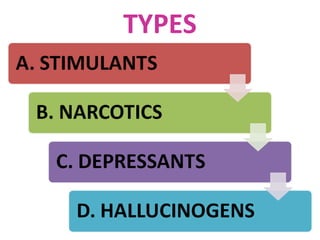
TYPES
A. Stimulants
 Drugs that increase the
activity of the CNS –
providing a sense of energy
and well-being
 Often they are called uppers
Examples
• Caffeine – coffee, tea, soft drinks
• Nicotine – cigarettes and other
tobacco products

HEALTH RISK
• Abnormal heart rhythms, anxiety,
insomnia
• Amphetamines – stimulant drugs
that generally produce a conscious
sense of increased energy,
alertness, enthusiasm, and a
euphoria
Amphetamine Psychosis
A prolonged reaction to excessive
use of stimulants characterized
by distorted thinking, confused
and rapidly changing emotions
and intense suspiciousness
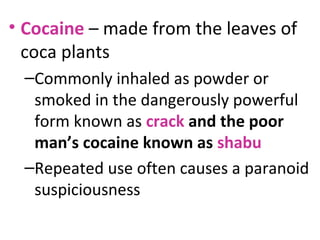
• Cocaine – made from the leaves of
coca plants
–Commonly inhaled as powder or
smoked in the dangerously powerful
form known as crack and the poor
man’s cocaine known as shabu
–Repeated use often causes a paranoid
suspiciousness
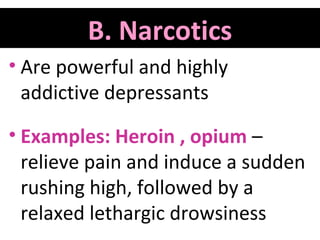
B. Narcotics
• Are powerful and highly
addictive depressants
• Examples: Heroin , opium –
relieve pain and induce a sudden
rushing high, followed by a
relaxed lethargic drowsiness
C. Depressants
• Are a large class of
psychoactive drugs that
influence conscious
experience by depressing
parts of the CNS
Examples
• Alcohol – most widely abused
drug to which most individuals
are physiologically addicted
- psychotropic drug in liquid
form
Effects
• Works principally as a depressant,
though it stimulates sociability and
exuberant activity
• It impairs visual judgment and
motor control and induces
sleepiness
• It worsens negative moods,
• Sedatives - Often called

downers, are depressants that
in mild doses generally produce
a state of calm relaxation
• Prescribe to aid sleep and
sometimes to combat anxiety
• Tranquilizers - Milder drugs
that are similar to sedatives
• They produce a sense of
calm relaxation for a brief
period of time
D. Hallucinogens
• Sometimes called psychedelics
• These drugs alter perceptual
experiences, but only large doses
cause vivid hallucinations
• Examples are Mescaline, Lysergic

acid diethylamide (LSD) and
psilocybin
Other Drugs
• Marijuana – produces a sense of
relaxation and well-being
–Prolonged use decreases the
efficiency of cognitive process,
weakens the body immune system,
decreases the action of male
hormones and increases risk of lung
cancer
• Inhalants – substances that
when inhaled produce a sense
of intoxication
–Toxic (poisonous) substances are
glue, paint, etc.
–These toxic fumes often cause
permanent damage and other
serious complications
Consciousness

Consciousness

  • 1.
    Consciousness and Its AlteredStates January 29, 2013
  • 3.
    OBJECTIVES • At theend of the discussion about Consciousness you are expected to: COGNITIVE: define consciousness in your own words examine critically one’s consciousness
  • 4.
    AFFECTIVE find pleasure instudying the consciousness of human beings  PSYCHOMOTOR draw-out conclusions based on the given facts about human consciousness 
  • 5.
  • 6.
    Consciousness is a stateof awareness of the outside world, of our own thoughts and feelings
  • 7.
    William James • Oneof the earliest Psychologists who dealt with consciousness
  • 8.
    Established the firstlaboratory of experimental Psychology in Harvard University Believes that our everyday conscious experience is only one of the possible forms of consciousness
  • 9.
    He argued thatthere are uncharted regions of human consciousness that can be explored by studying mental illnesses, dreams and drug use
  • 10.
    INTROSPECTION Examination of one’s ownthoughts and feelings Objective description of one’s experiences
  • 11.
    Normal Waking Consciousness What doesit mean to be conscious?
  • 12.
    Directed Consciousness • Ourconscious experience is focused, ordered and one-tracked
  • 13.
    Flowing Consciousness • Whenour awareness drifts from one thought to another
  • 14.
    Daydreaming • This isthe period of focused, directed thinking and feeling about fantasies
  • 15.
    Daydreams include fantasies aboutordinary, everyday things as well as extravagant flights of fancy (Klinger,1987) Daydreams add color and intrigue to our lives, making them more exciting.
  • 16.
    Advantages and Usesof daydreams Daydreams help make our life more creative and original Use the past to explore the future Help develop your personality
  • 17.
    Divided Consciousness • Characterizedby splitting of two conscious activities that occur simultaneously, performing two activities at the same time
  • 18.
  • 19.
    Selective Attention • Thecognitive mental process that limits the amount of information into consciousness
  • 20.
    Attention • William Jamesreferred to this as the means by which we can scan the environment and select only stimuli to which we respond while ignoring other stimuli
  • 21.
  • 22.
    Subconscious processes are mentalor behavioral activities that take place outside of conscious awareness
  • 24.
    Preconscious Processes Are thosesubconscious activities that can be brought into awareness by paying attention
  • 25.
    Unconscious Process Are thosesubconscious mental activities that are more or less permanently unavailable to consciousness
  • 26.
  • 28.
    Meditation A popular exerciseand an important part of yoga and other religious practices of Buddhism and other Asian religions
  • 29.
    Simplest form involves assuming arelaxed sitting position or lying position and breathing deeply, slowly, and rhythmically
  • 30.
    • In someforms of meditation, the individual repeats a sound or word silently to himself or herself – these words which have religious meanings are known as mantras
  • 31.
    Goal of Meditation TranscendentalState  achieving a desirable altered state of consciousness
  • 32.
    Effects of Meditation POSITIVE Has effect on personality, performance and perception
  • 33.
     provides evidencefor enhanced creativity, perceptual sensitivity, selfactualization, self-control and satisfaction in life
  • 34.
     Elicits significant physiologicaleffects – Heart rate drops during meditation – Blood pressure falls on regular practice
  • 35.
     Can betherapeutic for various psychological and psychosomatic disorders like anxiety, phobia, posttraumatic stress disorders, mild depression, etc.
  • 36.
    NEGATIVE  Psychological difficultiesat any stage specifically for beginners – episodes of anxiety and depression and even psychotic breaks particularly for those with history of previous psychosis may surface according to some experts
  • 37.
  • 38.
    Is a psychologicalstate, induced by ritualistic procedure in which the subject experiences changes in perception, memory and behavior in response to suggestions by the hypnotist
  • 39.
    Characteristics 1. A senseof deep relaxation and peacefulness exists 2. A hypnotized person experiences hypnotic hallucinations
  • 40.
    3. When toldto do so, the subject may experience hypnotic analgesia, that is, the subject may lose the sense of touch or pain in some regions of the body
  • 41.
    4. The subjectcan sometimes be made to feel that he or she is going back in time to an earlier stage of life, such as childhood 5. The actions of hypnotized individual sometimes seem as if they are out of individual’s control
  • 42.
    Depersonalization • Refers tothe perceptual experience of one’s body becoming “distorted” or “unreal” • It includes the illusion that the mind has left the body and traveled about in a so called “out-of-body experience” or “astral projection”
  • 43.
  • 44.
    Psychoactive Drugs Drugs thatalter conscious experience . They have powerful effects and can be very addictive.
  • 45.
  • 46.
    A. Stimulants  Drugsthat increase the activity of the CNS – providing a sense of energy and well-being  Often they are called uppers
  • 47.
    Examples • Caffeine –coffee, tea, soft drinks • Nicotine – cigarettes and other tobacco products HEALTH RISK • Abnormal heart rhythms, anxiety, insomnia
  • 48.
    • Amphetamines –stimulant drugs that generally produce a conscious sense of increased energy, alertness, enthusiasm, and a euphoria
  • 49.
    Amphetamine Psychosis A prolongedreaction to excessive use of stimulants characterized by distorted thinking, confused and rapidly changing emotions and intense suspiciousness
  • 50.
    • Cocaine –made from the leaves of coca plants –Commonly inhaled as powder or smoked in the dangerously powerful form known as crack and the poor man’s cocaine known as shabu –Repeated use often causes a paranoid suspiciousness
  • 51.
    B. Narcotics • Arepowerful and highly addictive depressants • Examples: Heroin , opium – relieve pain and induce a sudden rushing high, followed by a relaxed lethargic drowsiness
  • 52.
    C. Depressants • Area large class of psychoactive drugs that influence conscious experience by depressing parts of the CNS
  • 53.
    Examples • Alcohol –most widely abused drug to which most individuals are physiologically addicted - psychotropic drug in liquid form
  • 54.
    Effects • Works principallyas a depressant, though it stimulates sociability and exuberant activity • It impairs visual judgment and motor control and induces sleepiness • It worsens negative moods,
  • 55.
    • Sedatives -Often called downers, are depressants that in mild doses generally produce a state of calm relaxation • Prescribe to aid sleep and sometimes to combat anxiety
  • 56.
    • Tranquilizers -Milder drugs that are similar to sedatives • They produce a sense of calm relaxation for a brief period of time
  • 57.
    D. Hallucinogens • Sometimescalled psychedelics • These drugs alter perceptual experiences, but only large doses cause vivid hallucinations • Examples are Mescaline, Lysergic acid diethylamide (LSD) and psilocybin
  • 58.
    Other Drugs • Marijuana– produces a sense of relaxation and well-being –Prolonged use decreases the efficiency of cognitive process, weakens the body immune system, decreases the action of male hormones and increases risk of lung cancer
  • 59.
    • Inhalants –substances that when inhaled produce a sense of intoxication –Toxic (poisonous) substances are glue, paint, etc. –These toxic fumes often cause permanent damage and other serious complications