Chapter 5: States of
Consciousness
Some Early Definitions
• Consciousness: All the sensations,
perceptions, memories, and feelings you are
aware of in any instant
– Waking Consciousness: Normal, clear,
organized, alert awareness
• Altered State of Consciousness (ASC):
Awareness that is distinctly different in quality
or pattern from waking consciousness
Sleep
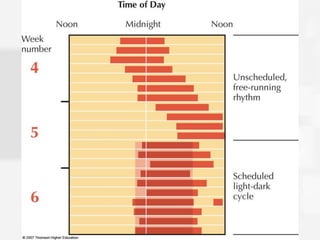
• Innate, biological rhythm
• Microsleep: Brief shift in brain-wave patterns
similar to those of sleep
• Sleep Deprivation: Sleep loss; being deprived
of needed amounts of sleep
• Sleep-Deprivation Psychosis: Major
disruption of mental and emotional
functioning that occurs because of sleep loss
• Hypersomnia: Excessive daytime sleepiness
Measuring Sleep Changes
• Electroencephalograph (EEG): Brain-wave
machine; amplifies and records electrical
activity in the brain
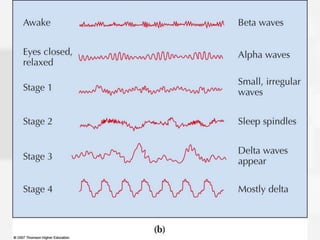
• Beta Waves: Small fast waves associated
with alertness and awakeness
• Alpha Waves: Large, slow waves associated
with relaxation and falling asleep
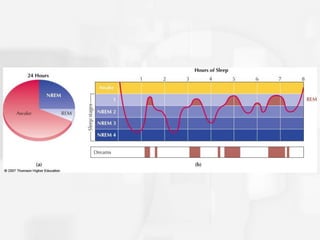
Stages of Sleep
• Stage 1: Small, irregular waves produced in
light sleep (people may or may not say they
were asleep)
– Hypnic Jerk: Reflex muscle twitch
throughout body that may occur in Stage 1
Stage 2
• Deeper sleep; sleep spindles (bursts of
distinctive brain-wave activity) appear
Stage 3
• Deeper sleep; Delta waves appear; very large
and slow
Stage 4
• Deepest level of normal sleep; almost purely
Delta waves
Kinds of Sleep
• Rapid Eye Movements (REM): Associated
with dreaming; sleep is very light
– Body is very still during REM sleep
– Lack of muscle paralysis during REM sleep
is called “REM Behavioral Disorder”
• Non-REM (NREM) Sleep: Occurs during
stages 1, 2, 3, and 4; no rapid eye movement
occurs
– Seems to help us recover from daily
fatigue
Sleep Disturbances
• Insomnia: Difficulty in getting to sleep or
staying asleep, or waking early
– Sleeping pills exacerbate insomnia; cause
decrease in REM and Stage 4 sleep and
may cause dependency
• Drug-Dependency Insomnia: Sleeplessness
that follows withdrawal from sleeping pills
Types and Causes of Insomnia
• Temporary Insomnia: Brief period of
sleeplessness caused by worry, stress, and
excitement.
– Avoid fighting it and read a book, for
example, until you’re struggling to stay
awake.
• Chronic Insomnia: Exists if sleeping troubles
last for more than three weeks.
– Adopt regular schedule; go to bed at the
same time each night, for example.
Sleep Disturbances
• Sleepwalking (Somnambulism): Occurs in
NREM sleep during Stages 3 and 4
• Sleeptalking: Speaking while asleep; occurs
in NREM sleep
Nightmares
• Bad dreams that occur during REM sleep
• Imagery Rehearsal: Mentally rehearse the
changed dream before you go to sleep again;
may help to eliminate nightmares
Night Terrors
• Total panic and hallucinations may occur
– Occurs during Stage 4 sleep
– Most common in childhood; may occur in
adults
Sleep Apnea
• Interrupted breathing during sleep; cause of
very loud snoring
– Hypersomnia: Extreme daytime sleepiness
– Apnea can be treated by
• Surgery
• Weight loss
• Breathing mask
Sudden Infant Death Syndrome
• Also known as SIDS or Crib Death; Sudden,
unexplained death of healthy infant (infants
should sleep on back or on side to try to
prevent)
• SIDS babies have a weak arousal reflex;
prevents them from changing positions and
resuming breathing after an apnea episode
REM Rebound
• Extra rapid eye movement sleep following
REM sleep deprivation
Psychodynamic (Freudian) Theory of
Dreaming
• Emphasizes internal conflicts, motives, and
unconscious forces
• Wish Fulfillment: Freudian belief that many
dreams are expressions of unconscious
desires
– Much evidence to refute this
• Dream Symbols: Images that have a deeper
symbolic meaning
Activation-Synthesis Hypothesis
• Dream content may be affected by motor
commands in the brain (that occur during
sleep) that are not carried out
Hypnosis
• Altered state of consciousness characterized
by intensely narrowed attention and
increased openness to suggestion
– Mesmer: Believed he could cure diseases
by passing magnets over body; true
“animal magnetism” (“mesmerize” means
to hypnotize)
– Must cooperate to become hypnotized
Hidden Observer
• Detached part of hypnotized person’s
awareness that silently observes events
Hypnosis Can
• Help people relax
• Reduce pain
• Get people to make better progress in
therapy
Hypnosis Cannot
• Produce acts of superhuman strength
• Produce age regression
• Force you to do things against your will
Stage Hypnosis
• Simulation of hypnotic effects
Tricks of the Trade
• Waking Suggestibility: People on stage do not
want to spoil the act, so they will follow any
instruction.
• Selection of Responsive Subjects: Any
“volunteer” who does not get hypnotized in
the stage group and does not follow
instructions is “voted off.”
• The Hypnosis Label Disinhibits: On stage,
once you are “in a hypnotic trance,” your
responsibility for actions is removed; you can
do whatever you want!
More Stage Hypnosis “Tricks of the
Trade”
• Hypnotist as Director: Once they are in a
trance, the “volunteers” are suddenly the
show’s stars, and they will act like it. The
hypnotists only need to direct them.
• Stage Hypnotists Use Tricks: Stage hypnosis
is 50% deception and 50% taking advantage
of the situation
More Hypnosis Concepts
• Hypnotic Susceptibility: How easily a person
can be hypnotized
• Basic Suggestion Effect: Tendency of
hypnotized people to carry out suggested
actions as though they were involuntary
Meditation
• Mental exercise designed to produce
relaxation or heightened awareness
• Concentrative Meditation: Attention is paid to
a single focal point (i.e., object, thought, etc.)
– Produces relaxation response and thus
works to reduce stress
• Mindfulness Meditation: Based on widening
attention span to become aware of everything
experienced at a given moment
• Mantra: Word(s) or sound(s) repeated during
concentrative meditation
Relaxation Response
• Occurs at time of relaxation; internal
response that prevents activation of adrenal
glands
Drugs and Altered States of
Consciousness
• Psychoactive Drug: Substance capable of
altering attention, judgment, memory, time
sense, self-control, emotion, or perception
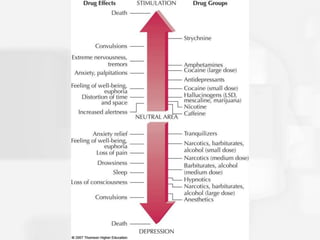
• Stimulant: Substance that increases activity in
body and nervous system
• Depressant: Substance that decreases
activity in body and nervous system
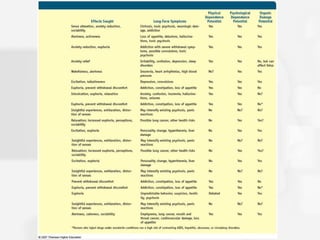
Physical Dependence
• Physical Addiction based on drug tolerance
and withdrawal symptoms
– Drug Tolerance: Reduction in body’s
response to a drug
– Withdrawal Symptoms: Physical illness
following withdrawal of the drug
Psychological Dependence
• Drug dependence based on psychological or
emotional needs
– Usually crave drug
– Can be as powerful as physiological
addiction
Stimulants (Uppers)
• Amphetamines: Synthetic stimulants that
excite the nervous system
– Dexedrine and Methamphetamine are two
types of stimulants
• Amphetamine Psychosis: Loss of contact with
reality because of amphetamine use; user
tends to have paranoid delusions
Cocaine
• Central Nervous System stimulant derived
from leaves of coca plant; also used as local
anesthetic
– From 1886-1906, Coca-Cola did indeed
have cocaine in it!
– Highly addictive drug
– Anhedonia (Inability to Feel Pleasure):
Common after cocaine withdrawal
MDMA (Ecstasy)
• Chemically similar to amphetamine; created
by small variations in a drug’s structure
– Risks of using MDMA are unclear
– May cause severe liver damage
– Repeated use damages serotonergic brain
cells
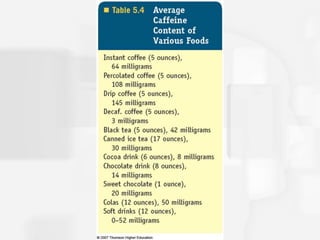
Caffeine
• Most frequently used psychoactive drug in
North America; present in colas, chocolate,
coffee, and tea
• Causes hand tremors, sweating,
talkativeness, tinnitus, suppresses fatigue or
sleepiness, increases alertness
– May be hazardous to pregnant women if
used excessively
Caffeinism
• Physiological dependence on caffeine
– Symptoms: Insomnia, irritability, loss of
appetite, chills, racing heart, elevated body
temperature
Nicotine
• Natural stimulant found mainly in tobacco;
known carcinogen
• May cause stomach pain, vomiting, diarrhea,
confusion, tremors
• Addictive
• Sum: Don’t smoke; smoking kills (so does
chewing tobacco)
Sedatives: Barbiturates
• Sedative drugs that depress brain activity
– Seconal and Amytal are two types
– Easy to overdose
GHB (Gamma-Hydroxybutyrate)
• Central Nervous System (CNS) depressant
that relaxes and sedates; combination of
degreasing solvent and drain cleaner
– Sedative effects may result in nausea, loss
of muscle control, and either sleep or a
loss of consciousness
– Inhibits gag reflex, so some choke to death
on their own vomit
– Addictive and deadly
Sedatives: Tranquilizers
• Lower anxiety and reduce tension
– Valium, Xanax, and Librium are three types
– Rohypnol: Related to Valium; lowers
inhibitions and produces relaxation or
intoxication. Larger doses can induce
short-term amnesia and sleep
• Date rape drug because it’s odorless
and tasteless
• Drug Interaction: One drug increases the
effect of another
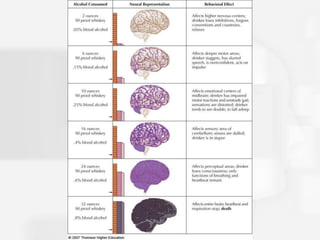
Alcohol
• Ethyl Alcohol: Intoxicating element in
fermented and distilled liquors
– Not a stimulant but does lower inhibitions
– Depressant
• Binge Drinking: Consuming five or more
drinks in a short time; four or more for women
– Serious sign of alcohol abuse
Detoxification
• Withdrawal of the person from alcohol
• Occurs in a medical setting and is tightly
controlled
• Often necessary before long-term treatment
begins
Some Hallucinogens
• Hallucinogen: Substance that alters or
distorts sensory impressions
• Lysergic Acid Diethylamide (LSD):
Hallucinogen that can produce hallucinations
and other psychotic symptoms
• Mescaline (Peyote) and Psilocybin (Magic
Mushrooms)
• PCP (Angel Dust): Initially can have
hallucinogenic effects; also an anesthetic and
has stimulant and depressant effects
Marijuana
• Leaves and flowers of the hemp plant
– Active chemical: THC
– Effects: Relaxation, time distortion,
perceptual distortions
Some Health Risks of Using Marijuana
• Increases risk of a variety of cancers,
including prostate and cervical cancer
• Can suppress immune system, perhaps
increasing risk of disease
• Activity levels in the cerebellum are lower
than normal in pot users
• Pot may damage some of the brain’s memory
centers
CHAPTER 5. CONSCIOUSNESS AND ALTERED STATES.ppt

CHAPTER 5. CONSCIOUSNESS AND ALTERED STATES.ppt

  • 1.
    Chapter 5: Statesof Consciousness
  • 2.
    Some Early Definitions •Consciousness: All the sensations, perceptions, memories, and feelings you are aware of in any instant – Waking Consciousness: Normal, clear, organized, alert awareness • Altered State of Consciousness (ASC): Awareness that is distinctly different in quality or pattern from waking consciousness
  • 3.
    Sleep • Innate, biologicalrhythm • Microsleep: Brief shift in brain-wave patterns similar to those of sleep • Sleep Deprivation: Sleep loss; being deprived of needed amounts of sleep • Sleep-Deprivation Psychosis: Major disruption of mental and emotional functioning that occurs because of sleep loss • Hypersomnia: Excessive daytime sleepiness
  • 5.
    Measuring Sleep Changes •Electroencephalograph (EEG): Brain-wave machine; amplifies and records electrical activity in the brain • Beta Waves: Small fast waves associated with alertness and awakeness • Alpha Waves: Large, slow waves associated with relaxation and falling asleep
  • 6.
    Stages of Sleep •Stage 1: Small, irregular waves produced in light sleep (people may or may not say they were asleep) – Hypnic Jerk: Reflex muscle twitch throughout body that may occur in Stage 1
  • 7.
    Stage 2 • Deepersleep; sleep spindles (bursts of distinctive brain-wave activity) appear
  • 8.
    Stage 3 • Deepersleep; Delta waves appear; very large and slow
  • 9.
    Stage 4 • Deepestlevel of normal sleep; almost purely Delta waves
  • 11.
    Kinds of Sleep •Rapid Eye Movements (REM): Associated with dreaming; sleep is very light – Body is very still during REM sleep – Lack of muscle paralysis during REM sleep is called “REM Behavioral Disorder” • Non-REM (NREM) Sleep: Occurs during stages 1, 2, 3, and 4; no rapid eye movement occurs – Seems to help us recover from daily fatigue
  • 13.
    Sleep Disturbances • Insomnia:Difficulty in getting to sleep or staying asleep, or waking early – Sleeping pills exacerbate insomnia; cause decrease in REM and Stage 4 sleep and may cause dependency • Drug-Dependency Insomnia: Sleeplessness that follows withdrawal from sleeping pills
  • 14.
    Types and Causesof Insomnia • Temporary Insomnia: Brief period of sleeplessness caused by worry, stress, and excitement. – Avoid fighting it and read a book, for example, until you’re struggling to stay awake. • Chronic Insomnia: Exists if sleeping troubles last for more than three weeks. – Adopt regular schedule; go to bed at the same time each night, for example.
  • 15.
    Sleep Disturbances • Sleepwalking(Somnambulism): Occurs in NREM sleep during Stages 3 and 4 • Sleeptalking: Speaking while asleep; occurs in NREM sleep
  • 16.
    Nightmares • Bad dreamsthat occur during REM sleep • Imagery Rehearsal: Mentally rehearse the changed dream before you go to sleep again; may help to eliminate nightmares
  • 17.
    Night Terrors • Totalpanic and hallucinations may occur – Occurs during Stage 4 sleep – Most common in childhood; may occur in adults
  • 18.
    Sleep Apnea • Interruptedbreathing during sleep; cause of very loud snoring – Hypersomnia: Extreme daytime sleepiness – Apnea can be treated by • Surgery • Weight loss • Breathing mask
  • 19.
    Sudden Infant DeathSyndrome • Also known as SIDS or Crib Death; Sudden, unexplained death of healthy infant (infants should sleep on back or on side to try to prevent) • SIDS babies have a weak arousal reflex; prevents them from changing positions and resuming breathing after an apnea episode
  • 20.
    REM Rebound • Extrarapid eye movement sleep following REM sleep deprivation
  • 21.
    Psychodynamic (Freudian) Theoryof Dreaming • Emphasizes internal conflicts, motives, and unconscious forces • Wish Fulfillment: Freudian belief that many dreams are expressions of unconscious desires – Much evidence to refute this • Dream Symbols: Images that have a deeper symbolic meaning
  • 22.
    Activation-Synthesis Hypothesis • Dreamcontent may be affected by motor commands in the brain (that occur during sleep) that are not carried out
  • 23.
    Hypnosis • Altered stateof consciousness characterized by intensely narrowed attention and increased openness to suggestion – Mesmer: Believed he could cure diseases by passing magnets over body; true “animal magnetism” (“mesmerize” means to hypnotize) – Must cooperate to become hypnotized
  • 24.
    Hidden Observer • Detachedpart of hypnotized person’s awareness that silently observes events
  • 25.
    Hypnosis Can • Helppeople relax • Reduce pain • Get people to make better progress in therapy
  • 26.
    Hypnosis Cannot • Produceacts of superhuman strength • Produce age regression • Force you to do things against your will
  • 27.
    Stage Hypnosis • Simulationof hypnotic effects
  • 28.
    Tricks of theTrade • Waking Suggestibility: People on stage do not want to spoil the act, so they will follow any instruction. • Selection of Responsive Subjects: Any “volunteer” who does not get hypnotized in the stage group and does not follow instructions is “voted off.” • The Hypnosis Label Disinhibits: On stage, once you are “in a hypnotic trance,” your responsibility for actions is removed; you can do whatever you want!
  • 29.
    More Stage Hypnosis“Tricks of the Trade” • Hypnotist as Director: Once they are in a trance, the “volunteers” are suddenly the show’s stars, and they will act like it. The hypnotists only need to direct them. • Stage Hypnotists Use Tricks: Stage hypnosis is 50% deception and 50% taking advantage of the situation
  • 30.
    More Hypnosis Concepts •Hypnotic Susceptibility: How easily a person can be hypnotized • Basic Suggestion Effect: Tendency of hypnotized people to carry out suggested actions as though they were involuntary
  • 31.
    Meditation • Mental exercisedesigned to produce relaxation or heightened awareness • Concentrative Meditation: Attention is paid to a single focal point (i.e., object, thought, etc.) – Produces relaxation response and thus works to reduce stress • Mindfulness Meditation: Based on widening attention span to become aware of everything experienced at a given moment • Mantra: Word(s) or sound(s) repeated during concentrative meditation
  • 32.
    Relaxation Response • Occursat time of relaxation; internal response that prevents activation of adrenal glands
  • 33.
    Drugs and AlteredStates of Consciousness • Psychoactive Drug: Substance capable of altering attention, judgment, memory, time sense, self-control, emotion, or perception • Stimulant: Substance that increases activity in body and nervous system • Depressant: Substance that decreases activity in body and nervous system
  • 35.
    Physical Dependence • PhysicalAddiction based on drug tolerance and withdrawal symptoms – Drug Tolerance: Reduction in body’s response to a drug – Withdrawal Symptoms: Physical illness following withdrawal of the drug
  • 36.
    Psychological Dependence • Drugdependence based on psychological or emotional needs – Usually crave drug – Can be as powerful as physiological addiction
  • 37.
    Stimulants (Uppers) • Amphetamines:Synthetic stimulants that excite the nervous system – Dexedrine and Methamphetamine are two types of stimulants • Amphetamine Psychosis: Loss of contact with reality because of amphetamine use; user tends to have paranoid delusions
  • 38.
    Cocaine • Central NervousSystem stimulant derived from leaves of coca plant; also used as local anesthetic – From 1886-1906, Coca-Cola did indeed have cocaine in it! – Highly addictive drug – Anhedonia (Inability to Feel Pleasure): Common after cocaine withdrawal
  • 39.
    MDMA (Ecstasy) • Chemicallysimilar to amphetamine; created by small variations in a drug’s structure – Risks of using MDMA are unclear – May cause severe liver damage – Repeated use damages serotonergic brain cells
  • 40.
    Caffeine • Most frequentlyused psychoactive drug in North America; present in colas, chocolate, coffee, and tea • Causes hand tremors, sweating, talkativeness, tinnitus, suppresses fatigue or sleepiness, increases alertness – May be hazardous to pregnant women if used excessively
  • 41.
    Caffeinism • Physiological dependenceon caffeine – Symptoms: Insomnia, irritability, loss of appetite, chills, racing heart, elevated body temperature
  • 43.
    Nicotine • Natural stimulantfound mainly in tobacco; known carcinogen • May cause stomach pain, vomiting, diarrhea, confusion, tremors • Addictive • Sum: Don’t smoke; smoking kills (so does chewing tobacco)
  • 44.
    Sedatives: Barbiturates • Sedativedrugs that depress brain activity – Seconal and Amytal are two types – Easy to overdose
  • 45.
    GHB (Gamma-Hydroxybutyrate) • CentralNervous System (CNS) depressant that relaxes and sedates; combination of degreasing solvent and drain cleaner – Sedative effects may result in nausea, loss of muscle control, and either sleep or a loss of consciousness – Inhibits gag reflex, so some choke to death on their own vomit – Addictive and deadly
  • 46.
    Sedatives: Tranquilizers • Loweranxiety and reduce tension – Valium, Xanax, and Librium are three types – Rohypnol: Related to Valium; lowers inhibitions and produces relaxation or intoxication. Larger doses can induce short-term amnesia and sleep • Date rape drug because it’s odorless and tasteless • Drug Interaction: One drug increases the effect of another
  • 47.
    Alcohol • Ethyl Alcohol:Intoxicating element in fermented and distilled liquors – Not a stimulant but does lower inhibitions – Depressant • Binge Drinking: Consuming five or more drinks in a short time; four or more for women – Serious sign of alcohol abuse
  • 51.
    Detoxification • Withdrawal ofthe person from alcohol • Occurs in a medical setting and is tightly controlled • Often necessary before long-term treatment begins
  • 52.
    Some Hallucinogens • Hallucinogen:Substance that alters or distorts sensory impressions • Lysergic Acid Diethylamide (LSD): Hallucinogen that can produce hallucinations and other psychotic symptoms • Mescaline (Peyote) and Psilocybin (Magic Mushrooms) • PCP (Angel Dust): Initially can have hallucinogenic effects; also an anesthetic and has stimulant and depressant effects
  • 53.
    Marijuana • Leaves andflowers of the hemp plant – Active chemical: THC – Effects: Relaxation, time distortion, perceptual distortions
  • 54.
    Some Health Risksof Using Marijuana • Increases risk of a variety of cancers, including prostate and cervical cancer • Can suppress immune system, perhaps increasing risk of disease • Activity levels in the cerebellum are lower than normal in pot users • Pot may damage some of the brain’s memory centers