GENERAL
PSYCHOLOGY

CHAPTER II:
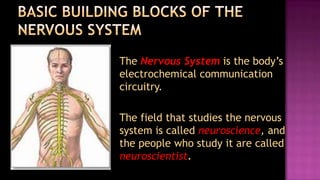
The Nervous System is the body’s
electrochemical communication
circuitry.

The field that studies the nervous
system is called neuroscience, and
the people who study it are called
neuroscientist.
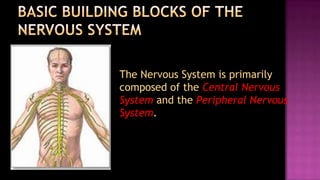
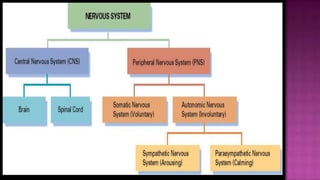
The Nervous System is primarily
composed of the Central Nervous
System and the Peripheral Nervous
System.
1. Complexity
2. Integration
3. Adaptability
4. Electrochemical Transmission
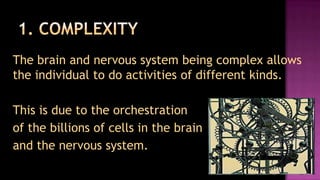
The brain and nervous system being complex allows
the individual to do activities of different kinds.

This is due to the orchestration
of the billions of cells in the brain
and the nervous system.
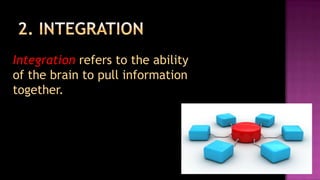
Integration refers to the ability
of the brain to pull information
together.
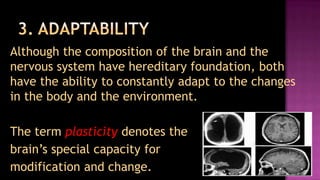
Although the composition of the brain and the
nervous system have hereditary foundation, both
have the ability to constantly adapt to the changes
in the body and the environment.

The term plasticity denotes the
brain’s special capacity for
modification and change.
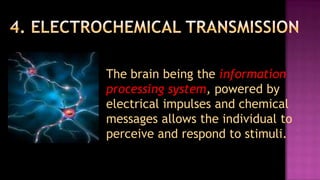
The brain being the information
processing system, powered by
electrical impulses and chemical
messages allows the individual to
perceive and respond to stimuli.
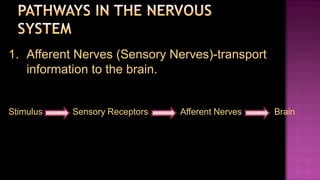
1. Afferent Nerves (Sensory Nerves)-transport
   information to the brain.


Stimulus   Sensory Receptors   Afferent Nerves   Brain
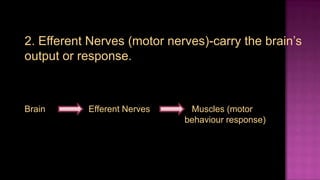
2. Efferent Nerves (motor nerves)-carry the brain’s
output or response.


Brain      Efferent Nerves    Muscles (motor
                             behaviour response)
3. Neural Networks-cluster of neurons that are
interconnected to process information by integrating
sensory input and motor output.
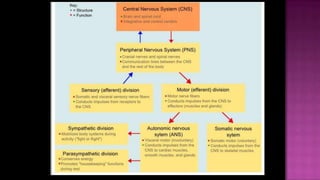
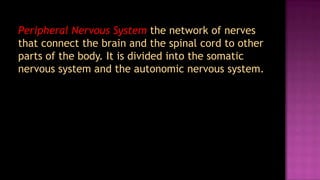
Peripheral Nervous System the network of nerves
that connect the brain and the spinal cord to other
parts of the body. It is divided into the somatic
nervous system and the autonomic nervous system.
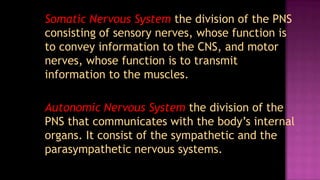
Somatic Nervous System the division of the PNS
consisting of sensory nerves, whose function is
to convey information to the CNS, and motor
nerves, whose function is to transmit
information to the muscles.

Autonomic Nervous System the division of the
PNS that communicates with the body’s internal
organs. It consist of the sympathetic and the
parasympathetic nervous systems.
Sympathetic Nervous System the division of
the autonomic nervous system that arouses
the body.

Parasympathetic Nervous System the
division of the autonomic nervous system
that calms the body.
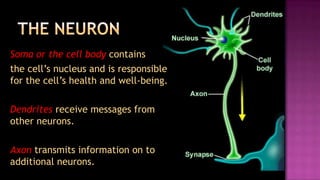
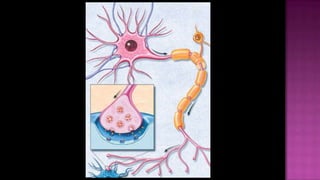
Soma or the cell body contains
the cell’s nucleus and is responsible
for the cell’s health and well-being.

Dendrites receive messages from
other neurons.

Axon transmits information on to
additional neurons.
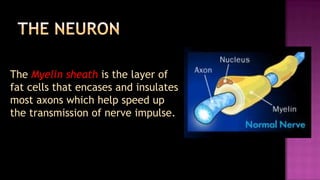
The Myelin sheath is the layer of
fat cells that encases and insulates
most axons which help speed up
the transmission of nerve impulse.
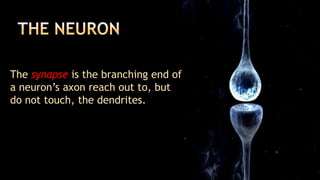
The synapse is the branching end of
a neuron’s axon reach out to, but
do not touch, the dendrites.
1. Acetylcholine (ACh) stimulates the firing of neurons and is involved
in the action of muscles, learning, and memory.

Deficiency in ACh will involve decline in memory storage and
Alzheimer’s disease.

2. Dopamine mainly inhibits and helps control the voluntary movement.

Dopamine affects sleep, mood, attention and learning (mainly in
planning, and the inhibition of irrelevant behaviours and ideas).

3. Serotonin also primarily inhibits. It also regulates sleep and
wakefulness, mood, attention and learning.
4. Gamma Aminobutyric Acid (GABA) helps to control the preciseness of
the signal being carried from one neuron to the next.

Low level of GABA is linked to anxiety.

5. Norepinephrine usually inhibits the firing of neurons in the central
nervous system, but it excites the heart muscle, intestine, and urogenital
tract.

Stress stimulates the release of norepinephrine. Too little norepinephrine is
associated with depression, and too much is linked with agitated and manic
states.
6. Endorphins are natural opiates that mainly stimulates the firing of
neurons. It shields the body from pain and elevates feelings of pleasure.
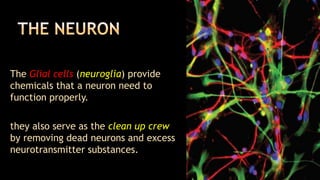
The Glial cells (neuroglia) provide
chemicals that a neuron need to
function properly.

they also serve as the clean up crew
by removing dead neurons and excess
neurotransmitter substances.
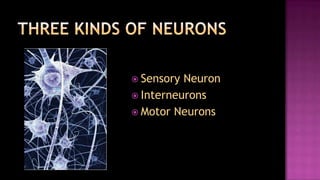
 Sensory Neuron
 Interneurons
 Motor Neurons
Resting Potential-the stable negative charge of
an inactive neuron.

Action Potential-the brief wave of electrical
charge that sweeps down the axon during the
transmission of a nerve impulse.
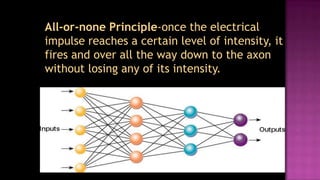
All-or-none Principle-once the electrical
impulse reaches a certain level of intensity, it
fires and over all the way down to the axon
without losing any of its intensity.
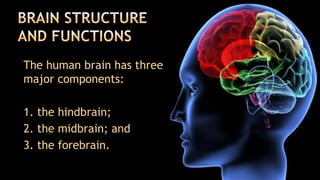
The human brain has three
major components:

1. the hindbrain;
2. the midbrain; and
3. the forebrain.
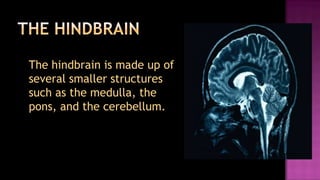
The hindbrain is made up of
several smaller structures
such as the medulla, the
pons, and the cerebellum.
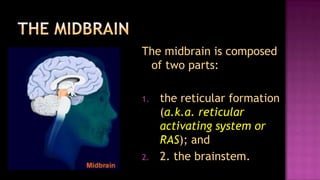
The midbrain is composed
 of two parts:

1.   the reticular formation
     (a.k.a. reticular
     activating system or
     RAS); and
2.   2. the brainstem.
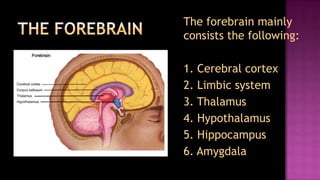
The forebrain mainly
consists the following:

1. Cerebral cortex
2. Limbic system
3. Thalamus
4. Hypothalamus
5. Hippocampus
6. Amygdala
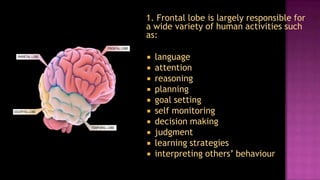
1. Frontal lobe is largely responsible for
a wide variety of human activities such
as:

   language
   attention
   reasoning
   planning
   goal setting
   self monitoring
   decision making
   judgment
   learning strategies
   interpreting others’ behaviour
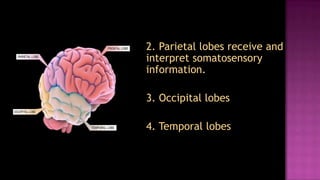
2. Parietal lobes receive and
interpret somatosensory
information.

3. Occipital lobes

4. Temporal lobes
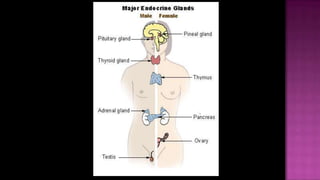
The Endocrine System is a set of glands that regulate the
activities of certain organs by secreting hormones to the
bloodstream.

These hormones are chemical messengers that are
manufactured by the glands in the system. The endocrine
glands include the pituitary, thyroid, parathyroid, and
adrenal glands, the pancreas, ovaries, and testes.
1. Pituitary Gland-is located at the base of the
skull, regulates the secretion of growth hormone and
controls all other endocrine glands. It is known as
the master gland.
The anterior pituitary is controlled by the
hypothalamus.

2. Pineal Gland-also located in the brain, it secretes
the hormone melatonin, which regulates the sleep
and wake cycle.
3. Thyroid Gland-locate inside the neck and
secretes a hormone called thyroxin that regulates
metabolism (how fast the body burns its available
energy).

4. Pancreas-controls the blood sugar level by
secreting the insulin and glucagons.
5. Adrenal Glands-one on top of each
kidney, produces the main hormone cortisol (steroid).
The adrenal glands regulate moods, energy, and the
ability to cope with stress.

They secrete epinephrine (adrenaline) and
norepinephrine (noradrenaline) in response to stress.

6. Gonads-produces sex hormones responsible for
primary and secondary sex characteristics.

biological-bases-of-behavior

  • 1.
  • 2.
    The Nervous Systemis the body’s electrochemical communication circuitry. The field that studies the nervous system is called neuroscience, and the people who study it are called neuroscientist.
  • 3.
    The Nervous Systemis primarily composed of the Central Nervous System and the Peripheral Nervous System.
  • 4.
    1. Complexity 2. Integration 3.Adaptability 4. Electrochemical Transmission
  • 5.
    The brain andnervous system being complex allows the individual to do activities of different kinds. This is due to the orchestration of the billions of cells in the brain and the nervous system.
  • 6.
    Integration refers tothe ability of the brain to pull information together.
  • 7.
    Although the compositionof the brain and the nervous system have hereditary foundation, both have the ability to constantly adapt to the changes in the body and the environment. The term plasticity denotes the brain’s special capacity for modification and change.
  • 8.
    The brain beingthe information processing system, powered by electrical impulses and chemical messages allows the individual to perceive and respond to stimuli.
  • 9.
    1. Afferent Nerves(Sensory Nerves)-transport information to the brain. Stimulus Sensory Receptors Afferent Nerves Brain
  • 10.
    2. Efferent Nerves(motor nerves)-carry the brain’s output or response. Brain Efferent Nerves Muscles (motor behaviour response)
  • 11.
    3. Neural Networks-clusterof neurons that are interconnected to process information by integrating sensory input and motor output.
  • 14.
    Peripheral Nervous Systemthe network of nerves that connect the brain and the spinal cord to other parts of the body. It is divided into the somatic nervous system and the autonomic nervous system.
  • 15.
    Somatic Nervous Systemthe division of the PNS consisting of sensory nerves, whose function is to convey information to the CNS, and motor nerves, whose function is to transmit information to the muscles. Autonomic Nervous System the division of the PNS that communicates with the body’s internal organs. It consist of the sympathetic and the parasympathetic nervous systems.
  • 16.
    Sympathetic Nervous Systemthe division of the autonomic nervous system that arouses the body. Parasympathetic Nervous System the division of the autonomic nervous system that calms the body.
  • 17.
    Soma or thecell body contains the cell’s nucleus and is responsible for the cell’s health and well-being. Dendrites receive messages from other neurons. Axon transmits information on to additional neurons.
  • 18.
    The Myelin sheathis the layer of fat cells that encases and insulates most axons which help speed up the transmission of nerve impulse.
  • 19.
    The synapse isthe branching end of a neuron’s axon reach out to, but do not touch, the dendrites.
  • 21.
    1. Acetylcholine (ACh)stimulates the firing of neurons and is involved in the action of muscles, learning, and memory. Deficiency in ACh will involve decline in memory storage and Alzheimer’s disease. 2. Dopamine mainly inhibits and helps control the voluntary movement. Dopamine affects sleep, mood, attention and learning (mainly in planning, and the inhibition of irrelevant behaviours and ideas). 3. Serotonin also primarily inhibits. It also regulates sleep and wakefulness, mood, attention and learning.
  • 22.
    4. Gamma AminobutyricAcid (GABA) helps to control the preciseness of the signal being carried from one neuron to the next. Low level of GABA is linked to anxiety. 5. Norepinephrine usually inhibits the firing of neurons in the central nervous system, but it excites the heart muscle, intestine, and urogenital tract. Stress stimulates the release of norepinephrine. Too little norepinephrine is associated with depression, and too much is linked with agitated and manic states.
  • 23.
    6. Endorphins arenatural opiates that mainly stimulates the firing of neurons. It shields the body from pain and elevates feelings of pleasure.
  • 24.
    The Glial cells(neuroglia) provide chemicals that a neuron need to function properly. they also serve as the clean up crew by removing dead neurons and excess neurotransmitter substances.
  • 25.
     Sensory Neuron Interneurons  Motor Neurons
  • 26.
    Resting Potential-the stablenegative charge of an inactive neuron. Action Potential-the brief wave of electrical charge that sweeps down the axon during the transmission of a nerve impulse.
  • 27.
    All-or-none Principle-once theelectrical impulse reaches a certain level of intensity, it fires and over all the way down to the axon without losing any of its intensity.
  • 28.
    The human brainhas three major components: 1. the hindbrain; 2. the midbrain; and 3. the forebrain.
  • 29.
    The hindbrain ismade up of several smaller structures such as the medulla, the pons, and the cerebellum.
  • 30.
    The midbrain iscomposed of two parts: 1. the reticular formation (a.k.a. reticular activating system or RAS); and 2. 2. the brainstem.
  • 31.
    The forebrain mainly consiststhe following: 1. Cerebral cortex 2. Limbic system 3. Thalamus 4. Hypothalamus 5. Hippocampus 6. Amygdala
  • 32.
    1. Frontal lobeis largely responsible for a wide variety of human activities such as:  language  attention  reasoning  planning  goal setting  self monitoring  decision making  judgment  learning strategies  interpreting others’ behaviour
  • 33.
    2. Parietal lobesreceive and interpret somatosensory information. 3. Occipital lobes 4. Temporal lobes
  • 35.
    The Endocrine Systemis a set of glands that regulate the activities of certain organs by secreting hormones to the bloodstream. These hormones are chemical messengers that are manufactured by the glands in the system. The endocrine glands include the pituitary, thyroid, parathyroid, and adrenal glands, the pancreas, ovaries, and testes.
  • 37.
    1. Pituitary Gland-islocated at the base of the skull, regulates the secretion of growth hormone and controls all other endocrine glands. It is known as the master gland. The anterior pituitary is controlled by the hypothalamus. 2. Pineal Gland-also located in the brain, it secretes the hormone melatonin, which regulates the sleep and wake cycle.
  • 38.
    3. Thyroid Gland-locateinside the neck and secretes a hormone called thyroxin that regulates metabolism (how fast the body burns its available energy). 4. Pancreas-controls the blood sugar level by secreting the insulin and glucagons.
  • 39.
    5. Adrenal Glands-oneon top of each kidney, produces the main hormone cortisol (steroid). The adrenal glands regulate moods, energy, and the ability to cope with stress. They secrete epinephrine (adrenaline) and norepinephrine (noradrenaline) in response to stress. 6. Gonads-produces sex hormones responsible for primary and secondary sex characteristics.