Myers’  EXPLORING   PSYCHOLOGY   (6th Ed) Chapter 6 States of Consciousness James A. McCubbin, PhD Clemson University Worth Publishers
Waking Consciousness Consciousness our awareness of ourselves and our environments Selective Attention focusing of conscious awareness on a particular stimulus
Sleep and Dreams Circadian Rhythm   the biological clock regular bodily rhythms, such as of wakefulness and body temperature, that occur on a 24-hour cycle
Sleep and Dreams REM  ( R apid  E ye  M ovement)  Sleep   recurring sleep stage  vivid dreams “ paradoxical sleep”   muscles are generally relaxed, but other body systems are active Sleep periodic, natural, reversible loss of consciousness
Sleep and Dreams Measuring sleep activity
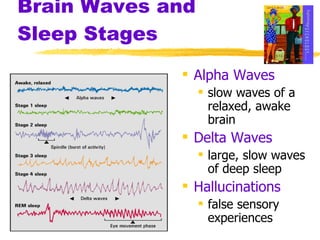
Brain Waves and Sleep Stages Alpha Waves slow waves of a relaxed, awake brain Delta Waves large, slow waves of deep sleep  Hallucinations false sensory experiences
Stages in a Typical Night’s Sleep 0 1 2 3 4 5 6 7 4 3 2 1 Sleep stages Awake Hours of sleep REM
Stages in a Typical Night’s Sleep Hours of sleep Minutes of  Stage 4 and  REM 1 2 3 4 5 6 7 8 0 10 15 20 25 5 Decreasing  Stage 4 Increasing  REM
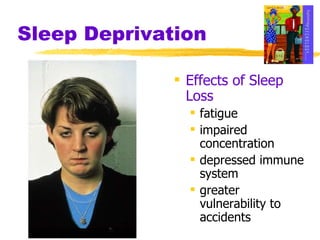
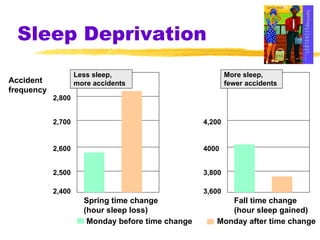
Sleep Deprivation Effects of Sleep Loss fatigue impaired concentration depressed immune system greater vulnerability to accidents
Sleep Deprivation 2,400 2,700 2,600 2,500 2,800 Spring time change (hour sleep loss) 3,600 4,200 4000 3,800 Fall time change (hour sleep gained) Less sleep, more accidents More sleep, fewer accidents Monday before time change Monday after time change Accident  frequency
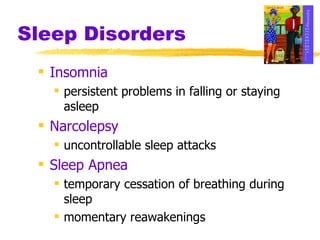
Sleep Disorders Insomnia persistent problems in falling or staying asleep Narcolepsy uncontrollable sleep attacks Sleep Apnea temporary cessation of breathing during sleep momentary reawakenings
Night Terrors and Nightmares Night Terrors occur within 2 or 3 hours of falling asleep, usually during Stage 4 high arousal - appearance of being terrified seldom remembered
Dreams: Freud Dreams sequence of images, emotions, and thoughts passing through a sleeping person’s mind hallucinatory imagery discontinuities incongruities delusional acceptance of the content difficulties remembering
Dreams: Freud Sigmund Freud -- The Interpretation of Dreams  (1900) wish fulfillment  discharge otherwise unacceptable feelings Manifest Content remembered story line Latent Content underlying meaning
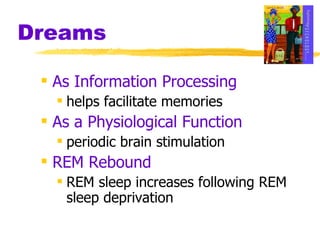
Dreams As Information Processing helps facilitate memories As a Physiological Function periodic brain stimulation REM Rebound REM sleep increases following REM sleep deprivation
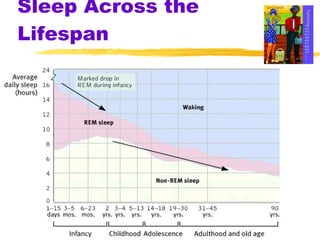
Sleep Across the Lifespan
Hypnosis Hypnosis a social interaction in which one person (the hypnotist) suggests to another (the subject) that certain perceptions, feelings, thoughts, or behaviors will spontaneously occur
Hypnosis Posthypnotic Amnesia supposed inability to recall what one experienced during hypnosis induced by the hypnotist’s suggestion
Hypnosis Orne & Evans (1965) hypnotized group told to dip hand in fake acid, then throw the “acid” in assistant’s face control group instructed to “pretend” unhypnotized subjects performed the same acts as the hypnotized ones
Hypnosis Posthypnotic Suggestion   suggestion to be carried out after the subject is no longer hypnotized used by some clinicians to help control undesired symptoms and behaviors
Hypnosis Dissociation a split in consciousness allows some thoughts and behaviors to occur simultaneously with others Hidden Observer Hilgard’s term describing a hypnotized subject’s awareness of experiences, such as pain, that go unreported during hypnosis
Explaining Hypnosis
Drugs and Consciousness Psychoactive Drug a chemical substance that alters perceptions and mood Physical Dependence   physiological need for a drug marked by unpleasant withdrawal symptoms Psychological Dependence a psychological need to use a drug for example, to relieve negative emotions
Dependence and Addiction Tolerance diminishing effect with regular use Withdrawal discomfort and distress that follow discontinued use   Small Large Drug dose Little effect Big effect Drug effect Response to first exposure After repeated exposure, more drug is needed to produce  same effect
Psychoactive Drugs Depressants drugs that reduce neural activity alcohol, barbiturates, opiates slow body functions
Psychoactive Drugs Alcohol affects motor skills, judgment, and memory reduces self awareness Barbiturates drugs that depress the activity of the central nervous system, reducing anxiety but impairing memory and judgment
Psychoactive Drugs Opiates opium and its derivatives (morphine and heroin) opiates depress neural activity, temporarily lessening pain and anxiety highly addictive
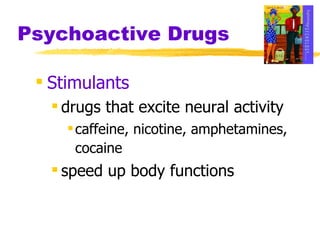
Psychoactive Drugs Stimulants drugs that excite neural activity  caffeine, nicotine, amphetamines, cocaine   speed up body functions
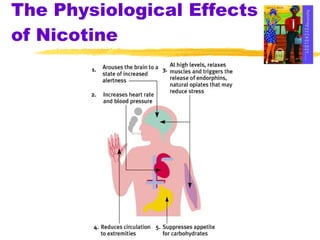
The Physiological Effects of Nicotine
Psychoactive Drugs Amphetamines drugs that stimulate neural activity, causing speeded-up body functions and associated energy and mood changes
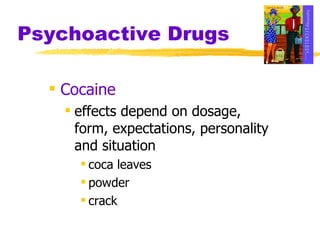
Psychoactive Drugs Cocaine effects depend on dosage, form, expectations, personality and situation coca leaves powder crack
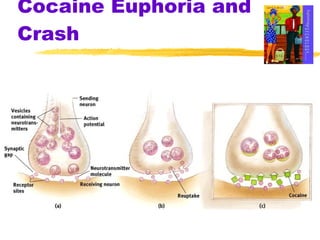
Cocaine Euphoria and Crash
Psychoactive Drugs Ecstasy MDMA (methylenedioxymethamphetamine) stimulant and mild hallucinogen dangerous short and long term effects
Psychoactive Drugs Hallucinogens psychedelic (mind-manifesting) drugs that distort perceptions and evoke sensory images in the absence of sensory input LSD MDMA (Ecstasy)
Psychoactive Drugs LSD   lysergic acid diethylamide a powerful hallucinogenic drug also known as acid THC the major active ingredient in marijuana triggers a variety of effects, including mild hallucinations
Psychoactive Drugs
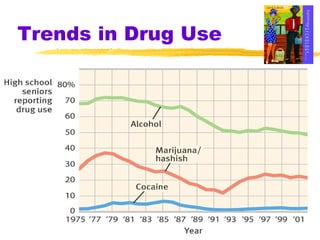
Trends in Drug Use
Perceived Marijuana Risk
Near-Death Experiences Near-Death Experience an altered state of consciousness reported after a close brush with death often similar to drug-induced hallucinations

Ch6

  • 1.
    Myers’ EXPLORING PSYCHOLOGY (6th Ed) Chapter 6 States of Consciousness James A. McCubbin, PhD Clemson University Worth Publishers
  • 2.
    Waking Consciousness Consciousnessour awareness of ourselves and our environments Selective Attention focusing of conscious awareness on a particular stimulus
  • 3.
    Sleep and DreamsCircadian Rhythm the biological clock regular bodily rhythms, such as of wakefulness and body temperature, that occur on a 24-hour cycle
  • 4.
    Sleep and DreamsREM ( R apid E ye M ovement) Sleep recurring sleep stage vivid dreams “ paradoxical sleep” muscles are generally relaxed, but other body systems are active Sleep periodic, natural, reversible loss of consciousness
  • 5.
    Sleep and DreamsMeasuring sleep activity
  • 6.
    Brain Waves andSleep Stages Alpha Waves slow waves of a relaxed, awake brain Delta Waves large, slow waves of deep sleep Hallucinations false sensory experiences
  • 7.
    Stages in aTypical Night’s Sleep 0 1 2 3 4 5 6 7 4 3 2 1 Sleep stages Awake Hours of sleep REM
  • 8.
    Stages in aTypical Night’s Sleep Hours of sleep Minutes of Stage 4 and REM 1 2 3 4 5 6 7 8 0 10 15 20 25 5 Decreasing Stage 4 Increasing REM
  • 9.
    Sleep Deprivation Effectsof Sleep Loss fatigue impaired concentration depressed immune system greater vulnerability to accidents
  • 10.
    Sleep Deprivation 2,4002,700 2,600 2,500 2,800 Spring time change (hour sleep loss) 3,600 4,200 4000 3,800 Fall time change (hour sleep gained) Less sleep, more accidents More sleep, fewer accidents Monday before time change Monday after time change Accident frequency
  • 11.
    Sleep Disorders Insomniapersistent problems in falling or staying asleep Narcolepsy uncontrollable sleep attacks Sleep Apnea temporary cessation of breathing during sleep momentary reawakenings
  • 12.
    Night Terrors andNightmares Night Terrors occur within 2 or 3 hours of falling asleep, usually during Stage 4 high arousal - appearance of being terrified seldom remembered
  • 13.
    Dreams: Freud Dreamssequence of images, emotions, and thoughts passing through a sleeping person’s mind hallucinatory imagery discontinuities incongruities delusional acceptance of the content difficulties remembering
  • 14.
    Dreams: Freud SigmundFreud -- The Interpretation of Dreams (1900) wish fulfillment discharge otherwise unacceptable feelings Manifest Content remembered story line Latent Content underlying meaning
  • 15.
    Dreams As InformationProcessing helps facilitate memories As a Physiological Function periodic brain stimulation REM Rebound REM sleep increases following REM sleep deprivation
  • 16.
  • 17.
    Hypnosis Hypnosis asocial interaction in which one person (the hypnotist) suggests to another (the subject) that certain perceptions, feelings, thoughts, or behaviors will spontaneously occur
  • 18.
    Hypnosis Posthypnotic Amnesiasupposed inability to recall what one experienced during hypnosis induced by the hypnotist’s suggestion
  • 19.
    Hypnosis Orne &Evans (1965) hypnotized group told to dip hand in fake acid, then throw the “acid” in assistant’s face control group instructed to “pretend” unhypnotized subjects performed the same acts as the hypnotized ones
  • 20.
    Hypnosis Posthypnotic Suggestion suggestion to be carried out after the subject is no longer hypnotized used by some clinicians to help control undesired symptoms and behaviors
  • 21.
    Hypnosis Dissociation asplit in consciousness allows some thoughts and behaviors to occur simultaneously with others Hidden Observer Hilgard’s term describing a hypnotized subject’s awareness of experiences, such as pain, that go unreported during hypnosis
  • 22.
  • 23.
    Drugs and ConsciousnessPsychoactive Drug a chemical substance that alters perceptions and mood Physical Dependence physiological need for a drug marked by unpleasant withdrawal symptoms Psychological Dependence a psychological need to use a drug for example, to relieve negative emotions
  • 24.
    Dependence and AddictionTolerance diminishing effect with regular use Withdrawal discomfort and distress that follow discontinued use Small Large Drug dose Little effect Big effect Drug effect Response to first exposure After repeated exposure, more drug is needed to produce same effect
  • 25.
    Psychoactive Drugs Depressantsdrugs that reduce neural activity alcohol, barbiturates, opiates slow body functions
  • 26.
    Psychoactive Drugs Alcoholaffects motor skills, judgment, and memory reduces self awareness Barbiturates drugs that depress the activity of the central nervous system, reducing anxiety but impairing memory and judgment
  • 27.
    Psychoactive Drugs Opiatesopium and its derivatives (morphine and heroin) opiates depress neural activity, temporarily lessening pain and anxiety highly addictive
  • 28.
    Psychoactive Drugs Stimulantsdrugs that excite neural activity caffeine, nicotine, amphetamines, cocaine speed up body functions
  • 29.
  • 30.
    Psychoactive Drugs Amphetaminesdrugs that stimulate neural activity, causing speeded-up body functions and associated energy and mood changes
  • 31.
    Psychoactive Drugs Cocaineeffects depend on dosage, form, expectations, personality and situation coca leaves powder crack
  • 32.
  • 33.
    Psychoactive Drugs EcstasyMDMA (methylenedioxymethamphetamine) stimulant and mild hallucinogen dangerous short and long term effects
  • 34.
    Psychoactive Drugs Hallucinogenspsychedelic (mind-manifesting) drugs that distort perceptions and evoke sensory images in the absence of sensory input LSD MDMA (Ecstasy)
  • 35.
    Psychoactive Drugs LSD lysergic acid diethylamide a powerful hallucinogenic drug also known as acid THC the major active ingredient in marijuana triggers a variety of effects, including mild hallucinations
  • 36.
  • 37.
  • 38.
  • 39.
    Near-Death Experiences Near-DeathExperience an altered state of consciousness reported after a close brush with death often similar to drug-induced hallucinations