The Synopsis of the
Existence of God
From reasoning about
the world of things
around us
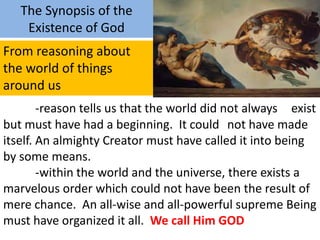
-reason tells us that the world did not always exist
but must have had a beginning. It could not have made
itself. An almighty Creator must have called it into being
by some means.
-within the world and the universe, there exists a
marvelous order which could not have been the result of
mere chance. An all-wise and all-powerful supreme Being
must have organized it all. We call Him GOD
Greek word, “apokalypsis”

-to remove the “veil”
-to uncover
DIVINE
“Divine revelation is God’s personal
loving communication to us of who He
is and His plan to save us all in His love.
It is God’s reaching out to us in
friendship, so we get to know and love
Him.” (CFC101)
“All revelation is symbolic.” (R. Haight)
“Revelatory symbols are those which express and
mediate God’s self-communication.” (A. Dulles)
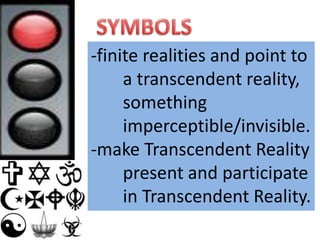
-finite realities and point to
a transcendent reality,
something
imperceptible/invisible.
-make Transcendent Reality
present and participate
in Transcendent Reality.
1.) The Transcendent Reality can be
expressed through various symbols.
-each symbol will not be able
to contain the full reality.
-we do not have direct access
to God but all these symbols
(Scriptures, nature, any finite
reality) mediate God’s
presence to us.
-symbols express more than what they are or
they seem to hold because they point to, by
participating it, God’s reality.
2.) Every claim that symbol is more
than what it is or makes the
divine present is a confessional
statement.
-it is not open to empirical
science.
3.) How God Reveals Himself.
a.) Natural Signs
-creating us, everything
we see, hear, touch.
-God’s first manifestation
is in creation.
“The created universe constitutes a first presence
and a first manifestation of God’s permanent
testimony of Himself to humanity inscribed in the
universe he has created.” (Rom 1:19-20; DV 3)
3.) How God Reveals Himself.
b.) Biblical Signs
-words and deeds in
scriptures, completed and
perfected in Jesus Christ.
c.) Ecclesial signs
-continuing presence by the Holy Spirit in
His people, the Church.
d.) Liturgical signs
-prayer and sacramental worship, doctrine
and moral service of the Church.
3.) How God Reveals Himself
e.) Grace in our conscience
-God’s interior presence
f.) Signs of the Times
-daily events in history
The Christian Idea of God
**reference- CFC 73, 102
4.) Jesus is the symbol of God
a.) “Christianity is the most
incarnational faith” (K.
Rahner)
-He has made the
invisible God visible.
b.) Jesus Christ is the “completion and perfection
of Divine Revelation. (DV4)
b.1)The Risen Christ is the unique, irrevocable
and definitive revelation of God. (CFC70)
4.) Jesus is the symbol of God
b.2) For Christians, Jesus is:
i.) The Revealer of the
Father
ii.) Himself, the image and
Word of God

iii.) The Final Goal of God’s Revelation, our
ultimate destiny.
4.) Jesus is the symbol of God
b.3) Christ is the goal, content
and the agent of God’s
self-revelation
i.) As Goal: Jesus is the key,
the center and the
purpose of the whole of
human history (GS 10) in whose image we
are to be conformed (Rom 8:29).
4.) Jesus is the symbol of God
ii.) As content: Jesus is the
revealed one.
-Christ, the new Adam, in
the very revelation of the
mystery of the Father and
His love, fully reveals man
to himself and brings to
light his highest calling.
(GS 22)
4.) Jesus is the symbol of God
iii.) As agent: Jesus is the
mediator (DV2).
-Christ is the revealer
through his part in
creation, through his
becoming man, through
his hidden and public life, and especially
through his passion, death and resurrection.
-after his resurrection, the Risen Christ
continues his revelation by sending us his
Holy Spirit. (DV4)
In what particular symbol God has
chosen to reveal Himself to you? What
do you think is the reason why God
chooses that symbol to reveal Himself
to you?

2nd lesson god_s_revelation_ppt

  • 1.
    The Synopsis ofthe Existence of God From reasoning about the world of things around us -reason tells us that the world did not always exist but must have had a beginning. It could not have made itself. An almighty Creator must have called it into being by some means. -within the world and the universe, there exists a marvelous order which could not have been the result of mere chance. An all-wise and all-powerful supreme Being must have organized it all. We call Him GOD
  • 3.
    Greek word, “apokalypsis” -toremove the “veil” -to uncover
  • 4.
  • 5.
    “Divine revelation isGod’s personal loving communication to us of who He is and His plan to save us all in His love. It is God’s reaching out to us in friendship, so we get to know and love Him.” (CFC101) “All revelation is symbolic.” (R. Haight) “Revelatory symbols are those which express and mediate God’s self-communication.” (A. Dulles)
  • 6.
    -finite realities andpoint to a transcendent reality, something imperceptible/invisible. -make Transcendent Reality present and participate in Transcendent Reality.
  • 7.
    1.) The TranscendentReality can be expressed through various symbols. -each symbol will not be able to contain the full reality. -we do not have direct access to God but all these symbols (Scriptures, nature, any finite reality) mediate God’s presence to us. -symbols express more than what they are or they seem to hold because they point to, by participating it, God’s reality.
  • 8.
    2.) Every claimthat symbol is more than what it is or makes the divine present is a confessional statement. -it is not open to empirical science.
  • 9.
    3.) How GodReveals Himself. a.) Natural Signs -creating us, everything we see, hear, touch. -God’s first manifestation is in creation. “The created universe constitutes a first presence and a first manifestation of God’s permanent testimony of Himself to humanity inscribed in the universe he has created.” (Rom 1:19-20; DV 3)
  • 10.
    3.) How GodReveals Himself. b.) Biblical Signs -words and deeds in scriptures, completed and perfected in Jesus Christ. c.) Ecclesial signs -continuing presence by the Holy Spirit in His people, the Church. d.) Liturgical signs -prayer and sacramental worship, doctrine and moral service of the Church.
  • 11.
    3.) How GodReveals Himself e.) Grace in our conscience -God’s interior presence f.) Signs of the Times -daily events in history The Christian Idea of God **reference- CFC 73, 102
  • 12.
    4.) Jesus isthe symbol of God a.) “Christianity is the most incarnational faith” (K. Rahner) -He has made the invisible God visible. b.) Jesus Christ is the “completion and perfection of Divine Revelation. (DV4) b.1)The Risen Christ is the unique, irrevocable and definitive revelation of God. (CFC70)
  • 13.
    4.) Jesus isthe symbol of God b.2) For Christians, Jesus is: i.) The Revealer of the Father ii.) Himself, the image and Word of God iii.) The Final Goal of God’s Revelation, our ultimate destiny.
  • 14.
    4.) Jesus isthe symbol of God b.3) Christ is the goal, content and the agent of God’s self-revelation i.) As Goal: Jesus is the key, the center and the purpose of the whole of human history (GS 10) in whose image we are to be conformed (Rom 8:29).
  • 15.
    4.) Jesus isthe symbol of God ii.) As content: Jesus is the revealed one. -Christ, the new Adam, in the very revelation of the mystery of the Father and His love, fully reveals man to himself and brings to light his highest calling. (GS 22)
  • 16.
    4.) Jesus isthe symbol of God iii.) As agent: Jesus is the mediator (DV2). -Christ is the revealer through his part in creation, through his becoming man, through his hidden and public life, and especially through his passion, death and resurrection. -after his resurrection, the Risen Christ continues his revelation by sending us his Holy Spirit. (DV4)
  • 17.
    In what particularsymbol God has chosen to reveal Himself to you? What do you think is the reason why God chooses that symbol to reveal Himself to you?