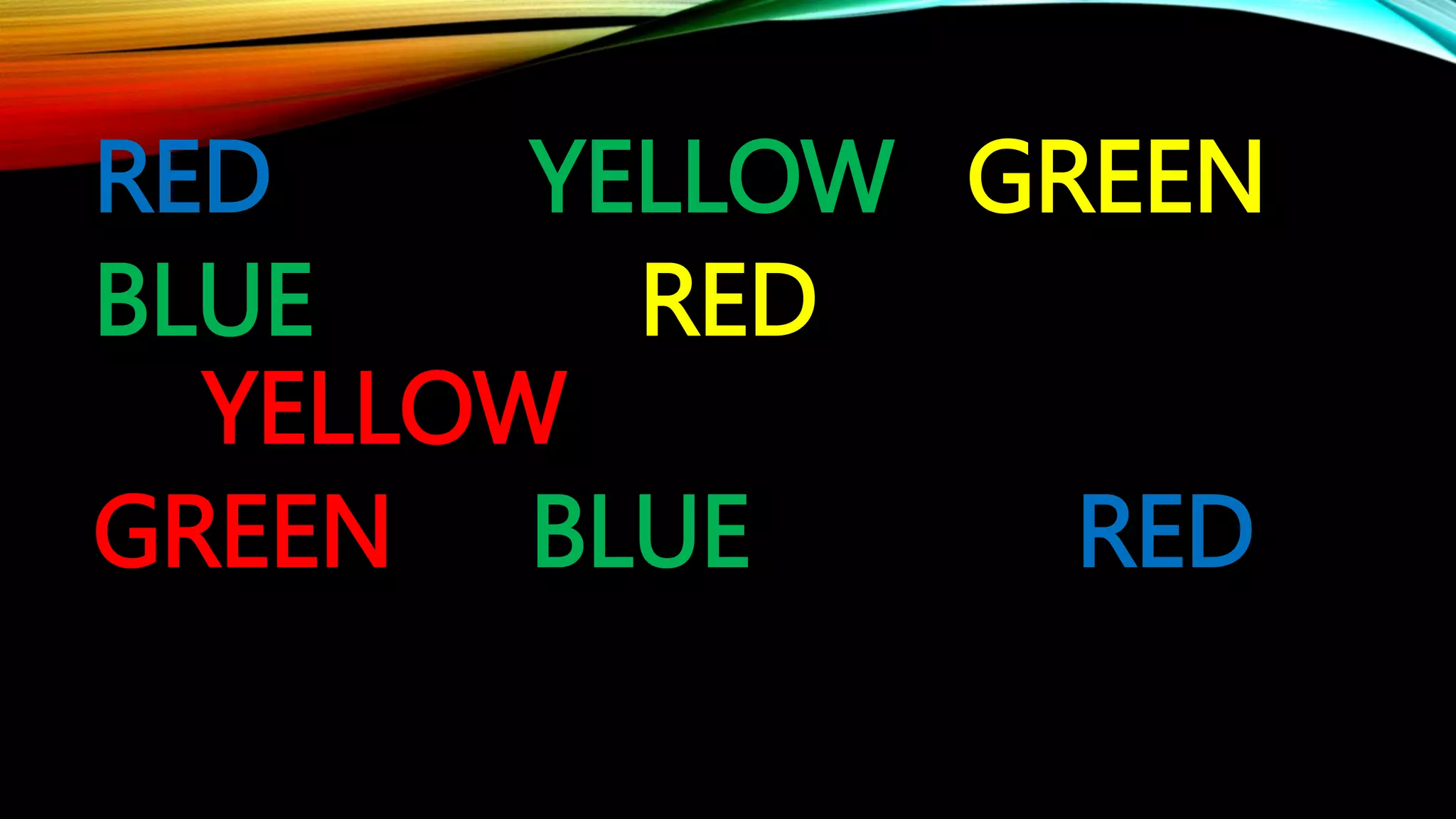
RED YELLOW GREEN
BLUE RED
YELLOW
GREEN BLUE RED
CONSCIOUSNESS
CONSCIOUSNESS
William James (1890):
Consciousness is a constantly moving stream of
thoughts, feelings, and emotions
Consciousness can be viewed as our subjective
awareness of mental events
Functions of consciousness:
Monitoring mental events
Control: consciousness allows us to formulate and
reach goals
GENERAL SIGNS OF AN ALTERED
STATE OF CONSCIOUSNESS
• Alterations in thinking:
attention/concentration/memory/judgment, trouble
distinguishing between cause and effect
• Disturbed time sense: time ceases to exist or goes by very
quickly/very slowly. (Dreams)
• Loss of control: feeling helpless. (Need to do things, but
just can’t – Left Hemisphere jumping in – something is
wrong!)
GENERAL SIGNS OF AN ALTERED
STATE OF CONSCIOUSNESS
• Change in emotional expression: emotional extremes or
becoming detached/expressionless.
• Body image change: Boundaries between oneself and
one’s environment is blurred. Parts of the body may seem
strange/heavy/awkward.
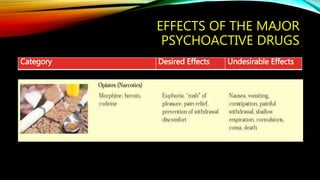
• Perceptual distortions: “Seeing” sound, “Hearing” color,
also hallucinations.
GENERAL SIGNS OF AN ALTERED
STATE OF CONSCIOUSNESS
• Attaching increased meaning to experiences: Things
become so profound!
• Sense of the ineffable: Amnesia/vivid memories/inability
to describe experiences to someone who has not
undergone something similar
• Feelings of rejuvenation: hope/feeling light, free euphoric.
Also, becoming hyper-suggestible. In Hypnotism, this the
ideal state of the “Hypnotee”
ALTERED STATE OF CONSCIOUSNESS
• Sensory Deprivation or constant exposure to repetitive
actions: Solitary Confinement and “Assembly-line”
daydreaming
• Sensory Overload: Opposite of the above, brought on by
sports/ecstatic dancing/chanting, extreme pain, getting
“all worked up” via sounds, smells, sights.
• Continuous focus over long periods of time: Study/work
for hours on end, mind may wander/dream.
ALTERED STATE OF CONSCIOUSNESS
• Decreased alertness: “Emptying the mind”, meditation,
conscious relaxing of the muscles.
• Alterations to the Nervous System: Dehydration, sleep
deprivation, hyperventilation, temporal lobe seizures (like
video), recreational/prescribed drugs (e.g.
Weed/Vicodin/Morphine)
10 FACTS ABOUT SLEEP
STAGES OF SLEEP
• NREM (Non-Rapid-Eye-Movement) Sleep:
• Stage 1 (lightest sleep)
• Stage 2 (deeper sleep)
• Stages 3 and 4 (deepest sleep)
• REM (Rapid-Eye-Movement) Sleep:
• Light sleep (also called paradoxical sleep)
NREM (NON-REM) SLEEP:
• includes Stages 1 through 4
• involves lower-frequency brain waves, decreased pulse
and breathing, and occasional, simple dreams
REM (RAPID-EYE-MOVEMENT) SLEEP:
• also known as paradoxical sleep
• involves high-frequency brain waves, increased pulse
and breathing, large muscle .
• serves a biological need.
• may play a role in learning and consolidating new
memories.
SLEEP DISORDERS
• Insomnia
• Condition of not being able to sleep
• Natural Remedies
• Exercise
• Avoid caffeine (including chocolate)
• Dimmer lights
• Avoid naps
• Wake at same time each day
SLEEP DISORDERS
• Narcolepsy
• uncontrollable sleep attacks
• sudden and irresistible onsets of sleep during normal
waking hours
• Hypersomnia
• 12-14 hours per day plus nap
SLEEP DISORDER
• Sleep Apnea
• intermittently stop breathing during sleep
• frequent momentary awakenings
• usually unaware of these episodes
• Night Terrors
• mostly seen in children
• appearance of being terrified (fast heart rate)
• occur during Stage 4
• not remembered when the child awakes
SLEEP DISORDER
Nightmares
• anxiety-arousing dreams occurring near the end of sleep,
during REM sleep
SLEEP DISORDER
Sleep Walking/Talking/Eating
• occur during Stage 4 (non-REM) Sleep
• runs in families
• more common in childhood
• usually harmless
• not remembered the next morning
HYPNOSIS
• Altered state of consciousness characterized by intensely
narrowed attention and increased openness to
suggestion
• Mesmer: Believed he could cure diseases by passing
magnets over body; true “animal magnetism”
(“mesmerize” means to hypnotize)
• Must cooperate to become hypnotized
HYPNOSIS
• “Acid” Study (Orne & Evans, 1965)
• hypnotized subjects told to plunge hand into “acid” &
throw it in researcher’s face
• Next day: denied they would follow such commands
• control group: told to “pretend” they were hypnotized
• unhypnotized subjects performed the same acts as the
hypnotized ones
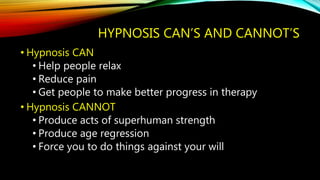
HYPNOSIS CAN’S AND CANNOT’S
• Hypnosis CAN
• Help people relax
• Reduce pain
• Get people to make better progress in therapy
• Hypnosis CANNOT
• Produce acts of superhuman strength
• Produce age regression
• Force you to do things against your will
HYPNOSIS
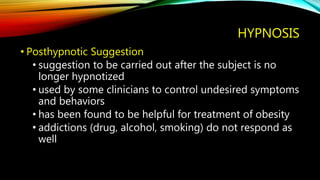
• Posthypnotic Suggestion
• suggestion to be carried out after the subject is no
longer hypnotized
• used by some clinicians to control undesired symptoms
and behaviors
• has been found to be helpful for treatment of obesity
• addictions (drug, alcohol, smoking) do not respond as
well
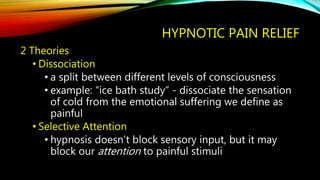
HYPNOTIC PAIN RELIEF
2 Theories
• Dissociation
• a split between different levels of consciousness
• example: “ice bath study” - dissociate the sensation
of cold from the emotional suffering we define as
painful
• Selective Attention
• hypnosis doesn’t block sensory input, but it may
block our attention to painful stimuli
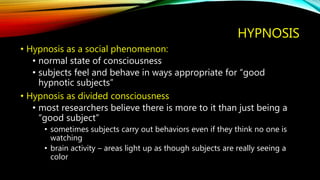
HYPNOSIS
• Hypnosis as a social phenomenon:
• normal state of consciousness
• subjects feel and behave in ways appropriate for “good
hypnotic subjects”
• Hypnosis as divided consciousness
• most researchers believe there is more to it than just being a
“good subject”
• sometimes subjects carry out behaviors even if they think no one is
watching
• brain activity – areas light up as though subjects are really seeing a
color
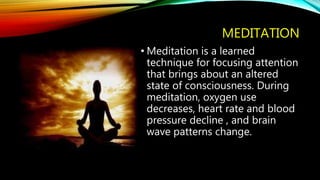
MEDITATION
• Meditation is a learned
technique for focusing attention
that brings about an altered
state of consciousness. During
meditation, oxygen use
decreases, heart rate and blood
pressure decline , and brain
wave patterns change.
MANY FORMS OF MEDITATION
• Yoga
• Breathing
• Repeating Mantra
WHY MEDITATION?
The key to meditation is to concentrate so thoroughly that
the mediator reaches a different state of consciousness.
When a person is overwhelmed with stress, life, kids, work,
or anything that is making them edgy they can meditate to
relieve stress.
BENEFITS OF MEDITATION
After meditation people often report feeling thoroughly
relaxed.
They sometimes relate that they have gained new insights
into themselves and their problems.
Long term practice if meditation may even improve health
because of physiological changes it produces.
PSYCHOACTIVE DRUGS
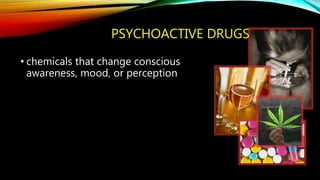
• chemicals that change conscious
awareness, mood, or perception
PSYCHOACTIVE DRUGS
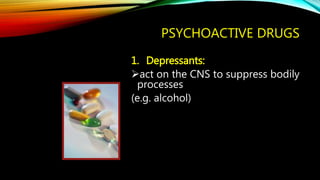
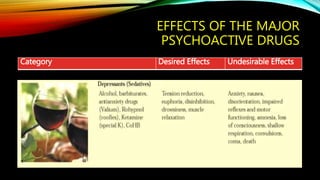
1. Depressants:
act on the CNS to suppress bodily
processes
(e.g. alcohol)
PSYCHOACTIVE DRUGS:
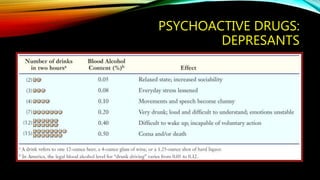
DEPRESANTS
PSYCHOACTIVE DRUGS:
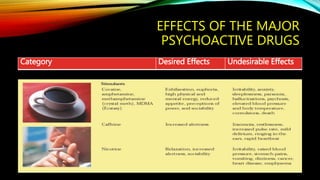
STIMULANTS
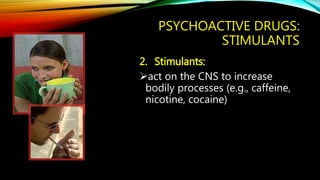
2. Stimulants:
act on the CNS to increase
bodily processes (e.g., caffeine,
nicotine, cocaine)
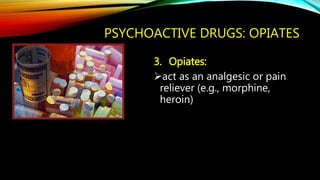
PSYCHOACTIVE DRUGS: OPIATES
3. Opiates:
act as an analgesic or pain
reliever (e.g., morphine,
heroin)
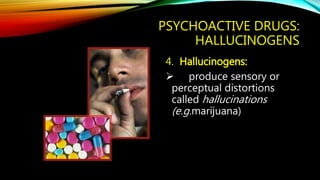
PSYCHOACTIVE DRUGS:
HALLUCINOGENS
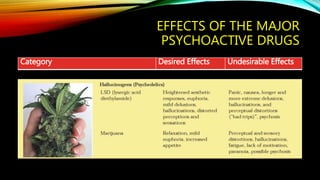
4. Hallucinogens:
 produce sensory or
perceptual distortions
called hallucinations
(e.g.marijuana)
EFFECTS OF THE MAJOR
PSYCHOACTIVE DRUGS
Category Desired Effects Undesirable Effects
EFFECTS OF THE MAJOR
PSYCHOACTIVE DRUGS
Category Desired Effects Undesirable Effects
EFFECTS OF THE MAJOR
PSYCHOACTIVE DRUGS
Category Desired Effects Undesirable Effects
EFFECTS OF THE MAJOR
PSYCHOACTIVE DRUGS
Category Desired Effects Undesirable Effects
Thank you for
listening.

Consciousness

  • 1.
    RED YELLOW GREEN BLUERED YELLOW GREEN BLUE RED
  • 2.
  • 3.
    CONSCIOUSNESS William James (1890): Consciousnessis a constantly moving stream of thoughts, feelings, and emotions Consciousness can be viewed as our subjective awareness of mental events Functions of consciousness: Monitoring mental events Control: consciousness allows us to formulate and reach goals
  • 4.
    GENERAL SIGNS OFAN ALTERED STATE OF CONSCIOUSNESS • Alterations in thinking: attention/concentration/memory/judgment, trouble distinguishing between cause and effect • Disturbed time sense: time ceases to exist or goes by very quickly/very slowly. (Dreams) • Loss of control: feeling helpless. (Need to do things, but just can’t – Left Hemisphere jumping in – something is wrong!)
  • 5.
    GENERAL SIGNS OFAN ALTERED STATE OF CONSCIOUSNESS • Change in emotional expression: emotional extremes or becoming detached/expressionless. • Body image change: Boundaries between oneself and one’s environment is blurred. Parts of the body may seem strange/heavy/awkward. • Perceptual distortions: “Seeing” sound, “Hearing” color, also hallucinations.
  • 6.
    GENERAL SIGNS OFAN ALTERED STATE OF CONSCIOUSNESS • Attaching increased meaning to experiences: Things become so profound! • Sense of the ineffable: Amnesia/vivid memories/inability to describe experiences to someone who has not undergone something similar • Feelings of rejuvenation: hope/feeling light, free euphoric. Also, becoming hyper-suggestible. In Hypnotism, this the ideal state of the “Hypnotee”
  • 7.
    ALTERED STATE OFCONSCIOUSNESS • Sensory Deprivation or constant exposure to repetitive actions: Solitary Confinement and “Assembly-line” daydreaming • Sensory Overload: Opposite of the above, brought on by sports/ecstatic dancing/chanting, extreme pain, getting “all worked up” via sounds, smells, sights. • Continuous focus over long periods of time: Study/work for hours on end, mind may wander/dream.
  • 8.
    ALTERED STATE OFCONSCIOUSNESS • Decreased alertness: “Emptying the mind”, meditation, conscious relaxing of the muscles. • Alterations to the Nervous System: Dehydration, sleep deprivation, hyperventilation, temporal lobe seizures (like video), recreational/prescribed drugs (e.g. Weed/Vicodin/Morphine)
  • 9.
  • 10.
    STAGES OF SLEEP •NREM (Non-Rapid-Eye-Movement) Sleep: • Stage 1 (lightest sleep) • Stage 2 (deeper sleep) • Stages 3 and 4 (deepest sleep) • REM (Rapid-Eye-Movement) Sleep: • Light sleep (also called paradoxical sleep)
  • 11.
    NREM (NON-REM) SLEEP: •includes Stages 1 through 4 • involves lower-frequency brain waves, decreased pulse and breathing, and occasional, simple dreams
  • 12.
    REM (RAPID-EYE-MOVEMENT) SLEEP: •also known as paradoxical sleep • involves high-frequency brain waves, increased pulse and breathing, large muscle . • serves a biological need. • may play a role in learning and consolidating new memories.
  • 13.
    SLEEP DISORDERS • Insomnia •Condition of not being able to sleep • Natural Remedies • Exercise • Avoid caffeine (including chocolate) • Dimmer lights • Avoid naps • Wake at same time each day
  • 14.
    SLEEP DISORDERS • Narcolepsy •uncontrollable sleep attacks • sudden and irresistible onsets of sleep during normal waking hours • Hypersomnia • 12-14 hours per day plus nap
  • 15.
    SLEEP DISORDER • SleepApnea • intermittently stop breathing during sleep • frequent momentary awakenings • usually unaware of these episodes • Night Terrors • mostly seen in children • appearance of being terrified (fast heart rate) • occur during Stage 4 • not remembered when the child awakes
  • 16.
    SLEEP DISORDER Nightmares • anxiety-arousingdreams occurring near the end of sleep, during REM sleep
  • 17.
    SLEEP DISORDER Sleep Walking/Talking/Eating •occur during Stage 4 (non-REM) Sleep • runs in families • more common in childhood • usually harmless • not remembered the next morning
  • 18.
    HYPNOSIS • Altered stateof consciousness characterized by intensely narrowed attention and increased openness to suggestion • Mesmer: Believed he could cure diseases by passing magnets over body; true “animal magnetism” (“mesmerize” means to hypnotize) • Must cooperate to become hypnotized
  • 19.
    HYPNOSIS • “Acid” Study(Orne & Evans, 1965) • hypnotized subjects told to plunge hand into “acid” & throw it in researcher’s face • Next day: denied they would follow such commands • control group: told to “pretend” they were hypnotized • unhypnotized subjects performed the same acts as the hypnotized ones
  • 20.
    HYPNOSIS CAN’S ANDCANNOT’S • Hypnosis CAN • Help people relax • Reduce pain • Get people to make better progress in therapy • Hypnosis CANNOT • Produce acts of superhuman strength • Produce age regression • Force you to do things against your will
  • 21.
    HYPNOSIS • Posthypnotic Suggestion •suggestion to be carried out after the subject is no longer hypnotized • used by some clinicians to control undesired symptoms and behaviors • has been found to be helpful for treatment of obesity • addictions (drug, alcohol, smoking) do not respond as well
  • 22.
    HYPNOTIC PAIN RELIEF 2Theories • Dissociation • a split between different levels of consciousness • example: “ice bath study” - dissociate the sensation of cold from the emotional suffering we define as painful • Selective Attention • hypnosis doesn’t block sensory input, but it may block our attention to painful stimuli
  • 23.
    HYPNOSIS • Hypnosis asa social phenomenon: • normal state of consciousness • subjects feel and behave in ways appropriate for “good hypnotic subjects” • Hypnosis as divided consciousness • most researchers believe there is more to it than just being a “good subject” • sometimes subjects carry out behaviors even if they think no one is watching • brain activity – areas light up as though subjects are really seeing a color
  • 24.
    MEDITATION • Meditation isa learned technique for focusing attention that brings about an altered state of consciousness. During meditation, oxygen use decreases, heart rate and blood pressure decline , and brain wave patterns change.
  • 25.
    MANY FORMS OFMEDITATION • Yoga • Breathing • Repeating Mantra
  • 26.
    WHY MEDITATION? The keyto meditation is to concentrate so thoroughly that the mediator reaches a different state of consciousness. When a person is overwhelmed with stress, life, kids, work, or anything that is making them edgy they can meditate to relieve stress.
  • 27.
    BENEFITS OF MEDITATION Aftermeditation people often report feeling thoroughly relaxed. They sometimes relate that they have gained new insights into themselves and their problems. Long term practice if meditation may even improve health because of physiological changes it produces.
  • 28.
    PSYCHOACTIVE DRUGS • chemicalsthat change conscious awareness, mood, or perception
  • 29.
    PSYCHOACTIVE DRUGS 1. Depressants: acton the CNS to suppress bodily processes (e.g. alcohol)
  • 30.
  • 31.
    PSYCHOACTIVE DRUGS: STIMULANTS 2. Stimulants: acton the CNS to increase bodily processes (e.g., caffeine, nicotine, cocaine)
  • 32.
    PSYCHOACTIVE DRUGS: OPIATES 3.Opiates: act as an analgesic or pain reliever (e.g., morphine, heroin)
  • 33.
    PSYCHOACTIVE DRUGS: HALLUCINOGENS 4. Hallucinogens: produce sensory or perceptual distortions called hallucinations (e.g.marijuana)
  • 34.
    EFFECTS OF THEMAJOR PSYCHOACTIVE DRUGS Category Desired Effects Undesirable Effects
  • 35.
    EFFECTS OF THEMAJOR PSYCHOACTIVE DRUGS Category Desired Effects Undesirable Effects
  • 36.
    EFFECTS OF THEMAJOR PSYCHOACTIVE DRUGS Category Desired Effects Undesirable Effects
  • 37.
    EFFECTS OF THEMAJOR PSYCHOACTIVE DRUGS Category Desired Effects Undesirable Effects
  • 38.