Attention
Deblina Roy
M.Sc. Psychiatric Nursing.
Assistant Professor
Department of Psychiatry KGMU.
Objectives
 Introduction
 Definition
 Characteristics.
 types
 Uses
 Factors influencing attention.
Introduction
 Attention is the focus of
consciousness on a particular object
or idea at a particular time , to the
exclusion of other objects or ideas.
Definition
 Attention is defined as a process
which compels the individual to select
a particular stimulus according to his
interest and attitude out of the multiple
stimuli of the environment.
(Sharma RN-1967)
Attention is the concentration of
consciousness upon one object rather
than upon another.
(Dumyille- 1938)
Characteristics of attention
 It is a selective mental activity
 It constantly shifts from one object to
another or from one aspect to another.
 Attention is focus of the consciousness
on one particular object.
 Attention is the state of preparedness or
alertness of
 Attention requires some motor and
sensory adjustments on the part of the
person being attentive.
Types or varieties of attention.
Attention
Voluntary
Involuntary
Voluntary attention
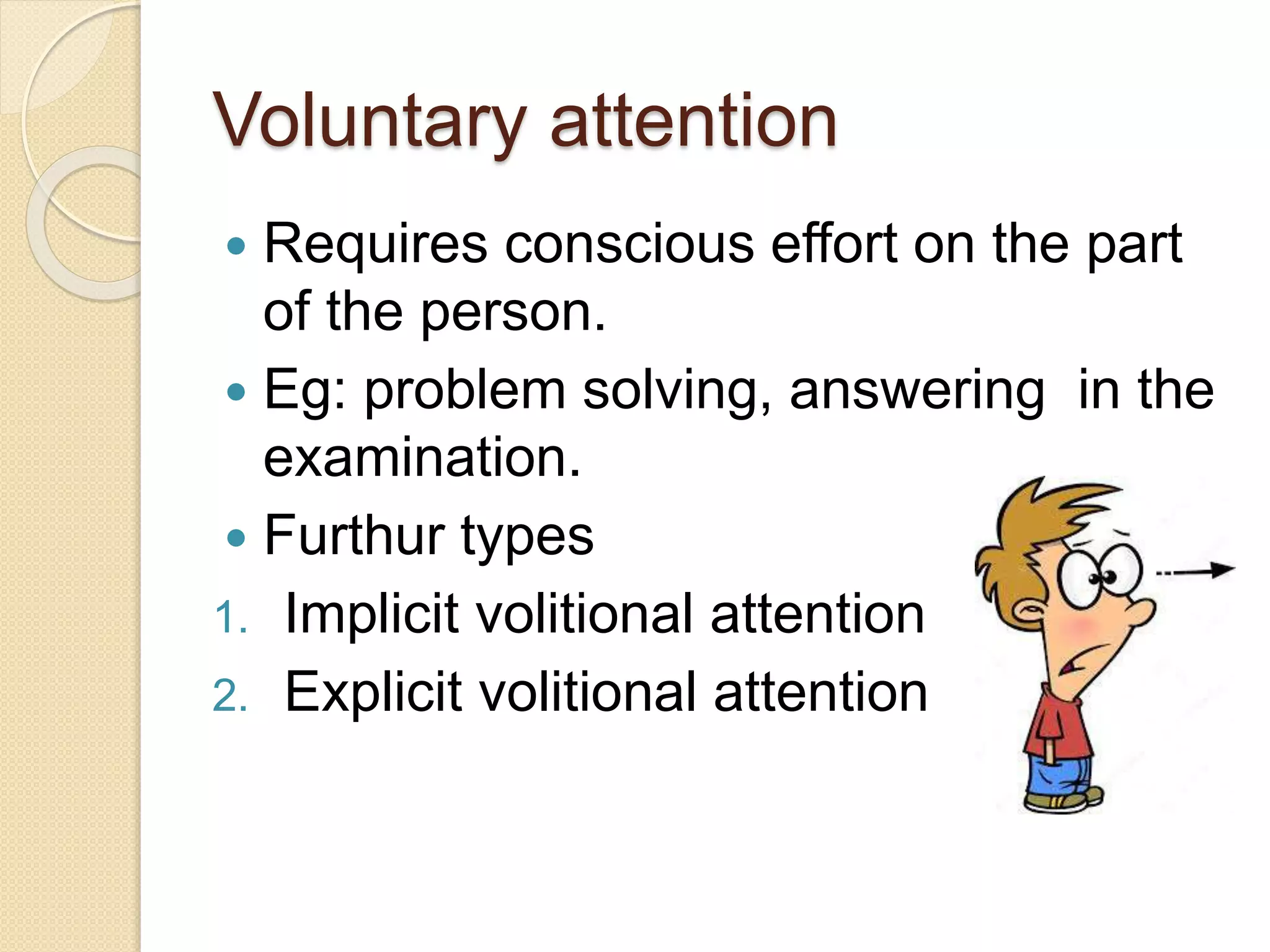
 Requires conscious effort on the part
of the person.
 Eg: problem solving, answering in the
examination.
 Furthur types
1. Implicit volitional attention
2. Explicit volitional attention
Implicit volitional attention
 A single act of will is responsible for
arousing attention.
 Eg home work given by teacher and
the fear of punishment mat arouse
attention in the student to complete
the given tasks.
Explicit volitional attention
 Attention is obtained by
repeated acts of will.
 One has to struggle hard
for keeping oneself
attentive.it requires strong
will power and motivation
to keep the attention
focused.
 Eg: during the preparatory
days of the examiantion.
Involuntary attention
 This type of attention is
aroused without the
conscious effort .
 Eg: bright lights, loud noise
and strong odours, pain etc.
 This type of attention can be
aroused by instincts called
enforced non volitional
attention.
 Attention given due to
preformed sentiments , to
people objects and things.
Uses
 It provides strength and ability to
continue the task despite the obstacles
present in the environment.
 Helps in better organization of the
perceptual field for maximum clarity and
understanding.
 It helps by providing the deeper
concentration by focusing ones
consciousness upon required object or
idea.
 Helps in bringing mental alertness and
preparedness.
Methods for arousing
attention
 Certain factors produce and control
the condition of attention in the
person.
 It can be to types:
 External factors
 Internal factors.
External factors
 Nature of the stimuli:
 The attributes of the stmuli are more
likely to arouse attention and allow
concentration
 Shape , color , beauty, odditiy,
 Picutres are more likely to attract
attention than that of the text.
External factors
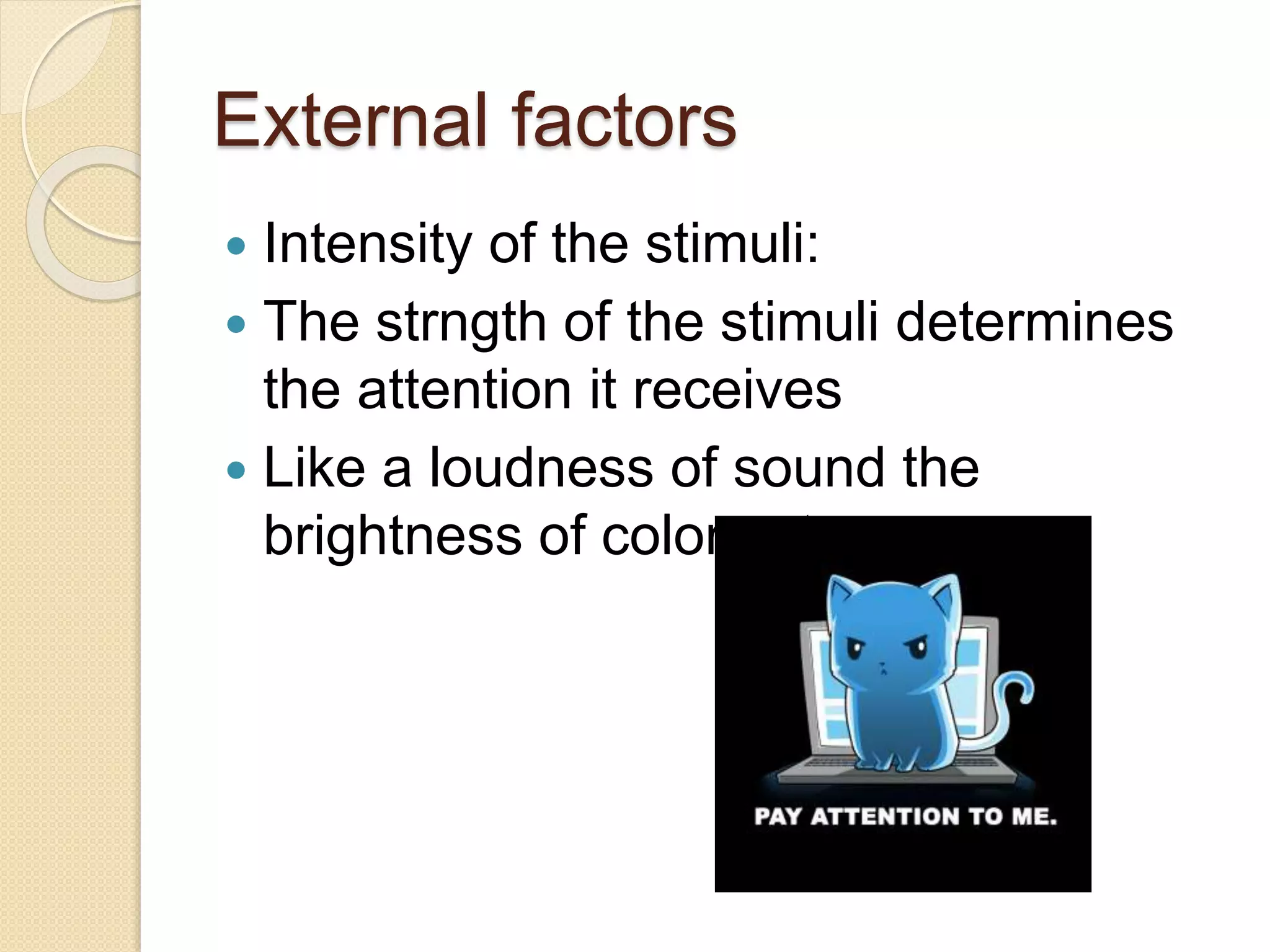
 Intensity of the stimuli:
 The strngth of the stimuli determines
the attention it receives
 Like a loudness of sound the
brightness of colors etc.
External factors
 Size of the stimulus :
 General rule is that the bigger the stimuli
the more attention it attracts and if the
item or object is unlikely in an environment
then that is also more likely attract
attention.
External factors
 Contrast of the stimuli:
 Change and contrast usually attract
more of attention, we do not notice the
ticking of the watch usually but when it
stops we notice it
 Novelty or newness attracts attention.
External factors
 Location of the stimulus :
 The area where the stimulus s
located is also important for
attracting the attention as
 advertisements on the upper-half or
on the front page attracts more
attention than being located
elsewhere.
External factors
 Repetition of the stimulus :
 A repeated stimulus attracts
our attention.
 A mis-spelt word in the same
paragraph for more than 2
times tends to get noticed more
often.
 But the excessive repetition of
the stimulus can also diminish
the attention.
 Eg: people working in a factory
with loud noise become
adjusted to that environment.
External factors
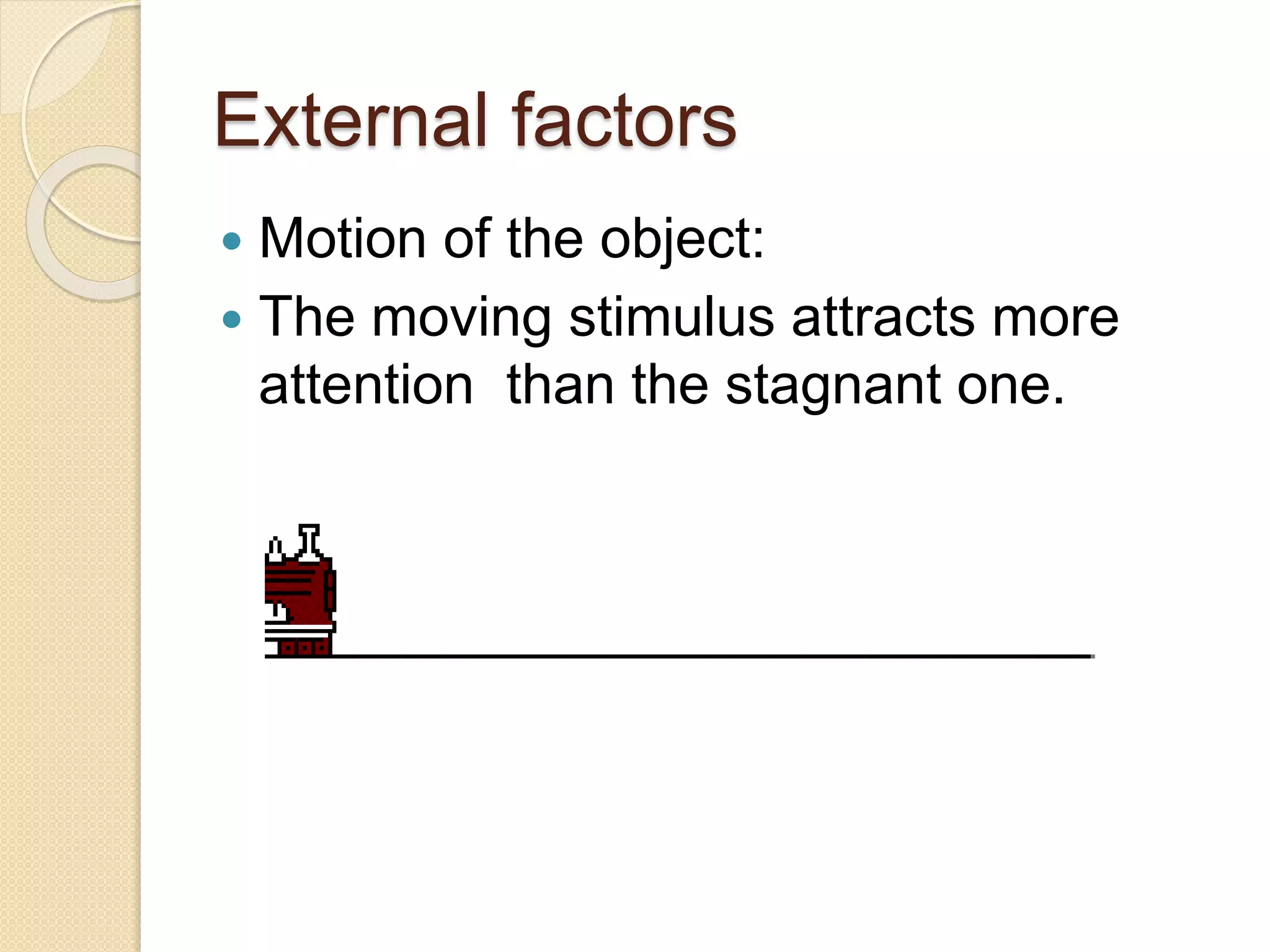
 Motion of the object:
 The moving stimulus attracts more
attention than the stagnant one.
External factors
 Definite form of the object:
 A sharply defined object attracts more
attention than a vaguely defined
object.
External factors
 Isolation of the stimulus:
 Isolation is an important determinant
of the attention. A black dot in a middle
of a white page attracts more attention
than , a dot in a written page.
Internal Factors
 Interest and attention:
 Interest is a very helpful factor in
securing attention.
 People tend to pay more attention to
the items and ideas which they are
more interested.
Internal Factors
 Motives :
 The basic drives and urges of the
individual are more important in
securing his attention.
 Hunger , thirst , curiosity and sex are
some motives.
Internal Factors
 Mental set up:
 A person always attends to one
subject which the mind has a set.
 During exam any talk about it
attracts the attention.
Internal Factors
 Past experience :
 Learning and previous experience
facilitate attention.
 If we find that certain thing has been
beneficial in the past we give more
attention to it in the present.
Internal Factors
 Emotion
 The emotional state of he individual
determines the attention the person
will put to any certain stimuli.
Internal Factors
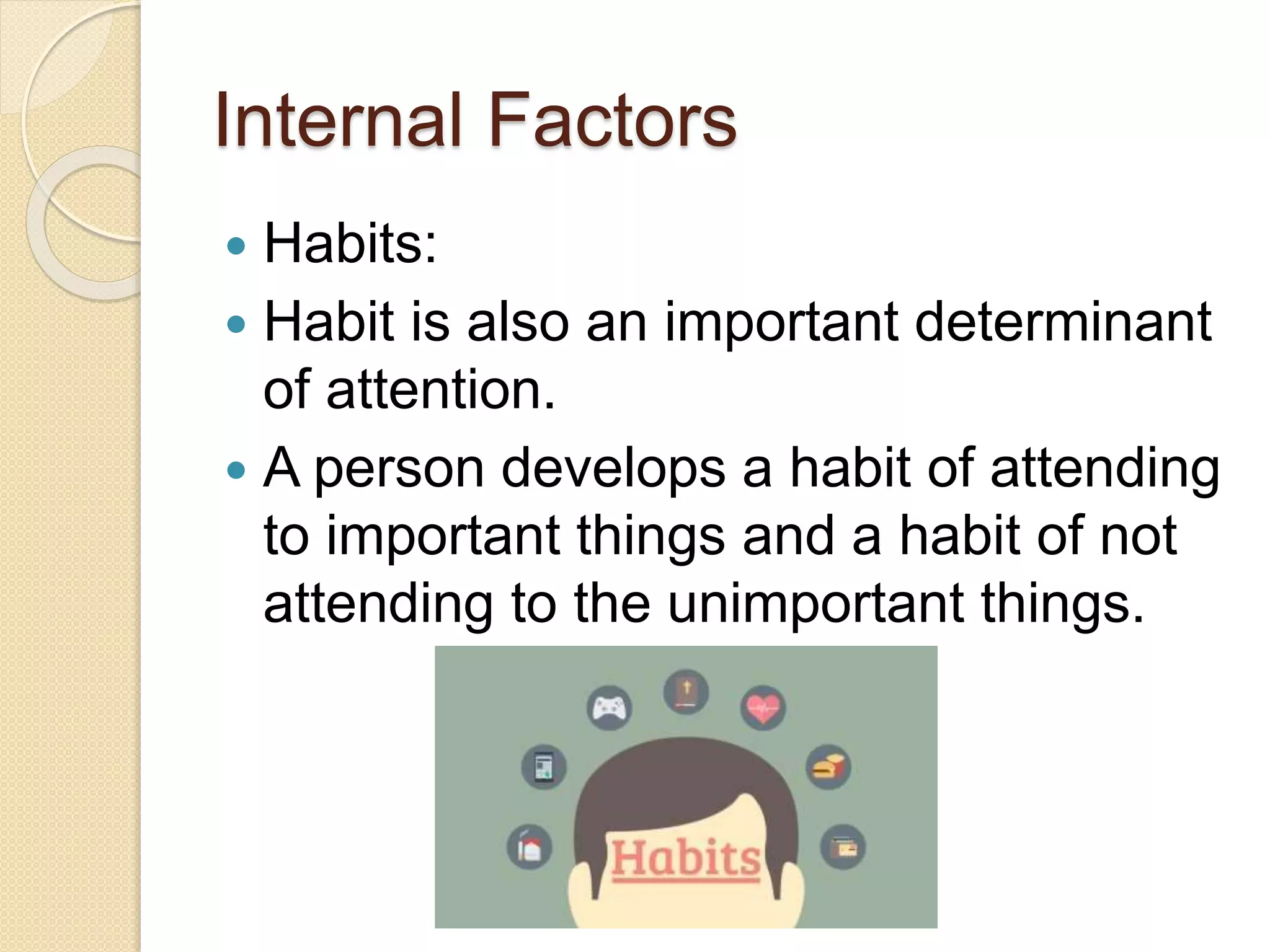
 Habits:
 Habit is also an important determinant
of attention.
 A person develops a habit of attending
to important things and a habit of not
attending to the unimportant things.
Internal Factors
 Aims:
 The personal Aims of the person also
guides his ability to attend to certain
stimuli.
 Meaning :
 The internal meaning of the stimuli
also deposits the meaning to the
methods.
 Disposition and temperament of the
person.
Duration of Attention
 Span of attention
 The maximum amount of attention that
can be attended in period of the is
called span of attention.
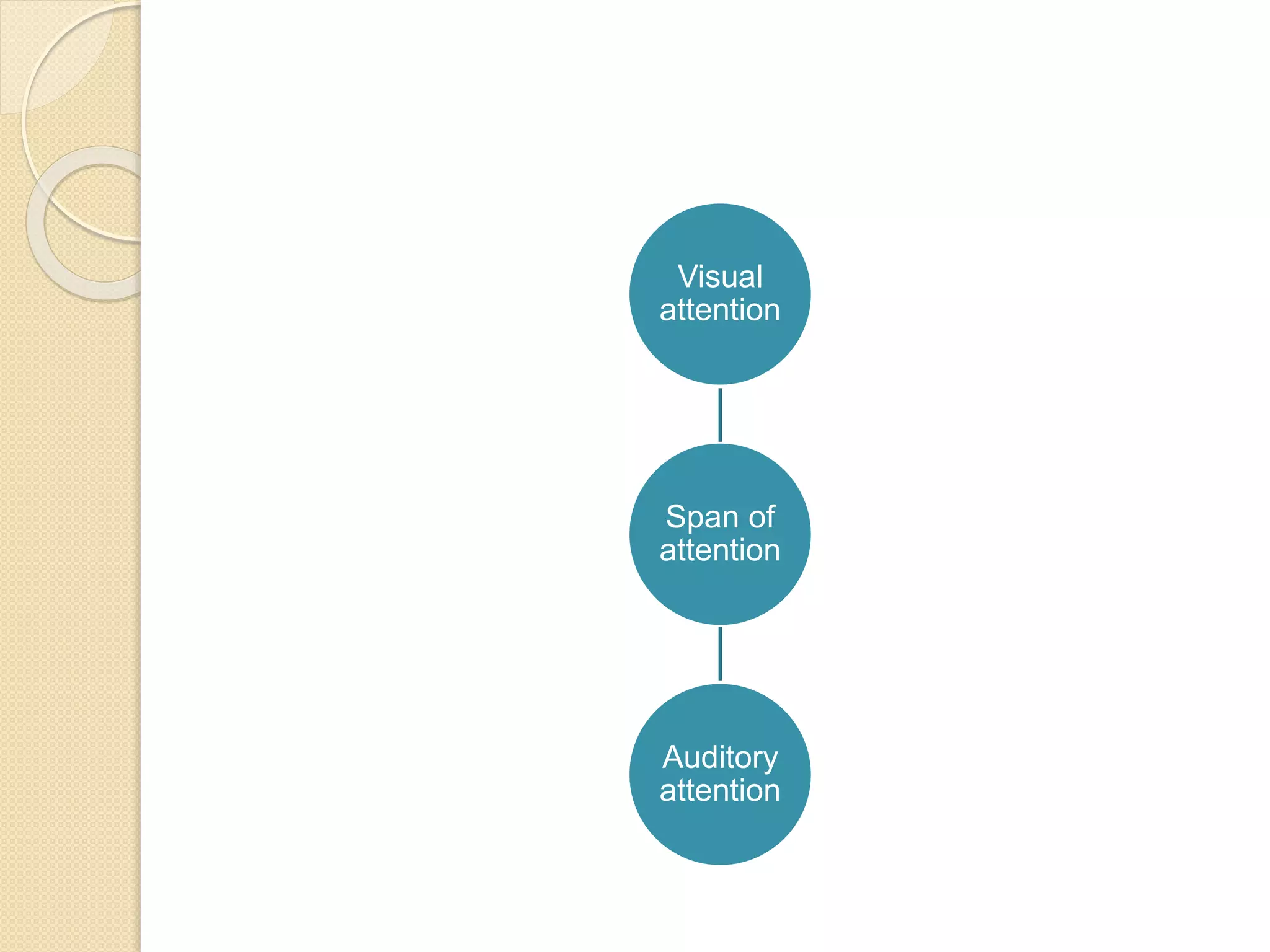
Span of
attention
Visual
attention
Auditory
attention
Visual attention
 The visual attention span is very less
the time of exposure is very short
ranging from 1/100 to 1/5 of a second.
 The mind can attend to only 4 or 5
separate units if the items are not
grouped together.
 But if the items are combined into
meaningful wholes, for instance
words, a large number of items can be
perceivd at once.
Span of auditory attention
 The number of auditory, impressons
perceived at a single instance is
slightly greater.
 An adult can perceive eight sounds
given rapidly in succsession . But
when sounds are given a rhythm, a
much larger number of sounds can be
perceived.
Duration of Attention
 It referrers to how long one can attend
to an object without a break.
 The duration of attention depends
uopn the nature of the stimulus and
the interest of the observer.
Sustained attention
(concentration)
 To sustain attention is to concentrate
ones activities continuously upon one
subject.
 The individual attention always
remains on track and activity proceeds
without any serious distractions.
Summary
Any questions?
 Tomorrow we will study distraction
Conclusion
 Attention is one of the most important
higher order mental functions.
 Its cardinal for assessing the mentally
ill patients.
 Alteration in the attention span and its
ability can lead to diagnosis of various
psychopathologies.
 Correctly assessing the attention in
MSE can give us insight about the
psychiatric illness.

Attention

  • 1.
    Attention Deblina Roy M.Sc. PsychiatricNursing. Assistant Professor Department of Psychiatry KGMU.
  • 2.
    Objectives  Introduction  Definition Characteristics.  types  Uses  Factors influencing attention.
  • 3.
    Introduction  Attention isthe focus of consciousness on a particular object or idea at a particular time , to the exclusion of other objects or ideas.
  • 4.
    Definition  Attention isdefined as a process which compels the individual to select a particular stimulus according to his interest and attitude out of the multiple stimuli of the environment. (Sharma RN-1967) Attention is the concentration of consciousness upon one object rather than upon another. (Dumyille- 1938)
  • 5.
    Characteristics of attention It is a selective mental activity  It constantly shifts from one object to another or from one aspect to another.  Attention is focus of the consciousness on one particular object.  Attention is the state of preparedness or alertness of  Attention requires some motor and sensory adjustments on the part of the person being attentive.
  • 6.
    Types or varietiesof attention. Attention Voluntary Involuntary
  • 7.
    Voluntary attention  Requiresconscious effort on the part of the person.  Eg: problem solving, answering in the examination.  Furthur types 1. Implicit volitional attention 2. Explicit volitional attention
  • 8.
    Implicit volitional attention A single act of will is responsible for arousing attention.  Eg home work given by teacher and the fear of punishment mat arouse attention in the student to complete the given tasks.
  • 9.
    Explicit volitional attention Attention is obtained by repeated acts of will.  One has to struggle hard for keeping oneself attentive.it requires strong will power and motivation to keep the attention focused.  Eg: during the preparatory days of the examiantion.
  • 10.
    Involuntary attention  Thistype of attention is aroused without the conscious effort .  Eg: bright lights, loud noise and strong odours, pain etc.  This type of attention can be aroused by instincts called enforced non volitional attention.  Attention given due to preformed sentiments , to people objects and things.
  • 11.
    Uses  It providesstrength and ability to continue the task despite the obstacles present in the environment.  Helps in better organization of the perceptual field for maximum clarity and understanding.  It helps by providing the deeper concentration by focusing ones consciousness upon required object or idea.  Helps in bringing mental alertness and preparedness.
  • 12.
    Methods for arousing attention Certain factors produce and control the condition of attention in the person.  It can be to types:  External factors  Internal factors.
  • 13.
    External factors  Natureof the stimuli:  The attributes of the stmuli are more likely to arouse attention and allow concentration  Shape , color , beauty, odditiy,  Picutres are more likely to attract attention than that of the text.
  • 14.
    External factors  Intensityof the stimuli:  The strngth of the stimuli determines the attention it receives  Like a loudness of sound the brightness of colors etc.
  • 15.
    External factors  Sizeof the stimulus :  General rule is that the bigger the stimuli the more attention it attracts and if the item or object is unlikely in an environment then that is also more likely attract attention.
  • 16.
    External factors  Contrastof the stimuli:  Change and contrast usually attract more of attention, we do not notice the ticking of the watch usually but when it stops we notice it  Novelty or newness attracts attention.
  • 17.
    External factors  Locationof the stimulus :  The area where the stimulus s located is also important for attracting the attention as  advertisements on the upper-half or on the front page attracts more attention than being located elsewhere.
  • 18.
    External factors  Repetitionof the stimulus :  A repeated stimulus attracts our attention.  A mis-spelt word in the same paragraph for more than 2 times tends to get noticed more often.  But the excessive repetition of the stimulus can also diminish the attention.  Eg: people working in a factory with loud noise become adjusted to that environment.
  • 19.
    External factors  Motionof the object:  The moving stimulus attracts more attention than the stagnant one.
  • 20.
    External factors  Definiteform of the object:  A sharply defined object attracts more attention than a vaguely defined object.
  • 21.
    External factors  Isolationof the stimulus:  Isolation is an important determinant of the attention. A black dot in a middle of a white page attracts more attention than , a dot in a written page.
  • 22.
    Internal Factors  Interestand attention:  Interest is a very helpful factor in securing attention.  People tend to pay more attention to the items and ideas which they are more interested.
  • 23.
    Internal Factors  Motives:  The basic drives and urges of the individual are more important in securing his attention.  Hunger , thirst , curiosity and sex are some motives.
  • 24.
    Internal Factors  Mentalset up:  A person always attends to one subject which the mind has a set.  During exam any talk about it attracts the attention.
  • 25.
    Internal Factors  Pastexperience :  Learning and previous experience facilitate attention.  If we find that certain thing has been beneficial in the past we give more attention to it in the present.
  • 26.
    Internal Factors  Emotion The emotional state of he individual determines the attention the person will put to any certain stimuli.
  • 27.
    Internal Factors  Habits: Habit is also an important determinant of attention.  A person develops a habit of attending to important things and a habit of not attending to the unimportant things.
  • 28.
    Internal Factors  Aims: The personal Aims of the person also guides his ability to attend to certain stimuli.  Meaning :  The internal meaning of the stimuli also deposits the meaning to the methods.  Disposition and temperament of the person.
  • 29.
    Duration of Attention Span of attention  The maximum amount of attention that can be attended in period of the is called span of attention.
  • 30.
  • 31.
    Visual attention  Thevisual attention span is very less the time of exposure is very short ranging from 1/100 to 1/5 of a second.  The mind can attend to only 4 or 5 separate units if the items are not grouped together.  But if the items are combined into meaningful wholes, for instance words, a large number of items can be perceivd at once.
  • 32.
    Span of auditoryattention  The number of auditory, impressons perceived at a single instance is slightly greater.  An adult can perceive eight sounds given rapidly in succsession . But when sounds are given a rhythm, a much larger number of sounds can be perceived.
  • 33.
    Duration of Attention It referrers to how long one can attend to an object without a break.  The duration of attention depends uopn the nature of the stimulus and the interest of the observer.
  • 34.
    Sustained attention (concentration)  Tosustain attention is to concentrate ones activities continuously upon one subject.  The individual attention always remains on track and activity proceeds without any serious distractions.
  • 35.
  • 36.
    Any questions?  Tomorrowwe will study distraction
  • 37.
    Conclusion  Attention isone of the most important higher order mental functions.  Its cardinal for assessing the mentally ill patients.  Alteration in the attention span and its ability can lead to diagnosis of various psychopathologies.  Correctly assessing the attention in MSE can give us insight about the psychiatric illness.